Forging of Metals
Introduction
 A metal is shaped by compressive forces
 Oldest metal working process – 4000BC
 Can be performed with a hammer and anvil
 Typical forged products:
 Bolts
 Rivets
 Connecting rods
 Gears
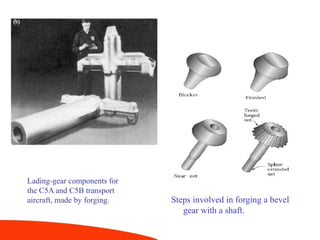
Lading-gear components for
the C5A and C5B transport
aircraft, made by forging. Steps involved in forging a bevel
gear with a shaft.
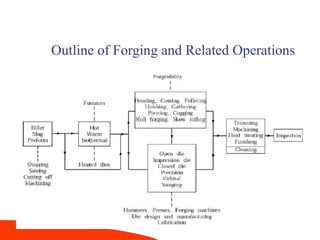
Outline of Forging and Related Operations
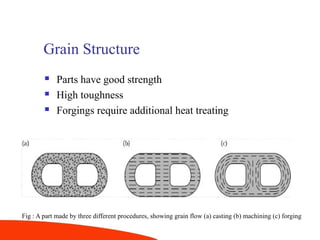
Grain Structure
 Parts have good strength
 High toughness
 Forgings require additional heat treating
Fig : A part made by three different procedures, showing grain flow (a) casting (b) machining (c) forging
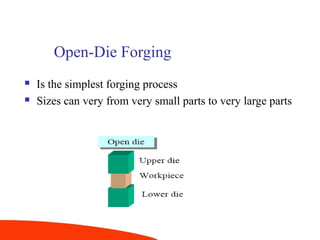
Open-Die Forging
 Is the simplest forging process
 Sizes can very from very small parts to very large parts
Open-Die Forging
 Upsetting or flat-die forgingUpsetting or flat-die forging – a solid workpiece is
placed between flat dies and is compressed
 Barreling
 caused by frictional forces at the die-workpiece
interfaces
 Can be minimized if a lubricant is used
 Thermal effects caused by barreling can be minimized
by using heated dies
Open-Die Forging
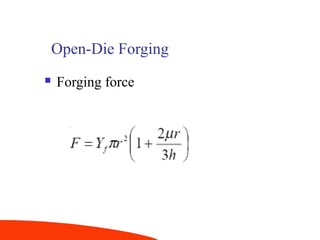
 Forging force
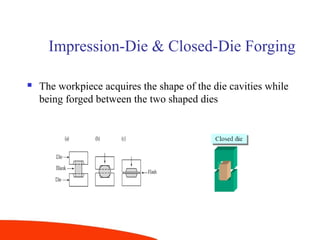
Impression-Die & Closed-Die Forging
 The workpiece acquires the shape of the die cavities while
being forged between the two shaped dies
Impression-Die & Closed-Die Forging
 The blank to be forged is prepared by:
 Cutting from a bar stock
 Preformed blank
 Casting
 Preformed blank from prior forging
Impression-Die & Closed-Die Forging
 Fullering & edging are used to distribute the
material
 Fullering – material is distributed away from an area
 Edging – material is gathered into an area
 Blocking – rough shaping of the part
 Impression dies – give the part its final shape
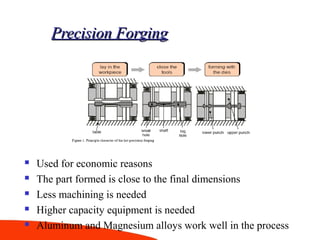
Precision ForgingPrecision Forging
 Used for economic reasons
 The part formed is close to the final dimensions
 Less machining is needed
 Higher capacity equipment is needed
 Aluminum and Magnesium alloys work well in the process
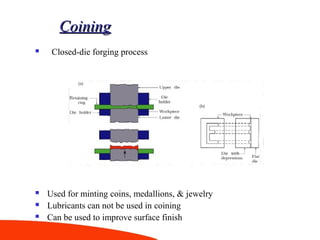
CoiningCoining
 Closed-die forging process
 Used for minting coins, medallions, & jewelry
 Lubricants can not be used in coining
 Can be used to improve surface finish
THE END

Forging Process. [Workshop Practices]

  • 1.
  • 2.
    Introduction  A metalis shaped by compressive forces  Oldest metal working process – 4000BC  Can be performed with a hammer and anvil  Typical forged products:  Bolts  Rivets  Connecting rods  Gears
  • 3.
    Lading-gear components for theC5A and C5B transport aircraft, made by forging. Steps involved in forging a bevel gear with a shaft.
  • 4.
    Outline of Forgingand Related Operations
  • 5.
    Grain Structure  Partshave good strength  High toughness  Forgings require additional heat treating Fig : A part made by three different procedures, showing grain flow (a) casting (b) machining (c) forging
  • 6.
    Open-Die Forging  Isthe simplest forging process  Sizes can very from very small parts to very large parts
  • 7.
    Open-Die Forging  Upsettingor flat-die forgingUpsetting or flat-die forging – a solid workpiece is placed between flat dies and is compressed  Barreling  caused by frictional forces at the die-workpiece interfaces  Can be minimized if a lubricant is used  Thermal effects caused by barreling can be minimized by using heated dies
  • 8.
  • 9.
    Impression-Die & Closed-DieForging  The workpiece acquires the shape of the die cavities while being forged between the two shaped dies
  • 10.
    Impression-Die & Closed-DieForging  The blank to be forged is prepared by:  Cutting from a bar stock  Preformed blank  Casting  Preformed blank from prior forging
  • 11.
    Impression-Die & Closed-DieForging  Fullering & edging are used to distribute the material  Fullering – material is distributed away from an area  Edging – material is gathered into an area  Blocking – rough shaping of the part  Impression dies – give the part its final shape
  • 12.
    Precision ForgingPrecision Forging Used for economic reasons  The part formed is close to the final dimensions  Less machining is needed  Higher capacity equipment is needed  Aluminum and Magnesium alloys work well in the process
  • 13.
    CoiningCoining  Closed-die forgingprocess  Used for minting coins, medallions, & jewelry  Lubricants can not be used in coining  Can be used to improve surface finish
  • 14.