Thermodynamic Cycles for CI engines
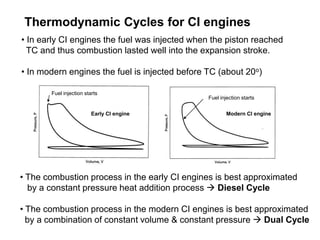
• In early CI engines the fuel was injected when the piston reached
TC and thus combustion lasted well into the expansion stroke.
• In modern engines the fuel is injected before TC (about 20o)
Fuel injection starts

Early CI engine

Fuel injection starts
Modern CI engine

• The combustion process in the early CI engines is best approximated
by a constant pressure heat addition process  Diesel Cycle
• The combustion process in the modern CI engines is best approximated
by a combination of constant volume & constant pressure  Dual Cycle
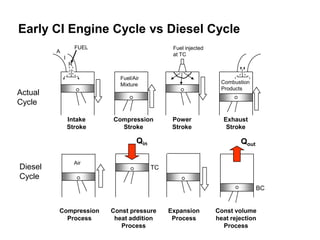
Early CI Engine Cycle vs Diesel Cycle
FUEL

A

Fuel injected
at TC

I
R
Fuel/Air
Mixture

Combustion
Products

Actual
Cycle
Intake
Stroke

Compression
Stroke

Power
Stroke

Qin
Diesel
Cycle

Air

Exhaust
Stroke

Qout
TC
BC

Compression
Process

Const pressure
heat addition
Process

Expansion
Process

Const volume
heat rejection
Process
Air-Standard Diesel Cycle
Process 1 2
Process 2  3
Process 3  4
Process 4  1

Isentropic compression
Constant pressure heat addition
Isentropic expansion
Constant volume heat rejection
Cut-off ratio:

Qin

rc

Qout

v2

TC

v1

BC

TC

BC

v3
v2
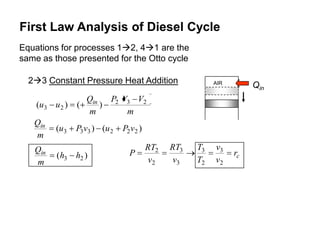
First Law Analysis of Diesel Cycle
Equations for processes 12, 41 are the
same as those presented for the Otto cycle
23 Constant Pressure Heat Addition
(

Qin
m

P3v3 ) (u 2

Qin
m

(h3

Qin

Qin
P V V2
) 2 3
m
m

(u3 u 2 )
(u3

AIR

h2 )

P2 v2 )

P

RT2
v2

RT3
v3

T3
T2

v3
v2

rc
3  4 Isentropic Expansion
(u 4 u3 )
Wout
m

vr4
vr3
P4 v4
T4

Wout
Q
(
)
m
m

AIR

(u3 u 4 )

v4
v4
note v4=v1 so
v3
v3
P3v3
T3

P4
P3

T4 r
T3 rc

v4 v2
v2 v3

v1 v2
v2 v3

vr
r

rc
vr

4

3

v4
v3

r
rc
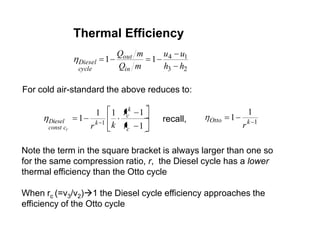
Thermal Efficiency
Diesel
cycle

1

Qout m
u u
1 4 1
Qin m
h3 h2

For cold air-standard the above reduces to:

Diesel
const cV

1

1
r

k 1

1 rck 1
k rc 1

recall,

Otto

1

1
rk

1

Note the term in the square bracket is always larger than one so
for the same compression ratio, r, the Diesel cycle has a lower
thermal efficiency than the Otto cycle
When rc (=v3/v2)1 the Diesel cycle efficiency approaches the
efficiency of the Otto cycle
Thermal Efficiency

Modern CI Engines
12 < r < 23

The cut-off ratio is not a natural choice for the independent variable
A more suitable parameter is the heat input, the two are related by:
rc

1

k 1 Qin
1
k P V1 r k 1
1

as Qin 0, rc1 and



Otto

diesel cycle presentation

  • 1.
    Thermodynamic Cycles forCI engines • In early CI engines the fuel was injected when the piston reached TC and thus combustion lasted well into the expansion stroke. • In modern engines the fuel is injected before TC (about 20o) Fuel injection starts Early CI engine Fuel injection starts Modern CI engine • The combustion process in the early CI engines is best approximated by a constant pressure heat addition process  Diesel Cycle • The combustion process in the modern CI engines is best approximated by a combination of constant volume & constant pressure  Dual Cycle
  • 2.
    Early CI EngineCycle vs Diesel Cycle FUEL A Fuel injected at TC I R Fuel/Air Mixture Combustion Products Actual Cycle Intake Stroke Compression Stroke Power Stroke Qin Diesel Cycle Air Exhaust Stroke Qout TC BC Compression Process Const pressure heat addition Process Expansion Process Const volume heat rejection Process
  • 3.
    Air-Standard Diesel Cycle Process1 2 Process 2  3 Process 3  4 Process 4  1 Isentropic compression Constant pressure heat addition Isentropic expansion Constant volume heat rejection Cut-off ratio: Qin rc Qout v2 TC v1 BC TC BC v3 v2
  • 4.
    First Law Analysisof Diesel Cycle Equations for processes 12, 41 are the same as those presented for the Otto cycle 23 Constant Pressure Heat Addition ( Qin m P3v3 ) (u 2 Qin m (h3 Qin Qin P V V2 ) 2 3 m m (u3 u 2 ) (u3 AIR h2 ) P2 v2 ) P RT2 v2 RT3 v3 T3 T2 v3 v2 rc
  • 5.
    3  4Isentropic Expansion (u 4 u3 ) Wout m vr4 vr3 P4 v4 T4 Wout Q ( ) m m AIR (u3 u 4 ) v4 v4 note v4=v1 so v3 v3 P3v3 T3 P4 P3 T4 r T3 rc v4 v2 v2 v3 v1 v2 v2 v3 vr r  rc vr 4 3 v4 v3 r rc
  • 6.
    Thermal Efficiency Diesel cycle 1 Qout m uu 1 4 1 Qin m h3 h2 For cold air-standard the above reduces to: Diesel const cV 1 1 r k 1 1 rck 1 k rc 1 recall, Otto 1 1 rk 1 Note the term in the square bracket is always larger than one so for the same compression ratio, r, the Diesel cycle has a lower thermal efficiency than the Otto cycle When rc (=v3/v2)1 the Diesel cycle efficiency approaches the efficiency of the Otto cycle
  • 7.
    Thermal Efficiency Modern CIEngines 12 < r < 23 The cut-off ratio is not a natural choice for the independent variable A more suitable parameter is the heat input, the two are related by: rc 1 k 1 Qin 1 k P V1 r k 1 1 as Qin 0, rc1 and  Otto