


Are You A Match?
Do you enjoy working with
your hands?
Do you like to travel?
Would you prefer to work
locally rather than travel?
Would you enjoy owning your
own business?
Program Description
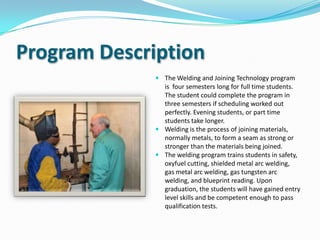
The Welding and Joining Technology program
is four semesters long for full time students.
The student could complete the program in
three semesters if scheduling worked out
perfectly. Evening students, or part time
students take longer.
Welding is the process of joining materials,
normally metals, to form a seam as strong or
stronger than the materials being joined.
The welding program trains students in safety,
oxyfuel cutting, shielded metal arc welding,
gas metal arc welding, gas tungsten arc
welding, and blueprint reading. Upon
graduation, the students will have gained entry
level skills and be competent enough to pass
qualification tests.
Employment
Opportunities: There are many employment options available to welders
such as: local fabrication shops, ship yards, nuclear power plants, pipe lines,
oil platforms in the Gulf of Mexico, and many overseas jobs.
Job placement: Until the recent economic recession, 100% of our graduates
were placed in the field. Currently, jobs are harder to find but they do exist.
A person might need to move from their local area to find employment.
Many professionals in the field think that the job market will soon rebound.
A beginning welding graduate can expect to earn between $10 and $15 per
hour in the local area. However, if a student is willing to relocate, he/she
may earn $20 per hour or more.
Advancements in the field: Welding foreman, supervisor, plant manager,
welding educator, welding inspector.
Additional Program Requirements
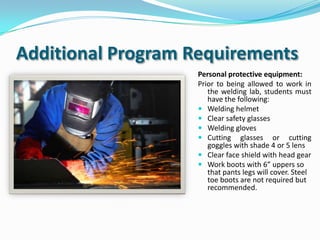
Personal protective equipment:
Prior to being allowed to work in
the welding lab, students must
have the following:
Welding helmet
Clear safety glasses
Welding gloves
Cutting glasses or cutting
goggles with shade 4 or 5 lens
Clear face shield with head gear
Work boots with 6” uppers so
that pants legs will cover. Steel
toe boots are not required but
recommended.
Timeline
How often do we register?
You are required to register before the first day of class upon initial entry.
Each following term, all current students will be preregistered at an
appointed time.
 What is the procedure for registering each term?
Contact your program advisor in person during new student registration
day or preregistration week if you are a current student.
 When should core classes be taken?
Core classes may be taken at any time during enrollment.
 How long does it take to complete the program?
A full time day student should complete the program in three to four
semesters, depending upon scheduling. Part time (evening students) take
about three years due to the fact that a part time student gets only ten
hours per week compared to thirty hours per week for a full time student.
Diploma/Degrees/Certificates
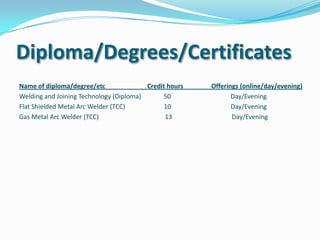
Name of diploma/degree/etc Credit hours Offerings (online/day/evening)
Welding and Joining Technology (Diploma) 50 Day/Evening
Flat Shielded Metal Arc Welder (TCC) 10 Day/Evening
Gas Metal Arc Welder (TCC) 13 Day/Evening
General Fees
One time application fee
Transcript requests
Late registration fees
Fees, by term, as follows:
a. Tuition is based on $89 per credit hour
($1,335 for 15 hours or more)
b. Registration fee of $50
c. Activity fee of $24
d. Technology fee of $105
e. Insurance of $4
f. Instructional fee of $50
Part of your tuition may be covered by HOPE and Pell grants if you are eligible. Check with financial aid
concerning your financial support eligibility. Check our website for the most recent tuition costs and
general fee costs.
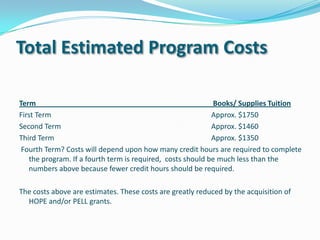
Total Estimated Program Costs
Term Books/ Supplies Tuition
First Term Approx. $1750
Second Term Approx. $1460
Third Term Approx. $1350
Fourth Term? Costs will depend upon how many credit hours are required to complete
the program. If a fourth term is required, costs should be much less than the
numbers above because fewer credit hours should be required.
The costs above are estimates. These costs are greatly reduced by the acquisition of
HOPE and/or PELL grants.
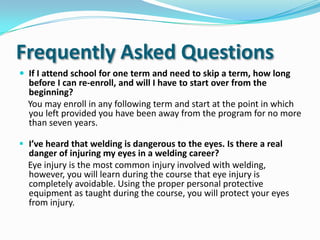
Frequently Asked Questions
If I attend school for one term and need to skip a term, how long
before I can re-enroll, and will I have to start over from the
beginning?
You may enroll in any following term and start at the point in which
you left provided you have been away from the program for no more
than seven years.
 I’ve heard that welding is dangerous to the eyes. Is there a real
danger of injuring my eyes in a welding career?
Eye injury is the most common injury involved with welding,
however, you will learn during the course that eye injury is
completely avoidable. Using the proper personal protective
equipment as taught during the course, you will protect your eyes
from injury.
Disclosure Information
http://www.slideshare.net/moultrietech/welding-
joining-technology-diploma-program-disclosure-
information
Instructor
 Brandon Reed, Program Chair,
Moultrie Technical College, Tifton
Campus
 Personal mission: To share knowledge
gained from 15 years in the industrial
construction field.
 Campus/Office#: Tifton Campus,
Room # A 135
 Office hours: Posted outside
instructor’s lab and office door
 E-mail: breed@moultrietech.edu
 Phone: 229-391-2619
Instructor
 Brad Simmons, Welding Instructor,
Tifton Campus
 E-mail: bsimmons@moultrietech.edu
 Personal mission: To share knowledge
gained from 20 years in the welding
and fabrication fields.
 Campus/Office#: Tifton Campus,
Room # A 133
 Office hours: Posted outside
instructor’s lab and office door
 Phone: 229-391-2634
As set forth in its student catalog, Moultrie Technical College does not
discriminate on the basis of race, color, creed, national or ethnic origin,
gender, religion, disability, age, political affiliation or belief, genetic
information, veteran status, or citizenship status (except in those special
circumstances permitted or mandated by law).
Lisa Newton, Title IX Equity Coordinator and ADA/Section 504
Coordinator - 229.217.4132
800 Veterans Parkway North, Moultrie, GA 31788
A unit of the Technical College System of Georgia

Welding & Joining Technology powerpoint

  • 2.
    Are You AMatch? Do you enjoy working with your hands? Do you like to travel? Would you prefer to work locally rather than travel? Would you enjoy owning your own business?
  • 3.
    Program Description The Weldingand Joining Technology program is four semesters long for full time students. The student could complete the program in three semesters if scheduling worked out perfectly. Evening students, or part time students take longer. Welding is the process of joining materials, normally metals, to form a seam as strong or stronger than the materials being joined. The welding program trains students in safety, oxyfuel cutting, shielded metal arc welding, gas metal arc welding, gas tungsten arc welding, and blueprint reading. Upon graduation, the students will have gained entry level skills and be competent enough to pass qualification tests.
  • 4.
    Employment Opportunities: There aremany employment options available to welders such as: local fabrication shops, ship yards, nuclear power plants, pipe lines, oil platforms in the Gulf of Mexico, and many overseas jobs. Job placement: Until the recent economic recession, 100% of our graduates were placed in the field. Currently, jobs are harder to find but they do exist. A person might need to move from their local area to find employment. Many professionals in the field think that the job market will soon rebound. A beginning welding graduate can expect to earn between $10 and $15 per hour in the local area. However, if a student is willing to relocate, he/she may earn $20 per hour or more. Advancements in the field: Welding foreman, supervisor, plant manager, welding educator, welding inspector.
  • 5.
    Additional Program Requirements Personalprotective equipment: Prior to being allowed to work in the welding lab, students must have the following: Welding helmet Clear safety glasses Welding gloves Cutting glasses or cutting goggles with shade 4 or 5 lens Clear face shield with head gear Work boots with 6” uppers so that pants legs will cover. Steel toe boots are not required but recommended.
  • 6.
    Timeline How often dowe register? You are required to register before the first day of class upon initial entry. Each following term, all current students will be preregistered at an appointed time.  What is the procedure for registering each term? Contact your program advisor in person during new student registration day or preregistration week if you are a current student.  When should core classes be taken? Core classes may be taken at any time during enrollment.  How long does it take to complete the program? A full time day student should complete the program in three to four semesters, depending upon scheduling. Part time (evening students) take about three years due to the fact that a part time student gets only ten hours per week compared to thirty hours per week for a full time student.
  • 7.
    Diploma/Degrees/Certificates Name of diploma/degree/etcCredit hours Offerings (online/day/evening) Welding and Joining Technology (Diploma) 50 Day/Evening Flat Shielded Metal Arc Welder (TCC) 10 Day/Evening Gas Metal Arc Welder (TCC) 13 Day/Evening
  • 8.
    General Fees One timeapplication fee Transcript requests Late registration fees Fees, by term, as follows: a. Tuition is based on $89 per credit hour ($1,335 for 15 hours or more) b. Registration fee of $50 c. Activity fee of $24 d. Technology fee of $105 e. Insurance of $4 f. Instructional fee of $50 Part of your tuition may be covered by HOPE and Pell grants if you are eligible. Check with financial aid concerning your financial support eligibility. Check our website for the most recent tuition costs and general fee costs.
  • 9.
    Total Estimated ProgramCosts Term Books/ Supplies Tuition First Term Approx. $1750 Second Term Approx. $1460 Third Term Approx. $1350 Fourth Term? Costs will depend upon how many credit hours are required to complete the program. If a fourth term is required, costs should be much less than the numbers above because fewer credit hours should be required. The costs above are estimates. These costs are greatly reduced by the acquisition of HOPE and/or PELL grants.
  • 10.
    Frequently Asked Questions IfI attend school for one term and need to skip a term, how long before I can re-enroll, and will I have to start over from the beginning? You may enroll in any following term and start at the point in which you left provided you have been away from the program for no more than seven years.  I’ve heard that welding is dangerous to the eyes. Is there a real danger of injuring my eyes in a welding career? Eye injury is the most common injury involved with welding, however, you will learn during the course that eye injury is completely avoidable. Using the proper personal protective equipment as taught during the course, you will protect your eyes from injury.
  • 11.
  • 12.
    Instructor  Brandon Reed,Program Chair, Moultrie Technical College, Tifton Campus  Personal mission: To share knowledge gained from 15 years in the industrial construction field.  Campus/Office#: Tifton Campus, Room # A 135  Office hours: Posted outside instructor’s lab and office door  E-mail: breed@moultrietech.edu  Phone: 229-391-2619
  • 13.
    Instructor  Brad Simmons,Welding Instructor, Tifton Campus  E-mail: bsimmons@moultrietech.edu  Personal mission: To share knowledge gained from 20 years in the welding and fabrication fields.  Campus/Office#: Tifton Campus, Room # A 133  Office hours: Posted outside instructor’s lab and office door  Phone: 229-391-2634
  • 14.
    As set forthin its student catalog, Moultrie Technical College does not discriminate on the basis of race, color, creed, national or ethnic origin, gender, religion, disability, age, political affiliation or belief, genetic information, veteran status, or citizenship status (except in those special circumstances permitted or mandated by law). Lisa Newton, Title IX Equity Coordinator and ADA/Section 504 Coordinator - 229.217.4132 800 Veterans Parkway North, Moultrie, GA 31788 A unit of the Technical College System of Georgia