Assistant Professor
Department of Mechanical Engineering
National University of Science and Technology
College of E M E
ME211-Mechanics of Materials 1
Contact: naveeddin@ceme.nust.edu.pk
Introduction to mechanics of materials
Mechanics of material is a study of the relationship between the external
loads applied to the body and the stress and strain caused by the internal
loads within the body.
In this course we shall be concerned with what might be called the internal
effects of forces acting on a body. The bodies themselves will no longer be
considered to be perfectly rigid as was assumed in statics; instead, the
calculation of the deformations of various bodies under a variety of loads will
be one of our primary concerns.
Basic Definitions
Equilibrium: A state of no acceleration, in either translational or rotational
senses.
Scalar: A quantity which has only magnitude. Examples include mass and
area.
Vector: A quantity which has both magnitude and direction e.g. displacement
force.
Force: The interaction between bodies which gives rise to an acceleration or
to the deformation of the body.
Moment: The product of the magnitude of a force and the perpendicular
distance of its line of action from a particular point. (Also a vector.)
Couple: It consists of two forces equal in magnitude but opposite in direction
whose line of action are parallel but no collinear.
1. Surface forces:
(a) caused by the direct contact of one body with the surface of another.
Forces are distributed over the area of contact between bodies. If
contacted area is small as compared to the area of the body then surface
force can be idealised as concentrated force (or point load).e.g. bicycle
wheel contact with surface.
(b) If load is linearly distributed along a narrow area over a specified length.
To deal with distributed loads, the resultant force is equivalent to the
area under the distributed loading curve and act through the centroid of
that area
A body is subject to only two types of external loadings
Introduction to mechanics of materials
2. Body Forces: No direct contact e.g. effects caused by earth’s gravitation
The surface force that develop at the supports or point of contact between bodies
are called reactions. If the support prevents motion (translation, rotation) in a
given direction , then a force or a moment must be developed on the member in
that direction.
Support Reactions
Introduction to mechanics of materials
Type of Supports
Introduction to mechanics of materials
Equation of equilibrium
Equilibrium of a body requires both a balance of forces, to prevent the body from
translating Or having accelerated motion along a straight or curved path, and a
balance of moments to Prevent body from rotating.
Sum of all forces acting on the body and sum
of the moments of all forces about any point
O either on or off the body must be zero
෍ 𝐹 = 0 ෍ 𝑀 𝑜 = 0
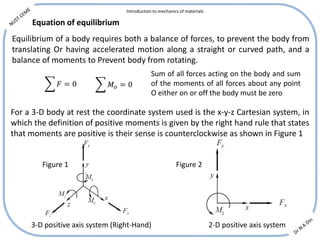
For a 3-D body at rest the coordinate system used is the x-y-z Cartesian system, in
which the definition of positive moments is given by the right hand rule that states
that moments are positive is their sense is counterclockwise as shown in Figure 1
3-D positive axis system (Right-Hand) 2-D positive axis system
Figure 1 Figure 2
Introduction to mechanics of materials
Force equilibrium equation is given as:
and Moment equilibrium as
The 2D x & y -axis system looks like Fig 2: For a two dimensional body in the xy-axis
system, the 3D equilibrium Eqs. simplify to:
Introduction to mechanics of materials
Free- body diagram
A sketch of the outlines shape (or simplified line sketch of the structure) of the
body isolated from its surrounding. On this sketch all forces and couple moments
that the surrounding exert on the body together with any support reactions must be
shown correctly. Only then applying equilibrium equations will be useful.
Internal loadings
These internal loading acting on a specific region within the body can be attained
by the Method of Section.
Method of Section: Imaginary cut is made through the body in the region where
the internal loading is to be determined. The two parts are separated and a free
body diagram of one of the parts is drawn. Only then applying equilibrium would
enable us to relate the resultant internal force and moment to the external
forces. Point O is often chosen as the
centroid of the sectioned area
Apply Equilibrium at this stage
Introduction to mechanics of materials
Three Dimensional Loading:
Normal force, N: This force act perpendicular to the area.
Shear Force, V: This force lies in the plane of the area (parallel)
Torsional Moment or Torque, T: This torque is developed when the external loads
tend to twist one segment of the body with respect to the other
Bending Moment, M: This moment is developed when the external loads tend to
bend the body.
Four types of internal loadings can be defined:
Introduction to mechanics of materials
If the body is subjected to a coplanar system of forces then only
normal force N, shear force V, and bending moment Mo
components will exist at the section.
Coplanar* Loading
Introduction to mechanics of materials
* points that lie in the same plane
• After sectioning, decide which segment of the body will be studied. If this
segment has a support or connection than a free body diagram for the entire
body must be done first to calculate the reactions of these supports.
• Pass an imaginary section through the body at the point where the resultant
internal loadings are to be determined and put the three unknowns (V, Mo,
N) at the cut section. Then apply equilibrium.
• Moments should be summed at the cut section. This will eliminates
unknown forces V and N and solve directly for Mo.
Procedure of Analysis
Draw free-body diagrams
and find the resultant
internal loading acting on
the cross section at point A
A
E
B
C
D
1.5m
1m 1m 1m
500Kg
Determine the resultant internal loading
acting on the cross section of the boom at
point E
Introduction to mechanics of materials
Determine the reactions at A and B
Examples
Introduction to mechanics of materials
Determine the resultant internal loading acting on the cross section of the boom at
point C
The shaft is supported by a smooth thrust bearing at A and a smooth journal
bearing at B. Determine the resultant internal loadings acting on the cross section
at C.

Me211 1

  • 1.
    Assistant Professor Department ofMechanical Engineering National University of Science and Technology College of E M E ME211-Mechanics of Materials 1 Contact: naveeddin@ceme.nust.edu.pk
  • 2.
    Introduction to mechanicsof materials Mechanics of material is a study of the relationship between the external loads applied to the body and the stress and strain caused by the internal loads within the body. In this course we shall be concerned with what might be called the internal effects of forces acting on a body. The bodies themselves will no longer be considered to be perfectly rigid as was assumed in statics; instead, the calculation of the deformations of various bodies under a variety of loads will be one of our primary concerns. Basic Definitions Equilibrium: A state of no acceleration, in either translational or rotational senses. Scalar: A quantity which has only magnitude. Examples include mass and area. Vector: A quantity which has both magnitude and direction e.g. displacement force.
  • 3.
    Force: The interactionbetween bodies which gives rise to an acceleration or to the deformation of the body. Moment: The product of the magnitude of a force and the perpendicular distance of its line of action from a particular point. (Also a vector.) Couple: It consists of two forces equal in magnitude but opposite in direction whose line of action are parallel but no collinear. 1. Surface forces: (a) caused by the direct contact of one body with the surface of another. Forces are distributed over the area of contact between bodies. If contacted area is small as compared to the area of the body then surface force can be idealised as concentrated force (or point load).e.g. bicycle wheel contact with surface. (b) If load is linearly distributed along a narrow area over a specified length. To deal with distributed loads, the resultant force is equivalent to the area under the distributed loading curve and act through the centroid of that area A body is subject to only two types of external loadings Introduction to mechanics of materials
  • 4.
    2. Body Forces:No direct contact e.g. effects caused by earth’s gravitation The surface force that develop at the supports or point of contact between bodies are called reactions. If the support prevents motion (translation, rotation) in a given direction , then a force or a moment must be developed on the member in that direction. Support Reactions Introduction to mechanics of materials
  • 5.
    Type of Supports Introductionto mechanics of materials
  • 6.
    Equation of equilibrium Equilibriumof a body requires both a balance of forces, to prevent the body from translating Or having accelerated motion along a straight or curved path, and a balance of moments to Prevent body from rotating. Sum of all forces acting on the body and sum of the moments of all forces about any point O either on or off the body must be zero ෍ 𝐹 = 0 ෍ 𝑀 𝑜 = 0 For a 3-D body at rest the coordinate system used is the x-y-z Cartesian system, in which the definition of positive moments is given by the right hand rule that states that moments are positive is their sense is counterclockwise as shown in Figure 1 3-D positive axis system (Right-Hand) 2-D positive axis system Figure 1 Figure 2 Introduction to mechanics of materials
  • 7.
    Force equilibrium equationis given as: and Moment equilibrium as The 2D x & y -axis system looks like Fig 2: For a two dimensional body in the xy-axis system, the 3D equilibrium Eqs. simplify to: Introduction to mechanics of materials
  • 8.
    Free- body diagram Asketch of the outlines shape (or simplified line sketch of the structure) of the body isolated from its surrounding. On this sketch all forces and couple moments that the surrounding exert on the body together with any support reactions must be shown correctly. Only then applying equilibrium equations will be useful. Internal loadings These internal loading acting on a specific region within the body can be attained by the Method of Section. Method of Section: Imaginary cut is made through the body in the region where the internal loading is to be determined. The two parts are separated and a free body diagram of one of the parts is drawn. Only then applying equilibrium would enable us to relate the resultant internal force and moment to the external forces. Point O is often chosen as the centroid of the sectioned area Apply Equilibrium at this stage Introduction to mechanics of materials
  • 9.
    Three Dimensional Loading: Normalforce, N: This force act perpendicular to the area. Shear Force, V: This force lies in the plane of the area (parallel) Torsional Moment or Torque, T: This torque is developed when the external loads tend to twist one segment of the body with respect to the other Bending Moment, M: This moment is developed when the external loads tend to bend the body. Four types of internal loadings can be defined: Introduction to mechanics of materials
  • 10.
    If the bodyis subjected to a coplanar system of forces then only normal force N, shear force V, and bending moment Mo components will exist at the section. Coplanar* Loading Introduction to mechanics of materials * points that lie in the same plane
  • 11.
    • After sectioning,decide which segment of the body will be studied. If this segment has a support or connection than a free body diagram for the entire body must be done first to calculate the reactions of these supports. • Pass an imaginary section through the body at the point where the resultant internal loadings are to be determined and put the three unknowns (V, Mo, N) at the cut section. Then apply equilibrium. • Moments should be summed at the cut section. This will eliminates unknown forces V and N and solve directly for Mo. Procedure of Analysis
  • 12.
    Draw free-body diagrams andfind the resultant internal loading acting on the cross section at point A
  • 13.
    A E B C D 1.5m 1m 1m 1m 500Kg Determinethe resultant internal loading acting on the cross section of the boom at point E Introduction to mechanics of materials Determine the reactions at A and B Examples
  • 14.
    Introduction to mechanicsof materials Determine the resultant internal loading acting on the cross section of the boom at point C The shaft is supported by a smooth thrust bearing at A and a smooth journal bearing at B. Determine the resultant internal loadings acting on the cross section at C.