LUMINESCENCE
 BY MANEESH
TIWAREE
 (NIT
NAGALAND)

INTRODUCTION
An electron absorbs a photon from the incident beam
and it jumps from valance band to the conduction
band. Thus ,this electron is in exited state or higher
state ,but it no longer be in the higher state and
eventually get back into lower energy state by
emitting radiation.
This phenomenon of emission of light by
a material after absorbing such type of energy ,is
known as luminescence.
1
CONTENTS
Photoluminescence
Fluorescence
Phosphorescence
Application of luminescence
2
PHOTOLUMINESCENCE
Photoluminescence is a type of
luminescence.
The process in which the emitting
radiation arises due to the absorption of
photon from the source such as
infrared,visible,ultravoilet or x-rays.
Photoluminescence is divided into two parts
namely,fluroscence and phosphorescence.
3
FLUORESCENCE
If a material absorbs light by any one of the
above intorduced source ,it radiates or emit
light within 10-8 sec. after the excitation is
removed. This luminescence is known as
fluorescence or fast photoluminescence.
It is a temperature independent phenomenon.
Substance like fluorspar,fluorescein,quinine
sulphate,uranium oxide,calcite,uranium glass
exhibit the phenomena of fluorescence.
4
 Characterstic luminescent materials
 Activator ion
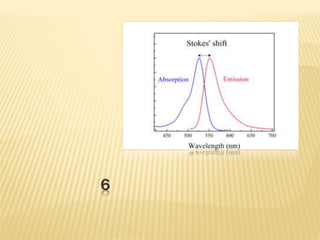
 Stokes effect- The same energy levels are involved for both
absorption and emission and hence,the wavelengths are
identical . The only difference between the two wavelegnths is a
shift in the emission spectrum towards the red end of the
absorption spectrum . This phenomenon is known as stokes
effect .
Reason: when the activator gets exited state ,gives up heat
energy to surrounding by means of vibration,this loss of energy
is the reason behind stokes shift.
Application : fluorescent lamps.
Therefore ,in Characterstic luminescent materials,the excitation
and emission ofolumi light takes place very rapidly in less than
10-8 s and hence called as fast photoluminescence.
5
6
PHOSPHORESCENCE
Certain materials emit light after the incident
radiaton is cut off. This process is known as
phosphorescence. The time delay between
the excitation of electron and emission of
light ranges from 10-8 s to several min.or
Hrs. Or even days.
7
 Non-Characterstic luminescent materials
 Activator
 Coactivators
 Hole trap(acceptor energy level)
 Electron trap(donor energy level)
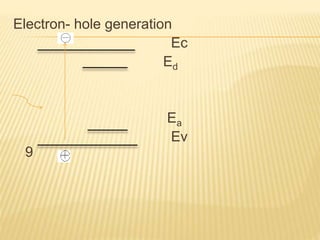
 Electron -hole generation and recombination
process
8
Electron- hole generation
Ec
Ed
Ea
Ev
9
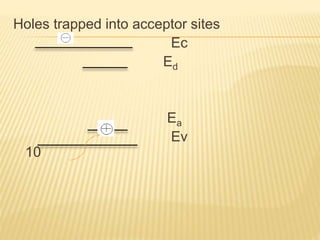
Holes trapped into acceptor sites
Ec
Ed
Ea
Ev
10
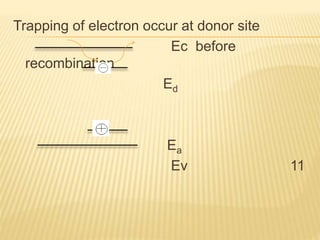
Trapping of electron occur at donor site
Ec before
recombination
Ed
Ea
Ev 11
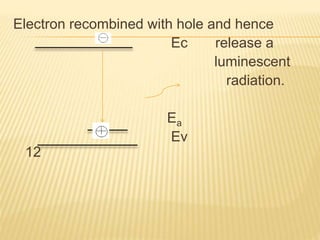
Electron recombined with hole and hence
Ec release a
luminescent
radiation.
Ea
Ev
12
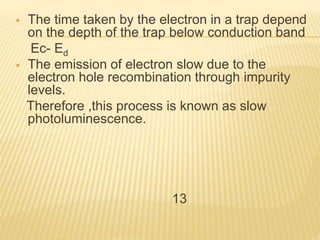
 The time taken by the electron in a trap depend
on the depth of the trap below conduction band
Ec- Ed
 The emission of electron slow due to the
electron hole recombination through impurity
levels.
Therefore ,this process is known as slow
photoluminescence.
13
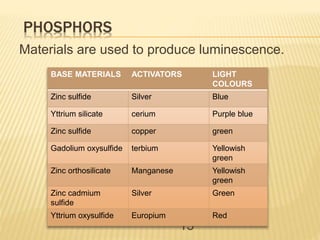
PHOSPHORS
Materials are used to produce luminescence.
15
BASE MATERIALS ACTIVATORS LIGHT
COLOURS
Zinc sulfide Silver Blue
Yttrium silicate cerium Purple blue
Zinc sulfide copper green
Gadolium oxysulfide terbium Yellowish
green
Zinc orthosilicate Manganese Yellowish
green
Zinc cadmium
sulfide
Silver Green
Yttrium oxysulfide Europium Red
APPLICATIONS
 Fluorescent materials are used in display devices
such as LED,LCD,CRT etc.
 A Fluorescent lamp consist of a thin coating of
Fluorescent materials like cadmium borate zinc
silicateetc. When uv radiation fall on it ,and they
absorbs incident radiation and re-emit the light having
the wavelength in visible region ,and hence,
increases luminous flux.
 When x-rays are made to fall on glass coated with
such materials produces fluorescent light. Therefore it
is used as a x-ray detector.
16
REFERENCES
 https://en.wikipedia.org/wiki/Stokes_shift
 Materials science (v rajendran)
17
PHOTOLUMINESCENCE
Presntation given by-
MANEESH
TIWAREE
(2014466003)
Under the supervision of –
DR.DEBRUN DHAR
PURKYASTHA
18
Luminescence.manish

Luminescence.manish

  • 1.
  • 2.
    INTRODUCTION An electron absorbsa photon from the incident beam and it jumps from valance band to the conduction band. Thus ,this electron is in exited state or higher state ,but it no longer be in the higher state and eventually get back into lower energy state by emitting radiation. This phenomenon of emission of light by a material after absorbing such type of energy ,is known as luminescence. 1
  • 3.
  • 4.
    PHOTOLUMINESCENCE Photoluminescence is atype of luminescence. The process in which the emitting radiation arises due to the absorption of photon from the source such as infrared,visible,ultravoilet or x-rays. Photoluminescence is divided into two parts namely,fluroscence and phosphorescence. 3
  • 5.
    FLUORESCENCE If a materialabsorbs light by any one of the above intorduced source ,it radiates or emit light within 10-8 sec. after the excitation is removed. This luminescence is known as fluorescence or fast photoluminescence. It is a temperature independent phenomenon. Substance like fluorspar,fluorescein,quinine sulphate,uranium oxide,calcite,uranium glass exhibit the phenomena of fluorescence. 4
  • 6.
     Characterstic luminescentmaterials  Activator ion  Stokes effect- The same energy levels are involved for both absorption and emission and hence,the wavelengths are identical . The only difference between the two wavelegnths is a shift in the emission spectrum towards the red end of the absorption spectrum . This phenomenon is known as stokes effect . Reason: when the activator gets exited state ,gives up heat energy to surrounding by means of vibration,this loss of energy is the reason behind stokes shift. Application : fluorescent lamps. Therefore ,in Characterstic luminescent materials,the excitation and emission ofolumi light takes place very rapidly in less than 10-8 s and hence called as fast photoluminescence. 5
  • 7.
  • 8.
    PHOSPHORESCENCE Certain materials emitlight after the incident radiaton is cut off. This process is known as phosphorescence. The time delay between the excitation of electron and emission of light ranges from 10-8 s to several min.or Hrs. Or even days. 7
  • 9.
     Non-Characterstic luminescentmaterials  Activator  Coactivators  Hole trap(acceptor energy level)  Electron trap(donor energy level)  Electron -hole generation and recombination process 8
  • 10.
  • 11.
    Holes trapped intoacceptor sites Ec Ed Ea Ev 10
  • 12.
    Trapping of electronoccur at donor site Ec before recombination Ed Ea Ev 11
  • 13.
    Electron recombined withhole and hence Ec release a luminescent radiation. Ea Ev 12
  • 14.
     The timetaken by the electron in a trap depend on the depth of the trap below conduction band Ec- Ed  The emission of electron slow due to the electron hole recombination through impurity levels. Therefore ,this process is known as slow photoluminescence. 13
  • 15.
    PHOSPHORS Materials are usedto produce luminescence. 15 BASE MATERIALS ACTIVATORS LIGHT COLOURS Zinc sulfide Silver Blue Yttrium silicate cerium Purple blue Zinc sulfide copper green Gadolium oxysulfide terbium Yellowish green Zinc orthosilicate Manganese Yellowish green Zinc cadmium sulfide Silver Green Yttrium oxysulfide Europium Red
  • 16.
    APPLICATIONS  Fluorescent materialsare used in display devices such as LED,LCD,CRT etc.  A Fluorescent lamp consist of a thin coating of Fluorescent materials like cadmium borate zinc silicateetc. When uv radiation fall on it ,and they absorbs incident radiation and re-emit the light having the wavelength in visible region ,and hence, increases luminous flux.  When x-rays are made to fall on glass coated with such materials produces fluorescent light. Therefore it is used as a x-ray detector. 16
  • 17.
  • 18.
    PHOTOLUMINESCENCE Presntation given by- MANEESH TIWAREE (2014466003) Underthe supervision of – DR.DEBRUN DHAR PURKYASTHA 18