SNS COLLEGE OF TECHNOLOGY
An Autonomous Institution
Coimbatore - 35
PRESENTED BY
SUBASH P
713521ME062
MECHANICAL ENGINEERING
MANUFACTURING TECHNOLOGY-19MET202
MULTI POINT CUTTING AND ABRASIVE MACHINING PROCESSES
TYPES OF OPERATIONS
• Drilling operation
• Reaming
• Boring
• Tapping
• Milling operation
DRILLING OPERATION
• Drilling is a cutting process that involves the use of a drill bit to cut a circular-shape
hole in a workpiece. The drill bit used in drilling is a type of rotary cutting tool that,
like other rotary cutting tools, rotates while subsequently scraping material out of
the workpiece.
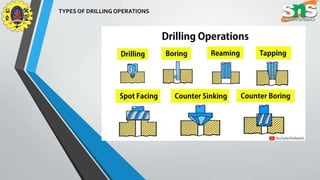
Types of drilling operations
• Reaming
• Boring
• Tapping
TYPES OF DRILLING OPERATIONS
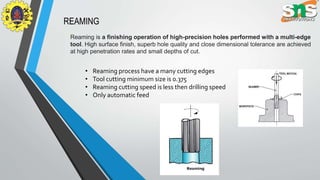
REAMING
Reaming is a finishing operation of high-precision holes performed with a multi-edge
tool. High surface finish, superb hole quality and close dimensional tolerance are achieved
at high penetration rates and small depths of cut.
• Reaming process have a many cutting edges
• Tool cutting minimum size is 0.375
• Reaming cutting speed is less then drilling speed
• Only automatic feed
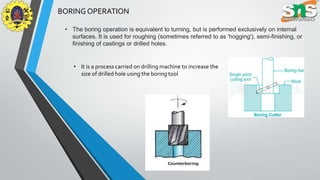
BORING OPERATION
• The boring operation is equivalent to turning, but is performed exclusively on internal
surfaces. It is used for roughing (sometimes referred to as 'hogging'), semi-finishing, or
finishing of castings or drilled holes.
• It is a process carried on drilling machine to increase the
size of drilled hole using the boring tool
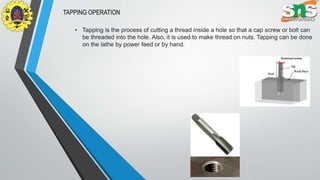
TAPPING OPERATION
• Tapping is the process of cutting a thread inside a hole so that a cap screw or bolt can
be threaded into the hole. Also, it is used to make thread on nuts. Tapping can be done
on the lathe by power feed or by hand.
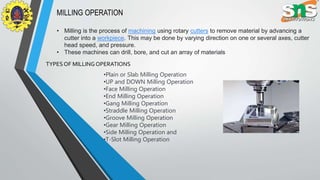
MILLING OPERATION
• Milling is the process of machining using rotary cutters to remove material by advancing a
cutter into a workpiece. This may be done by varying direction on one or several axes, cutter
head speed, and pressure.
• These machines can drill, bore, and cut an array of materials
•Plain or Slab Milling Operation
•UP and DOWN Milling Operation
•Face Milling Operation
•End Milling Operation
•Gang Milling Operation
•Straddle Milling Operation
•Groove Milling Operation
•Gear Milling Operation
•Side Milling Operation and
•T-Slot Milling Operation
TYPES OF MILLINGOPERATIONS
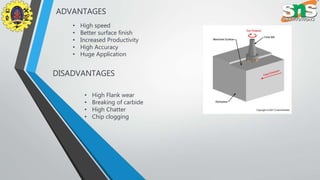
ADVANTAGES
• High speed
• Better surface finish
• Increased Productivity
• High Accuracy
• Huge Application
DISADVANTAGES
• High Flank wear
• Breaking of carbide
• High Chatter
• Chip clogging
SNSCT

SNSCT

  • 1.
    SNS COLLEGE OFTECHNOLOGY An Autonomous Institution Coimbatore - 35 PRESENTED BY SUBASH P 713521ME062 MECHANICAL ENGINEERING MANUFACTURING TECHNOLOGY-19MET202
  • 2.
    MULTI POINT CUTTINGAND ABRASIVE MACHINING PROCESSES TYPES OF OPERATIONS • Drilling operation • Reaming • Boring • Tapping • Milling operation
  • 3.
    DRILLING OPERATION • Drillingis a cutting process that involves the use of a drill bit to cut a circular-shape hole in a workpiece. The drill bit used in drilling is a type of rotary cutting tool that, like other rotary cutting tools, rotates while subsequently scraping material out of the workpiece. Types of drilling operations • Reaming • Boring • Tapping
  • 4.
  • 5.
    REAMING Reaming is afinishing operation of high-precision holes performed with a multi-edge tool. High surface finish, superb hole quality and close dimensional tolerance are achieved at high penetration rates and small depths of cut. • Reaming process have a many cutting edges • Tool cutting minimum size is 0.375 • Reaming cutting speed is less then drilling speed • Only automatic feed
  • 6.
    BORING OPERATION • Theboring operation is equivalent to turning, but is performed exclusively on internal surfaces. It is used for roughing (sometimes referred to as 'hogging'), semi-finishing, or finishing of castings or drilled holes. • It is a process carried on drilling machine to increase the size of drilled hole using the boring tool
  • 7.
    TAPPING OPERATION • Tappingis the process of cutting a thread inside a hole so that a cap screw or bolt can be threaded into the hole. Also, it is used to make thread on nuts. Tapping can be done on the lathe by power feed or by hand.
  • 8.
    MILLING OPERATION • Millingis the process of machining using rotary cutters to remove material by advancing a cutter into a workpiece. This may be done by varying direction on one or several axes, cutter head speed, and pressure. • These machines can drill, bore, and cut an array of materials •Plain or Slab Milling Operation •UP and DOWN Milling Operation •Face Milling Operation •End Milling Operation •Gang Milling Operation •Straddle Milling Operation •Groove Milling Operation •Gear Milling Operation •Side Milling Operation and •T-Slot Milling Operation TYPES OF MILLINGOPERATIONS
  • 9.
    ADVANTAGES • High speed •Better surface finish • Increased Productivity • High Accuracy • Huge Application DISADVANTAGES • High Flank wear • Breaking of carbide • High Chatter • Chip clogging