Machine Learning: Concept Learning &  Decision-Tree Learning  Yuval Shahar M.D., Ph.D. Medical Decision Support Systems
Machine Learning Learning: Improving (a program’s) performance in some task with experience Multiple application domains, such as Game playing (e.g., TD-gammon) Speech recognition (e.g., Sphinx) Data mining (e.g., marketing) Driving autonomous vehicles (e.g., ALVINN) Classification of ER and ICU patients Prediction of financial and other fraud Prediction of pneumonia-patients recovery rate
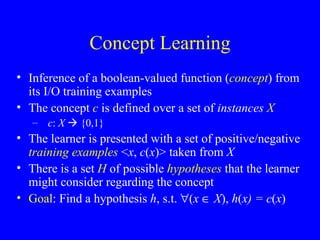
Concept Learning Inference of a boolean-valued function ( concept ) from its I/O training examples The concept  c   is defined over a set of  instances   X c :  X     {0,1} The learner is presented with a set of positive/negative  training examples  < x ,  c ( x )> taken from  X There is a set  H  of possible  hypotheses  that the learner might consider regarding the concept Goal : Find a hypothesis  h , s.t.   ( x      X ),  h ( x) = c ( x )
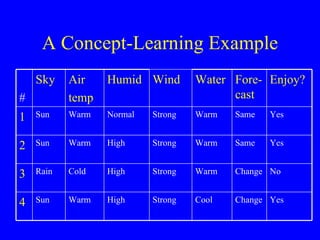
A Concept-Learning Example Enjoy? Fore-cast Water Wind Humid Air  temp Sky # Yes Same Warm Strong Normal Warm Sun 1 Yes Same Warm Strong High Warm Sun 2 No Change Warm Strong High Cold Rain 3 Yes Change Cool Strong High Warm Sun 4
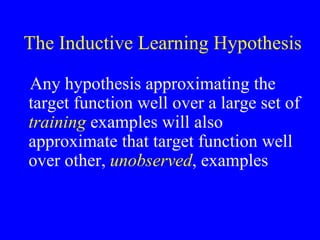
The Inductive Learning Hypothesis Any hypothesis approximating the target function well over a large set of  training  examples will also approximate that target function well over other,  unobserved , examples
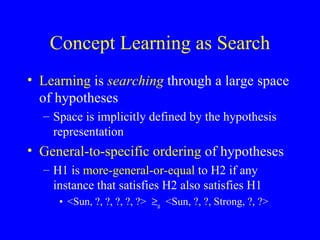
Concept Learning as Search Learning  is  searching  through a large space of hypotheses Space is implicitly defined by the hypothesis representation General-to-specific ordering  of hypotheses H1 is  more-general-or-equal  to H2 if any instance that satisfies H2 also satisfies H1 <Sun, ?, ?, ?, ?, ?>   g   <Sun, ?, ?, Strong, ?, ?>
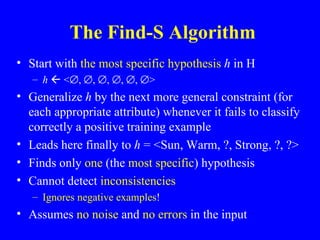
The Find-S Algorithm Start with  the most specific hypothesis  h  in H h    <  ,   ,   ,   ,   ,   > Generalize  h  by the next more general constraint (for each appropriate attribute) whenever it fails to classify correctly a positive training example Leads here finally to  h  = <Sun, Warm, ?, Strong, ?, ?> Finds only  one  (the  most specific ) hypothesis Cannot detect  inconsistencies Ignores negative examples !  Assumes  no noise  and  no errors  in the input
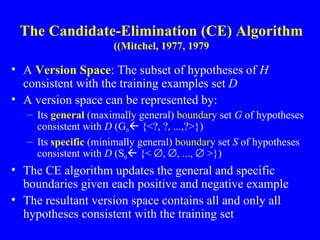
The Candidate-Elimination (CE) Algorithm (Mitchel, 1977, 1979) A  Version Space : The subset of hypotheses of  H  consistent with the training examples set  D A version space can be represented by: Its  general  (maximally general)  boundary  set  G  of hypotheses consistent with  D  (G 0   {<?, ?, ...,?>})   Its  specific  (minimally general)  boundary  set  S  of hypotheses consistent with  D  (S 0   {<   ,   , ...,    >})   The CE algorithm   updates the general and specific boundaries given each positive and negative example The resultant version space contains all and only all hypotheses consistent with the training set
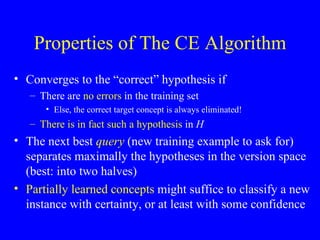
Properties of The CE Algorithm Converges to the “correct” hypothesis if There are  no errors  in the training set  Else, the correct target concept is always eliminated! There is in fact such a hypothesis  in  H The next best  query  (new training example to ask for) separates maximally the hypotheses in the version space (best: into two halves) Partially learned concepts  might suffice to classify a new instance with certainty, or at least with some confidence
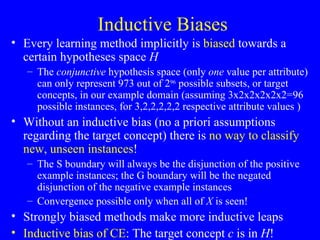
Inductive Biases Every learning method implicitly is  biased  towards a certain hypotheses space  H The  conjunctive  hypothesis space (only  one  value per attribute) can only represent 973 out of 2 96  possible subsets, or target concepts, in our example domain (assuming 3x2x2x2x2x2=96 possible instances, for 3,2,2,2,2,2 respective attribute values )  Without an inductive bias (no a priori assumptions regarding the target concept) there is  no way to classify new, unseen instances ! The S boundary will always be the disjunction of the positive example instances; the G boundary will be the negated disjunction of the negative example instances Convergence possible only when all of  X  is seen! Strongly biased methods make more inductive leaps Inductive bias of CE : The target concept  c  is in  H !
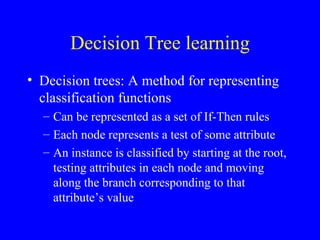
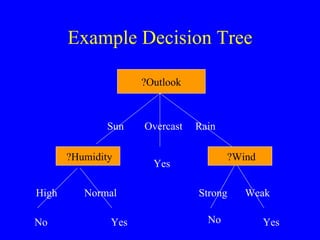
Decision Tree learning Decision trees: A method for representing classification functions Can be represented as a set of If-Then rules Each node represents a test of some attribute An instance is classified by starting at the root, testing attributes in each node and moving along the branch corresponding to that attribute’s value
Example Decision Tree Outlook? Humidity?  Wind?  Yes Yes Yes No No Sun Overcast Rain High Normal Strong Weak
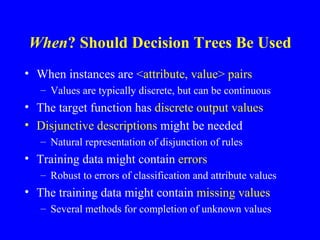
When  Should Decision Trees Be Used? When instances are  <attribute, value> pairs Values are typically discrete, but can be continuous The target function has  discrete output values Disjunctive descriptions  might be needed Natural representation of disjunction of rules Training data might contain  errors Robust to errors of classification and attribute values The training data might contain  missing values Several methods for completion of unknown values
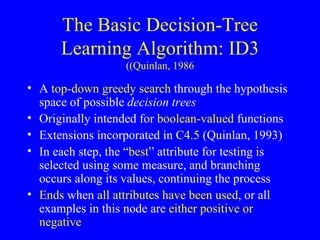
The Basic Decision-Tree Learning Algorithm: ID3 (Quinlan, 1986) A  top-down greedy search  through the hypothesis space of possible  decision trees Originally intended for  boolean-valued  functions Extensions incorporated in  C4.5  (Quinlan, 1993) In each step, the “ best ” attribute for testing is selected using some measure, and branching occurs along its values, continuing the process Ends  when  all attributes have been used , or all examples in this node are  either positive or negative
Which Attribute is Best to Test? The central choice in the ID3 algorithm and similar approaches Here, an  information gain  measure is used, which measures how well each attribute separates training examples according to their target classification
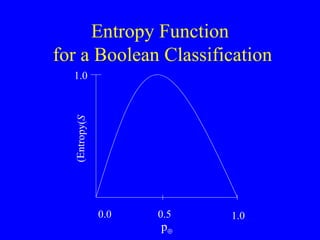
Entropy Entropy : An information-theory measure that characterizes the (im)purity of an example set  S  using the proportion of positive (  ) and negative instances (  ) Informally: Number of bits needed to encode the classification of an arbitrary member of  S;  Entropy( S ) = –p    log 2 p   – p   log 2 p    Entropy( S ) is in [0..1] Entropy( S ) is 0 if all members are positive or negative Entropy is maximal (1) when p   = p    = 0.5 (uniform distribution of positive and negative cases) If there are  c  different values to the target concept, Entropy( S ) =   i=1.. c  – p i  log 2 p i  (p i  is proportion of class  i )
Entropy Function  for a Boolean Classification p  1.0  0.0  0.5  Entropy( S ) 1.0
Entropy and Surprise Entropy can also be considered as the  mean surprise  on seeing the outcome (actual class) -log 2 p is also called the  surprisal [Tribus, 1961] It is the only nonnegative function consistent with the principle that the amount we are surprised by the occurrence of two independent events with probabilities  p 1  and  p 2  is the same as we are surprised by the occurrence of a single event with probability  p 1  x  p 2
Information Gain of an Attribute Sometimes termed the  Mutual Information  (MI)  gained regarding a class (e.g., a disease) given an attribute (e.g., a test), since it is symmetric The  expected  reduction in entropy E(S) caused by partitioning the examples in  S  using the attribute  A  and all its corresponding values Gain( S ,  A )    E ( S ) –   v    Values( A )  (| S v |/| S |) E (S v ) The attribute with maximal information gain is chosen by ID3 for splitting the node Follows from intuitive axioms [Benish, in press], e.g. not caring  how  the test result is revealed
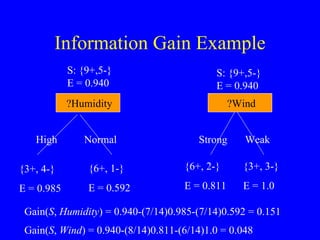
Information Gain Example Humidity?  Wind?  {3+, 4-} E = 0.985 High Normal Strong Weak S: {9+,5-} E = 0.940 S: {9+,5-} E = 0.940 {6+, 1-} E = 0.592 {6+, 2-} E = 0.811 {3+, 3-} E = 1.0 Gain( S ,  Humidity ) = 0.940-(7/14)0.985-(7/14)0.592 = 0.151 Gain( S ,  Wind ) = 0.940-(8/14)0.811-(6/14)1.0 = 0.048
Properties of ID3 Searches the  hypothesis space  of  decision trees A  complete  space  of  all   finite discrete-valued functions  (unlike using conjunctive hypotheses) Maintains only a  single  hypothesis (unlike CE) Performs  no backtracking ; thus, might get stuck in a local optimum Uses  all  training examples at every step to refine the current hypothesis (unlike Find-S or CE) (Approximate)  Inductive bias : Prefers  shorter trees  over larger trees ( Occam’s razor ), and  trees that place high information gain close to the root  over those that do not
The Data Over-Fitting Problem Occurs due to noise in data or too-few examples Handling the data over-fitting problem: Stop growing the tree earlier, or Prune the final tree retrospectively In either case, correct final tree size is determined by A separate  validation set  of examples, or Using  all  examples, deciding if expansion is likely to help Using an explicit measure to encode the training examples and the tree and stop when the measure is minimized
Other Improvements to ID3 Handling  continuous values  of attributes Pick a threshold that maximizes information gain Avoid selection of many-valued attributes  such as  date  by using more sophisticated measures, such as  gain ratio  (dividing the gain of  S  relative to  A  and the target concept by the entropy of  S  with respect to the values of  A ) Handling  missing values  (average value or distribution) Handling  costs  of measuring attributes (e.g., laboratory tests) by including cost in the attribute selection process
Summary:  Concept and Decision-Tree Learning Concept learning  is a search through a  hypothesis space The  Candidate Elimination  algorithm uses general-to-specific ordering of hypotheses to compute the  version space Inductive learning algorithms can classify unseen examples only because of their   implicit  inductive bias ID3 searches through the space of  decision trees ID3 searches a  complete  hypothesis space and can handle  noise  and  missing values  in the training set Over-fitting  the training is a common problem and requires handling by methods such as  post-pruning

Machine Learning

  • 1.
    Machine Learning: ConceptLearning & Decision-Tree Learning Yuval Shahar M.D., Ph.D. Medical Decision Support Systems
  • 2.
    Machine Learning Learning:Improving (a program’s) performance in some task with experience Multiple application domains, such as Game playing (e.g., TD-gammon) Speech recognition (e.g., Sphinx) Data mining (e.g., marketing) Driving autonomous vehicles (e.g., ALVINN) Classification of ER and ICU patients Prediction of financial and other fraud Prediction of pneumonia-patients recovery rate
  • 3.
    Concept Learning Inferenceof a boolean-valued function ( concept ) from its I/O training examples The concept c is defined over a set of instances X c : X  {0,1} The learner is presented with a set of positive/negative training examples < x , c ( x )> taken from X There is a set H of possible hypotheses that the learner might consider regarding the concept Goal : Find a hypothesis h , s.t.  ( x  X ), h ( x) = c ( x )
  • 4.
    A Concept-Learning ExampleEnjoy? Fore-cast Water Wind Humid Air temp Sky # Yes Same Warm Strong Normal Warm Sun 1 Yes Same Warm Strong High Warm Sun 2 No Change Warm Strong High Cold Rain 3 Yes Change Cool Strong High Warm Sun 4
  • 5.
    The Inductive LearningHypothesis Any hypothesis approximating the target function well over a large set of training examples will also approximate that target function well over other, unobserved , examples
  • 6.
    Concept Learning asSearch Learning is searching through a large space of hypotheses Space is implicitly defined by the hypothesis representation General-to-specific ordering of hypotheses H1 is more-general-or-equal to H2 if any instance that satisfies H2 also satisfies H1 <Sun, ?, ?, ?, ?, ?>  g <Sun, ?, ?, Strong, ?, ?>
  • 7.
    The Find-S AlgorithmStart with the most specific hypothesis h in H h  <  ,  ,  ,  ,  ,  > Generalize h by the next more general constraint (for each appropriate attribute) whenever it fails to classify correctly a positive training example Leads here finally to h = <Sun, Warm, ?, Strong, ?, ?> Finds only one (the most specific ) hypothesis Cannot detect inconsistencies Ignores negative examples ! Assumes no noise and no errors in the input
  • 8.
    The Candidate-Elimination (CE)Algorithm (Mitchel, 1977, 1979) A Version Space : The subset of hypotheses of H consistent with the training examples set D A version space can be represented by: Its general (maximally general) boundary set G of hypotheses consistent with D (G 0  {<?, ?, ...,?>}) Its specific (minimally general) boundary set S of hypotheses consistent with D (S 0  {<  ,  , ...,  >}) The CE algorithm updates the general and specific boundaries given each positive and negative example The resultant version space contains all and only all hypotheses consistent with the training set
  • 9.
    Properties of TheCE Algorithm Converges to the “correct” hypothesis if There are no errors in the training set Else, the correct target concept is always eliminated! There is in fact such a hypothesis in H The next best query (new training example to ask for) separates maximally the hypotheses in the version space (best: into two halves) Partially learned concepts might suffice to classify a new instance with certainty, or at least with some confidence
  • 10.
    Inductive Biases Everylearning method implicitly is biased towards a certain hypotheses space H The conjunctive hypothesis space (only one value per attribute) can only represent 973 out of 2 96 possible subsets, or target concepts, in our example domain (assuming 3x2x2x2x2x2=96 possible instances, for 3,2,2,2,2,2 respective attribute values ) Without an inductive bias (no a priori assumptions regarding the target concept) there is no way to classify new, unseen instances ! The S boundary will always be the disjunction of the positive example instances; the G boundary will be the negated disjunction of the negative example instances Convergence possible only when all of X is seen! Strongly biased methods make more inductive leaps Inductive bias of CE : The target concept c is in H !
  • 11.
    Decision Tree learningDecision trees: A method for representing classification functions Can be represented as a set of If-Then rules Each node represents a test of some attribute An instance is classified by starting at the root, testing attributes in each node and moving along the branch corresponding to that attribute’s value
  • 12.
    Example Decision TreeOutlook? Humidity? Wind? Yes Yes Yes No No Sun Overcast Rain High Normal Strong Weak
  • 13.
    When ShouldDecision Trees Be Used? When instances are <attribute, value> pairs Values are typically discrete, but can be continuous The target function has discrete output values Disjunctive descriptions might be needed Natural representation of disjunction of rules Training data might contain errors Robust to errors of classification and attribute values The training data might contain missing values Several methods for completion of unknown values
  • 14.
    The Basic Decision-TreeLearning Algorithm: ID3 (Quinlan, 1986) A top-down greedy search through the hypothesis space of possible decision trees Originally intended for boolean-valued functions Extensions incorporated in C4.5 (Quinlan, 1993) In each step, the “ best ” attribute for testing is selected using some measure, and branching occurs along its values, continuing the process Ends when all attributes have been used , or all examples in this node are either positive or negative
  • 15.
    Which Attribute isBest to Test? The central choice in the ID3 algorithm and similar approaches Here, an information gain measure is used, which measures how well each attribute separates training examples according to their target classification
  • 16.
    Entropy Entropy :An information-theory measure that characterizes the (im)purity of an example set S using the proportion of positive (  ) and negative instances (  ) Informally: Number of bits needed to encode the classification of an arbitrary member of S; Entropy( S ) = –p  log 2 p  – p  log 2 p  Entropy( S ) is in [0..1] Entropy( S ) is 0 if all members are positive or negative Entropy is maximal (1) when p  = p  = 0.5 (uniform distribution of positive and negative cases) If there are c different values to the target concept, Entropy( S ) =  i=1.. c – p i log 2 p i (p i is proportion of class i )
  • 17.
    Entropy Function for a Boolean Classification p  1.0 0.0 0.5 Entropy( S ) 1.0
  • 18.
    Entropy and SurpriseEntropy can also be considered as the mean surprise on seeing the outcome (actual class) -log 2 p is also called the surprisal [Tribus, 1961] It is the only nonnegative function consistent with the principle that the amount we are surprised by the occurrence of two independent events with probabilities p 1 and p 2 is the same as we are surprised by the occurrence of a single event with probability p 1 x p 2
  • 19.
    Information Gain ofan Attribute Sometimes termed the Mutual Information (MI) gained regarding a class (e.g., a disease) given an attribute (e.g., a test), since it is symmetric The expected reduction in entropy E(S) caused by partitioning the examples in S using the attribute A and all its corresponding values Gain( S , A )  E ( S ) –  v  Values( A ) (| S v |/| S |) E (S v ) The attribute with maximal information gain is chosen by ID3 for splitting the node Follows from intuitive axioms [Benish, in press], e.g. not caring how the test result is revealed
  • 20.
    Information Gain ExampleHumidity? Wind? {3+, 4-} E = 0.985 High Normal Strong Weak S: {9+,5-} E = 0.940 S: {9+,5-} E = 0.940 {6+, 1-} E = 0.592 {6+, 2-} E = 0.811 {3+, 3-} E = 1.0 Gain( S , Humidity ) = 0.940-(7/14)0.985-(7/14)0.592 = 0.151 Gain( S , Wind ) = 0.940-(8/14)0.811-(6/14)1.0 = 0.048
  • 21.
    Properties of ID3Searches the hypothesis space of decision trees A complete space of all finite discrete-valued functions (unlike using conjunctive hypotheses) Maintains only a single hypothesis (unlike CE) Performs no backtracking ; thus, might get stuck in a local optimum Uses all training examples at every step to refine the current hypothesis (unlike Find-S or CE) (Approximate) Inductive bias : Prefers shorter trees over larger trees ( Occam’s razor ), and trees that place high information gain close to the root over those that do not
  • 22.
    The Data Over-FittingProblem Occurs due to noise in data or too-few examples Handling the data over-fitting problem: Stop growing the tree earlier, or Prune the final tree retrospectively In either case, correct final tree size is determined by A separate validation set of examples, or Using all examples, deciding if expansion is likely to help Using an explicit measure to encode the training examples and the tree and stop when the measure is minimized
  • 23.
    Other Improvements toID3 Handling continuous values of attributes Pick a threshold that maximizes information gain Avoid selection of many-valued attributes such as date by using more sophisticated measures, such as gain ratio (dividing the gain of S relative to A and the target concept by the entropy of S with respect to the values of A ) Handling missing values (average value or distribution) Handling costs of measuring attributes (e.g., laboratory tests) by including cost in the attribute selection process
  • 24.
    Summary: Conceptand Decision-Tree Learning Concept learning is a search through a hypothesis space The Candidate Elimination algorithm uses general-to-specific ordering of hypotheses to compute the version space Inductive learning algorithms can classify unseen examples only because of their implicit inductive bias ID3 searches through the space of decision trees ID3 searches a complete hypothesis space and can handle noise and missing values in the training set Over-fitting the training is a common problem and requires handling by methods such as post-pruning