

Timeline

• Remaining lectures
   – 2 lectures on machine learning (today and next Tuesday)
   – And then onto planning/search


• Homeworks
   – # (N-grams) is due today
   – # (HMMs) will be out shortly, due Friday next week
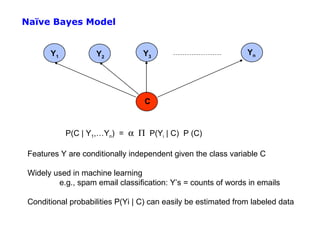
Naïve Bayes Model


       Y1           Y2            Y3                            Yn


                                  C


            P(C | Y1,…Yn) = α Π P(Yi | C) P (C)

 Features Y are conditionally independent given the class variable C

 Widely used in machine learning
         e.g., spam email classification: Y’s = counts of words in emails

 Conditional probabilities P(Yi | C) can easily be estimated from labeled data
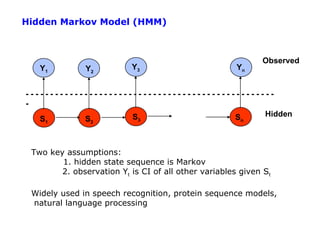
Hidden Markov Model (HMM)


                                                            Observed
   Y1          Y2          Y3                         Yn


---------------------------------------------------
-
                      S3                   Sn    Hidden
   S1       S2


 Two key assumptions:
        1. hidden state sequence is Markov
        2. observation Yt is CI of all other variables given St

 Widely used in speech recognition, protein sequence models,
 natural language processing
Machine Learning


CS 371: Spring 2012
Outline


• Different types of learning algorithms

• Induction learning
   – Decision trees


• Evaluation

• Reading for today’s lecture
   – AIMA Chapter 18.1 to 18.3 (inclusive)
Learning

• Why is it useful for our agent to be able to learn?
    – Learning is a key hallmark of intelligence


• Learning is essential for unknown environments,
    – i.e., when designer lacks omniscience

• Learning is useful as a system construction method,
    – i.e., expose the agent to reality rather than trying to write it down

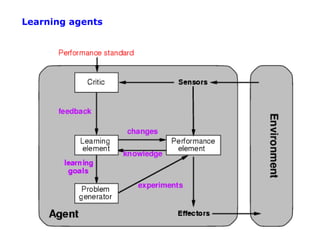
• Learning modifies the agent's decision mechanisms to improve
  performance
Learning agents
Learning element

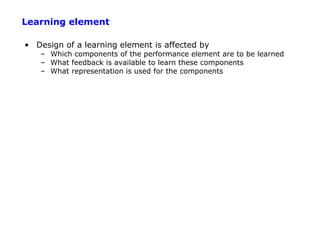
• Design of a learning element is affected by
   – Which components of the performance element are to be learned
   – What feedback is available to learn these components
   – What representation is used for the components
Automated Learning


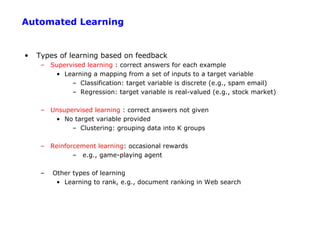
•   Types of learning based on feedback
     – Supervised learning : correct answers for each example
        • Learning a mapping from a set of inputs to a target variable
             – Classification: target variable is discrete (e.g., spam email)
             – Regression: target variable is real-valued (e.g., stock market)

     – Unsupervised learning : correct answers not given
        • No target variable provided
             – Clustering: grouping data into K groups

     – Reinforcement learning: occasional rewards
              – e.g., game-playing agent

     –   Other types of learning
          • Learning to rank, e.g., document ranking in Web search
Simple illustrative learning problem

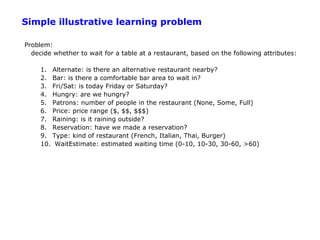
Problem:
  decide whether to wait for a table at a restaurant, based on the following attributes:

     1. Alternate: is there an alternative restaurant nearby?
     2. Bar: is there a comfortable bar area to wait in?
     3. Fri/Sat: is today Friday or Saturday?
     4. Hungry: are we hungry?
     5. Patrons: number of people in the restaurant (None, Some, Full)
     6. Price: price range ($, $$, $$$)
     7. Raining: is it raining outside?
     8. Reservation: have we made a reservation?
     9. Type: kind of restaurant (French, Italian, Thai, Burger)
     10. WaitEstimate: estimated waiting time (0-10, 10-30, 30-60, >60)
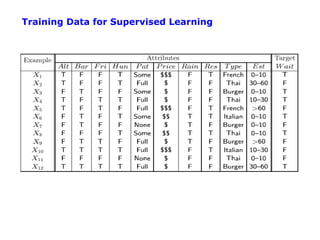
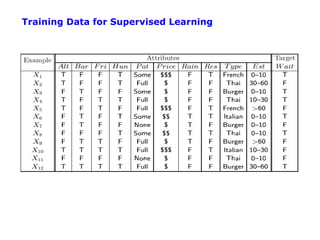
Training Data for Supervised Learning
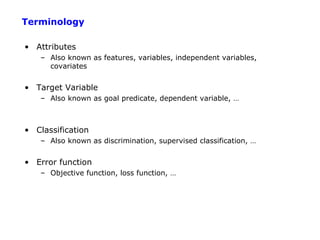
Terminology

• Attributes
   – Also known as features, variables, independent variables,
     covariates


• Target Variable
   – Also known as goal predicate, dependent variable, …


• Classification
   – Also known as discrimination, supervised classification, …


• Error function
   – Objective function, loss function, …
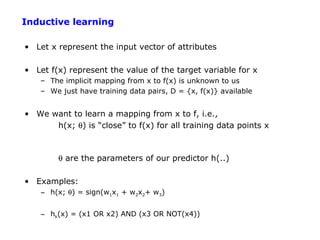
Inductive learning

• Let x represent the input vector of attributes

• Let f(x) represent the value of the target variable for x
    – The implicit mapping from x to f(x) is unknown to us
    – We just have training data pairs, D = {x, f(x)} available


• We want to learn a mapping from x to f, i.e.,
      h(x; θ) is “close” to f(x) for all training data points x


        θ are the parameters of our predictor h(..)

• Examples:
    – h(x; θ) = sign(w1x1 + w2x2+ w3)


    – hk(x) = (x1 OR x2) AND (x3 OR NOT(x4))
Empirical Error Functions

• Empirical error function:
       E(h) =   Σx distance[h(x; θ) , f]

   e.g., distance = squared error if h and f are real-valued (regression)
         distance = delta-function if h and f are categorical (classification)

   Sum is over all training pairs in the training data D


   In learning, we get to choose

      1. what class of functions h(..) that we want to learn
           – potentially a huge space! (“hypothesis space”)

      2. what error function/distance to use
            - should be chosen to reflect real “loss” in problem
            - but often chosen for mathematical/algorithmic convenience
Inductive Learning as Optimization or Search

•   Empirical error function:
        E(h) =   Σx   distance[h(x; θ) , f]


•   Empirical learning = finding h(x), or h(x; θ) that minimizes E(h)


•   Once we decide on what the functional form of h is, and what the error function E
    is, then machine learning typically reduces to a large search or optimization
    problem

•   Additional aspect: we really want to learn an h(..) that will generalize well to new
    data, not just memorize training data – will return to this later
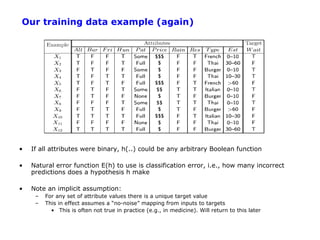
Our training data example (again)


•   If all attributes were binary, h(..) could be any arbitrary Boolean function

•   Natural error function E(h) to use is classification error, i.e., how many incorrect
    predictions does a hypothesis h make

•   Note an implicit assumption:
     –   For any set of attribute values there is a unique target value
     –   This in effect assumes a “no-noise” mapping from inputs to targets
           • This is often not true in practice (e.g., in medicine). Will return to this later
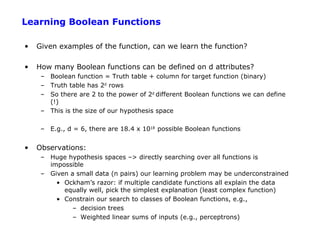
Learning Boolean Functions

•   Given examples of the function, can we learn the function?

•   How many Boolean functions can be defined on d attributes?
     – Boolean function = Truth table + column for target function (binary)
     – Truth table has 2d rows
     – So there are 2 to the power of 2d different Boolean functions we can define
       (!)
     – This is the size of our hypothesis space

     – E.g., d = 6, there are 18.4 x 10¹⁸ possible Boolean functions


•   Observations:
     – Huge hypothesis spaces –> directly searching over all functions is
       impossible
     – Given a small data (n pairs) our learning problem may be underconstrained
         • Ockham’s razor: if multiple candidate functions all explain the data
           equally well, pick the simplest explanation (least complex function)
         • Constrain our search to classes of Boolean functions, e.g.,
              – decision trees
              – Weighted linear sums of inputs (e.g., perceptrons)
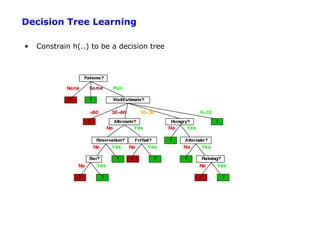
Decision Tree Learning

•   Constrain h(..) to be a decision tree
Decision Tree Representations

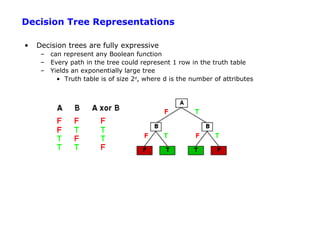
•   Decision trees are fully expressive
     – can represent any Boolean function
     – Every path in the tree could represent 1 row in the truth table
     – Yields an exponentially large tree
         • Truth table is of size 2d, where d is the number of attributes
Decision Tree Representations


•   Trees can be very inefficient for certain types of functions
     – Parity function: 1 only if an even number of 1’s in the input vector
         • Trees are very inefficient at representing such functions
     – Majority function: 1 if more than ½ the inputs are 1’s
         • Also inefficient
Decision Tree Learning

•   Find the smallest decision tree consistent with the n examples
     – Unfortunately this is provably intractable to do optimally

•   Greedy heuristic search used in practice:
     –   Select root node that is “best” in some sense
     –   Partition data into 2 subsets, depending on root attribute value
     –   Recursively grow subtrees
     –   Different termination criteria
           • For noiseless data, if all examples at a node have the same label then
              declare it a leaf and backup
           • For noisy data it might not be possible to find a “pure” leaf using the
              given attributes
                 – we’ll return to this later – but a simple approach is to have a
                   depth-bound on the tree (or go to max depth) and use majority
                   vote

•   We have talked about binary variables up until now, but we can
    trivially extend to multi-valued variables
Pseudocode for Decision tree learning
Training Data for Supervised Learning
Choosing an attribute

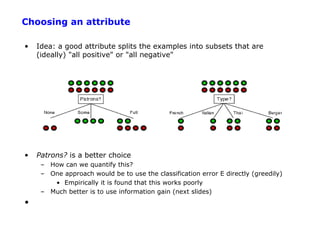
•   Idea: a good attribute splits the examples into subsets that are
    (ideally) "all positive" or "all negative"


•   Patrons? is a better choice
     – How can we quantify this?
     – One approach would be to use the classification error E directly (greedily)
        • Empirically it is found that this works poorly
     – Much better is to use information gain (next slides)
•
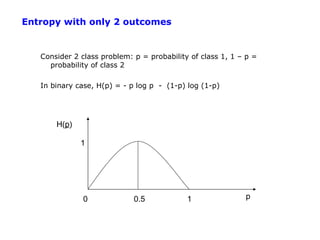
Entropy

H(p) = entropy of distribution p = {pi}
                          (called “information” in text)

     = E [pi log (1/pi) ] = - p log p - (1-p) log (1-p)


    Intuitively log 1/pi is the amount of information we get when we find
      out that outcome i occurred, e.g.,
         i = “6.0 earthquake in New York today”, p(i) = 1/220
                             log 1/pi = 20 bits
         j = “rained in New York today”, p(i) = ½
                          log 1/pj = 1 bit


    Entropy is the expected amount of information we gain, given a
      probability distribution – its our average uncertainty

   In general, H(p) is maximized when all pi are equal and minimized
      (=0) when one of the pi’s is 1 and all others zero.
Entropy with only 2 outcomes


   Consider 2 class problem: p = probability of class 1, 1 – p =
     probability of class 2

   In binary case, H(p) = - p log p - (1-p) log (1-p)


       H(p)

              1


               0             0.5            1               p
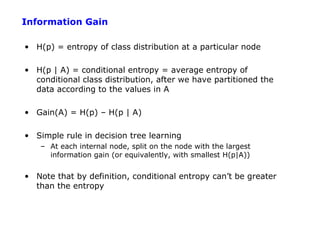
Information Gain

• H(p) = entropy of class distribution at a particular node

• H(p | A) = conditional entropy = average entropy of
  conditional class distribution, after we have partitioned the
  data according to the values in A

• Gain(A) = H(p) – H(p | A)

• Simple rule in decision tree learning
    – At each internal node, split on the node with the largest
      information gain (or equivalently, with smallest H(p|A))


• Note that by definition, conditional entropy can’t be greater
  than the entropy
Root Node Example

For the training set, 6 positives, 6 negatives, H(6/12, 6/12) = 1 bit

Consider the attributes Patrons and Type:

                       2         4         6  2 4
IG ( Patrons ) = 1 − [ H (0,1) + H (1,0) + H ( , )] = .0541 bits
                      12        12        12  6 6

                     2    1 1   2   1 1   4   2 2   4   2 2
IG (Type) = 1 − [      H ( , ) + H ( , ) + H ( , ) + H ( , )] = 0 bits
                    12    2 2 12    2 2 12    4 4 12    4 4


Patrons has the highest IG of all attributes and so is chosen by the learning
    algorithm as the root

Information gain is then repeatedly applied at internal nodes until all leaves contain
    only examples from one class or the other
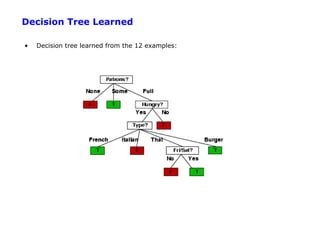
Decision Tree Learned

•   Decision tree learned from the 12 examples:
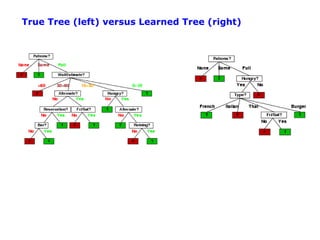
True Tree (left) versus Learned Tree (right)
Summary

• Inductive learning
   – Error function, class of hypothesis/models {h}
   – Want to minimize E on our training data
   – Example: decision tree learning

Machine learning

  • 1.
    Timeline • Remaining lectures – 2 lectures on machine learning (today and next Tuesday) – And then onto planning/search • Homeworks – # (N-grams) is due today – # (HMMs) will be out shortly, due Friday next week
  • 2.
    Naïve Bayes Model Y1 Y2 Y3 Yn C P(C | Y1,…Yn) = α Π P(Yi | C) P (C) Features Y are conditionally independent given the class variable C Widely used in machine learning e.g., spam email classification: Y’s = counts of words in emails Conditional probabilities P(Yi | C) can easily be estimated from labeled data
  • 3.
    Hidden Markov Model(HMM) Observed Y1 Y2 Y3 Yn --------------------------------------------------- - S3 Sn Hidden S1 S2 Two key assumptions: 1. hidden state sequence is Markov 2. observation Yt is CI of all other variables given St Widely used in speech recognition, protein sequence models, natural language processing
  • 4.
  • 5.
    Outline • Different typesof learning algorithms • Induction learning – Decision trees • Evaluation • Reading for today’s lecture – AIMA Chapter 18.1 to 18.3 (inclusive)
  • 6.
    Learning • Why isit useful for our agent to be able to learn? – Learning is a key hallmark of intelligence • Learning is essential for unknown environments, – i.e., when designer lacks omniscience • Learning is useful as a system construction method, – i.e., expose the agent to reality rather than trying to write it down • Learning modifies the agent's decision mechanisms to improve performance
  • 7.
  • 8.
    Learning element • Designof a learning element is affected by – Which components of the performance element are to be learned – What feedback is available to learn these components – What representation is used for the components
  • 9.
    Automated Learning • Types of learning based on feedback – Supervised learning : correct answers for each example • Learning a mapping from a set of inputs to a target variable – Classification: target variable is discrete (e.g., spam email) – Regression: target variable is real-valued (e.g., stock market) – Unsupervised learning : correct answers not given • No target variable provided – Clustering: grouping data into K groups – Reinforcement learning: occasional rewards – e.g., game-playing agent – Other types of learning • Learning to rank, e.g., document ranking in Web search
  • 10.
    Simple illustrative learningproblem Problem: decide whether to wait for a table at a restaurant, based on the following attributes: 1. Alternate: is there an alternative restaurant nearby? 2. Bar: is there a comfortable bar area to wait in? 3. Fri/Sat: is today Friday or Saturday? 4. Hungry: are we hungry? 5. Patrons: number of people in the restaurant (None, Some, Full) 6. Price: price range ($, $$, $$$) 7. Raining: is it raining outside? 8. Reservation: have we made a reservation? 9. Type: kind of restaurant (French, Italian, Thai, Burger) 10. WaitEstimate: estimated waiting time (0-10, 10-30, 30-60, >60)
  • 11.
    Training Data forSupervised Learning
  • 12.
    Terminology • Attributes – Also known as features, variables, independent variables, covariates • Target Variable – Also known as goal predicate, dependent variable, … • Classification – Also known as discrimination, supervised classification, … • Error function – Objective function, loss function, …
  • 13.
    Inductive learning • Letx represent the input vector of attributes • Let f(x) represent the value of the target variable for x – The implicit mapping from x to f(x) is unknown to us – We just have training data pairs, D = {x, f(x)} available • We want to learn a mapping from x to f, i.e., h(x; θ) is “close” to f(x) for all training data points x θ are the parameters of our predictor h(..) • Examples: – h(x; θ) = sign(w1x1 + w2x2+ w3) – hk(x) = (x1 OR x2) AND (x3 OR NOT(x4))
  • 14.
    Empirical Error Functions •Empirical error function: E(h) = Σx distance[h(x; θ) , f] e.g., distance = squared error if h and f are real-valued (regression) distance = delta-function if h and f are categorical (classification) Sum is over all training pairs in the training data D In learning, we get to choose 1. what class of functions h(..) that we want to learn – potentially a huge space! (“hypothesis space”) 2. what error function/distance to use - should be chosen to reflect real “loss” in problem - but often chosen for mathematical/algorithmic convenience
  • 15.
    Inductive Learning asOptimization or Search • Empirical error function: E(h) = Σx distance[h(x; θ) , f] • Empirical learning = finding h(x), or h(x; θ) that minimizes E(h) • Once we decide on what the functional form of h is, and what the error function E is, then machine learning typically reduces to a large search or optimization problem • Additional aspect: we really want to learn an h(..) that will generalize well to new data, not just memorize training data – will return to this later
  • 16.
    Our training dataexample (again) • If all attributes were binary, h(..) could be any arbitrary Boolean function • Natural error function E(h) to use is classification error, i.e., how many incorrect predictions does a hypothesis h make • Note an implicit assumption: – For any set of attribute values there is a unique target value – This in effect assumes a “no-noise” mapping from inputs to targets • This is often not true in practice (e.g., in medicine). Will return to this later
  • 17.
    Learning Boolean Functions • Given examples of the function, can we learn the function? • How many Boolean functions can be defined on d attributes? – Boolean function = Truth table + column for target function (binary) – Truth table has 2d rows – So there are 2 to the power of 2d different Boolean functions we can define (!) – This is the size of our hypothesis space – E.g., d = 6, there are 18.4 x 10¹⁸ possible Boolean functions • Observations: – Huge hypothesis spaces –> directly searching over all functions is impossible – Given a small data (n pairs) our learning problem may be underconstrained • Ockham’s razor: if multiple candidate functions all explain the data equally well, pick the simplest explanation (least complex function) • Constrain our search to classes of Boolean functions, e.g., – decision trees – Weighted linear sums of inputs (e.g., perceptrons)
  • 18.
    Decision Tree Learning • Constrain h(..) to be a decision tree
  • 19.
    Decision Tree Representations • Decision trees are fully expressive – can represent any Boolean function – Every path in the tree could represent 1 row in the truth table – Yields an exponentially large tree • Truth table is of size 2d, where d is the number of attributes
  • 20.
    Decision Tree Representations • Trees can be very inefficient for certain types of functions – Parity function: 1 only if an even number of 1’s in the input vector • Trees are very inefficient at representing such functions – Majority function: 1 if more than ½ the inputs are 1’s • Also inefficient
  • 21.
    Decision Tree Learning • Find the smallest decision tree consistent with the n examples – Unfortunately this is provably intractable to do optimally • Greedy heuristic search used in practice: – Select root node that is “best” in some sense – Partition data into 2 subsets, depending on root attribute value – Recursively grow subtrees – Different termination criteria • For noiseless data, if all examples at a node have the same label then declare it a leaf and backup • For noisy data it might not be possible to find a “pure” leaf using the given attributes – we’ll return to this later – but a simple approach is to have a depth-bound on the tree (or go to max depth) and use majority vote • We have talked about binary variables up until now, but we can trivially extend to multi-valued variables
  • 22.
  • 23.
    Training Data forSupervised Learning
  • 24.
    Choosing an attribute • Idea: a good attribute splits the examples into subsets that are (ideally) "all positive" or "all negative" • Patrons? is a better choice – How can we quantify this? – One approach would be to use the classification error E directly (greedily) • Empirically it is found that this works poorly – Much better is to use information gain (next slides) •
  • 25.
    Entropy H(p) = entropyof distribution p = {pi} (called “information” in text) = E [pi log (1/pi) ] = - p log p - (1-p) log (1-p) Intuitively log 1/pi is the amount of information we get when we find out that outcome i occurred, e.g., i = “6.0 earthquake in New York today”, p(i) = 1/220 log 1/pi = 20 bits j = “rained in New York today”, p(i) = ½ log 1/pj = 1 bit Entropy is the expected amount of information we gain, given a probability distribution – its our average uncertainty In general, H(p) is maximized when all pi are equal and minimized (=0) when one of the pi’s is 1 and all others zero.
  • 26.
    Entropy with only2 outcomes Consider 2 class problem: p = probability of class 1, 1 – p = probability of class 2 In binary case, H(p) = - p log p - (1-p) log (1-p) H(p) 1 0 0.5 1 p
  • 27.
    Information Gain • H(p)= entropy of class distribution at a particular node • H(p | A) = conditional entropy = average entropy of conditional class distribution, after we have partitioned the data according to the values in A • Gain(A) = H(p) – H(p | A) • Simple rule in decision tree learning – At each internal node, split on the node with the largest information gain (or equivalently, with smallest H(p|A)) • Note that by definition, conditional entropy can’t be greater than the entropy
  • 28.
    Root Node Example Forthe training set, 6 positives, 6 negatives, H(6/12, 6/12) = 1 bit Consider the attributes Patrons and Type: 2 4 6 2 4 IG ( Patrons ) = 1 − [ H (0,1) + H (1,0) + H ( , )] = .0541 bits 12 12 12 6 6 2 1 1 2 1 1 4 2 2 4 2 2 IG (Type) = 1 − [ H ( , ) + H ( , ) + H ( , ) + H ( , )] = 0 bits 12 2 2 12 2 2 12 4 4 12 4 4 Patrons has the highest IG of all attributes and so is chosen by the learning algorithm as the root Information gain is then repeatedly applied at internal nodes until all leaves contain only examples from one class or the other
  • 29.
    Decision Tree Learned • Decision tree learned from the 12 examples:
  • 30.
    True Tree (left)versus Learned Tree (right)
  • 31.
    Summary • Inductive learning – Error function, class of hypothesis/models {h} – Want to minimize E on our training data – Example: decision tree learning