Representing
Uncertainty In Expert
Systems
Presented By :
Bhupendra Kumar
Integrated M.Tech.
Faculty of Engg.
• Introduction to expert systems
• Merits & Demerits in expert systems
• Introduction to uncertainty
• Sources of Uncertain Knowledge
• Bayesian Rule
• Reasoning in Expert Systems
• Bias of the Bayesian method
• Certainty factors theory and evidential reasoning
OUTLINE
• An Expert System is a computer program that simulates
human intelligence and behavior in specific and limited
domains.
• It is composed of three major modules:
• A Knowledge Base
• An Inference Engine
• A User Interface
Expert system
Expert system
Major Components
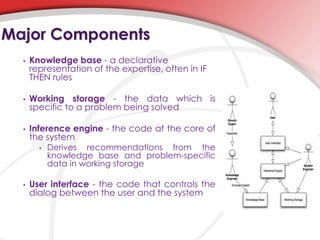
• Knowledge base - a declarative
representation of the expertise, often in IF
THEN rules
• Working storage - the data which is
specific to a problem being solved
• Inference engine - the code at the core of
the system
• Derives recommendations from the
knowledge base and problem-specific
data in working storage
• User interface - the code that controls the
dialog between the user and the system
Advantage of expert system
• Providing expert opinion in remote sites
• Enhance the performance of tasks by applying
heuristic expert knowledge
• Planning, Troubleshooting, Robotic manipulation,
Exploration, Process Control
• Expert systems are not good for :
• Representing temporal knowledge
• Representing spatial knowledge
• Performing commonsense reasoning
• Recognizing the limits of their ability
• Handling inconsistent knowledge
Problems with expert system
• The information available to humans is often
imperfect. An expert can cope with defects.
• Classical logic permits only exact reasoning
• IF A is true
THEN A is ¬ false
and
• IF B is false
THEN B is¬ true
• Most real-world problems do not provide exact
information. It can be inexact, incomplete or even
immeasurable.
Introduction to uncertainty
• Uncertainty is defined as the lack of the exact knowledge,
that
would enable us to reach a perfectly reliable conclusion.
• Classical logic permits only exact reasoning. It assumes that
perfect knowledge always exists and the law of the
excluded middle can always be applied.
¬TRUE = FALSE.
Definition
• Weak implications:
• Domain experts and knowledge engineers must establish
concrete correlations between IF and THEN parts of the
rules.
• Therefore, expert systems need to have the ability to
handle vague associations, for example by accepting the
degree of correlations as numerical certainty factors.
Sources of uncertain knowledge
• Imprecise Language: Our natural language is ambiguous
and imprecise. As a result, it can be difficult to express
knowledge in the precise
IF-THEN form of production rules. Expert systems need
quantified measures.
Unknown Data: When the data is incomplete or missing,
the only solution is to accept the value “unknown” and
proceed to an approximate reasoning with this value.
• Disagreement among experts: Weighting associated to
different expert opinions.
Sources of Uncertain Knowledge
Probabilistic reasoning
• Probability Theory Basics
• Bayesian Reasoning
Examine the uncertainty
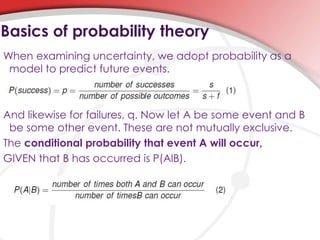
Basics of probability theory
When examining uncertainty, we adopt probability as a
model to predict future events.
And likewise for failures, q. Now let A be some event and B
be some other event. These are not mutually exclusive.
The conditional probability that event A will occur,
GIVEN that B has occurred is P(AlB).
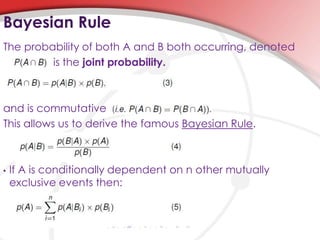
Bayesian Rule
The probability of both A and B both occurring, denoted
is the joint probability.
and is commutative
This allows us to derive the famous Bayesian Rule.
• If A is conditionally dependent on n other mutually
exclusive events then:
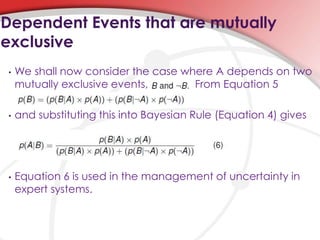
• We shall now consider the case where A depends on two
mutually exclusive events, From Equation 5
• and substituting this into Bayesian Rule (Equation 4) gives
• Equation 6 is used in the management of uncertainty in
expert systems.
Dependent Events that are mutually
exclusive
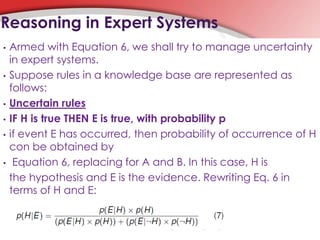
• Armed with Equation 6, we shall try to manage uncertainty
in expert systems.
• Suppose rules in a knowledge base are represented as
follows:
• Uncertain rules
• IF H is true THEN E is true, with probability p
• if event E has occurred, then probability of occurrence of H
con be obtained by
• Equation 6, replacing for A and B. In this case, H is
the hypothesis and E is the evidence. Rewriting Eq. 6 in
terms of H and E:
Reasoning in Expert Systems
• Single evidence E and m hypotheses imply:
• Suppose the expert, given multiple (n) evidences, cannot
distinguish between m hypotheses:
• An application of Eq. 9 requires us to obtain the
conditional probabilities of all possible combinations of
evidences for all hypotheses! This grows exponentially.
Therefore, assume conditional independence if possible.
Generalising to m hypotheses and n
evidences
• Let the posterior probability of hypothesis Hi upon
observing evidences E1… En be:
• This is a far more tractable solution and assumes
conditional independence among different
evidences.
• Users provide information about the evidence
observed and the expert system computes p(H|E) for
hypothesis H in light of the user-supplied evidence E.
Probability p(H|E) is called the posterior probability of
hypothesis H upon observing evidence E.
Probabilistic reasoning in expert
systems
• Example
How does an expert system compute posterior
probabilities and rank hypotheses?
After evidence E3 is observed, belief in hypothesis H1
decreases and becomes equal to belief in hypothesis H2.
Belief in hypothesis H3 increases and even nearly reaches
beliefs in hypotheses H1 and H2.
Thus,
32,1,=,
3
1
3
3
3 i
HpHEp
HpHEp
EHp
k
kk
ii
i





0.34
25.0.90+35.07.0+0.400.6
0.400.6
31 


EHp
0.34
25.0.90+35.07.0+0.400.6
35.07.0
32 


EHp
0.32
25.0.90+35.07.0+0.400.6
25.09.0
33 


EHp
Suppose now that we observe evidence E1.
The posterior probabilities are calculated as
Hence,
32,1,=,
3
1
31
31
31 i
HpHEpHEp
HpHEpHEp
EEHp
k
kkk
iii
i





0.19
25.00.5+35.07.00.8+0.400.60.3
0.400.60.3
311 


EEHp
0.52
25.00.5+35.07.00.8+0.400.60.3
35.07.00.8
312 


EEHp
0.29
25.00.5+35.07.00.8+0.400.60.3
25.09.00.5
313 


EEHp
Hypothesis H2 has now become the most likely
one.
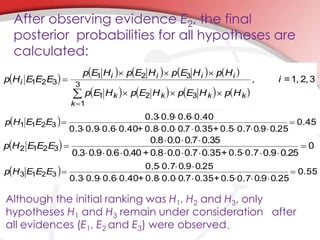
After observing evidence E2, the final
posterior probabilities for all hypotheses are
calculated:
Although the initial ranking was H1, H2 and H3, only
hypotheses H1 and H3 remain under consideration after
all evidences (E1, E2 and E3) were observed.
32,1,=,
3
1
321
321
321 i
HpHEpHEpHEp
HpHEpHEpHEp
EEEHp
k
kkkk
iiii
i





0.45
25.09.00.5 0.7
0.7
0.7
0.5
+.3507.00.00.8+0.400.60.90.3
0.400.60.90.3
3211 


EEEHp
0
25.09.0+.3507.00.00.8+0.400.60.90.3
35.07.00.00.8
3212 


EEEHp
0.55
25.09.00.5+.3507.00.00.8+0.400.60.90.3
25.09.00.70.5
3213 


EEEHp
• Bayesian reasoning requires probability inputs requiring
human judgement,
• Humans do not elicit probabilities completely accurately,
• Conditional probabilities may be inconsistent with prior
probabilities given by the expert.
• The expert makes different assumptions and can make
inaccurate judgements.
Bias of the Bayesian method
 Certainty factors theory is a popular alternative to
Bayesian reasoning.
 A certainty factor (cf ), a number to measure the expert’s
belief. The maximum value of the certainty factor is, say,
+1.0 (definitely true) and the minimum -1.0 (definitely
false). For example, if the expert states that some
evidence is almost certainly true, a cf value of 0.8 would
be assigned to this evidence.
Certainty factors theory and
evidential reasoning
Uncertain terms and their
interpretation in MYCIN
Term
Definitely not
Almost certainly not
Probably not
Maybe not
Unknown
Certainty Factor
+0.4
+0.6
+0.8
+1.0
Maybe
Probably
Almost certainly
Definitely
1.0_
0.8_
0.6
_
0.4_
0.2 to +0.2
_
 In expert systems with certainty factors, the
knowledge base consists of a set of rules
that have the following syntax:
IF <evidence>
THEN <hypothesis> {cf }
where cf represents belief in hypothesis H
given that evidence E has occurred.
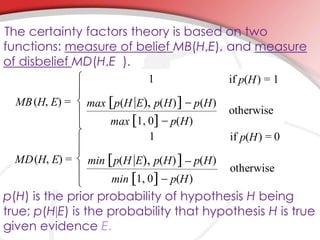
The certainty factors theory is based on two
functions: measure of belief MB(H,E), and measure
of disbelief MD(H,E ).
p(H) is the prior probability of hypothesis H being
true; p(H|E) is the probability that hypothesis H is true
given evidence E.
if p(H) = 1





MB(H, E) =
1
max 1, 0 - p(H)
max p(H|E), p(H) -
-
p(H)
otherwise
if p(H) = 0





MD(H, E) =
1
min 1, 0 - p(H)
min p(H|E), p(H) p(H)
otherwise
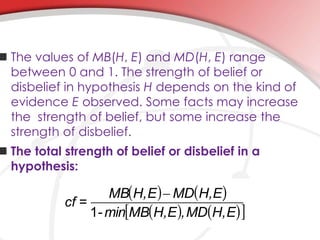
 The values of MB(H, E) and MD(H, E) range
between 0 and 1. The strength of belief or
disbelief in hypothesis H depends on the kind of
evidence E observed. Some facts may increase
the strength of belief, but some increase the
strength of disbelief.
 The total strength of belief or disbelief in a
hypothesis:
EH,MD,EH,MBmin-
EH,MDEH,MB
=cf
1
-
Example:
Consider a simple rule:
IF A is X
THEN B is Y
An expert may not be absolutely certain that
this rule holds. Also suppose it has been
observed that in some cases, even when the IF
part of the rule is satisfied and object A takes
on value X, object B can acquire some
different value Z.
IF A is X
THEN B is Y {cf 0.7};
B is Z {cf 0.2}
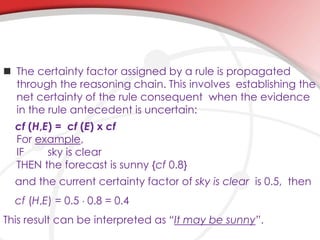
 The certainty factor assigned by a rule is propagated
through the reasoning chain. This involves establishing the
net certainty of the rule consequent when the evidence
in the rule antecedent is uncertain:
cf (H,E) = cf (E) x cf
For example,
IF sky is clear
THEN the forecast is sunny {cf 0.8}
and the current certainty factor of sky is clear is 0.5, then
cf (H,E) = 0.5  0.8 = 0.4
This result can be interpreted as “It may be sunny”.
• The certainty factors theory provides a practical
alternative to Bayesian reasoning.
• The heuristic manner of combining certainty factors is
different from the manner in which they would be
combined if they were probabilities.
• The certainty theory is not “mathematically pure” but
does mimic the thinking process of a human expert
Representing uncertainty in expert systems

Representing uncertainty in expert systems

  • 1.
    Representing Uncertainty In Expert Systems PresentedBy : Bhupendra Kumar Integrated M.Tech. Faculty of Engg.
  • 2.
    • Introduction toexpert systems • Merits & Demerits in expert systems • Introduction to uncertainty • Sources of Uncertain Knowledge • Bayesian Rule • Reasoning in Expert Systems • Bias of the Bayesian method • Certainty factors theory and evidential reasoning OUTLINE
  • 3.
    • An ExpertSystem is a computer program that simulates human intelligence and behavior in specific and limited domains. • It is composed of three major modules: • A Knowledge Base • An Inference Engine • A User Interface Expert system
  • 4.
  • 5.
    Major Components • Knowledgebase - a declarative representation of the expertise, often in IF THEN rules • Working storage - the data which is specific to a problem being solved • Inference engine - the code at the core of the system • Derives recommendations from the knowledge base and problem-specific data in working storage • User interface - the code that controls the dialog between the user and the system
  • 6.
    Advantage of expertsystem • Providing expert opinion in remote sites • Enhance the performance of tasks by applying heuristic expert knowledge • Planning, Troubleshooting, Robotic manipulation, Exploration, Process Control
  • 7.
    • Expert systemsare not good for : • Representing temporal knowledge • Representing spatial knowledge • Performing commonsense reasoning • Recognizing the limits of their ability • Handling inconsistent knowledge Problems with expert system
  • 8.
    • The informationavailable to humans is often imperfect. An expert can cope with defects. • Classical logic permits only exact reasoning • IF A is true THEN A is ¬ false and • IF B is false THEN B is¬ true • Most real-world problems do not provide exact information. It can be inexact, incomplete or even immeasurable. Introduction to uncertainty
  • 9.
    • Uncertainty isdefined as the lack of the exact knowledge, that would enable us to reach a perfectly reliable conclusion. • Classical logic permits only exact reasoning. It assumes that perfect knowledge always exists and the law of the excluded middle can always be applied. ¬TRUE = FALSE. Definition
  • 10.
    • Weak implications: •Domain experts and knowledge engineers must establish concrete correlations between IF and THEN parts of the rules. • Therefore, expert systems need to have the ability to handle vague associations, for example by accepting the degree of correlations as numerical certainty factors. Sources of uncertain knowledge
  • 11.
    • Imprecise Language:Our natural language is ambiguous and imprecise. As a result, it can be difficult to express knowledge in the precise IF-THEN form of production rules. Expert systems need quantified measures. Unknown Data: When the data is incomplete or missing, the only solution is to accept the value “unknown” and proceed to an approximate reasoning with this value. • Disagreement among experts: Weighting associated to different expert opinions. Sources of Uncertain Knowledge
  • 12.
    Probabilistic reasoning • ProbabilityTheory Basics • Bayesian Reasoning Examine the uncertainty
  • 13.
    Basics of probabilitytheory When examining uncertainty, we adopt probability as a model to predict future events. And likewise for failures, q. Now let A be some event and B be some other event. These are not mutually exclusive. The conditional probability that event A will occur, GIVEN that B has occurred is P(AlB).
  • 14.
    Bayesian Rule The probabilityof both A and B both occurring, denoted is the joint probability. and is commutative This allows us to derive the famous Bayesian Rule. • If A is conditionally dependent on n other mutually exclusive events then:
  • 15.
    • We shallnow consider the case where A depends on two mutually exclusive events, From Equation 5 • and substituting this into Bayesian Rule (Equation 4) gives • Equation 6 is used in the management of uncertainty in expert systems. Dependent Events that are mutually exclusive
  • 16.
    • Armed withEquation 6, we shall try to manage uncertainty in expert systems. • Suppose rules in a knowledge base are represented as follows: • Uncertain rules • IF H is true THEN E is true, with probability p • if event E has occurred, then probability of occurrence of H con be obtained by • Equation 6, replacing for A and B. In this case, H is the hypothesis and E is the evidence. Rewriting Eq. 6 in terms of H and E: Reasoning in Expert Systems
  • 17.
    • Single evidenceE and m hypotheses imply: • Suppose the expert, given multiple (n) evidences, cannot distinguish between m hypotheses: • An application of Eq. 9 requires us to obtain the conditional probabilities of all possible combinations of evidences for all hypotheses! This grows exponentially. Therefore, assume conditional independence if possible. Generalising to m hypotheses and n evidences
  • 18.
    • Let theposterior probability of hypothesis Hi upon observing evidences E1… En be: • This is a far more tractable solution and assumes conditional independence among different evidences. • Users provide information about the evidence observed and the expert system computes p(H|E) for hypothesis H in light of the user-supplied evidence E. Probability p(H|E) is called the posterior probability of hypothesis H upon observing evidence E. Probabilistic reasoning in expert systems
  • 19.
    • Example How doesan expert system compute posterior probabilities and rank hypotheses?
  • 20.
    After evidence E3is observed, belief in hypothesis H1 decreases and becomes equal to belief in hypothesis H2. Belief in hypothesis H3 increases and even nearly reaches beliefs in hypotheses H1 and H2. Thus, 32,1,=, 3 1 3 3 3 i HpHEp HpHEp EHp k kk ii i      0.34 25.0.90+35.07.0+0.400.6 0.400.6 31    EHp 0.34 25.0.90+35.07.0+0.400.6 35.07.0 32    EHp 0.32 25.0.90+35.07.0+0.400.6 25.09.0 33    EHp
  • 21.
    Suppose now thatwe observe evidence E1. The posterior probabilities are calculated as Hence, 32,1,=, 3 1 31 31 31 i HpHEpHEp HpHEpHEp EEHp k kkk iii i      0.19 25.00.5+35.07.00.8+0.400.60.3 0.400.60.3 311    EEHp 0.52 25.00.5+35.07.00.8+0.400.60.3 35.07.00.8 312    EEHp 0.29 25.00.5+35.07.00.8+0.400.60.3 25.09.00.5 313    EEHp Hypothesis H2 has now become the most likely one.
  • 22.
    After observing evidenceE2, the final posterior probabilities for all hypotheses are calculated: Although the initial ranking was H1, H2 and H3, only hypotheses H1 and H3 remain under consideration after all evidences (E1, E2 and E3) were observed. 32,1,=, 3 1 321 321 321 i HpHEpHEpHEp HpHEpHEpHEp EEEHp k kkkk iiii i      0.45 25.09.00.5 0.7 0.7 0.7 0.5 +.3507.00.00.8+0.400.60.90.3 0.400.60.90.3 3211    EEEHp 0 25.09.0+.3507.00.00.8+0.400.60.90.3 35.07.00.00.8 3212    EEEHp 0.55 25.09.00.5+.3507.00.00.8+0.400.60.90.3 25.09.00.70.5 3213    EEEHp
  • 23.
    • Bayesian reasoningrequires probability inputs requiring human judgement, • Humans do not elicit probabilities completely accurately, • Conditional probabilities may be inconsistent with prior probabilities given by the expert. • The expert makes different assumptions and can make inaccurate judgements. Bias of the Bayesian method
  • 24.
     Certainty factorstheory is a popular alternative to Bayesian reasoning.  A certainty factor (cf ), a number to measure the expert’s belief. The maximum value of the certainty factor is, say, +1.0 (definitely true) and the minimum -1.0 (definitely false). For example, if the expert states that some evidence is almost certainly true, a cf value of 0.8 would be assigned to this evidence. Certainty factors theory and evidential reasoning
  • 25.
    Uncertain terms andtheir interpretation in MYCIN Term Definitely not Almost certainly not Probably not Maybe not Unknown Certainty Factor +0.4 +0.6 +0.8 +1.0 Maybe Probably Almost certainly Definitely 1.0_ 0.8_ 0.6 _ 0.4_ 0.2 to +0.2 _
  • 26.
     In expertsystems with certainty factors, the knowledge base consists of a set of rules that have the following syntax: IF <evidence> THEN <hypothesis> {cf } where cf represents belief in hypothesis H given that evidence E has occurred.
  • 27.
    The certainty factorstheory is based on two functions: measure of belief MB(H,E), and measure of disbelief MD(H,E ). p(H) is the prior probability of hypothesis H being true; p(H|E) is the probability that hypothesis H is true given evidence E. if p(H) = 1      MB(H, E) = 1 max 1, 0 - p(H) max p(H|E), p(H) - - p(H) otherwise if p(H) = 0      MD(H, E) = 1 min 1, 0 - p(H) min p(H|E), p(H) p(H) otherwise
  • 28.
     The valuesof MB(H, E) and MD(H, E) range between 0 and 1. The strength of belief or disbelief in hypothesis H depends on the kind of evidence E observed. Some facts may increase the strength of belief, but some increase the strength of disbelief.  The total strength of belief or disbelief in a hypothesis: EH,MD,EH,MBmin- EH,MDEH,MB =cf 1 -
  • 29.
    Example: Consider a simplerule: IF A is X THEN B is Y An expert may not be absolutely certain that this rule holds. Also suppose it has been observed that in some cases, even when the IF part of the rule is satisfied and object A takes on value X, object B can acquire some different value Z. IF A is X THEN B is Y {cf 0.7}; B is Z {cf 0.2}
  • 30.
     The certaintyfactor assigned by a rule is propagated through the reasoning chain. This involves establishing the net certainty of the rule consequent when the evidence in the rule antecedent is uncertain: cf (H,E) = cf (E) x cf For example, IF sky is clear THEN the forecast is sunny {cf 0.8} and the current certainty factor of sky is clear is 0.5, then cf (H,E) = 0.5  0.8 = 0.4 This result can be interpreted as “It may be sunny”.
  • 31.
    • The certaintyfactors theory provides a practical alternative to Bayesian reasoning. • The heuristic manner of combining certainty factors is different from the manner in which they would be combined if they were probabilities. • The certainty theory is not “mathematically pure” but does mimic the thinking process of a human expert