1


MACHINE LEARNING FOR
MEDICAL IMAGING DATA
Yiou (Leo) Li
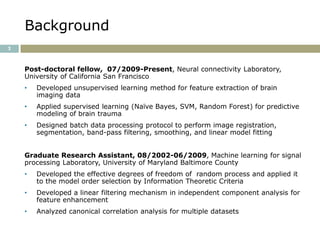
Background
2


    Post-doctoral fellow, 07/2009-Present, Neural connectivity Laboratory,
    University of California San Francisco
    •   Developed unsupervised learning method for feature extraction of brain
        imaging data
    •   Applied supervised learning (Naïve Bayes, SVM, Random Forest) for predictive
        modeling of brain trauma
    •   Designed batch data processing protocol to perform image registration,
        segmentation, band-pass filtering, smoothing, and linear model fitting


    Graduate Research Assistant, 08/2002-06/2009, Machine learning for signal
    processing Laboratory, University of Maryland Baltimore County
    •   Developed the effective degrees of freedom of random process and applied it
        to the model order selection by Information Theoretic Criteria
    •   Developed a linear filtering mechanism in independent component analysis for
        feature enhancement
    •   Analyzed canonical correlation analysis for multiple datasets
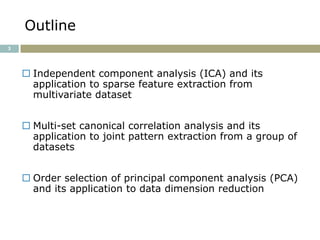
Outline
3


     Independent component analysis (ICA) and its
      application to sparse feature extraction from
      multivariate dataset


     Multi-set canonical correlation analysis and its
      application to joint pattern extraction from a group of
      datasets


     Order selection of principal component analysis (PCA)
      and its application to data dimension reduction
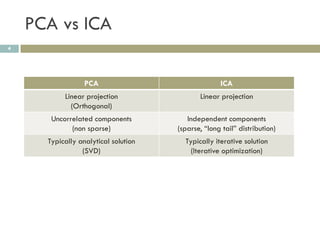
PCA vs ICA
4


                  PCA                               ICA
           Linear projection                 Linear projection
             (Orthogonal)
       Uncorrelated components           Independent components
             (non sparse)             (sparse, “long tail” distribution)
      Typically analytical solution     Typically iterative solution
                 (SVD)                    (Iterative optimization)
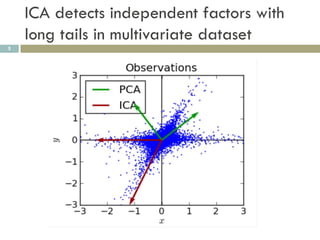
ICA detects independent factors with
    long tails in multivariate dataset
5
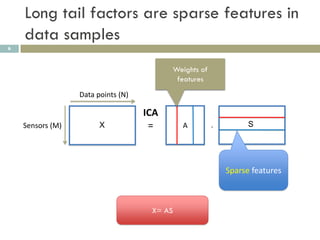
Long tail factors are sparse features in
    data samples
6


                                          Weights of
                                           features
                  Data points (N)

                                    ICA
    Sensors (M)         X            =       A         .         S


                                                           Sparse features


                                     X= AS
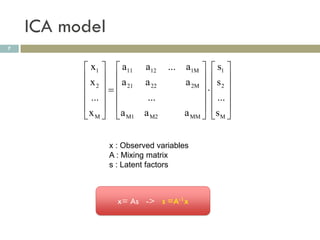
ICA model
7


           x1   a11 a12 ... a1M   s1 
          x  a       a 22   a 2M   s 2 
           2    21               
           ...        ...          ... 
                                   
           x M  a M1 a M2   a MM  s M 


                x : Observed variables
                A : Mixing matrix
                s : Latent factors


                  x= As -> s =A-1x
ICA by maximum likelihood estimation
8


    Transformation of multivariate random variable: x = As
                              p(s 1, s2 , ... , sM )
    p(x 1,x 2 , ... , x M )                                 (1)
                                    det(A)
    Statistical independence condition of s:

    p(s 1, s2 , ... , sM )  i 1 p(si )
                                          M
                                                             (2)

    Log likelihood function of x with parameter A:

    log p(x 1,x 2 ,...x M )   log p([A x] i )  log det(A)
                                                      -1

                                      i
ICA Application: Sparse feature extraction from
    multivariate dataset
9
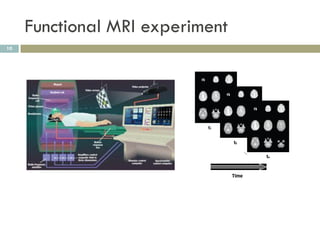
Functional MRI experiment
10
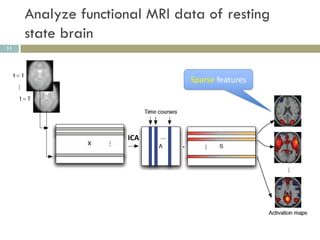
Analyze functional MRI data of resting
     state brain
11


                              Sparse features


                    ICA
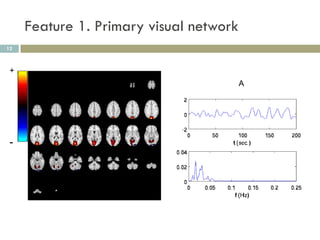
Feature 1. Primary visual network
12


 +
                                         A


 -
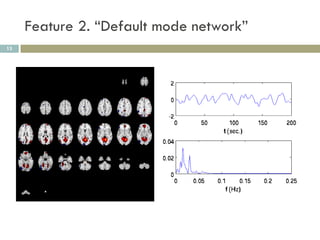
Feature 2. “Default mode network”
13
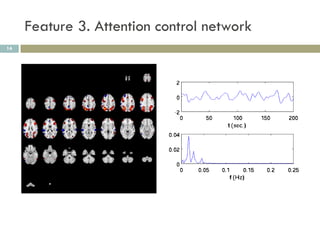
Feature 3. Attention control network
14
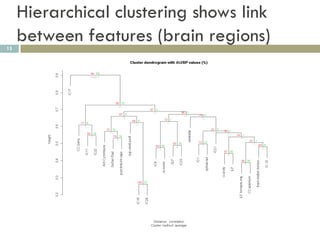
Hierarchical clustering shows link
15
     between features (brain regions)
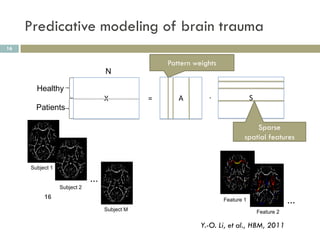
Predicative modeling of brain trauma
16

                                                 Pattern weights
                                 N

       Healthy
                                 X           =      A        .                 S
       Patients

                                                                               Sparse
                                                                           spatial features


     Subject 1

                             …
                 Subject 2
          16                                                                       Pattern 2
                                                                   Feature 1                   …
                                 Subject M                                         Feature 2

                                                           Y.-O. Li, et al., HBM, 2011
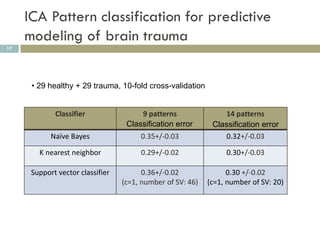
ICA Pattern classification for predictive
     modeling of brain trauma
17


      • 29 healthy + 29 trauma, 10-fold cross-validation


             Classifier                9 patterns                14 patterns
                                   Classification error      Classification error
            Naïve Bayes                0.35+/-0.03               0.32+/-0.03

        K nearest neighbor             0.29+/-0.02               0.30+/-0.03

      Support vector classifier         0.36+/-0.02               0.30 +/-0.02
                                  (c=1, number of SV: 46)   (c=1, number of SV: 20)
Outline
18


      Independent component analysis (ICA) and its
       application to sparse feature extraction from
       multivariate dataset


      Multi-set canonical correlation analysis and its
       application to joint pattern extraction from a group of
       datasets


      Order selection of principal component analysis (PCA)
       and its application to dimension reduction
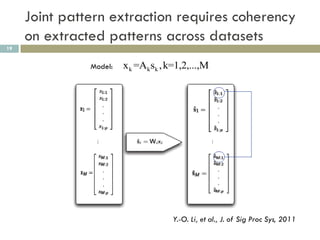
Joint pattern extraction requires coherency
     on extracted patterns across datasets
19


               Model:   x k =Aksk , k=1,2,...,M


                                     Y.-O. Li, et al., J. of Sig Proc Sys, 2011
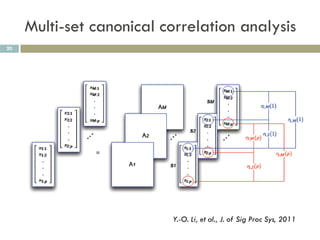
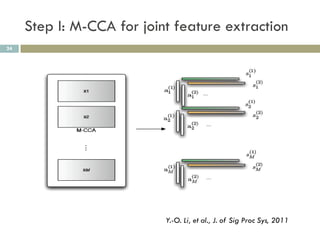
Multi-set canonical correlation analysis
20


                          Y.-O. Li, et al., J. of Sig Proc Sys, 2011
Multi-set canonical correlation
     analysis
21


          Correlation matrix of [S1,S2, … SM]

                                        Y.-O. Li, et al., J. of Sig Proc Sys, 2011
Application: joint pattern extraction from a
     group of datasets
22


     •   Analyze group functional MRI data from
         simulated driving experiment
Simulated driving experiment
23

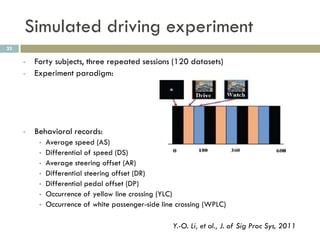
     •   Forty subjects, three repeated sessions (120 datasets)
     •   Experiment paradigm:


     •   Behavioral records:
          •   Average speed (AS)
          •   Differential of speed (DS)
          •   Average steering offset (AR)
          •   Differential steering offset (DR)
          •   Differential pedal offset (DP)
          •   Occurrence of yellow line crossing (YLC)
          •   Occurrence of white passenger-side line crossing (WPLC)

                                                    Y.-O. Li, et al., J. of Sig Proc Sys, 2011
Step I: M-CCA for joint feature extraction
24


                           Y.-O. Li, et al., J. of Sig Proc Sys, 2011
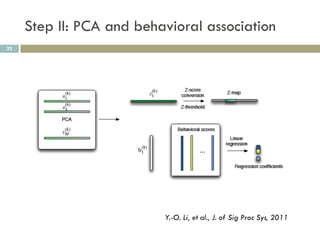
Step II: PCA and behavioral association
25


                          Y.-O. Li, et al., J. of Sig Proc Sys, 2011
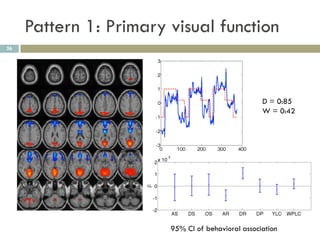
Pattern 1: Primary visual function
26


                                                   D = 0:85
                                                   W = 0:42


                        95% CI of behavioral association
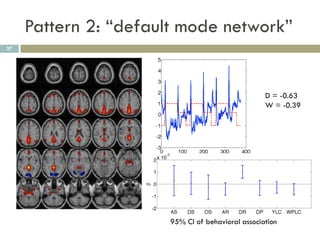
Pattern 2: “default mode network”
27


                                                  D = -0.63
                                                  W = -0.39


                      95% CI of behavioral association
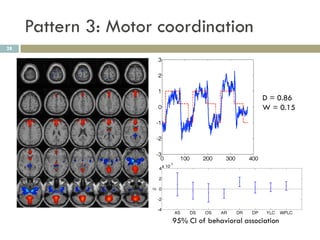
Pattern 3: Motor coordination
28


                                                  D = 0.86
                                                  W = 0.15


                       95% CI of behavioral association
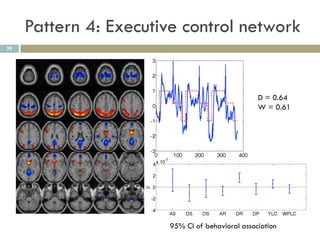
Pattern 4: Executive control network
29


                                                 D = 0.64
                                                 W = 0.61


                       95% CI of behavioral association
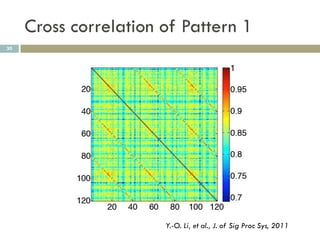
Cross correlation of Pattern 1
30


                       Y.-O. Li, et al., J. of Sig Proc Sys, 2011
Outline
31


      Independent component analysis (ICA) and its
       application to sparse feature extraction from
       multivariate dataset


      Multi-set canonical correlation analysis and its
       application to joint pattern extraction from a group of
       datasets


      Order selection of principal component analysis (PCA)
       and its application to data dimension reduction
Decreased reproducibility of independent
     component on high-dimensional dataset
32

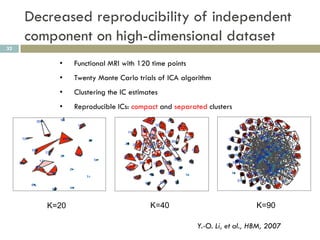
          •    Functional MRI with 120 time points
          •    Twenty Monte Carlo trials of ICA algorithm
          •    Clustering the IC estimates
          •    Reproducible ICs: compact and separated clusters


        K=20                           K=40                             K=90

                                                     Y.-O. Li, et al., HBM, 2007
Dimension reduction of high-dimensional
     data by PCA
33


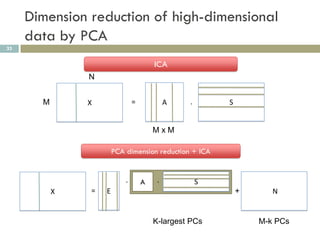
                                       ICA              N
               N


       M       X               =            A   .       S


                                       MxM

                       PCA dimension reduction + ICA


                           .       A    .           S
           X   =   E                                        +      N


                                       K-largest PCs            M-k PCs
Failure of information-theoretic criteria with
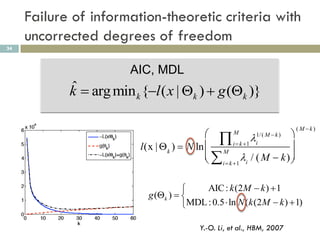
     uncorrected degrees of freedom
34


                        AIC, MDL
            ˆ
            k  arg min k {l ( x | k )  g (k )}

                                                                            ( M k)
                                                                    
                                                i k 1 
                                                     M       1/ ( M  k )

                          l(x |  k )  N ln  M             i
                                                                     
                                             
                                              i k 1 i / ( M  k) 
                                                                     

                                           AIC : k (2M  k )  1
                            g ( k )  
                                       MDL : 0.5  ln N (k (2M  k )  1)

                                           Y.-O. Li, et al., HBM, 2007
Estimation of degrees of freedom by
     entropy rate
35


                 Entropy rate of a Gaussian process
                                        1       
                     h( x)  ln 2 e 
                                       4        ln s()d
                                               


            h( x)  ln 2 e     iff x[n] is an i.i.d. random process


       h(x) = 0.40               h(x) = 1.28                  h(x) = 1.41
                                                     Y.-O. Li, et al., HBM, 2007
Application: Order selection of high-
     dimensional dataset
36
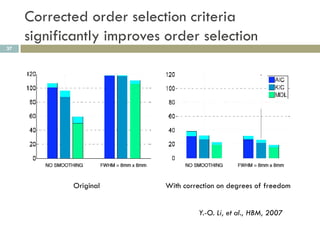
Corrected order selection criteria
     significantly improves order selection
37


            Original       With correction on degrees of freedom


                                    Y.-O. Li, et al., HBM, 2007
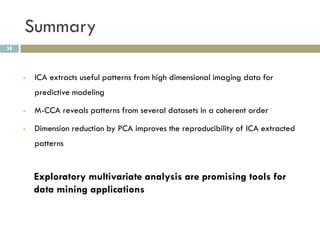
Summary
38


     •   ICA extracts useful patterns from high dimensional imaging data for
         predictive modeling

     •   M-CCA reveals patterns from several datasets in a coherent order

     •   Dimension reduction by PCA improves the reproducibility of ICA extracted
         patterns


         Exploratory multivariate analysis are promising tools for
         data mining applications

Machine learning for medical imaging data

  • 1.
    1 MACHINE LEARNING FOR MEDICALIMAGING DATA Yiou (Leo) Li
  • 2.
    Background 2 Post-doctoral fellow, 07/2009-Present, Neural connectivity Laboratory, University of California San Francisco • Developed unsupervised learning method for feature extraction of brain imaging data • Applied supervised learning (Naïve Bayes, SVM, Random Forest) for predictive modeling of brain trauma • Designed batch data processing protocol to perform image registration, segmentation, band-pass filtering, smoothing, and linear model fitting Graduate Research Assistant, 08/2002-06/2009, Machine learning for signal processing Laboratory, University of Maryland Baltimore County • Developed the effective degrees of freedom of random process and applied it to the model order selection by Information Theoretic Criteria • Developed a linear filtering mechanism in independent component analysis for feature enhancement • Analyzed canonical correlation analysis for multiple datasets
  • 3.
    Outline 3  Independent component analysis (ICA) and its application to sparse feature extraction from multivariate dataset  Multi-set canonical correlation analysis and its application to joint pattern extraction from a group of datasets  Order selection of principal component analysis (PCA) and its application to data dimension reduction
  • 4.
    PCA vs ICA 4 PCA ICA Linear projection Linear projection (Orthogonal) Uncorrelated components Independent components (non sparse) (sparse, “long tail” distribution) Typically analytical solution Typically iterative solution (SVD) (Iterative optimization)
  • 5.
    ICA detects independentfactors with long tails in multivariate dataset 5
  • 6.
    Long tail factorsare sparse features in data samples 6 Weights of features Data points (N) ICA Sensors (M) X = A . S Sparse features X= AS
  • 7.
    ICA model 7  x1   a11 a12 ... a1M   s1  x  a a 22 a 2M   s 2   2    21    ...   ...   ...         x M  a M1 a M2 a MM  s M  x : Observed variables A : Mixing matrix s : Latent factors x= As -> s =A-1x
  • 8.
    ICA by maximumlikelihood estimation 8 Transformation of multivariate random variable: x = As p(s 1, s2 , ... , sM ) p(x 1,x 2 , ... , x M )  (1) det(A) Statistical independence condition of s: p(s 1, s2 , ... , sM )  i 1 p(si ) M (2) Log likelihood function of x with parameter A: log p(x 1,x 2 ,...x M )   log p([A x] i )  log det(A) -1 i
  • 9.
    ICA Application: Sparsefeature extraction from multivariate dataset 9
  • 10.
  • 11.
    Analyze functional MRIdata of resting state brain 11 Sparse features ICA
  • 12.
    Feature 1. Primaryvisual network 12 + A -
  • 13.
    Feature 2. “Defaultmode network” 13
  • 14.
    Feature 3. Attentioncontrol network 14
  • 15.
    Hierarchical clustering showslink 15 between features (brain regions)
  • 16.
    Predicative modeling ofbrain trauma 16 Pattern weights N Healthy X = A . S Patients Sparse spatial features Subject 1 … Subject 2 16 Pattern 2 Feature 1 … Subject M Feature 2 Y.-O. Li, et al., HBM, 2011
  • 17.
    ICA Pattern classificationfor predictive modeling of brain trauma 17 • 29 healthy + 29 trauma, 10-fold cross-validation Classifier 9 patterns 14 patterns Classification error Classification error Naïve Bayes 0.35+/-0.03 0.32+/-0.03 K nearest neighbor 0.29+/-0.02 0.30+/-0.03 Support vector classifier 0.36+/-0.02 0.30 +/-0.02 (c=1, number of SV: 46) (c=1, number of SV: 20)
  • 18.
    Outline 18  Independent component analysis (ICA) and its application to sparse feature extraction from multivariate dataset  Multi-set canonical correlation analysis and its application to joint pattern extraction from a group of datasets  Order selection of principal component analysis (PCA) and its application to dimension reduction
  • 19.
    Joint pattern extractionrequires coherency on extracted patterns across datasets 19 Model: x k =Aksk , k=1,2,...,M Y.-O. Li, et al., J. of Sig Proc Sys, 2011
  • 20.
    Multi-set canonical correlationanalysis 20 Y.-O. Li, et al., J. of Sig Proc Sys, 2011
  • 21.
    Multi-set canonical correlation analysis 21 Correlation matrix of [S1,S2, … SM] Y.-O. Li, et al., J. of Sig Proc Sys, 2011
  • 22.
    Application: joint patternextraction from a group of datasets 22 • Analyze group functional MRI data from simulated driving experiment
  • 23.
    Simulated driving experiment 23 • Forty subjects, three repeated sessions (120 datasets) • Experiment paradigm: • Behavioral records: • Average speed (AS) • Differential of speed (DS) • Average steering offset (AR) • Differential steering offset (DR) • Differential pedal offset (DP) • Occurrence of yellow line crossing (YLC) • Occurrence of white passenger-side line crossing (WPLC) Y.-O. Li, et al., J. of Sig Proc Sys, 2011
  • 24.
    Step I: M-CCAfor joint feature extraction 24 Y.-O. Li, et al., J. of Sig Proc Sys, 2011
  • 25.
    Step II: PCAand behavioral association 25 Y.-O. Li, et al., J. of Sig Proc Sys, 2011
  • 26.
    Pattern 1: Primaryvisual function 26 D = 0:85 W = 0:42 95% CI of behavioral association
  • 27.
    Pattern 2: “defaultmode network” 27 D = -0.63 W = -0.39 95% CI of behavioral association
  • 28.
    Pattern 3: Motorcoordination 28 D = 0.86 W = 0.15 95% CI of behavioral association
  • 29.
    Pattern 4: Executivecontrol network 29 D = 0.64 W = 0.61 95% CI of behavioral association
  • 30.
    Cross correlation ofPattern 1 30 Y.-O. Li, et al., J. of Sig Proc Sys, 2011
  • 31.
    Outline 31  Independent component analysis (ICA) and its application to sparse feature extraction from multivariate dataset  Multi-set canonical correlation analysis and its application to joint pattern extraction from a group of datasets  Order selection of principal component analysis (PCA) and its application to data dimension reduction
  • 32.
    Decreased reproducibility ofindependent component on high-dimensional dataset 32 • Functional MRI with 120 time points • Twenty Monte Carlo trials of ICA algorithm • Clustering the IC estimates • Reproducible ICs: compact and separated clusters K=20 K=40 K=90 Y.-O. Li, et al., HBM, 2007
  • 33.
    Dimension reduction ofhigh-dimensional data by PCA 33 ICA N N M X = A . S MxM PCA dimension reduction + ICA . A . S X = E + N K-largest PCs M-k PCs
  • 34.
    Failure of information-theoreticcriteria with uncorrected degrees of freedom 34 AIC, MDL ˆ k  arg min k {l ( x | k )  g (k )} ( M k)    i k 1  M 1/ ( M  k ) l(x |  k )  N ln  M i    i k 1 i / ( M  k)    AIC : k (2M  k )  1 g ( k )   MDL : 0.5  ln N (k (2M  k )  1) Y.-O. Li, et al., HBM, 2007
  • 35.
    Estimation of degreesof freedom by entropy rate 35 Entropy rate of a Gaussian process 1  h( x)  ln 2 e  4   ln s()d  h( x)  ln 2 e iff x[n] is an i.i.d. random process h(x) = 0.40 h(x) = 1.28 h(x) = 1.41 Y.-O. Li, et al., HBM, 2007
  • 36.
    Application: Order selectionof high- dimensional dataset 36
  • 37.
    Corrected order selectioncriteria significantly improves order selection 37 Original With correction on degrees of freedom Y.-O. Li, et al., HBM, 2007
  • 38.
    Summary 38 • ICA extracts useful patterns from high dimensional imaging data for predictive modeling • M-CCA reveals patterns from several datasets in a coherent order • Dimension reduction by PCA improves the reproducibility of ICA extracted patterns Exploratory multivariate analysis are promising tools for data mining applications