Decision Tree Learning
Dr. Radhey Shyam
Dept. Of CSE, BIET Lucknow
Email ID: shyam0058@gmail.com
Introduction To Machine Learning, Tom Mitchell,
Published by
Mc Graw-Hill International Editions, 199720/10/20
Inductive inference with decision trees
 Decision Trees is one of the most
widely used and practical methods of
inductive inference
 Features
 Method for approximating discrete-
valued functions (including Boolean)
 Learned functions are represented as
decision trees (or if-then-else rules)
 Expressive hypotheses space, including
dis junction
 Robust to noisy data
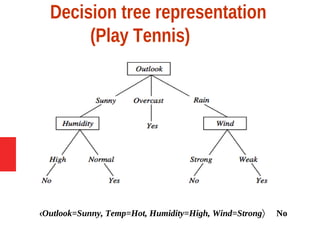
Decision tree representation
(Play Tennis)
Outlook=Sunny, Temp=Hot, Humidity=High, Wind=Strong No
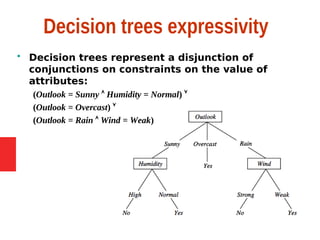
Decision trees expressivity
 Decision trees represent a disjunction of
conjunctions on constraints on the value of
attributes:
(Outlook = Sunny  Humidity = Normal) 
(Outlook = Overcast) 
(Outlook = Rain  Wind = Weak)
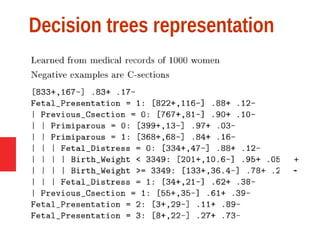
Decision trees representation
+

When to use Decision Trees
 Problem characteristics:
 Instances can be described by attribute value
pairs
 Target function is discrete valued
 Disjunctive hypothesis may be required
 Possibly noisy training data samples
 Robust to errors in training data
 Missing attribute values
 Different classification problems:
 Equipment or medical diagnosis
 Credit risk analysis
 Several tasks in natural language processing
Top-down induction of DT
 ID3 (Quinlan, 1986) is a basic algorithm for
learning DT's
 Given a training set of examples, the algorithms
for building DT performs search in the space of
decision trees
 The construction of the tree is top-down. The
algorithm is greedy.
 The fundamental question is “which attribute
should be tested next? Which question gives us
more information?”
 Select the best attribute
 A descendent node is then created for each
possible value of this attribute and examples
are partitioned according to this value
 The process is repeated for each successor node
until all the examples are classified correctly or
there are no attributes left
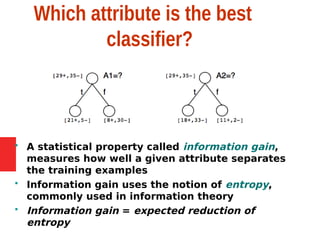
Which attribute is the best
classifier?
 A statistical property called information gain,
measures how well a given attribute separates
the training examples
 Information gain uses the notion of entropy,
commonly used in information theory
 Information gain = expected reduction of
entropy
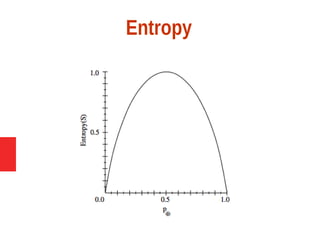
Entropy in binary classification
 Entropy measures the impurity of a collection of
examples. It depends from the distribution of the
random variable p.
 S is a collection of training examples
 p+ the proportion of positive examples in S
 p– the proportion of negative examples in S
Entropy (S)  – p+ log2 p+ – p–log2 p– [0 log20 = 0]
Entropy ([14+, 0–]) = –14/14 log2 (14/14) – 0log2 (0) = 0
Entropy ([9+, 5–]) = – 9/14 log2 (9/14) – 5/14 log2 (5/14) = 0.94
Entropy ([7+, 7– ]) = – 7/14 log2 (7/14) – 7/14log2 (7/14) =
= 1/2 + 1/2 = 1 [log21/2 = – 1]
Note: the log of a number < 1 is negative, 0  p  1, 0 
entropy  1
Entropy
Entropy in general
 Entropy measures the amount of information in
a random variable
H(X) = – p+ log2 p+ – p– log2 p– X = {+, –}
for binary classification [two-valued random
variable]
c c
H(X) = –  pi log2 pi =  pi log2 1/ pi X = {i, …, c}
i=1 i=1
for classification in c classes
Example: rolling a die with 8, equally probable,
sides
8
H(X) = –  1/8 log2 1/8 = – log2 1/8 = log2 8 = 3
i=1
Entropy and information theory
 Entropy specifies the number the average length
(in bits) of the message needed to transmit the
outcome of a random variable. This depends on
the probability distribution.
 Optimal length code assigns  log2 p bits to
messages with probability p. Most probable
messages get shorter codes.
 Example: 8-sided [unbalanced] die
1 2 3 4 5 6 7 8
4/16 4/16 2/16 2/16 1/16 1/16 1/16 1/16
2 bits 2 bits 3 bits 3 bits 4bits 4bits 4bits 4bits
E = (1/4 log2 4)  2 + (1/8 log2 8)  2 + (1/16 log2 16)  4 = 1+3/4+1 =
2.75
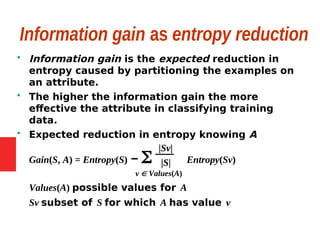
Information gain as entropy reduction
 Information gain is the expected reduction in
entropy caused by partitioning the examples on
an attribute.
 The higher the information gain the more
effective the attribute in classifying training
data.
 Expected reduction in entropy knowing A
Gain(S, A) = Entropy(S) −  Entropy(Sv)
v  Values(A)
Values(A) possible values for A
Sv subset of S for which A has value v
|Sv|
|S|
Example: expected information
gain
 Let
 Values(Wind) = {Weak, Strong}
 S = [9+, 5−]
 SWeak = [6+, 2−]
 SStrong = [3+, 3−]
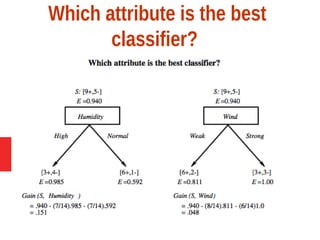
 Information gain due to knowing Wind:
Gain(S, Wind) = Entropy(S) − 8/14 Entropy(SWeak) − 6/14 Entropy(SStrong)
= 0.94 − 8/14  0.811 − 6/14  1.00
= 0.048
Which attribute is the best
classifier?
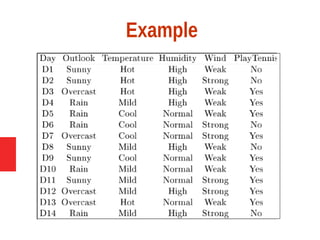
Example
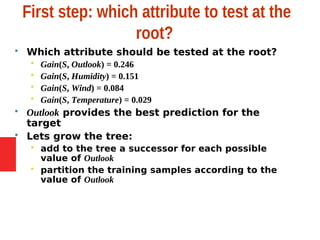
First step: which attribute to test at the
root?
 Which attribute should be tested at the root?
 Gain(S, Outlook) = 0.246
 Gain(S, Humidity) = 0.151
 Gain(S, Wind) = 0.084
 Gain(S, Temperature) = 0.029
 Outlook provides the best prediction for the
target
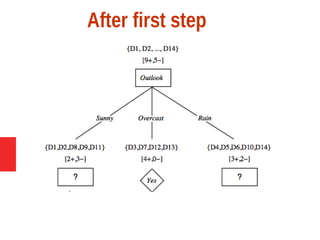
 Lets grow the tree:
 add to the tree a successor for each possible
value of Outlook
 partition the training samples according to the
value of Outlook
After first step
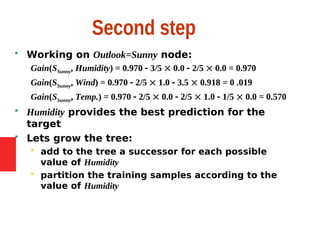
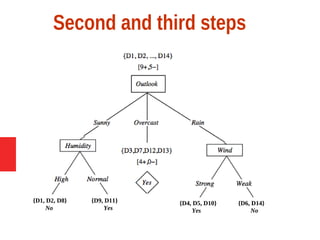
Second step
 Working on Outlook=Sunny node:
Gain(SSunny, Humidity) = 0.970  3/5  0.0  2/5  0.0 = 0.970
Gain(SSunny, Wind) = 0.970  2/5  1.0  3.5  0.918 = 0 .019
Gain(SSunny, Temp.) = 0.970  2/5  0.0  2/5  1.0  1/5  0.0 = 0.570
 Humidity provides the best prediction for the
target
 Lets grow the tree:
 add to the tree a successor for each possible
value of Humidity
 partition the training samples according to the
value of Humidity
Second and third steps
{D1, D2, D8}
No
{D9, D11}
Yes
{D4, D5, D10}
Yes
{D6, D14}
No
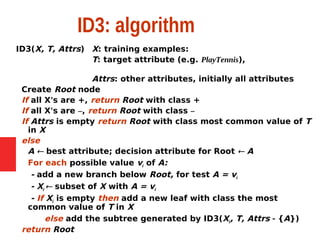
ID3: algorithm
ID3(X, T, Attrs) X: training examples:
T: target attribute (e.g. PlayTennis),
Attrs: other attributes, initially all attributes
Create Root node
If all X's are +, return Root with class +
If all X's are –, return Root with class –
If Attrs is empty return Root with class most common value of T
in X
else
A  best attribute; decision attribute for Root  A
For each possible value vi of A:
- add a new branch below Root, for test A = vi
- Xi  subset of X with A = vi
- If Xi is empty then add a new leaf with class the most
common value of T in X
else add the subtree generated by ID3(Xi, T, Attrs  {A})
return Root
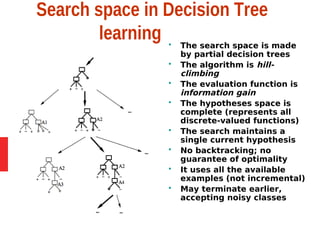
Search space in Decision Tree
learning  The search space is made
by partial decision trees
 The algorithm is hill-
climbing
 The evaluation function is
information gain
 The hypotheses space is
complete (represents all
discrete-valued functions)
 The search maintains a
single current hypothesis
 No backtracking; no
guarantee of optimality
 It uses all the available
examples (not incremental)
 May terminate earlier,
accepting noisy classes
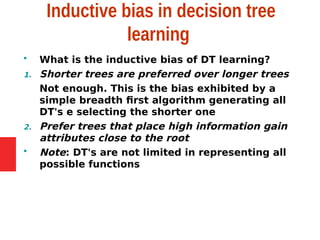
Inductive bias in decision tree
learning
 What is the inductive bias of DT learning?
1. Shorter trees are preferred over longer trees
Not enough. This is the bias exhibited by a
simple breadth first algorithm generating all
DT's e selecting the shorter one
2. Prefer trees that place high information gain
attributes close to the root
 Note: DT's are not limited in representing all
possible functions
Two kinds of biases
 Preference or search biases (due to the search
strategy)
 ID3 searches a complete hypotheses space; the
search strategy is incomplete
 Restriction or language biases (due to the set
of hypotheses expressible or considered)
 Candidate-Elimination searches an incomplete
hypotheses space; the search strategy is
complete
 A combination of biases in learning a linear
combination of weighted features in board
games.
Prefer shorter hypotheses: Occam's rasor
 Why prefer shorter hypotheses?
 Arguments in favor:
 There are fewer short hypotheses than long ones
 If a short hypothesis fits data unlikely to be a
coincidence
 Elegance and aesthetics
 Arguments against:
 Not every short hypothesis is a reasonable one.
 Occam's razor:"The simplest explanation is
usually the best one."
 a principle usually (though incorrectly)
attributed14th-century English logician and
Franciscan friar, William of Ockham.
 lex parsimoniae ("law of parsimony", "law of
economy", or "law of succinctness")
 The term razor refers to the act of shaving away
unnecessary assumptions to get to the simplest
explanation.
Issues in decision trees learning
 Over-fitting
 Reduced error pruning
 Rule post-pruning
 Extensions
 Continuous valued attributes
 Alternative measures for selecting attributes
 Handling training examples with missing attribute
values
 Handling attributes with different costs
 Improving computational efficiency
 Most of these improvements in C4.5 (Quinlan,
1993)
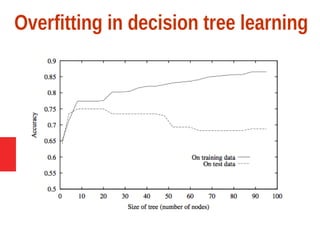
Overfitting: definition
 Building trees that “adapt too much” to the
training examples may lead to “overfitting”.
 Consider error of hypothesis h over
 training data: errorD(h) empirical error
 entire distribution X of data: errorX(h) expected
error
 Hypothesis h overfits training data if there is an
alternative hypothesis h'  H such that
errorD(h) < errorD(h’) and
errorX(h’) < errorX(h)
i.e. h’ behaves better over unseen data
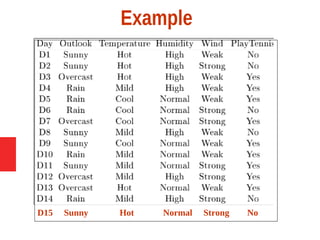
Example
D15 Sunny Hot Normal Strong No
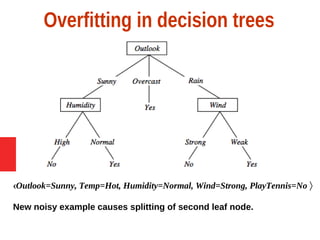
Overfitting in decision trees
Outlook=Sunny, Temp=Hot, Humidity=Normal, Wind=Strong, PlayTennis=No 
New noisy example causes splitting of second leaf node.
Overfitting in decision tree learning
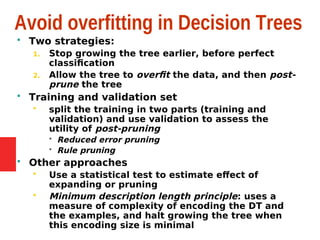
Avoid overfitting in Decision Trees
 Two strategies:
1. Stop growing the tree earlier, before perfect
classification
2. Allow the tree to overfit the data, and then post-
prune the tree
 Training and validation set
 split the training in two parts (training and
validation) and use validation to assess the
utility of post-pruning
 Reduced error pruning
 Rule pruning
 Other approaches
 Use a statistical test to estimate effect of
expanding or pruning
 Minimum description length principle: uses a
measure of complexity of encoding the DT and
the examples, and halt growing the tree when
this encoding size is minimal
Reduced-error pruning (Quinlan 1987)
 Each node is a candidate for pruning
 Pruning consists in removing a subtree rooted
in a node: the node becomes a leaf and is
assigned the most common classification
 Nodes are removed only if the resulting tree
performs no worse on the validation set.
 Nodes are pruned iteratively: at each iteration
the node whose removal most increases
accuracy on the validation set is pruned.
 Pruning stops when no pruning increases
accuracy
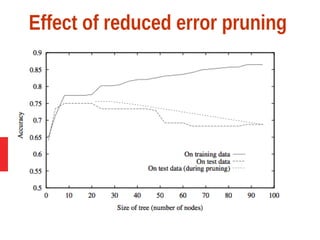
Effect of reduced error pruning
Rule post-pruning
1. Create the decision tree from the training set
2. Convert the tree into an equivalent set of rules
 Each path corresponds to a rule
 Each node along a path corresponds to a pre-
condition
 Each leaf classification to the post-condition
3. Prune (generalize) each rule by removing those
preconditions whose removal improves
accuracy …
 … over validation set
 … over training with a pessimistic, statistically
inspired, measure
4. Sort the rules in estimated order of accuracy,
and consider them in sequence when
classifying new instances
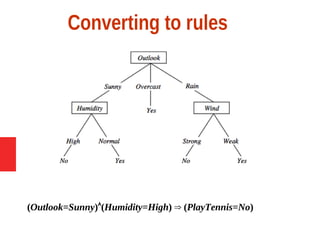
Converting to rules
(Outlook=Sunny)(Humidity=High) (⇒ PlayTennis=No)
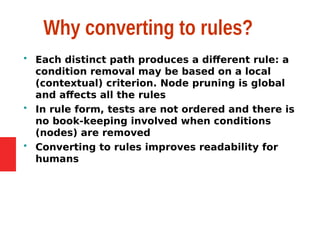
Why converting to rules?
 Each distinct path produces a different rule: a
condition removal may be based on a local
(contextual) criterion. Node pruning is global
and affects all the rules
 In rule form, tests are not ordered and there is
no book-keeping involved when conditions
(nodes) are removed
 Converting to rules improves readability for
humans
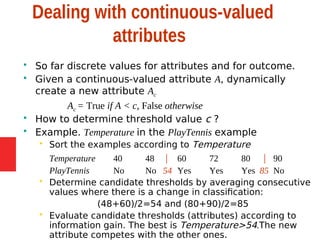
Dealing with continuous-valued
attributes
 So far discrete values for attributes and for outcome.
 Given a continuous-valued attribute A, dynamically
create a new attribute Ac
Ac = True if A < c, False otherwise
 How to determine threshold value c ?
 Example. Temperature in the PlayTennis example
 Sort the examples according to Temperature
Temperature 40 48 | 60 72 80 | 90
PlayTennis No No 54 Yes Yes Yes 85 No
 Determine candidate thresholds by averaging consecutive
values where there is a change in classification:
(48+60)/2=54 and (80+90)/2=85
 Evaluate candidate thresholds (attributes) according to
information gain. The best is Temperature>54.The new
attribute competes with the other ones.
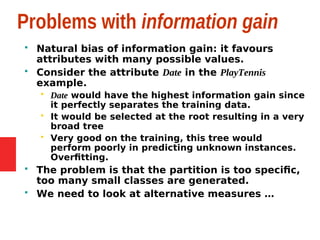
Problems with information gain
 Natural bias of information gain: it favours
attributes with many possible values.
 Consider the attribute Date in the PlayTennis
example.
 Date would have the highest information gain since
it perfectly separates the training data.
 It would be selected at the root resulting in a very
broad tree
 Very good on the training, this tree would
perform poorly in predicting unknown instances.
Overfitting.
 The problem is that the partition is too specific,
too many small classes are generated.
 We need to look at alternative measures …
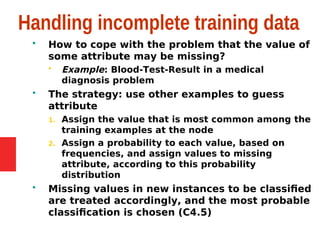
Handling incomplete training data
 How to cope with the problem that the value of
some attribute may be missing?
 Example: Blood-Test-Result in a medical
diagnosis problem
 The strategy: use other examples to guess
attribute
1. Assign the value that is most common among the
training examples at the node
2. Assign a probability to each value, based on
frequencies, and assign values to missing
attribute, according to this probability
distribution
 Missing values in new instances to be classified
are treated accordingly, and the most probable
classification is chosen (C4.5)
References
 Introduction to Machine Learning, Tom Mitchell,
Mc Graw-Hill International Editions, 1997.

Decision tree learning

  • 1.
    Decision Tree Learning Dr.Radhey Shyam Dept. Of CSE, BIET Lucknow Email ID: shyam0058@gmail.com Introduction To Machine Learning, Tom Mitchell, Published by Mc Graw-Hill International Editions, 199720/10/20
  • 2.
    Inductive inference withdecision trees  Decision Trees is one of the most widely used and practical methods of inductive inference  Features  Method for approximating discrete- valued functions (including Boolean)  Learned functions are represented as decision trees (or if-then-else rules)  Expressive hypotheses space, including dis junction  Robust to noisy data
  • 3.
    Decision tree representation (PlayTennis) Outlook=Sunny, Temp=Hot, Humidity=High, Wind=Strong No
  • 4.
    Decision trees expressivity Decision trees represent a disjunction of conjunctions on constraints on the value of attributes: (Outlook = Sunny  Humidity = Normal)  (Outlook = Overcast)  (Outlook = Rain  Wind = Weak)
  • 5.
  • 6.
    When to useDecision Trees  Problem characteristics:  Instances can be described by attribute value pairs  Target function is discrete valued  Disjunctive hypothesis may be required  Possibly noisy training data samples  Robust to errors in training data  Missing attribute values  Different classification problems:  Equipment or medical diagnosis  Credit risk analysis  Several tasks in natural language processing
  • 7.
    Top-down induction ofDT  ID3 (Quinlan, 1986) is a basic algorithm for learning DT's  Given a training set of examples, the algorithms for building DT performs search in the space of decision trees  The construction of the tree is top-down. The algorithm is greedy.  The fundamental question is “which attribute should be tested next? Which question gives us more information?”  Select the best attribute  A descendent node is then created for each possible value of this attribute and examples are partitioned according to this value  The process is repeated for each successor node until all the examples are classified correctly or there are no attributes left
  • 8.
    Which attribute isthe best classifier?  A statistical property called information gain, measures how well a given attribute separates the training examples  Information gain uses the notion of entropy, commonly used in information theory  Information gain = expected reduction of entropy
  • 9.
    Entropy in binaryclassification  Entropy measures the impurity of a collection of examples. It depends from the distribution of the random variable p.  S is a collection of training examples  p+ the proportion of positive examples in S  p– the proportion of negative examples in S Entropy (S)  – p+ log2 p+ – p–log2 p– [0 log20 = 0] Entropy ([14+, 0–]) = –14/14 log2 (14/14) – 0log2 (0) = 0 Entropy ([9+, 5–]) = – 9/14 log2 (9/14) – 5/14 log2 (5/14) = 0.94 Entropy ([7+, 7– ]) = – 7/14 log2 (7/14) – 7/14log2 (7/14) = = 1/2 + 1/2 = 1 [log21/2 = – 1] Note: the log of a number < 1 is negative, 0  p  1, 0  entropy  1
  • 10.
  • 11.
    Entropy in general Entropy measures the amount of information in a random variable H(X) = – p+ log2 p+ – p– log2 p– X = {+, –} for binary classification [two-valued random variable] c c H(X) = –  pi log2 pi =  pi log2 1/ pi X = {i, …, c} i=1 i=1 for classification in c classes Example: rolling a die with 8, equally probable, sides 8 H(X) = –  1/8 log2 1/8 = – log2 1/8 = log2 8 = 3 i=1
  • 12.
    Entropy and informationtheory  Entropy specifies the number the average length (in bits) of the message needed to transmit the outcome of a random variable. This depends on the probability distribution.  Optimal length code assigns  log2 p bits to messages with probability p. Most probable messages get shorter codes.  Example: 8-sided [unbalanced] die 1 2 3 4 5 6 7 8 4/16 4/16 2/16 2/16 1/16 1/16 1/16 1/16 2 bits 2 bits 3 bits 3 bits 4bits 4bits 4bits 4bits E = (1/4 log2 4)  2 + (1/8 log2 8)  2 + (1/16 log2 16)  4 = 1+3/4+1 = 2.75
  • 13.
    Information gain asentropy reduction  Information gain is the expected reduction in entropy caused by partitioning the examples on an attribute.  The higher the information gain the more effective the attribute in classifying training data.  Expected reduction in entropy knowing A Gain(S, A) = Entropy(S) −  Entropy(Sv) v  Values(A) Values(A) possible values for A Sv subset of S for which A has value v |Sv| |S|
  • 14.
    Example: expected information gain Let  Values(Wind) = {Weak, Strong}  S = [9+, 5−]  SWeak = [6+, 2−]  SStrong = [3+, 3−]  Information gain due to knowing Wind: Gain(S, Wind) = Entropy(S) − 8/14 Entropy(SWeak) − 6/14 Entropy(SStrong) = 0.94 − 8/14  0.811 − 6/14  1.00 = 0.048
  • 15.
    Which attribute isthe best classifier?
  • 16.
  • 17.
    First step: whichattribute to test at the root?  Which attribute should be tested at the root?  Gain(S, Outlook) = 0.246  Gain(S, Humidity) = 0.151  Gain(S, Wind) = 0.084  Gain(S, Temperature) = 0.029  Outlook provides the best prediction for the target  Lets grow the tree:  add to the tree a successor for each possible value of Outlook  partition the training samples according to the value of Outlook
  • 18.
  • 19.
    Second step  Workingon Outlook=Sunny node: Gain(SSunny, Humidity) = 0.970  3/5  0.0  2/5  0.0 = 0.970 Gain(SSunny, Wind) = 0.970  2/5  1.0  3.5  0.918 = 0 .019 Gain(SSunny, Temp.) = 0.970  2/5  0.0  2/5  1.0  1/5  0.0 = 0.570  Humidity provides the best prediction for the target  Lets grow the tree:  add to the tree a successor for each possible value of Humidity  partition the training samples according to the value of Humidity
  • 20.
    Second and thirdsteps {D1, D2, D8} No {D9, D11} Yes {D4, D5, D10} Yes {D6, D14} No
  • 21.
    ID3: algorithm ID3(X, T,Attrs) X: training examples: T: target attribute (e.g. PlayTennis), Attrs: other attributes, initially all attributes Create Root node If all X's are +, return Root with class + If all X's are –, return Root with class – If Attrs is empty return Root with class most common value of T in X else A  best attribute; decision attribute for Root  A For each possible value vi of A: - add a new branch below Root, for test A = vi - Xi  subset of X with A = vi - If Xi is empty then add a new leaf with class the most common value of T in X else add the subtree generated by ID3(Xi, T, Attrs  {A}) return Root
  • 22.
    Search space inDecision Tree learning  The search space is made by partial decision trees  The algorithm is hill- climbing  The evaluation function is information gain  The hypotheses space is complete (represents all discrete-valued functions)  The search maintains a single current hypothesis  No backtracking; no guarantee of optimality  It uses all the available examples (not incremental)  May terminate earlier, accepting noisy classes
  • 23.
    Inductive bias indecision tree learning  What is the inductive bias of DT learning? 1. Shorter trees are preferred over longer trees Not enough. This is the bias exhibited by a simple breadth first algorithm generating all DT's e selecting the shorter one 2. Prefer trees that place high information gain attributes close to the root  Note: DT's are not limited in representing all possible functions
  • 24.
    Two kinds ofbiases  Preference or search biases (due to the search strategy)  ID3 searches a complete hypotheses space; the search strategy is incomplete  Restriction or language biases (due to the set of hypotheses expressible or considered)  Candidate-Elimination searches an incomplete hypotheses space; the search strategy is complete  A combination of biases in learning a linear combination of weighted features in board games.
  • 25.
    Prefer shorter hypotheses:Occam's rasor  Why prefer shorter hypotheses?  Arguments in favor:  There are fewer short hypotheses than long ones  If a short hypothesis fits data unlikely to be a coincidence  Elegance and aesthetics  Arguments against:  Not every short hypothesis is a reasonable one.  Occam's razor:"The simplest explanation is usually the best one."  a principle usually (though incorrectly) attributed14th-century English logician and Franciscan friar, William of Ockham.  lex parsimoniae ("law of parsimony", "law of economy", or "law of succinctness")  The term razor refers to the act of shaving away unnecessary assumptions to get to the simplest explanation.
  • 26.
    Issues in decisiontrees learning  Over-fitting  Reduced error pruning  Rule post-pruning  Extensions  Continuous valued attributes  Alternative measures for selecting attributes  Handling training examples with missing attribute values  Handling attributes with different costs  Improving computational efficiency  Most of these improvements in C4.5 (Quinlan, 1993)
  • 27.
    Overfitting: definition  Buildingtrees that “adapt too much” to the training examples may lead to “overfitting”.  Consider error of hypothesis h over  training data: errorD(h) empirical error  entire distribution X of data: errorX(h) expected error  Hypothesis h overfits training data if there is an alternative hypothesis h'  H such that errorD(h) < errorD(h’) and errorX(h’) < errorX(h) i.e. h’ behaves better over unseen data
  • 28.
    Example D15 Sunny HotNormal Strong No
  • 29.
    Overfitting in decisiontrees Outlook=Sunny, Temp=Hot, Humidity=Normal, Wind=Strong, PlayTennis=No  New noisy example causes splitting of second leaf node.
  • 30.
  • 31.
    Avoid overfitting inDecision Trees  Two strategies: 1. Stop growing the tree earlier, before perfect classification 2. Allow the tree to overfit the data, and then post- prune the tree  Training and validation set  split the training in two parts (training and validation) and use validation to assess the utility of post-pruning  Reduced error pruning  Rule pruning  Other approaches  Use a statistical test to estimate effect of expanding or pruning  Minimum description length principle: uses a measure of complexity of encoding the DT and the examples, and halt growing the tree when this encoding size is minimal
  • 32.
    Reduced-error pruning (Quinlan1987)  Each node is a candidate for pruning  Pruning consists in removing a subtree rooted in a node: the node becomes a leaf and is assigned the most common classification  Nodes are removed only if the resulting tree performs no worse on the validation set.  Nodes are pruned iteratively: at each iteration the node whose removal most increases accuracy on the validation set is pruned.  Pruning stops when no pruning increases accuracy
  • 33.
    Effect of reducederror pruning
  • 34.
    Rule post-pruning 1. Createthe decision tree from the training set 2. Convert the tree into an equivalent set of rules  Each path corresponds to a rule  Each node along a path corresponds to a pre- condition  Each leaf classification to the post-condition 3. Prune (generalize) each rule by removing those preconditions whose removal improves accuracy …  … over validation set  … over training with a pessimistic, statistically inspired, measure 4. Sort the rules in estimated order of accuracy, and consider them in sequence when classifying new instances
  • 35.
  • 36.
    Why converting torules?  Each distinct path produces a different rule: a condition removal may be based on a local (contextual) criterion. Node pruning is global and affects all the rules  In rule form, tests are not ordered and there is no book-keeping involved when conditions (nodes) are removed  Converting to rules improves readability for humans
  • 37.
    Dealing with continuous-valued attributes So far discrete values for attributes and for outcome.  Given a continuous-valued attribute A, dynamically create a new attribute Ac Ac = True if A < c, False otherwise  How to determine threshold value c ?  Example. Temperature in the PlayTennis example  Sort the examples according to Temperature Temperature 40 48 | 60 72 80 | 90 PlayTennis No No 54 Yes Yes Yes 85 No  Determine candidate thresholds by averaging consecutive values where there is a change in classification: (48+60)/2=54 and (80+90)/2=85  Evaluate candidate thresholds (attributes) according to information gain. The best is Temperature>54.The new attribute competes with the other ones.
  • 38.
    Problems with informationgain  Natural bias of information gain: it favours attributes with many possible values.  Consider the attribute Date in the PlayTennis example.  Date would have the highest information gain since it perfectly separates the training data.  It would be selected at the root resulting in a very broad tree  Very good on the training, this tree would perform poorly in predicting unknown instances. Overfitting.  The problem is that the partition is too specific, too many small classes are generated.  We need to look at alternative measures …
  • 39.
    Handling incomplete trainingdata  How to cope with the problem that the value of some attribute may be missing?  Example: Blood-Test-Result in a medical diagnosis problem  The strategy: use other examples to guess attribute 1. Assign the value that is most common among the training examples at the node 2. Assign a probability to each value, based on frequencies, and assign values to missing attribute, according to this probability distribution  Missing values in new instances to be classified are treated accordingly, and the most probable classification is chosen (C4.5)
  • 40.
    References  Introduction toMachine Learning, Tom Mitchell, Mc Graw-Hill International Editions, 1997.