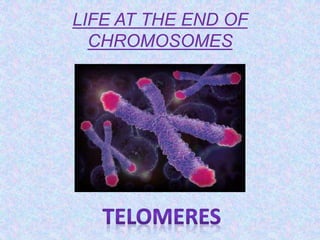
LIFE AT THE END OF
CHROMOSOMES
CONTENTS
• Introduction of telomere
• Structure
• Telomere as a multi protein complex
• Functions
• Telomere and aging
• Link between telomere and telomerase
• Telomere biology and cancer
INTRODUCTION
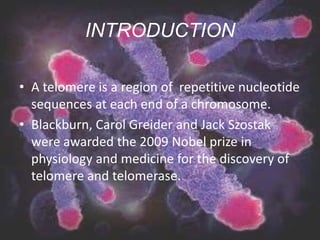
• A telomere is a region of repetitive nucleotide
sequences at each end of a chromosome.
• Blackburn, Carol Greider and Jack Szostak
were awarded the 2009 Nobel prize in
physiology and medicine for the discovery of
telomere and telomerase.
INTRODUCTION
• Unique structures at the end of chromosomes are
necessary for chromosomal integrity and overall
genomic stability called as telomeres which
protect our genetic data, make it possible for cells
to divide, and hold some secrets to how we grow
old and get cancer.
• An entire chromosome has about 150 million base
pairs. Each time a cell divides, an average person
loses 30 to 200 base pairs from the ends of that
cell's telomeres
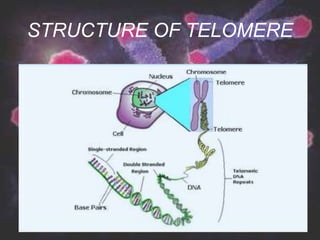
STRUCTURE OF TELOMERE
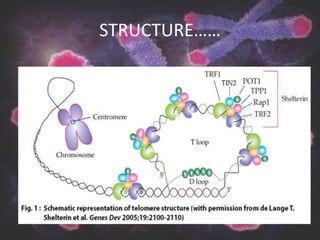
STRUCTURE…..
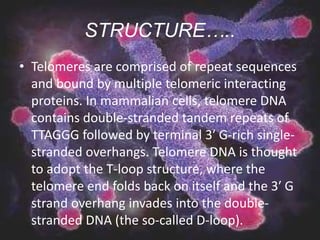
• Telomeres are comprised of repeat sequences
and bound by multiple telomeric interacting
proteins. In mammalian cells, telomere DNA
contains double-stranded tandem repeats of
TTAGGG followed by terminal 3′ G-rich single-
stranded overhangs. Telomere DNA is thought
to adopt the T-loop structure, where the
telomere end folds back on itself and the 3′ G
strand overhang invades into the double-
stranded DNA (the so-called D-loop).
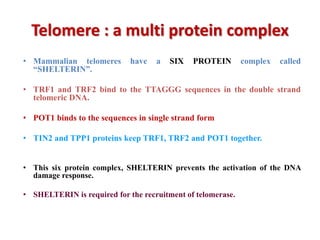
Telomere : a multi protein complex
• Mammalian telomeres have a SIX PROTEIN complex called
“SHELTERIN”.
• TRF1 and TRF2 bind to the TTAGGG sequences in the double strand
telomeric DNA.
• POT1 binds to the sequences in single strand form
• TIN2 and TPP1 proteins keep TRF1, TRF2 and POT1 together.
• This six protein complex, SHELTERIN prevents the activation of the DNA
damage response.
• SHELTERIN is required for the recruitment of telomerase.
STRUCTURE……
FUNCTIONS
• They protect the chromosomes.
• They separate one chromosome from another
in the DNA sequence.
• Without telomeres, the ends of the
chromosomes would be "repaired", leading to
chromosome fusion and massive genomic
instability.
FUNCTION CONT….
• Telomeres are also thought to be the "clock"
that regulates how many times an individual
cell can divide. Telemetric sequences shorten
each time the DNA replicates.
FUNCTIONS CONT…
Telomere function
Replication Capping
(RED)
A) The telomeres are seen as the
bright red signals on the
chromosome ends.
B) Fusions between the
chromosomes are indicated by
the arrows, no telometric DNA is
observed at these points.
Telomeres and aging
• It has been proposed that telomere shortening
may be a molecular clock mechanism that counts
the number of times a cell has divided and when
telomeres are short, cellular senescence (growth
arrest) occurs.
• It is believed that shortened telomeres in mitotic
(dividing) cells may be responsible for some of
the changes we associate with normal aging.
Cells normally can divide only about 50 to 70
times, with telomeres getting progressively
shorter until the cells become senescent, die or
sustain genetic damage that can cause cancer.
Example:
In human blood cells, the length of telomeres
ranges from 8,000 base pairs at birth to 3,000
base pairs as people age and as low as 1,500 in
elderly people.
Telomeres do not shorten with age in tissues
such as heart muscle in which cells do not
continually divide.
People who are older have
chromosomes that have replicated
more times.
0
2000
4000
6000
8000
10000
12000
14000
16000
No. of nucleotides
No. of cell
divisions
Number of cell division Vs Number of
nucleotides lost in normal cell :
Why do telomeres get shorter each
time a cell divides?
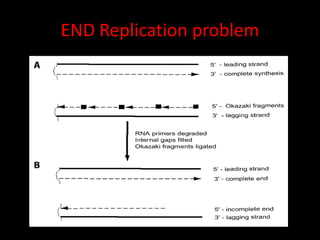
• While replicating DNA, the eukaryotic DNA
replicating enzymes, cannot replicate the
sequences present at the end of chromosomes.
Hence these sequences and the information
they carry may get lost.
• They cap the end sequences and themselves
get lost in the process of DNA replication.
• In 1972, James Watson called this as End-
replication problem.
Since the DNA structure can be rebuilt on both
parent strands, two identical DNA helices are
produced, each containing one original parent
strand and one newly synthesized strand, called a
complementary strand.
Due to the nature of the mechanism via which
DNA is replicated, one strand of the DNA is left
with an incompletely replicated end. Without
specialized means of maintaining chromosomes,
this causes chromosome ends to shrink with each
successive cell division.
END Replication problem
WHAT NEXT?
• Dr. Jerry Shay and his colleagues (The
University of Texas Southwestern Medical
Center at Dallas ) found that cellular
aging can be bypassed or put on hold by
the introduction of the catalytic
component of telomerase.
TELOMERASE
• Telomerase (TEE-LÓM-ER-ACE) is a
ribonucleoprotein enzyme complex (a cellular
reverse transcriptase) that has been referred
to as a cellular immortalizing enzyme.
• It stabilizes telomere length by adding
hexametric (TTAGGG) repeats onto the
telomeric ends of the chromosomes, thus
compensating for the erosion of telomeres
that occurs in its absence
HOW DOES TELOMERASE WORKS?
• Telomerase works by adding back telomeric
DNA to the ends of chromosomes, thus
compensating for the loss of telomeres that
normally occurs as cells divide.
• Most normal cells do not have this enzyme
and thus they lose telomeres with each
division.
HOW DOES TELOMERASE WORKS?
• In humans, telomerase is active in germ cells,
in vitro immortalized cells, the vast majority of
cancer cells and, possibly, in some stem cells.
• High telomerase activity exists in germ cells,
stem cells, epidermal skin cells, follicular hair
cells, and cancer cells.
HOW DOES TELOMERASE WORKS?
• Some cells are immortal because their
telomerase is switched on
• Examples of immortal cells: blood cells
and cancer cells
• Cancer cells do not age because they
produce telomerase, which keeps the
telomere intact.
Telomere and CANCER
• Telomeres were first discovered in cancer cells
because, cancer cells are saturated with an
enzyme called telomerase.
• Telomerase is the key enzyme for human cells to
accquire immortality.
• As a cell begins to cancerous, it divides more
often and its telomere becomes very short. If its
telomeres get too short, the cell may die, whereas
normal cell is devoid of telomerase activity.
Telomere and CANCER
• It can escape this fate by becoming cancerous cell by
activating telomerase (or) ALT pathway is activated,
resulting in abnormal
telomere lengthening & proliferative growth
• Telomerase is over expressed in many cancers cells.
• When cells lose the function of P53 pathway, they can
no longer arrest cells in G1 an important point in cell
cycle for repairing DNA damage response. Cells
without P53 are able to divide with deprotected
telomeres, which cause genomic instability a common
feature of malignant cells.
CONCLUSION…
• Measuring telomerase may be a new way to
detect cancer.
• If scientists can learn how to stop telomerase, they
might be able to fight with cancer by making
cancer cells age and die.
• Some of the drugs are showed positive results by
inhibiting telomerase and associated proteins and
finding the way to shortening of telomere which
results in cell death/apoptosis.
• Most of anti-telomerase drugs are still in Clinical
phases I and II.
REFRENCES (1 OF 2)
• Role of telomere and telomerase — Elizabeth
Blackburn.
• Telomeres—structure, function, and regulation—
Weisi Lua, YiZhangb, DanLiub,
ZhouSongyanga,b,c,n, MaWanb,
• Telomeres and telomerase as targets for
anticancer drug development—Ken André
Olaussen a, Karine Dubrana a, Julien Domonta,
Jean-Philippe Spano b,
REFRENCES (2 OF 2)
• Geron Symposium No. 3 “Telomerase and
Telomere Dynamics in Cancer and Aging”
(www.geron.com/)
• “Mouse model demonstrates role of
telomeres and telomerase in aging, cancer
and lifespan” (http://www.arclab.org/ March
4, 1999 )
ANY QUESTION?
Telomere

Telomere

  • 1.
    LIFE AT THEEND OF CHROMOSOMES
  • 2.
    CONTENTS • Introduction oftelomere • Structure • Telomere as a multi protein complex • Functions • Telomere and aging • Link between telomere and telomerase • Telomere biology and cancer
  • 3.
    INTRODUCTION • A telomereis a region of repetitive nucleotide sequences at each end of a chromosome. • Blackburn, Carol Greider and Jack Szostak were awarded the 2009 Nobel prize in physiology and medicine for the discovery of telomere and telomerase.
  • 4.
    INTRODUCTION • Unique structuresat the end of chromosomes are necessary for chromosomal integrity and overall genomic stability called as telomeres which protect our genetic data, make it possible for cells to divide, and hold some secrets to how we grow old and get cancer. • An entire chromosome has about 150 million base pairs. Each time a cell divides, an average person loses 30 to 200 base pairs from the ends of that cell's telomeres
  • 5.
  • 6.
    STRUCTURE….. • Telomeres arecomprised of repeat sequences and bound by multiple telomeric interacting proteins. In mammalian cells, telomere DNA contains double-stranded tandem repeats of TTAGGG followed by terminal 3′ G-rich single- stranded overhangs. Telomere DNA is thought to adopt the T-loop structure, where the telomere end folds back on itself and the 3′ G strand overhang invades into the double- stranded DNA (the so-called D-loop).
  • 7.
    Telomere : amulti protein complex • Mammalian telomeres have a SIX PROTEIN complex called “SHELTERIN”. • TRF1 and TRF2 bind to the TTAGGG sequences in the double strand telomeric DNA. • POT1 binds to the sequences in single strand form • TIN2 and TPP1 proteins keep TRF1, TRF2 and POT1 together. • This six protein complex, SHELTERIN prevents the activation of the DNA damage response. • SHELTERIN is required for the recruitment of telomerase.
  • 8.
  • 9.
    FUNCTIONS • They protectthe chromosomes. • They separate one chromosome from another in the DNA sequence. • Without telomeres, the ends of the chromosomes would be "repaired", leading to chromosome fusion and massive genomic instability.
  • 10.
    FUNCTION CONT…. • Telomeresare also thought to be the "clock" that regulates how many times an individual cell can divide. Telemetric sequences shorten each time the DNA replicates.
  • 11.
  • 12.
    A) The telomeresare seen as the bright red signals on the chromosome ends. B) Fusions between the chromosomes are indicated by the arrows, no telometric DNA is observed at these points.
  • 13.
    Telomeres and aging •It has been proposed that telomere shortening may be a molecular clock mechanism that counts the number of times a cell has divided and when telomeres are short, cellular senescence (growth arrest) occurs. • It is believed that shortened telomeres in mitotic (dividing) cells may be responsible for some of the changes we associate with normal aging.
  • 14.
    Cells normally candivide only about 50 to 70 times, with telomeres getting progressively shorter until the cells become senescent, die or sustain genetic damage that can cause cancer. Example: In human blood cells, the length of telomeres ranges from 8,000 base pairs at birth to 3,000 base pairs as people age and as low as 1,500 in elderly people. Telomeres do not shorten with age in tissues such as heart muscle in which cells do not continually divide.
  • 15.
    People who areolder have chromosomes that have replicated more times.
  • 16.
    0 2000 4000 6000 8000 10000 12000 14000 16000 No. of nucleotides No.of cell divisions Number of cell division Vs Number of nucleotides lost in normal cell :
  • 17.
    Why do telomeresget shorter each time a cell divides? • While replicating DNA, the eukaryotic DNA replicating enzymes, cannot replicate the sequences present at the end of chromosomes. Hence these sequences and the information they carry may get lost. • They cap the end sequences and themselves get lost in the process of DNA replication. • In 1972, James Watson called this as End- replication problem.
  • 18.
    Since the DNAstructure can be rebuilt on both parent strands, two identical DNA helices are produced, each containing one original parent strand and one newly synthesized strand, called a complementary strand. Due to the nature of the mechanism via which DNA is replicated, one strand of the DNA is left with an incompletely replicated end. Without specialized means of maintaining chromosomes, this causes chromosome ends to shrink with each successive cell division.
  • 19.
  • 20.
    WHAT NEXT? • Dr.Jerry Shay and his colleagues (The University of Texas Southwestern Medical Center at Dallas ) found that cellular aging can be bypassed or put on hold by the introduction of the catalytic component of telomerase.
  • 21.
    TELOMERASE • Telomerase (TEE-LÓM-ER-ACE)is a ribonucleoprotein enzyme complex (a cellular reverse transcriptase) that has been referred to as a cellular immortalizing enzyme. • It stabilizes telomere length by adding hexametric (TTAGGG) repeats onto the telomeric ends of the chromosomes, thus compensating for the erosion of telomeres that occurs in its absence
  • 22.
    HOW DOES TELOMERASEWORKS? • Telomerase works by adding back telomeric DNA to the ends of chromosomes, thus compensating for the loss of telomeres that normally occurs as cells divide. • Most normal cells do not have this enzyme and thus they lose telomeres with each division.
  • 23.
    HOW DOES TELOMERASEWORKS? • In humans, telomerase is active in germ cells, in vitro immortalized cells, the vast majority of cancer cells and, possibly, in some stem cells. • High telomerase activity exists in germ cells, stem cells, epidermal skin cells, follicular hair cells, and cancer cells.
  • 24.
    HOW DOES TELOMERASEWORKS? • Some cells are immortal because their telomerase is switched on • Examples of immortal cells: blood cells and cancer cells • Cancer cells do not age because they produce telomerase, which keeps the telomere intact.
  • 25.
    Telomere and CANCER •Telomeres were first discovered in cancer cells because, cancer cells are saturated with an enzyme called telomerase. • Telomerase is the key enzyme for human cells to accquire immortality. • As a cell begins to cancerous, it divides more often and its telomere becomes very short. If its telomeres get too short, the cell may die, whereas normal cell is devoid of telomerase activity.
  • 26.
    Telomere and CANCER •It can escape this fate by becoming cancerous cell by activating telomerase (or) ALT pathway is activated, resulting in abnormal telomere lengthening & proliferative growth • Telomerase is over expressed in many cancers cells. • When cells lose the function of P53 pathway, they can no longer arrest cells in G1 an important point in cell cycle for repairing DNA damage response. Cells without P53 are able to divide with deprotected telomeres, which cause genomic instability a common feature of malignant cells.
  • 29.
    CONCLUSION… • Measuring telomerasemay be a new way to detect cancer. • If scientists can learn how to stop telomerase, they might be able to fight with cancer by making cancer cells age and die. • Some of the drugs are showed positive results by inhibiting telomerase and associated proteins and finding the way to shortening of telomere which results in cell death/apoptosis. • Most of anti-telomerase drugs are still in Clinical phases I and II.
  • 30.
    REFRENCES (1 OF2) • Role of telomere and telomerase — Elizabeth Blackburn. • Telomeres—structure, function, and regulation— Weisi Lua, YiZhangb, DanLiub, ZhouSongyanga,b,c,n, MaWanb, • Telomeres and telomerase as targets for anticancer drug development—Ken André Olaussen a, Karine Dubrana a, Julien Domonta, Jean-Philippe Spano b,
  • 31.
    REFRENCES (2 OF2) • Geron Symposium No. 3 “Telomerase and Telomere Dynamics in Cancer and Aging” (www.geron.com/) • “Mouse model demonstrates role of telomeres and telomerase in aging, cancer and lifespan” (http://www.arclab.org/ March 4, 1999 )
  • 32.