LYMPHATIC
SYSTEM
By
Neeshma.s
Natural science
LYMPHATIC SYSTEM
COMPONENTS OF LYMPHATIC SYSTEM
•Lymph is the fluid.
•Lymph Vessels called lymphatic.
•Lymph nodes.
Functions of lymphatic system
•Return tissue fluid to the bloodstream.
•Transport fats from the digestive tract to the
bloodstream
•Surveillance & defence.
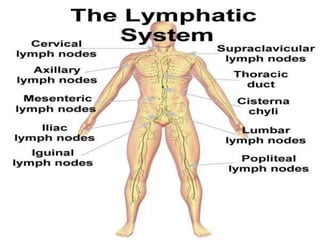
Originate as lymph capillaries.
Capillaries unite to form larger vessels.
Lymphatic Resemble veins in structure.
Lymphatic Connect to lymph nodes at various
intervals.
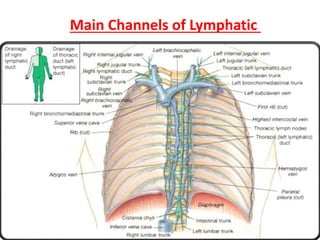
Lymphatic ultimately deliver lymph into 2 main
channels-
Right lymphatic duct
Thoracic duct
LYMPHATIC
Main Channels of Lymphatic
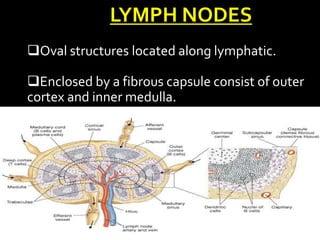
Oval structures located along lymphatic.
Enclosed by a fibrous capsule consist of outer
cortex and inner medulla.
LYMPH NODES
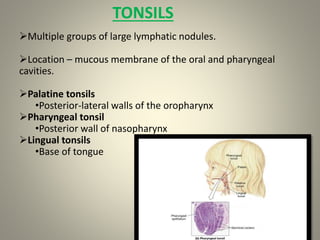
TONSILS
Multiple groups of large lymphatic nodules.
Location – mucous membrane of the oral and pharyngeal
cavities.
Palatine tonsils
•Posterior-lateral walls of the oropharynx
Pharyngeal tonsil
•Posterior wall of nasopharynx
Lingual tonsils
•Base of tongue
SPLEEN
 Largest lymphatic organ
 Located between the stomach & diaphragm.
 Structure is similar to a node.
 Functions of spleen
o Filters blood
o Stores blood
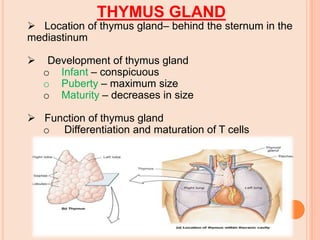
THYMUS GLAND
 Location of thymus gland– behind the sternum in the
mediastinum
 Development of thymus gland
o Infant – conspicuous
o Puberty – maximum size
o Maturity – decreases in size
 Function of thymus gland
o Differentiation and maturation of T cells
FUNCTION OF THE LYMPHATIC
SYSTEM
 Defense against harmful organisms and
chemicals.
 Immunity –it involves B cells that become
plasma cells which produce antibodies that
bind with specific antigens.
Cell-mediated immunity involves T cells
that directly destroy foreign cells
Lymphatic system-ppt

Lymphatic system-ppt

  • 2.
  • 3.
    LYMPHATIC SYSTEM COMPONENTS OFLYMPHATIC SYSTEM •Lymph is the fluid. •Lymph Vessels called lymphatic. •Lymph nodes. Functions of lymphatic system •Return tissue fluid to the bloodstream. •Transport fats from the digestive tract to the bloodstream •Surveillance & defence.
  • 5.
    Originate as lymphcapillaries. Capillaries unite to form larger vessels. Lymphatic Resemble veins in structure. Lymphatic Connect to lymph nodes at various intervals. Lymphatic ultimately deliver lymph into 2 main channels- Right lymphatic duct Thoracic duct LYMPHATIC
  • 7.
  • 8.
    Oval structures locatedalong lymphatic. Enclosed by a fibrous capsule consist of outer cortex and inner medulla. LYMPH NODES
  • 9.
    TONSILS Multiple groups oflarge lymphatic nodules. Location – mucous membrane of the oral and pharyngeal cavities. Palatine tonsils •Posterior-lateral walls of the oropharynx Pharyngeal tonsil •Posterior wall of nasopharynx Lingual tonsils •Base of tongue
  • 10.
    SPLEEN  Largest lymphaticorgan  Located between the stomach & diaphragm.  Structure is similar to a node.  Functions of spleen o Filters blood o Stores blood
  • 11.
    THYMUS GLAND  Locationof thymus gland– behind the sternum in the mediastinum  Development of thymus gland o Infant – conspicuous o Puberty – maximum size o Maturity – decreases in size  Function of thymus gland o Differentiation and maturation of T cells
  • 12.
    FUNCTION OF THELYMPHATIC SYSTEM  Defense against harmful organisms and chemicals.  Immunity –it involves B cells that become plasma cells which produce antibodies that bind with specific antigens. Cell-mediated immunity involves T cells that directly destroy foreign cells