 HAFSA KHALID
 LAIBA ROOP PAUL
 AQSA MUSHTAQ
 MARYAM KHALID
 LAREB SATTAR
 SABIHA MANZOOR
 Any form of active exercise in which dynamic or static
muscle contraction is resisted by an outside force applied
manually or mechanically.
 Also referred to as resistance training.
 Muscle performance - capacity of a muscle to do work
 An essential element of rehabilitation programs for
persons with impaired function .
 An integral component of conditioning programs for
those who wish to promote or maintain health and
physical well-being, potentially enhance performance of
motor skills.
 The key elements of muscle performance :
I. Strength ,
II. Power
III. Endurance
 one or more of these areas of muscle performance is
impaired, functional limitations and disability or increased
risk of dysfunction may ensue.
 injury, disease,
 immobilization, disuse,
 Inactivity , etc. may result in impaired muscle performance,
leading to weakness and muscle atrophy.
 Enhanced muscle performance:
 Restoration, improvement of muscle strength,
power, and endurance
 Greater BMD or less bone demineralization
 Decreased stress on joints during physical activity
 Reduced risk of soft tissue injury during physical
activity
 Possible improvement in balance .
 Enhanced physical performance during
daily living, occupational, and
recreational activities
 Positive changes in body composition: ↑
lean muscle mass or ↓ body fat
 Enhanced feeling of physical well-being
 Possible improvement in quality of life
(1)Strength
 The ability of contractile tissue to produce tension and a
resultant force based on the demands placed on the
muscle
 The greatest measurable force that can be exerted by a
muscle or muscle group to overcome resistance during a
single maximum effort
 Functional strength The ability of the neuromuscular
system to produce, reduce, or control forces, imposed,
during functional activities, in a smooth, coordinated
manner.
I. MMT
II. Dynamometer
 a systematic procedure of a muscle or muscle
group lifting, lowering, or controlling heavy
loads (resistance) for a relatively low number of
repetitions or over a short period of time.
 The most common adaptation to heavy
resistance exercise is an increase in the
maximum force-producing capacity of muscle,
that is, an increase in muscle strength, primarily
as the result of neural adaptations and increase
in muscle fiber size
 the rate of performing work.
 the work (force*distance) produced by a muscle per
unit of time (force*distance/time)
 related to the strength and speed of movement
 The rate at which a muscle contracts and produces
a resultant force and the relationship of that force
and velocity
 anaerobic power a single burst of high-intensity
activity (such as lifting a heavy piece of luggage
onto an overhead rack or performing a high jump)
 aerobic power, repeated bursts of less intense
muscle activity (such as climbing a flight of stairs).
 Many motor skills in our lives are composed of
movements that are explosive and involve both
strength and speed
 Muscle strength is a necessary foundation for
developing muscle power
 increasing the work a muscle must perform
during a specified period of time or reducing
the amount of time required to produce a given
force. power directly proportional to work & inversely to
time
 The greater the intensity of the exercise and the
shorter the time period taken to generate force,
the greater is the muscle power
 The ability to perform low-intensity,
repetitive, or sustained activities over a
prolonged period of time
 Cardiopulmonary endurance (total body
endurance)
 Muscle endurance (Local endurance)
 muscle contract and lift or lower a light load for
many repetitions or sustain a muscle
contraction for an extended period of time
 Low-intensity muscle contractions, a large
number of repetitions, and a prolonged time
period
 Increase oxidative and metabolic capacities,
which allows better delivery and use of
oxygen
 For many patients with impaired muscle performance,
endurance training has a more positive impact on
improving function than strength training.
 In addition, using low levels of resistance in an exercise
program;
 Minimizes adverse forces on joints,
 produces less irritation to soft tissues,
 is more comfortable than heavy resistance training.
 A guiding principle on which the use of resistance
exercise to improve muscle performance is based is the
overload principle
 If muscle performance is to improve, a load that
exceeds the metabolic capacity of the muscle must be
applied
 The muscle must be challenged to perform at a level
greater than that to which it is accustomed
 If the demands remain constant after the muscle has
adapted, the level of muscle performance can be
maintained but not increased
 The overload principle focuses on the progressive loading of
muscle by manipulating, the intensity or volume of exercise.
 Intensity of resistance exercise refers to how much weight
(resistance) is imposed on the muscle,
 Volume the total number of repetitions of a particular exercise
during a single exercise session multiplied by the resistance
used .
 Volume encompasses variables such as
Repetitions
Frequency of exercise
Any one or more of which can be gradually adjusted to increase
the demands on the muscle.
 In a strength training program, the amount of
resistance applied to the muscle is incrementally
and progressively increased.
 For endurance training, more emphasis is placed
on increasing the time a muscle contraction is
sustained or the number of repetitions
performed than on increasing resistance
 The SAID principle suggests that the body adapts in a
specific fashion to the specific demands that are placed on
it.
 An extension of Wolff’s law
 This principle helps therapists determine the exercise
prescription to create specific training effects that best
meet specific functional needs and goals.
 a widely accepted concept suggesting that the
adaptive effects of training, such as improvement
of strength, power, and endurance, are highly
specific to the training method employed
 if the desired functional activity requires greater
muscular endurance than strength, the intensity
and duration of exercises should be geared to
improve muscular endurance
 Adaptive changes in the body’s systems, (increased strength or
endurance ) in response to a resistance exercise program are
transient unless :
A: Training-induced improvements are regularly used for functional
activities
or
B: The participates in maintenance program of resistance exercises.
 Detraining, (reduction in muscle performance,) begins within a
week or two after the cessation of resistance exercises and
continues until training effects are lost.
 It is imperative that gains in strength and endurance are
incorporated into daily activities as early as possible in a
rehabilitation program.
 It is also advisable for patients to
participate in a maintenance program of
resistance exercises as an integral
component of a lifelong fitness program.
 Knowledge of the factors that influence the
force-producing capacity of normal muscle
during an active contraction is fundamental to
understanding how the neuromuscular system
adapts as the result of resistance training.
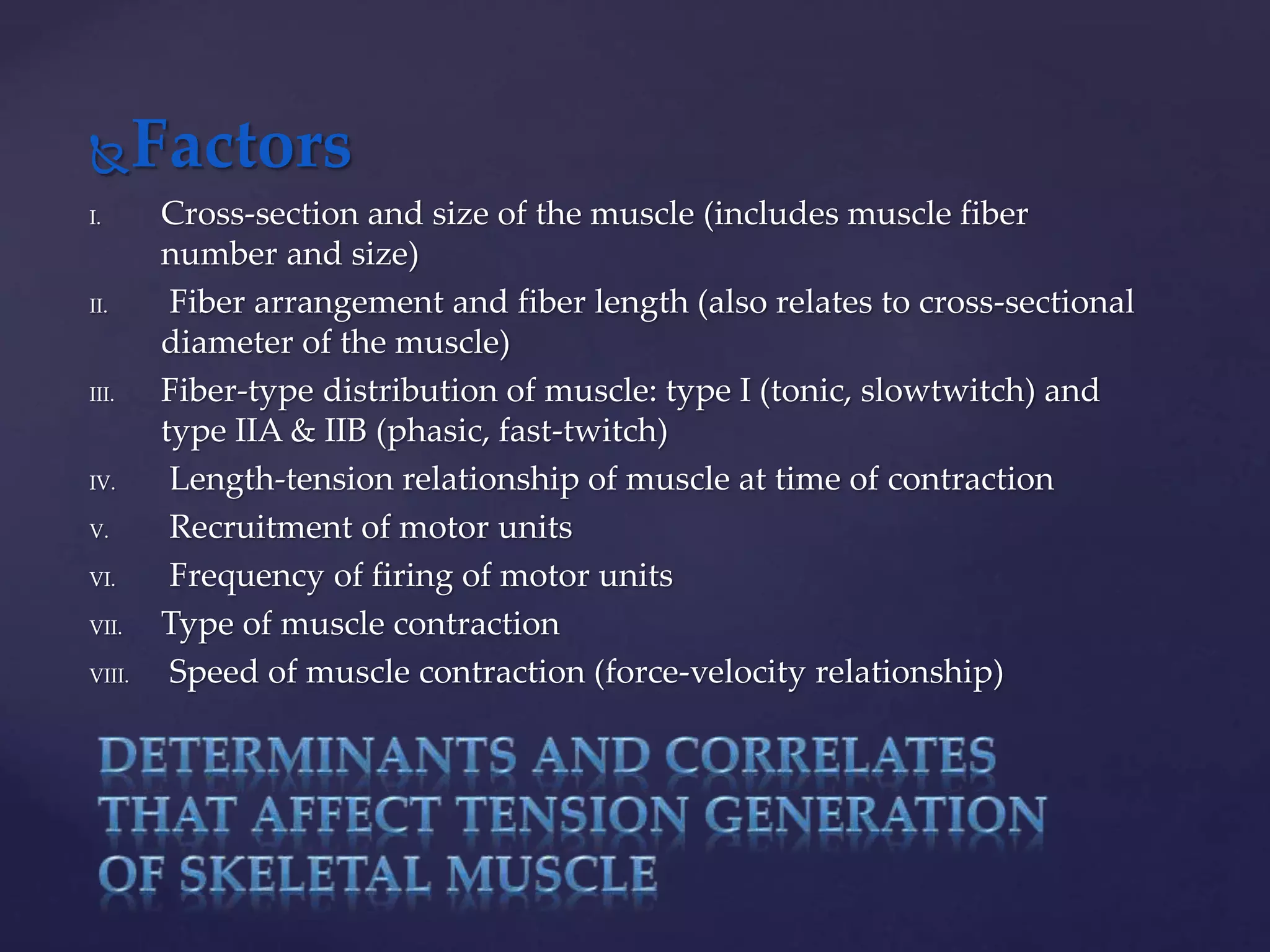
Factors
I. Cross-section and size of the muscle (includes muscle fiber
number and size)
II. Fiber arrangement and fiber length (also relates to cross-sectional
diameter of the muscle)
III. Fiber-type distribution of muscle: type I (tonic, slowtwitch) and
type IIA & IIB (phasic, fast-twitch)
IV. Length-tension relationship of muscle at time of contraction
V. Recruitment of motor units
VI. Frequency of firing of motor units
VII. Type of muscle contraction
VIII. Speed of muscle contraction (force-velocity relationship)
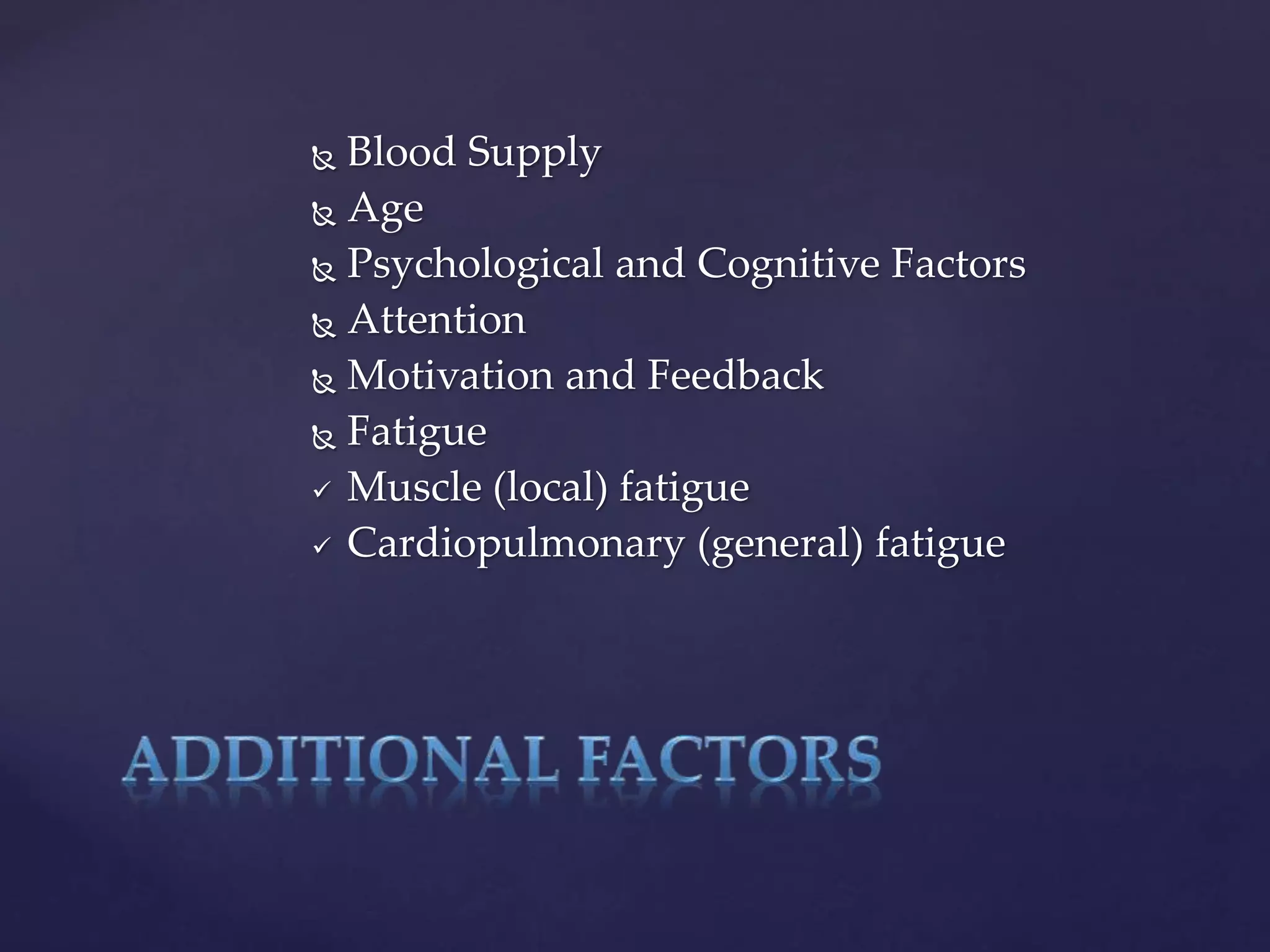
 Blood Supply
 Age
 Psychological and Cognitive Factors
 Attention
 Motivation and Feedback
 Fatigue
 Muscle (local) fatigue
 Cardiopulmonary (general) fatigue
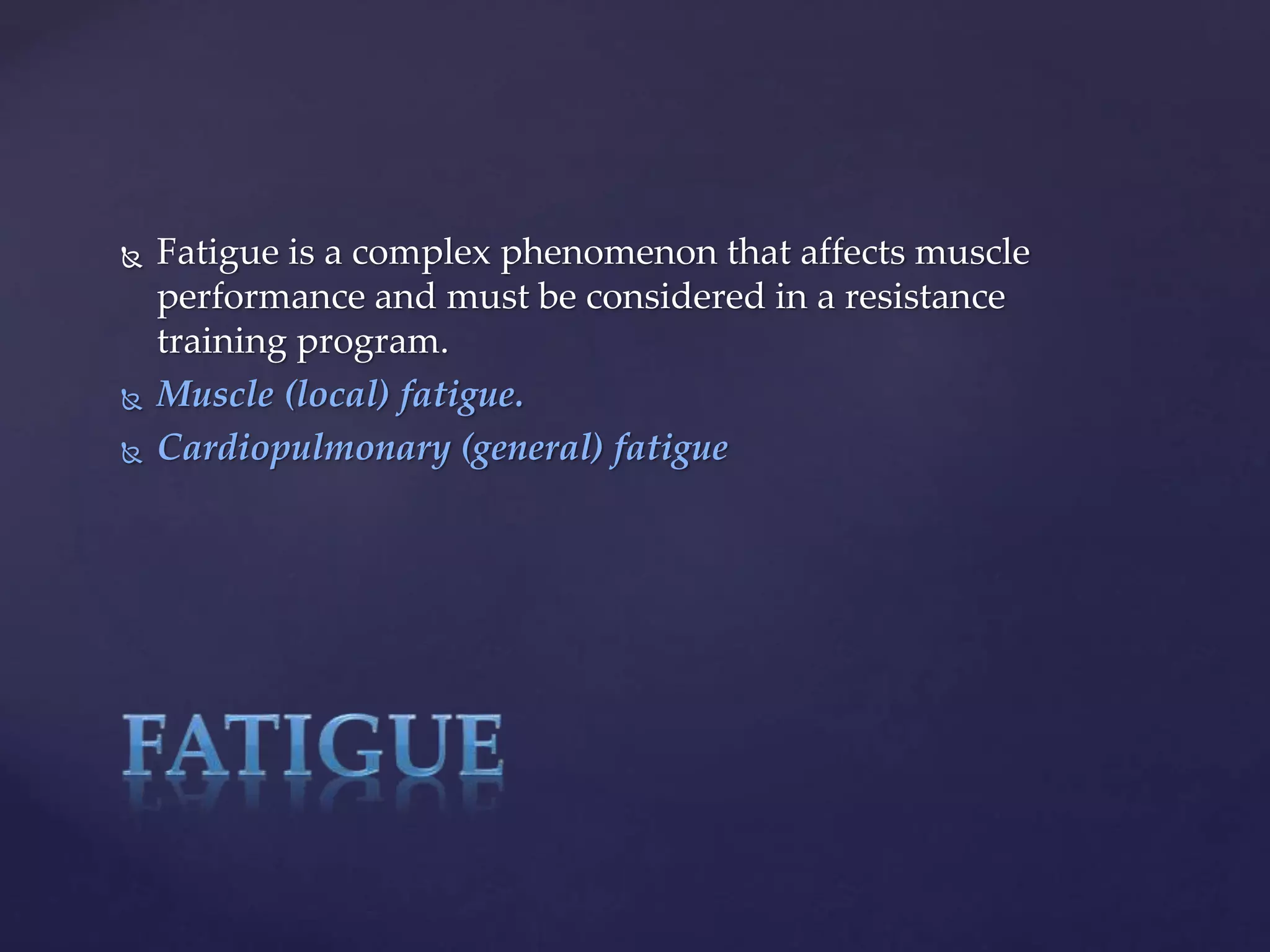
 Fatigue is a complex phenomenon that affects muscle
performance and must be considered in a resistance
training program.
 Muscle (local) fatigue.
 Cardiopulmonary (general) fatigue
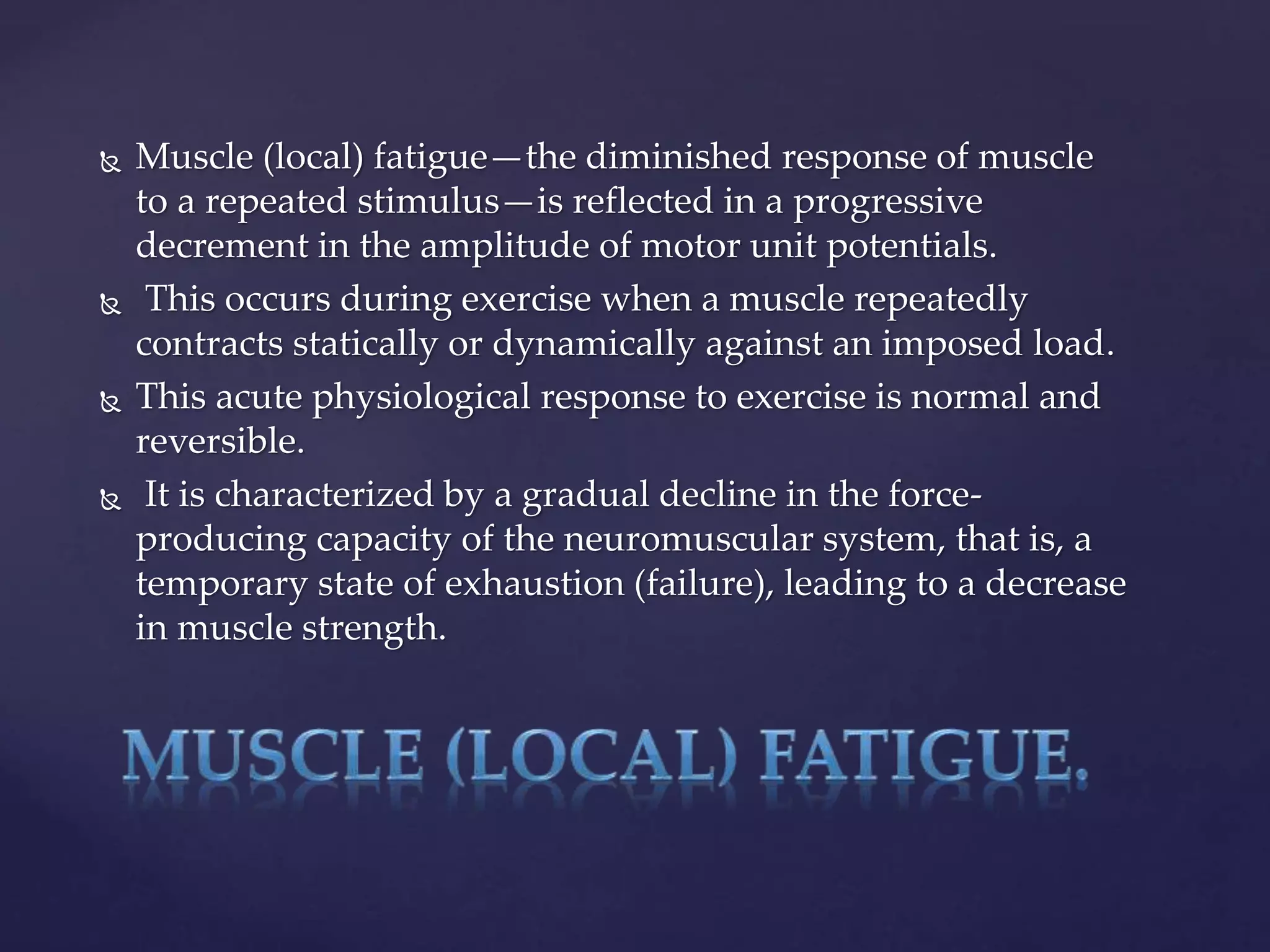
 Muscle (local) fatigue—the diminished response of muscle
to a repeated stimulus—is reflected in a progressive
decrement in the amplitude of motor unit potentials.
 This occurs during exercise when a muscle repeatedly
contracts statically or dynamically against an imposed load.
 This acute physiological response to exercise is normal and
reversible.
 It is characterized by a gradual decline in the force-
producing capacity of the neuromuscular system, that is, a
temporary state of exhaustion (failure), leading to a decrease
in muscle strength.
 The diminished response of the muscle is
caused by a combination of factors, which
include:
 Disturbances in the contractile mechanism of
the muscle itself because of a decrease in energy
stores, insufficient oxygen, and a build-up of H
 Inhibitory (protective) influences from the
central nervous system
 Possibly a decrease in the conduction of
impulses at the myoneural junction,
particularly in fast-twitch fibers
 This type of fatigue is the diminished response of an
individual (the entire body) as the result of prolonged
physical activity, such as walking, jogging, cycling, or
repetitive lifting or digging.
 It is related to the body’s ability to use oxygen efficiently.
 Cardiopulmonary fatigue associated with endurance
training is probably caused by a combination of the
following factors:
 Decrease in blood sugar (glucose) levels
 Decrease in glycogen stores in muscle and liver
 Depletion of potassium, especially in the elderly patient
 An uncomfortable sensation in the muscle, even pain and
cramping
 Tremulousness in the contracting muscle
 Active movements jerky, not smooth
 Inability to complete the movement pattern through the
full range of available motion during dynamic exercise
against the same level of resistance
 Use of substitute motions—that is, incorrect movement
patterns—to complete the movement pattern
 Inability to continue low-intensity physical activity
 . Threshold for fatigue is the level of exercise
that cannot be sustained indefinitely.
 A patient’s threshold for fatigue could be noted
as the length of time a contraction is
maintained or the number of repetitions of an
exercise that initially can be performed.
 This sets a baseline from which adaptive
changes in physical performance can be
measured.
 Factors that influence fatigue are diverse. A
patient’s health status, diet, or lifestyle
(sedentary or active) all influence fatigue.
 In patients with neuromuscular,
cardiopulmonary, oncologic, inflammatory, or
psychological disorders, the onset of fatigue is
often abnormal.
 For instance, it may occur abruptly, more
rapidly, or at predictable intervals
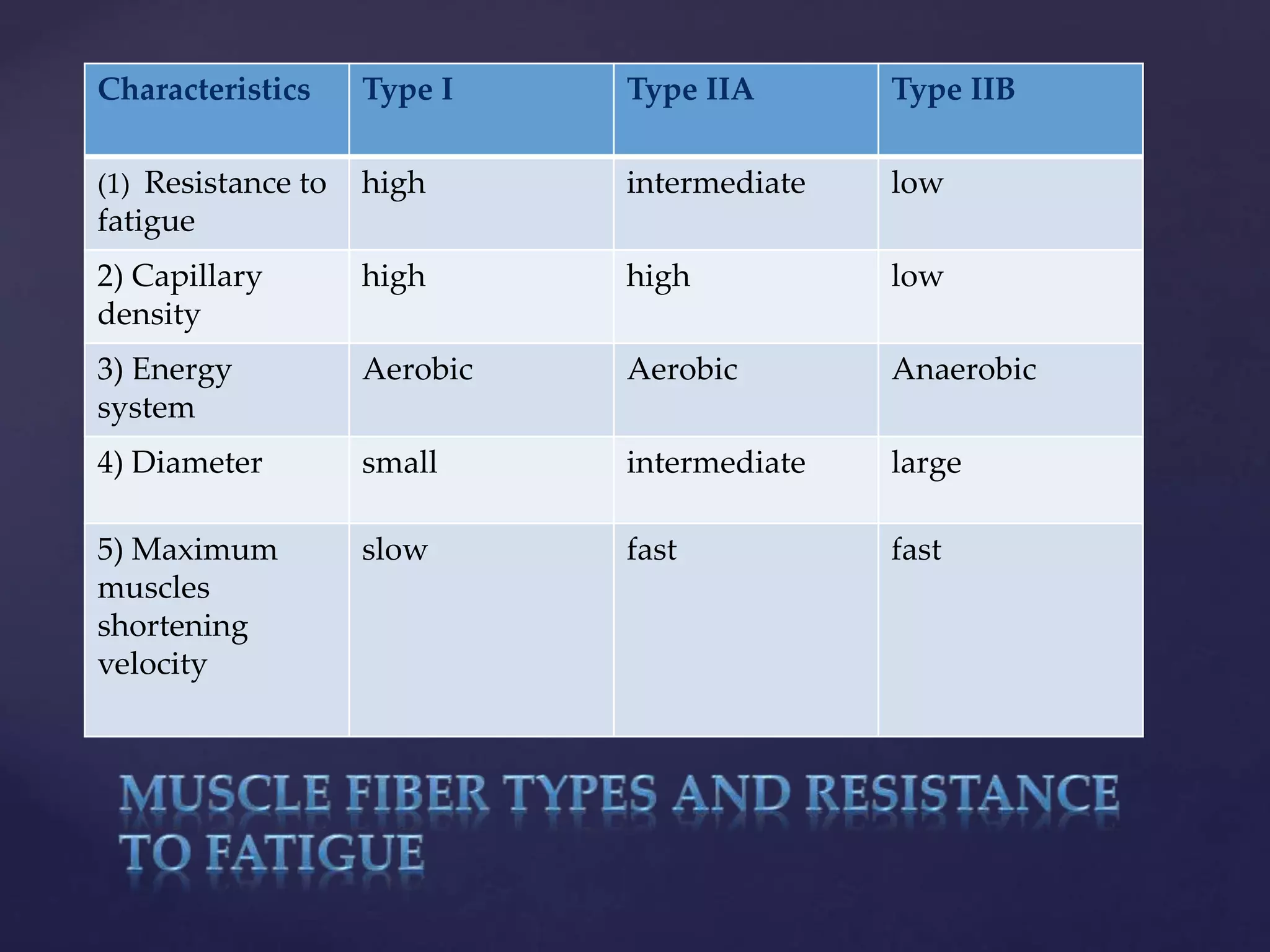
Characteristics Type I Type IIA Type IIB
(1) Resistance to
fatigue
high intermediate low
2) Capillary
density
high high low
3) Energy
system
Aerobic Aerobic Anaerobic
4) Diameter small intermediate large
5) Maximum
muscles
shortening
velocity
slow fast fast
 Oxygen stores are replenished in muscles.
 Energy stores are replenished.
 Lactic acid(Strong affinity for water) is removed from
skeletal muscle and blood within approximately 1 hour
after exercise.
 Glycogen is replaced over several days.
RESISTANCE EXERCISE FOR MUSCLE IMPAIRED PERFORMANCE

RESISTANCE EXERCISE FOR MUSCLE IMPAIRED PERFORMANCE

  • 3.
     HAFSA KHALID LAIBA ROOP PAUL  AQSA MUSHTAQ  MARYAM KHALID  LAREB SATTAR  SABIHA MANZOOR
  • 5.
     Any formof active exercise in which dynamic or static muscle contraction is resisted by an outside force applied manually or mechanically.  Also referred to as resistance training.  Muscle performance - capacity of a muscle to do work  An essential element of rehabilitation programs for persons with impaired function .  An integral component of conditioning programs for those who wish to promote or maintain health and physical well-being, potentially enhance performance of motor skills.
  • 6.
     The keyelements of muscle performance : I. Strength , II. Power III. Endurance  one or more of these areas of muscle performance is impaired, functional limitations and disability or increased risk of dysfunction may ensue.  injury, disease,  immobilization, disuse,  Inactivity , etc. may result in impaired muscle performance, leading to weakness and muscle atrophy.
  • 7.
     Enhanced muscleperformance:  Restoration, improvement of muscle strength, power, and endurance  Greater BMD or less bone demineralization  Decreased stress on joints during physical activity  Reduced risk of soft tissue injury during physical activity
  • 8.
     Possible improvementin balance .  Enhanced physical performance during daily living, occupational, and recreational activities  Positive changes in body composition: ↑ lean muscle mass or ↓ body fat  Enhanced feeling of physical well-being  Possible improvement in quality of life
  • 9.
    (1)Strength  The abilityof contractile tissue to produce tension and a resultant force based on the demands placed on the muscle  The greatest measurable force that can be exerted by a muscle or muscle group to overcome resistance during a single maximum effort  Functional strength The ability of the neuromuscular system to produce, reduce, or control forces, imposed, during functional activities, in a smooth, coordinated manner. I. MMT II. Dynamometer
  • 10.
     a systematicprocedure of a muscle or muscle group lifting, lowering, or controlling heavy loads (resistance) for a relatively low number of repetitions or over a short period of time.  The most common adaptation to heavy resistance exercise is an increase in the maximum force-producing capacity of muscle, that is, an increase in muscle strength, primarily as the result of neural adaptations and increase in muscle fiber size
  • 11.
     the rateof performing work.  the work (force*distance) produced by a muscle per unit of time (force*distance/time)  related to the strength and speed of movement  The rate at which a muscle contracts and produces a resultant force and the relationship of that force and velocity  anaerobic power a single burst of high-intensity activity (such as lifting a heavy piece of luggage onto an overhead rack or performing a high jump)  aerobic power, repeated bursts of less intense muscle activity (such as climbing a flight of stairs).
  • 12.
     Many motorskills in our lives are composed of movements that are explosive and involve both strength and speed  Muscle strength is a necessary foundation for developing muscle power  increasing the work a muscle must perform during a specified period of time or reducing the amount of time required to produce a given force. power directly proportional to work & inversely to time  The greater the intensity of the exercise and the shorter the time period taken to generate force, the greater is the muscle power
  • 13.
     The abilityto perform low-intensity, repetitive, or sustained activities over a prolonged period of time  Cardiopulmonary endurance (total body endurance)  Muscle endurance (Local endurance)
  • 14.
     muscle contractand lift or lower a light load for many repetitions or sustain a muscle contraction for an extended period of time  Low-intensity muscle contractions, a large number of repetitions, and a prolonged time period  Increase oxidative and metabolic capacities, which allows better delivery and use of oxygen
  • 15.
     For manypatients with impaired muscle performance, endurance training has a more positive impact on improving function than strength training.  In addition, using low levels of resistance in an exercise program;  Minimizes adverse forces on joints,  produces less irritation to soft tissues,  is more comfortable than heavy resistance training.
  • 16.
     A guidingprinciple on which the use of resistance exercise to improve muscle performance is based is the overload principle  If muscle performance is to improve, a load that exceeds the metabolic capacity of the muscle must be applied  The muscle must be challenged to perform at a level greater than that to which it is accustomed  If the demands remain constant after the muscle has adapted, the level of muscle performance can be maintained but not increased
  • 17.
     The overloadprinciple focuses on the progressive loading of muscle by manipulating, the intensity or volume of exercise.  Intensity of resistance exercise refers to how much weight (resistance) is imposed on the muscle,  Volume the total number of repetitions of a particular exercise during a single exercise session multiplied by the resistance used .  Volume encompasses variables such as Repetitions Frequency of exercise Any one or more of which can be gradually adjusted to increase the demands on the muscle.
  • 18.
     In astrength training program, the amount of resistance applied to the muscle is incrementally and progressively increased.  For endurance training, more emphasis is placed on increasing the time a muscle contraction is sustained or the number of repetitions performed than on increasing resistance
  • 19.
     The SAIDprinciple suggests that the body adapts in a specific fashion to the specific demands that are placed on it.  An extension of Wolff’s law  This principle helps therapists determine the exercise prescription to create specific training effects that best meet specific functional needs and goals.
  • 20.
     a widelyaccepted concept suggesting that the adaptive effects of training, such as improvement of strength, power, and endurance, are highly specific to the training method employed  if the desired functional activity requires greater muscular endurance than strength, the intensity and duration of exercises should be geared to improve muscular endurance
  • 21.
     Adaptive changesin the body’s systems, (increased strength or endurance ) in response to a resistance exercise program are transient unless : A: Training-induced improvements are regularly used for functional activities or B: The participates in maintenance program of resistance exercises.  Detraining, (reduction in muscle performance,) begins within a week or two after the cessation of resistance exercises and continues until training effects are lost.  It is imperative that gains in strength and endurance are incorporated into daily activities as early as possible in a rehabilitation program.
  • 22.
     It isalso advisable for patients to participate in a maintenance program of resistance exercises as an integral component of a lifelong fitness program.
  • 23.
     Knowledge ofthe factors that influence the force-producing capacity of normal muscle during an active contraction is fundamental to understanding how the neuromuscular system adapts as the result of resistance training.
  • 25.
    Factors I. Cross-section andsize of the muscle (includes muscle fiber number and size) II. Fiber arrangement and fiber length (also relates to cross-sectional diameter of the muscle) III. Fiber-type distribution of muscle: type I (tonic, slowtwitch) and type IIA & IIB (phasic, fast-twitch) IV. Length-tension relationship of muscle at time of contraction V. Recruitment of motor units VI. Frequency of firing of motor units VII. Type of muscle contraction VIII. Speed of muscle contraction (force-velocity relationship)
  • 26.
     Blood Supply Age  Psychological and Cognitive Factors  Attention  Motivation and Feedback  Fatigue  Muscle (local) fatigue  Cardiopulmonary (general) fatigue
  • 27.
     Fatigue isa complex phenomenon that affects muscle performance and must be considered in a resistance training program.  Muscle (local) fatigue.  Cardiopulmonary (general) fatigue
  • 28.
     Muscle (local)fatigue—the diminished response of muscle to a repeated stimulus—is reflected in a progressive decrement in the amplitude of motor unit potentials.  This occurs during exercise when a muscle repeatedly contracts statically or dynamically against an imposed load.  This acute physiological response to exercise is normal and reversible.  It is characterized by a gradual decline in the force- producing capacity of the neuromuscular system, that is, a temporary state of exhaustion (failure), leading to a decrease in muscle strength.
  • 29.
     The diminishedresponse of the muscle is caused by a combination of factors, which include:  Disturbances in the contractile mechanism of the muscle itself because of a decrease in energy stores, insufficient oxygen, and a build-up of H  Inhibitory (protective) influences from the central nervous system  Possibly a decrease in the conduction of impulses at the myoneural junction, particularly in fast-twitch fibers
  • 30.
     This typeof fatigue is the diminished response of an individual (the entire body) as the result of prolonged physical activity, such as walking, jogging, cycling, or repetitive lifting or digging.  It is related to the body’s ability to use oxygen efficiently.  Cardiopulmonary fatigue associated with endurance training is probably caused by a combination of the following factors:  Decrease in blood sugar (glucose) levels  Decrease in glycogen stores in muscle and liver  Depletion of potassium, especially in the elderly patient
  • 31.
     An uncomfortablesensation in the muscle, even pain and cramping  Tremulousness in the contracting muscle  Active movements jerky, not smooth  Inability to complete the movement pattern through the full range of available motion during dynamic exercise against the same level of resistance  Use of substitute motions—that is, incorrect movement patterns—to complete the movement pattern  Inability to continue low-intensity physical activity
  • 32.
     . Thresholdfor fatigue is the level of exercise that cannot be sustained indefinitely.  A patient’s threshold for fatigue could be noted as the length of time a contraction is maintained or the number of repetitions of an exercise that initially can be performed.  This sets a baseline from which adaptive changes in physical performance can be measured.
  • 33.
     Factors thatinfluence fatigue are diverse. A patient’s health status, diet, or lifestyle (sedentary or active) all influence fatigue.  In patients with neuromuscular, cardiopulmonary, oncologic, inflammatory, or psychological disorders, the onset of fatigue is often abnormal.  For instance, it may occur abruptly, more rapidly, or at predictable intervals
  • 34.
    Characteristics Type IType IIA Type IIB (1) Resistance to fatigue high intermediate low 2) Capillary density high high low 3) Energy system Aerobic Aerobic Anaerobic 4) Diameter small intermediate large 5) Maximum muscles shortening velocity slow fast fast
  • 35.
     Oxygen storesare replenished in muscles.  Energy stores are replenished.  Lactic acid(Strong affinity for water) is removed from skeletal muscle and blood within approximately 1 hour after exercise.  Glycogen is replaced over several days.

Editor's Notes

  • #6 Resistance exercise, also referred to as resistance training, 8,9,32,168 is an essential element of rehabilitation programs for persons with impaired function and an integral component of conditioning programs for those who wish to promote or maintain health and physical well-being, potentially enhance performance of motor skills, and prevent or reduce the risk of injury and disease