The Bourbon Dynasty &
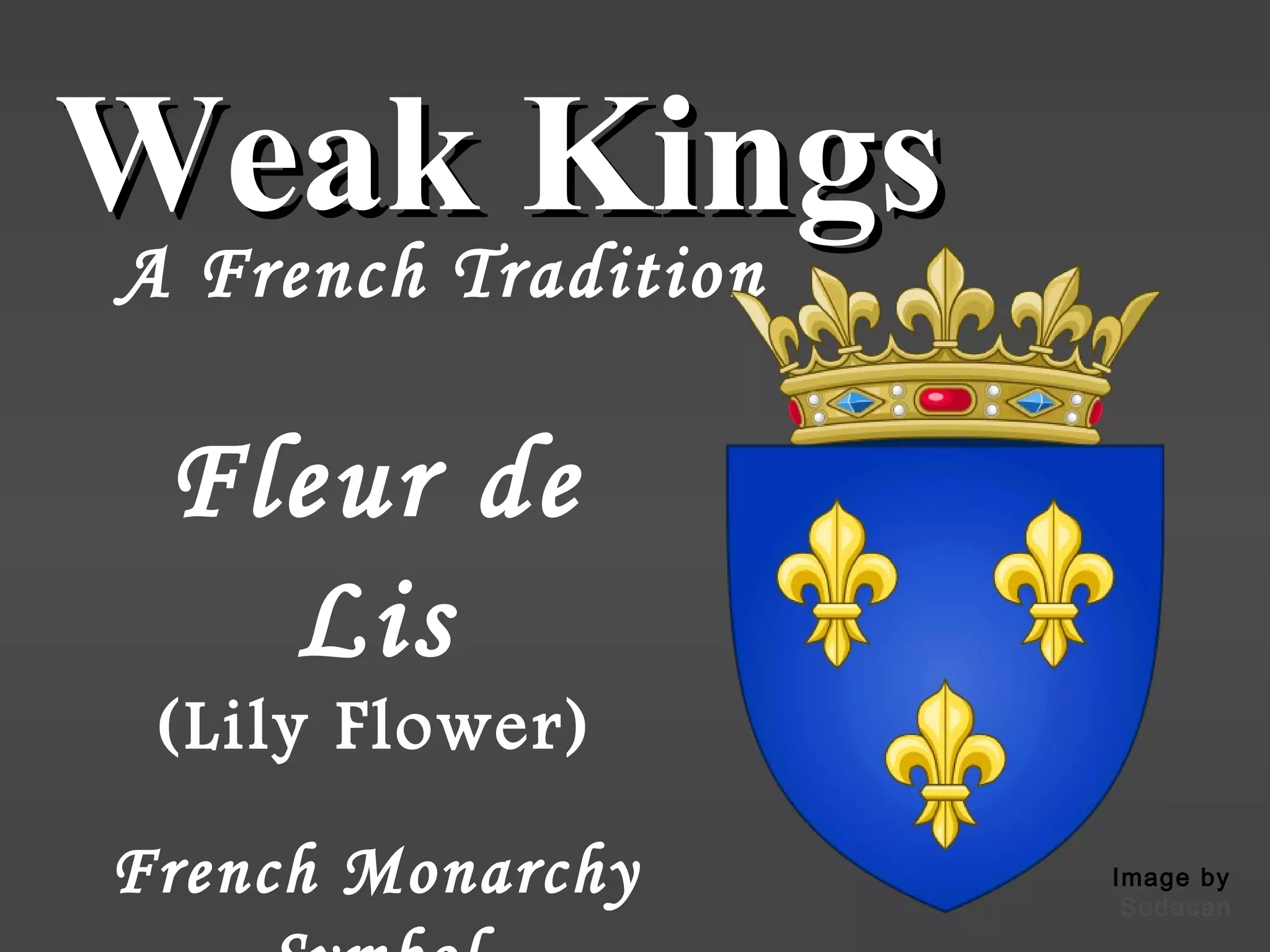
Weak KingsWeak Kings
A French Tradition
Image by
Sodacan
Fleur de
Lis
(Lily Flower)
French Monarchy
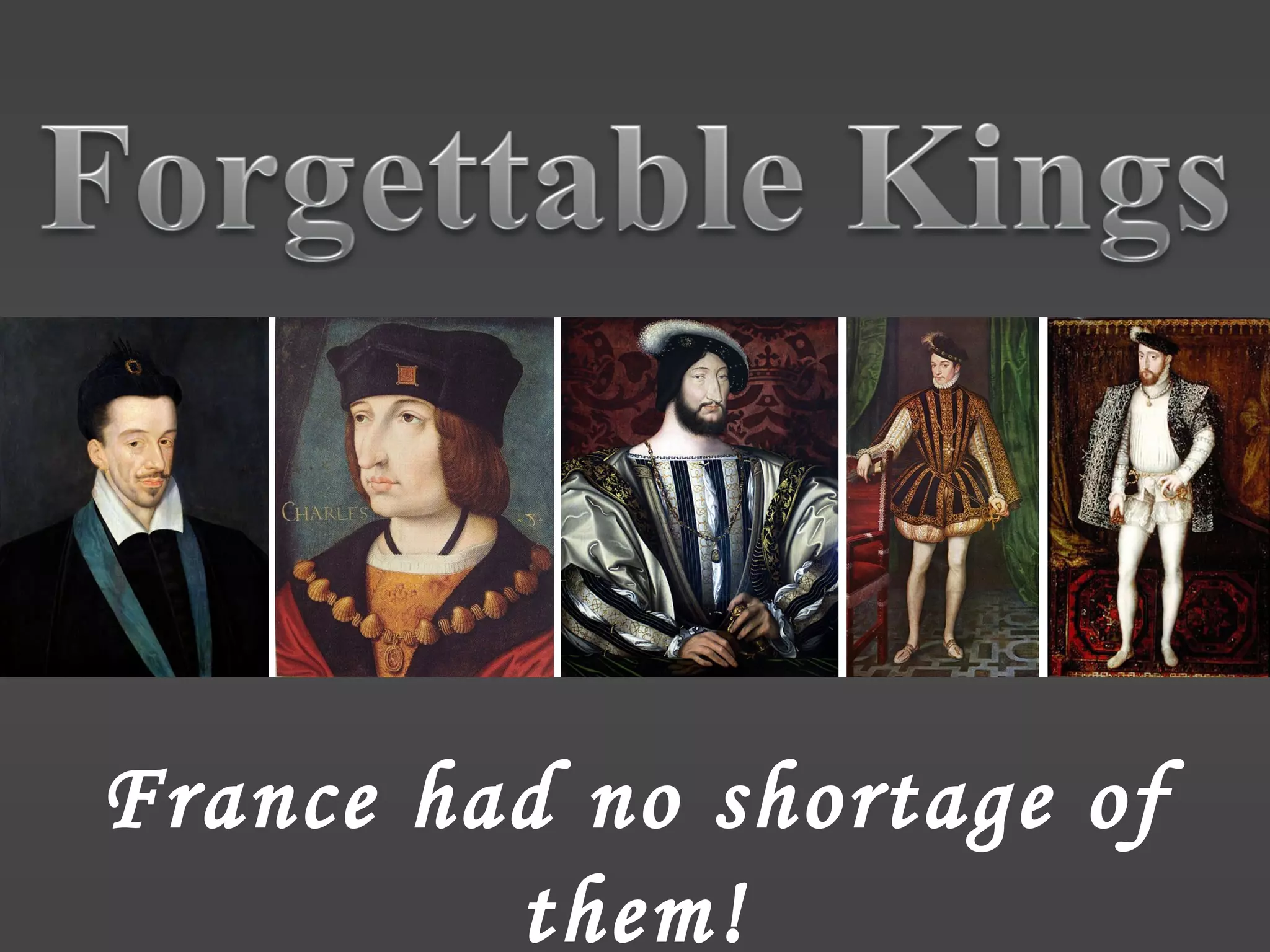
France had no shortage of
them!
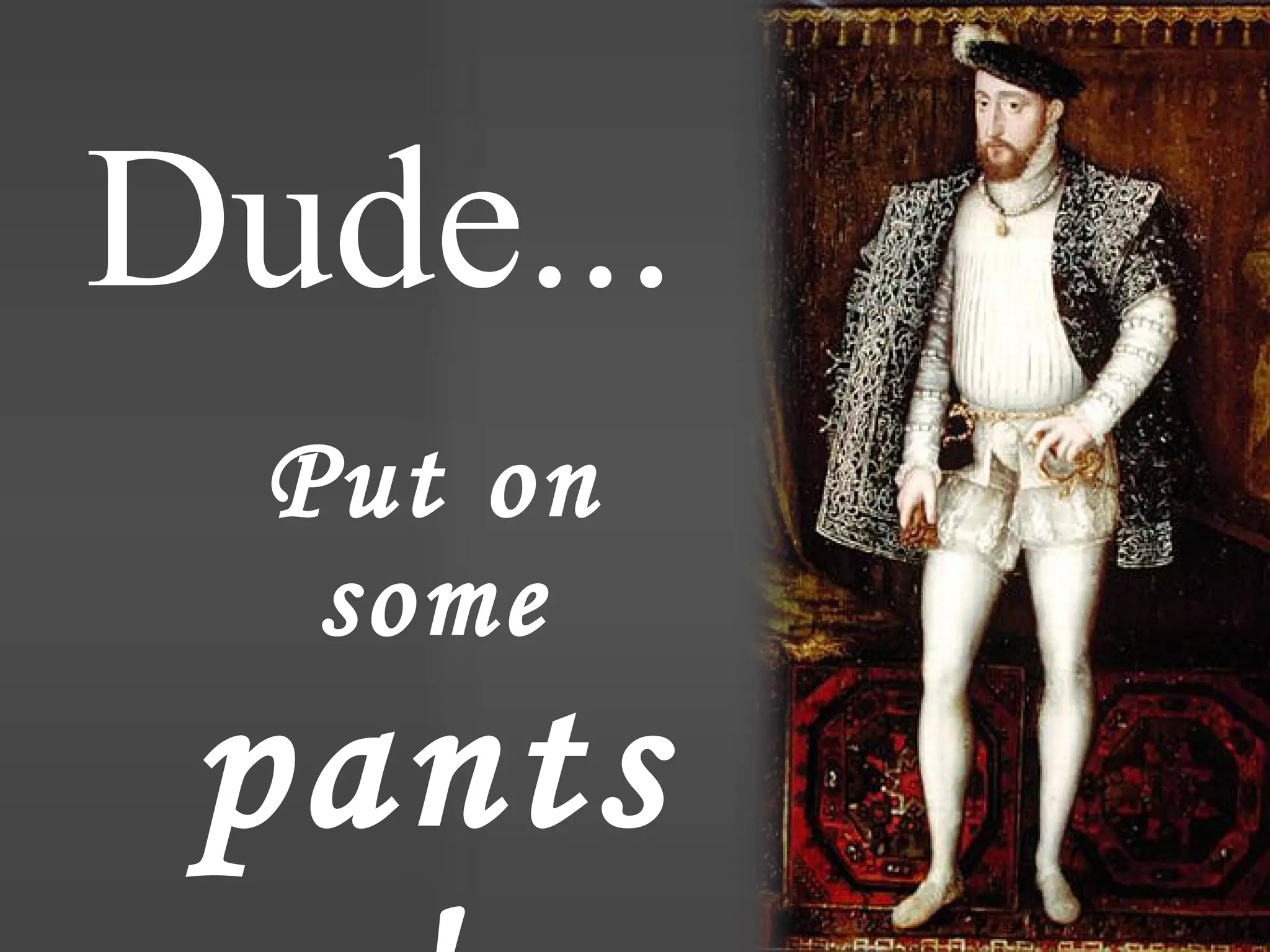
Dude...
Put on
some
pants
Louis XIII’s
Chief Minister
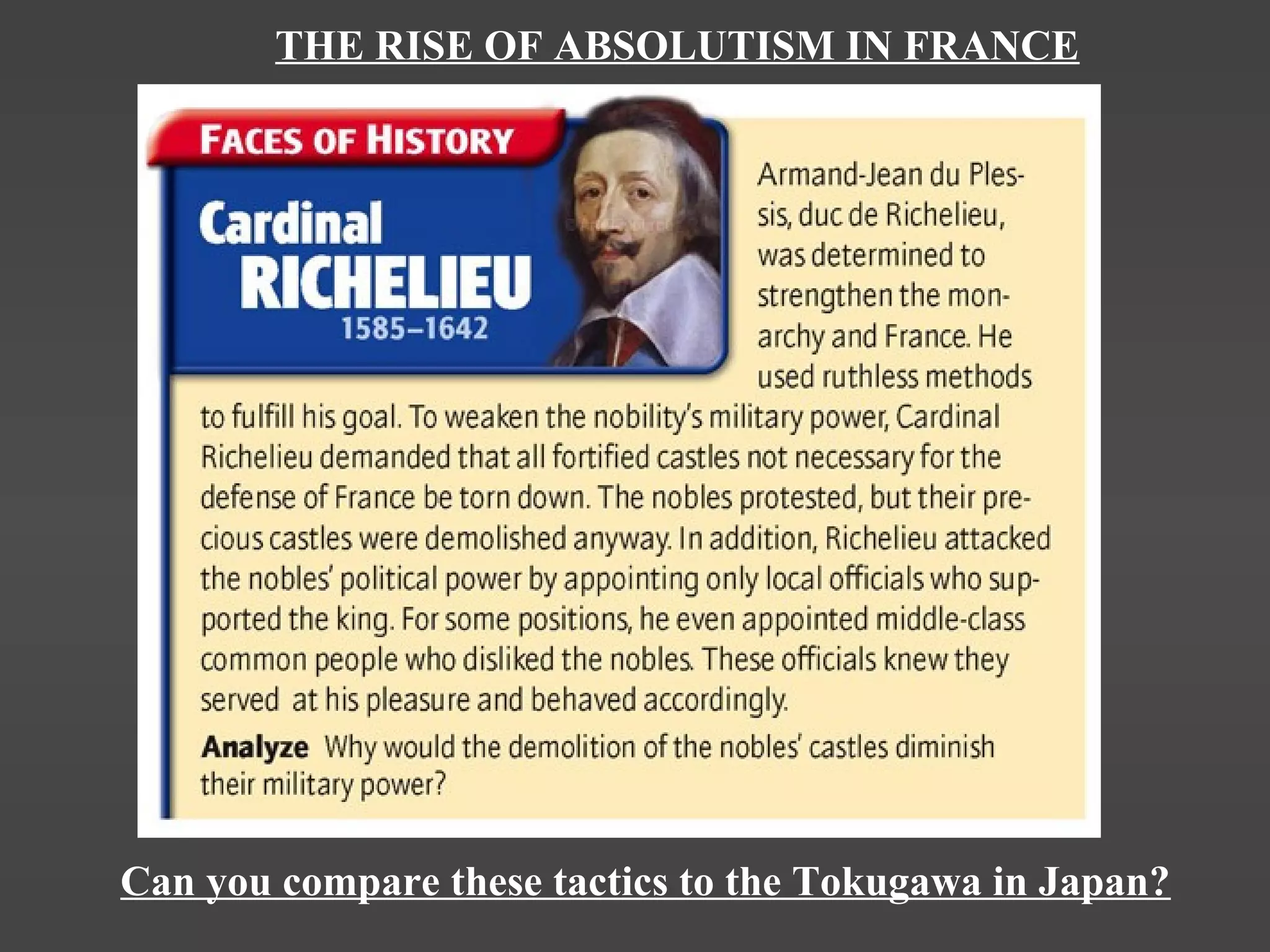
THE RISE OF ABSOLUTISM
IN FRANCE
Cardinal Richelieu
• Reduced power of nobility
• Restricted local authorities
•Richelieu’s spies uncovered series of planned revolts
•Punishments were severe, including death for treason
•wanted to reduce power of Huguenots, strengthen monarchy
Punished Nobles
THE RISE OF ABSOLUTISM IN FRANCE
Can you compare these tactics to the Tokugawa in Japan?
Louis XIII’s
queen, Anne of
Austria, gave
birth to FOUR
stillborn
Louis XIII
dedicated
France to the
Virgin Mary in
1638.
Louis-Dieudonné
the God-given
This miracle baby would bring
the French monarchy to
Louis’ father died
when he was four.
Young Louis XIV
Chief Minister
of France
1642-1661
• Louis XIV becomes king at young
age, with mother as regent
• Cardinal Mazarin, chief minister
after Richelieu, provided advice
• Louis raised to be king, taught skills
needed from childhood
Rise of the Sun King
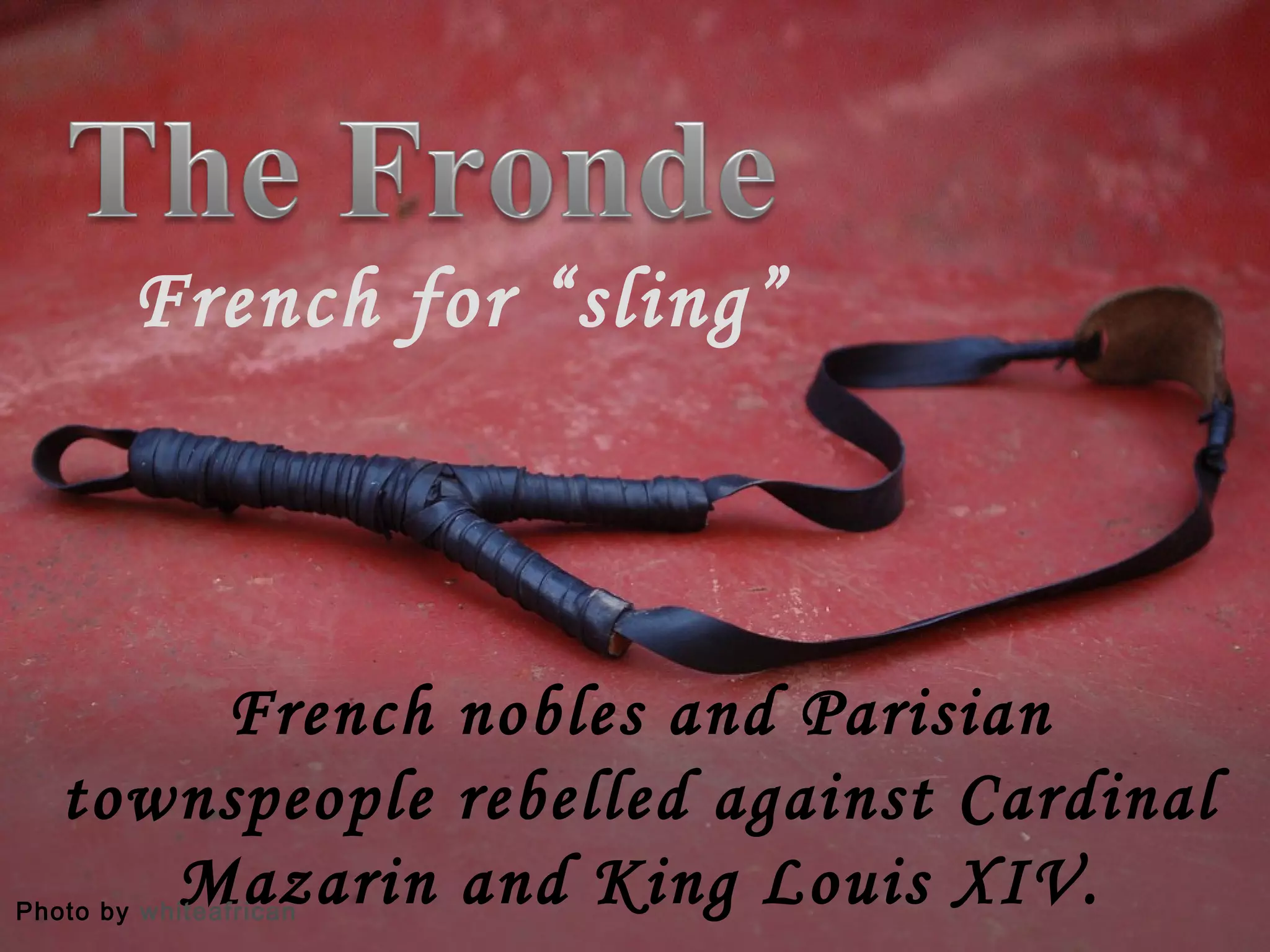
French nobles and Parisian
townspeople rebelled against Cardinal
Mazarin and King Louis XIV. Photo by whiteafrican
French for “sling”
Louis put the nobles in theirLouis put the nobles in their
• Louis XIV retained absolute power – Declared Divine Right Rule
• Began tradition of absolute monarchy to last more than century
• Demanded to be in charge of all military, political, economic initiatives
Absolute Monarchy
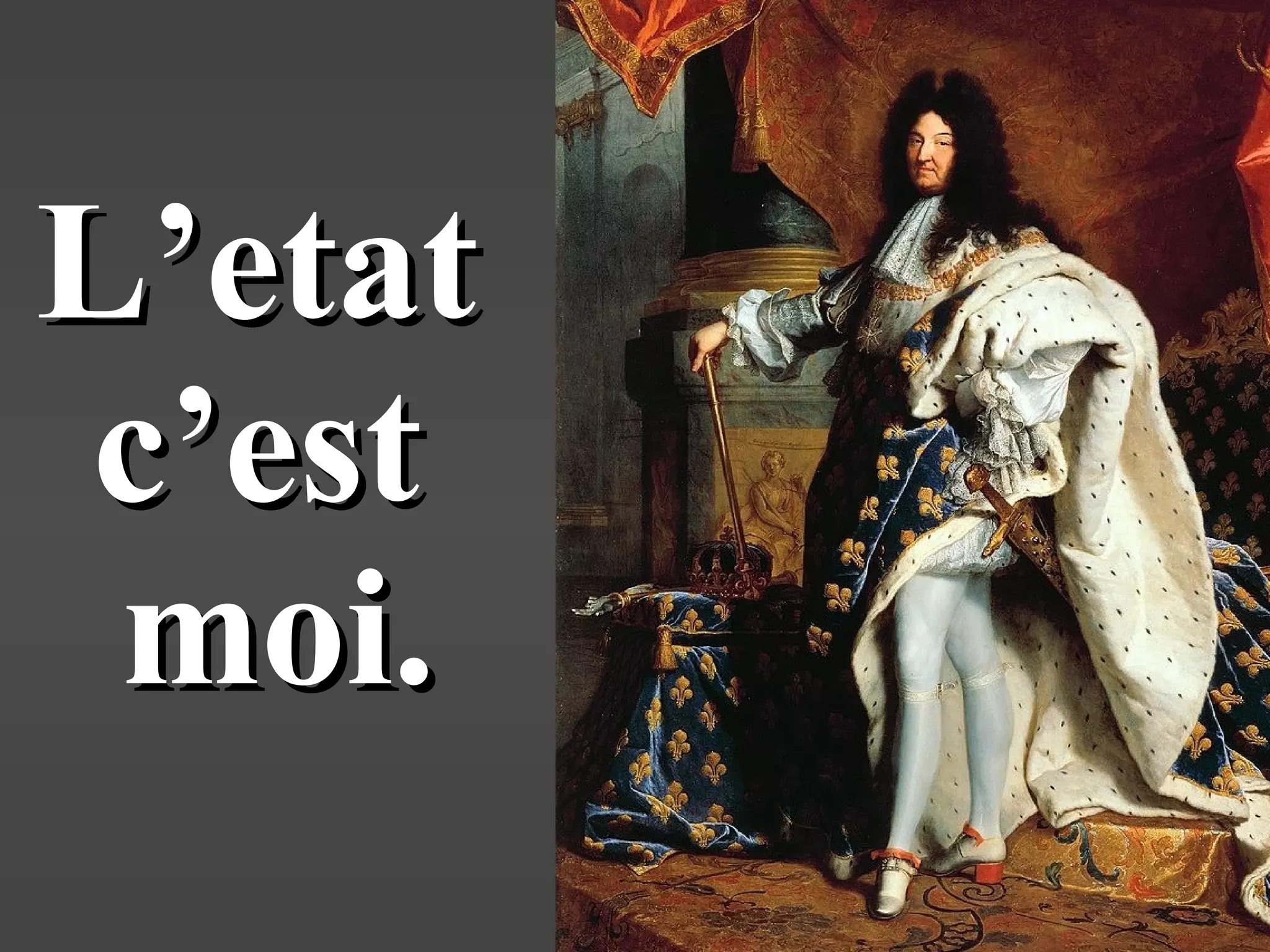
L’etatL’etat
c’estc’est
moi.moi.
I am theI am the
State.State.
• Young king supremely confident in
ability to rule
• When Mazarin died, 18-year-old
Louis declared he would run
government himself – takes reigns
of government in 1661
• “I am the state,” he declared
Confident in Ability to Rule
Central Government
• Drew power to himself, deprived nobles of influence
• Built palace outside Paris at Versailles; demanded nobles visit and live there
Central Government
• As nobles grew poorer, had to depend on king’s generosity just to survive
• Nobles gained prestige being servants at Versailles court, not by fighting
• Additionally, Louis urged nobles to develop expensive new habits of dressing, dining, and gambling
I’m so Fancy....
WHO DAT,WHO DAT,
WHO DAT?WHO DAT?
Photo Credit: G CHP
French nobles wereFrench nobles were
expected to attend toexpected to attend to
Louis regularly at hisLouis regularly at his
new palace atnew palace at
Versailles…Versailles…
PALACE OF VERSAILLES
Versailles was a grand spectacle of kingly power
• Louis XIV’s style, ceremony emphasized political strength
Film ClipFilm Clip
• Practically every moment of king’s day required rituals by bowing courtiers
– Eating, dressing, walking in garden, all required a ritual
– Louis always knew who had given what he considered proper attention
Un roi.Un roi.
Une loi.Une loi.
Une foi.Une foi.
ONEONE
KingKing
Some rights reserved by waitscm
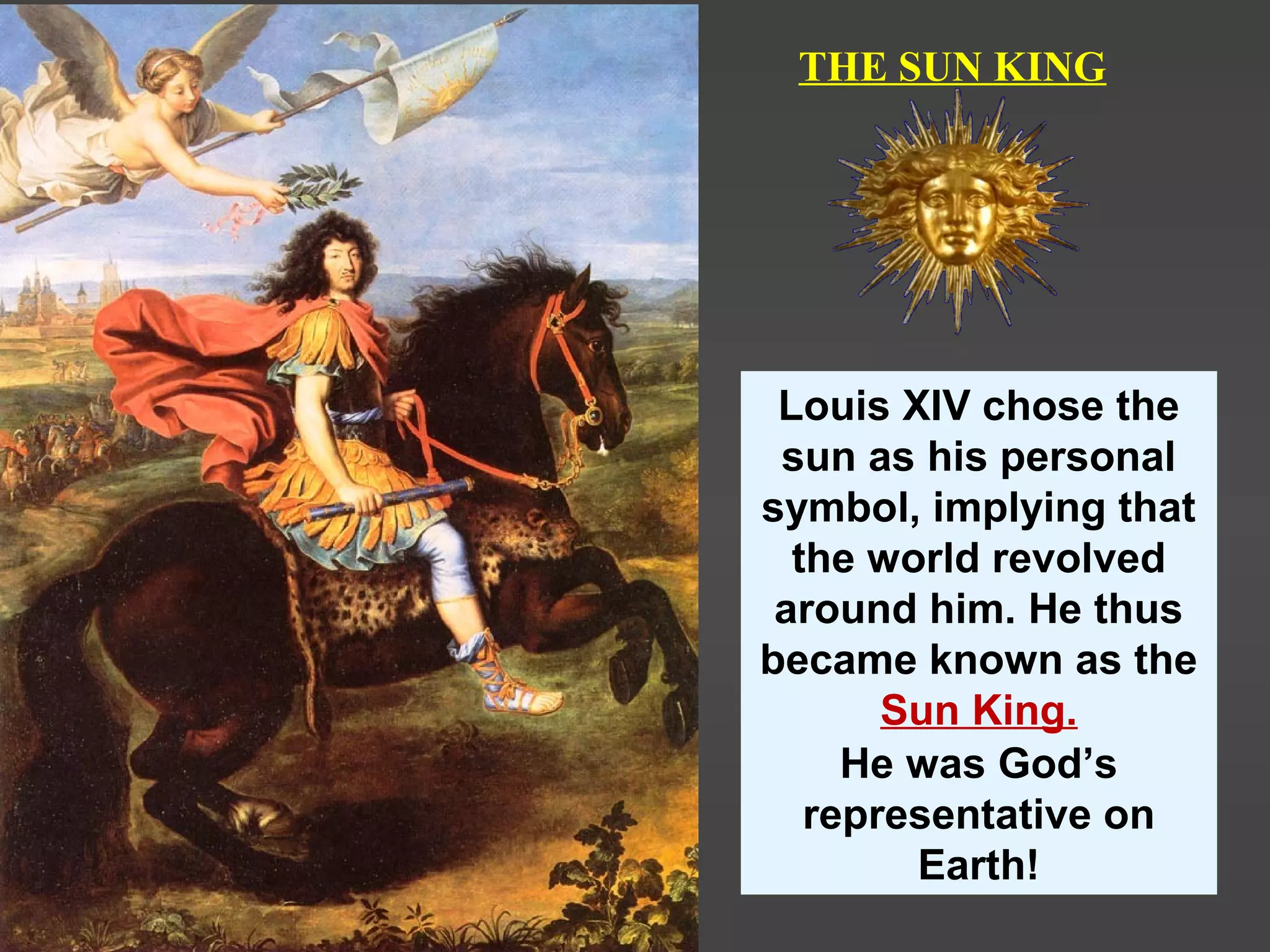
THE SUN KING
Louis XIV chose the
sun as his personal
symbol, implying that
the world revolved
around him. He thus
became known as the
Sun King.
He was God’s
representative on
Earth!
SWORDSWORD
NoblesNobles
Some rights reserved by Vasnic64
Old
Nobility
Some rights reserved by byronv2
ROBEROBE
NoblesNobles
New NobilityNew Nobility
ONEONE
LawLaw
TheThe CodeCode
LouisLouis
Louis attempted to
standardize the
laws in France,
which were based
on regional
customs.
ONEONE
FaithFaith
1598
Toleration for
Huguenots in some
French towns
Toleration for
Huguenots in some
French towns
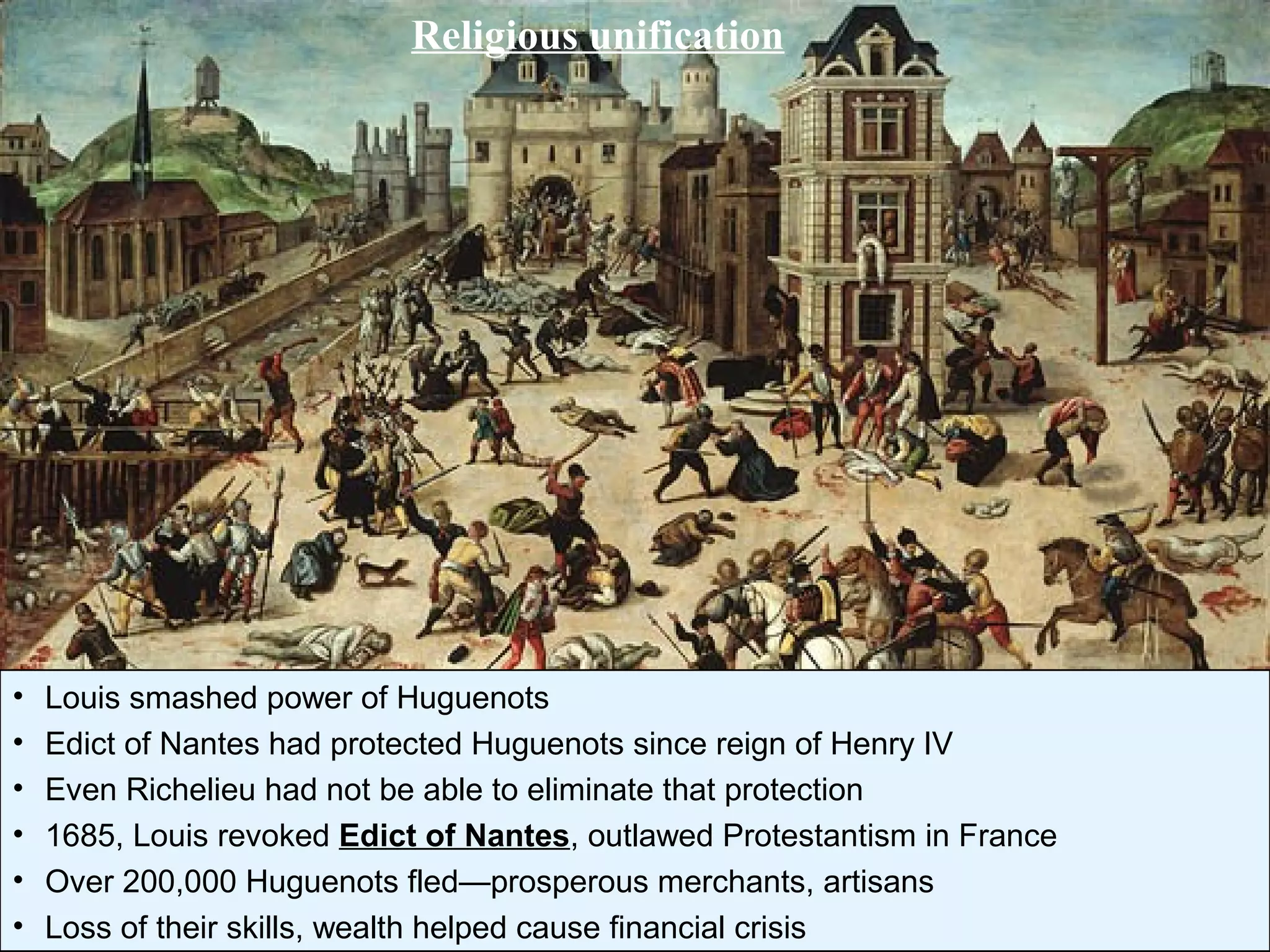
Religious unification
• Louis smashed power of Huguenots
• Edict of Nantes had protected Huguenots since reign of Henry IV
• Even Richelieu had not be able to eliminate that protection
• 1685, Louis revoked Edict of Nantes, outlawed Protestantism in France
• Over 200,000 Huguenots fled—prosperous merchants, artisans
• Loss of their skills, wealth helped cause financial crisis
But above all,But above all,
he washe was
KINGKINGSome rights reserved by jbelluch
• Louis needed cash to build up military, expand French territory– led to high
taxes
• Enlarged army to more than 200,000 disciplined soldiers
• Spent money on good equipment, weapons, shipping
• Was most powerful ruler in Europe, taking France to war four times
Most Powerful Ruler
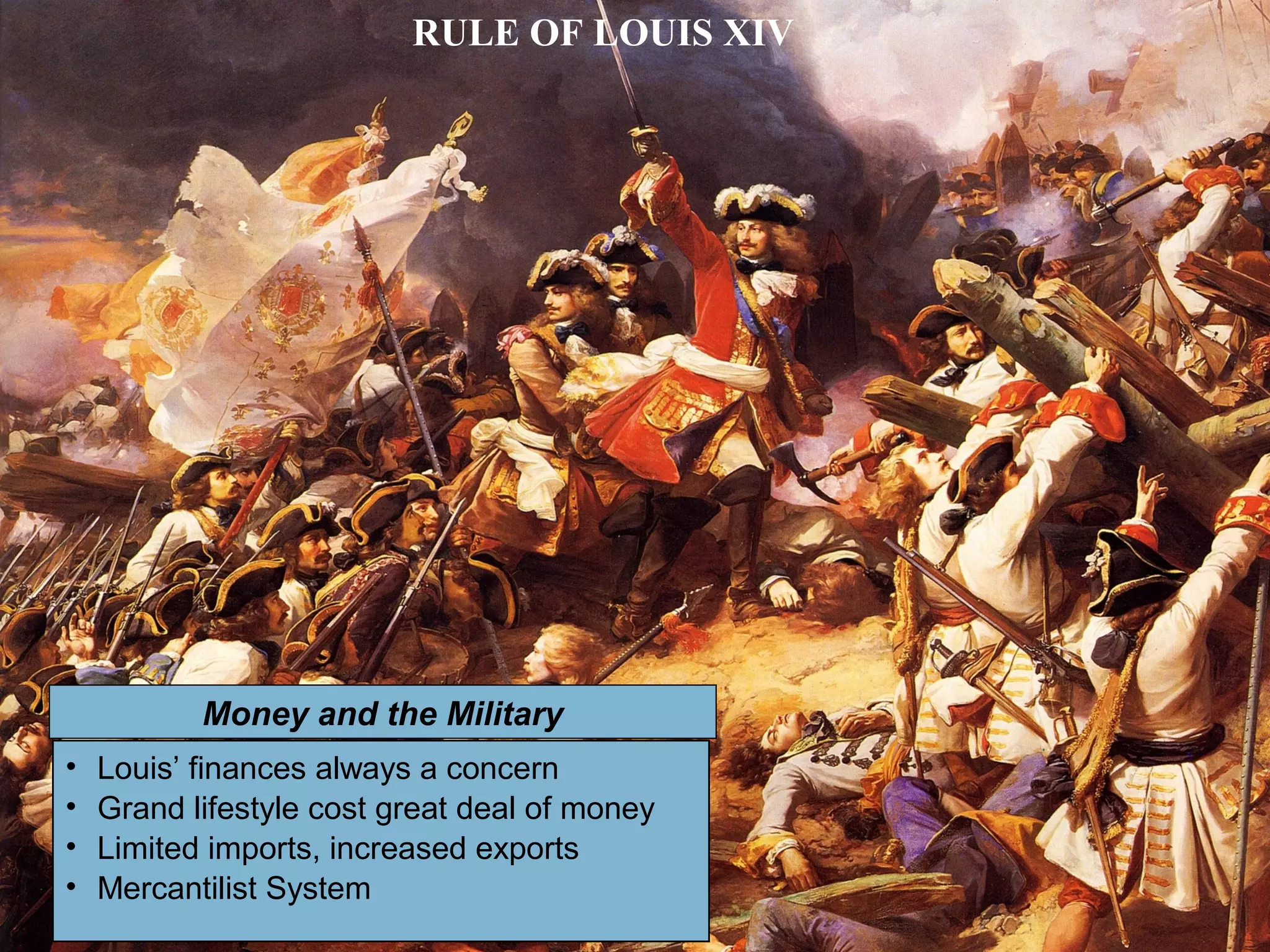
RULE OF LOUIS XIV
• Louis’ finances always a concern
• Grand lifestyle cost great deal of money
• Limited imports, increased exports
• Mercantilist System
Money and the Military
ABSOLUTISM IN FRANCE
 Dependant on many advisors & bureaucrats
 Many old privileges & customs continued to exist
UNNECESSARYUNNECESSARY
Louis never had to convene the Estates General,
the king’s advisory representative body.
Estates General
 Representative law making body – had to be called to meet by the King
ABSOLUTISM IN FRANCE
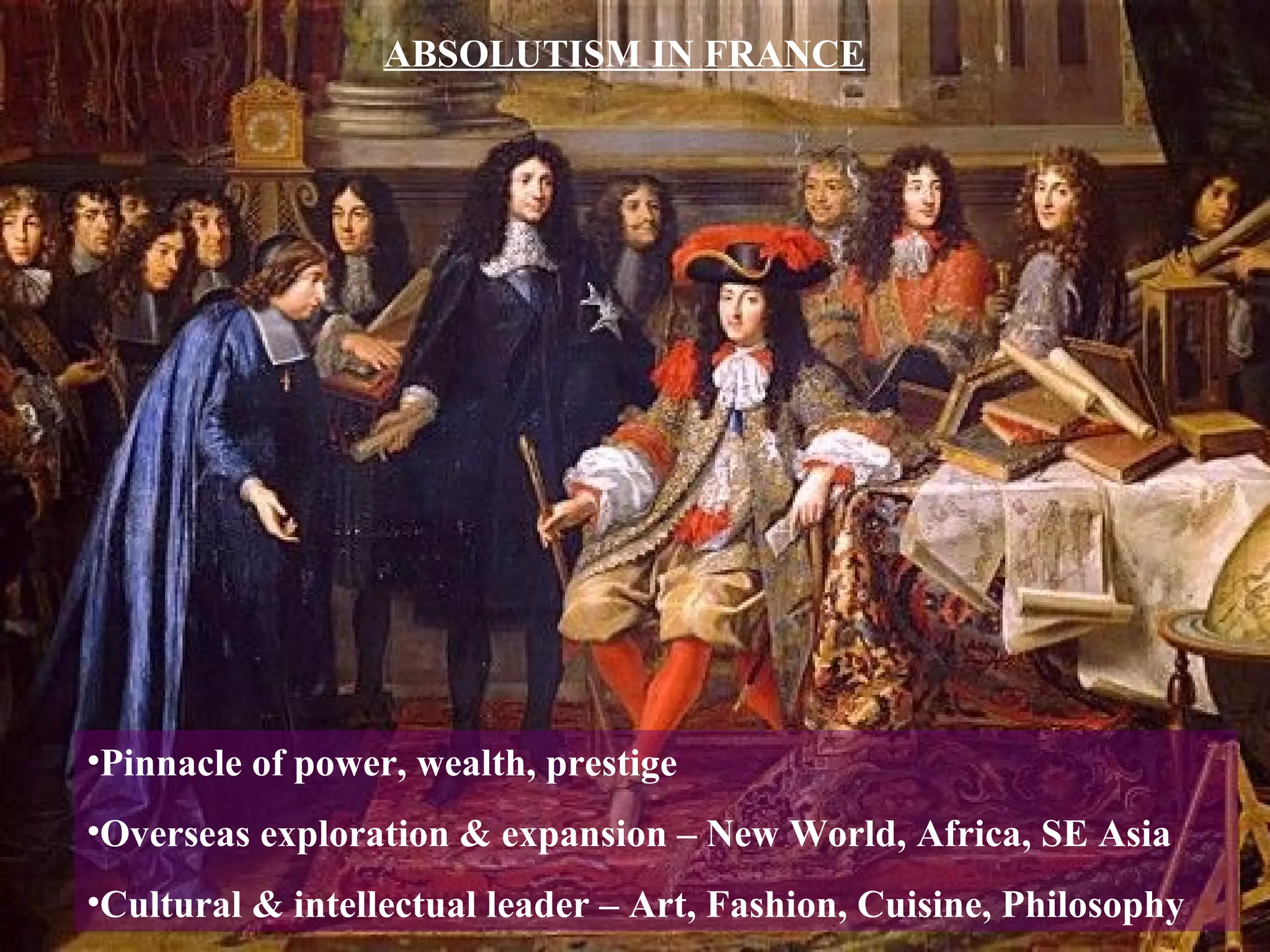
•Pinnacle of power, wealth, prestige
•Overseas exploration & expansion – New World, Africa, SE Asia
•Cultural & intellectual leader – Art, Fashion, Cuisine, Philosophy
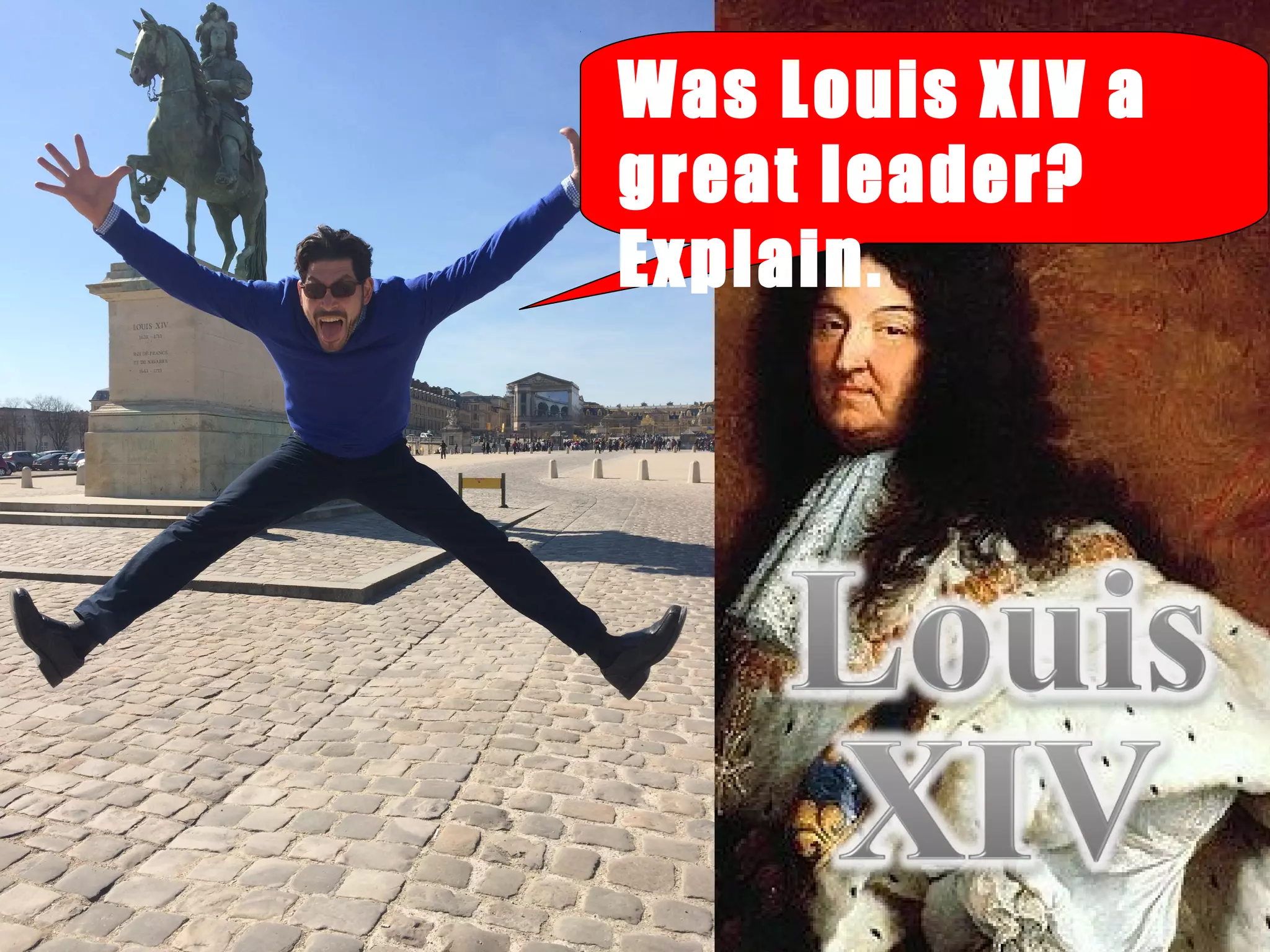
Was Louis XIV a
great leader?
Explain.
“I am leaving you, but the state remains
forever.”
-- Last Words of Louis XIVPhoto by Grangeburn
Niccola Machiavelli
The descriptions within The Prince
have the general theme of accepting
that the aims of princes—such as
glory and survival—can justify the
use of immoral means to achieve
those ends.
The descriptions within The Prince
have the general theme of accepting
that the aims of princes—such as
glory and survival—can justify the
use of immoral means to achieve
those ends.
Published in 1532 –
Famous for stating that
“the ends,
justify the
means”
Published in 1532 –
Famous for stating that
“the ends,
justify the
means”
Bronx Tale Machiavelli Clip
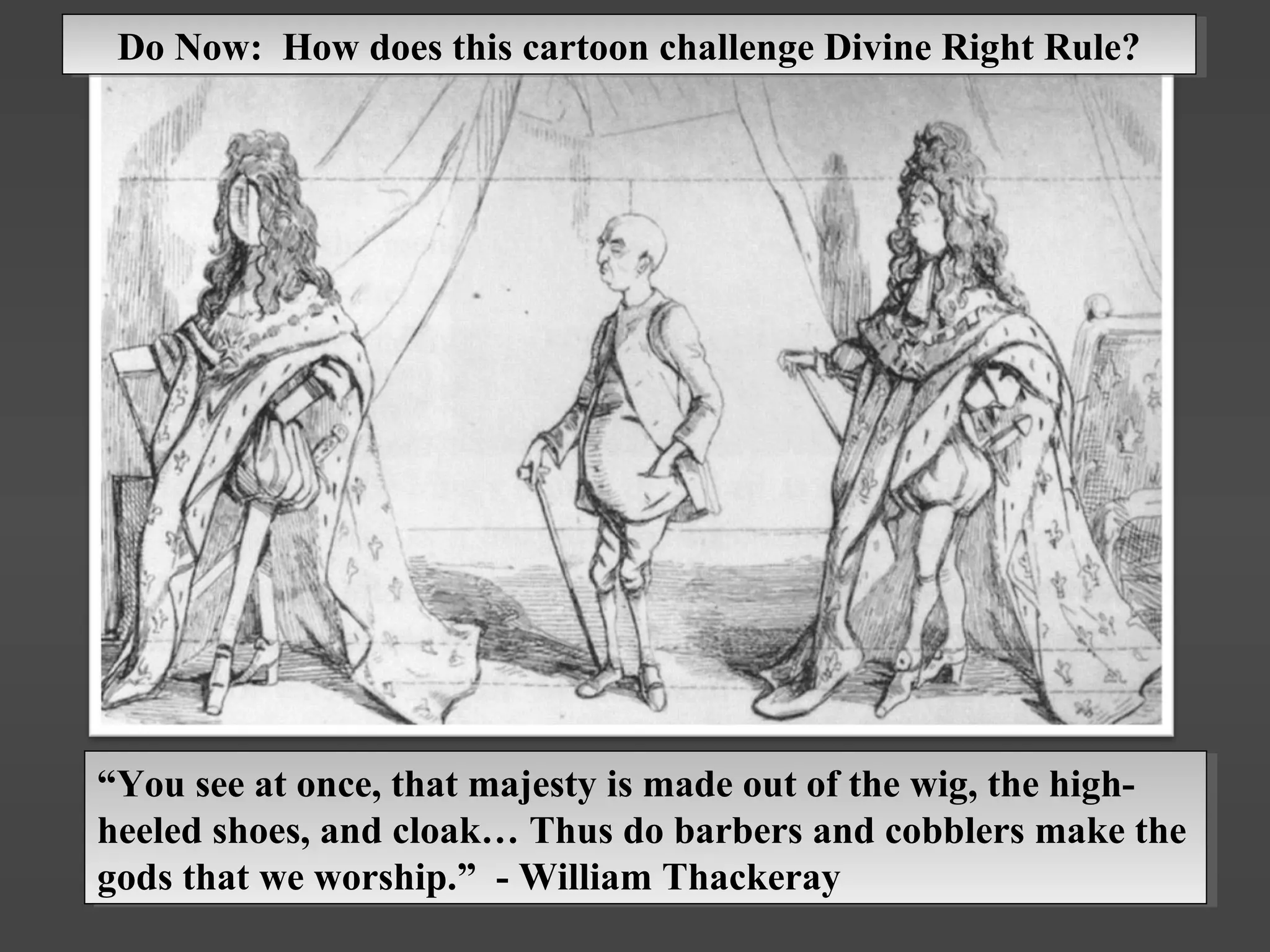
“You see at once, that majesty is made out of the wig, the high-
heeled shoes, and cloak… Thus do barbers and cobblers make the
gods that we worship.” - William Thackeray
“You see at once, that majesty is made out of the wig, the high-
heeled shoes, and cloak… Thus do barbers and cobblers make the
gods that we worship.” - William Thackeray
Do Now: How does this cartoon challenge Divine Right Rule?Do Now: How does this cartoon challenge Divine Right Rule?
Principal Ideas
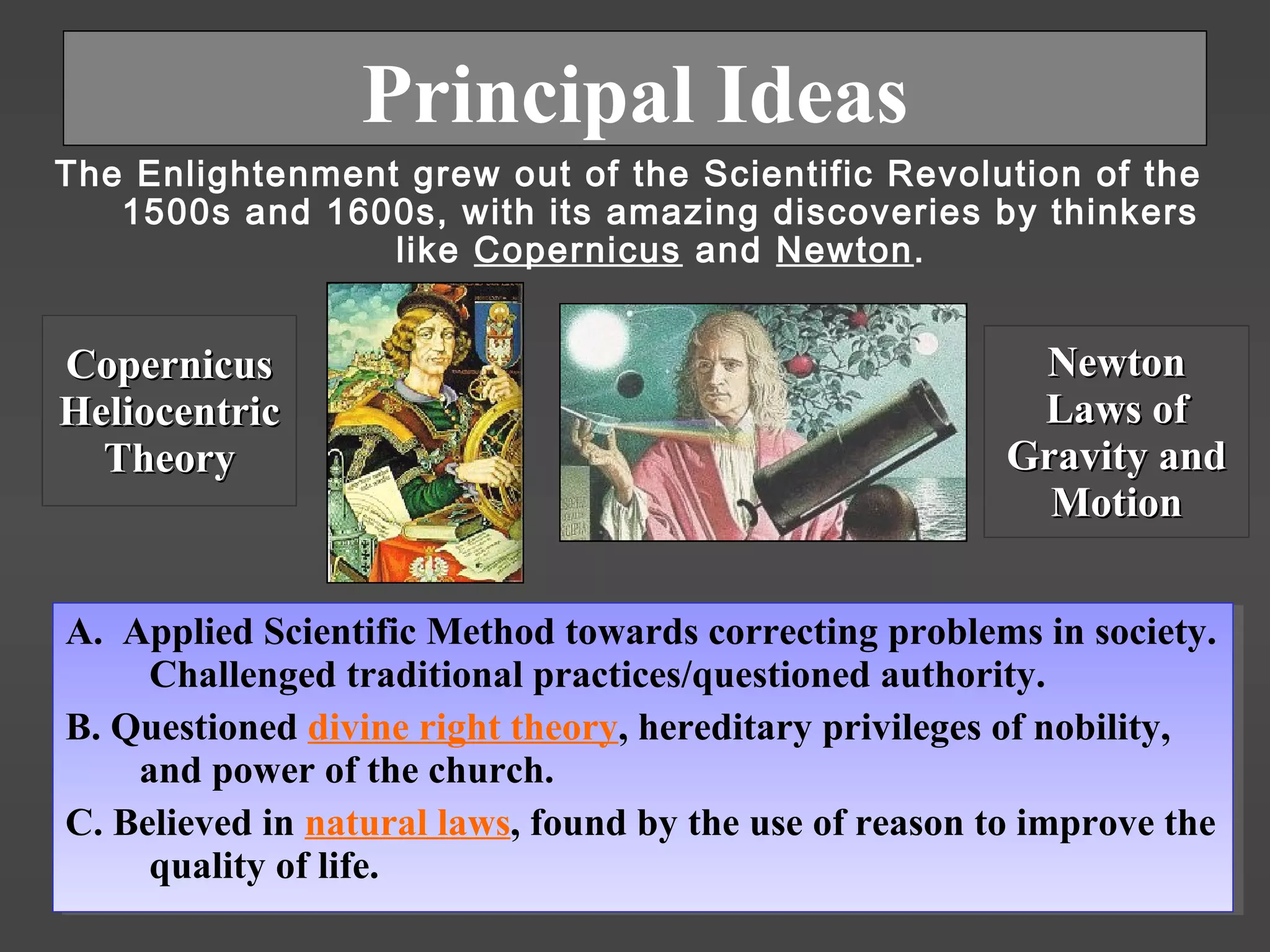
The Enlightenment grew out of the Scientific Revolution of the
1500s and 1600s, with its amazing discoveries by thinkers
like Copernicus and Newton.
CopernicusCopernicus
HeliocentricHeliocentric
TheoryTheory
NewtonNewton
Laws ofLaws of
Gravity andGravity and
MotionMotion
A. Applied Scientific Method towards correcting problems in society.
Challenged traditional practices/questioned authority.
B. Questioned divine right theory, hereditary privileges of nobility,
and power of the church.
C. Believed in natural laws, found by the use of reason to improve the
quality of life.
A. Applied Scientific Method towards correcting problems in society.
Challenged traditional practices/questioned authority.
B. Questioned divine right theory, hereditary privileges of nobility,
and power of the church.
C. Believed in natural laws, found by the use of reason to improve the
quality of life.
Key Thinkers of the Enlightenment:
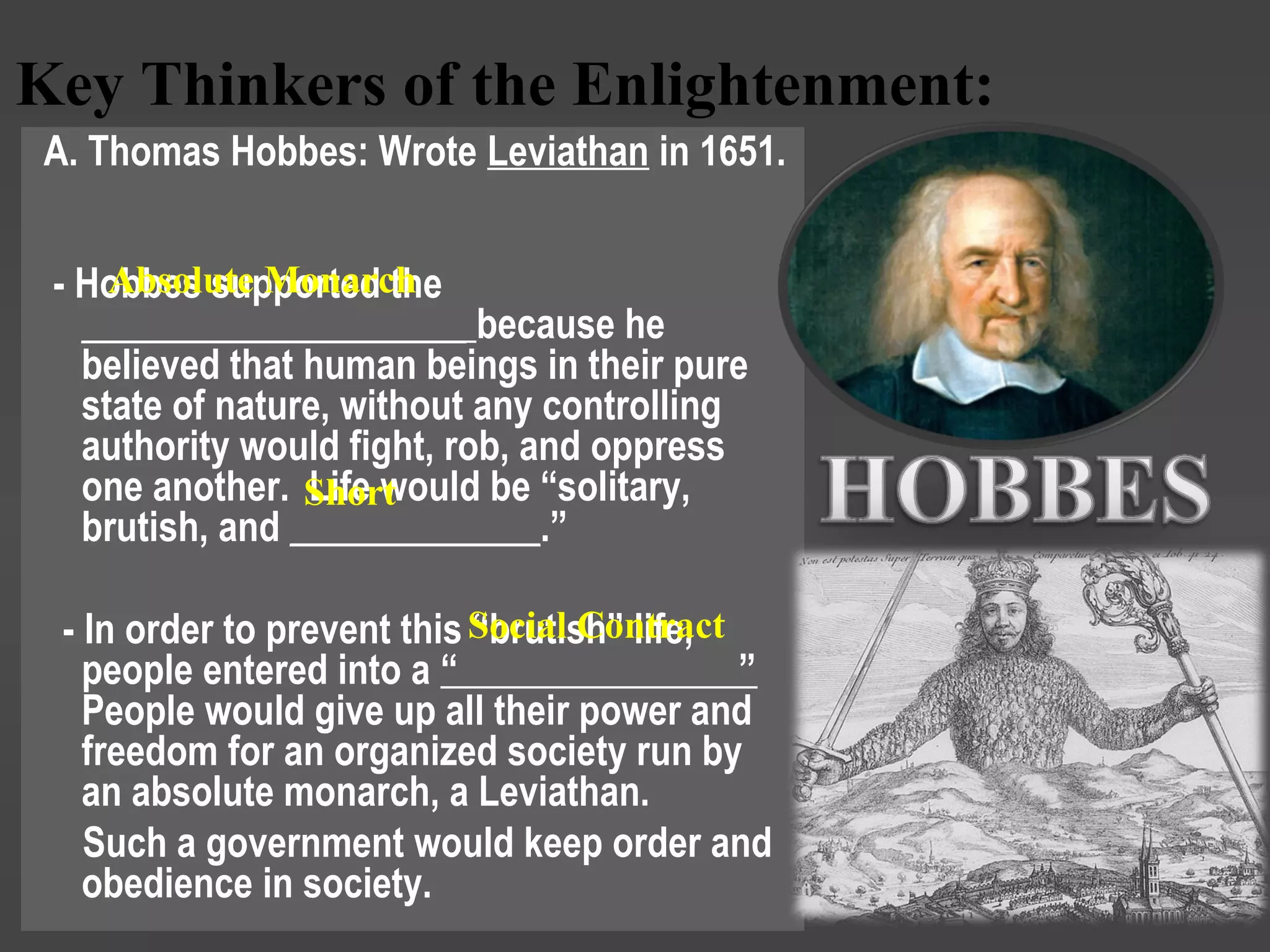
A. Thomas Hobbes: Wrote Leviathan in 1651.
- Hobbes supported the
____________________ because he
believed that human beings in their pure
state of nature, without any controlling
authority would fight, rob, and oppress
one another. Life would be “solitary,
brutish, and _____________.”
- In order to prevent this “brutish” life,
people entered into a “ ”
People would give up all their power and
freedom for an organized society run by
an absolute monarch, a Leviathan.
Such a government would keep order and
obedience in society.
Absolute Monarch
Short
Social Contract
B. John Locke: Wrote “Two Treatises of Government” in 1690.
- Locke supported the power of Parliament. He believed that human
beings in their pure state of nature were basically good, moral, and
. Also, he believed that all humans had “ ”
that they had since birth, which included the right to
______________________.
- People would agree with each other in a to set up a
government to protect their natural rights. People would give up
some rights but keep many others. The best government had
limited power and was accepted by all .
life, liberty, and propertylife, liberty, and property
Natural RightsNatural Rights
CitizensCitizens
Social ContractSocial Contract
ReasonableReasonable
**Locke changed the world with the idea
that government had an obligation to
those it governs. If it fails its obligations
and violates people’s natural rights, the
people have the right to ____________
the government. For Locke, the power
of the government was not ___________,
the consent of the __________ was
needed.
overthrowoverthrow
absoluteabsolute
peoplepeople
Enlightenment Matching!
Match the Enlightenment Thinker with their major idea
Thomas HobbesThomas Hobbes John LockeJohn Locke
Baron deBaron de
MontesquieuMontesquieu
People are naturally evil,
driven by selfishness and
greed. To avoid a
“Nasty, brutish and short
life” people must give up
their freedom to a strong
and strict government
that will ensure order. A
leviathan!
People are naturally
good and have three
natural rights, “life,
Liberty, and Property.”
Government is there to
protect those rights.
The people have a right
to change their
government if it fails to
do so.
The powers of
government should
be separated into
executive, legislative,
and judicial
branches, to prevent
any one group from
gaining too much
power.
Enlightenment Matching!
Match the Enlightenment Thinker with their major idea
Questioned the notion that
women were by nature
inferior to men and argued
that women have been
excluded from the social
contract. Stated that a
women’s first duty was to
be a good mother, but that
a woman should be able to
have an education and
equal rights of men.
People are basically
good but become
corrupted by society.
In an ideal society,
people would make
the laws and would
obey them willingly.
Government should
act for the “Common
good.”
Writer and orator who
targeted corrupt officials
and criticized inequality,
and superstition. Fought
for freedom of speech by
saying, “I do not agree
with a word you say, but
I will defend to the death
your right to say it.”
Mary WollstonecraftMary Wollstonecraft
VoltaireVoltaire Jean-Jacques RousseauJean-Jacques Rousseau
Enlightenment Summary
Which of the following were thoughts and goals of the
Enlightenment?
To Question “Divine Right” ruleTo Question “Divine Right” rule
To limit the Power of the KingTo limit the Power of the King
To give strong rulers total control over their nation.To give strong rulers total control over their nation.
To ensure the protection of an individual’s natural rights ofTo ensure the protection of an individual’s natural rights of
“Life, Liberty, and Property.”“Life, Liberty, and Property.”
To preserve old traditions, customs, and superstitionsTo preserve old traditions, customs, and superstitions
To protect free speech, religious freedom, and ensure socialTo protect free speech, religious freedom, and ensure social
equalityequality

Louis XIV

  • 1.
  • 2.
    Weak KingsWeak Kings AFrench Tradition Image by Sodacan Fleur de Lis (Lily Flower) French Monarchy
  • 3.
    France had noshortage of them!
  • 4.
  • 6.
  • 8.
    THE RISE OFABSOLUTISM IN FRANCE Cardinal Richelieu • Reduced power of nobility • Restricted local authorities •Richelieu’s spies uncovered series of planned revolts •Punishments were severe, including death for treason •wanted to reduce power of Huguenots, strengthen monarchy Punished Nobles
  • 9.
    THE RISE OFABSOLUTISM IN FRANCE Can you compare these tactics to the Tokugawa in Japan?
  • 10.
    Louis XIII’s queen, Anneof Austria, gave birth to FOUR stillborn
  • 11.
    Louis XIII dedicated France tothe Virgin Mary in 1638.
  • 12.
    Louis-Dieudonné the God-given This miraclebaby would bring the French monarchy to
  • 13.
    Louis’ father died whenhe was four. Young Louis XIV
  • 14.
    Chief Minister of France 1642-1661 •Louis XIV becomes king at young age, with mother as regent • Cardinal Mazarin, chief minister after Richelieu, provided advice • Louis raised to be king, taught skills needed from childhood Rise of the Sun King
  • 15.
    French nobles andParisian townspeople rebelled against Cardinal Mazarin and King Louis XIV. Photo by whiteafrican French for “sling”
  • 18.
    Louis put thenobles in theirLouis put the nobles in their • Louis XIV retained absolute power – Declared Divine Right Rule • Began tradition of absolute monarchy to last more than century • Demanded to be in charge of all military, political, economic initiatives Absolute Monarchy
  • 19.
  • 20.
    I am theIam the State.State. • Young king supremely confident in ability to rule • When Mazarin died, 18-year-old Louis declared he would run government himself – takes reigns of government in 1661 • “I am the state,” he declared Confident in Ability to Rule
  • 21.
    Central Government • Drewpower to himself, deprived nobles of influence • Built palace outside Paris at Versailles; demanded nobles visit and live there
  • 22.
    Central Government • Asnobles grew poorer, had to depend on king’s generosity just to survive • Nobles gained prestige being servants at Versailles court, not by fighting • Additionally, Louis urged nobles to develop expensive new habits of dressing, dining, and gambling
  • 23.
    I’m so Fancy.... WHODAT,WHO DAT, WHO DAT?WHO DAT?
  • 24.
    Photo Credit: GCHP French nobles wereFrench nobles were expected to attend toexpected to attend to Louis regularly at hisLouis regularly at his new palace atnew palace at Versailles…Versailles…
  • 25.
    PALACE OF VERSAILLES Versailleswas a grand spectacle of kingly power • Louis XIV’s style, ceremony emphasized political strength Film ClipFilm Clip
  • 26.
    • Practically everymoment of king’s day required rituals by bowing courtiers – Eating, dressing, walking in garden, all required a ritual – Louis always knew who had given what he considered proper attention
  • 27.
    Un roi.Un roi. Uneloi.Une loi. Une foi.Une foi.
  • 28.
  • 29.
  • 30.
    THE SUN KING LouisXIV chose the sun as his personal symbol, implying that the world revolved around him. He thus became known as the Sun King. He was God’s representative on Earth!
  • 31.
  • 32.
    Some rights reservedby byronv2 ROBEROBE NoblesNobles New NobilityNew Nobility
  • 33.
  • 34.
    TheThe CodeCode LouisLouis Louis attemptedto standardize the laws in France, which were based on regional customs.
  • 35.
  • 36.
    1598 Toleration for Huguenots insome French towns Toleration for Huguenots in some French towns
  • 37.
    Religious unification • Louissmashed power of Huguenots • Edict of Nantes had protected Huguenots since reign of Henry IV • Even Richelieu had not be able to eliminate that protection • 1685, Louis revoked Edict of Nantes, outlawed Protestantism in France • Over 200,000 Huguenots fled—prosperous merchants, artisans • Loss of their skills, wealth helped cause financial crisis
  • 38.
    But above all,Butabove all, he washe was KINGKINGSome rights reserved by jbelluch • Louis needed cash to build up military, expand French territory– led to high taxes • Enlarged army to more than 200,000 disciplined soldiers • Spent money on good equipment, weapons, shipping • Was most powerful ruler in Europe, taking France to war four times Most Powerful Ruler
  • 39.
    RULE OF LOUISXIV • Louis’ finances always a concern • Grand lifestyle cost great deal of money • Limited imports, increased exports • Mercantilist System Money and the Military
  • 40.
    ABSOLUTISM IN FRANCE Dependant on many advisors & bureaucrats  Many old privileges & customs continued to exist
  • 41.
    UNNECESSARYUNNECESSARY Louis never hadto convene the Estates General, the king’s advisory representative body. Estates General  Representative law making body – had to be called to meet by the King
  • 42.
    ABSOLUTISM IN FRANCE •Pinnacleof power, wealth, prestige •Overseas exploration & expansion – New World, Africa, SE Asia •Cultural & intellectual leader – Art, Fashion, Cuisine, Philosophy
  • 43.
    Was Louis XIVa great leader? Explain.
  • 44.
    “I am leavingyou, but the state remains forever.” -- Last Words of Louis XIVPhoto by Grangeburn
  • 45.
    Niccola Machiavelli The descriptionswithin The Prince have the general theme of accepting that the aims of princes—such as glory and survival—can justify the use of immoral means to achieve those ends. The descriptions within The Prince have the general theme of accepting that the aims of princes—such as glory and survival—can justify the use of immoral means to achieve those ends. Published in 1532 – Famous for stating that “the ends, justify the means” Published in 1532 – Famous for stating that “the ends, justify the means” Bronx Tale Machiavelli Clip
  • 46.
    “You see atonce, that majesty is made out of the wig, the high- heeled shoes, and cloak… Thus do barbers and cobblers make the gods that we worship.” - William Thackeray “You see at once, that majesty is made out of the wig, the high- heeled shoes, and cloak… Thus do barbers and cobblers make the gods that we worship.” - William Thackeray Do Now: How does this cartoon challenge Divine Right Rule?Do Now: How does this cartoon challenge Divine Right Rule?
  • 47.
    Principal Ideas The Enlightenmentgrew out of the Scientific Revolution of the 1500s and 1600s, with its amazing discoveries by thinkers like Copernicus and Newton. CopernicusCopernicus HeliocentricHeliocentric TheoryTheory NewtonNewton Laws ofLaws of Gravity andGravity and MotionMotion A. Applied Scientific Method towards correcting problems in society. Challenged traditional practices/questioned authority. B. Questioned divine right theory, hereditary privileges of nobility, and power of the church. C. Believed in natural laws, found by the use of reason to improve the quality of life. A. Applied Scientific Method towards correcting problems in society. Challenged traditional practices/questioned authority. B. Questioned divine right theory, hereditary privileges of nobility, and power of the church. C. Believed in natural laws, found by the use of reason to improve the quality of life.
  • 48.
    Key Thinkers ofthe Enlightenment: A. Thomas Hobbes: Wrote Leviathan in 1651. - Hobbes supported the ____________________ because he believed that human beings in their pure state of nature, without any controlling authority would fight, rob, and oppress one another. Life would be “solitary, brutish, and _____________.” - In order to prevent this “brutish” life, people entered into a “ ” People would give up all their power and freedom for an organized society run by an absolute monarch, a Leviathan. Such a government would keep order and obedience in society. Absolute Monarch Short Social Contract
  • 49.
    B. John Locke:Wrote “Two Treatises of Government” in 1690. - Locke supported the power of Parliament. He believed that human beings in their pure state of nature were basically good, moral, and . Also, he believed that all humans had “ ” that they had since birth, which included the right to ______________________. - People would agree with each other in a to set up a government to protect their natural rights. People would give up some rights but keep many others. The best government had limited power and was accepted by all . life, liberty, and propertylife, liberty, and property Natural RightsNatural Rights CitizensCitizens Social ContractSocial Contract ReasonableReasonable
  • 50.
    **Locke changed theworld with the idea that government had an obligation to those it governs. If it fails its obligations and violates people’s natural rights, the people have the right to ____________ the government. For Locke, the power of the government was not ___________, the consent of the __________ was needed. overthrowoverthrow absoluteabsolute peoplepeople
  • 51.
    Enlightenment Matching! Match theEnlightenment Thinker with their major idea Thomas HobbesThomas Hobbes John LockeJohn Locke Baron deBaron de MontesquieuMontesquieu People are naturally evil, driven by selfishness and greed. To avoid a “Nasty, brutish and short life” people must give up their freedom to a strong and strict government that will ensure order. A leviathan! People are naturally good and have three natural rights, “life, Liberty, and Property.” Government is there to protect those rights. The people have a right to change their government if it fails to do so. The powers of government should be separated into executive, legislative, and judicial branches, to prevent any one group from gaining too much power.
  • 52.
    Enlightenment Matching! Match theEnlightenment Thinker with their major idea Questioned the notion that women were by nature inferior to men and argued that women have been excluded from the social contract. Stated that a women’s first duty was to be a good mother, but that a woman should be able to have an education and equal rights of men. People are basically good but become corrupted by society. In an ideal society, people would make the laws and would obey them willingly. Government should act for the “Common good.” Writer and orator who targeted corrupt officials and criticized inequality, and superstition. Fought for freedom of speech by saying, “I do not agree with a word you say, but I will defend to the death your right to say it.” Mary WollstonecraftMary Wollstonecraft VoltaireVoltaire Jean-Jacques RousseauJean-Jacques Rousseau
  • 53.
    Enlightenment Summary Which ofthe following were thoughts and goals of the Enlightenment? To Question “Divine Right” ruleTo Question “Divine Right” rule To limit the Power of the KingTo limit the Power of the King To give strong rulers total control over their nation.To give strong rulers total control over their nation. To ensure the protection of an individual’s natural rights ofTo ensure the protection of an individual’s natural rights of “Life, Liberty, and Property.”“Life, Liberty, and Property.” To preserve old traditions, customs, and superstitionsTo preserve old traditions, customs, and superstitions To protect free speech, religious freedom, and ensure socialTo protect free speech, religious freedom, and ensure social equalityequality

Editor's Notes

  • #18 http://commons.wikimedia.org/wiki/File:Louis_XIV_by_Juste_d'Egmont.jpg