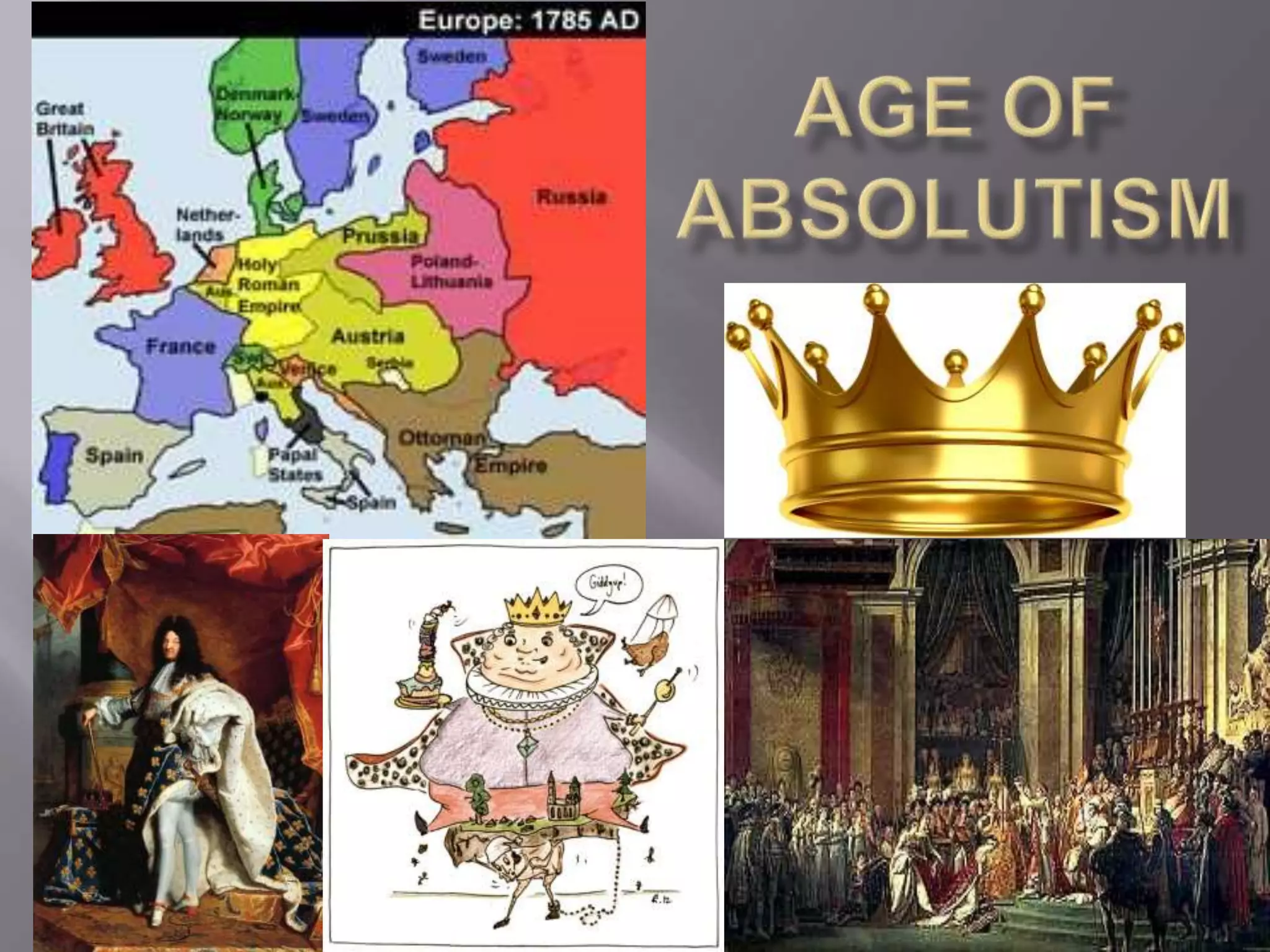
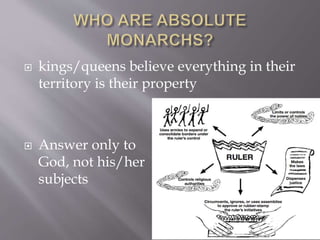
 kings/queens believe everything in their
territory is their property
 Answer only to
God, not his/her
subjects
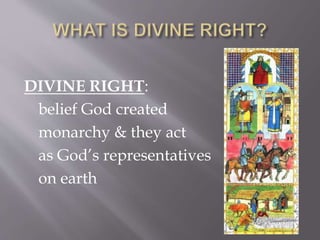
DIVINE RIGHT:
belief God created
monarchy & they act
as God’s representatives
on earth
 1562-1598  Huguenots & Catholics
fought 8 religious wars
 Chaos in France  leads to opening for
strong leaders to take over
 Similar cases in other European countries
 INCREASE OF MIDDLE CLASS, DECLINE OF
FEUDALISM, RISE OF CITIES
 17th Century was period of huge change in Europe
 monarchs imposed order by increasing own
power
 Monarchs created new government bureaucracies
to control economic life  GOAL: be free from
limitations set by nobility & Parliament; therefore
rule absolutely
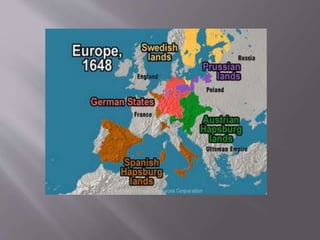
 Who: Hapsburgs of Austria and Spain vs. France,
Sweden, and German states
 What: When each religion in central Europe tried to
gain followers  led to war
 When: 1618 – 1648
 Where: Mostly fought on German soil
 Why: One last major war of religions in Europe;
following it’s end, religion divided Europe and
everyone had to be ok with it!
Ends war in 1648, consequences:
1) Weakened Hapsburgs of Spain & Austria
2) Strengthened France – gave it German territories
3) Made German princes independent of Holy
Roman Emperor
4) Ended religious wars in Europe
5) Introduced new method of peace negotiation
6) Most important: abandoned idea of Catholic
empire in Europe & recognized Europe as group of
independent states now all equal to each other
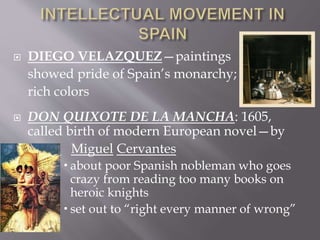
 DIEGO VELAZQUEZ—paintings
showed pride of Spain’s monarchy;
rich colors
 DON QUIXOTE DE LA MANCHA: 1605,
called birth of modern European novel—by
 Miguel Cervantes
 about poor Spanish nobleman who goes
crazy from reading too many books on
heroic knights
 set out to “right every manner of wrong”
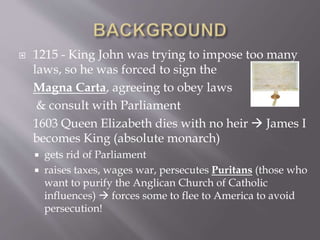
 1215 - King John was trying to impose too many
laws, so he was forced to sign the
Magna Carta, agreeing to obey laws
& consult with Parliament
1603 Queen Elizabeth dies with no heir  James I
becomes King (absolute monarch)
 gets rid of Parliament
 raises taxes, wages war, persecutes Puritans (those who
want to purify the Anglican Church of Catholic
influences)  forces some to flee to America to avoid
persecution!
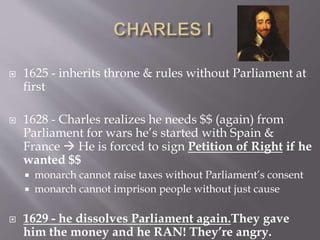
 1625 - inherits throne & rules without Parliament at
first
 1628 - Charles realizes he needs $$ (again) from
Parliament for wars he’s started with Spain &
France  He is forced to sign Petition of Right if he
wanted $$
 monarch cannot raise taxes without Parliament’s consent
 monarch cannot imprison people without just cause
 1629 - he dissolves Parliament again.They gave
him the money and he RAN! They’re angry.
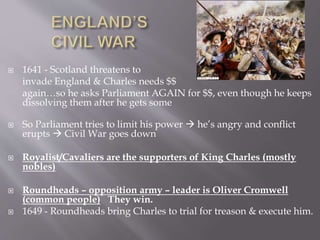
 1641 - Scotland threatens to
invade England & Charles needs $$
again…so he asks Parliament AGAIN for $$, even though he keeps
dissolving them after he gets some
 So Parliament tries to limit his power  he’s angry and conflict
erupts  Civil War goes down
 Royalist/Cavaliers are the supporters of King Charles (mostly
nobles)
 Roundheads – opposition army – leader is Oliver Cromwell
(common people) They win.
 1649 - Roundheads bring Charles to trial for treason & execute him.
 Cromwell becomes military ruler of England (abolishes
monarchy)
 passes strict laws against “sinful” acts (closes theatres, outlaws
gambling /dancing, bans books, etc.)…he’s crazy. He even bans
CHRISTMAS!!
 crushes rebellion in Ireland & takes land for his own soldiers
 religious toleration for everyone except Catholics (Ireland)
 1658 - Cromwell dies & new Parliament invites Charles
II to rule as King  “RESTORATION”
 He enjoyed parties and entertainment and restored everything
fun! He never married and had no legitimate kids.
 1685 - Charles II dies with no heir (he was too
busy partying)  James II becomes King (his
brother)
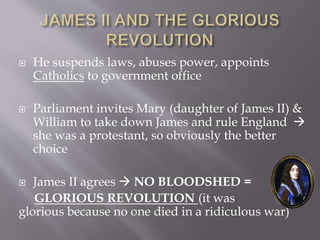
 He suspends laws, abuses power, appoints
Catholics to government office
 Parliament invites Mary (daughter of James II) &
William to take down James and rule England 
she was a protestant, so obviously the better
choice
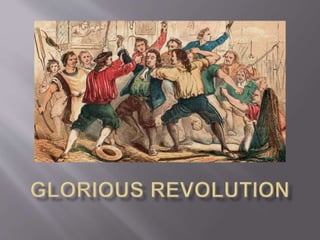
 James II agrees  NO BLOODSHED =
GLORIOUS REVOLUTION (it was
glorious because no one died in a ridiculous war)
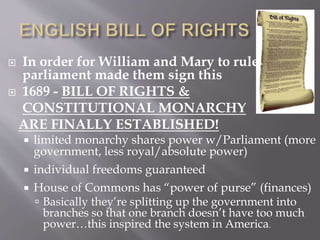
 In order for William and Mary to rule,
parliament made them sign this
 1689 - BILL OF RIGHTS &
CONSTITUTIONAL MONARCHY
ARE FINALLY ESTABLISHED!
 limited monarchy shares power w/Parliament (more
government, less royal/absolute power)
 individual freedoms guaranteed
 House of Commons has “power of purse” (finances)
 Basically they’re splitting up the government into
branches so that one branch doesn’t have too much
power…this inspired the system in America.
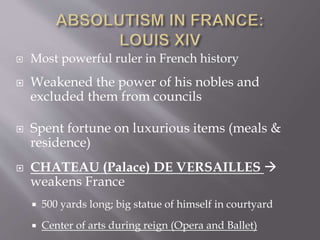
 Most powerful ruler in French history
 Weakened the power of his nobles and
excluded them from councils
 Spent fortune on luxurious items (meals &
residence)
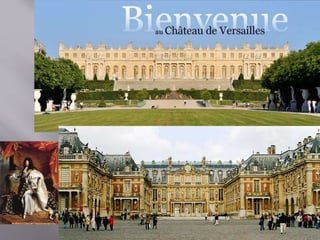
 CHATEAU (Palace) DE VERSAILLES 
weakens France
 500 yards long; big statue of himself in courtyard
 Center of arts during reign (Opera and Ballet)
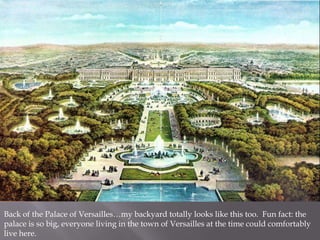
Back of the Palace of Versailles…my backyard totally looks like this too. Fun fact: the
palace is so big, everyone living in the town of Versailles at the time could comfortably
live here.
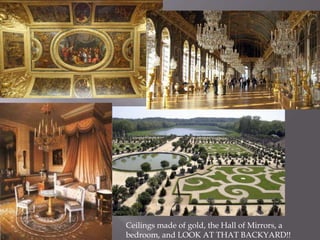
Ceilings made of gold, the Hall of Mirrors, a
bedroom, and LOOK AT THAT BACKYARD!!
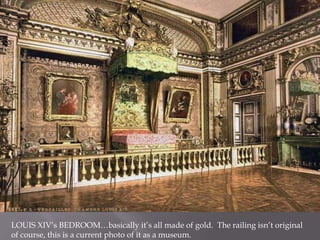
LOUIS XIV’s BEDROOM…basically it’s all made of gold. The railing isn’t original
of course, this is a current photo of it as a museum.
 1700, Louis’s grandson, Philip of Anjou, was promised the
throne of Spain after King Charles II’s death (no heir)
 So that meant the 2 greatest powers in Europe (France and
Spain) would now both be ruled by the Bourbon Family!
 Countries in Europe felt threatened by this & joined together
to fight France & Spain  War of Spanish Succession.
 End of the war was kind of a tie. Basically they all agreed that as long
as Philip and Louis didn’t unite their kingdoms into one mega-
kingdom, then Philip could go ahead and rule Spain . They agreed.
 Louis dies 1715--left a mixed legacy to his country because he
was a great military leader and built France’s military to be
the STRONGEST IN ITS HISTORY…but he wasted a lot of
money being selfish.
1. Hapsburgs of Austria (Holy Roman
Empire)  King Charles VI
Vs.
2. Hohenzollerns of Prussia – enemies of
Hapsburgs  King Fredrick William
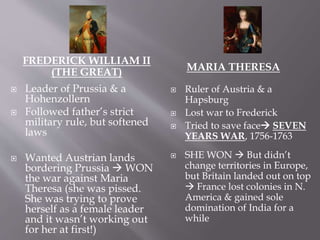
FREDERICK WILLIAM II
(THE GREAT) MARIA THERESA
 Leader of Prussia & a
Hohenzollern
 Followed father’s strict
military rule, but softened
laws
 Wanted Austrian lands
bordering Prussia  WON
the war against Maria
Theresa (she was pissed.
She was trying to prove
herself as a female leader
and it wasn’t working out
for her at first!)
 Ruler of Austria & a
Hapsburg
 Lost war to Frederick
 Tried to save face SEVEN
YEARS WAR, 1756-1763
 SHE WON  But didn’t
change territories in Europe,
but Britain landed out on top
 France lost colonies in N.
America & gained sole
domination of India for a
while
 Believed Russia’s future depends on warm-water
port  then could compete w/western Europe
 Went on GRAND EMBASSY with a goal of
westernization: using Europe as model for change &
make Russia stronger
 Russian Orthodox Church under state control
 Reduced power of landowners
 Heavy taxes to pay for army of 200,000
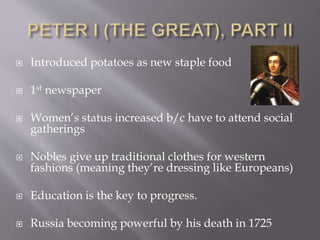
 Introduced potatoes as new staple food
 1st newspaper
 Women’s status increased b/c have to attend social
gatherings
 Nobles give up traditional clothes for western
fashions (meaning they’re dressing like Europeans)
 Education is the key to progress.
 Russia becoming powerful by his death in 1725

Absolutism

  • 2.
     kings/queens believeeverything in their territory is their property  Answer only to God, not his/her subjects
  • 3.
    DIVINE RIGHT: belief Godcreated monarchy & they act as God’s representatives on earth
  • 4.
     1562-1598 Huguenots & Catholics fought 8 religious wars  Chaos in France  leads to opening for strong leaders to take over  Similar cases in other European countries
  • 5.
     INCREASE OFMIDDLE CLASS, DECLINE OF FEUDALISM, RISE OF CITIES  17th Century was period of huge change in Europe  monarchs imposed order by increasing own power  Monarchs created new government bureaucracies to control economic life  GOAL: be free from limitations set by nobility & Parliament; therefore rule absolutely
  • 6.
     Who: Hapsburgsof Austria and Spain vs. France, Sweden, and German states  What: When each religion in central Europe tried to gain followers  led to war  When: 1618 – 1648  Where: Mostly fought on German soil  Why: One last major war of religions in Europe; following it’s end, religion divided Europe and everyone had to be ok with it!
  • 8.
    Ends war in1648, consequences: 1) Weakened Hapsburgs of Spain & Austria 2) Strengthened France – gave it German territories 3) Made German princes independent of Holy Roman Emperor 4) Ended religious wars in Europe 5) Introduced new method of peace negotiation 6) Most important: abandoned idea of Catholic empire in Europe & recognized Europe as group of independent states now all equal to each other
  • 9.
     DIEGO VELAZQUEZ—paintings showedpride of Spain’s monarchy; rich colors  DON QUIXOTE DE LA MANCHA: 1605, called birth of modern European novel—by  Miguel Cervantes  about poor Spanish nobleman who goes crazy from reading too many books on heroic knights  set out to “right every manner of wrong”
  • 11.
     1215 -King John was trying to impose too many laws, so he was forced to sign the Magna Carta, agreeing to obey laws & consult with Parliament 1603 Queen Elizabeth dies with no heir  James I becomes King (absolute monarch)  gets rid of Parliament  raises taxes, wages war, persecutes Puritans (those who want to purify the Anglican Church of Catholic influences)  forces some to flee to America to avoid persecution!
  • 12.
     1625 -inherits throne & rules without Parliament at first  1628 - Charles realizes he needs $$ (again) from Parliament for wars he’s started with Spain & France  He is forced to sign Petition of Right if he wanted $$  monarch cannot raise taxes without Parliament’s consent  monarch cannot imprison people without just cause  1629 - he dissolves Parliament again.They gave him the money and he RAN! They’re angry.
  • 13.
     1641 -Scotland threatens to invade England & Charles needs $$ again…so he asks Parliament AGAIN for $$, even though he keeps dissolving them after he gets some  So Parliament tries to limit his power  he’s angry and conflict erupts  Civil War goes down  Royalist/Cavaliers are the supporters of King Charles (mostly nobles)  Roundheads – opposition army – leader is Oliver Cromwell (common people) They win.  1649 - Roundheads bring Charles to trial for treason & execute him.
  • 14.
     Cromwell becomesmilitary ruler of England (abolishes monarchy)  passes strict laws against “sinful” acts (closes theatres, outlaws gambling /dancing, bans books, etc.)…he’s crazy. He even bans CHRISTMAS!!  crushes rebellion in Ireland & takes land for his own soldiers  religious toleration for everyone except Catholics (Ireland)  1658 - Cromwell dies & new Parliament invites Charles II to rule as King  “RESTORATION”  He enjoyed parties and entertainment and restored everything fun! He never married and had no legitimate kids.
  • 15.
     1685 -Charles II dies with no heir (he was too busy partying)  James II becomes King (his brother)
  • 16.
     He suspendslaws, abuses power, appoints Catholics to government office  Parliament invites Mary (daughter of James II) & William to take down James and rule England  she was a protestant, so obviously the better choice  James II agrees  NO BLOODSHED = GLORIOUS REVOLUTION (it was glorious because no one died in a ridiculous war)
  • 17.
     In orderfor William and Mary to rule, parliament made them sign this  1689 - BILL OF RIGHTS & CONSTITUTIONAL MONARCHY ARE FINALLY ESTABLISHED!  limited monarchy shares power w/Parliament (more government, less royal/absolute power)  individual freedoms guaranteed  House of Commons has “power of purse” (finances)  Basically they’re splitting up the government into branches so that one branch doesn’t have too much power…this inspired the system in America.
  • 19.
     Most powerfulruler in French history  Weakened the power of his nobles and excluded them from councils  Spent fortune on luxurious items (meals & residence)  CHATEAU (Palace) DE VERSAILLES  weakens France  500 yards long; big statue of himself in courtyard  Center of arts during reign (Opera and Ballet)
  • 21.
    Back of thePalace of Versailles…my backyard totally looks like this too. Fun fact: the palace is so big, everyone living in the town of Versailles at the time could comfortably live here.
  • 22.
    Ceilings made ofgold, the Hall of Mirrors, a bedroom, and LOOK AT THAT BACKYARD!!
  • 23.
    LOUIS XIV’s BEDROOM…basicallyit’s all made of gold. The railing isn’t original of course, this is a current photo of it as a museum.
  • 24.
     1700, Louis’sgrandson, Philip of Anjou, was promised the throne of Spain after King Charles II’s death (no heir)  So that meant the 2 greatest powers in Europe (France and Spain) would now both be ruled by the Bourbon Family!  Countries in Europe felt threatened by this & joined together to fight France & Spain  War of Spanish Succession.  End of the war was kind of a tie. Basically they all agreed that as long as Philip and Louis didn’t unite their kingdoms into one mega- kingdom, then Philip could go ahead and rule Spain . They agreed.  Louis dies 1715--left a mixed legacy to his country because he was a great military leader and built France’s military to be the STRONGEST IN ITS HISTORY…but he wasted a lot of money being selfish.
  • 25.
    1. Hapsburgs ofAustria (Holy Roman Empire)  King Charles VI Vs. 2. Hohenzollerns of Prussia – enemies of Hapsburgs  King Fredrick William
  • 26.
    FREDERICK WILLIAM II (THEGREAT) MARIA THERESA  Leader of Prussia & a Hohenzollern  Followed father’s strict military rule, but softened laws  Wanted Austrian lands bordering Prussia  WON the war against Maria Theresa (she was pissed. She was trying to prove herself as a female leader and it wasn’t working out for her at first!)  Ruler of Austria & a Hapsburg  Lost war to Frederick  Tried to save face SEVEN YEARS WAR, 1756-1763  SHE WON  But didn’t change territories in Europe, but Britain landed out on top  France lost colonies in N. America & gained sole domination of India for a while
  • 27.
     Believed Russia’sfuture depends on warm-water port  then could compete w/western Europe  Went on GRAND EMBASSY with a goal of westernization: using Europe as model for change & make Russia stronger  Russian Orthodox Church under state control  Reduced power of landowners  Heavy taxes to pay for army of 200,000
  • 28.
     Introduced potatoesas new staple food  1st newspaper  Women’s status increased b/c have to attend social gatherings  Nobles give up traditional clothes for western fashions (meaning they’re dressing like Europeans)  Education is the key to progress.  Russia becoming powerful by his death in 1725