WELCOME
EVENTS AND PROCESSES
• Today we often take the ideas of liberty, freedom and equality for
granted. But we need to remind ourselves that these ideas also have a
history.
• The French Revolution led to the end of monarchy in France. A society
based on privileges gave way to a new system of governance. The
Declarations of the Rights of Man during the revolution, announced
the coming of a new time. The idea that all individuals had rights and
could claim equality became part of a new language of politics. These
notions of equality and freedom emerged as the central ideas of a new
age; but in different countries they were reinterpreted and rethought in
many different ways. The anti-colonial movements in India and China,
Africa and South-America, produced ideas that were innovative and
original, but they spoke in a language that gained currency only from
the late eighteenth century.
THE FRENCH REVOLUTION
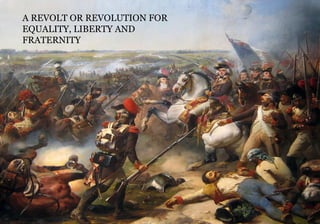
A REVOLT OR REVOLUTION FOR
EQUALITY, LIBERTY AND
FRATERNITY
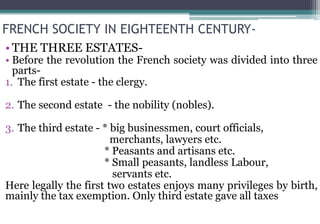
FRENCH SOCIETY IN EIGHTEENTH CENTURY-
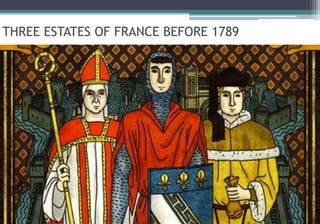
• THE THREE ESTATES-
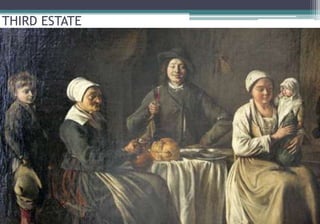
• Before the revolution the French society was divided into three
parts-
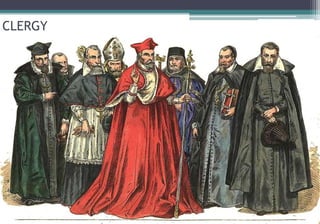
1. The first estate - the clergy.
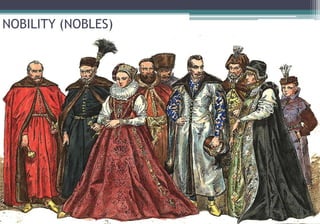
2. The second estate - the nobility (nobles).
3. The third estate - * big businessmen, court officials,
merchants, lawyers etc.
* Peasants and artisans etc.
* Small peasants, landless Labour,
servants etc.
Here legally the first two estates enjoys many privileges by birth,
mainly the tax exemption. Only third estate gave all taxes
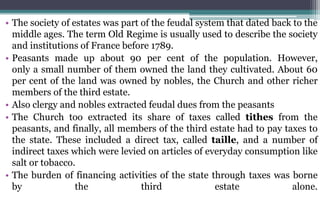
• The society of estates was part of the feudal system that dated back to the
middle ages. The term Old Regime is usually used to describe the society
and institutions of France before 1789.
• Peasants made up about 90 per cent of the population. However,
only a small number of them owned the land they cultivated. About 60
per cent of the land was owned by nobles, the Church and other richer
members of the third estate.
• Also clergy and nobles extracted feudal dues from the peasants
• The Church too extracted its share of taxes called tithes from the
peasants, and finally, all members of the third estate had to pay taxes to
the state. These included a direct tax, called taille, and a number of
indirect taxes which were levied on articles of everyday consumption like
salt or tobacco.
• The burden of financing activities of the state through taxes was borne
by the third estate alone.
THREE ESTATES OF FRANCE BEFORE 1789
CLERGY
NOBILITY (NOBLES)
THIRD ESTATE
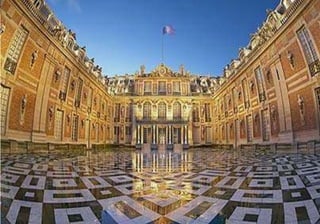
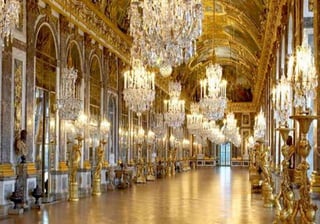
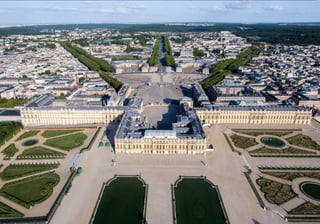
ROYAL PALACES OF VERSAILLES
LOUIS XVI
• Louis XVI was born on August 23rd 1754 at Palace of
Versailles, France. He belongs to Bourbon family of kings.
His first name was Louis-auguste then named as louis xvi
after his grandfather louis xv.
• In 1774, Louis (dauphin of France) ascended the
throne of France to his son Louis XVI. He was 20 years old
and married to the Austrian princess Marie Antoinette.
Upon his accession the new king found an empty treasury.
Long years of war had drained the financial resources of
France. Added to this was the cost of maintaining an
extravagant court at the immense palace of Versailles.
• Under Louis XVI, France helped the thirteen American
colonies to gain their independence from the common
enemy, Britain. The war added more than a billion livres
(currency of France at that time) to a debt that had already
risen to more than 2 billion livres. Lenders who gave the
state credit, now began to charge 10 per cent interest on
loans. So the French government was obliged to spend an
increasing percentage of its budget on interest payments
alone. To meet its regular expenses, such as the cost of
maintaining an army, the court, running government offices
or universities, the state was forced to increase taxes.
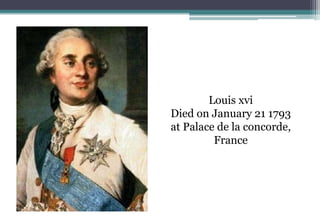
Louis xvi
Died on January 21 1793
at Palace de la concorde,
France
MARIE ANTOINETTE
• Marie Antoinette, an Archduchess (daughter of the emperor of
Austria) of Austria, was the fifteenth and second youngest child of
Holy Roman Emperor Francis I and Empress Maria Theresa.
• In April 1770, upon her marriage (at the age of 14 years and 5
months) to Louis-auguste, heir to the throne of France, she became
Dauphine of France. On 10 May 1774, when her husband ascended
the throne as Louis xvi, upon the death of his grandfather Louis xv,
she became queen of Austria and Navarre, a title she held until
September 1791, when, as the French Revolution proceeded, she
became Queen of the French, a title she held until 21 September
1792.
• Born on November 2 , 1755 at Vienna, Austria.
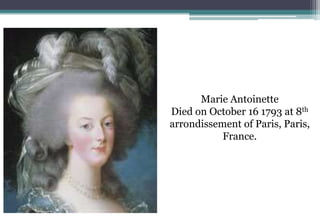
Marie Antoinette
Died on October 16 1793 at 8th
arrondissement of Paris, Paris,
France.
THE STRUGGLE TO SURVIVE
•The population of France rose from about 23 million in
1715 to 28 million in 1789. This led to a rapid increase
in the demand for food grains. Production of grains
could not keep pace with the demand. So the price of
bread which was the staple diet of the majority rose
rapidly. Most workers were employed as labourers in
workshops whose owner fixed their wages. But wages
did not keep pace with the rise in prices. So the gap
between the poor and the rich widened.
A GROWING OF MIDDLE CLASS ENVISAGES AND END TO
PRIVILEGES
• In the past, peasants and workers had participated in revolts against
increasing taxes and food scarcity. But they lacked the means and
programmes to carry out full-scale measures that would bring about
a change in the social and economic order. This was left to those
groups within the third estate who had become prosperous and had
access to education and new ideas.
• The eighteenth century witnessed the emergence of social groups,
termed the middle class, who earned their wealth through an
expanding overseas trade and from the manufacture of goods such as
woollen and silk textiles that were either exported or bought by the
richer members of society. In addition to merchants and
manufacturers, the third estate included professions such as lawyers
or administrative officials. All of these were educated and believed
that no group in society should be privileged by birth. Rather, a
person’s social position must depend on his merit.
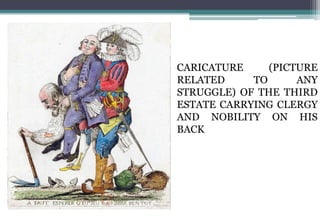
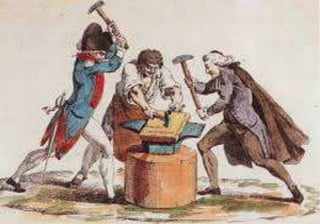
CARICATURE (PICTURE
RELATED TO ANY
STRUGGLE) OF THE THIRD
ESTATE CARRYING CLERGY
AND NOBILITY ON HIS
BACK
SOME PHILOSOPHERS WHO HELPED TO BRING EQUALITY IN
FRANCE
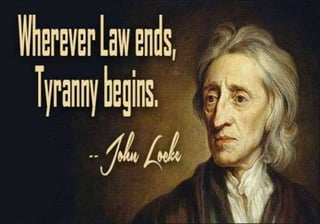
I. JOHN LOCKE-
• John Locke was born on 29th August 1632 was an English philosopher and
physician, widely regarded as one of the most influential
of Enlightenment thinkers and commonly known as the "Father
of Liberalism". Considered one of the first of the British empiricists,
following the tradition of Sir Francis Bacon, he is equally important
to social contract theory. His work greatly affected the development of
epistemology and political philosophy. His writings
influenced Voltaire and Rousseau, many Scottish enlightenment thinkers,
as well as the American revolutionaries. His contributions to classical
republicanism and liberal theory are reflected in the United states
declaration of independence. He wrote many books like Two Treatises of
Government, A Letter Concerning Toleration etc.. In his book ‘Two
Treatises of Government’ he sought to prove the doctrine of the divine and
absolute right of the monarch. He died on 28 October 1704.
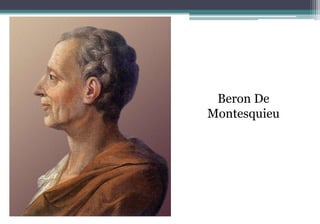
II. Beron De La Brède et de Montesquieu-
• Baron de La Brède et de Montesquieu born on 18th January 1689,
generally referred to as simply Montesquieu, was
a French lawyer, man of letters, and political philosopher who
lived during the Age of Enlightenment. He is famous for his
articulation of the theory of separation of powers, which is
implemented in many constitutions throughout the world. He is
also known for doing more than any other author to secure the
place of the word despotism in the political lexicon. He wrote
many books like The Spirit of the Laws, The Temple of Gnidos,
Gleanings etc.. In his book ‘The Spirit of Laws’ proposed a
division of power within the government between the legislative,
the executive and the judiciary. This model of government was
put into force in the USA, after the thirteen colonies declared
their independence from Britain. The American constitution and
its guarantee of individual rights was an important example for
political thinkers in France. He died on 10th February 1755.
Beron De
Montesquieu
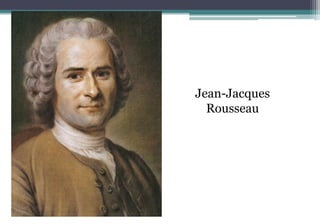
III. Jean-Jacques Rousseau
• Jean-Jacques Rousseau 28th June 1712 was a Francophone Genevan
philosopher, writer, and composer of the 18th century. His political
philosophy influenced the Enlightenment in France and across Europe, as
well as aspects of the French Revolution and the overall development of
modern political and educational thought.
• Rousseau's novel Emile, or On Education is a treatise on the education of
the whole person for citizenship. Rousseau's autobiographical writings —
his Confessions, which initiated the modern autobiography, His Discourse
on Inequality and The Social Contract are cornerstones in modern political
and social thought.
• He died on 2nd July 1778
Jean-Jacques
Rousseau
The Outbreak of the Revolution
• In France of the Old Regime the monarch did not have the power to impose
taxes according to his will alone. Rather he had to call a meeting of the
Estates General which would then pass his proposals for new taxes. The
Estates General was a political body to which the three estates sent their
representatives. The last time it was done was in 1614. On 5 May 1789, Louis
XVI called together an assembly of the Estates General to pass proposals for
new taxes. A resplendent hall in Versailles was prepared to host the
delegates. The first and second estates sent 300 representatives each, who
were seated in rows facing each other on two sides, while the 600 members
of the third estate had to stand at the back. The third estate was represented
by its more prosperous and educated members. However, their grievances
and demands were listed in some 40,000 letters which the representatives
had brought with them. Voting in the Estates General in the past had been
conducted according to the principle that each estate had one vote. This time
too Louis XVI was determined to continue the same practice. But members of
the third estate demanded that voting now be conducted by the assembly as a
whole, where each member would have one vote.
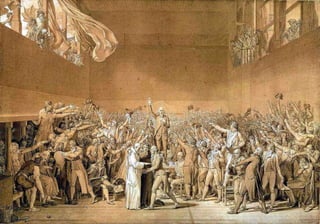
• The representatives of the third estate viewed themselves as
spokesmen for the whole French nation. On 20 June they
assembled in the hall of an indoor tennis court in the
grounds of Versailles. They declared themselves a National
Assembly and swore not to disperse till they had drafted a
constitution for France that would limit the powers of the
monarch. They were led by Mirabeau and Abbé Sieyès.
Mirabeau was born in a noble family but was convinced of
the need to do away with a society of feudal privilege. He
brought out a journal and delivered powerful speeches to the
crowds assembled at Versailles.
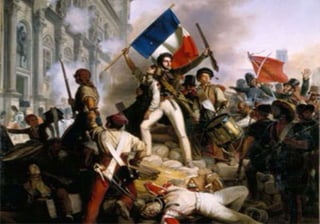
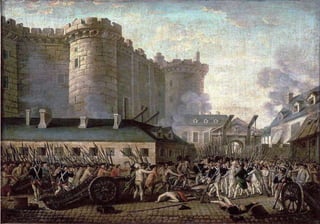
STORMING OF THIRD ESTATE PEOPLE ON BASTILLE IN 1789
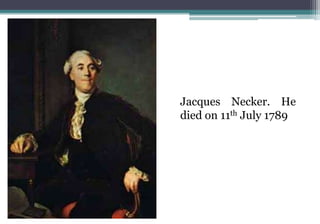
• Jacques Necker - Jacques Necker 30th September 1732 was a
French statesman of Swiss birth and finance minister of Louis XVI,
a post he held in the lead-up to the French Revolution in 1789. By
this time, Necker had earned the enmity of many members of the
French court for his overt manipulation of public opinion. Marie
Antoinette, the King's younger brother Comte d‘ Artois, and other
conservative members of the King's privy council urged him to
dismiss Necker as financial advisor. On 11th July 1789, after Necker
published an inaccurate account of the government's debts and
made it available to the public, the King fired him, and completely
restructured the finance ministry at the same time.
Jacques Necker. He
died on 11th July 1789
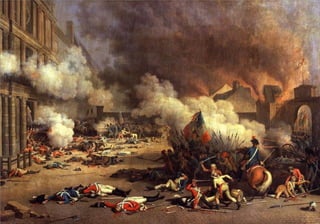
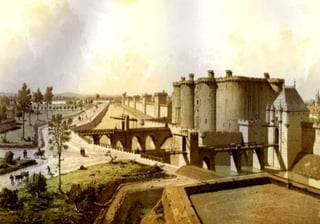
• On 14 July, the insurgents set their eyes on the large weapons and
ammunition cache inside the Bastille fortress, which was also perceived to
be a symbol of royal power. After several hours of combat, the prison fell
that afternoon. Despite ordering a ceasefire, which prevented a mutual
massacre, Governor Marquis Bernard de Launay was beaten, stabbed and
decapitated; his head was placed on a pike and paraded about the city.
Although the fortress had held only seven prisoners (four forgers, two
noblemen kept for immoral behaviour, and a murder suspect) the Bastille
served as a potent symbol of everything hated under the Ancient Regime.
Returning to the Hotel de Ville (city hall) the mob accused
the mayor Jacques de Flesselles of treachery and butchered him. The King,
alarmed by the violence, backed down, at least for the time being.
The Marquis de la Fayette took up command of the National Guard at
Paris. Jean-Sylvain Bailly, president of the Assembly at the time of
the Tennis Court Oath, became the city's mayor under a new governmental
structure known as the commune. The King visited Paris, where, on 17th
July he accepted a tricolour cockade, to cries of Vive la Nation and Vive le
Roi ("Long live the King").
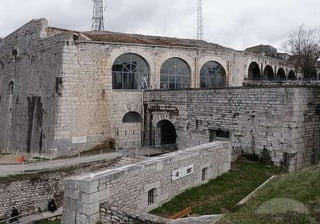
SOME PHOTOS OF ROYAL
FORT BASTILLE BEFORE THE
REVOLT
Abolition of feudalism and France becomes
constitutional monarchy
• On the night of 4th August 1789, the National Constituent Assembly
abolished feudalism (numerous peasant revolts had almost brought
feudalism to an end) in the Auguste Decrees, sweeping away both the
seigneurial rights of the Second Estate and the tithes (a 10% tax for the
Church) gathered by the First Estate. During the course of a few hours
nobles, clergy, towns, provinces, companies and cities lost their special
privileges.
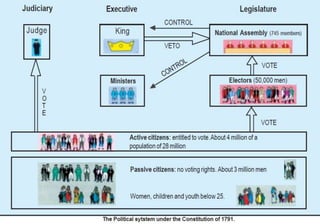
• The National Assembly completed the draft of the constitution in
1791. Its main object was to limit the powers of the monarch. These
powers instead of being concentrated in the hands of one person,
were now separated and assigned to different institutions – the
legislature, executive and judiciary. This made France a constitutional
monarchy.
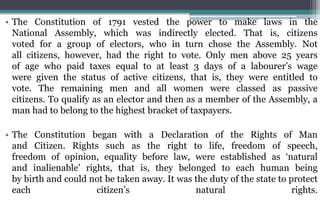
• The Constitution of 1791 vested the power to make laws in the
National Assembly, which was indirectly elected. That is, citizens
voted for a group of electors, who in turn chose the Assembly. Not
all citizens, however, had the right to vote. Only men above 25 years
of age who paid taxes equal to at least 3 days of a labourer’s wage
were given the status of active citizens, that is, they were entitled to
vote. The remaining men and all women were classed as passive
citizens. To qualify as an elector and then as a member of the Assembly, a
man had to belong to the highest bracket of taxpayers.
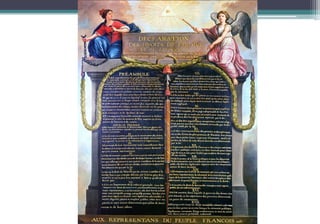
• The Constitution began with a Declaration of the Rights of Man
and Citizen. Rights such as the right to life, freedom of speech,
freedom of opinion, equality before law, were established as ‘natural
and inalienable’ rights, that is, they belonged to each human being
by birth and could not be taken away. It was the duty of the state to protect
each citizen’s natural rights.
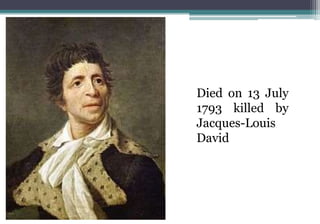
JEAN PAUL MARAT
• JEAN-PAUL MARAT was a revolutionary journalist born on 24th May 1743
at Boudry, Switzerland who wrote many articles in the famous newspaper
of France at that time - L’Ami du peuple (The friend of the people). His
articles were like which tells government about the state of people and tells
the government how to improve the law system indirectly.
• He in his newspaper on the Constitution drafted by the National Assembly:
• ‘The task of representing the people has been given to the rich … the lot of
the poor and oppressed will never be improved by peaceful means alone.
Here we have absolute proof of how wealth influences the law. Yet laws will
last only as long as the people agree to obey them. And when they have
managed to cast off the yoke of the aristocrats, they will do the same to the
other owners of wealth.’
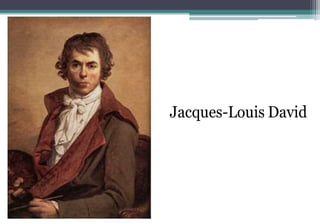
Died on 13 July
1793 killed by
Jacques-Louis
David
SOME POLITICAL SYMBOLS OF FRANCE WHICH WE HAVE TO
KNOW
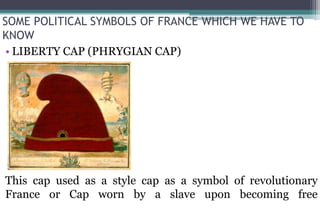
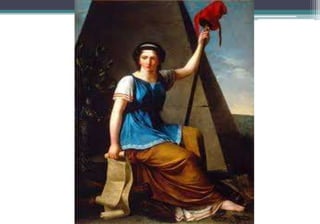
• LIBERTY CAP (PHRYGIAN CAP)
This cap used as a style cap as a symbol of revolutionary
France or Cap worn by a slave upon becoming free
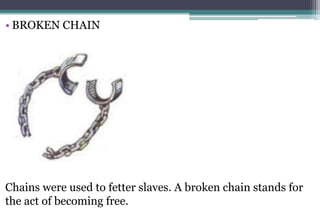
• BROKEN CHAIN
Chains were used to fetter slaves. A broken chain stands for
the act of becoming free.
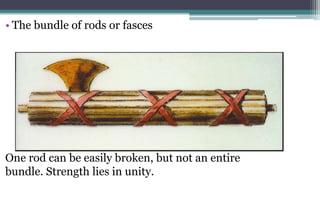
• The bundle of rods or fasces
One rod can be easily broken, but not an entire
bundle. Strength lies in unity.
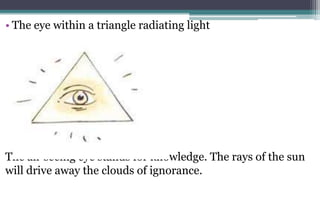
• The eye within a triangle radiating light
The all-seeing eye stands for knowledge. The rays of the sun
will drive away the clouds of ignorance.
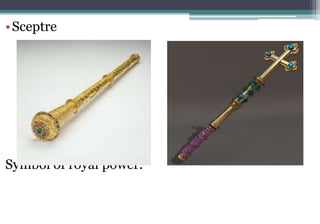
•Sceptre
Symbol of royal power.
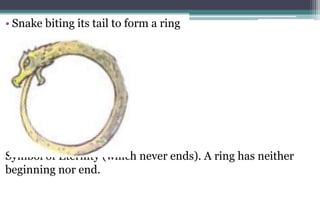
• Snake biting its tail to form a ring
Symbol of Eternity (which never ends). A ring has neither
beginning nor end.
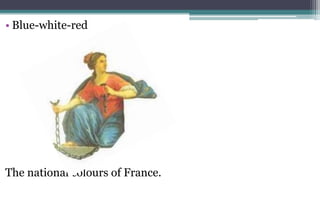
• Blue-white-red
The national colours of France.
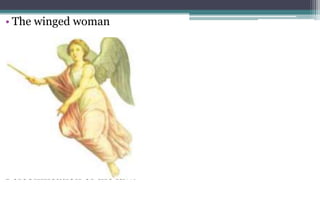
• The winged woman
Personification of the law.
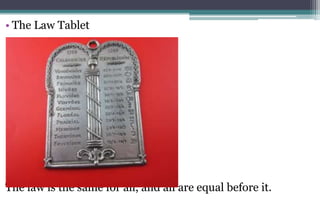
• The Law Tablet
The law is the same for all, and all are equal before it.
France Abolishes Monarchy
and Becomes a Republic
• In Revolutionary France, the Legislative Assembly votes to abolish the
monarchy and establish the First Republic. The measure came one year after
King Louis XVI reluctantly approved a new constitution that stripped him of
much of his power.
• Rulers of other neighbouring countries too were worried by the developments
in France and made plans to send troops to put down the events that had been
taking place there since the summer of 1789. Before this could happen, the
National Assembly voted in April 1792 to declare war against Prussia and
Austria. Thousands of volunteers thronged from the provinces to join the army.
They saw this as a war of the people against kings and aristocracies all over
Europe.
• Everybody sings La Marseillaise in many groups. Now this song is the national
anthem of France. This song was written by poet Claude Joseph Rouget de
Lisle on 1792 in Strasbourg, Alsace, France.
• The revolutionary wars brought losses and economic difficulties
to the people. While the men were away fighting at the front,
women were left to cope with the tasks of earning a living and
looking after their families.
• The Constitution of 1791 gave political rights only to the richer sections of
• Political clubs became an important rallying point for
people who wished to discuss government policies and plan their
own forms of action. The most successful of these clubs was that of
the Jacobins, which got its name from the former convent of St
Jacob in Paris. Women too, who had been active throughout this
period, formed their own clubs.
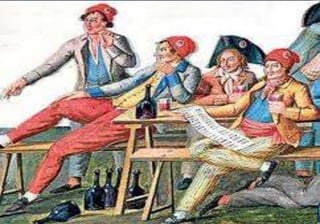
• The members of the Jacobin club belonged mainly to the less
prosperous sections of society. They included small shopkeepers,
artisans such as shoemakers, pastry cooks, watch-makers, printers,
as well as servants and daily-wage workers. Their leader was
Maximillian Robespierre. A large group among the Jacobins decided
to start wearing long striped trousers similar to those worn by
dock workers. This was to set themselves apart from the fashionable
sections of society, especially nobles, who wore knee breeches.
was a way of proclaiming the end of the power wielded by the
wearers of knee breeches. These Jacobins came to be known as the
sans-culottes, literally meaning ‘those without knee breeches’. Sans-
culottes men wore in addition the red cap that symbolised liberty. Women
however were not allowed to do so.
• The newly elected assembly was called the Convention. On
21 September 1792 it abolished the monarchy and declared
France a republic. As you know, a republic is a form of
government where the people elect the government including
the head of the government. There is no hereditary monarchy.
• You can try and find out about some other countries that are
republics and investigate when and how they became so. Louis
XVI was sentenced to death by a court on the charge of treason
(helped another country in a war). On 21 January 1793 he was
executed publicly at the Place de la Concorde. The queen Marie
Antoinette met with the same fate shortly after.
The Reign of Terror
• The Reign of Terror (6 September 1793 – 28 July 1794),
also known as The Terror, was a period of violence that
occurred after the onset of the French Revolution, incited
by conflict between two rival political factions,
the Girondins and The Jacobins, and marked by mass
executions of "enemies of the revolution". The death toll
ranged in the tens of thousands, with 16,594 executed
by guillotine (2,639 in Paris), and another 25,000
in summary executions across France.
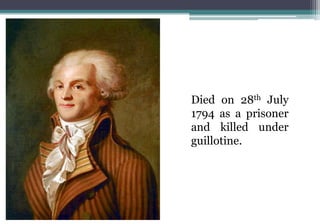
• Maximilien François Marie Isidore de Robespierre was born on 6th
May 1758 Arras, Artois, France. Robespierre followed a policy of severe
control and punishment. All those whom he saw as being ‘enemies’ of the
republic – ex-nobles and clergy, members of other political parties, even
members of his own party who did not agree with his methods – were
arrested, imprisoned and then tried by a
revolutionary tribunal. If the court found them ‘guilty’ they were guillotined.
• Robespierre’s government issued laws placing a maximum ceiling on wages
and prices. Meat and bread were rationed. Peasants were forced to transport
their grain to the cities and sell it at prices fixed by the government. The use
of more expensive white flour was forbidden; all citizens were required to eat
the pain d’égalité (equality bread), a loaf made of whole-wheat. Equality was
also sought to be practised through forms of speech and address. Instead of
the traditional Monsieur (Sir) and Madame (Madam) all French men and
women were henceforth Citoyen and Citoyenne (Citizen). Churches were
shut down and their buildings converted into barracks or offices. Robespierre
pursued his policies so relentlessly that even his supporters began to demand
moderation. Finally, he was convicted by a court in July 1794, arrested and
on the next day sent to the guillotine.
Died on 28th July
1794 as a prisoner
and killed under
guillotine.
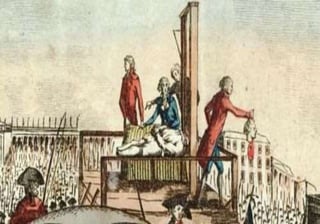
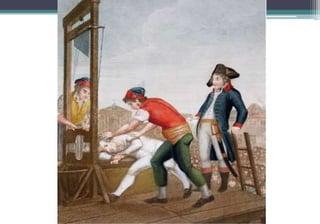
GUILLOTINE
• If the court found them ‘guilty’ they were guillotined. The
guillotine is a device consisting of two poles and a blade with
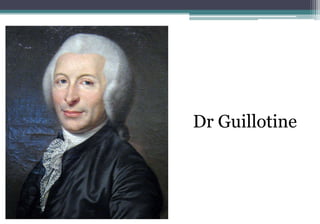
which a person is beheaded. It was named after Dr Joseph-
Ignace Guillotine who invented it on 10th October 1789.
• The guillotine (called the "National Razor") became the symbol
of the revolutionary cause, strengthened by a string of
executions - King Louis XVI, Marie Antoinette, the Girondins,
Maximillian Robespierre, Philippe Égalité , and Madame
Roland, and others such as pioneering chemist Antoine
Lavoisier, lost their lives under its blade.
Dr Guillotine
A DIRECTORY RULES FRANCE
• The fall of the Jacobin government allowed the wealthier middle
classes to seize power. A new constitution was introduced which
denied the vote to non-propertied sections of society. It provided
for two elected legislative councils. These then appointed a Directory,
an executive made up of five members. This was meant as a safeguard
against the concentration of power in a one-man executive as under
the Jacobins. However, the Directors often clashed with the legislative
councils, who then sought to dismiss them. The political instability
of the Directory paved the way for the rise of a military dictator,
Napoleon Bonaparte.
• Through all these changes in the form of government, the ideals of
freedom, of equality before the law and of fraternity remained
inspiring ideals that motivated political movements in France and the
rest of Europe during the following century.
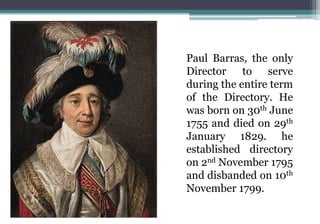
Paul Barras, the only
Director to serve
during the entire term
of the Directory. He
was born on 30th June
1755 and died on 29th
January 1829. he
established directory
on 2nd November 1795
and disbanded on 10th
November 1799.
Did Women have a Revolution?
• From the very beginning women were active participants in the events
which brought about so many important changes in French society.
They hoped that their involvement would pressurise the revolutionary
government to introduce measures to improve their lives. Most
women of the third estate had to work for a living. They worked as
seamstresses or laundresses, sold flowers, fruits and vegetables at the
market, or were employed as domestic servants in the houses of
prosperous people. Most women did not have access to education or
job training. Only daughters of nobles or wealthier members of the
third estate could study at a convent, after which their families
arranged a marriage for them. Working women had also to care for
their families, that is, cook, fetch water, queue up for bread and
look after the children. Their wages were lower than those of men.
• The Society of Revolutionary and Republican Women was the most famous of
them. One of their main demands was that women enjoy the same political rights
as men. Women were disappointed that the Constitution of 1791 reduced
them to passive citizens. They demanded the right to vote, to be
elected to the Assembly and to hold political office. Only then, they
felt, would their interests be represented in the new government.
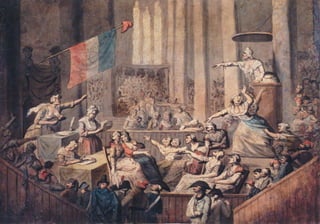
OLYMPE DE GOUGES(A REVOLUTIONARY WOMEN)
• Olympe de Gouges was born on 7th May 1748 at Montauban, France one of
the most important of the politically active women in revolutionary France.
She protested against the Constitution and the Declaration of Rights of
Man and Citizen as they excluded women from basic rights that each
human being was entitled to. So, in 1791, she wrote a Declaration of the
Rights of Woman and Citizen, which she addressed to the Queen and
to the members of the National Assembly, demanding that they act upon it.
In 1793, Olympe de Gouges criticised the Jacobin government for forcibly
closing down women’s clubs. She was tried by the National Convention,
which charged her with treason. Soon after this she was executed.
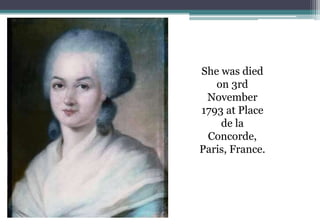
She was died
on 3rd
November
1793 at Place
de la
Concorde,
Paris, France.
THE ABOLITION OF SLAVERY
• One of the most revolutionary social reforms of the Jacobin
regime was the abolition of slavery in the French colonies. The
colonies in the Caribbean – Martinique, Guadeloupe and San
Domingo – were important suppliers of commodities such as
tobacco, indigo, sugar and coffee. But the reluctance of
Europeans to go and work in distant and unfamiliar lands
meant a shortage of labour on the plantations. So this was met
by a triangular slave trade between Europe, Africa and the
Americas. The slave trade began in the seventeenth century.
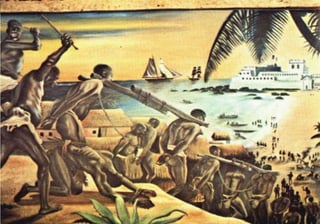
French merchants sailed from the ports of Bordeaux or Nantes
to the African coast, where they bought slaves from local
chieftains. Slaves were packed tightly into ships for the three-
month long voyage across the Atlantic to the Caribbean.
• Throughout the eighteenth century there was little criticism of
slavery in France. The National Assembly held long debates
about whether the rights of man should be extended to all
French subjects including those in the colonies. But it did not
pass any laws, fearing opposition from businessmen whose
incomes depended on the slave trade. It was finally the
Convention which in 1794 legislated to free all slaves in the
French overseas possessions. This, however, turned out to be a
short-term measure: ten years later, Napoleon reintroduced
slavery. Plantation owners understood their freedom as
including the right to enslave African Negroes in pursuit of
their economic interests. Slavery was finally abolished in
French colonies in 1848.
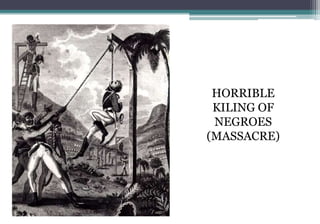
HORRIBLE
KILING OF
NEGROES
(MASSACRE)
NAPOLEON BONAPARTE
• Napoléon di Bonaparte was born on 15th August 1769 at Corsica, France in a
small nobility family. was a French military and political leader who rose to
prominence during the French Revolution and led several successful
campaigns during the Revolutionary Wars. As Napoleon I, he
was Emperor of the French from 1804 until 1814, and again in 1815.
Napoleon dominated European and global affairs for more than a decade
while leading France against a series of coalitions in the Napoleonic Wars.
He won most of these wars and the vast majority of his battles, building
a large empire that ruled over continental Europe before its final collapse
in 1815. One of the greatest commanders in history, his wars and
campaigns are studied at military schools worldwide. He also remains one
of the most celebrated and controversial political figures in history.
Napoleon had an extensive and powerful influence on the modern world,
bringing liberal reforms to the numerous territories that he conquered and
controlled, especially the Low Countries, Switzerland, and large parts of
modern Italy and Germany. He implemented fundamental liberal policies
in France and throughout Western Europe. His lasting legal achievement,
the Napoleonic Code, has been highly influential.
•Napoleon saw his role as a moderniser of Europe. He
introduced many laws such as the protection of
private property and a uniform system of weights
and measures provided by the decimal system.
Initially, many saw Napoleon as a liberator who
would bring freedom for the people. But soon the
Napoleonic armies came to be viewed everywhere as
an invading force. He was finally defeated at
Waterloo in 1815. Many of his measures that carried
the revolutionary ideas of liberty and modern laws to
other parts of Europe had an impact on people long
after Napoleon had left.
CONCLUTION
•The ideas of liberty and democratic rights were the
most important legacy of the French Revolution.
These spread from France to the rest of Europe
during the nineteenth century, where feudal systems
were abolished. Colonised peoples reworked the idea
of freedom from bondage into their movements to
create a sovereign nation state. Tipu Sultan and Ram
Mohan Roy are two examples of individuals who
responded to the ideas coming from revolutionary
France.
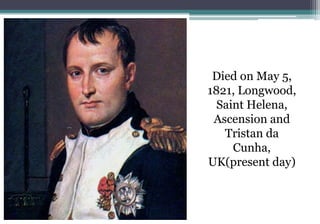
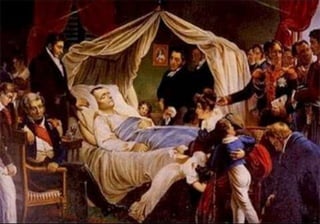
Died on May 5,
1821, Longwood,
Saint Helena,
Ascension and
Tristan da
Cunha,
UK(present day)
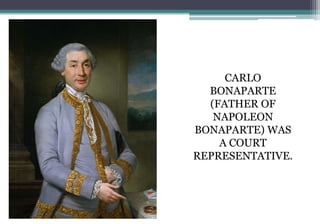
CARLO
BONAPARTE
(FATHER OF
NAPOLEON
BONAPARTE) WAS
A COURT
REPRESENTATIVE.
THANK YOU
•A.SHANTANU
•CLASS- ix-B
• ROLL NO.- 27
•Subject- SST (FRENCH REVOLUTION)
•SCHOOL-K.V. Berhampur, ganjam.

Sst french revolution 1

  • 1.
  • 2.
    EVENTS AND PROCESSES •Today we often take the ideas of liberty, freedom and equality for granted. But we need to remind ourselves that these ideas also have a history. • The French Revolution led to the end of monarchy in France. A society based on privileges gave way to a new system of governance. The Declarations of the Rights of Man during the revolution, announced the coming of a new time. The idea that all individuals had rights and could claim equality became part of a new language of politics. These notions of equality and freedom emerged as the central ideas of a new age; but in different countries they were reinterpreted and rethought in many different ways. The anti-colonial movements in India and China, Africa and South-America, produced ideas that were innovative and original, but they spoke in a language that gained currency only from the late eighteenth century.
  • 3.
  • 4.
    A REVOLT ORREVOLUTION FOR EQUALITY, LIBERTY AND FRATERNITY
  • 6.
    FRENCH SOCIETY INEIGHTEENTH CENTURY- • THE THREE ESTATES- • Before the revolution the French society was divided into three parts- 1. The first estate - the clergy. 2. The second estate - the nobility (nobles). 3. The third estate - * big businessmen, court officials, merchants, lawyers etc. * Peasants and artisans etc. * Small peasants, landless Labour, servants etc. Here legally the first two estates enjoys many privileges by birth, mainly the tax exemption. Only third estate gave all taxes
  • 7.
    • The societyof estates was part of the feudal system that dated back to the middle ages. The term Old Regime is usually used to describe the society and institutions of France before 1789. • Peasants made up about 90 per cent of the population. However, only a small number of them owned the land they cultivated. About 60 per cent of the land was owned by nobles, the Church and other richer members of the third estate. • Also clergy and nobles extracted feudal dues from the peasants • The Church too extracted its share of taxes called tithes from the peasants, and finally, all members of the third estate had to pay taxes to the state. These included a direct tax, called taille, and a number of indirect taxes which were levied on articles of everyday consumption like salt or tobacco. • The burden of financing activities of the state through taxes was borne by the third estate alone.
  • 8.
    THREE ESTATES OFFRANCE BEFORE 1789
  • 9.
  • 10.
  • 11.
  • 12.
    ROYAL PALACES OFVERSAILLES
  • 16.
    LOUIS XVI • LouisXVI was born on August 23rd 1754 at Palace of Versailles, France. He belongs to Bourbon family of kings. His first name was Louis-auguste then named as louis xvi after his grandfather louis xv. • In 1774, Louis (dauphin of France) ascended the throne of France to his son Louis XVI. He was 20 years old and married to the Austrian princess Marie Antoinette. Upon his accession the new king found an empty treasury. Long years of war had drained the financial resources of France. Added to this was the cost of maintaining an extravagant court at the immense palace of Versailles.
  • 17.
    • Under LouisXVI, France helped the thirteen American colonies to gain their independence from the common enemy, Britain. The war added more than a billion livres (currency of France at that time) to a debt that had already risen to more than 2 billion livres. Lenders who gave the state credit, now began to charge 10 per cent interest on loans. So the French government was obliged to spend an increasing percentage of its budget on interest payments alone. To meet its regular expenses, such as the cost of maintaining an army, the court, running government offices or universities, the state was forced to increase taxes.
  • 18.
    Louis xvi Died onJanuary 21 1793 at Palace de la concorde, France
  • 19.
    MARIE ANTOINETTE • MarieAntoinette, an Archduchess (daughter of the emperor of Austria) of Austria, was the fifteenth and second youngest child of Holy Roman Emperor Francis I and Empress Maria Theresa. • In April 1770, upon her marriage (at the age of 14 years and 5 months) to Louis-auguste, heir to the throne of France, she became Dauphine of France. On 10 May 1774, when her husband ascended the throne as Louis xvi, upon the death of his grandfather Louis xv, she became queen of Austria and Navarre, a title she held until September 1791, when, as the French Revolution proceeded, she became Queen of the French, a title she held until 21 September 1792. • Born on November 2 , 1755 at Vienna, Austria.
  • 20.
    Marie Antoinette Died onOctober 16 1793 at 8th arrondissement of Paris, Paris, France.
  • 21.
    THE STRUGGLE TOSURVIVE •The population of France rose from about 23 million in 1715 to 28 million in 1789. This led to a rapid increase in the demand for food grains. Production of grains could not keep pace with the demand. So the price of bread which was the staple diet of the majority rose rapidly. Most workers were employed as labourers in workshops whose owner fixed their wages. But wages did not keep pace with the rise in prices. So the gap between the poor and the rich widened.
  • 22.
    A GROWING OFMIDDLE CLASS ENVISAGES AND END TO PRIVILEGES • In the past, peasants and workers had participated in revolts against increasing taxes and food scarcity. But they lacked the means and programmes to carry out full-scale measures that would bring about a change in the social and economic order. This was left to those groups within the third estate who had become prosperous and had access to education and new ideas. • The eighteenth century witnessed the emergence of social groups, termed the middle class, who earned their wealth through an expanding overseas trade and from the manufacture of goods such as woollen and silk textiles that were either exported or bought by the richer members of society. In addition to merchants and manufacturers, the third estate included professions such as lawyers or administrative officials. All of these were educated and believed that no group in society should be privileged by birth. Rather, a person’s social position must depend on his merit.
  • 23.
    CARICATURE (PICTURE RELATED TOANY STRUGGLE) OF THE THIRD ESTATE CARRYING CLERGY AND NOBILITY ON HIS BACK
  • 24.
    SOME PHILOSOPHERS WHOHELPED TO BRING EQUALITY IN FRANCE I. JOHN LOCKE- • John Locke was born on 29th August 1632 was an English philosopher and physician, widely regarded as one of the most influential of Enlightenment thinkers and commonly known as the "Father of Liberalism". Considered one of the first of the British empiricists, following the tradition of Sir Francis Bacon, he is equally important to social contract theory. His work greatly affected the development of epistemology and political philosophy. His writings influenced Voltaire and Rousseau, many Scottish enlightenment thinkers, as well as the American revolutionaries. His contributions to classical republicanism and liberal theory are reflected in the United states declaration of independence. He wrote many books like Two Treatises of Government, A Letter Concerning Toleration etc.. In his book ‘Two Treatises of Government’ he sought to prove the doctrine of the divine and absolute right of the monarch. He died on 28 October 1704.
  • 26.
    II. Beron DeLa Brède et de Montesquieu- • Baron de La Brède et de Montesquieu born on 18th January 1689, generally referred to as simply Montesquieu, was a French lawyer, man of letters, and political philosopher who lived during the Age of Enlightenment. He is famous for his articulation of the theory of separation of powers, which is implemented in many constitutions throughout the world. He is also known for doing more than any other author to secure the place of the word despotism in the political lexicon. He wrote many books like The Spirit of the Laws, The Temple of Gnidos, Gleanings etc.. In his book ‘The Spirit of Laws’ proposed a division of power within the government between the legislative, the executive and the judiciary. This model of government was put into force in the USA, after the thirteen colonies declared their independence from Britain. The American constitution and its guarantee of individual rights was an important example for political thinkers in France. He died on 10th February 1755.
  • 27.
  • 28.
    III. Jean-Jacques Rousseau •Jean-Jacques Rousseau 28th June 1712 was a Francophone Genevan philosopher, writer, and composer of the 18th century. His political philosophy influenced the Enlightenment in France and across Europe, as well as aspects of the French Revolution and the overall development of modern political and educational thought. • Rousseau's novel Emile, or On Education is a treatise on the education of the whole person for citizenship. Rousseau's autobiographical writings — his Confessions, which initiated the modern autobiography, His Discourse on Inequality and The Social Contract are cornerstones in modern political and social thought. • He died on 2nd July 1778
  • 29.
  • 30.
    The Outbreak ofthe Revolution
  • 31.
    • In Franceof the Old Regime the monarch did not have the power to impose taxes according to his will alone. Rather he had to call a meeting of the Estates General which would then pass his proposals for new taxes. The Estates General was a political body to which the three estates sent their representatives. The last time it was done was in 1614. On 5 May 1789, Louis XVI called together an assembly of the Estates General to pass proposals for new taxes. A resplendent hall in Versailles was prepared to host the delegates. The first and second estates sent 300 representatives each, who were seated in rows facing each other on two sides, while the 600 members of the third estate had to stand at the back. The third estate was represented by its more prosperous and educated members. However, their grievances and demands were listed in some 40,000 letters which the representatives had brought with them. Voting in the Estates General in the past had been conducted according to the principle that each estate had one vote. This time too Louis XVI was determined to continue the same practice. But members of the third estate demanded that voting now be conducted by the assembly as a whole, where each member would have one vote.
  • 32.
    • The representativesof the third estate viewed themselves as spokesmen for the whole French nation. On 20 June they assembled in the hall of an indoor tennis court in the grounds of Versailles. They declared themselves a National Assembly and swore not to disperse till they had drafted a constitution for France that would limit the powers of the monarch. They were led by Mirabeau and Abbé Sieyès. Mirabeau was born in a noble family but was convinced of the need to do away with a society of feudal privilege. He brought out a journal and delivered powerful speeches to the crowds assembled at Versailles.
  • 34.
    STORMING OF THIRDESTATE PEOPLE ON BASTILLE IN 1789 • Jacques Necker - Jacques Necker 30th September 1732 was a French statesman of Swiss birth and finance minister of Louis XVI, a post he held in the lead-up to the French Revolution in 1789. By this time, Necker had earned the enmity of many members of the French court for his overt manipulation of public opinion. Marie Antoinette, the King's younger brother Comte d‘ Artois, and other conservative members of the King's privy council urged him to dismiss Necker as financial advisor. On 11th July 1789, after Necker published an inaccurate account of the government's debts and made it available to the public, the King fired him, and completely restructured the finance ministry at the same time.
  • 35.
    Jacques Necker. He diedon 11th July 1789
  • 36.
    • On 14July, the insurgents set their eyes on the large weapons and ammunition cache inside the Bastille fortress, which was also perceived to be a symbol of royal power. After several hours of combat, the prison fell that afternoon. Despite ordering a ceasefire, which prevented a mutual massacre, Governor Marquis Bernard de Launay was beaten, stabbed and decapitated; his head was placed on a pike and paraded about the city. Although the fortress had held only seven prisoners (four forgers, two noblemen kept for immoral behaviour, and a murder suspect) the Bastille served as a potent symbol of everything hated under the Ancient Regime. Returning to the Hotel de Ville (city hall) the mob accused the mayor Jacques de Flesselles of treachery and butchered him. The King, alarmed by the violence, backed down, at least for the time being. The Marquis de la Fayette took up command of the National Guard at Paris. Jean-Sylvain Bailly, president of the Assembly at the time of the Tennis Court Oath, became the city's mayor under a new governmental structure known as the commune. The King visited Paris, where, on 17th July he accepted a tricolour cockade, to cries of Vive la Nation and Vive le Roi ("Long live the King").
  • 38.
    SOME PHOTOS OFROYAL FORT BASTILLE BEFORE THE REVOLT
  • 42.
    Abolition of feudalismand France becomes constitutional monarchy • On the night of 4th August 1789, the National Constituent Assembly abolished feudalism (numerous peasant revolts had almost brought feudalism to an end) in the Auguste Decrees, sweeping away both the seigneurial rights of the Second Estate and the tithes (a 10% tax for the Church) gathered by the First Estate. During the course of a few hours nobles, clergy, towns, provinces, companies and cities lost their special privileges. • The National Assembly completed the draft of the constitution in 1791. Its main object was to limit the powers of the monarch. These powers instead of being concentrated in the hands of one person, were now separated and assigned to different institutions – the legislature, executive and judiciary. This made France a constitutional monarchy.
  • 45.
    • The Constitutionof 1791 vested the power to make laws in the National Assembly, which was indirectly elected. That is, citizens voted for a group of electors, who in turn chose the Assembly. Not all citizens, however, had the right to vote. Only men above 25 years of age who paid taxes equal to at least 3 days of a labourer’s wage were given the status of active citizens, that is, they were entitled to vote. The remaining men and all women were classed as passive citizens. To qualify as an elector and then as a member of the Assembly, a man had to belong to the highest bracket of taxpayers. • The Constitution began with a Declaration of the Rights of Man and Citizen. Rights such as the right to life, freedom of speech, freedom of opinion, equality before law, were established as ‘natural and inalienable’ rights, that is, they belonged to each human being by birth and could not be taken away. It was the duty of the state to protect each citizen’s natural rights.
  • 47.
    JEAN PAUL MARAT •JEAN-PAUL MARAT was a revolutionary journalist born on 24th May 1743 at Boudry, Switzerland who wrote many articles in the famous newspaper of France at that time - L’Ami du peuple (The friend of the people). His articles were like which tells government about the state of people and tells the government how to improve the law system indirectly. • He in his newspaper on the Constitution drafted by the National Assembly: • ‘The task of representing the people has been given to the rich … the lot of the poor and oppressed will never be improved by peaceful means alone. Here we have absolute proof of how wealth influences the law. Yet laws will last only as long as the people agree to obey them. And when they have managed to cast off the yoke of the aristocrats, they will do the same to the other owners of wealth.’
  • 48.
    Died on 13July 1793 killed by Jacques-Louis David
  • 50.
    SOME POLITICAL SYMBOLSOF FRANCE WHICH WE HAVE TO KNOW • LIBERTY CAP (PHRYGIAN CAP) This cap used as a style cap as a symbol of revolutionary France or Cap worn by a slave upon becoming free
  • 51.
    • BROKEN CHAIN Chainswere used to fetter slaves. A broken chain stands for the act of becoming free.
  • 52.
    • The bundleof rods or fasces One rod can be easily broken, but not an entire bundle. Strength lies in unity.
  • 53.
    • The eyewithin a triangle radiating light The all-seeing eye stands for knowledge. The rays of the sun will drive away the clouds of ignorance.
  • 54.
  • 55.
    • Snake bitingits tail to form a ring Symbol of Eternity (which never ends). A ring has neither beginning nor end.
  • 56.
  • 57.
    • The wingedwoman Personification of the law.
  • 58.
    • The LawTablet The law is the same for all, and all are equal before it.
  • 59.
  • 60.
    • In RevolutionaryFrance, the Legislative Assembly votes to abolish the monarchy and establish the First Republic. The measure came one year after King Louis XVI reluctantly approved a new constitution that stripped him of much of his power. • Rulers of other neighbouring countries too were worried by the developments in France and made plans to send troops to put down the events that had been taking place there since the summer of 1789. Before this could happen, the National Assembly voted in April 1792 to declare war against Prussia and Austria. Thousands of volunteers thronged from the provinces to join the army. They saw this as a war of the people against kings and aristocracies all over Europe. • Everybody sings La Marseillaise in many groups. Now this song is the national anthem of France. This song was written by poet Claude Joseph Rouget de Lisle on 1792 in Strasbourg, Alsace, France. • The revolutionary wars brought losses and economic difficulties to the people. While the men were away fighting at the front, women were left to cope with the tasks of earning a living and looking after their families. • The Constitution of 1791 gave political rights only to the richer sections of
  • 62.
    • Political clubsbecame an important rallying point for people who wished to discuss government policies and plan their own forms of action. The most successful of these clubs was that of the Jacobins, which got its name from the former convent of St Jacob in Paris. Women too, who had been active throughout this period, formed their own clubs. • The members of the Jacobin club belonged mainly to the less prosperous sections of society. They included small shopkeepers, artisans such as shoemakers, pastry cooks, watch-makers, printers, as well as servants and daily-wage workers. Their leader was Maximillian Robespierre. A large group among the Jacobins decided to start wearing long striped trousers similar to those worn by dock workers. This was to set themselves apart from the fashionable sections of society, especially nobles, who wore knee breeches. was a way of proclaiming the end of the power wielded by the wearers of knee breeches. These Jacobins came to be known as the sans-culottes, literally meaning ‘those without knee breeches’. Sans- culottes men wore in addition the red cap that symbolised liberty. Women however were not allowed to do so.
  • 64.
    • The newlyelected assembly was called the Convention. On 21 September 1792 it abolished the monarchy and declared France a republic. As you know, a republic is a form of government where the people elect the government including the head of the government. There is no hereditary monarchy. • You can try and find out about some other countries that are republics and investigate when and how they became so. Louis XVI was sentenced to death by a court on the charge of treason (helped another country in a war). On 21 January 1793 he was executed publicly at the Place de la Concorde. The queen Marie Antoinette met with the same fate shortly after.
  • 66.
    The Reign ofTerror • The Reign of Terror (6 September 1793 – 28 July 1794), also known as The Terror, was a period of violence that occurred after the onset of the French Revolution, incited by conflict between two rival political factions, the Girondins and The Jacobins, and marked by mass executions of "enemies of the revolution". The death toll ranged in the tens of thousands, with 16,594 executed by guillotine (2,639 in Paris), and another 25,000 in summary executions across France.
  • 67.
    • Maximilien FrançoisMarie Isidore de Robespierre was born on 6th May 1758 Arras, Artois, France. Robespierre followed a policy of severe control and punishment. All those whom he saw as being ‘enemies’ of the republic – ex-nobles and clergy, members of other political parties, even members of his own party who did not agree with his methods – were arrested, imprisoned and then tried by a revolutionary tribunal. If the court found them ‘guilty’ they were guillotined. • Robespierre’s government issued laws placing a maximum ceiling on wages and prices. Meat and bread were rationed. Peasants were forced to transport their grain to the cities and sell it at prices fixed by the government. The use of more expensive white flour was forbidden; all citizens were required to eat the pain d’égalité (equality bread), a loaf made of whole-wheat. Equality was also sought to be practised through forms of speech and address. Instead of the traditional Monsieur (Sir) and Madame (Madam) all French men and women were henceforth Citoyen and Citoyenne (Citizen). Churches were shut down and their buildings converted into barracks or offices. Robespierre pursued his policies so relentlessly that even his supporters began to demand moderation. Finally, he was convicted by a court in July 1794, arrested and on the next day sent to the guillotine.
  • 68.
    Died on 28thJuly 1794 as a prisoner and killed under guillotine.
  • 71.
    GUILLOTINE • If thecourt found them ‘guilty’ they were guillotined. The guillotine is a device consisting of two poles and a blade with which a person is beheaded. It was named after Dr Joseph- Ignace Guillotine who invented it on 10th October 1789. • The guillotine (called the "National Razor") became the symbol of the revolutionary cause, strengthened by a string of executions - King Louis XVI, Marie Antoinette, the Girondins, Maximillian Robespierre, Philippe Égalité , and Madame Roland, and others such as pioneering chemist Antoine Lavoisier, lost their lives under its blade.
  • 73.
  • 74.
    A DIRECTORY RULESFRANCE • The fall of the Jacobin government allowed the wealthier middle classes to seize power. A new constitution was introduced which denied the vote to non-propertied sections of society. It provided for two elected legislative councils. These then appointed a Directory, an executive made up of five members. This was meant as a safeguard against the concentration of power in a one-man executive as under the Jacobins. However, the Directors often clashed with the legislative councils, who then sought to dismiss them. The political instability of the Directory paved the way for the rise of a military dictator, Napoleon Bonaparte. • Through all these changes in the form of government, the ideals of freedom, of equality before the law and of fraternity remained inspiring ideals that motivated political movements in France and the rest of Europe during the following century.
  • 75.
    Paul Barras, theonly Director to serve during the entire term of the Directory. He was born on 30th June 1755 and died on 29th January 1829. he established directory on 2nd November 1795 and disbanded on 10th November 1799.
  • 77.
    Did Women havea Revolution?
  • 78.
    • From thevery beginning women were active participants in the events which brought about so many important changes in French society. They hoped that their involvement would pressurise the revolutionary government to introduce measures to improve their lives. Most women of the third estate had to work for a living. They worked as seamstresses or laundresses, sold flowers, fruits and vegetables at the market, or were employed as domestic servants in the houses of prosperous people. Most women did not have access to education or job training. Only daughters of nobles or wealthier members of the third estate could study at a convent, after which their families arranged a marriage for them. Working women had also to care for their families, that is, cook, fetch water, queue up for bread and look after the children. Their wages were lower than those of men. • The Society of Revolutionary and Republican Women was the most famous of them. One of their main demands was that women enjoy the same political rights as men. Women were disappointed that the Constitution of 1791 reduced them to passive citizens. They demanded the right to vote, to be elected to the Assembly and to hold political office. Only then, they felt, would their interests be represented in the new government.
  • 80.
    OLYMPE DE GOUGES(AREVOLUTIONARY WOMEN) • Olympe de Gouges was born on 7th May 1748 at Montauban, France one of the most important of the politically active women in revolutionary France. She protested against the Constitution and the Declaration of Rights of Man and Citizen as they excluded women from basic rights that each human being was entitled to. So, in 1791, she wrote a Declaration of the Rights of Woman and Citizen, which she addressed to the Queen and to the members of the National Assembly, demanding that they act upon it. In 1793, Olympe de Gouges criticised the Jacobin government for forcibly closing down women’s clubs. She was tried by the National Convention, which charged her with treason. Soon after this she was executed.
  • 81.
    She was died on3rd November 1793 at Place de la Concorde, Paris, France.
  • 82.
  • 83.
    • One ofthe most revolutionary social reforms of the Jacobin regime was the abolition of slavery in the French colonies. The colonies in the Caribbean – Martinique, Guadeloupe and San Domingo – were important suppliers of commodities such as tobacco, indigo, sugar and coffee. But the reluctance of Europeans to go and work in distant and unfamiliar lands meant a shortage of labour on the plantations. So this was met by a triangular slave trade between Europe, Africa and the Americas. The slave trade began in the seventeenth century. French merchants sailed from the ports of Bordeaux or Nantes to the African coast, where they bought slaves from local chieftains. Slaves were packed tightly into ships for the three- month long voyage across the Atlantic to the Caribbean.
  • 84.
    • Throughout theeighteenth century there was little criticism of slavery in France. The National Assembly held long debates about whether the rights of man should be extended to all French subjects including those in the colonies. But it did not pass any laws, fearing opposition from businessmen whose incomes depended on the slave trade. It was finally the Convention which in 1794 legislated to free all slaves in the French overseas possessions. This, however, turned out to be a short-term measure: ten years later, Napoleon reintroduced slavery. Plantation owners understood their freedom as including the right to enslave African Negroes in pursuit of their economic interests. Slavery was finally abolished in French colonies in 1848.
  • 85.
  • 87.
    NAPOLEON BONAPARTE • Napoléondi Bonaparte was born on 15th August 1769 at Corsica, France in a small nobility family. was a French military and political leader who rose to prominence during the French Revolution and led several successful campaigns during the Revolutionary Wars. As Napoleon I, he was Emperor of the French from 1804 until 1814, and again in 1815. Napoleon dominated European and global affairs for more than a decade while leading France against a series of coalitions in the Napoleonic Wars. He won most of these wars and the vast majority of his battles, building a large empire that ruled over continental Europe before its final collapse in 1815. One of the greatest commanders in history, his wars and campaigns are studied at military schools worldwide. He also remains one of the most celebrated and controversial political figures in history. Napoleon had an extensive and powerful influence on the modern world, bringing liberal reforms to the numerous territories that he conquered and controlled, especially the Low Countries, Switzerland, and large parts of modern Italy and Germany. He implemented fundamental liberal policies in France and throughout Western Europe. His lasting legal achievement, the Napoleonic Code, has been highly influential.
  • 88.
    •Napoleon saw hisrole as a moderniser of Europe. He introduced many laws such as the protection of private property and a uniform system of weights and measures provided by the decimal system. Initially, many saw Napoleon as a liberator who would bring freedom for the people. But soon the Napoleonic armies came to be viewed everywhere as an invading force. He was finally defeated at Waterloo in 1815. Many of his measures that carried the revolutionary ideas of liberty and modern laws to other parts of Europe had an impact on people long after Napoleon had left.
  • 89.
    CONCLUTION •The ideas ofliberty and democratic rights were the most important legacy of the French Revolution. These spread from France to the rest of Europe during the nineteenth century, where feudal systems were abolished. Colonised peoples reworked the idea of freedom from bondage into their movements to create a sovereign nation state. Tipu Sultan and Ram Mohan Roy are two examples of individuals who responded to the ideas coming from revolutionary France.
  • 90.
    Died on May5, 1821, Longwood, Saint Helena, Ascension and Tristan da Cunha, UK(present day)
  • 92.
  • 93.
  • 94.
    •A.SHANTANU •CLASS- ix-B • ROLLNO.- 27 •Subject- SST (FRENCH REVOLUTION) •SCHOOL-K.V. Berhampur, ganjam.