Dr. Chavan P.R.
Pharm D
Definition
 a loss of sensation in a circumscribed area of the body
caused by a depression of excitation in nerve endings
 Or an inhibition of the conduction process in
peripheral nerves; no loss of consciousness occurs
Properties of Local Anesthetics:
1) Not irritating to the tissue
2) No permanent alteration of nerve structure
3) Systemic toxicity should be low
4) Effective whether injected or applied topically
5) Time of onset of anesthesia should be as short as possible
6) Duration of action must be long enough to complete the
procedure but not so long as to require an extended
recovery
7) Should be stable in solution and easily biotransformed
8) Should not cause allergic reactions
9) Should be sterile or capable of being sterilized by use of
heat
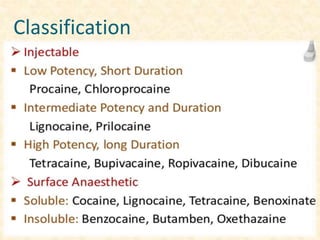
Classification
Mode and Site of Action of Local
Anesthetics
 Local anesthetics interfere with the excitation process
in the nerve membrane in one or more of the following
ways:
 1) Altering the basic resting potential of the nerve
membrane
 2) Altering the threshold potential (firing level)
 3) Decreasing the rate of depolarization*
 4) Prolonging the rate of repolarization
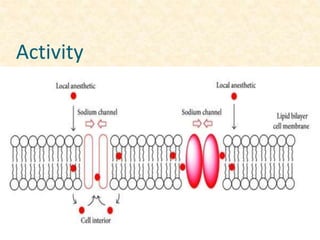
Activity
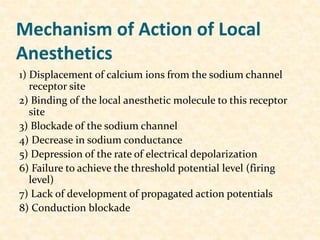
Mechanism of Action of Local
Anesthetics
1) Displacement of calcium ions from the sodium channel
receptor site
2) Binding of the local anesthetic molecule to this receptor
site
3) Blockade of the sodium channel
4) Decrease in sodium conductance
5) Depression of the rate of electrical depolarization
6) Failure to achieve the threshold potential level (firing
level)
7) Lack of development of propagated action potentials
8) Conduction blockade
Actions
CNS
 Cocaine is a powerful CNS stimulant causing in
sequence euphoria—excitement—mental confusion—
restlessness—tremor and twitching of muscles—
convulsions—unconsciousness—respiratory
depression—death
C.V.S.
 Heart- decrease automaticity, excitability,
contractility, conductivity and prolong effective
refractory period (ERP).
 Blood vessels - fall in BP
 Cocaine has sympathomimetic property; increases
sympathetic tone, causes local vasoconstriction,
marked rise in BP and tachycardia.
Pharmacokinetics
 Soluble surface anaesthetics (lidocaine, tetracaine) are
rapidly absorbed from mucous membranes and
abraded areas, but absorption from intact skin is
minimal
 Rate of absorption depends on the blood flow to the
area of application or injection.
 LAs are rapidly but temporarily bound to tissues,
especially nerves, at the site of injection.
Precautions and interactions
 Before injecting the LA, aspirate lightly to avoid
intravascular injection.
 Inject the LA slowly and take care not to exceed the
maximum safe dose, especially in children.
 Propranolol (probably other β blockers also) may reduce
metabolism of lidocaine and other amide LAs by reducing
hepatic blood flow.
 Vasoconstrictor (adrenaline) containing LA should be
avoided for patients with ischaemic heart disease, cardiac
arrhythmia, thyrotoxicosis, uncontrolled hypertension, and
those receiving β blockers (rise in BP can occur due to
unopposed α action) or tricyclic antidepressants (uptake
blockade and potentiation of Adr).
Uses and techniques
 Surface anaesthesia
 Infiltration anaesthesia- used for minor operations, e.g. incisions,
excisions, hydrocele, herniorrhaphy
 Conduction block
- field block- used in herniorrhaphy, appendicectomy,
dental procedures, scalp stitching, operations on forearms and legs,
- nerve block- used for tooth extraction, operations
on eye, limbs, abdominal wall, fracture setting, trauma to ribs,
neuralgias, persistent hiccup
 Spinal anaesthesia
 Epidural anaesthesia- thoracic, lumbar, caudal
 Intravenous regional anaesthesia (Intravascular
infiltration anaesthesia)- upper limb and for
orthopedic procedures.
Complications of spinal anasthesia
 Respiratory paralysis
 Hypotension
 Headache
 Cauda equina syndrome
 Septic meningitis
Cocaine
 Obtained from erythroxylon coca
 Rapidly absorbed from buccal mucous membrane
 First used for ocular anaesthesia in 1884.
 Never be injected; it is a protoplasmic poison and
causes tissue necrosis.
 Produces prominent CNS stimulation
 Not producing significant tolerance on repeated use
 Stimulates vagal centre→bradycardia; vasomotor
centre→rise in BP; vomiting centre→nausea and
vomiting; temperature regulating centre→pyrexia
 Blocks uptake of NA and adr into adrenergic nerve
endings
 Local vasoconstriction, tachycardia, rise in BP and
mydriasis
 Only indication - ocular anaesthesia.
Lidocaine (Lignocaine)
 Versatile LA
 Injected around a nerve it blocks conduction within 3
min
 Anaesthesia is more intense and longer lasting.
 Used for surface application, infiltration, nerve block,
epidural, spinal and intravenous regional block
anaesthesia
 Overdose causes muscle twitching, convulsions, cardiac
arrhythmias, fall in BP, coma and respiratory arrest
 Popular antiarrhythmic
Prilocaine
 Does not cause vasodilatation at the site of infiltration
 Lower CNS toxicity due to larger volume of
distribution
 Methaemoglobinaemia
 Use - infiltration, nerve block and intravenous
regional anaesthesia.
Eutectic lidocaine/prilocaine
 Alternative to lidocaine infiltration
 Applied under occlusive dressing for 1 hr before i.V.
Cannulation, split skin graft harvesting and other
superficial procedures
Bupivacaine
 Potent and long-acting amidelinked LA
 Use- infiltration, nerve block, epidural and spinal
anaesthesia of long duration
 Very popular in obstetrics and for postoperative pain
relief by continuous epidural infusion.
 Prolong qtc interval and induce ventricular
tachycardia or cardiac depression—should not be used
for intravenous regional analgesia.
 0.75% bupivacaine – contraindicated due to
development of cardiac arrest
Ropivacaine
 A newer bupivacaine congener,
 Equally long acting but less cardiotoxic
 Blocks aδ and C fibres more completely than aβ fibres
which control motor function.
 Epidural ropivacaine is being used for relief of
postoperative and labour pain
 For nerve blocks
Dibucaine (Cinchocaine)
 Most potent, most toxic and longest acting LA
 Surface anaesthetic on less delicate mucous
membranes (anal canal).
 Spinal anaesthesia use get reduced
Benoxinate
 Good surface anaesthetic for the eye
 Has little irritancy
 0.4% solution- used for Tonometry without causing
mydriasis or corneal damage.
Benzocaine and
Butylaminobenzoate (Butamben)
 long-lasting anaesthesia without systemic toxicity
 Use- lozenges for stomatitis, sore throat; as dusting
powder/ointment on wounds/ulcerated surfaces and
as suppository for anorectal lesions
 Both are PABA derivative—can antagonize
sulfonamides locally.
Oxethazaine
 A potent topical anaesthetic,
 Unique in ionizing to a very small extent even at low
ph values
 Effective in anaesthetising gastric mucosa despite
acidity of the medium
 Swallowed along with antacids it affords symptomatic
relief in gastritis, drug induced gastric irritation,
gastroesophageal reflux and heartburn of pregnancy.
 Doses exceeding 100 mg/day may produce dizziness
and drowsiness
Local anesthetics pharmacology

Local anesthetics pharmacology

  • 1.
  • 2.
    Definition  a lossof sensation in a circumscribed area of the body caused by a depression of excitation in nerve endings  Or an inhibition of the conduction process in peripheral nerves; no loss of consciousness occurs
  • 3.
    Properties of LocalAnesthetics: 1) Not irritating to the tissue 2) No permanent alteration of nerve structure 3) Systemic toxicity should be low 4) Effective whether injected or applied topically 5) Time of onset of anesthesia should be as short as possible 6) Duration of action must be long enough to complete the procedure but not so long as to require an extended recovery 7) Should be stable in solution and easily biotransformed 8) Should not cause allergic reactions 9) Should be sterile or capable of being sterilized by use of heat
  • 4.
  • 6.
    Mode and Siteof Action of Local Anesthetics  Local anesthetics interfere with the excitation process in the nerve membrane in one or more of the following ways:  1) Altering the basic resting potential of the nerve membrane  2) Altering the threshold potential (firing level)  3) Decreasing the rate of depolarization*  4) Prolonging the rate of repolarization
  • 7.
  • 8.
    Mechanism of Actionof Local Anesthetics 1) Displacement of calcium ions from the sodium channel receptor site 2) Binding of the local anesthetic molecule to this receptor site 3) Blockade of the sodium channel 4) Decrease in sodium conductance 5) Depression of the rate of electrical depolarization 6) Failure to achieve the threshold potential level (firing level) 7) Lack of development of propagated action potentials 8) Conduction blockade
  • 9.
    Actions CNS  Cocaine isa powerful CNS stimulant causing in sequence euphoria—excitement—mental confusion— restlessness—tremor and twitching of muscles— convulsions—unconsciousness—respiratory depression—death
  • 10.
    C.V.S.  Heart- decreaseautomaticity, excitability, contractility, conductivity and prolong effective refractory period (ERP).  Blood vessels - fall in BP  Cocaine has sympathomimetic property; increases sympathetic tone, causes local vasoconstriction, marked rise in BP and tachycardia.
  • 11.
    Pharmacokinetics  Soluble surfaceanaesthetics (lidocaine, tetracaine) are rapidly absorbed from mucous membranes and abraded areas, but absorption from intact skin is minimal  Rate of absorption depends on the blood flow to the area of application or injection.  LAs are rapidly but temporarily bound to tissues, especially nerves, at the site of injection.
  • 12.
    Precautions and interactions Before injecting the LA, aspirate lightly to avoid intravascular injection.  Inject the LA slowly and take care not to exceed the maximum safe dose, especially in children.  Propranolol (probably other β blockers also) may reduce metabolism of lidocaine and other amide LAs by reducing hepatic blood flow.  Vasoconstrictor (adrenaline) containing LA should be avoided for patients with ischaemic heart disease, cardiac arrhythmia, thyrotoxicosis, uncontrolled hypertension, and those receiving β blockers (rise in BP can occur due to unopposed α action) or tricyclic antidepressants (uptake blockade and potentiation of Adr).
  • 13.
    Uses and techniques Surface anaesthesia  Infiltration anaesthesia- used for minor operations, e.g. incisions, excisions, hydrocele, herniorrhaphy  Conduction block - field block- used in herniorrhaphy, appendicectomy, dental procedures, scalp stitching, operations on forearms and legs, - nerve block- used for tooth extraction, operations on eye, limbs, abdominal wall, fracture setting, trauma to ribs, neuralgias, persistent hiccup
  • 14.
     Spinal anaesthesia Epidural anaesthesia- thoracic, lumbar, caudal  Intravenous regional anaesthesia (Intravascular infiltration anaesthesia)- upper limb and for orthopedic procedures.
  • 15.
    Complications of spinalanasthesia  Respiratory paralysis  Hypotension  Headache  Cauda equina syndrome  Septic meningitis
  • 16.
    Cocaine  Obtained fromerythroxylon coca  Rapidly absorbed from buccal mucous membrane  First used for ocular anaesthesia in 1884.  Never be injected; it is a protoplasmic poison and causes tissue necrosis.  Produces prominent CNS stimulation  Not producing significant tolerance on repeated use
  • 17.
     Stimulates vagalcentre→bradycardia; vasomotor centre→rise in BP; vomiting centre→nausea and vomiting; temperature regulating centre→pyrexia  Blocks uptake of NA and adr into adrenergic nerve endings  Local vasoconstriction, tachycardia, rise in BP and mydriasis  Only indication - ocular anaesthesia.
  • 18.
    Lidocaine (Lignocaine)  VersatileLA  Injected around a nerve it blocks conduction within 3 min  Anaesthesia is more intense and longer lasting.  Used for surface application, infiltration, nerve block, epidural, spinal and intravenous regional block anaesthesia  Overdose causes muscle twitching, convulsions, cardiac arrhythmias, fall in BP, coma and respiratory arrest  Popular antiarrhythmic
  • 19.
    Prilocaine  Does notcause vasodilatation at the site of infiltration  Lower CNS toxicity due to larger volume of distribution  Methaemoglobinaemia  Use - infiltration, nerve block and intravenous regional anaesthesia.
  • 20.
    Eutectic lidocaine/prilocaine  Alternativeto lidocaine infiltration  Applied under occlusive dressing for 1 hr before i.V. Cannulation, split skin graft harvesting and other superficial procedures
  • 21.
    Bupivacaine  Potent andlong-acting amidelinked LA  Use- infiltration, nerve block, epidural and spinal anaesthesia of long duration  Very popular in obstetrics and for postoperative pain relief by continuous epidural infusion.  Prolong qtc interval and induce ventricular tachycardia or cardiac depression—should not be used for intravenous regional analgesia.  0.75% bupivacaine – contraindicated due to development of cardiac arrest
  • 22.
    Ropivacaine  A newerbupivacaine congener,  Equally long acting but less cardiotoxic  Blocks aδ and C fibres more completely than aβ fibres which control motor function.  Epidural ropivacaine is being used for relief of postoperative and labour pain  For nerve blocks
  • 23.
    Dibucaine (Cinchocaine)  Mostpotent, most toxic and longest acting LA  Surface anaesthetic on less delicate mucous membranes (anal canal).  Spinal anaesthesia use get reduced
  • 24.
    Benoxinate  Good surfaceanaesthetic for the eye  Has little irritancy  0.4% solution- used for Tonometry without causing mydriasis or corneal damage.
  • 25.
    Benzocaine and Butylaminobenzoate (Butamben) long-lasting anaesthesia without systemic toxicity  Use- lozenges for stomatitis, sore throat; as dusting powder/ointment on wounds/ulcerated surfaces and as suppository for anorectal lesions  Both are PABA derivative—can antagonize sulfonamides locally.
  • 26.
    Oxethazaine  A potenttopical anaesthetic,  Unique in ionizing to a very small extent even at low ph values  Effective in anaesthetising gastric mucosa despite acidity of the medium  Swallowed along with antacids it affords symptomatic relief in gastritis, drug induced gastric irritation, gastroesophageal reflux and heartburn of pregnancy.  Doses exceeding 100 mg/day may produce dizziness and drowsiness