Neuralgia
Dr. S. Parasuraman,
Faculty of Pharmacy,
AIMST University.
Course: PHARMACOTHERAPEUTICS II
Neuralgia
• Neuralgia is a stabbing, burning, and often quite severe
pain that occurs along a damaged nerve. The damaged
nerve may be anywhere in the body, but is most common
in the face and neck. The cause of a damaged nerve may
be a disease like diabetes or multiple sclerosis, an
infection like shingles, or the result of old age.
Causes of Neuralgia
• Infection
• Multiple Sclerosis
• Pressure on Nerves
• Diabetes
• Less Common Causes
– chronic kidney disease
– porphyria
– medications like cisplatin, paclitaxel, or vincristine
– trauma
– chemical irritation
Types of Neuralgia
• Postherpetic Neuralgia (PHN)
• Trigeminal Neuralgia
• Glossopharyngeal Neuralgia
• Swimmer's headache, or supraorbital neuralgia
• Occipital Neuralgia
Treatment of Neuralgia
• Surgery to relieve the pressure on the nerve.
• Control of blood sugar levels (diabetes-caused neuralgia)
• Physical therapy.
• Nerve block, which is an injection directed at a particular
nerve or nerve group that is intended to “turn off” pain
signals and reduce inflammation.
• Medications to relieve the pain.
Types of Neuralgia
Postherpetic Neuralgia (PHN):
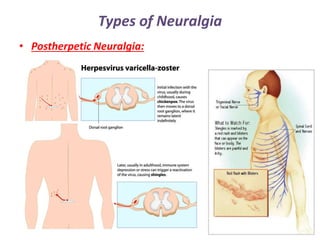
• It occurs as a complication of shingles and may be anywhere on
the body. Shingles is a viral infection characterized by a painful
rash and blisters.
• Postherpetic neuralgia is a nerve pain due to damage caused by
the varicella zoster virus, herpes zoster (HZ).
• Risk factors: Advancing age, site of HZ involvement, severe
prodromal pain and rash.
• Diagnostic test: No specific tests. Viral culture or
immunofluorescence staining and antibody measurements.
• Treatment: Antiviral agents (famciclovir), analgesics, topical
local anesthetic agents, corticosteroids.
Types of Neuralgia
• Postherpetic Neuralgia:
Types of Neuralgia
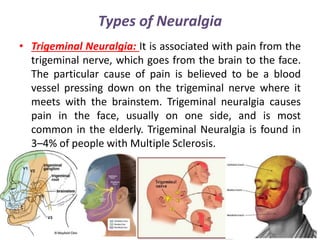
• Trigeminal Neuralgia: It is associated with pain from the
trigeminal nerve, which goes from the brain to the face.
The particular cause of pain is believed to be a blood
vessel pressing down on the trigeminal nerve where it
meets with the brainstem. Trigeminal neuralgia causes
pain in the face, usually on one side, and is most
common in the elderly. Trigeminal Neuralgia is found in
3–4% of people with Multiple Sclerosis.
Types of Neuralgia
• Trigeminal Neuralgia:
• The trigeminal nerve is a mixed cranial nerve responsible
for sensory data such as tactition (pressure),
thermoception (temperature), and nociception (pain)
originating from the face above the jawline.
• Causes:
– enlarged or lengthened blood vessel of superior cerebellar
artery
– compressing or throbbing against the microvasculature of the
trigeminal nerve near its connection with the pons
Types of Neuralgia
• Trigeminal Neuralgia:
Management:
• Pharmacological approach:
– first line treatment: carbamazepine
– second line treatment: baclofen, lamotrigine, oxcarbazepine,
phenytoin, gabapentin and pregabalin
– Others: amitriptyline, morphine and oxycodone
• Surgical
– Microvascular decompression appears to result in the longest
pain relief.
– Stereotactic radiosurgery
Types of Neuralgia
Glossopharyngeal Neuralgia:
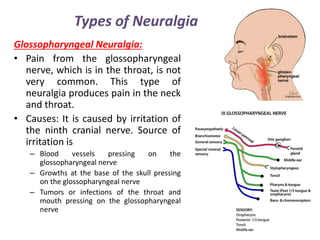
• Pain from the glossopharyngeal
nerve, which is in the throat, is not
very common. This type of
neuralgia produces pain in the neck
and throat.
• Causes: It is caused by irritation of
the ninth cranial nerve. Source of
irritation is
– Blood vessels pressing on the
glossopharyngeal nerve
– Growths at the base of the skull pressing
on the glossopharyngeal nerve
– Tumors or infections of the throat and
mouth pressing on the glossopharyngeal
nerve
Types of Neuralgia
Glossopharyngeal Neuralgia:
• Symptoms:
Pain on…..
– Back of the nose and throat (nasopharynx)
– Back of the tongue
– Ear
– Throat
– Tonsil area
– Voice box (larynx)
• Examination: Blood tests, CT, MRI, X-Ray head and neck.
• Treatment: Medication for controlling pain. In severe
cases, when pain is difficult to treat, surgery to take
pressure off the glossopharyngeal nerve.
Types of Neuralgia
Swimmer's headache, or supraorbital neuralgia or Goggle
Headache:
• .
Proc (Bayl Univ Med Cent). 2004 Oct; 17(4): 418–419. [PMC1200682]
Types of Neuralgia
Swimmer's headache, or supraorbital neuralgia:
• Supraorbital neuralgia is a rare type of neuralgia
characterized by persistent pain over the supraorbital
region and forehead along with shocklike paresthesia in the
distribution of the supraorbital nerve. It is also known as
goggle headache.
• Cause: Damage of supraorbital nerve, severe headaches.
• Risk factors: Trauma and nerve injury.
• Symptoms:
– unilateral pain in the forehead
– Tinel's sign at the supraorbital notch, and hypoesthesia in the
forehead
Types of Neuralgia
Swimmer's headache, or supraorbital neuralgia:
• Treatment:
– removal of the triggering factor
– low dose anti-convulsants
– nerve stimulation
– surgeries
Types of Neuralgia
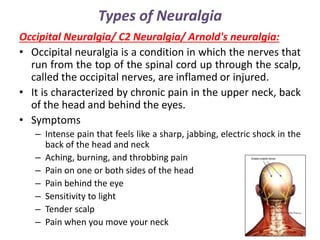
Occipital Neuralgia/ C2 Neuralgia/ Arnold's neuralgia:
• Occipital neuralgia is a condition in which the nerves that
run from the top of the spinal cord up through the scalp,
called the occipital nerves, are inflamed or injured.
• It is characterized by chronic pain in the upper neck, back
of the head and behind the eyes.
• Symptoms
– Intense pain that feels like a sharp, jabbing, electric shock in the
back of the head and neck
– Aching, burning, and throbbing pain
– Pain on one or both sides of the head
– Pain behind the eye
– Sensitivity to light
– Tender scalp
– Pain when you move your neck
Types of Neuralgia
Occipital Neuralgia:
• Causes:
– Trauma to the back of the head
– Neck tension or tight neck muscles
– Osteoarthritis
– Tumors in the neck
– Cervical disc disease
– Infection
– Gout
– Diabetes
– Blood vessel inflammation
Types of Neuralgia
Occipital Neuralgia:
• Treatments:
– Physical therapy
– NSAIDs
– Muscle relaxants
– low dose anti-convulsants
– Surgery
• Occipital nerve stimulation
• Microvascular decompression
Thank you

Neuralgia

  • 1.
    Neuralgia Dr. S. Parasuraman, Facultyof Pharmacy, AIMST University. Course: PHARMACOTHERAPEUTICS II
  • 2.
    Neuralgia • Neuralgia isa stabbing, burning, and often quite severe pain that occurs along a damaged nerve. The damaged nerve may be anywhere in the body, but is most common in the face and neck. The cause of a damaged nerve may be a disease like diabetes or multiple sclerosis, an infection like shingles, or the result of old age.
  • 3.
    Causes of Neuralgia •Infection • Multiple Sclerosis • Pressure on Nerves • Diabetes • Less Common Causes – chronic kidney disease – porphyria – medications like cisplatin, paclitaxel, or vincristine – trauma – chemical irritation
  • 4.
    Types of Neuralgia •Postherpetic Neuralgia (PHN) • Trigeminal Neuralgia • Glossopharyngeal Neuralgia • Swimmer's headache, or supraorbital neuralgia • Occipital Neuralgia
  • 5.
    Treatment of Neuralgia •Surgery to relieve the pressure on the nerve. • Control of blood sugar levels (diabetes-caused neuralgia) • Physical therapy. • Nerve block, which is an injection directed at a particular nerve or nerve group that is intended to “turn off” pain signals and reduce inflammation. • Medications to relieve the pain.
  • 6.
    Types of Neuralgia PostherpeticNeuralgia (PHN): • It occurs as a complication of shingles and may be anywhere on the body. Shingles is a viral infection characterized by a painful rash and blisters. • Postherpetic neuralgia is a nerve pain due to damage caused by the varicella zoster virus, herpes zoster (HZ). • Risk factors: Advancing age, site of HZ involvement, severe prodromal pain and rash. • Diagnostic test: No specific tests. Viral culture or immunofluorescence staining and antibody measurements. • Treatment: Antiviral agents (famciclovir), analgesics, topical local anesthetic agents, corticosteroids.
  • 7.
    Types of Neuralgia •Postherpetic Neuralgia:
  • 8.
    Types of Neuralgia •Trigeminal Neuralgia: It is associated with pain from the trigeminal nerve, which goes from the brain to the face. The particular cause of pain is believed to be a blood vessel pressing down on the trigeminal nerve where it meets with the brainstem. Trigeminal neuralgia causes pain in the face, usually on one side, and is most common in the elderly. Trigeminal Neuralgia is found in 3–4% of people with Multiple Sclerosis.
  • 9.
    Types of Neuralgia •Trigeminal Neuralgia: • The trigeminal nerve is a mixed cranial nerve responsible for sensory data such as tactition (pressure), thermoception (temperature), and nociception (pain) originating from the face above the jawline. • Causes: – enlarged or lengthened blood vessel of superior cerebellar artery – compressing or throbbing against the microvasculature of the trigeminal nerve near its connection with the pons
  • 10.
    Types of Neuralgia •Trigeminal Neuralgia: Management: • Pharmacological approach: – first line treatment: carbamazepine – second line treatment: baclofen, lamotrigine, oxcarbazepine, phenytoin, gabapentin and pregabalin – Others: amitriptyline, morphine and oxycodone • Surgical – Microvascular decompression appears to result in the longest pain relief. – Stereotactic radiosurgery
  • 11.
    Types of Neuralgia GlossopharyngealNeuralgia: • Pain from the glossopharyngeal nerve, which is in the throat, is not very common. This type of neuralgia produces pain in the neck and throat. • Causes: It is caused by irritation of the ninth cranial nerve. Source of irritation is – Blood vessels pressing on the glossopharyngeal nerve – Growths at the base of the skull pressing on the glossopharyngeal nerve – Tumors or infections of the throat and mouth pressing on the glossopharyngeal nerve
  • 12.
    Types of Neuralgia GlossopharyngealNeuralgia: • Symptoms: Pain on….. – Back of the nose and throat (nasopharynx) – Back of the tongue – Ear – Throat – Tonsil area – Voice box (larynx) • Examination: Blood tests, CT, MRI, X-Ray head and neck. • Treatment: Medication for controlling pain. In severe cases, when pain is difficult to treat, surgery to take pressure off the glossopharyngeal nerve.
  • 13.
    Types of Neuralgia Swimmer'sheadache, or supraorbital neuralgia or Goggle Headache: • . Proc (Bayl Univ Med Cent). 2004 Oct; 17(4): 418–419. [PMC1200682]
  • 14.
    Types of Neuralgia Swimmer'sheadache, or supraorbital neuralgia: • Supraorbital neuralgia is a rare type of neuralgia characterized by persistent pain over the supraorbital region and forehead along with shocklike paresthesia in the distribution of the supraorbital nerve. It is also known as goggle headache. • Cause: Damage of supraorbital nerve, severe headaches. • Risk factors: Trauma and nerve injury. • Symptoms: – unilateral pain in the forehead – Tinel's sign at the supraorbital notch, and hypoesthesia in the forehead
  • 15.
    Types of Neuralgia Swimmer'sheadache, or supraorbital neuralgia: • Treatment: – removal of the triggering factor – low dose anti-convulsants – nerve stimulation – surgeries
  • 16.
    Types of Neuralgia OccipitalNeuralgia/ C2 Neuralgia/ Arnold's neuralgia: • Occipital neuralgia is a condition in which the nerves that run from the top of the spinal cord up through the scalp, called the occipital nerves, are inflamed or injured. • It is characterized by chronic pain in the upper neck, back of the head and behind the eyes. • Symptoms – Intense pain that feels like a sharp, jabbing, electric shock in the back of the head and neck – Aching, burning, and throbbing pain – Pain on one or both sides of the head – Pain behind the eye – Sensitivity to light – Tender scalp – Pain when you move your neck
  • 17.
    Types of Neuralgia OccipitalNeuralgia: • Causes: – Trauma to the back of the head – Neck tension or tight neck muscles – Osteoarthritis – Tumors in the neck – Cervical disc disease – Infection – Gout – Diabetes – Blood vessel inflammation
  • 18.
    Types of Neuralgia OccipitalNeuralgia: • Treatments: – Physical therapy – NSAIDs – Muscle relaxants – low dose anti-convulsants – Surgery • Occipital nerve stimulation • Microvascular decompression
  • 19.

Editor's Notes

  • #7 Site of HZ involvement Lower risk - Jaw, neck, sacral, and lumbar Moderate risk - Thoracic Highest risk - Trigeminal (especially ophthalmic division), brachial plexus