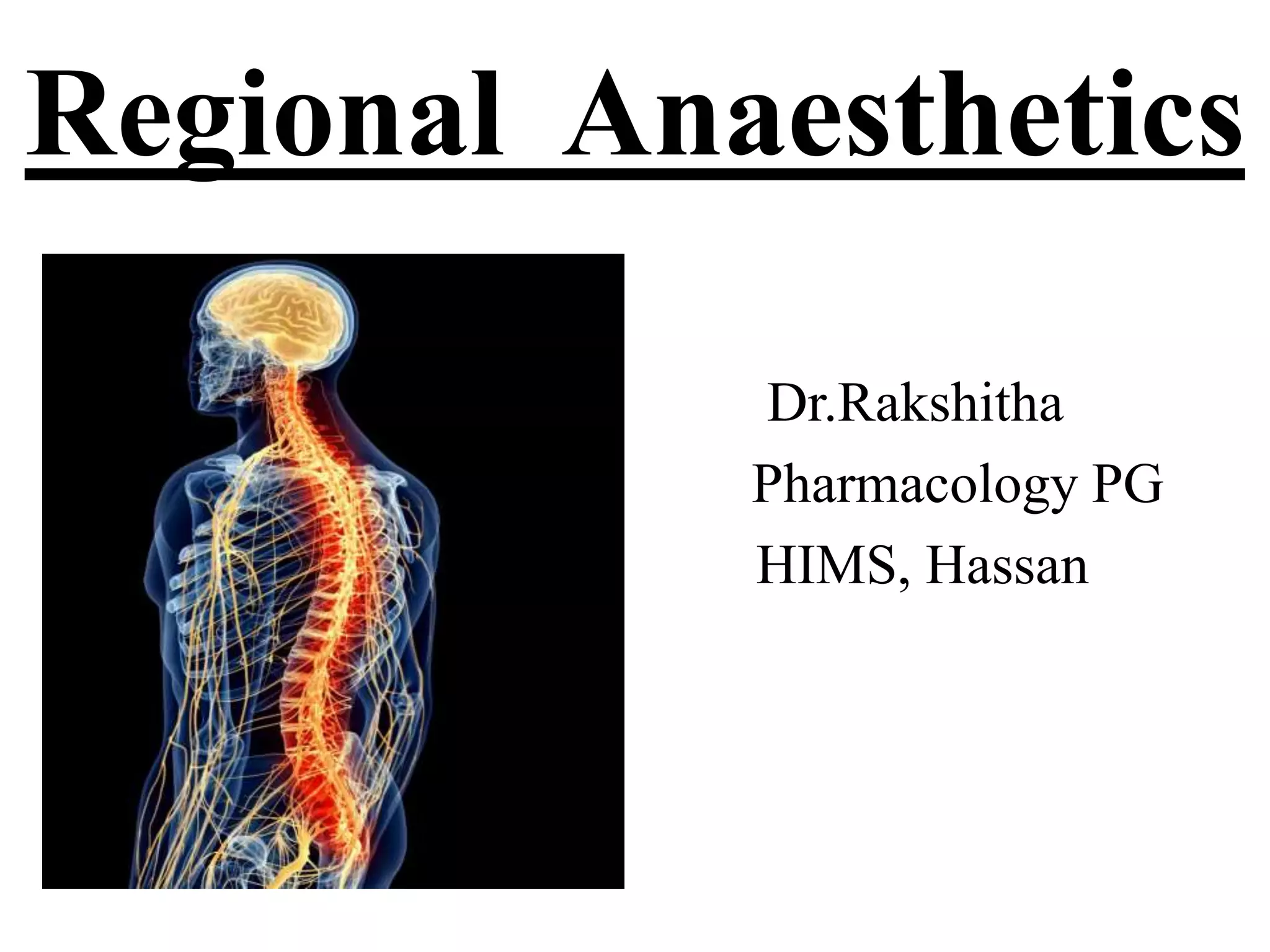



Regional Anaesthetics
Dr.Rakshitha
Pharmacology PG
HIMS, Hassan
Regional Anaesthetics
CONTENTS
 Introduction- Definition
 History
 Classification
 Mechanism of action of local
anaesthetics
 Pharmacological action
 Therapeutic uses
 Conclusion
Regional anaesthesia
DEFINITION
• The word anaesthesia is coined from two Greek
words: "an" meaning "without" and "aesthesis"
meaning "sensation".
• There are various types of anaesthesia.
Regional anaesthesia
DEFINITION
• Anaesthesia of a segment of the body
• Selective interruption of nerve transmission (i.e.,
Peripheral or neuraxial)
• No loss of consciousness.
Regional Anaesthetics
PRINCIPLES OF REGIONAL ANAESTHESIA
• Review physiology of nerve impulse conduction
• Identify equipment and preparation to provide
peripheral nerve blocks
• Identify types of local anaesthetic agents,
characteristics and risk factors
• Identify techniques and its risks.
Regional anaesthesia
History
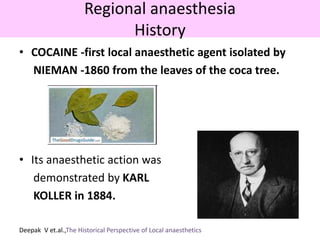
• COCAINE -first local anaesthetic agent isolated by
NIEMAN -1860 from the leaves of the coca tree.
• Its anaesthetic action was
demonstrated by KARL
KOLLER in 1884.
Deepak V et.al.,The Historical Perspective of Local anaesthetics
Regional anaesthesia
Some highlights on local anesthesia
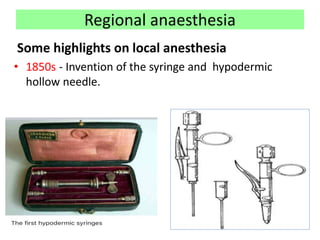
• 1850s - Invention of the syringe and hypodermic
hollow needle.
Regional anaesthesia
• 1884 -Halsted, an American surgeon, blocks the
brachial plexus with a solution of cocaine under direct
surgical exposure
• 1885 -Wood, in the United Kingdom, is credited with
the introduction of conduction anaesthesia through
hypodermic injection.
• 1897-- Epinephrine is isolated by John Abel at Johns
Hopkins Medical School.
• 1897-- Braun in Germany relates cocaine toxicity with
systemic absorption and advocates the use of
epinephrine.
Regional anaesthesia
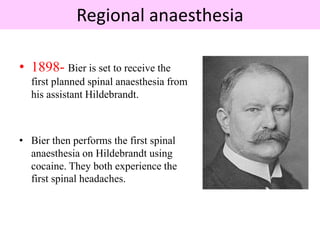
• 1898- Bier is set to receive the
first planned spinal anaesthesia from
his assistant Hildebrandt.
• Bier then performs the first spinal
anaesthesia on Hildebrandt using
cocaine. They both experience the
first spinal headaches.
Regional anaesthesia
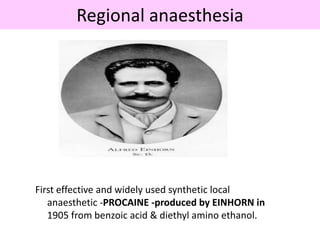
First effective and widely used synthetic local
anaesthetic -PROCAINE -produced by EINHORN in
1905 from benzoic acid & diethyl amino ethanol.
Regional anaesthesia
• 1908-- Bier introduces the intravenous
peripheral nerve block (Bier block) with
procaine.
• 1911-- Hirschel performs the first percutaneous
axillary block.
• 1911-- Kulenkampff performs the first
percutaneous supraclavicular block.
Regional Anaesthetics
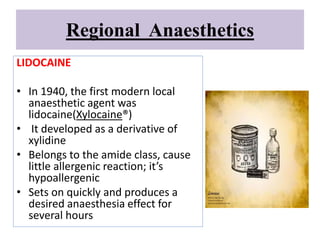
LIDOCAINE
• In 1940, the first modern local
anaesthetic agent was
lidocaine(Xylocaine®)
• It developed as a derivative of
xylidine
• Belongs to the amide class, cause
little allergenic reaction; it’s
hypoallergenic
• Sets on quickly and produces a
desired anaesthesia effect for
several hours
Regional Anaesthetics
DEFINITION
• Local anaesthesia is defined as a loss of
sensation in a circumscribed area of the body
caused by depression of excitation in nerve
endings or an inhibition of the conduction
process in peripheral nerves. STANLEY
F.MALAMED (1980)
Regional anaesthesia
DESIRABLE PROPERTIES OF LOCALANAESTHETICS
• Non irritating .
• It should not cause any permanent alteration of nerve structure .
• Systemic toxicity should be low .
• Fast onset of action .
• It should be effective regardless of whether it is injected into the tissue
or applied locally to mucous membrane
• Long duration of action.
Regional anaesthesia
DESIRABLE PROPERTIES OF LOCAL
ANAESTHETICS
• It should have the potency sufficient to give complete
anaesthesia without the use of harmful concentration
solutions.
• It should be free from producing allergic reactions.
• It should be stable in solution and relatively undergo
biotransformation in the body.
• It should be either sterile or be capable of being
sterilized by heat with out deterioration.
17
Regional Anaesthetics
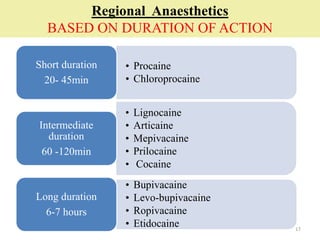
BASED ON DURATION OF ACTION
• Procaine
• Chloroprocaine
Short duration
20- 45min
• Lignocaine
• Articaine
• Mepivacaine
• Prilocaine
• Cocaine
Intermediate
duration
60 -120min
• Bupivacaine
• Levo-bupivacaine
• Ropivacaine
• Etidocaine
Long duration
6-7 hours
18
Regional Anaesthetics
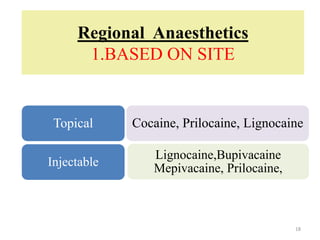
1.BASED ON SITE
Cocaine, Prilocaine, LignocaineTopical
Lignocaine,Bupivacaine
Mepivacaine, Prilocaine,Injectable
Regional Anaesthetics
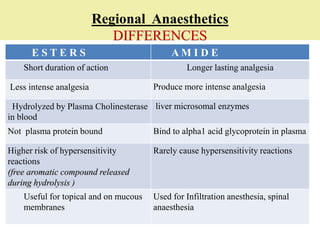
DIFFERENCES
E S T E R S A M I D E
Short duration of action Longer lasting analgesia
Less intense analgesia Produce more intense analgesia
Hydrolyzed by Plasma Cholinesterase
in blood
liver microsomal enzymes
Not plasma protein bound Bind to alpha1 acid glycoprotein in plasma
Higher risk of hypersensitivity
reactions
(free aromatic compound released
during hydrolysis )
Rarely cause hypersensitivity reactions
Useful for topical and on mucous
membranes
Used for Infiltration anesthesia, spinal
anaesthesia
Regional Anaesthetics
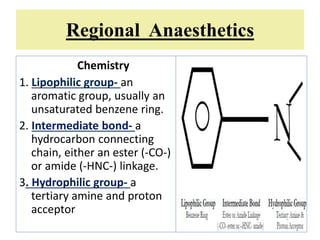
Chemistry
1. Lipophilic group- an
aromatic group, usually an
unsaturated benzene ring.
2. Intermediate bond- a
hydrocarbon connecting
chain, either an ester (-CO-)
or amide (-HNC-) linkage.
3. Hydrophilic group- a
tertiary amine and proton
acceptor
Regional Anaesthetics
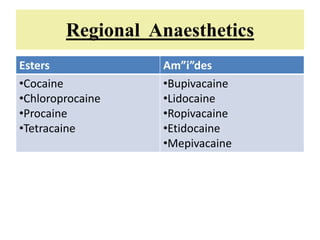
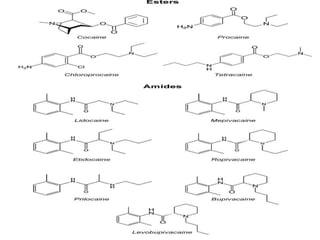
Esters Am”i”des
•Cocaine
•Chloroprocaine
•Procaine
•Tetracaine
•Bupivacaine
•Lidocaine
•Ropivacaine
•Etidocaine
•Mepivacaine
Regional anaesthesia
Physicochemical properties-activity relationship
1. Lipid solubility:
Determines intrinsic local anaesthetic activity.
↑ Lipid solubility
↑ Penetration into neuronal membrane
↑uptake
Hence, Lipid solubility parallels LA Potency
Regional Anaesthetics
Physicochemical properties-activity relationship
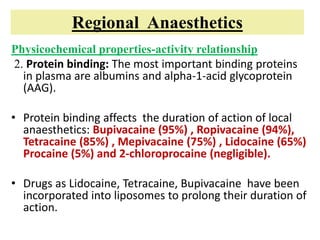
2. Protein binding: The most important binding proteins
in plasma are albumins and alpha-1-acid glycoprotein
(AAG).
• Protein binding affects the duration of action of local
anaesthetics: Bupivacaine (95%) , Ropivacaine (94%),
Tetracaine (85%) , Mepivacaine (75%) , Lidocaine (65%)
Procaine (5%) and 2-chloroprocaine (negligible).
• Drugs as Lidocaine, Tetracaine, Bupivacaine have been
incorporated into liposomes to prolong their duration of
action.
Regional Anaesthetics
Physicochemical properties-activity relationship
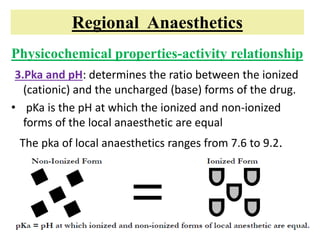
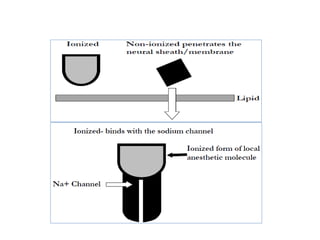
3.Pka and pH: determines the ratio between the ionized
(cationic) and the uncharged (base) forms of the drug.
• pKa is the pH at which the ionized and non-ionized
forms of the local anaesthetic are equal
The pka of local anaesthetics ranges from 7.6 to 9.2.
Regional Anaesthetics
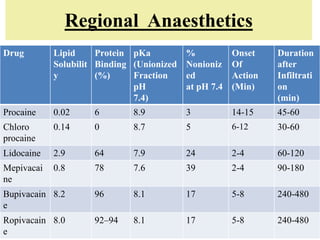
Drug Lipid
Solubilit
y
Protein
Binding
(%)
pKa
(Unionized
Fraction
pH
7.4)
%
Nonioniz
ed
at pH 7.4
Onset
Of
Action
(Min)
Duration
after
Infiltrati
on
(min)
Procaine 0.02 6 8.9 3 14-15 45-60
Chloro
procaine
0.14 0 8.7 5 6-12 30-60
Lidocaine 2.9 64 7.9 24 2-4 60-120
Mepivacai
ne
0.8 78 7.6 39 2-4 90-180
Bupivacain
e
8.2 96 8.1 17 5-8 240-480
Ropivacain
e
8.0 92–94 8.1 17 5-8 240-480
Regional Anaesthetics
Mechanism of action
ELETROPHYSIOLOGY OF NERVE
CONDUCTION
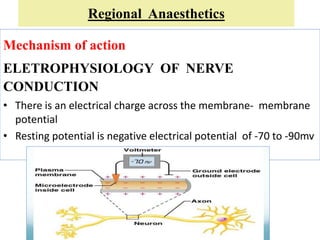
• There is an electrical charge across the membrane- membrane
potential
• Resting potential is negative electrical potential of -70 to -90mv
Regional Anaesthetics
GENERATION OF THE ACTION POTENTIAL:
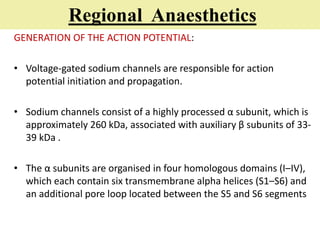
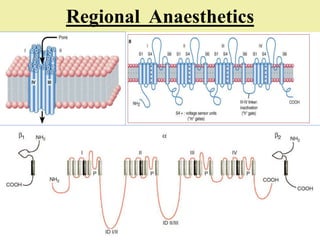
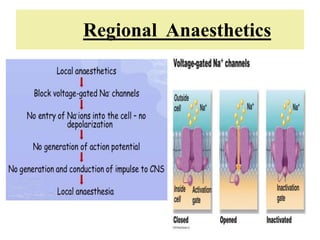
• Voltage-gated sodium channels are responsible for action
potential initiation and propagation.
• Sodium channels consist of a highly processed α subunit, which is
approximately 260 kDa, associated with auxiliary β subunits of 33-
39 kDa .
• The α subunits are organised in four homologous domains (I–IV),
which each contain six transmembrane alpha helices (S1–S6) and
an additional pore loop located between the S5 and S6 segments
Regional Anaesthetics
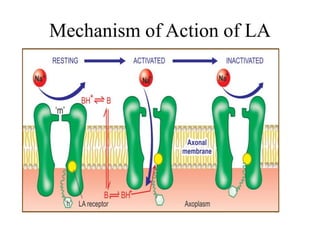
• Gate m (the activation gate) is normally
closed, and opens when the cell starts to get
more positive.
• Gate h (the deactivation gate) is normally
open, and swings shut when the cells gets too
positive.
Mechanism of Action of LA
Regional Anaesthetics
PHARMACOLOGICALACTIONS
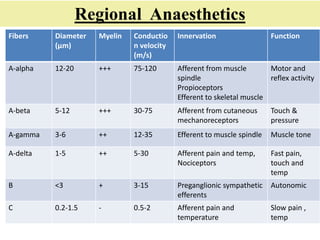
LOCAL ACTIONS
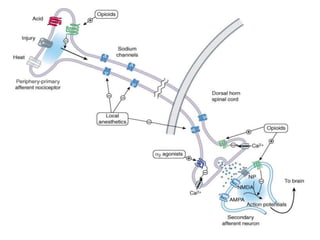
- Block sensory nerve endings , nerve trunks, ganglionic synapse.
- Receptors level: Reduce release of Ach from motor nerve endings
- Myelinated fibres more susceptible
• Small fibres > larger fibres
• Type C and B fibres> small A delta fibres> type A alpha/beta/
gamma fibres
• ORDER OF BLOCK
Pain – temperature- touch- deep pressure- motor
Fibres more susceptible to LA first to be blocked and last to recover
Regional Anaesthetics
Fibers Diameter
(µm)
Myelin Conductio
n velocity
(m/s)
Innervation Function
A-alpha 12-20 +++ 75-120 Afferent from muscle
spindle
Propioceptors
Efferent to skeletal muscle
Motor and
reflex activity
A-beta 5-12 +++ 30-75 Afferent from cutaneous
mechanoreceptors
Touch &
pressure
A-gamma 3-6 ++ 12-35 Efferent to muscle spindle Muscle tone
A-delta 1-5 ++ 5-30 Afferent pain and temp,
Nociceptors
Fast pain,
touch and
temp
B <3 + 3-15 Preganglionic sympathetic
efferents
Autonomic
C 0.2-1.5 - 0.5-2 Afferent pain and
temperature
Slow pain ,
temp
Regional Anaesthetics
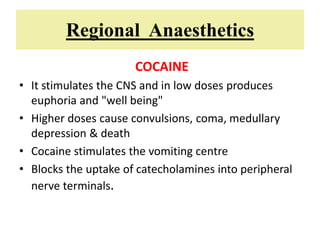
COCAINE
• It stimulates the CNS and in low doses produces
euphoria and "well being"
• Higher doses cause convulsions, coma, medullary
depression & death
• Cocaine stimulates the vomiting centre
• Blocks the uptake of catecholamines into peripheral
nerve terminals.
Regional Anaesthetics
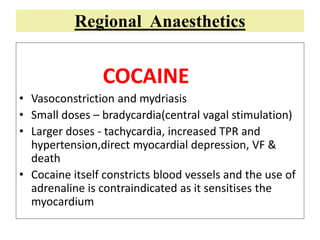
COCAINE
• Vasoconstriction and mydriasis
• Small doses – bradycardia(central vagal stimulation)
• Larger doses - tachycardia, increased TPR and
hypertension,direct myocardial depression, VF &
death
• Cocaine itself constricts blood vessels and the use of
adrenaline is contraindicated as it sensitises the
myocardium
Regional Anaesthetics
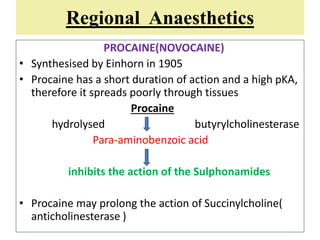
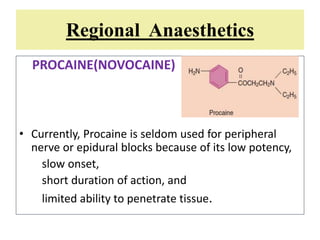
PROCAINE(NOVOCAINE)
• Synthesised by Einhorn in 1905
• Procaine has a short duration of action and a high pKA,
therefore it spreads poorly through tissues
Procaine
hydrolysed butyrylcholinesterase
Para-aminobenzoic acid
inhibits the action of the Sulphonamides
• Procaine may prolong the action of Succinylcholine(
anticholinesterase )
Regional Anaesthetics
PROCAINE(NOVOCAINE)
• Currently, Procaine is seldom used for peripheral
nerve or epidural blocks because of its low potency,
slow onset,
short duration of action, and
limited ability to penetrate tissue.
Regional Anaesthetics
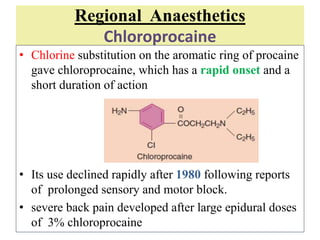
Chloroprocaine
• Chlorine substitution on the aromatic ring of procaine
gave chloroprocaine, which has a rapid onset and a
short duration of action
• Its use declined rapidly after 1980 following reports
of prolonged sensory and motor block.
• severe back pain developed after large epidural doses
of 3% chloroprocaine
Regional Anaesthetics
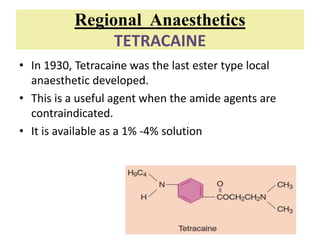
TETRACAINE
• In 1930, Tetracaine was the last ester type local
anaesthetic developed.
• This is a useful agent when the amide agents are
contraindicated.
• It is available as a 1% -4% solution
Regional Anaesthetics
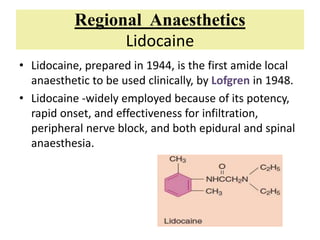
Lidocaine
• Lidocaine, prepared in 1944, is the first amide local
anaesthetic to be used clinically, by Lofgren in 1948.
• Lidocaine -widely employed because of its potency,
rapid onset, and effectiveness for infiltration,
peripheral nerve block, and both epidural and spinal
anaesthesia.
Regional Anaesthetics
Lidocaine
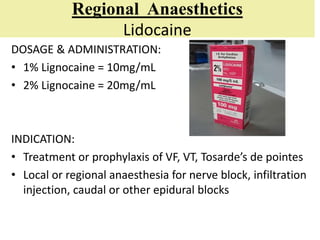
DOSAGE & ADMINISTRATION:
• 1% Lignocaine = 10mg/mL
• 2% Lignocaine = 20mg/mL
INDICATION:
• Treatment or prophylaxis of VF, VT, Tosarde’s de pointes
• Local or regional anaesthesia for nerve block, infiltration
injection, caudal or other epidural blocks
Regional Anaesthetics
Lidocaine
LOCAL ANAESTHETIC
Maximum dose:
• Lignocaine without adrenaline - 3mg/kg
• Lignocaine with adrenaline -7mg/kg
ARRHYTHMIAS
Bolus dose
• Bolus of 1 to 1.5 mg/kg (usually 75 to 100 mg) IV, over 1
to 2 minutes
• Duration of action of single bolus dose is 10-20minutes
Regional Anaesthetics
Lidocaine
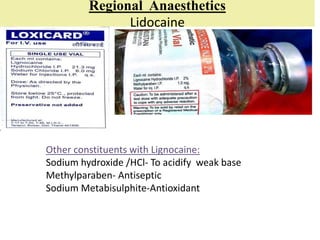
Other constituents with Lignocaine:
Sodium hydroxide /HCl- To acidify weak base
Methylparaben- Antiseptic
Sodium Metabisulphite-Antioxidant
Regional Anaesthetics
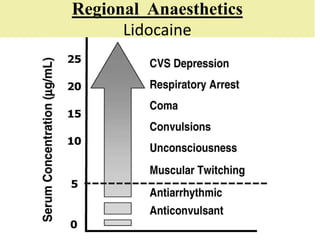
Lidocaine
Adverse/effects:
• CVS: hypotension, bradycardia, decreased cardiac
output, heart block, arrhythmia and cardiac arrest
• CNS: circumoral paraesthesia, numbness of the tongue,
light headedness and tinnitus.
• Tremors.
• Unconsciousness
• Malignant hyperthermia
Regional Anaesthetics
Lidocaine
Regional Anaesthetics
Lidocaine
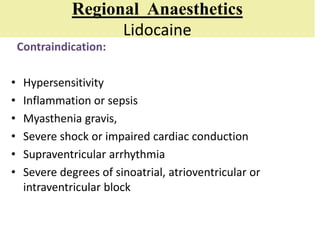
Contraindication:
• Hypersensitivity
• Inflammation or sepsis
• Myasthenia gravis,
• Severe shock or impaired cardiac conduction
• Supraventricular arrhythmia
• Severe degrees of sinoatrial, atrioventricular or
intraventricular block
Regional Anaesthetics
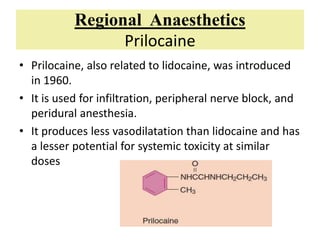
Prilocaine
• Prilocaine, also related to lidocaine, was introduced
in 1960.
• It is used for infiltration, peripheral nerve block, and
peridural anesthesia.
• It produces less vasodilatation than lidocaine and has
a lesser potential for systemic toxicity at similar
doses
Regional Anaesthetics
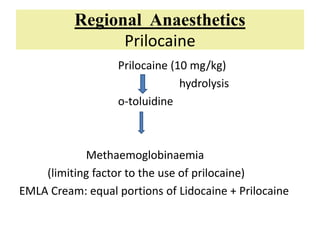
Prilocaine
Prilocaine (10 mg/kg)
hydrolysis
o-toluidine
Methaemoglobinaemia
(limiting factor to the use of prilocaine)
EMLA Cream: equal portions of Lidocaine + Prilocaine
Regional Anaesthetics
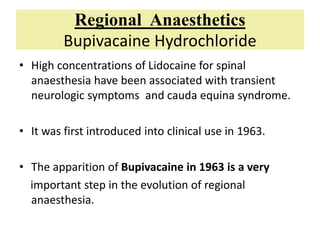
Bupivacaine Hydrochloride
• High concentrations of Lidocaine for spinal
anaesthesia have been associated with transient
neurologic symptoms and cauda equina syndrome.
• It was first introduced into clinical use in 1963.
• The apparition of Bupivacaine in 1963 is a very
important step in the evolution of regional
anaesthesia.
Regional Anaesthetics
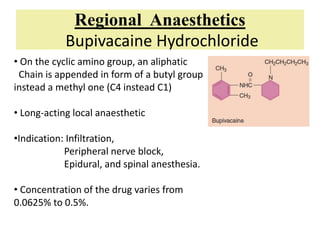
Bupivacaine Hydrochloride
• On the cyclic amino group, an aliphatic
Chain is appended in form of a butyl group
instead a methyl one (C4 instead C1)
• Long-acting local anaesthetic
•Indication: Infiltration,
Peripheral nerve block,
Epidural, and spinal anesthesia.
• Concentration of the drug varies from
0.0625% to 0.5%.
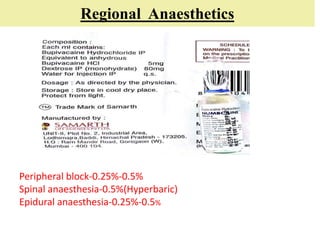
Regional Anaesthetics
Peripheral block-0.25%-0.5%
Spinal anaesthesia-0.5%(Hyperbaric)
Epidural anaesthesia-0.25%-0.5%
Regional Anaesthetics
Bupivacaine Adverse/Effects: {0.5-5µg/ml}
• Prolong QT interval
• Ventricular tachycardia
• Cardiac depression
• Cardiac arrest
• Hypotension,
• Bradycardia
Cox B, Durieux ME, Marcus MA. Toxicity of local anaesthetics. Best practice &
research Clinical anaesthesiology. 2003 Mar 1;17(1):111-36
Regional Anaesthetics
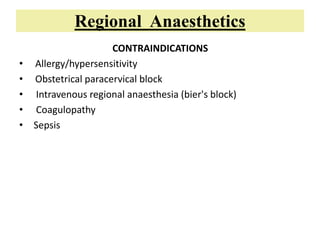
CONTRAINDICATIONS
• Allergy/hypersensitivity
• Obstetrical paracervical block
• Intravenous regional anaesthesia (bier's block)
• Coagulopathy
• Sepsis
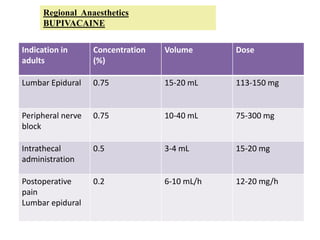
Indication in
adults
Concentration
(%)
Volume Dose
Lumbar Epidural 0.75 15-20 mL 113-150 mg
Peripheral nerve
block
0.75 10-40 mL 75-300 mg
Intrathecal
administration
0.5 3-4 mL 15-20 mg
Postoperative
pain
Lumbar epidural
0.2 6-10 mL/h 12-20 mg/h
Regional Anaesthetics
BUPIVACAINE
Regional Anaesthetics
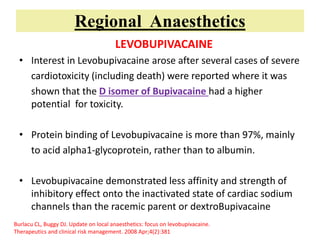
LEVOBUPIVACAINE
• Interest in Levobupivacaine arose after several cases of severe
cardiotoxicity (including death) were reported where it was
shown that the D isomer of Bupivacaine had a higher
potential for toxicity.
• Protein binding of Levobupivacaine is more than 97%, mainly
to acid alpha1-glycoprotein, rather than to albumin.
• Levobupivacaine demonstrated less affinity and strength of
inhibitory effect onto the inactivated state of cardiac sodium
channels than the racemic parent or dextroBupivacaine
Burlacu CL, Buggy DJ. Update on local anaesthetics: focus on levobupivacaine.
Therapeutics and clinical risk management. 2008 Apr;4(2):381
Regional Anaesthetics
LEVOBUPIVACAINE
• As a result of its lower cardiac and neurotoxicity compared to
racemic Bupivacaine, anaesthetists feel safer working with
Levobupivacaine, than with Bupivacaine.
Adverse Effects
• Hypotension,
• Bradycardia,
• Nausea, vomiting,
• Headache, dizziness, constipation,
• vomiting and convulsion
Burlacu CL, Buggy DJ. Update on local anaesthetics: focus on levobupivacaine.
Therapeutics and clinical risk management. 2008 Apr;4(2):381
Regional Anaesthetics
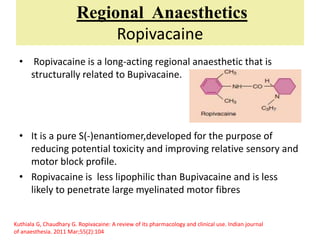
Ropivacaine
• Ropivacaine is a long-acting regional anaesthetic that is
structurally related to Bupivacaine.
• It is a pure S(-)enantiomer,developed for the purpose of
reducing potential toxicity and improving relative sensory and
motor block profile.
• Ropivacaine is less lipophilic than Bupivacaine and is less
likely to penetrate large myelinated motor fibres
Kuthiala G, Chaudhary G. Ropivacaine: A review of its pharmacology and clinical use. Indian journal
of anaesthesia. 2011 Mar;55(2):104
Regional Anaesthetics
Ropivacaine
Adverse effects:
• Hypotension ,
• Nausea , Vomiting , Bradycardia ,
• Fever , Pain ,
• Headache ,
• Pruritus , and
• Back pain
Kuthiala G, Chaudhary G. Ropivacaine: A review of its pharmacology and clinical use. Indian journal
of anaesthesia. 2011 Mar;55(2):104
Regional Anaesthetics
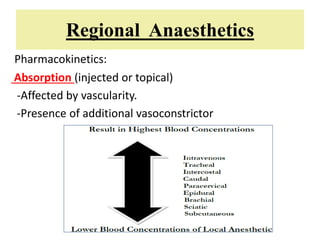
Pharmacokinetics:
Absorption (injected or topical)
-Affected by vascularity.
-Presence of additional vasoconstrictor
Regional Anaesthetics
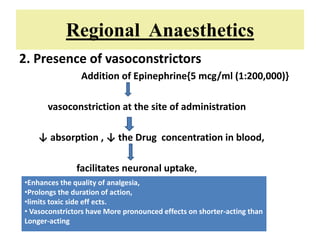
2. Presence of vasoconstrictors
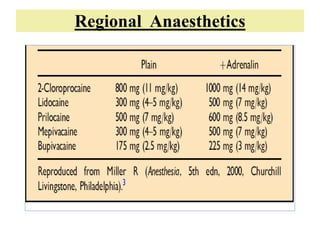
Addition of Epinephrine{5 mcg/ml (1:200,000)}
vasoconstriction at the site of administration
↓ absorption , ↓ the Drug concentration in blood,
facilitates neuronal uptake,
•Enhances the quality of analgesia,
•Prolongs the duration of action,
•limits toxic side eff ects.
• Vasoconstrictors have More pronounced effects on shorter-acting than
Longer-acting
Regional Anaesthetics
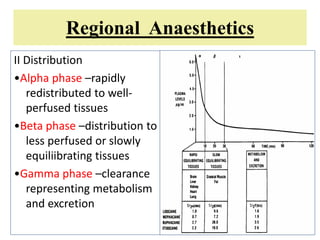
II Distribution
•Alpha phase –rapidly
redistributed to well-
perfused tissues
•Beta phase –distribution to
less perfused or slowly
equiliibrating tissues
•Gamma phase –clearance
representing metabolism
and excretion
Regional Anaesthetics
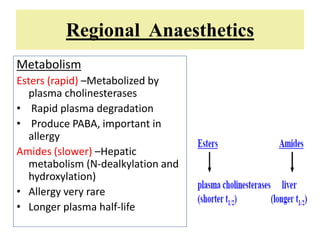
Metabolism
Esters (rapid) –Metabolized by
plasma cholinesterases
• Rapid plasma degradation
• Produce PABA, important in
allergy
Amides (slower) –Hepatic
metabolism (N-dealkylation and
hydroxylation)
• Allergy very rare
• Longer plasma half-life
Regional Anaesthetics
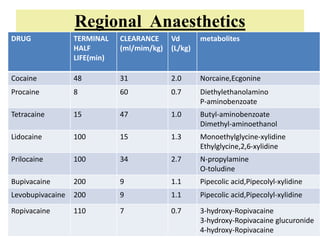
DRUG TERMINAL
HALF
LIFE(min)
CLEARANCE
(ml/mim/kg)
Vd
(L/kg)
metabolites
Cocaine 48 31 2.0 Norcaine,Ecgonine
Procaine 8 60 0.7 Diethylethanolamino
P-aminobenzoate
Tetracaine 15 47 1.0 Butyl-aminobenzoate
Dimethyl-aminoethanol
Lidocaine 100 15 1.3 Monoethylglycine-xylidine
Ethylglycine,2,6-xylidine
Prilocaine 100 34 2.7 N-propylamine
O-toludine
Bupivacaine 200 9 1.1 Pipecolic acid,Pipecolyl-xylidine
Levobupivacaine 200 9 1.1 Pipecolic acid,Pipecolyl-xylidine
Ropivacaine 110 7 0.7 3-hydroxy-Ropivacaine
3-hydroxy-Ropivacaine glucuronide
4-hydroxy-Ropivacaine
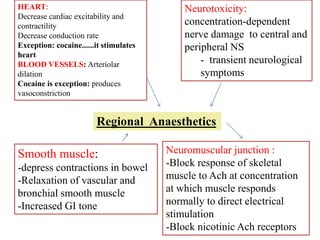
HEART:
Decrease cardiac excitability and
contractility
Decrease conduction rate
Exception: cocaine......it stimulates
heart
BLOOD VESSELS: Arteriolar
dilation
Cocaine is exception: produces
vasoconstriction
Neurotoxicity:
concentration-dependent
nerve damage to central and
peripheral NS
- transient neurological
symptoms
Smooth muscle:
-depress contractions in bowel
-Relaxation of vascular and
bronchial smooth muscle
-Increased GI tone
Neuromuscular junction :
-Block response of skeletal
muscle to Ach at concentration
at which muscle responds
normally to direct electrical
stimulation
-Block nicotinic Ach receptors
Regional Anaesthetics
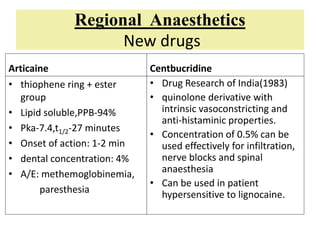
New drugs
Articaine
• thiophene ring + ester
group
• Lipid soluble,PPB-94%
• Pka-7.4,t1/2-27 minutes
• Onset of action: 1-2 min
• dental concentration: 4%
• A/E: methemoglobinemia,
paresthesia
Centbucridine
• Drug Research of India(1983)
• quinolone derivative with
intrinsic vasoconstricting and
anti-histaminic properties.
• Concentration of 0.5% can be
used effectively for infiltration,
nerve blocks and spinal
anaesthesia
• Can be used in patient
hypersensitive to lignocaine.
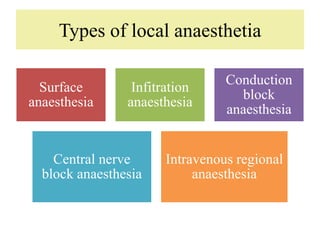
Types of local anaesthetia
Surface
anaesthesia
Infitration
anaesthesia
Conduction
block
anaesthesia
Central nerve
block anaesthesia
Intravenous regional
anaesthesia
Regional Anaesthetics
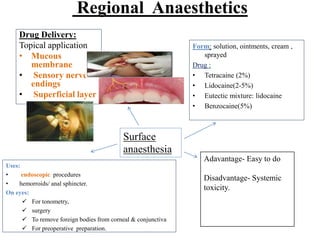
Drug Delivery:
Topical application
• Mucous
membrane
• Sensory nerve
endings
• Superficial layer
Form: solution, ointments, cream ,
sprayed
Drug :
• Tetracaine (2%)
• Lidocaine(2-5%)
• Eutectic mixture: lidocaine
• Benzocaine(5%)
Uses:
• endoscopic procedures
• hemorroids/ anal sphincter.
On eyes:
 For tonometry,
 surgery
 To remove foreign bodies from corneal & conjunctiva
 For preoperative preparation.
Adavantage- Easy to do
Disadvantage- Systemic
toxicity.
Surface
anaesthesia
Regional Anaesthetics
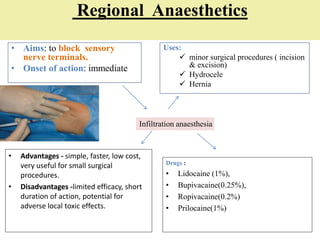
• Aims: to block sensory
nerve terminals.
• Onset of action: immediate
Uses:
 minor surgical procedures ( incision
& excision)
 Hydrocele
 Hernia
• Advantages - simple, faster, low cost,
very useful for small surgical
procedures.
• Disadvantages -limited efficacy, short
duration of action, potential for
adverse local toxic effects.
Drugs :
• Lidocaine (1%),
• Bupivacaine(0.25%),
• Ropivacaine(0.2%)
• Prilocaine(1%)
Infiltration anaesthesia
Regional Anaesthetics
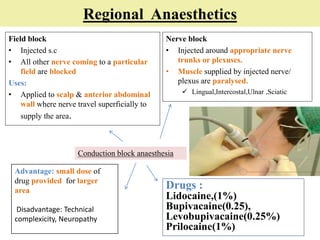
Field block
• Injected s.c
• All other nerve coming to a particular
field are blocked
Uses:
• Applied to scalp & anterior abdominal
wall where nerve travel superficially to
supply the area.
Nerve block
• Injected around appropriate nerve
trunks or plexuses.
• Muscle supplied by injected nerve/
plexus are paralysed.
 Lingual,Intercostal,Ulnar ,Sciatic
Drugs :
Lidocaine,(1%)
Bupivacaine(0.25),
Levobupivacaine(0.25%)
Prilocaine(1%)
Advantage: small dose of
drug provided for larger
area
Disadvantage: Technical
complexicity, Neuropathy
Conduction block anaesthesia
Regional Anaesthetics
Central nerve block anaesthesia
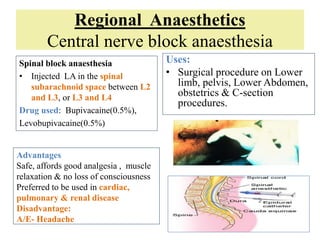
Spinal block anaesthesia
• Injected LA in the spinal
subarachnoid space between L2
and L3, or L3 and L4
Drug used: Bupivacaine(0.5%),
Levobupivacaine(0.5%)
Uses:
• Surgical procedure on Lower
limb, pelvis, Lower Abdomen,
obstetrics & C-section
procedures.
Advantages
Safe, affords good analgesia , muscle
relaxation & no loss of consciousness
Preferred to be used in cardiac,
pulmonary & renal disease
Disadvantage:
A/E- Headache
Regional Anaesthetics
Spinal Anaesthesia
Advantages of Spinal/Epidural Anesthesia
•Avoids Hazards of General Anesthesia
•Patient is Alert earlier postoperative
•Lower incidence of Nausea/Vomiting
•Better Pain Control/Less Narcotics
Regional Anaesthetics
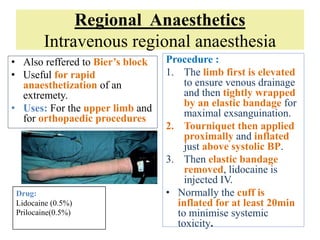
Intravenous regional anaesthesia
• Also reffered to Bier’s block
• Useful for rapid
anaesthetization of an
extremety.
• Uses: For the upper limb and
for orthopaedic procedures
Procedure :
1. The limb first is elevated
to ensure venous drainage
and then tightly wrapped
by an elastic bandage for
maximal exsanguination.
2. Tourniquet then applied
proximally and inflated
just above systolic BP.
3. Then elastic bandage
removed, lidocaine is
injected IV.
• Normally the cuff is
inflated for at least 20min
to minimise systemic
toxicity.
Drug:
Lidocaine (0.5%)
Prilocaine(0.5%)
Regional Anaesthetics
NewerDrug delivery system
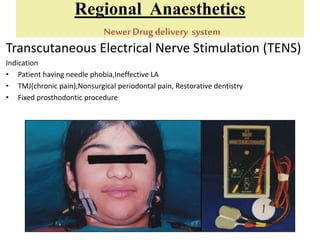
Transcutaneous Electrical Nerve Stimulation (TENS)
Indication
• Patient having needle phobia,Ineffective LA
• TMJ(chronic pain),Nonsurgical periodontal pain, Restorative dentistry
• Fixed prosthodontic procedure
Regional Anaesthetics
NewerDrug delivery system
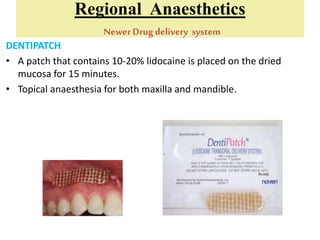
DENTIPATCH
• A patch that contains 10-20% lidocaine is placed on the dried
mucosa for 15 minutes.
• Topical anaesthesia for both maxilla and mandible.
Regional Anaesthetics
NewerDrug delivery system
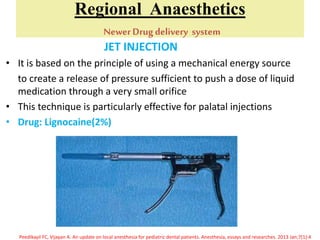
JET INJECTION
• It is based on the principle of using a mechanical energy source
to create a release of pressure sufficient to push a dose of liquid
medication through a very small orifice
• This technique is particularly effective for palatal injections
• Drug: Lignocaine(2%)
Peedikayil FC, Vijayan A. An update on local anesthesia for pediatric dental patients. Anesthesia, essays and researches. 2013 Jan;7(1):4
Local Anaesthetics
NewerDrug delivery system
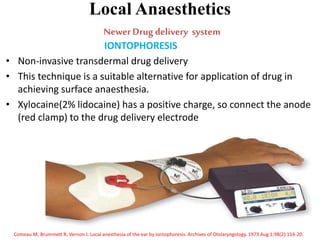
IONTOPHORESIS
• Non-invasive transdermal drug delivery
• This technique is a suitable alternative for application of drug in
achieving surface anaesthesia.
• Xylocaine(2% lidocaine) has a positive charge, so connect the anode
(red clamp) to the drug delivery electrode
Comeau M, Brummett R, Vernon J. Local anesthesia of the ear by iontophoresis. Archives of Otolaryngology. 1973 Aug 1;98(2):114-20.
Local Anaesthetics
NewerDrug delivery system
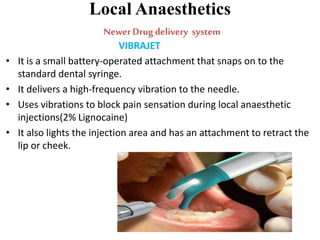
VIBRAJET
• It is a small battery-operated attachment that snaps on to the
standard dental syringe.
• It delivers a high-frequency vibration to the needle.
• Uses vibrations to block pain sensation during local anaesthetic
injections(2% Lignocaine)
• It also lights the injection area and has an attachment to retract the
lip or cheek.
Local Anaesthetics
Conclusion
• LA never intentionally injected into nerve: painful
and cause nerve damage
• LA agent is deposited as close to nerve as possible.
• Careful attention to detail and a thorough
understanding of the limitations and potential
complications of the technique are essential to
achieve the optimal outcome.
References
• R J Litz et.al.,Successful resuscitation of a patient with
Ropivacaine-induced asystole after axillary plexus block
using lipid infusion Anaesthesia, 2006, 61, pages 800–
801
• Acute management of anaphylaxis ASCIA guidelines
• National Essential Anaesthesia Drug List (NEADL) 2015
•Tripati K.D “Essentials of medical Pharmacology” ,7 th
edition.
•Guidelines for the Provision of Anaesthesia Services
(GPAS)
• K eith J .Anesthesia Emergencies .Oxford University
press.
•Wolters K. “The Washington Manual of medical
Therapeutics”.32nd edition:p-241
• P.E. Marik, Handbook of Evidence-Based Critical Care,
• Miller’s Anaesthesia, 7th Edition, Vol 1:pP1378 -80
References
• Leone et al., Pharmacology,toxicology,and
clinical use of new long acting local
anaesthetics,ropivacaine and levobupivacaine.
ACTA BIOMED 2008; 79: 92-105
• Newer Local Anaesthetic Drugs and Delivery
Systems in Dentistry – An Update .2012:1; 10-16
• Peedikayil FC, Vijayan A. An update on local
anesthesia for pediatric dental patients.
Anesthesia, essays and researches. 2013
Jan;7(1):4
• Comeau M, Brummett R, Vernon J. Local
anesthesia of the ear by iontophoresis. Archives
of Otolaryngology. 1973 Aug 1;98(2):114-20.
Local  anaesthetics

Local anaesthetics

  • 1.
  • 2.
    Regional Anaesthetics CONTENTS  Introduction-Definition  History  Classification  Mechanism of action of local anaesthetics  Pharmacological action  Therapeutic uses  Conclusion
  • 3.
    Regional anaesthesia DEFINITION • Theword anaesthesia is coined from two Greek words: "an" meaning "without" and "aesthesis" meaning "sensation". • There are various types of anaesthesia.
  • 4.
    Regional anaesthesia DEFINITION • Anaesthesiaof a segment of the body • Selective interruption of nerve transmission (i.e., Peripheral or neuraxial) • No loss of consciousness.
  • 5.
    Regional Anaesthetics PRINCIPLES OFREGIONAL ANAESTHESIA • Review physiology of nerve impulse conduction • Identify equipment and preparation to provide peripheral nerve blocks • Identify types of local anaesthetic agents, characteristics and risk factors • Identify techniques and its risks.
  • 6.
    Regional anaesthesia History • COCAINE-first local anaesthetic agent isolated by NIEMAN -1860 from the leaves of the coca tree. • Its anaesthetic action was demonstrated by KARL KOLLER in 1884. Deepak V et.al.,The Historical Perspective of Local anaesthetics
  • 7.
    Regional anaesthesia Some highlightson local anesthesia • 1850s - Invention of the syringe and hypodermic hollow needle.
  • 8.
    Regional anaesthesia • 1884-Halsted, an American surgeon, blocks the brachial plexus with a solution of cocaine under direct surgical exposure • 1885 -Wood, in the United Kingdom, is credited with the introduction of conduction anaesthesia through hypodermic injection. • 1897-- Epinephrine is isolated by John Abel at Johns Hopkins Medical School. • 1897-- Braun in Germany relates cocaine toxicity with systemic absorption and advocates the use of epinephrine.
  • 9.
    Regional anaesthesia • 1898-Bier is set to receive the first planned spinal anaesthesia from his assistant Hildebrandt. • Bier then performs the first spinal anaesthesia on Hildebrandt using cocaine. They both experience the first spinal headaches.
  • 10.
    Regional anaesthesia First effectiveand widely used synthetic local anaesthetic -PROCAINE -produced by EINHORN in 1905 from benzoic acid & diethyl amino ethanol.
  • 11.
    Regional anaesthesia • 1908--Bier introduces the intravenous peripheral nerve block (Bier block) with procaine. • 1911-- Hirschel performs the first percutaneous axillary block. • 1911-- Kulenkampff performs the first percutaneous supraclavicular block.
  • 12.
    Regional Anaesthetics LIDOCAINE • In1940, the first modern local anaesthetic agent was lidocaine(Xylocaine®) • It developed as a derivative of xylidine • Belongs to the amide class, cause little allergenic reaction; it’s hypoallergenic • Sets on quickly and produces a desired anaesthesia effect for several hours
  • 13.
    Regional Anaesthetics DEFINITION • Localanaesthesia is defined as a loss of sensation in a circumscribed area of the body caused by depression of excitation in nerve endings or an inhibition of the conduction process in peripheral nerves. STANLEY F.MALAMED (1980)
  • 14.
    Regional anaesthesia DESIRABLE PROPERTIESOF LOCALANAESTHETICS • Non irritating . • It should not cause any permanent alteration of nerve structure . • Systemic toxicity should be low . • Fast onset of action . • It should be effective regardless of whether it is injected into the tissue or applied locally to mucous membrane • Long duration of action.
  • 15.
    Regional anaesthesia DESIRABLE PROPERTIESOF LOCAL ANAESTHETICS • It should have the potency sufficient to give complete anaesthesia without the use of harmful concentration solutions. • It should be free from producing allergic reactions. • It should be stable in solution and relatively undergo biotransformation in the body. • It should be either sterile or be capable of being sterilized by heat with out deterioration.
  • 16.
    17 Regional Anaesthetics BASED ONDURATION OF ACTION • Procaine • Chloroprocaine Short duration 20- 45min • Lignocaine • Articaine • Mepivacaine • Prilocaine • Cocaine Intermediate duration 60 -120min • Bupivacaine • Levo-bupivacaine • Ropivacaine • Etidocaine Long duration 6-7 hours
  • 17.
    18 Regional Anaesthetics 1.BASED ONSITE Cocaine, Prilocaine, LignocaineTopical Lignocaine,Bupivacaine Mepivacaine, Prilocaine,Injectable
  • 18.
    Regional Anaesthetics DIFFERENCES E ST E R S A M I D E Short duration of action Longer lasting analgesia Less intense analgesia Produce more intense analgesia Hydrolyzed by Plasma Cholinesterase in blood liver microsomal enzymes Not plasma protein bound Bind to alpha1 acid glycoprotein in plasma Higher risk of hypersensitivity reactions (free aromatic compound released during hydrolysis ) Rarely cause hypersensitivity reactions Useful for topical and on mucous membranes Used for Infiltration anesthesia, spinal anaesthesia
  • 19.
    Regional Anaesthetics Chemistry 1. Lipophilicgroup- an aromatic group, usually an unsaturated benzene ring. 2. Intermediate bond- a hydrocarbon connecting chain, either an ester (-CO-) or amide (-HNC-) linkage. 3. Hydrophilic group- a tertiary amine and proton acceptor
  • 20.
  • 22.
    Regional anaesthesia Physicochemical properties-activityrelationship 1. Lipid solubility: Determines intrinsic local anaesthetic activity. ↑ Lipid solubility ↑ Penetration into neuronal membrane ↑uptake Hence, Lipid solubility parallels LA Potency
  • 23.
    Regional Anaesthetics Physicochemical properties-activityrelationship 2. Protein binding: The most important binding proteins in plasma are albumins and alpha-1-acid glycoprotein (AAG). • Protein binding affects the duration of action of local anaesthetics: Bupivacaine (95%) , Ropivacaine (94%), Tetracaine (85%) , Mepivacaine (75%) , Lidocaine (65%) Procaine (5%) and 2-chloroprocaine (negligible). • Drugs as Lidocaine, Tetracaine, Bupivacaine have been incorporated into liposomes to prolong their duration of action.
  • 24.
    Regional Anaesthetics Physicochemical properties-activityrelationship 3.Pka and pH: determines the ratio between the ionized (cationic) and the uncharged (base) forms of the drug. • pKa is the pH at which the ionized and non-ionized forms of the local anaesthetic are equal The pka of local anaesthetics ranges from 7.6 to 9.2.
  • 26.
    Regional Anaesthetics Drug Lipid Solubilit y Protein Binding (%) pKa (Unionized Fraction pH 7.4) % Nonioniz ed atpH 7.4 Onset Of Action (Min) Duration after Infiltrati on (min) Procaine 0.02 6 8.9 3 14-15 45-60 Chloro procaine 0.14 0 8.7 5 6-12 30-60 Lidocaine 2.9 64 7.9 24 2-4 60-120 Mepivacai ne 0.8 78 7.6 39 2-4 90-180 Bupivacain e 8.2 96 8.1 17 5-8 240-480 Ropivacain e 8.0 92–94 8.1 17 5-8 240-480
  • 27.
    Regional Anaesthetics Mechanism ofaction ELETROPHYSIOLOGY OF NERVE CONDUCTION • There is an electrical charge across the membrane- membrane potential • Resting potential is negative electrical potential of -70 to -90mv
  • 28.
    Regional Anaesthetics GENERATION OFTHE ACTION POTENTIAL: • Voltage-gated sodium channels are responsible for action potential initiation and propagation. • Sodium channels consist of a highly processed α subunit, which is approximately 260 kDa, associated with auxiliary β subunits of 33- 39 kDa . • The α subunits are organised in four homologous domains (I–IV), which each contain six transmembrane alpha helices (S1–S6) and an additional pore loop located between the S5 and S6 segments
  • 30.
  • 31.
    Regional Anaesthetics • Gatem (the activation gate) is normally closed, and opens when the cell starts to get more positive. • Gate h (the deactivation gate) is normally open, and swings shut when the cells gets too positive.
  • 32.
  • 33.
  • 34.
    Regional Anaesthetics PHARMACOLOGICALACTIONS LOCAL ACTIONS -Block sensory nerve endings , nerve trunks, ganglionic synapse. - Receptors level: Reduce release of Ach from motor nerve endings - Myelinated fibres more susceptible • Small fibres > larger fibres • Type C and B fibres> small A delta fibres> type A alpha/beta/ gamma fibres • ORDER OF BLOCK Pain – temperature- touch- deep pressure- motor Fibres more susceptible to LA first to be blocked and last to recover
  • 35.
    Regional Anaesthetics Fibers Diameter (µm) MyelinConductio n velocity (m/s) Innervation Function A-alpha 12-20 +++ 75-120 Afferent from muscle spindle Propioceptors Efferent to skeletal muscle Motor and reflex activity A-beta 5-12 +++ 30-75 Afferent from cutaneous mechanoreceptors Touch & pressure A-gamma 3-6 ++ 12-35 Efferent to muscle spindle Muscle tone A-delta 1-5 ++ 5-30 Afferent pain and temp, Nociceptors Fast pain, touch and temp B <3 + 3-15 Preganglionic sympathetic efferents Autonomic C 0.2-1.5 - 0.5-2 Afferent pain and temperature Slow pain , temp
  • 36.
    Regional Anaesthetics COCAINE • Itstimulates the CNS and in low doses produces euphoria and "well being" • Higher doses cause convulsions, coma, medullary depression & death • Cocaine stimulates the vomiting centre • Blocks the uptake of catecholamines into peripheral nerve terminals.
  • 37.
    Regional Anaesthetics COCAINE • Vasoconstrictionand mydriasis • Small doses – bradycardia(central vagal stimulation) • Larger doses - tachycardia, increased TPR and hypertension,direct myocardial depression, VF & death • Cocaine itself constricts blood vessels and the use of adrenaline is contraindicated as it sensitises the myocardium
  • 38.
    Regional Anaesthetics PROCAINE(NOVOCAINE) • Synthesisedby Einhorn in 1905 • Procaine has a short duration of action and a high pKA, therefore it spreads poorly through tissues Procaine hydrolysed butyrylcholinesterase Para-aminobenzoic acid inhibits the action of the Sulphonamides • Procaine may prolong the action of Succinylcholine( anticholinesterase )
  • 39.
    Regional Anaesthetics PROCAINE(NOVOCAINE) • Currently,Procaine is seldom used for peripheral nerve or epidural blocks because of its low potency, slow onset, short duration of action, and limited ability to penetrate tissue.
  • 40.
    Regional Anaesthetics Chloroprocaine • Chlorinesubstitution on the aromatic ring of procaine gave chloroprocaine, which has a rapid onset and a short duration of action • Its use declined rapidly after 1980 following reports of prolonged sensory and motor block. • severe back pain developed after large epidural doses of 3% chloroprocaine
  • 41.
    Regional Anaesthetics TETRACAINE • In1930, Tetracaine was the last ester type local anaesthetic developed. • This is a useful agent when the amide agents are contraindicated. • It is available as a 1% -4% solution
  • 42.
    Regional Anaesthetics Lidocaine • Lidocaine,prepared in 1944, is the first amide local anaesthetic to be used clinically, by Lofgren in 1948. • Lidocaine -widely employed because of its potency, rapid onset, and effectiveness for infiltration, peripheral nerve block, and both epidural and spinal anaesthesia.
  • 43.
    Regional Anaesthetics Lidocaine DOSAGE &ADMINISTRATION: • 1% Lignocaine = 10mg/mL • 2% Lignocaine = 20mg/mL INDICATION: • Treatment or prophylaxis of VF, VT, Tosarde’s de pointes • Local or regional anaesthesia for nerve block, infiltration injection, caudal or other epidural blocks
  • 44.
    Regional Anaesthetics Lidocaine LOCAL ANAESTHETIC Maximumdose: • Lignocaine without adrenaline - 3mg/kg • Lignocaine with adrenaline -7mg/kg ARRHYTHMIAS Bolus dose • Bolus of 1 to 1.5 mg/kg (usually 75 to 100 mg) IV, over 1 to 2 minutes • Duration of action of single bolus dose is 10-20minutes
  • 45.
    Regional Anaesthetics Lidocaine Other constituentswith Lignocaine: Sodium hydroxide /HCl- To acidify weak base Methylparaben- Antiseptic Sodium Metabisulphite-Antioxidant
  • 46.
    Regional Anaesthetics Lidocaine Adverse/effects: • CVS:hypotension, bradycardia, decreased cardiac output, heart block, arrhythmia and cardiac arrest • CNS: circumoral paraesthesia, numbness of the tongue, light headedness and tinnitus. • Tremors. • Unconsciousness • Malignant hyperthermia
  • 47.
  • 48.
    Regional Anaesthetics Lidocaine Contraindication: • Hypersensitivity •Inflammation or sepsis • Myasthenia gravis, • Severe shock or impaired cardiac conduction • Supraventricular arrhythmia • Severe degrees of sinoatrial, atrioventricular or intraventricular block
  • 49.
    Regional Anaesthetics Prilocaine • Prilocaine,also related to lidocaine, was introduced in 1960. • It is used for infiltration, peripheral nerve block, and peridural anesthesia. • It produces less vasodilatation than lidocaine and has a lesser potential for systemic toxicity at similar doses
  • 50.
    Regional Anaesthetics Prilocaine Prilocaine (10mg/kg) hydrolysis o-toluidine Methaemoglobinaemia (limiting factor to the use of prilocaine) EMLA Cream: equal portions of Lidocaine + Prilocaine
  • 51.
    Regional Anaesthetics Bupivacaine Hydrochloride •High concentrations of Lidocaine for spinal anaesthesia have been associated with transient neurologic symptoms and cauda equina syndrome. • It was first introduced into clinical use in 1963. • The apparition of Bupivacaine in 1963 is a very important step in the evolution of regional anaesthesia.
  • 52.
    Regional Anaesthetics Bupivacaine Hydrochloride •On the cyclic amino group, an aliphatic Chain is appended in form of a butyl group instead a methyl one (C4 instead C1) • Long-acting local anaesthetic •Indication: Infiltration, Peripheral nerve block, Epidural, and spinal anesthesia. • Concentration of the drug varies from 0.0625% to 0.5%.
  • 53.
    Regional Anaesthetics Peripheral block-0.25%-0.5% Spinalanaesthesia-0.5%(Hyperbaric) Epidural anaesthesia-0.25%-0.5%
  • 54.
    Regional Anaesthetics Bupivacaine Adverse/Effects:{0.5-5µg/ml} • Prolong QT interval • Ventricular tachycardia • Cardiac depression • Cardiac arrest • Hypotension, • Bradycardia Cox B, Durieux ME, Marcus MA. Toxicity of local anaesthetics. Best practice & research Clinical anaesthesiology. 2003 Mar 1;17(1):111-36
  • 55.
    Regional Anaesthetics CONTRAINDICATIONS • Allergy/hypersensitivity •Obstetrical paracervical block • Intravenous regional anaesthesia (bier's block) • Coagulopathy • Sepsis
  • 56.
    Indication in adults Concentration (%) Volume Dose LumbarEpidural 0.75 15-20 mL 113-150 mg Peripheral nerve block 0.75 10-40 mL 75-300 mg Intrathecal administration 0.5 3-4 mL 15-20 mg Postoperative pain Lumbar epidural 0.2 6-10 mL/h 12-20 mg/h Regional Anaesthetics BUPIVACAINE
  • 57.
  • 58.
    Regional Anaesthetics LEVOBUPIVACAINE • Interestin Levobupivacaine arose after several cases of severe cardiotoxicity (including death) were reported where it was shown that the D isomer of Bupivacaine had a higher potential for toxicity. • Protein binding of Levobupivacaine is more than 97%, mainly to acid alpha1-glycoprotein, rather than to albumin. • Levobupivacaine demonstrated less affinity and strength of inhibitory effect onto the inactivated state of cardiac sodium channels than the racemic parent or dextroBupivacaine Burlacu CL, Buggy DJ. Update on local anaesthetics: focus on levobupivacaine. Therapeutics and clinical risk management. 2008 Apr;4(2):381
  • 59.
    Regional Anaesthetics LEVOBUPIVACAINE • Asa result of its lower cardiac and neurotoxicity compared to racemic Bupivacaine, anaesthetists feel safer working with Levobupivacaine, than with Bupivacaine. Adverse Effects • Hypotension, • Bradycardia, • Nausea, vomiting, • Headache, dizziness, constipation, • vomiting and convulsion Burlacu CL, Buggy DJ. Update on local anaesthetics: focus on levobupivacaine. Therapeutics and clinical risk management. 2008 Apr;4(2):381
  • 60.
    Regional Anaesthetics Ropivacaine • Ropivacaineis a long-acting regional anaesthetic that is structurally related to Bupivacaine. • It is a pure S(-)enantiomer,developed for the purpose of reducing potential toxicity and improving relative sensory and motor block profile. • Ropivacaine is less lipophilic than Bupivacaine and is less likely to penetrate large myelinated motor fibres Kuthiala G, Chaudhary G. Ropivacaine: A review of its pharmacology and clinical use. Indian journal of anaesthesia. 2011 Mar;55(2):104
  • 61.
    Regional Anaesthetics Ropivacaine Adverse effects: •Hypotension , • Nausea , Vomiting , Bradycardia , • Fever , Pain , • Headache , • Pruritus , and • Back pain Kuthiala G, Chaudhary G. Ropivacaine: A review of its pharmacology and clinical use. Indian journal of anaesthesia. 2011 Mar;55(2):104
  • 62.
    Regional Anaesthetics Pharmacokinetics: Absorption (injectedor topical) -Affected by vascularity. -Presence of additional vasoconstrictor
  • 63.
    Regional Anaesthetics 2. Presenceof vasoconstrictors Addition of Epinephrine{5 mcg/ml (1:200,000)} vasoconstriction at the site of administration ↓ absorption , ↓ the Drug concentration in blood, facilitates neuronal uptake, •Enhances the quality of analgesia, •Prolongs the duration of action, •limits toxic side eff ects. • Vasoconstrictors have More pronounced effects on shorter-acting than Longer-acting
  • 64.
    Regional Anaesthetics II Distribution •Alphaphase –rapidly redistributed to well- perfused tissues •Beta phase –distribution to less perfused or slowly equiliibrating tissues •Gamma phase –clearance representing metabolism and excretion
  • 65.
    Regional Anaesthetics Metabolism Esters (rapid)–Metabolized by plasma cholinesterases • Rapid plasma degradation • Produce PABA, important in allergy Amides (slower) –Hepatic metabolism (N-dealkylation and hydroxylation) • Allergy very rare • Longer plasma half-life
  • 66.
    Regional Anaesthetics DRUG TERMINAL HALF LIFE(min) CLEARANCE (ml/mim/kg) Vd (L/kg) metabolites Cocaine48 31 2.0 Norcaine,Ecgonine Procaine 8 60 0.7 Diethylethanolamino P-aminobenzoate Tetracaine 15 47 1.0 Butyl-aminobenzoate Dimethyl-aminoethanol Lidocaine 100 15 1.3 Monoethylglycine-xylidine Ethylglycine,2,6-xylidine Prilocaine 100 34 2.7 N-propylamine O-toludine Bupivacaine 200 9 1.1 Pipecolic acid,Pipecolyl-xylidine Levobupivacaine 200 9 1.1 Pipecolic acid,Pipecolyl-xylidine Ropivacaine 110 7 0.7 3-hydroxy-Ropivacaine 3-hydroxy-Ropivacaine glucuronide 4-hydroxy-Ropivacaine
  • 67.
    HEART: Decrease cardiac excitabilityand contractility Decrease conduction rate Exception: cocaine......it stimulates heart BLOOD VESSELS: Arteriolar dilation Cocaine is exception: produces vasoconstriction Neurotoxicity: concentration-dependent nerve damage to central and peripheral NS - transient neurological symptoms Smooth muscle: -depress contractions in bowel -Relaxation of vascular and bronchial smooth muscle -Increased GI tone Neuromuscular junction : -Block response of skeletal muscle to Ach at concentration at which muscle responds normally to direct electrical stimulation -Block nicotinic Ach receptors Regional Anaesthetics
  • 68.
    Regional Anaesthetics New drugs Articaine •thiophene ring + ester group • Lipid soluble,PPB-94% • Pka-7.4,t1/2-27 minutes • Onset of action: 1-2 min • dental concentration: 4% • A/E: methemoglobinemia, paresthesia Centbucridine • Drug Research of India(1983) • quinolone derivative with intrinsic vasoconstricting and anti-histaminic properties. • Concentration of 0.5% can be used effectively for infiltration, nerve blocks and spinal anaesthesia • Can be used in patient hypersensitive to lignocaine.
  • 69.
    Types of localanaesthetia Surface anaesthesia Infitration anaesthesia Conduction block anaesthesia Central nerve block anaesthesia Intravenous regional anaesthesia
  • 70.
    Regional Anaesthetics Drug Delivery: Topicalapplication • Mucous membrane • Sensory nerve endings • Superficial layer Form: solution, ointments, cream , sprayed Drug : • Tetracaine (2%) • Lidocaine(2-5%) • Eutectic mixture: lidocaine • Benzocaine(5%) Uses: • endoscopic procedures • hemorroids/ anal sphincter. On eyes:  For tonometry,  surgery  To remove foreign bodies from corneal & conjunctiva  For preoperative preparation. Adavantage- Easy to do Disadvantage- Systemic toxicity. Surface anaesthesia
  • 71.
    Regional Anaesthetics • Aims:to block sensory nerve terminals. • Onset of action: immediate Uses:  minor surgical procedures ( incision & excision)  Hydrocele  Hernia • Advantages - simple, faster, low cost, very useful for small surgical procedures. • Disadvantages -limited efficacy, short duration of action, potential for adverse local toxic effects. Drugs : • Lidocaine (1%), • Bupivacaine(0.25%), • Ropivacaine(0.2%) • Prilocaine(1%) Infiltration anaesthesia
  • 72.
    Regional Anaesthetics Field block •Injected s.c • All other nerve coming to a particular field are blocked Uses: • Applied to scalp & anterior abdominal wall where nerve travel superficially to supply the area. Nerve block • Injected around appropriate nerve trunks or plexuses. • Muscle supplied by injected nerve/ plexus are paralysed.  Lingual,Intercostal,Ulnar ,Sciatic Drugs : Lidocaine,(1%) Bupivacaine(0.25), Levobupivacaine(0.25%) Prilocaine(1%) Advantage: small dose of drug provided for larger area Disadvantage: Technical complexicity, Neuropathy Conduction block anaesthesia
  • 73.
    Regional Anaesthetics Central nerveblock anaesthesia Spinal block anaesthesia • Injected LA in the spinal subarachnoid space between L2 and L3, or L3 and L4 Drug used: Bupivacaine(0.5%), Levobupivacaine(0.5%) Uses: • Surgical procedure on Lower limb, pelvis, Lower Abdomen, obstetrics & C-section procedures. Advantages Safe, affords good analgesia , muscle relaxation & no loss of consciousness Preferred to be used in cardiac, pulmonary & renal disease Disadvantage: A/E- Headache
  • 74.
    Regional Anaesthetics Spinal Anaesthesia Advantagesof Spinal/Epidural Anesthesia •Avoids Hazards of General Anesthesia •Patient is Alert earlier postoperative •Lower incidence of Nausea/Vomiting •Better Pain Control/Less Narcotics
  • 75.
    Regional Anaesthetics Intravenous regionalanaesthesia • Also reffered to Bier’s block • Useful for rapid anaesthetization of an extremety. • Uses: For the upper limb and for orthopaedic procedures Procedure : 1. The limb first is elevated to ensure venous drainage and then tightly wrapped by an elastic bandage for maximal exsanguination. 2. Tourniquet then applied proximally and inflated just above systolic BP. 3. Then elastic bandage removed, lidocaine is injected IV. • Normally the cuff is inflated for at least 20min to minimise systemic toxicity. Drug: Lidocaine (0.5%) Prilocaine(0.5%)
  • 76.
    Regional Anaesthetics NewerDrug deliverysystem Transcutaneous Electrical Nerve Stimulation (TENS) Indication • Patient having needle phobia,Ineffective LA • TMJ(chronic pain),Nonsurgical periodontal pain, Restorative dentistry • Fixed prosthodontic procedure
  • 77.
    Regional Anaesthetics NewerDrug deliverysystem DENTIPATCH • A patch that contains 10-20% lidocaine is placed on the dried mucosa for 15 minutes. • Topical anaesthesia for both maxilla and mandible.
  • 78.
    Regional Anaesthetics NewerDrug deliverysystem JET INJECTION • It is based on the principle of using a mechanical energy source to create a release of pressure sufficient to push a dose of liquid medication through a very small orifice • This technique is particularly effective for palatal injections • Drug: Lignocaine(2%) Peedikayil FC, Vijayan A. An update on local anesthesia for pediatric dental patients. Anesthesia, essays and researches. 2013 Jan;7(1):4
  • 79.
    Local Anaesthetics NewerDrug deliverysystem IONTOPHORESIS • Non-invasive transdermal drug delivery • This technique is a suitable alternative for application of drug in achieving surface anaesthesia. • Xylocaine(2% lidocaine) has a positive charge, so connect the anode (red clamp) to the drug delivery electrode Comeau M, Brummett R, Vernon J. Local anesthesia of the ear by iontophoresis. Archives of Otolaryngology. 1973 Aug 1;98(2):114-20.
  • 80.
    Local Anaesthetics NewerDrug deliverysystem VIBRAJET • It is a small battery-operated attachment that snaps on to the standard dental syringe. • It delivers a high-frequency vibration to the needle. • Uses vibrations to block pain sensation during local anaesthetic injections(2% Lignocaine) • It also lights the injection area and has an attachment to retract the lip or cheek.
  • 81.
    Local Anaesthetics Conclusion • LAnever intentionally injected into nerve: painful and cause nerve damage • LA agent is deposited as close to nerve as possible. • Careful attention to detail and a thorough understanding of the limitations and potential complications of the technique are essential to achieve the optimal outcome.
  • 82.
    References • R JLitz et.al.,Successful resuscitation of a patient with Ropivacaine-induced asystole after axillary plexus block using lipid infusion Anaesthesia, 2006, 61, pages 800– 801 • Acute management of anaphylaxis ASCIA guidelines • National Essential Anaesthesia Drug List (NEADL) 2015 •Tripati K.D “Essentials of medical Pharmacology” ,7 th edition. •Guidelines for the Provision of Anaesthesia Services (GPAS) • K eith J .Anesthesia Emergencies .Oxford University press. •Wolters K. “The Washington Manual of medical Therapeutics”.32nd edition:p-241 • P.E. Marik, Handbook of Evidence-Based Critical Care, • Miller’s Anaesthesia, 7th Edition, Vol 1:pP1378 -80
  • 83.
    References • Leone etal., Pharmacology,toxicology,and clinical use of new long acting local anaesthetics,ropivacaine and levobupivacaine. ACTA BIOMED 2008; 79: 92-105 • Newer Local Anaesthetic Drugs and Delivery Systems in Dentistry – An Update .2012:1; 10-16 • Peedikayil FC, Vijayan A. An update on local anesthesia for pediatric dental patients. Anesthesia, essays and researches. 2013 Jan;7(1):4 • Comeau M, Brummett R, Vernon J. Local anesthesia of the ear by iontophoresis. Archives of Otolaryngology. 1973 Aug 1;98(2):114-20.

Editor's Notes

  • #7 the Indians in the highlands of Peru chewed the leaves of coca shrub to relieve fatigue and hunger and to produce a feeling of exhilaration.German chemist Albert Niemann. Austrian psychoanalyst Sigmund Freud, who used the drug himself, was the first to broadly promote cocaine as a tonic to cure depression and sexual impotence.In 1884, he published an article entitled “Über Coca”
  • #8 Round hole-thumb ring, beside this finger grip. Dr. Alexander Wood’s –scottish phyisian. Pravaz designed a syringe measuring 3 cm (1.18 in) long and 5 mm (0.2 in) in diameter; it was made entirely of silver.
  • #10 August Karl Gustav Bier (24 November 1861 – 12 March 1949) was a German surgeon. He was the first to perform spinal anesthesia[1] and intravenous regional anesthesia. On 16 August 1898, Bier performed the first operation under spinal anesthesia at the Royal Surgical Hospital of the University of KielThere were two problems with cocaine, physical dependence and toxicity.
  • #17 In addition to these qualities, BENNET lists other desirable properties of ideal L.A
  • #20 A byproduct of this metabolism is the formation of Para-amino benzoic acid (PABA), which has been implicated in the development of allergic responses in a small but significant portion of the general population
  • #21 The basic chemical structure of a local anaesthetic molecule consists of 3 parts: The intermediate bond/type of linkage determines the classification of local anaesthetic. The aromatic or lipophilic portion of the molecule allows the drug to penetrate lipid-rich nerve sheaths and nerve membranes. solubility of local anaesthetic in the dental cartridge and the interstitial fluid
  • #24 Lipid sol-by facilitating their transfer through membranes and by keeping the drug close to the site of action and away from metabolism. determines bot the potency and the duration of action of local anaesthetics. In addition, the local anaesthetic receptor site in Na+ channels is thought to be hydrophobic, so its affinity for hydrophobic drugs is greater. Hydrophobicity also increases toxicity, so the therapeutic index of more lipid soluble drugs is decreased.
  • #25  Higher levels of AAG lead to decreased levels of unbound fraction of local anaesthetics and a decreased potential for local anaesthetic toxicity. However, changes in protein binding are only clinically important for drugs highly protein-bound, such as bupivacaine, which is 96% bound, and sufentanil and alfentanil, which are both 92% bound
  • #26  By definition the pka is the pH at which 50% of the drug is ionized and 50% is present as a base. The pka generally correlates with the speed of onset of most local anaesthetics. The closer the pka is to physiologic pH, the faster the onset. One important exception is 2-chloroprocaine that, despite its pka of 9.1, has a very rapid onset. This is usually attributed to the relatively high concentrations used in clinical practice (3%) that are possible thanks to its low toxicity. It is also claimed that 2-chloroprocaine has better “tissue penetrability”.
  • #27 Pka governs the proportion of LA tat is present in unionised form at physiological PH.Low pka values assosciated with rapid onset of action.
  • #29 Neuronal cell membrane-hydrophobic lipid bilayer,which allows non polar molecules,for charged ion should travel through ion specific protein channnel.conductance depends on 2 factors that is 1.Relative conc., of ions 2. Relative charge.Hence ions tend to diffuse from areas of higher conc., to lower conc or to areas of opposite polarity.
  • #30 excitable cells-nerve, muscle, and neuroendocrine cell types. Sodium channels in the adult central nervous system (CNS) and heart contain a mixture of β1 - β4 subunits, while sodium channels in adult skeletal muscle have only the β1 subunit
  • #31 Equillibrium potential of Sodium channel is +50mv & k+ is -90mv.
  • #32 excitable cells-nerve, muscle, and neuroendocrine cell types. Sodium channels in the adult central nervous system (CNS) and heart contain a mixture of β1 - β4 subunits, while sodium channels in adult skeletal muscle have only the β1 subunit
  • #33 M for make;h for halt gate
  • #38 The euphoric effects and the abuse potential of the drug are related to its ability to block both dopamine (DA) and NE reuptake at key sites within the brain,there by increasing DOPAMINE LEVELS. Cocaine has a short half life of 0.7-1.5 hours and is extensively metabolized by cholinesterase enzymes
  • #39 Cocaine was used in the past for ophthalmological procedures, however has now been abandoned due to sloughing of the corneal epithelium & increased intraocular pressure the only use today is as a topical local anaesthetic in ENT (5%)
  • #43 Additionally, Tetracaine is an effective topical airway anaesthetic. Signs of an allergic reaction, like rash; hives; itching; red, swollen, blistered, or peeling skin with or without fever; wheezing;
  • #44 Lofgren in 1948
  • #45 torsades de pointes. : ventricular tachycardia that is characterized by fluctuation of the QRS complexes-causes sotalol, procainamide, quinidine and dofetilide, antipsychotics or tricyclic antidepressants.Class 1b anti arrhythmic.
  • #47 Methylparaben, was used as a preservative in amide local anaesthetic solutions until it was discovered that it also produced allergic reactions in susceptible patients
  • #51 Dental 4%; Prilocaine 3% + Felypressin{octapressin-a non catecholamine vasoconstrictor chemically related to vasopressine-less cardiotoxic,less vasocontriction}
  • #52 4% is used for surface anaesthesia.O toulidine oxidizes hb(Fe2+) to methhb(Fe 3+).maxi dose-400mg
  • #53 first synthesized in 1957 by Ekenstam, a Scandinavian chemist
  • #54 It is the longer side chain with four methylene groups on the piperidine ring that is responsible for the different properties of bupivacaine when compared to lignocaine.
  • #55 IVRA- including ventricular fibrillation resistant to conventional therapy SO BUPI CI.
  • #56 CPR Plus 1.5-4ml/kg bolus of 20% lipid solution,followed by 0.25-0.5ml/kg/m.
  • #57 Paracervical block is most commonly used to provide analgesia during gynecological procedures, such as pregnancy termination by dilation and evacuation (D&E), D&E for a missed abortion, and office hysteroscopy. because of potential risk of tourniquet failure and systemic absorption of the drug and subsequentcardiac arrest
  • #58 n children Caudal epidural block (Below T12)§ 0.2
  • #59 Ropivacaine-3mg/kg toxic dose.
  • #60 This union to proteins is somewhat higher than the union of racemic bupivacaine to proteins (95%)
  • #61 Adverse Effects:These are the same as caused by racemic bupivacaine and any other local anaesthetic
  • #62 Adverse Effects:These are the same as caused by racemic bupivacaine and any other local anaesthetic.Crdiotoxicity is less (reduced to 20-30% bec., less affinity to cardiac na+ channels)
  • #63 therefore, it has selective action on the pain-transmitting A δ and C nerves rather than A βfibres, which are involved in motor function
  • #64 Selection of a local anaesthetic is based largely on its pharmacokinetics.
  • #65 Addition of epinephrine—or less commonly phenylephrine. Side effects of epinephrine Side effects of epinephrine  Epinephrine circulates the heart, causes the heart beat stronger and Epinephrine circulates the heart, causes the heart beat stronger and faster, and makes people feel nervous. Braun in 1903 demonstrated that the addition of adrenaline to local anaesthetics greatly intensified and prolonged their duration of action
  • #67 paraaminobenzoicacid
  • #70 The thiophene ring bestows enhanced performance by increasing the lipid solubility and protein binding capacity of the drug. anaesthetic potency 4-5 times greater than that of 2% lignocaine
  • #74 Field block-Injected around the nerve trunk, so the area distal to site of injection is anaesthetised & paralysed.
  • #75 Primary site of action is the nerve roots in cauda equina rather than spinal cord
  • #78 It is powered by a battery ,two small sponges are placed in the patients mouth or on the face, which are attached to the control box that the patient uses to select the depth of anesthesia. he current intensity (A) (strength) will typically be in the range of 0 - 80 mA, though some machines may provide outputs up to 100mA.
  • #79 It is powered by a battery ,two small sponges are placed in the patients mouth or on the face, which are attached to the control box that the patient uses to select the depth of anesthesia
  • #80 It is powered by a battery ,two small sponges are placed in the patients mouth or on the face, which are attached to the control box that the patient uses to select the depth of anesthesia. 27- or 30-gauge needle.
  • #81 It is a painless modality of administrating anesthesia
  • #82 It is a painless modality of administrating anesthesia