LOCALLOCAL
ANESTHETICSANESTHETICS
Local Anesthetics
DEFINITION
 Drugs which
– produce a REVERSIBLE loss of sensation …
– in a localized part of the body…..
– when applied directly onto nerve tissues or
mucous membranes
 Local anesthetics are ‘local’ ONLY
because of how they are administered!
(Selectivity)
The first clinically used Local Anesthetic
Cocaine (ISA activity)
A natural alkaloid from Erythroxylon coca.
Prototype Drug Lignocaine (Synthetic)
Properties Desirable in a Local
Anesthetic
 Non-irritating
 Do not cause permanent damage to nerve structure
 Systemic toxicity should be low
 Effective
Injected
Applied locally
 Onset of action as short as possible
 DOA long enough to allow time for counter plated surgery
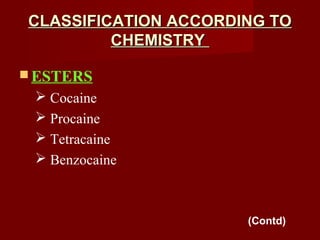
CLASSIFICATION ACCORDING TOCLASSIFICATION ACCORDING TO
CHEMISTRYCHEMISTRY
 ESTERS
 Cocaine
 Procaine
 Tetracaine
 Benzocaine
(Contd)
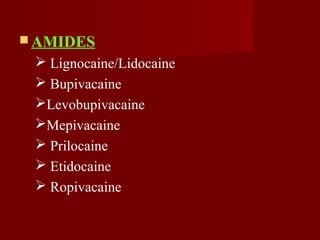
 AMIDES
 Lignocaine/Lidocaine
 Bupivacaine
Levobupivacaine
Mepivacaine
 Prilocaine
 Etidocaine
 Ropivacaine
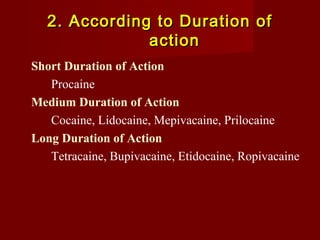
2. According to Duration of2. According to Duration of
actionaction
Short Duration of Action
Procaine
Medium Duration of Action
Cocaine, Lidocaine, Mepivacaine, Prilocaine
Long Duration of Action
Tetracaine, Bupivacaine, Etidocaine, Ropivacaine
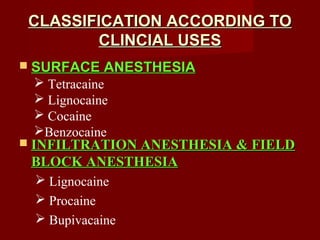
CLASSIFICATION ACCORDING TOCLASSIFICATION ACCORDING TO
CLINCIAL USESCLINCIAL USES
 SURFACE ANESTHESIASURFACE ANESTHESIA
 INFILTRATION ANESTHESIA & FIELDINFILTRATION ANESTHESIA & FIELD
BLOCK ANESTHESIABLOCK ANESTHESIA
 Lignocaine
 Procaine
 Bupivacaine
 Tetracaine
 Lignocaine
 Cocaine
Benzocaine
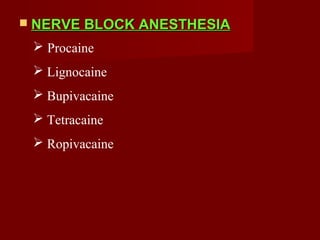
 NERVE BLOCK ANESTHESIANERVE BLOCK ANESTHESIA
 Procaine
 Lignocaine
 Bupivacaine
 Tetracaine
 Ropivacaine
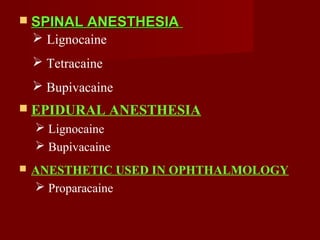
 SPINAL ANESTHESIASPINAL ANESTHESIA
 Lignocaine
 Tetracaine
 Bupivacaine
 EPIDURAL ANESTHESIA
 Lignocaine
 Bupivacaine
 ANESTHETIC USED IN OPHTHALMOLOGY
 Proparacaine
ChemistryChemistry
Most local anesthetics consist of 3 partsMost local anesthetics consist of 3 parts
1. Lipophilic Aromatic group
2. Intermediate chain
3. Hydrophilic Amino group
C
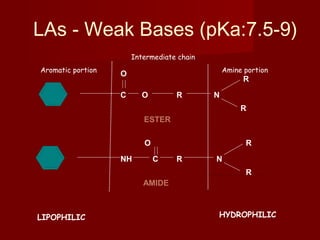
LAs - Weak Bases (pKa:7.5-9)
C O
O
R N
R
R
NH
O
R N
R
R
Aromatic portion Amine portion
Intermediate chain
ESTER
AMIDE
LIPOPHILIC HYDROPHILIC
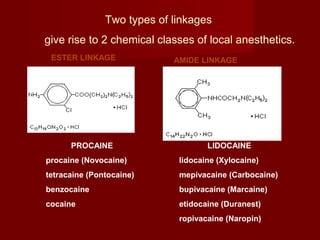
Two types of linkages
give rise to 2 chemical classes of local anesthetics.
ESTER LINKAGE AMIDE LINKAGE
PROCAINE
procaine (Novocaine)
tetracaine (Pontocaine)
benzocaine
cocaine
LIDOCAINE
lidocaine (Xylocaine)
mepivacaine (Carbocaine)
bupivacaine (Marcaine)
etidocaine (Duranest)
ropivacaine (Naropin)
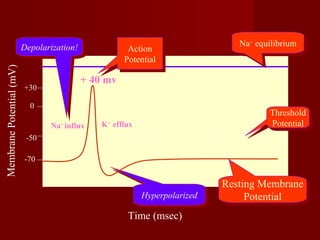
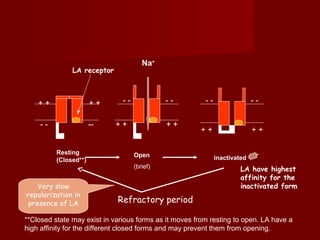
MECHANISM OF ACTION
 Diffusion into the nerve fiber
 Blockade of sodium channels
MembranePotential(mV)
-50
-70
0
+30
Time (msec)
Threshold
Potential
Threshold
Potential
Resting Membrane
Potential
Resting Membrane
Potential
Na+
equilibriumNa+
equilibrium
Action
Potential
Action
Potential
Depolarization!Depolarization!
HyperpolarizedHyperpolarized
+ 40 mv
Na+
influx K+
efflux
+ +
- -
+ +
--
- -
+ + + +
- -
Na+
+ ++ +
- - - -
Resting
(Closed**)
Open
(brief)
inactivated
Very slow
repolarization in
presence of LA
LA receptor
LA have highest
affinity for the
inactivated form
Refractory period
**Closed state may exist in various forms as it moves from resting to open. LA have a
high affinity for the different closed forms and may prevent them from opening.
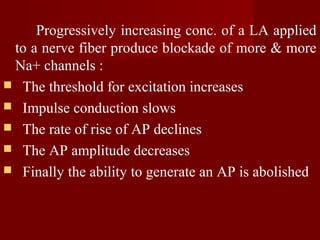
Progressively increasing conc. of a LA applied
to a nerve fiber produce blockade of more & more
Na+ channels :
 The threshold for excitation increases
 Impulse conduction slows
 The rate of rise of AP declines
 The AP amplitude decreases
 Finally the ability to generate an AP is abolished
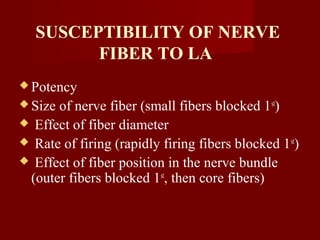
SUSCEPTIBILITY OF NERVE
FIBER TO LA
 Potency
 Size of nerve fiber (small fibers blocked 1st
)
 Effect of fiber diameter
 Rate of firing (rapidly firing fibers blocked 1st
)
 Effect of fiber position in the nerve bundle
(outer fibers blocked 1st
, then core fibers)
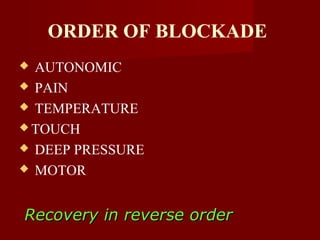
ORDER OF BLOCKADE
 AUTONOMIC
 PAIN
 TEMPERATURE
 TOUCH
 DEEP PRESSURE
 MOTOR
Recovery in reverse orderRecovery in reverse order
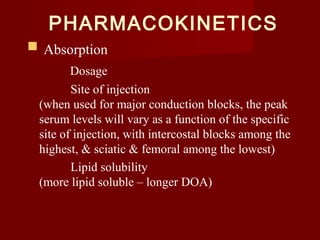
PHARMACOKINETICS
 Absorption
Dosage
Site of injection
(when used for major conduction blocks, the peak
serum levels will vary as a function of the specific
site of injection, with intercostal blocks among the
highest, & sciatic & femoral among the lowest)
Lipid solubility
(more lipid soluble – longer DOA)
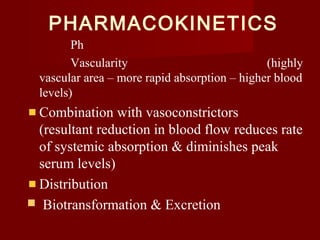
PHARMACOKINETICS
Ph
Vascularity (highly
vascular area – more rapid absorption – higher blood
levels)
Combination with vasoconstrictors
(resultant reduction in blood flow reduces rate
of systemic absorption & diminishes peak
serum levels)
Distribution
 Biotransformation & Excretion
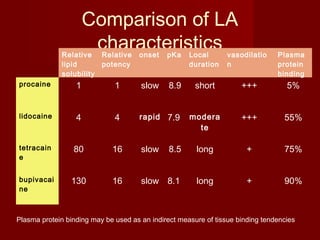
Comparison of LA
characteristicsRelative
lipid
solubility
Relative
potency
onset pKa Local
duration
vasodilatio
n
Plasma
protein
binding
procaine 1 1 slow 8.9 short +++ 5%
lidocaine 4 4 rapid 7.9 modera
te
+++ 55%
tetracain
e
80 16 slow 8.5 long + 75%
bupivacai
ne
130 16 slow 8.1 long + 90%
Plasma protein binding may be used as an indirect measure of tissue binding tendencies
ADVERSE EFFECTS
 CNS (1st
stimulation, then depression)
 Local Neurotoxicity
(cauda equina syndrome associated with
continuous spinal anesthesia – CSA)
 CVS (bupivacaine – most cardiotoxic)
 ANS
 Motor Paralysis
 Hematological Effects
 Hypersensitivity reactions
Prevention of Toxicity
 Enquire about history of allergy.
 Caution in presence of liver/myocardial damage.
 Proper site (correct knowledge of nerve course).
 Minimal effective dose usage (avoid I/V adm).
 Wait after injection.
 Observe the face for any twitching, excitement, and pulse
for tachycardia.
 Observe post – op for allergic reactions.
 Avoid food intake at least 04 hrs prior to anesthesia to
prevent vomiting.
 Cocaine
 Medical use limited to surface or topical
anesthesia
 Avoid epinephrine because cocaine already has
vasoconstrictor properties. (EXCEPTION!!!)
 A toxic action on heart may induce rapid and
lethal cardiac failure.
 A marked pyrexia is associated with cocaine
overdose.
SELECTIVE PHARMACOLOGICAL
 Benzocaine
– pKa ~ 3,
– Available in many preps for relief of pain and
irritation
– for surface anesthesia (topical) only ...
ointments, sprays, etc.
– Used to produce anesthesia of mucous
membranes
– methemoglobinemia
SELECTIVE PHARMACOLOGICAL PROPERTIES OF
SOME AMIDE - type LA
 LIDOCAINE (Xylocaine) Most widely used
LA
– Effective by all routes.
– Faster onset, more intense, longer lasting,
than procaine.
– Good alternative for those allergic to ester
type
– More potent than procaine but about equal
toxicity
– More sedative than others
SELECTIVE PHARMACOLOGICAL PROPERTIES OF
SOME AMIDE - type LA
 Bupivacaine (Marcaine)
– No topical effectiveness
– Slower onset and one of the longer duration
agents
– Unique property of sensory and motor
dissociation can provide sensory analgesia
with minimal motor block
 has been popular drug for analgesia during labor
– More cardiotoxic than other LA
SELECTIVE PHARMACOLOGICAL PROPERTIES OF
SOME AMIDE - type LA
 Ropivacaine
– Enantiomer of bupivacaine (S stereoisomer)
– No topical effectiveness
– Clinically ~ equivalent to bupivacaine
– Similar sensory versus motor selectivity as
bupivacaine with significantly less CV
toxicity
CLINICAL APPLICATIONS
 SURFACE ANESTHESIA (Topical)
– Ear,Nose, mouth, bronchial tree,
nasopharynx,cornea, GIT and urinary tracts
 Lidocaine, tetracaine, Benzocaine
 EMLA cream (Eutectic
Mixture of Local Anesthetics)
lidocaine 2.5% + prilocaine 2.5%
permits anesthetic penetration of keratinized layer
of skin as deep as 5mm, producing localized
numbness.
Clinical Applications
 INFILTRATION ANESTHESIA
– Direct injection into tissues to reach nerve
branches and terminals.
– Can be superficial as well as deep.
– Used in minor surgery.
– Immediate onset with variable duration.
– This type involve skin region as deep as
intraabdominal tissue.
.Most LA’s used
Clinical Applications
 NERVE BLOCK or FIELD BLOCK
– Interruption of nerve conduction upon
injection into the region of nerve plexus or
trunk.
– Used for surgery, dentistry, analgesia.
– Less anesthetic needed than for infiltration
– Given within specific nerve area such as
brachial plexus, within intercostal
nerves,abdominal nerves are targeted,
cervical plexus when neck region is targeted.
.Most LA’s used
Clinical Applications
 SPINAL ANESTHESIA
– Injection into subarachnoid space below level
of L2 vertebra to produce effect in spinal roots
and spinal cord.
– Use hyperbaric or hypobaric solutions
depending on area of blockade.
– Used for surgery to abdomen, pelvis or leg
when can’t use general anesthesia.
– Can be employed in pts of hepatic, renal &
CVS diseases
 Lidocaine, tetracaine
Clinical Applications
 EPIDURAL AND CAUDAL ANESTHESIA
– Injection into epidural space usually at lumbar
or sacral levels or near dura matter where
nearly most nerves pass closely. Areas
supplied by these nerves are targeted e.g.
.ligamentum flavum(post)
.spinal periosteum(laterally), dura(ant).
– Lower part of the body. Pelvic region
– For painless child birth.
Clinical Applications
– Unwanted effects similar to that of spinal
(pain, hematoma, introduction of foreign
particle, hypotension – Rx: raise foot-end of
bed or give sympathomimetics, headache –
Rx: small bore needle & blood patch, cauda
equina syndrome, rarely respiratory paralysis)
 Lidocaine, bupivacaine, ropivacaine

local anesthetics

  • 1.
  • 2.
    Local Anesthetics DEFINITION  Drugswhich – produce a REVERSIBLE loss of sensation … – in a localized part of the body….. – when applied directly onto nerve tissues or mucous membranes  Local anesthetics are ‘local’ ONLY because of how they are administered! (Selectivity)
  • 3.
    The first clinicallyused Local Anesthetic Cocaine (ISA activity) A natural alkaloid from Erythroxylon coca. Prototype Drug Lignocaine (Synthetic)
  • 4.
    Properties Desirable ina Local Anesthetic  Non-irritating  Do not cause permanent damage to nerve structure  Systemic toxicity should be low  Effective Injected Applied locally  Onset of action as short as possible  DOA long enough to allow time for counter plated surgery
  • 5.
    CLASSIFICATION ACCORDING TOCLASSIFICATIONACCORDING TO CHEMISTRYCHEMISTRY  ESTERS  Cocaine  Procaine  Tetracaine  Benzocaine (Contd)
  • 6.
     AMIDES  Lignocaine/Lidocaine Bupivacaine Levobupivacaine Mepivacaine  Prilocaine  Etidocaine  Ropivacaine
  • 7.
    2. According toDuration of2. According to Duration of actionaction Short Duration of Action Procaine Medium Duration of Action Cocaine, Lidocaine, Mepivacaine, Prilocaine Long Duration of Action Tetracaine, Bupivacaine, Etidocaine, Ropivacaine
  • 8.
    CLASSIFICATION ACCORDING TOCLASSIFICATIONACCORDING TO CLINCIAL USESCLINCIAL USES  SURFACE ANESTHESIASURFACE ANESTHESIA  INFILTRATION ANESTHESIA & FIELDINFILTRATION ANESTHESIA & FIELD BLOCK ANESTHESIABLOCK ANESTHESIA  Lignocaine  Procaine  Bupivacaine  Tetracaine  Lignocaine  Cocaine Benzocaine
  • 9.
     NERVE BLOCKANESTHESIANERVE BLOCK ANESTHESIA  Procaine  Lignocaine  Bupivacaine  Tetracaine  Ropivacaine
  • 10.
     SPINAL ANESTHESIASPINALANESTHESIA  Lignocaine  Tetracaine  Bupivacaine  EPIDURAL ANESTHESIA  Lignocaine  Bupivacaine  ANESTHETIC USED IN OPHTHALMOLOGY  Proparacaine
  • 11.
    ChemistryChemistry Most local anestheticsconsist of 3 partsMost local anesthetics consist of 3 parts 1. Lipophilic Aromatic group 2. Intermediate chain 3. Hydrophilic Amino group
  • 12.
    C LAs - WeakBases (pKa:7.5-9) C O O R N R R NH O R N R R Aromatic portion Amine portion Intermediate chain ESTER AMIDE LIPOPHILIC HYDROPHILIC
  • 13.
    Two types oflinkages give rise to 2 chemical classes of local anesthetics. ESTER LINKAGE AMIDE LINKAGE PROCAINE procaine (Novocaine) tetracaine (Pontocaine) benzocaine cocaine LIDOCAINE lidocaine (Xylocaine) mepivacaine (Carbocaine) bupivacaine (Marcaine) etidocaine (Duranest) ropivacaine (Naropin)
  • 14.
    MECHANISM OF ACTION Diffusion into the nerve fiber  Blockade of sodium channels
  • 15.
    MembranePotential(mV) -50 -70 0 +30 Time (msec) Threshold Potential Threshold Potential Resting Membrane Potential RestingMembrane Potential Na+ equilibriumNa+ equilibrium Action Potential Action Potential Depolarization!Depolarization! HyperpolarizedHyperpolarized + 40 mv Na+ influx K+ efflux
  • 16.
    + + - - ++ -- - - + + + + - - Na+ + ++ + - - - - Resting (Closed**) Open (brief) inactivated Very slow repolarization in presence of LA LA receptor LA have highest affinity for the inactivated form Refractory period **Closed state may exist in various forms as it moves from resting to open. LA have a high affinity for the different closed forms and may prevent them from opening.
  • 17.
    Progressively increasing conc.of a LA applied to a nerve fiber produce blockade of more & more Na+ channels :  The threshold for excitation increases  Impulse conduction slows  The rate of rise of AP declines  The AP amplitude decreases  Finally the ability to generate an AP is abolished
  • 18.
    SUSCEPTIBILITY OF NERVE FIBERTO LA  Potency  Size of nerve fiber (small fibers blocked 1st )  Effect of fiber diameter  Rate of firing (rapidly firing fibers blocked 1st )  Effect of fiber position in the nerve bundle (outer fibers blocked 1st , then core fibers)
  • 19.
    ORDER OF BLOCKADE AUTONOMIC  PAIN  TEMPERATURE  TOUCH  DEEP PRESSURE  MOTOR Recovery in reverse orderRecovery in reverse order
  • 20.
    PHARMACOKINETICS  Absorption Dosage Site ofinjection (when used for major conduction blocks, the peak serum levels will vary as a function of the specific site of injection, with intercostal blocks among the highest, & sciatic & femoral among the lowest) Lipid solubility (more lipid soluble – longer DOA)
  • 21.
    PHARMACOKINETICS Ph Vascularity (highly vascular area– more rapid absorption – higher blood levels) Combination with vasoconstrictors (resultant reduction in blood flow reduces rate of systemic absorption & diminishes peak serum levels) Distribution  Biotransformation & Excretion
  • 22.
    Comparison of LA characteristicsRelative lipid solubility Relative potency onsetpKa Local duration vasodilatio n Plasma protein binding procaine 1 1 slow 8.9 short +++ 5% lidocaine 4 4 rapid 7.9 modera te +++ 55% tetracain e 80 16 slow 8.5 long + 75% bupivacai ne 130 16 slow 8.1 long + 90% Plasma protein binding may be used as an indirect measure of tissue binding tendencies
  • 23.
    ADVERSE EFFECTS  CNS(1st stimulation, then depression)  Local Neurotoxicity (cauda equina syndrome associated with continuous spinal anesthesia – CSA)  CVS (bupivacaine – most cardiotoxic)  ANS  Motor Paralysis  Hematological Effects  Hypersensitivity reactions
  • 24.
    Prevention of Toxicity Enquire about history of allergy.  Caution in presence of liver/myocardial damage.  Proper site (correct knowledge of nerve course).  Minimal effective dose usage (avoid I/V adm).  Wait after injection.  Observe the face for any twitching, excitement, and pulse for tachycardia.  Observe post – op for allergic reactions.  Avoid food intake at least 04 hrs prior to anesthesia to prevent vomiting.
  • 25.
     Cocaine  Medicaluse limited to surface or topical anesthesia  Avoid epinephrine because cocaine already has vasoconstrictor properties. (EXCEPTION!!!)  A toxic action on heart may induce rapid and lethal cardiac failure.  A marked pyrexia is associated with cocaine overdose.
  • 26.
    SELECTIVE PHARMACOLOGICAL  Benzocaine –pKa ~ 3, – Available in many preps for relief of pain and irritation – for surface anesthesia (topical) only ... ointments, sprays, etc. – Used to produce anesthesia of mucous membranes – methemoglobinemia
  • 27.
    SELECTIVE PHARMACOLOGICAL PROPERTIESOF SOME AMIDE - type LA  LIDOCAINE (Xylocaine) Most widely used LA – Effective by all routes. – Faster onset, more intense, longer lasting, than procaine. – Good alternative for those allergic to ester type – More potent than procaine but about equal toxicity – More sedative than others
  • 28.
    SELECTIVE PHARMACOLOGICAL PROPERTIESOF SOME AMIDE - type LA  Bupivacaine (Marcaine) – No topical effectiveness – Slower onset and one of the longer duration agents – Unique property of sensory and motor dissociation can provide sensory analgesia with minimal motor block  has been popular drug for analgesia during labor – More cardiotoxic than other LA
  • 29.
    SELECTIVE PHARMACOLOGICAL PROPERTIESOF SOME AMIDE - type LA  Ropivacaine – Enantiomer of bupivacaine (S stereoisomer) – No topical effectiveness – Clinically ~ equivalent to bupivacaine – Similar sensory versus motor selectivity as bupivacaine with significantly less CV toxicity
  • 30.
    CLINICAL APPLICATIONS  SURFACEANESTHESIA (Topical) – Ear,Nose, mouth, bronchial tree, nasopharynx,cornea, GIT and urinary tracts  Lidocaine, tetracaine, Benzocaine  EMLA cream (Eutectic Mixture of Local Anesthetics) lidocaine 2.5% + prilocaine 2.5% permits anesthetic penetration of keratinized layer of skin as deep as 5mm, producing localized numbness.
  • 31.
    Clinical Applications  INFILTRATIONANESTHESIA – Direct injection into tissues to reach nerve branches and terminals. – Can be superficial as well as deep. – Used in minor surgery. – Immediate onset with variable duration. – This type involve skin region as deep as intraabdominal tissue. .Most LA’s used
  • 32.
    Clinical Applications  NERVEBLOCK or FIELD BLOCK – Interruption of nerve conduction upon injection into the region of nerve plexus or trunk. – Used for surgery, dentistry, analgesia. – Less anesthetic needed than for infiltration – Given within specific nerve area such as brachial plexus, within intercostal nerves,abdominal nerves are targeted, cervical plexus when neck region is targeted. .Most LA’s used
  • 33.
    Clinical Applications  SPINALANESTHESIA – Injection into subarachnoid space below level of L2 vertebra to produce effect in spinal roots and spinal cord. – Use hyperbaric or hypobaric solutions depending on area of blockade. – Used for surgery to abdomen, pelvis or leg when can’t use general anesthesia. – Can be employed in pts of hepatic, renal & CVS diseases  Lidocaine, tetracaine
  • 34.
    Clinical Applications  EPIDURALAND CAUDAL ANESTHESIA – Injection into epidural space usually at lumbar or sacral levels or near dura matter where nearly most nerves pass closely. Areas supplied by these nerves are targeted e.g. .ligamentum flavum(post) .spinal periosteum(laterally), dura(ant). – Lower part of the body. Pelvic region – For painless child birth.
  • 35.
    Clinical Applications – Unwantedeffects similar to that of spinal (pain, hematoma, introduction of foreign particle, hypotension – Rx: raise foot-end of bed or give sympathomimetics, headache – Rx: small bore needle & blood patch, cauda equina syndrome, rarely respiratory paralysis)  Lidocaine, bupivacaine, ropivacaine