Local Anesthetics
Sub:- Pharmacology
Dr. G Apada Reddy M.Pharm, Ph.D.
Local Anesthetics
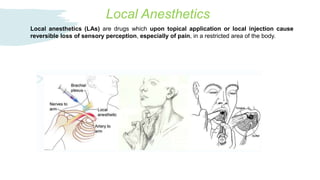
Local anesthetics (LAs) are drugs which upon topical application or local injection cause
reversible loss of sensory perception, especially of pain, in a restricted area of the body.
Local Anesthetics
Local Anesthetics
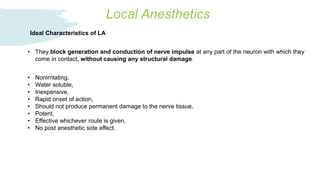
• They block generation and conduction of nerve impulse at any part of the neuron with which they
come in contact, without causing any structural damage.
Ideal Characteristics of LA
• Nonirritating,
• Water soluble,
• Inexpensive,
• Rapid onset of action,
• Should not produce permanent damage to the nerve tissue,
• Potent,
• Effective whichever route is given,
• No post anesthetic side effect.
Local Anesthetics
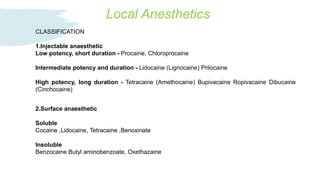
CLASSIFICATION
1.Injectable anaesthetic
Low potency, short duration - Procaine, Chloroprocaine
Intermediate potency and duration - Lidocaine (Lignocaine) Prilocaine
High potency, long duration - Tetracaine (Amethocaine) Bupivacaine Ropivacaine Dibucaine
(Cinchocaine)
2.Surface anaesthetic
Soluble
Cocaine ,Lidocaine, Tetracaine ,Benoxinate
Insoluble
Benzocaine Butyl aminobenzoate, Oxethazaine
Local Anesthetics
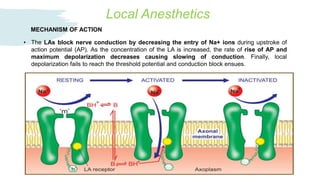
MECHANISM OF ACTION
• The LAs block nerve conduction by decreasing the entry of Na+ ions during upstroke of
action potential (AP). As the concentration of the LA is increased, the rate of rise of AP and
maximum depolarization decreases causing slowing of conduction. Finally, local
depolarization fails to reach the threshold potential and conduction block ensues.
Local Anesthetics
pharmacokinetics
• Because LAs act near their site of administration, pharmacokinetic characteristics are not
important determinants of their efficacy, but markedly influence their systemic effects and
toxicity
• Soluble surface anaesthetics (lidocaine, tetracaine) are rapidly absorbed from mucous
membranes and abraded areas, but absorption from intact skin is minimal.
• Rate of absorption depends on the blood flow to the area of application or injection.
• After oral ingestion both procaine and lignocaine have high first pass metabolism in the
liver.
Local Anesthetics
LOCAL ACTIONS
The clinically used LAs have no/minimal local irritant action and block sensory nerve endings,
1.Topical anaesthesia
E.g., lidocaine. – Topical application provide anesthesia on
• Skin and the mucus membrane of the rectum.
• Urethra and vagina.
• Available in creams, ointments, aerosols, sprays, lotions, and jellies.
2.Nerve block anaesthesia
• Often a group of nerves, called a plexus or ganglion. that causes pain to a specific organ or body
region can be blocked with the injection of medication into a specific area of the body.
• The injection of this nerve numbing substance is called a nerve block.
• Affect the bundle of nerves serving the area to be operated upon.
• This anesthesia used to block sensation in a limb or large area such as face.
Local Anesthetics
3.Local infiltration anaesthesia
Blocks a specific group of nerves in a small area.
• Subcutaneous infiltration (IV placement, superficial/ biopsy, suturing)
• Submucosal infiltration (dental procedures, laceration repairs)
• Wound infiltration (postoperative pain control at incision site)
• Intraarticular injections (postsurgical pain control, arthritic joint pain control)
• Infiltrative nerve blocks (ankle block, scalp block, digit block)
Local Anesthetics
4.Spinal anaesthesia
In this anesthesia, an anesthetic agent is injected into the subarachnoid space through spinal
needle.
Drugs affect large regional areas such as lower abdomen and leg.
5.Epidural anaesthesia
It involves injection of the local anesthetic into the epidural (lumbar or caudal) space via a catheter
that allows repeated infusions. – It absorb slowly in to the cerebrospinal fluid. – Used in labor and
delivery.
Local Anesthetics
• C.N.S - All LAs are capable of producing a sequence of stimulation followed by depression.
Cocaine is a powerful CNS stimulant causing in sequence euphoria—excitement—mental
confusion— restlessness—tremor and twitching of muscles— convulsions—unconsciousness—
respiratory depression—death, in a dose-dependent manner.
SYSTEMIC ACTIONS
• Any LA injected or applied locally is ultimately absorbed and can produce systemic effects
depending on the concentration attained in the plasma and tissues.
• C.V.S. - Heart LAs are cardiac depressants, but no significant effects are observed at
conventional doses.
• Blood vessels - LAs tend to produce fall in BP. This is primarily due to sympathetic blockade.
Local Anesthetics
ADVERSE EFFECTS
(1) CNS effects are light-headedness, dizziness, auditory and visual disturbances, mental confusion,
disorientation, shivering, twitchings, involuntary movements, finally convulsions and respiratory arrest.
(2) Cardiovascular toxicity of LAs is manifested as bradycardia, hypotension, cardiac arrhythmias and
vascular collapse.
(3) Injection of LAs may be painful, but local tissue toxicity of LAs is low. However, wound healing may be
sometimes delayed.
(4) Hypersensitivity reactions like rashes, angioedema, dermatitis, contact sensitization, asthma and
rarely anaphylaxis occur.
7.Local Anesthetics.pptx

7.Local Anesthetics.pptx

  • 1.
    Local Anesthetics Sub:- Pharmacology Dr.G Apada Reddy M.Pharm, Ph.D.
  • 2.
    Local Anesthetics Local anesthetics(LAs) are drugs which upon topical application or local injection cause reversible loss of sensory perception, especially of pain, in a restricted area of the body.
  • 3.
  • 4.
    Local Anesthetics • Theyblock generation and conduction of nerve impulse at any part of the neuron with which they come in contact, without causing any structural damage. Ideal Characteristics of LA • Nonirritating, • Water soluble, • Inexpensive, • Rapid onset of action, • Should not produce permanent damage to the nerve tissue, • Potent, • Effective whichever route is given, • No post anesthetic side effect.
  • 5.
    Local Anesthetics CLASSIFICATION 1.Injectable anaesthetic Lowpotency, short duration - Procaine, Chloroprocaine Intermediate potency and duration - Lidocaine (Lignocaine) Prilocaine High potency, long duration - Tetracaine (Amethocaine) Bupivacaine Ropivacaine Dibucaine (Cinchocaine) 2.Surface anaesthetic Soluble Cocaine ,Lidocaine, Tetracaine ,Benoxinate Insoluble Benzocaine Butyl aminobenzoate, Oxethazaine
  • 6.
    Local Anesthetics MECHANISM OFACTION • The LAs block nerve conduction by decreasing the entry of Na+ ions during upstroke of action potential (AP). As the concentration of the LA is increased, the rate of rise of AP and maximum depolarization decreases causing slowing of conduction. Finally, local depolarization fails to reach the threshold potential and conduction block ensues.
  • 7.
    Local Anesthetics pharmacokinetics • BecauseLAs act near their site of administration, pharmacokinetic characteristics are not important determinants of their efficacy, but markedly influence their systemic effects and toxicity • Soluble surface anaesthetics (lidocaine, tetracaine) are rapidly absorbed from mucous membranes and abraded areas, but absorption from intact skin is minimal. • Rate of absorption depends on the blood flow to the area of application or injection. • After oral ingestion both procaine and lignocaine have high first pass metabolism in the liver.
  • 8.
    Local Anesthetics LOCAL ACTIONS Theclinically used LAs have no/minimal local irritant action and block sensory nerve endings, 1.Topical anaesthesia E.g., lidocaine. – Topical application provide anesthesia on • Skin and the mucus membrane of the rectum. • Urethra and vagina. • Available in creams, ointments, aerosols, sprays, lotions, and jellies. 2.Nerve block anaesthesia • Often a group of nerves, called a plexus or ganglion. that causes pain to a specific organ or body region can be blocked with the injection of medication into a specific area of the body. • The injection of this nerve numbing substance is called a nerve block. • Affect the bundle of nerves serving the area to be operated upon. • This anesthesia used to block sensation in a limb or large area such as face.
  • 9.
    Local Anesthetics 3.Local infiltrationanaesthesia Blocks a specific group of nerves in a small area. • Subcutaneous infiltration (IV placement, superficial/ biopsy, suturing) • Submucosal infiltration (dental procedures, laceration repairs) • Wound infiltration (postoperative pain control at incision site) • Intraarticular injections (postsurgical pain control, arthritic joint pain control) • Infiltrative nerve blocks (ankle block, scalp block, digit block)
  • 10.
    Local Anesthetics 4.Spinal anaesthesia Inthis anesthesia, an anesthetic agent is injected into the subarachnoid space through spinal needle. Drugs affect large regional areas such as lower abdomen and leg. 5.Epidural anaesthesia It involves injection of the local anesthetic into the epidural (lumbar or caudal) space via a catheter that allows repeated infusions. – It absorb slowly in to the cerebrospinal fluid. – Used in labor and delivery.
  • 11.
    Local Anesthetics • C.N.S- All LAs are capable of producing a sequence of stimulation followed by depression. Cocaine is a powerful CNS stimulant causing in sequence euphoria—excitement—mental confusion— restlessness—tremor and twitching of muscles— convulsions—unconsciousness— respiratory depression—death, in a dose-dependent manner. SYSTEMIC ACTIONS • Any LA injected or applied locally is ultimately absorbed and can produce systemic effects depending on the concentration attained in the plasma and tissues. • C.V.S. - Heart LAs are cardiac depressants, but no significant effects are observed at conventional doses. • Blood vessels - LAs tend to produce fall in BP. This is primarily due to sympathetic blockade.
  • 12.
    Local Anesthetics ADVERSE EFFECTS (1)CNS effects are light-headedness, dizziness, auditory and visual disturbances, mental confusion, disorientation, shivering, twitchings, involuntary movements, finally convulsions and respiratory arrest. (2) Cardiovascular toxicity of LAs is manifested as bradycardia, hypotension, cardiac arrhythmias and vascular collapse. (3) Injection of LAs may be painful, but local tissue toxicity of LAs is low. However, wound healing may be sometimes delayed. (4) Hypersensitivity reactions like rashes, angioedema, dermatitis, contact sensitization, asthma and rarely anaphylaxis occur.