Local
Anaesthetics
KRVS Chaitanya
Introduction
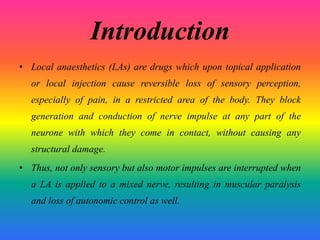
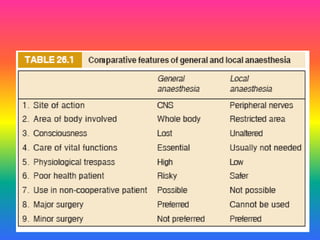
• Local anaesthetics (LAs) are drugs which upon topical application
or local injection cause reversible loss of sensory perception,
especially of pain, in a restricted area of the body. They block
generation and conduction of nerve impulse at any part of the
neurone with which they come in contact, without causing any
structural damage.
• Thus, not only sensory but also motor impulses are interrupted when
a LA is applied to a mixed nerve, resulting in muscular paralysis
and loss of autonomic control as well.
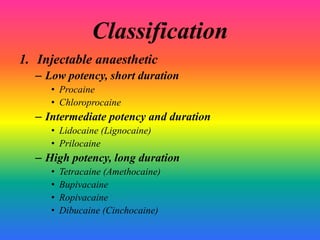
Classification
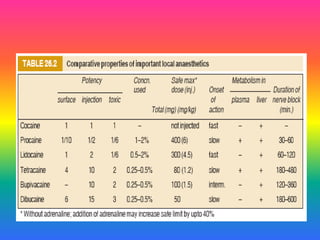
1. Injectable anaesthetic
– Low potency, short duration
• Procaine
• Chloroprocaine
– Intermediate potency and duration
• Lidocaine (Lignocaine)
• Prilocaine
– High potency, long duration
• Tetracaine (Amethocaine)
• Bupivacaine
• Ropivacaine
• Dibucaine (Cinchocaine)
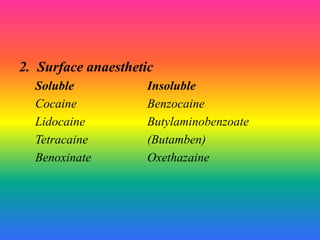
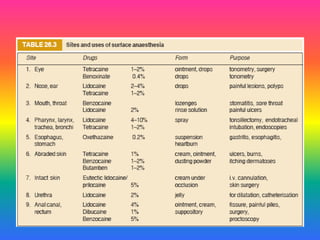
2. Surface anaesthetic
Soluble Insoluble
Cocaine Benzocaine
Lidocaine Butylaminobenzoate
Tetracaine (Butamben)
Benoxinate Oxethazaine
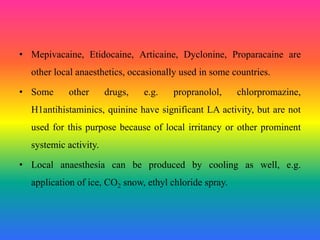
• Mepivacaine, Etidocaine, Articaine, Dyclonine, Proparacaine are
other local anaesthetics, occasionally used in some countries.
• Some other drugs, e.g. propranolol, chlorpromazine,
H1antihistaminics, quinine have significant LA activity, but are not
used for this purpose because of local irritancy or other prominent
systemic activity.
• Local anaesthesia can be produced by cooling as well, e.g.
application of ice, CO2 snow, ethyl chloride spray.
Chemistry
• The clinically useful LAs are weak bases with amphiphilic
property.
• A hydrophilic secondary or tertiary amine on one side and a
lipophilic aromatic residue on the other are joined by an alkyl
chain through an ester or amide linkage.
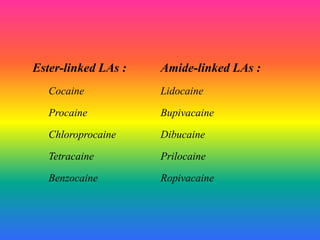
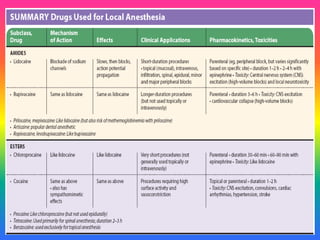
Ester-linked LAs : Amide-linked LAs :
Cocaine Lidocaine
Procaine Bupivacaine
Chloroprocaine Dibucaine
Tetracaine Prilocaine
Benzocaine Ropivacaine
Mechanism of action
• The LAs block nerve conduction by decreasing the entry of
Na+ ions during upstroke of action potential (AP).
• As the concentration of the LA is increased, the rate of rise of
AP and maximum depolarization decreases (Fig. 26.1) causing
slowing of conduction.
• Finally, local depolarization fails to reach the threshold
potential and conduction block ensues.
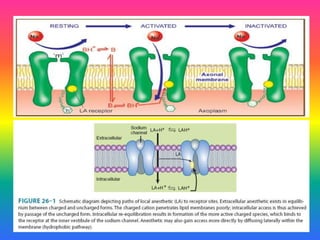
• The LAs interact with a receptor situated within the voltage
sensitive Na+ channel and raise the threshold of channel opening:
Na+ permeability fails to increase in response to an impulse or
stimulus.
• Impulse conduction is interrupted when the Na+ channels over a
critical length of the fibre (2–3 nodes of Ranvier in case of
myelinated fibres) are blocked.
• At physiological pH, the LA molecule is partly ionized. The
equilibrium between the unionized base form (B) and the ionized
cationic form (BH+) depends on the pKa of the LA.
1. LOCALACTIONS
• The clinically used LAs have no/minimal local irritant action and
block sensory nerve endings, nerve trunks, neuromuscular junction,
ganglionic synapse and receptors (non-selectively), i.e. those
structures which function through increased Na+ permeability.
• They also reduce release of acetylcholine from motor nerve endings.
Injected around a mixed nerve they cause anaesthesia of skin and
paralysis of the voluntary muscle supplied by that nerve.
• Autonomic fibres are generally more susceptible than somatic
fibres.
• Among the somatic afferents order of blockade is: pain—
temperature sense—touch—deep pressure sense.
• Since pain is generally carried by smaller diameter fibres than those
carrying other sensations or motor impulses, pain in the first
modality to be affected.
• Applied to the tongue, bitter taste is lost first followed by sweet and
sour, and salty taste last of all.
• The LA often fails to afford adequate pain control in inflamed
tissues (like infected tooth).
• The likely reasons are:
a. Inflammation lowers pH of the tissue—greater fraction of the LA is in the
ionized form hindering diffusion into the axolemma.
b. Blood flow to the inflamed area is increased—the LA is removed more
rapidly from the site.
c. Effectiveness of Adr injected with the LA is reduced at the inflamed site.
d. Inflammatory products may oppose LA Action. Addition of a
vasoconstrictor, e.g. Adrenaline (1:50,000 to 1:200,000):
e. Prolongs duration of action of LAs by decreasing their rate of removal from
the local site into the circulation: contact time of the LA with the nerve fibre
is prolonged.
f. Enhances the intensity of nerve block.
g. Reduces systemic toxicity of LAs: rate of absorption is reduced and
metabolism keeps
h. the plasma concentration lower.
i. Provides a more bloodless field for surgery.
j. Increases the chances of subsequent local tissue oedema and necrosis as
well as delays wound healing by reducing oxygen supply and enhancing
oxygen consumption in the affected Area.
k. May raise BP and promote arrhythmia insusceptible individuals.
2. SYSTEMIC ACTIONS
• Any LA injected or applied locally is ultimately absorbed and
can produce systemic effects depending on the concentration
attained in the plasma and tissues.
C.N.S.
• All LAs are capable of producing a sequence of stimulation
followed by depression.
• Cocaine is a powerful CNS stimulant causing in sequence
euphoria— excitement— mental confusion—restlessness—
tremor and twitching of muscles—convulsions—
unconsciousness—respiratory depression—death, in a dose-
dependent manner
C.V.S.
• Heart LAs are cardiac depressants, but no significant effects
are observed at conventional doses.
• At high doses (2–3 times the doses producing CNS effects) or
on inadvertent i.v. injection, they decrease automaticity,
excitability, contractility, conductivity and prolong effective
refractory period (ERP).
BLOOD VESSELS
• LAs tend to produce fall in BP. This is primarily due to sympathetic
blockade, but high concentrations, as obtained locally at the site of
injection, do cause direct relaxation of arteriolar smooth muscle.
• Bupivacaine is more vasodilatory than lidocaine, while prilocaine is
the least vasodilatory.
• Toxic doses of Las produce Cardiovascular collapse. Cocaine has
sympathomimetic property; increases sympathetic tone, causes local
vasoconstriction, marked rise in BP and tachycardia.
PHARMACOKINETICS
• Because LAs act near their site of administration,
pharmacokinetic characteristics are not important determinants
of their efficacy, but markedly influence their systemic effects
and toxicity.
• Soluble surface anaesthetics (lidocaine, tetracaine)are rapidly
absorbed from mucous membranes and abraded areas, but
absorption from intact skin is minimal.
• Procaine does not significantly penetrate mucous membranes.
• Rate of absorption depends on the blood flow to the area of
application or injection.
• The absorbed LA being lipophilic is widely distributed; rapidly
enters highly perfused brain, heart, liver, and kidney, followed
by muscle and other viscera
• Procaine is negligibly bound to plasma proteins, but amide
LAs are bound to plasma α1 acidglycoprotein.
• LAs are rapidly but temporarily bound to tissues, especially
nerves, at the site of injection.
• Ester-linked LAs (procaine, etc.) arerapidly hydrolysed by
plasma pseudo cholinesterase and the remaining by esterases
in the liver.
• Amide-linked LAs (lidocaine, etc.) are degraded only in the
liver microsomes by dealkylation and hydrolysis.
• Metabolism of lidocaine is hepatic blood-flow dependent.
• The maximal safe dose of LAs is lower in patients with hepatic
disease and in the elderly who have decreased liver function.
Adverse effects
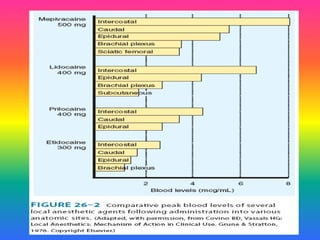
• Systemic toxicity on rapid i.v. injection is related to the intrinsic
anaesthetic potency of the LA.
• However, toxicity after topical application or regional injection is
influenced by the relative rates of absorption and metabolism.
• Those rapidly absorbed but slowly metabolized are more toxic.
1. CNS effects are light-headedness, dizziness, auditory and visual
disturbances, mental confusion, disorientation, shivering, twitchings,
involuntary movements, finally convulsions and respiratory arrest. This
can be prevented and treated by diazepam.
2. Cardiovascular toxicity of LAs is manifested as bradycardia,
hypotension, cardiac arrhythmias and vascular collapse.
3. Injection of LAs may be painful, but local tissue toxicity of
LAs is low.
• However, wound healing may be sometimes delayed.
• Addition of vasoconstrictors enhances the local tissue
damage; rarely necrosis results.
• Vasoconstrictors should not be added for ring block of hands,
feet, fingers, toes, penis and in pinna. Bupivacaine has the
highest local tissue irritancy.
4. Hypersensitivity reactions
– Rashes, angioedema, dermatitis, contact sensitization, asthma
and rarely anaphylaxis occur.
– These are more common with ester-linked LAs, but rare with
lidocaine or its congeners.
– Cross reactivity is frequent among ester compounds, but not
with amide-linked Las.
– Often methylparaben added as preservative in certain LA
solutions is responsible for the allergic reaction.
Precautions and interactions
• Before injecting the LA, aspirate lightly to avoid intravascular
injection.
• Inject the LA slowly and take care not to exceed the maximum
safe dose, especially in children.
• Propranolol (probably other β blockers also)may reduce
metabolism of lidocaine and other amide LAs by reducing
hepatic blood flow.
• Vasoconstrictor (adrenaline) containing LAshould be
avoided for patients with ischaemic heart disease,
cardiac arrhythmia, thyrotoxicosis, uncontrolled
hypertension, and those receiving β blockers (rise in
BP can occur due to unopposed α action) or tricyclic
antidepressants(uptake blockade and potentiation of
Adr).
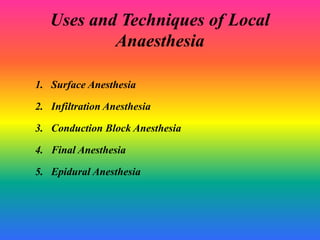
Uses and Techniques of Local
Anaesthesia
1. Surface Anesthesia
2. Infiltration Anesthesia
3. Conduction Block Anesthesia
4. Final Anesthesia
5. Epidural Anesthesia
1. Surface anaesthesia
– It is produced by topical application of a surface anaesthetic to
mucous membranes and abraded skin.
– Only the superficial layer is anaesthetised and there is no loss of
motor function.
– Onset and duration depends on the site, the drug, its
concentration and form, e.g. lidocaine (10%) sprayed in the
throat acts in 2–5 min and produces anaesthesia for 30–45 min.
– Addition of Adr does not affect duration of topical
anaesthesia, but phenylephrine can cause mucosal
vasoconstriction and prolong topical anaesthesia.
– Absorption of soluble LAs from mucous membranes is
rapid; blood concentrations of lidocaine and tetracaine
sprayed in throat/tracheobronchial tree approach those
attained on i.v. injection—toxicity can occur.
2. Infiltration anaesthesia
– Dilute solution of LA is infiltrated under the skin in the area of operation—
blocks sensory nerve endings.
– Onset of action is almost immediate and duration is shorter than that after
nerve block, e.g. lidocaine30–60 min, Bupivacaine 90–180 min.
– Infiltration is used for minor operations, e.g. Incisions, excisions,
hydrocele, herniorrhaphy, etc. When the area to be anaesthetised is small.
– Relatively larger amount of LA is required compared to the area
anaesthetized, but motor function is not Affected.
3. Conduction block
– The LA is injected around nerve trunks so that the area
distal to injection is anaesthetised and paralysed.
– Choice of the LA and its concentration is mainly dictated
by the required duration of action; lidocaine(1–2%) with
intermediate duration of action is most commonly used, but
for longer lasting anaesthesia Bupivacaine may be selected.
a) Field block
– It is produced by injecting the LA subcutaneously in a
manner that all nerves coming to a particular field are
blocked—as is done for herniorrhaphy, appendicectomy,
dental procedures, scalp stitching, operations on forearms
and legs, etc.
– Larger area beginning 2–3 cm distal to the line of injection
can be anaesthetised with lesser drug compared to
infiltration. The same concentration of LA as for infiltration
isused for field block.
b) Nerve block
– It is produced by injecting the LA around the appropriate nerve trunks
or plexuses.
– The area of resulting anaesthesia is still larger compared to the amount
of drug used.
– Muscles supplied by the injected nerve/plexus are paralysed.
– The latency of anaesthesia depends on the drug and the area to be
covered bydiffusion, e.g. lidocaine anaesthetises intercostalnerves
within 3 min, but brachial plexus block may take 15 min.
– For plexus block a ‘flooding’ technique is used and larger
volumes are needed.
– Nerve block lasts longer than field block or infiltration
anaesthesia.
– Frequently performed nerve blocks are—lingual,
intercostal, ulnar, sciatic, femoral, brachial plexus,
trigeminal, facial, phrenic, etc.—used for tooth extraction,
operations on eye, limbs, abdominal wall, fracture setting,
trauma to ribs, neuralgias, persistent hiccup, etc.
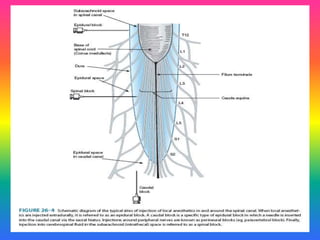
4. Spinal anaesthesia
– The LA is injected in the subarachnoid space between L2–3 orL3–4 i.e.
below the lower end of spinal cord.
– The primary site of action is the nerve roots in the cauda equine rather
than the spinal cord.
– Lower abdomen and hind limbs are anaesthetised and paralysed.
– The level of anaesthesia depends on the volume and speed of injection,
specific gravity of drug solution and posture of the patient. The drug
solution could be hyperbaric (in 10%glucose) or isobaric with CSF.
Advantages of spinal anaesthesia
• over general anaesthesia are:
– It is safer.
– Produces good analgesia and muscle relaxation without
loss of consciousness.
– Cardiac, pulmonary, renal disease and diabetes pose less
problem.
Complications of spinal anaesthesia
1. Respiratory paralysis:
– Intercostal muscles may be paralysed, but diaphragm (supplied by phrenic nerve)
maintains breathing.
2. Hypotension
– Due to blockade of sympathetic vasoconstrictor outflow to blood vessels
3. Headache ( due to seepage of CSF)
4. Cauda equine syndrome (loss of control over bladder and bowel sphincters)
5. Septic meningitis (infection introduced during lumbar puncture)
6. Nausea and vomiting ( reflexes triggered by traction on abdominal viscera)
5. Epidural anaesthesia
– The spinal dural space is filled with semi liquid fat through
which nerve roots travel.
– The LA injected in this space— acts primarily on nerve
roots (in the epidural as well as subarachnoid spaces to
which it diffuses) and small amount permeates through
intervertebral foramina to produce multiple paravertebral
blocks.
• Epidural anaesthesia can be divided into 3 categories
depending on the site of injection.
1. Thoracic
2. Lumbar
3. Caudal
6. Intravenous regional anaesthesia (Intravascular
infiltration anaesthesia) :
– It consists of injection of LA in a vein of a tourniquet occluded limb
such that the drug diffuses retrograde from the peripheral vascular bed
to nonvascular tissues including nerve endings.
– The limb is first elevated to ensure venous drainage by gravity and then
tightly wrapped in an elastic bandage for maximal exsanguinations.
– Tourniquet is then applied proximally and inflated to above arterial BP.
– Elastic bandage is now removed and 20–40 ml of 0.5% lidocaine is
injected i.v. under pressure distal to the tourniquet.
Thank you

Local Anesthetics

  • 1.
  • 2.
    Introduction • Local anaesthetics(LAs) are drugs which upon topical application or local injection cause reversible loss of sensory perception, especially of pain, in a restricted area of the body. They block generation and conduction of nerve impulse at any part of the neurone with which they come in contact, without causing any structural damage. • Thus, not only sensory but also motor impulses are interrupted when a LA is applied to a mixed nerve, resulting in muscular paralysis and loss of autonomic control as well.
  • 3.
    Classification 1. Injectable anaesthetic –Low potency, short duration • Procaine • Chloroprocaine – Intermediate potency and duration • Lidocaine (Lignocaine) • Prilocaine – High potency, long duration • Tetracaine (Amethocaine) • Bupivacaine • Ropivacaine • Dibucaine (Cinchocaine)
  • 4.
    2. Surface anaesthetic SolubleInsoluble Cocaine Benzocaine Lidocaine Butylaminobenzoate Tetracaine (Butamben) Benoxinate Oxethazaine
  • 5.
    • Mepivacaine, Etidocaine,Articaine, Dyclonine, Proparacaine are other local anaesthetics, occasionally used in some countries. • Some other drugs, e.g. propranolol, chlorpromazine, H1antihistaminics, quinine have significant LA activity, but are not used for this purpose because of local irritancy or other prominent systemic activity. • Local anaesthesia can be produced by cooling as well, e.g. application of ice, CO2 snow, ethyl chloride spray.
  • 7.
    Chemistry • The clinicallyuseful LAs are weak bases with amphiphilic property. • A hydrophilic secondary or tertiary amine on one side and a lipophilic aromatic residue on the other are joined by an alkyl chain through an ester or amide linkage.
  • 8.
    Ester-linked LAs :Amide-linked LAs : Cocaine Lidocaine Procaine Bupivacaine Chloroprocaine Dibucaine Tetracaine Prilocaine Benzocaine Ropivacaine
  • 9.
    Mechanism of action •The LAs block nerve conduction by decreasing the entry of Na+ ions during upstroke of action potential (AP). • As the concentration of the LA is increased, the rate of rise of AP and maximum depolarization decreases (Fig. 26.1) causing slowing of conduction. • Finally, local depolarization fails to reach the threshold potential and conduction block ensues.
  • 10.
    • The LAsinteract with a receptor situated within the voltage sensitive Na+ channel and raise the threshold of channel opening: Na+ permeability fails to increase in response to an impulse or stimulus. • Impulse conduction is interrupted when the Na+ channels over a critical length of the fibre (2–3 nodes of Ranvier in case of myelinated fibres) are blocked. • At physiological pH, the LA molecule is partly ionized. The equilibrium between the unionized base form (B) and the ionized cationic form (BH+) depends on the pKa of the LA.
  • 13.
    1. LOCALACTIONS • Theclinically used LAs have no/minimal local irritant action and block sensory nerve endings, nerve trunks, neuromuscular junction, ganglionic synapse and receptors (non-selectively), i.e. those structures which function through increased Na+ permeability. • They also reduce release of acetylcholine from motor nerve endings. Injected around a mixed nerve they cause anaesthesia of skin and paralysis of the voluntary muscle supplied by that nerve.
  • 14.
    • Autonomic fibresare generally more susceptible than somatic fibres. • Among the somatic afferents order of blockade is: pain— temperature sense—touch—deep pressure sense. • Since pain is generally carried by smaller diameter fibres than those carrying other sensations or motor impulses, pain in the first modality to be affected. • Applied to the tongue, bitter taste is lost first followed by sweet and sour, and salty taste last of all.
  • 15.
    • The LAoften fails to afford adequate pain control in inflamed tissues (like infected tooth). • The likely reasons are: a. Inflammation lowers pH of the tissue—greater fraction of the LA is in the ionized form hindering diffusion into the axolemma. b. Blood flow to the inflamed area is increased—the LA is removed more rapidly from the site. c. Effectiveness of Adr injected with the LA is reduced at the inflamed site. d. Inflammatory products may oppose LA Action. Addition of a vasoconstrictor, e.g. Adrenaline (1:50,000 to 1:200,000):
  • 16.
    e. Prolongs durationof action of LAs by decreasing their rate of removal from the local site into the circulation: contact time of the LA with the nerve fibre is prolonged. f. Enhances the intensity of nerve block. g. Reduces systemic toxicity of LAs: rate of absorption is reduced and metabolism keeps h. the plasma concentration lower. i. Provides a more bloodless field for surgery. j. Increases the chances of subsequent local tissue oedema and necrosis as well as delays wound healing by reducing oxygen supply and enhancing oxygen consumption in the affected Area. k. May raise BP and promote arrhythmia insusceptible individuals.
  • 17.
    2. SYSTEMIC ACTIONS •Any LA injected or applied locally is ultimately absorbed and can produce systemic effects depending on the concentration attained in the plasma and tissues.
  • 18.
    C.N.S. • All LAsare capable of producing a sequence of stimulation followed by depression. • Cocaine is a powerful CNS stimulant causing in sequence euphoria— excitement— mental confusion—restlessness— tremor and twitching of muscles—convulsions— unconsciousness—respiratory depression—death, in a dose- dependent manner
  • 19.
    C.V.S. • Heart LAsare cardiac depressants, but no significant effects are observed at conventional doses. • At high doses (2–3 times the doses producing CNS effects) or on inadvertent i.v. injection, they decrease automaticity, excitability, contractility, conductivity and prolong effective refractory period (ERP).
  • 20.
    BLOOD VESSELS • LAstend to produce fall in BP. This is primarily due to sympathetic blockade, but high concentrations, as obtained locally at the site of injection, do cause direct relaxation of arteriolar smooth muscle. • Bupivacaine is more vasodilatory than lidocaine, while prilocaine is the least vasodilatory. • Toxic doses of Las produce Cardiovascular collapse. Cocaine has sympathomimetic property; increases sympathetic tone, causes local vasoconstriction, marked rise in BP and tachycardia.
  • 21.
    PHARMACOKINETICS • Because LAsact near their site of administration, pharmacokinetic characteristics are not important determinants of their efficacy, but markedly influence their systemic effects and toxicity. • Soluble surface anaesthetics (lidocaine, tetracaine)are rapidly absorbed from mucous membranes and abraded areas, but absorption from intact skin is minimal.
  • 22.
    • Procaine doesnot significantly penetrate mucous membranes. • Rate of absorption depends on the blood flow to the area of application or injection. • The absorbed LA being lipophilic is widely distributed; rapidly enters highly perfused brain, heart, liver, and kidney, followed by muscle and other viscera
  • 23.
    • Procaine isnegligibly bound to plasma proteins, but amide LAs are bound to plasma α1 acidglycoprotein. • LAs are rapidly but temporarily bound to tissues, especially nerves, at the site of injection. • Ester-linked LAs (procaine, etc.) arerapidly hydrolysed by plasma pseudo cholinesterase and the remaining by esterases in the liver.
  • 24.
    • Amide-linked LAs(lidocaine, etc.) are degraded only in the liver microsomes by dealkylation and hydrolysis. • Metabolism of lidocaine is hepatic blood-flow dependent. • The maximal safe dose of LAs is lower in patients with hepatic disease and in the elderly who have decreased liver function.
  • 25.
    Adverse effects • Systemictoxicity on rapid i.v. injection is related to the intrinsic anaesthetic potency of the LA. • However, toxicity after topical application or regional injection is influenced by the relative rates of absorption and metabolism. • Those rapidly absorbed but slowly metabolized are more toxic. 1. CNS effects are light-headedness, dizziness, auditory and visual disturbances, mental confusion, disorientation, shivering, twitchings, involuntary movements, finally convulsions and respiratory arrest. This can be prevented and treated by diazepam.
  • 26.
    2. Cardiovascular toxicityof LAs is manifested as bradycardia, hypotension, cardiac arrhythmias and vascular collapse. 3. Injection of LAs may be painful, but local tissue toxicity of LAs is low. • However, wound healing may be sometimes delayed. • Addition of vasoconstrictors enhances the local tissue damage; rarely necrosis results. • Vasoconstrictors should not be added for ring block of hands, feet, fingers, toes, penis and in pinna. Bupivacaine has the highest local tissue irritancy.
  • 27.
    4. Hypersensitivity reactions –Rashes, angioedema, dermatitis, contact sensitization, asthma and rarely anaphylaxis occur. – These are more common with ester-linked LAs, but rare with lidocaine or its congeners. – Cross reactivity is frequent among ester compounds, but not with amide-linked Las. – Often methylparaben added as preservative in certain LA solutions is responsible for the allergic reaction.
  • 29.
    Precautions and interactions •Before injecting the LA, aspirate lightly to avoid intravascular injection. • Inject the LA slowly and take care not to exceed the maximum safe dose, especially in children. • Propranolol (probably other β blockers also)may reduce metabolism of lidocaine and other amide LAs by reducing hepatic blood flow.
  • 30.
    • Vasoconstrictor (adrenaline)containing LAshould be avoided for patients with ischaemic heart disease, cardiac arrhythmia, thyrotoxicosis, uncontrolled hypertension, and those receiving β blockers (rise in BP can occur due to unopposed α action) or tricyclic antidepressants(uptake blockade and potentiation of Adr).
  • 34.
    Uses and Techniquesof Local Anaesthesia 1. Surface Anesthesia 2. Infiltration Anesthesia 3. Conduction Block Anesthesia 4. Final Anesthesia 5. Epidural Anesthesia
  • 35.
    1. Surface anaesthesia –It is produced by topical application of a surface anaesthetic to mucous membranes and abraded skin. – Only the superficial layer is anaesthetised and there is no loss of motor function. – Onset and duration depends on the site, the drug, its concentration and form, e.g. lidocaine (10%) sprayed in the throat acts in 2–5 min and produces anaesthesia for 30–45 min.
  • 36.
    – Addition ofAdr does not affect duration of topical anaesthesia, but phenylephrine can cause mucosal vasoconstriction and prolong topical anaesthesia. – Absorption of soluble LAs from mucous membranes is rapid; blood concentrations of lidocaine and tetracaine sprayed in throat/tracheobronchial tree approach those attained on i.v. injection—toxicity can occur.
  • 37.
    2. Infiltration anaesthesia –Dilute solution of LA is infiltrated under the skin in the area of operation— blocks sensory nerve endings. – Onset of action is almost immediate and duration is shorter than that after nerve block, e.g. lidocaine30–60 min, Bupivacaine 90–180 min. – Infiltration is used for minor operations, e.g. Incisions, excisions, hydrocele, herniorrhaphy, etc. When the area to be anaesthetised is small. – Relatively larger amount of LA is required compared to the area anaesthetized, but motor function is not Affected.
  • 39.
    3. Conduction block –The LA is injected around nerve trunks so that the area distal to injection is anaesthetised and paralysed. – Choice of the LA and its concentration is mainly dictated by the required duration of action; lidocaine(1–2%) with intermediate duration of action is most commonly used, but for longer lasting anaesthesia Bupivacaine may be selected.
  • 40.
    a) Field block –It is produced by injecting the LA subcutaneously in a manner that all nerves coming to a particular field are blocked—as is done for herniorrhaphy, appendicectomy, dental procedures, scalp stitching, operations on forearms and legs, etc. – Larger area beginning 2–3 cm distal to the line of injection can be anaesthetised with lesser drug compared to infiltration. The same concentration of LA as for infiltration isused for field block.
  • 41.
    b) Nerve block –It is produced by injecting the LA around the appropriate nerve trunks or plexuses. – The area of resulting anaesthesia is still larger compared to the amount of drug used. – Muscles supplied by the injected nerve/plexus are paralysed. – The latency of anaesthesia depends on the drug and the area to be covered bydiffusion, e.g. lidocaine anaesthetises intercostalnerves within 3 min, but brachial plexus block may take 15 min.
  • 42.
    – For plexusblock a ‘flooding’ technique is used and larger volumes are needed. – Nerve block lasts longer than field block or infiltration anaesthesia. – Frequently performed nerve blocks are—lingual, intercostal, ulnar, sciatic, femoral, brachial plexus, trigeminal, facial, phrenic, etc.—used for tooth extraction, operations on eye, limbs, abdominal wall, fracture setting, trauma to ribs, neuralgias, persistent hiccup, etc.
  • 43.
    4. Spinal anaesthesia –The LA is injected in the subarachnoid space between L2–3 orL3–4 i.e. below the lower end of spinal cord. – The primary site of action is the nerve roots in the cauda equine rather than the spinal cord. – Lower abdomen and hind limbs are anaesthetised and paralysed. – The level of anaesthesia depends on the volume and speed of injection, specific gravity of drug solution and posture of the patient. The drug solution could be hyperbaric (in 10%glucose) or isobaric with CSF.
  • 44.
    Advantages of spinalanaesthesia • over general anaesthesia are: – It is safer. – Produces good analgesia and muscle relaxation without loss of consciousness. – Cardiac, pulmonary, renal disease and diabetes pose less problem.
  • 45.
    Complications of spinalanaesthesia 1. Respiratory paralysis: – Intercostal muscles may be paralysed, but diaphragm (supplied by phrenic nerve) maintains breathing. 2. Hypotension – Due to blockade of sympathetic vasoconstrictor outflow to blood vessels 3. Headache ( due to seepage of CSF) 4. Cauda equine syndrome (loss of control over bladder and bowel sphincters) 5. Septic meningitis (infection introduced during lumbar puncture) 6. Nausea and vomiting ( reflexes triggered by traction on abdominal viscera)
  • 46.
    5. Epidural anaesthesia –The spinal dural space is filled with semi liquid fat through which nerve roots travel. – The LA injected in this space— acts primarily on nerve roots (in the epidural as well as subarachnoid spaces to which it diffuses) and small amount permeates through intervertebral foramina to produce multiple paravertebral blocks.
  • 47.
    • Epidural anaesthesiacan be divided into 3 categories depending on the site of injection. 1. Thoracic 2. Lumbar 3. Caudal
  • 48.
    6. Intravenous regionalanaesthesia (Intravascular infiltration anaesthesia) : – It consists of injection of LA in a vein of a tourniquet occluded limb such that the drug diffuses retrograde from the peripheral vascular bed to nonvascular tissues including nerve endings. – The limb is first elevated to ensure venous drainage by gravity and then tightly wrapped in an elastic bandage for maximal exsanguinations. – Tourniquet is then applied proximally and inflated to above arterial BP. – Elastic bandage is now removed and 20–40 ml of 0.5% lidocaine is injected i.v. under pressure distal to the tourniquet.
  • 49.