
Local
Anaesthetics
Dr Mayur Chaudhari
Assistant Professor
Department of Pharmacology
Government Medical College, Surat

Available at www.slideshare.net

1
At The End Of Class…..
• Local Anaesthesia

• Mechanism of Action
• Pharmacodynamic

• Pharmacokinetic
• Individual Agents
• Techniques and uses
2
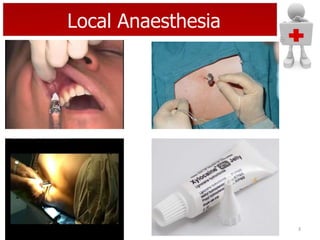
Local Anaesthesia

3
Local Anaesthesia
• Reversible loss of sensation (Sensory)

• In a local area
• Without loss of consciousness

• Without loss of control of vital functions
• Topical/Injection/Infiltration

4
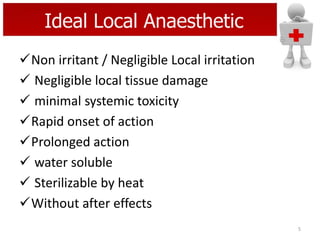
Ideal Local Anaesthetic
Non irritant / Negligible Local irritation
 Negligible local tissue damage
 minimal systemic toxicity
Rapid onset of action
Prolonged action
 water soluble
 Sterilizable by heat
Without after effects
5
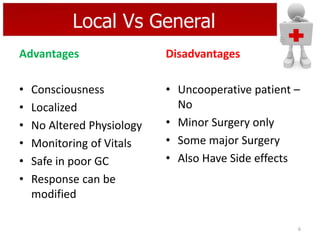
Local Vs General
Advantages

Disadvantages

•
•
•
•
•
•

• Uncooperative patient –
No
• Minor Surgery only
• Some major Surgery
• Also Have Side effects

Consciousness
Localized
No Altered Physiology
Monitoring of Vitals
Safe in poor GC
Response can be
modified

6
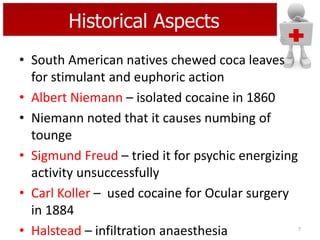
Historical Aspects
• South American natives chewed coca leaves
for stimulant and euphoric action
• Albert Niemann – isolated cocaine in 1860
• Niemann noted that it causes numbing of
tounge
• Sigmund Freud – tried it for psychic energizing
activity unsuccessfully
• Carl Koller – used cocaine for Ocular surgery
in 1884
• Halstead – infiltration anaesthesia

7
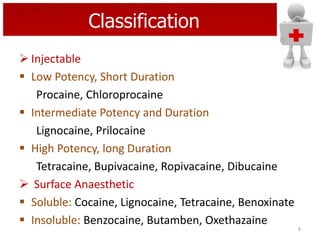
Classification
 Injectable
 Low Potency, Short Duration
Procaine, Chloroprocaine
 Intermediate Potency and Duration
Lignocaine, Prilocaine
 High Potency, long Duration
Tetracaine, Bupivacaine, Ropivacaine, Dibucaine
 Surface Anaesthetic
 Soluble: Cocaine, Lignocaine, Tetracaine, Benoxinate
 Insoluble: Benzocaine, Butamben, Oxethazaine

8
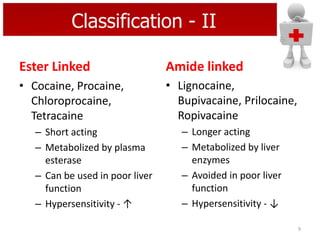
Classification - II
Ester Linked

Amide linked

• Cocaine, Procaine,
Chloroprocaine,
Tetracaine

• Lignocaine,
Bupivacaine, Prilocaine,
Ropivacaine

– Short acting
– Metabolized by plasma
esterase
– Can be used in poor liver
function
– Hypersensitivity - ↑

– Longer acting
– Metabolized by liver
enzymes
– Avoided in poor liver
function
– Hypersensitivity - ↓
9
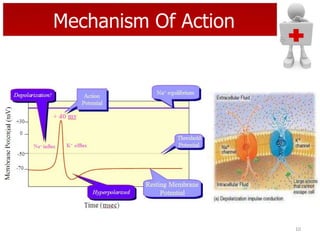
Mechanism Of Action

10
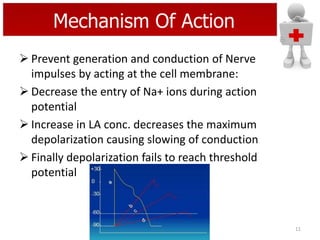
Mechanism Of Action
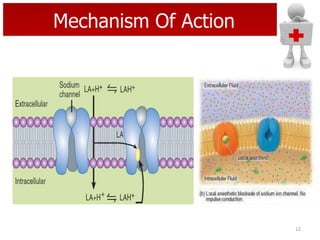
 Prevent generation and conduction of Nerve
impulses by acting at the cell membrane:
 Decrease the entry of Na+ ions during action
potential
 Increase in LA conc. decreases the maximum
depolarization causing slowing of conduction
 Finally depolarization fails to reach threshold
potential

11
Mechanism Of Action

12
Mechanism Of Action
Degree of blockade is frequency dependent:
Greater blockade at higher frequency of
stimulation
Higher concentration of Ca++ reduces
inactivation of Na+ channel
Blockade is not due to hyperpolarization
RMP is unaltered as K+ channels are not
blocked
13
Factors Influencing Action of LA
 Lipid Solubility
 Lipid solubility helps in nerve penetration, faster action
 Non ionized form can easily cross nerve membrane

pH
 Lower pKa (7.6 – 7.8) – faster acting (lidocaine, mepivacaine)
 Higher pKa (8.1 – 8.9) – slower acting (procaine, tetracaine,
bupivacaine)

14
Factors Influencing Action of LA
 Vasoconstrictors (Adrenaline, Phenylephrine)
 Tissue Necrosis, Systemic Side effects
 CI in areas with terminal arteries (Fingers, Toe, Nose, Penis)
- Hypoxic injury
- Tissue Necrosis and May Produce gangrene
 Felypressin (Vasopressin Analogue)

- Used as vasoconstrictor in CV Dz Patients
15
Factors Influencing Action of LA
Inflammation

 Acidic environment
 ionized LA, Penetration decreased

 Alkalization
 Hasten onset of nerve block
 Limited increase in unionized form
 precipitation of LA
16
Pharmacodynamics
Functions lost by LA (Local)
 Pain perception
 Temperature
 Touch sensation
 Proprioception
 Skeletal muscle tone
17
Pharmacodynamics
Sensory > Motor

Nonmyelinated > Myelinated
Small fibres > Large fibres

Autonomic fibres > Somatic Fibres

18
Pharmacodynamics (Systemic)
CNS
• Inhibition of inhibitory neurons
• Euphoria, Dysphoria, Muscle twitches
• Stimulation – Restlessness, tremors, Convulsions
• Respiratory depression in high doses
• Respiratory failure - death
19
Pharmacodynamics (Systemic)
CVS
• ↓ Automaticity, Conductivity, Excitability,
Contractility, Conductivity
• ↑ Effective refractory period
• Prolonged QTc interval
• Ventricular Tachycardia, Ventricular Fibrillation
• ↓ in Blood Pressure by Sympathetic blockade
• Cocaine ↑ Blood pressure

20
Pharmacodynamics (Systemic)
Smooth Muscle
• ↓ contraction of bowel
• Relaxation of vascular and bronchial smooth muscle


Sympathetic System

• Blockade – Spinal, Epidural anaesthesia, local
infiltration in peritoneal cavity


Neuromuscular Junction

• Block NMJ, Inhibit ganglionic transmission

21
Pharmacokinetics
• Surface anesthetics from mucus membrane and
abraded areas
• Depends on Blood flow to the area, total dose and
specific drug characteristics
• Widely distributed in the body: (lipophilic)
• Enters brain, heart, liver and kidney
• Followed by muscle and other viscera
22
Pharmacokinetics
• Ester linked LA – inactivated by hydrolysis by plasma
esterases, cholinesterase
• Spinal anaesthesia – absorbed into systemic
circulation
• Amide linked LA – Degraded in liver by CYP450
• Use restricted in Liver disease

23
Pharmacokinetics
• Amide linked LA – bind with α1 acid glycoprotein

• α1 acid glycoprotein (↑) – MI, Trauma, Cancer,
Surgery, Smoking
• α1 acid glycoprotein (↓) – Oral Contraceptive Pill,
Infants
• Termination of action depends on rate of absorption

and elimination
24
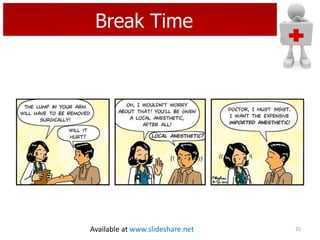
Break Time

Available at www.slideshare.net

25
Toxicity
 CNS
 Numbness in circumoral area and tongue
 Metallic taste
 Drowsiness, Lightheadedness, Restlessness
 Visual and auditory disturbances, Nystgmus
 Respiratory depression, convulsions
 Death due to respiratory failure
26
Toxicity
CVS
 Hypotension, Bradycardia, Cardiac Dysrhythmia
 CV Collapse

Methaemoglobinaemia
 Prilocaine and Benzocaine
 AE due to Vasoconstrictor
27
Toxicity
Hypersensitivity

 Esters> Amides (Methyl Paraben)
 Asthmatic attack

 Allergic dermatitis

28
Prevention of Toxicity
 Proper History, Allergy Testing

 4 hour fasting, Premedication
 Avoid in Hepatic and cardiac disease
 Administration at Proper site
 Wait for development of effect
 Look for signs of toxicity
 Observation post operatively
29
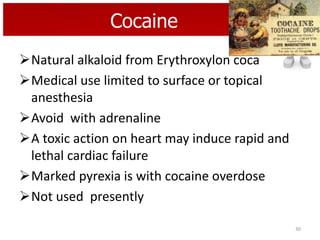
Cocaine
Natural alkaloid from Erythroxylon coca
Medical use limited to surface or topical
anesthesia
Avoid with adrenaline
A toxic action on heart may induce rapid and
lethal cardiac failure
Marked pyrexia is with cocaine overdose
Not used presently
30
Procaine
 Topically ineffective
 Used for infiltration because of low potency and
short duration
 Most commonly used for spinal anesthesia
 Produces significant vasodilation. Adrenaline used to
prolong effect
 Systemic toxicity negligible because rapidly destroyed
in plasma
 Procaine penicillin
31
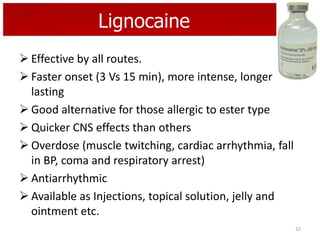
Lignocaine
 Effective by all routes.
 Faster onset (3 Vs 15 min), more intense, longer
lasting
 Good alternative for those allergic to ester type
 Quicker CNS effects than others
 Overdose (muscle twitching, cardiac arrhythmia, fall
in BP, coma and respiratory arrest)
 Antiarrhythmic
 Available as Injections, topical solution, jelly and
ointment etc.
32
Bupivacaine
 No topical effect
 Slower onset and one of longer duration agents
 Used for infiltration, spinal, nerve block and epidural
 Unique analgesia without significant motor blockade
(popular drug for analgesia during labor)
 High lipid solubility, high distribution in tissues and
less in blood (benefit to fetus)
 More cardio toxic than other LA (prolong QT interval)

33
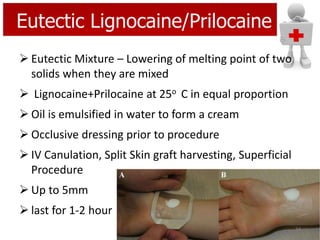
Eutectic Lignocaine/Prilocaine
 Eutectic Mixture – Lowering of melting point of two
solids when they are mixed

 Lignocaine+Prilocaine at 25o C in equal proportion
 Oil is emulsified in water to form a cream
 Occlusive dressing prior to procedure
 IV Canulation, Split Skin graft harvesting, Superficial
Procedure
 Up to 5mm
 last for 1-2 hour
34
Benzocaine, Butamben
 Low aqueous solubility – Not absorbed from mucosa
or broken skin
 Long lasting anaesthesia without systemic toxicity
 Lozenges for stomatitis, Sore throat
 Dusting powder on wounds/ Ulcerated surfaces
 Suppositories for anorectal lesions

35
Techniques
Surface Anaesthesia
 Mucous membranes and abraded skin
 Nose, mouth, bronchial tree, cornea and urinary
tracts
 Lignocaine, Tetracaine

36
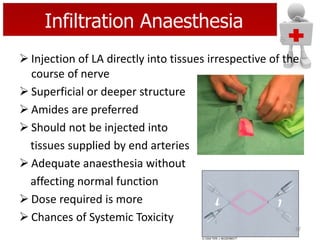
Infiltration Anaesthesia
 Injection of LA directly into tissues irrespective of the
course of nerve
 Superficial or deeper structure
 Amides are preferred
 Should not be injected into
tissues supplied by end arteries
 Adequate anaesthesia without
affecting normal function
 Dose required is more
 Chances of Systemic Toxicity
37
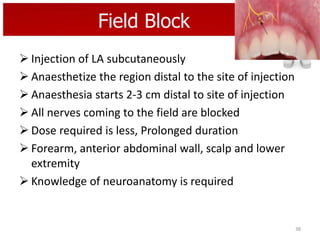
Field Block
 Injection of LA subcutaneously
 Anaesthetize the region distal to the site of injection
 Anaesthesia starts 2-3 cm distal to site of injection
 All nerves coming to the field are blocked
 Dose required is less, Prolonged duration
 Forearm, anterior abdominal wall, scalp and lower
extremity
 Knowledge of neuroanatomy is required

38
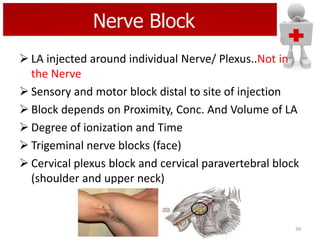
Nerve Block
 LA injected around individual Nerve/ Plexus..Not in
the Nerve
 Sensory and motor block distal to site of injection
 Block depends on Proximity, Conc. And Volume of LA
 Degree of ionization and Time
 Trigeminal nerve blocks (face)
 Cervical plexus block and cervical paravertebral block
(shoulder and upper neck)

39
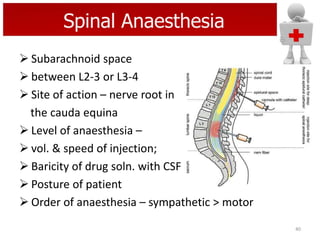
Spinal Anaesthesia
 Subarachnoid space
 between L2-3 or L3-4
 Site of action – nerve root in
the cauda equina
 Level of anaesthesia –
 vol. & speed of injection;
 Baricity of drug soln. with CSF
 Posture of patient
 Order of anaesthesia – sympathetic > motor
40
Spinal Anaesthesia
 Uses – lower limbs, pelvis, lower abdomen,
prostatectomy fracture setting and obstetric
procedures
 Spinal headache, hypotension, bradycardia and
respiratory depression, cauda equina syndrome and
nausea-vomiting
 Drugs - Lidocaine, Tetracaine

41
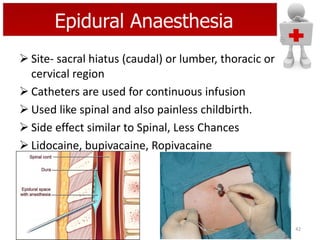
Epidural Anaesthesia
 Site- sacral hiatus (caudal) or lumber, thoracic or
cervical region
 Catheters are used for continuous infusion
 Used like spinal and also painless childbirth.
 Side effect similar to Spinal, Less Chances
 Lidocaine, bupivacaine, Ropivacaine

42
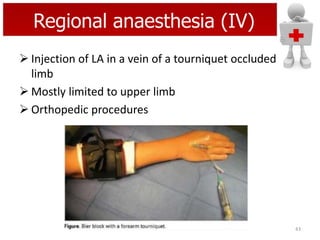
Regional anaesthesia (IV)
 Injection of LA in a vein of a tourniquet occluded
limb
 Mostly limited to upper limb
 Orthopedic procedures

43
Summary
-Caine …

Na+ Channel Blockers
Esters and Amides

Local and Systemic Actions (Toxicity)
 Techniques
Available at www.slideshare.net
44

Local anaesthetics

  • 1.
    Local Anaesthetics Dr Mayur Chaudhari AssistantProfessor Department of Pharmacology Government Medical College, Surat Available at www.slideshare.net 1
  • 2.
    At The EndOf Class….. • Local Anaesthesia • Mechanism of Action • Pharmacodynamic • Pharmacokinetic • Individual Agents • Techniques and uses 2
  • 3.
  • 4.
    Local Anaesthesia • Reversibleloss of sensation (Sensory) • In a local area • Without loss of consciousness • Without loss of control of vital functions • Topical/Injection/Infiltration 4
  • 5.
    Ideal Local Anaesthetic Nonirritant / Negligible Local irritation  Negligible local tissue damage  minimal systemic toxicity Rapid onset of action Prolonged action  water soluble  Sterilizable by heat Without after effects 5
  • 6.
    Local Vs General Advantages Disadvantages • • • • • • •Uncooperative patient – No • Minor Surgery only • Some major Surgery • Also Have Side effects Consciousness Localized No Altered Physiology Monitoring of Vitals Safe in poor GC Response can be modified 6
  • 7.
    Historical Aspects • SouthAmerican natives chewed coca leaves for stimulant and euphoric action • Albert Niemann – isolated cocaine in 1860 • Niemann noted that it causes numbing of tounge • Sigmund Freud – tried it for psychic energizing activity unsuccessfully • Carl Koller – used cocaine for Ocular surgery in 1884 • Halstead – infiltration anaesthesia 7
  • 8.
    Classification  Injectable  LowPotency, Short Duration Procaine, Chloroprocaine  Intermediate Potency and Duration Lignocaine, Prilocaine  High Potency, long Duration Tetracaine, Bupivacaine, Ropivacaine, Dibucaine  Surface Anaesthetic  Soluble: Cocaine, Lignocaine, Tetracaine, Benoxinate  Insoluble: Benzocaine, Butamben, Oxethazaine 8
  • 9.
    Classification - II EsterLinked Amide linked • Cocaine, Procaine, Chloroprocaine, Tetracaine • Lignocaine, Bupivacaine, Prilocaine, Ropivacaine – Short acting – Metabolized by plasma esterase – Can be used in poor liver function – Hypersensitivity - ↑ – Longer acting – Metabolized by liver enzymes – Avoided in poor liver function – Hypersensitivity - ↓ 9
  • 10.
  • 11.
    Mechanism Of Action Prevent generation and conduction of Nerve impulses by acting at the cell membrane:  Decrease the entry of Na+ ions during action potential  Increase in LA conc. decreases the maximum depolarization causing slowing of conduction  Finally depolarization fails to reach threshold potential 11
  • 12.
  • 13.
    Mechanism Of Action Degreeof blockade is frequency dependent: Greater blockade at higher frequency of stimulation Higher concentration of Ca++ reduces inactivation of Na+ channel Blockade is not due to hyperpolarization RMP is unaltered as K+ channels are not blocked 13
  • 14.
    Factors Influencing Actionof LA  Lipid Solubility  Lipid solubility helps in nerve penetration, faster action  Non ionized form can easily cross nerve membrane pH  Lower pKa (7.6 – 7.8) – faster acting (lidocaine, mepivacaine)  Higher pKa (8.1 – 8.9) – slower acting (procaine, tetracaine, bupivacaine) 14
  • 15.
    Factors Influencing Actionof LA  Vasoconstrictors (Adrenaline, Phenylephrine)  Tissue Necrosis, Systemic Side effects  CI in areas with terminal arteries (Fingers, Toe, Nose, Penis) - Hypoxic injury - Tissue Necrosis and May Produce gangrene  Felypressin (Vasopressin Analogue) - Used as vasoconstrictor in CV Dz Patients 15
  • 16.
    Factors Influencing Actionof LA Inflammation  Acidic environment  ionized LA, Penetration decreased  Alkalization  Hasten onset of nerve block  Limited increase in unionized form  precipitation of LA 16
  • 17.
    Pharmacodynamics Functions lost byLA (Local)  Pain perception  Temperature  Touch sensation  Proprioception  Skeletal muscle tone 17
  • 18.
    Pharmacodynamics Sensory > Motor Nonmyelinated> Myelinated Small fibres > Large fibres Autonomic fibres > Somatic Fibres 18
  • 19.
    Pharmacodynamics (Systemic) CNS • Inhibitionof inhibitory neurons • Euphoria, Dysphoria, Muscle twitches • Stimulation – Restlessness, tremors, Convulsions • Respiratory depression in high doses • Respiratory failure - death 19
  • 20.
    Pharmacodynamics (Systemic) CVS • ↓Automaticity, Conductivity, Excitability, Contractility, Conductivity • ↑ Effective refractory period • Prolonged QTc interval • Ventricular Tachycardia, Ventricular Fibrillation • ↓ in Blood Pressure by Sympathetic blockade • Cocaine ↑ Blood pressure 20
  • 21.
    Pharmacodynamics (Systemic) Smooth Muscle •↓ contraction of bowel • Relaxation of vascular and bronchial smooth muscle  Sympathetic System • Blockade – Spinal, Epidural anaesthesia, local infiltration in peritoneal cavity  Neuromuscular Junction • Block NMJ, Inhibit ganglionic transmission 21
  • 22.
    Pharmacokinetics • Surface anestheticsfrom mucus membrane and abraded areas • Depends on Blood flow to the area, total dose and specific drug characteristics • Widely distributed in the body: (lipophilic) • Enters brain, heart, liver and kidney • Followed by muscle and other viscera 22
  • 23.
    Pharmacokinetics • Ester linkedLA – inactivated by hydrolysis by plasma esterases, cholinesterase • Spinal anaesthesia – absorbed into systemic circulation • Amide linked LA – Degraded in liver by CYP450 • Use restricted in Liver disease 23
  • 24.
    Pharmacokinetics • Amide linkedLA – bind with α1 acid glycoprotein • α1 acid glycoprotein (↑) – MI, Trauma, Cancer, Surgery, Smoking • α1 acid glycoprotein (↓) – Oral Contraceptive Pill, Infants • Termination of action depends on rate of absorption and elimination 24
  • 25.
    Break Time Available atwww.slideshare.net 25
  • 26.
    Toxicity  CNS  Numbnessin circumoral area and tongue  Metallic taste  Drowsiness, Lightheadedness, Restlessness  Visual and auditory disturbances, Nystgmus  Respiratory depression, convulsions  Death due to respiratory failure 26
  • 27.
    Toxicity CVS  Hypotension, Bradycardia,Cardiac Dysrhythmia  CV Collapse Methaemoglobinaemia  Prilocaine and Benzocaine  AE due to Vasoconstrictor 27
  • 28.
    Toxicity Hypersensitivity  Esters> Amides(Methyl Paraben)  Asthmatic attack  Allergic dermatitis 28
  • 29.
    Prevention of Toxicity Proper History, Allergy Testing  4 hour fasting, Premedication  Avoid in Hepatic and cardiac disease  Administration at Proper site  Wait for development of effect  Look for signs of toxicity  Observation post operatively 29
  • 30.
    Cocaine Natural alkaloid fromErythroxylon coca Medical use limited to surface or topical anesthesia Avoid with adrenaline A toxic action on heart may induce rapid and lethal cardiac failure Marked pyrexia is with cocaine overdose Not used presently 30
  • 31.
    Procaine  Topically ineffective Used for infiltration because of low potency and short duration  Most commonly used for spinal anesthesia  Produces significant vasodilation. Adrenaline used to prolong effect  Systemic toxicity negligible because rapidly destroyed in plasma  Procaine penicillin 31
  • 32.
    Lignocaine  Effective byall routes.  Faster onset (3 Vs 15 min), more intense, longer lasting  Good alternative for those allergic to ester type  Quicker CNS effects than others  Overdose (muscle twitching, cardiac arrhythmia, fall in BP, coma and respiratory arrest)  Antiarrhythmic  Available as Injections, topical solution, jelly and ointment etc. 32
  • 33.
    Bupivacaine  No topicaleffect  Slower onset and one of longer duration agents  Used for infiltration, spinal, nerve block and epidural  Unique analgesia without significant motor blockade (popular drug for analgesia during labor)  High lipid solubility, high distribution in tissues and less in blood (benefit to fetus)  More cardio toxic than other LA (prolong QT interval) 33
  • 34.
    Eutectic Lignocaine/Prilocaine  EutecticMixture – Lowering of melting point of two solids when they are mixed  Lignocaine+Prilocaine at 25o C in equal proportion  Oil is emulsified in water to form a cream  Occlusive dressing prior to procedure  IV Canulation, Split Skin graft harvesting, Superficial Procedure  Up to 5mm  last for 1-2 hour 34
  • 35.
    Benzocaine, Butamben  Lowaqueous solubility – Not absorbed from mucosa or broken skin  Long lasting anaesthesia without systemic toxicity  Lozenges for stomatitis, Sore throat  Dusting powder on wounds/ Ulcerated surfaces  Suppositories for anorectal lesions 35
  • 36.
    Techniques Surface Anaesthesia  Mucousmembranes and abraded skin  Nose, mouth, bronchial tree, cornea and urinary tracts  Lignocaine, Tetracaine 36
  • 37.
    Infiltration Anaesthesia  Injectionof LA directly into tissues irrespective of the course of nerve  Superficial or deeper structure  Amides are preferred  Should not be injected into tissues supplied by end arteries  Adequate anaesthesia without affecting normal function  Dose required is more  Chances of Systemic Toxicity 37
  • 38.
    Field Block  Injectionof LA subcutaneously  Anaesthetize the region distal to the site of injection  Anaesthesia starts 2-3 cm distal to site of injection  All nerves coming to the field are blocked  Dose required is less, Prolonged duration  Forearm, anterior abdominal wall, scalp and lower extremity  Knowledge of neuroanatomy is required 38
  • 39.
    Nerve Block  LAinjected around individual Nerve/ Plexus..Not in the Nerve  Sensory and motor block distal to site of injection  Block depends on Proximity, Conc. And Volume of LA  Degree of ionization and Time  Trigeminal nerve blocks (face)  Cervical plexus block and cervical paravertebral block (shoulder and upper neck) 39
  • 40.
    Spinal Anaesthesia  Subarachnoidspace  between L2-3 or L3-4  Site of action – nerve root in the cauda equina  Level of anaesthesia –  vol. & speed of injection;  Baricity of drug soln. with CSF  Posture of patient  Order of anaesthesia – sympathetic > motor 40
  • 41.
    Spinal Anaesthesia  Uses– lower limbs, pelvis, lower abdomen, prostatectomy fracture setting and obstetric procedures  Spinal headache, hypotension, bradycardia and respiratory depression, cauda equina syndrome and nausea-vomiting  Drugs - Lidocaine, Tetracaine 41
  • 42.
    Epidural Anaesthesia  Site-sacral hiatus (caudal) or lumber, thoracic or cervical region  Catheters are used for continuous infusion  Used like spinal and also painless childbirth.  Side effect similar to Spinal, Less Chances  Lidocaine, bupivacaine, Ropivacaine 42
  • 43.
    Regional anaesthesia (IV) Injection of LA in a vein of a tourniquet occluded limb  Mostly limited to upper limb  Orthopedic procedures 43
  • 44.
    Summary -Caine … Na+ ChannelBlockers Esters and Amides Local and Systemic Actions (Toxicity)  Techniques Available at www.slideshare.net 44