









Prepared By Raheel Ahmad
 Local anesthetics (LA) are drugs that are used to prevent or relieve pain in
specific regions of the body without loss of consciousness. They act by reversibly
blocking nerve conduction.
Local Anesthesia works by:
 Altering the basic potential of the nerve membrane
 Altering the threshold or firing level
 Decreasing the rate of depolarization
 Prolonging the rate of repolarization
 LOCAL ANESTHETICS CALSIFICATION –
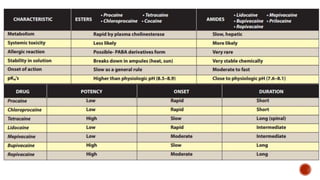
 Esters Cocaine, Procaine Chlore procaine ,Tetracaine . –
 Amids : Lidocaine Mepivacaine, Prilocaine Articaine Popivacaine, Etidocaine. –
 Ketons :Dyclon. –
 Quinoline: Centbucridine
 After injection into the area of nerve fibers, local anesthetics are absorbed into
blood.
 Ester-linked local anesthetics are quickly hydrolyzed by butyrylcholinesterase in
blood.
 Amide-linked local anesthetics can be widely distributed via circulation.
 Amide- linked local anesthetics are hydrolyzed by liver microsomal enzymes.
Thus, half life of these drugs are significantly longer and toxicity is more likely to
occur in patients with impaired liver function
 Absorption of local anesthetics is affected by following factors: – dosage, – site of
injection, – drug-tissue-binding and – Presence of vaso-constrictings.
 The onset and duration of action of local anesthetics are effected by several factors including :
 tissue pH
 nerve morphology
 Concentration
 pKa
 lipid solubility of the drug.
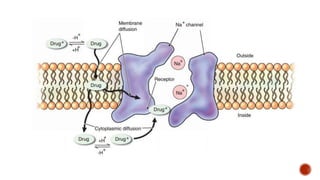
pH of the tissue and pKa are most important. At physiologic pH, these compounds are charged.
The ionized form interacts with the protein receptor of the Na+channel to inhibit its function and
achieve local anesthesia.
The pH may drop in infected sites, causing onset to be delayed or even prevented. Within limits,
higher concentration and greater lipid solubility improve onset somewhat.
Duration of action depends on the length of time the drug can stay near the nerve to block sodium
channels.
 Local anesthetics cause vasodilation, leading to rapid diffusion away from the site
of action and shorter duration when these drugs are administered alone.
 the vasoconstrictor epinephrine, the rate of local anesthetic absorption and
diffusion is decreased.
 This decrease systemic toxicity and increases the duration of action.
 Hepatic function does not affect the duration of action of local anesthesia,
 Some local anesthetics have other therapeutic uses (for example, lidocaineis an IV
antiarrhythmic)
 1. Topical Anesthesia
Anesthesia of mucous membranes of the nose, mouth and throat can be produced by
direct application of aqueous solutions of salts of many local anesthetics or by
suspension of the poorly soluble local anesthetics as tetracaine (2%) or lidocaine
(2%). Epinephrine, topically applied, has no significant local effect and does not
prolong the duration of action of local anesthetics applied to mucous membranes
because of poor penetration.
 2. Infiltration Anesthesia:
Infiltration anesthesia is the injection of local anesthetic directly into tissue without
taking into consideration the course of nerves. The local anesthetics used most
frequently for infiltration anesthesia are 1- lidocaine 2- procaine 3- bupivacaine
When used without epinephrine, greater amounts could be given
 3- Field Block Anesthesia:
Field block anesthesia is produced by subcutaneous injection of a solution of local
anesthetic in order to anesthetize the region distal to the injection.
 4- Nerve block:
Injection of a solution of a local anesthetic into or about individual peripheral
nerves or nerve plexuses
 1. pH influence
 Usually at range 7.6 – 8.9
 Decrease in pH shifts equilibrium toward the ionized form, delaying the onset
action.
 Lower pH, solution more acidic, gives slower onset of action
 2. Effect of inflammation on the activity of local anesthetics
 Inflammation increases the acidity of the medium
 Therefore, administration of local anesthetics at sites of inflammation increases
their ionization .
 This leads to lesser penetration into the nerves and, therefore, lesser activity
 3- Factors affecting absorption of local anesthetics into the systemic circulation
 Dosage (higher dose = greater probability of systemic absorption)
 Site of injection (injection at areas of large blood supply increase absorption)
 Presence of vasoconstricting drugs.
 4- Vasodilation
 Vasoconstrictor is a substance used to keep the anesthetic solution in place at a
longer period and prolongs the action of the drug
 vasoconstrictor delays the absorption which slows down the absorption into the
bloodstream
 Lower vasodilator activity of a local anesthetic leads to a slower absorption and
longer duration of action
 vasoconstrictor used the naturally hormone called epinephrine (adrenaline).
Epinephrine decreases vasodilator. Side effects of epinephrine
 Epinephrine circulates the heart, causes the heart beat stronger and faster, and
makes people feel nervous
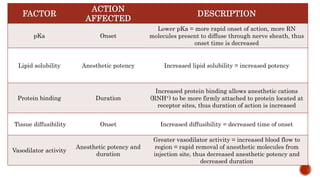
FACTOR
ACTION
AFFECTED
DESCRIPTION
pKa Onset
Lower pKa = more rapid onset of action, more RN
molecules present to diffuse through nerve sheath, thus
onset time is decreased
Lipid solubility Anesthetic potency Increased lipid solubility = increased potency
Protein binding Duration
Increased protein binding allows anesthetic cations
(RNH+) to be more firmly attached to protein located at
receptor sites, thus duration of action is increased
Tissue diffusibility Onset Increased diffusibility = decreased time of onset
Vasodilator activity
Anesthetic potency and
duration
Greater vasodilator activity = increased blood flow to
region = rapid removal of anesthetic molecules from
injection site, thus decreased anesthetic potency and
decreased duration
 Adverse effects are usually caused by :
 high plasma concentrations of a local anesthetic drug that result from –
inadvertent intravascular injection,
 excessive dose or rate of injection
 delayed drug clearance
 administration into vascular tissue
 These effects occur due to systemic absorption of large doses due to
 : 1- accidental intravascular injection
 2- Injection of large doses
Central nervous system: --
 Stimulation of the CNS caused by inhibition of inhibitory neuronal activity, producing
 1- restlessness
 2- tremors that may proceed to convulsions. –
 At high blood concentrations, local anesthetics cause depression and even respiratory
failure
 Administering a 20% lipid emulsion infusion (lipid rescue therapy) is a valuable asse
 Peripheral nervous system: --- Local anesthetics affect transmission at the
neuromuscular junction producing muscle weakness and tremors.
 Smooth muscles: --- Depress contractions of intestine, vascular, and bronchial
smooth muscle.
 Allergic reaction: --- Ester-linked local anesthetics may cause allergic reactions in
a small population of patients due to their metabolism producing para amino
benzoic acid which is allergy
 Cardiovascular system: ---
 Decrease electrical excitability, conduction rate, and force of contraction in the
myocardium.
 Cause arteriolar dilation.
 Cocaine differs from the other local anesthetics: it blocks norepinephrine
reuptake, resulting in vasoconstriction and hypertension, even cardiac
arrhythmias
 Allergic shock:
 Patient reports of allergic reactions to local anesthetics are fairly common, but often
times reported “allergies” are actually side effects from epinephrine added to the local
anesthetic.
 Psychogenic reactions to injections may be misdiagnosed as allergic reactions and may
also mimic them with signs such as urticaria, edema, and bronchospasm.
 True allergy to an amide local anesthetic is exceedingly rare, whereas the ester
procaineis somewhat more allergenic.
 Allergy to one ester rules out use of another ester, because the allergenic component is
the metabolite para-aminobenzoic acid, produced by all esters.
 In contrast, allergy to one amide does not rule out the use of another amide.
 A patient may be allergic to other compounds in the local anesthetic, such as
preservatives in multidose vial
 Allergic shock:
 Esters are highly allergenic, their use should be avoided and restricted to special
cases after allergy test.
 a patient may in fact be allergic only to the bisulfite preservative used to stabilize
the vasoconstrictor.
 If the allergic reaction was not too serious, it may be worth trying again with
either mepivicaine or prilocaine without vasoconstrictor. Anesthetic manufactures
do not use preservatives in carpules that do not also contain vasoconstrictor
 Signs and symptoms of anesthetics allergic reaction
 The signs and symptoms of allergic reaction include: – generalized body rash or
skin redness – itching, urticaria (hives) – broncospasm (difficulty breathing) –
swelling of the throat – asthma – abdominal cramping – irregular heartbeat –
hypotension (low blood pressure) – swelling of the face and lips (angioneurotic
edema)
Anaphylactic shock
 Fortunately, the majority of allergic reactions to local anesthetics are fairly mild
 In a very serious anaphylactic reaction, the patient may experience serious
difficulty breathing due to closing down of the bronchioles in the lungs or swelling
in the throat area due to urticaria as well as seriously low blood pressure leading
to anaphylactic shock. This set of events, left untreated can lead to death
Management of anaphylactic shock
 Position the patient on his or her back with the feet elevated.
 Maintain an airway. If the patient is not breathing on his own, use rescue
breathing like you learned in CPR class.
 Check the carotid artery for heartbeat and use chest compressions if necessary
 The two drugs that you must have on hand to stabilize a patient in anaphylactic
shock are as follows: –
 Epinephrine (adrenalin) 1:1000 subcutaneous injection. It opens the bronchioles
allowing free breathing, increases the blood pressure counteracting shock and
evens out and intensifies the heart beat. Its effects are drastic, but short lived.
The standard dose is 1 mg given in three doses five minutes apart. –
 Benedryl (diphenhydramine) 25-50 mg injectable. This is an antihistamine and
can also be taken in pill form an hour before the procedure to help prevent serious
allergic reaction before it begins. Injectable diphenhydrimine which can be
administered either subcutaneously, or in the buccal fold if the dentist is more
comfortable with that rout
 Pregnant woman
 Local anesthesia are not teratogenic, and may administered to pregnancy patient
is usual clinical doses.
 Large dose of prilocaine are know to cause methemoglobinemia which could cause
maternal & fetal hypoxia.
 Local vasoconstriction – Delay uptake from the site of injection – Increase the
effectiveness & duration There is no specific contraindication to these
vasoconstrictors in a pregnant patient although it is prudent to use minimal
effective dose.
 Pregnant woman
 Lidocaine + vasoconstrictor: most common local anesthetic used in dentistry
extensively used in pregnancy with no proven ill effects• accidental intravascular
injections of lidocaine pass through the placenta but the concentrations are too
low to harm fetus•
 Drug classes: B: lidocaine, prilocaine, etidocaine C: mepivacaine, bupivacaine Not
yet assigned: Procaine• The need for careful Hx taking & for aspiration & slow
injected technique is obvious
 Before administering local anesthetic to a child, the maximum dose based on
weight should be calculated to prevent accidental overdose.
 There are no significant differences in response to local anesthetics between
younger and older adults.
 It is prudent to stay well below maximum recommended doses in elderly patients
who often have some compromise in liver function. Because some degree of
cardiovascular compromise may be expected in elderly patients, reducing the dose
of epinephrine may be prudent.
 Local anesthetics are safe for patients who are susceptible to MH
Local anesthetics

Local anesthetics

  • 1.
  • 2.
     Local anesthetics(LA) are drugs that are used to prevent or relieve pain in specific regions of the body without loss of consciousness. They act by reversibly blocking nerve conduction.
  • 3.
    Local Anesthesia worksby:  Altering the basic potential of the nerve membrane  Altering the threshold or firing level  Decreasing the rate of depolarization  Prolonging the rate of repolarization
  • 5.
     LOCAL ANESTHETICSCALSIFICATION –  Esters Cocaine, Procaine Chlore procaine ,Tetracaine . –  Amids : Lidocaine Mepivacaine, Prilocaine Articaine Popivacaine, Etidocaine. –  Ketons :Dyclon. –  Quinoline: Centbucridine
  • 6.
     After injectioninto the area of nerve fibers, local anesthetics are absorbed into blood.  Ester-linked local anesthetics are quickly hydrolyzed by butyrylcholinesterase in blood.  Amide-linked local anesthetics can be widely distributed via circulation.  Amide- linked local anesthetics are hydrolyzed by liver microsomal enzymes. Thus, half life of these drugs are significantly longer and toxicity is more likely to occur in patients with impaired liver function  Absorption of local anesthetics is affected by following factors: – dosage, – site of injection, – drug-tissue-binding and – Presence of vaso-constrictings.
  • 7.
     The onsetand duration of action of local anesthetics are effected by several factors including :  tissue pH  nerve morphology  Concentration  pKa  lipid solubility of the drug. pH of the tissue and pKa are most important. At physiologic pH, these compounds are charged. The ionized form interacts with the protein receptor of the Na+channel to inhibit its function and achieve local anesthesia. The pH may drop in infected sites, causing onset to be delayed or even prevented. Within limits, higher concentration and greater lipid solubility improve onset somewhat. Duration of action depends on the length of time the drug can stay near the nerve to block sodium channels.
  • 8.
     Local anestheticscause vasodilation, leading to rapid diffusion away from the site of action and shorter duration when these drugs are administered alone.  the vasoconstrictor epinephrine, the rate of local anesthetic absorption and diffusion is decreased.  This decrease systemic toxicity and increases the duration of action.  Hepatic function does not affect the duration of action of local anesthesia,  Some local anesthetics have other therapeutic uses (for example, lidocaineis an IV antiarrhythmic)
  • 9.
     1. TopicalAnesthesia Anesthesia of mucous membranes of the nose, mouth and throat can be produced by direct application of aqueous solutions of salts of many local anesthetics or by suspension of the poorly soluble local anesthetics as tetracaine (2%) or lidocaine (2%). Epinephrine, topically applied, has no significant local effect and does not prolong the duration of action of local anesthetics applied to mucous membranes because of poor penetration.  2. Infiltration Anesthesia: Infiltration anesthesia is the injection of local anesthetic directly into tissue without taking into consideration the course of nerves. The local anesthetics used most frequently for infiltration anesthesia are 1- lidocaine 2- procaine 3- bupivacaine When used without epinephrine, greater amounts could be given
  • 10.
     3- FieldBlock Anesthesia: Field block anesthesia is produced by subcutaneous injection of a solution of local anesthetic in order to anesthetize the region distal to the injection.  4- Nerve block: Injection of a solution of a local anesthetic into or about individual peripheral nerves or nerve plexuses
  • 11.
     1. pHinfluence  Usually at range 7.6 – 8.9  Decrease in pH shifts equilibrium toward the ionized form, delaying the onset action.  Lower pH, solution more acidic, gives slower onset of action  2. Effect of inflammation on the activity of local anesthetics  Inflammation increases the acidity of the medium  Therefore, administration of local anesthetics at sites of inflammation increases their ionization .  This leads to lesser penetration into the nerves and, therefore, lesser activity
  • 12.
     3- Factorsaffecting absorption of local anesthetics into the systemic circulation  Dosage (higher dose = greater probability of systemic absorption)  Site of injection (injection at areas of large blood supply increase absorption)  Presence of vasoconstricting drugs.
  • 13.
     4- Vasodilation Vasoconstrictor is a substance used to keep the anesthetic solution in place at a longer period and prolongs the action of the drug  vasoconstrictor delays the absorption which slows down the absorption into the bloodstream  Lower vasodilator activity of a local anesthetic leads to a slower absorption and longer duration of action  vasoconstrictor used the naturally hormone called epinephrine (adrenaline). Epinephrine decreases vasodilator. Side effects of epinephrine  Epinephrine circulates the heart, causes the heart beat stronger and faster, and makes people feel nervous
  • 14.
    FACTOR ACTION AFFECTED DESCRIPTION pKa Onset Lower pKa= more rapid onset of action, more RN molecules present to diffuse through nerve sheath, thus onset time is decreased Lipid solubility Anesthetic potency Increased lipid solubility = increased potency Protein binding Duration Increased protein binding allows anesthetic cations (RNH+) to be more firmly attached to protein located at receptor sites, thus duration of action is increased Tissue diffusibility Onset Increased diffusibility = decreased time of onset Vasodilator activity Anesthetic potency and duration Greater vasodilator activity = increased blood flow to region = rapid removal of anesthetic molecules from injection site, thus decreased anesthetic potency and decreased duration
  • 15.
     Adverse effectsare usually caused by :  high plasma concentrations of a local anesthetic drug that result from – inadvertent intravascular injection,  excessive dose or rate of injection  delayed drug clearance  administration into vascular tissue
  • 16.
     These effectsoccur due to systemic absorption of large doses due to  : 1- accidental intravascular injection  2- Injection of large doses Central nervous system: --  Stimulation of the CNS caused by inhibition of inhibitory neuronal activity, producing  1- restlessness  2- tremors that may proceed to convulsions. –  At high blood concentrations, local anesthetics cause depression and even respiratory failure  Administering a 20% lipid emulsion infusion (lipid rescue therapy) is a valuable asse
  • 17.
     Peripheral nervoussystem: --- Local anesthetics affect transmission at the neuromuscular junction producing muscle weakness and tremors.  Smooth muscles: --- Depress contractions of intestine, vascular, and bronchial smooth muscle.  Allergic reaction: --- Ester-linked local anesthetics may cause allergic reactions in a small population of patients due to their metabolism producing para amino benzoic acid which is allergy
  • 18.
     Cardiovascular system:---  Decrease electrical excitability, conduction rate, and force of contraction in the myocardium.  Cause arteriolar dilation.  Cocaine differs from the other local anesthetics: it blocks norepinephrine reuptake, resulting in vasoconstriction and hypertension, even cardiac arrhythmias
  • 19.
     Allergic shock: Patient reports of allergic reactions to local anesthetics are fairly common, but often times reported “allergies” are actually side effects from epinephrine added to the local anesthetic.  Psychogenic reactions to injections may be misdiagnosed as allergic reactions and may also mimic them with signs such as urticaria, edema, and bronchospasm.  True allergy to an amide local anesthetic is exceedingly rare, whereas the ester procaineis somewhat more allergenic.  Allergy to one ester rules out use of another ester, because the allergenic component is the metabolite para-aminobenzoic acid, produced by all esters.  In contrast, allergy to one amide does not rule out the use of another amide.  A patient may be allergic to other compounds in the local anesthetic, such as preservatives in multidose vial
  • 20.
     Allergic shock: Esters are highly allergenic, their use should be avoided and restricted to special cases after allergy test.  a patient may in fact be allergic only to the bisulfite preservative used to stabilize the vasoconstrictor.  If the allergic reaction was not too serious, it may be worth trying again with either mepivicaine or prilocaine without vasoconstrictor. Anesthetic manufactures do not use preservatives in carpules that do not also contain vasoconstrictor
  • 21.
     Signs andsymptoms of anesthetics allergic reaction  The signs and symptoms of allergic reaction include: – generalized body rash or skin redness – itching, urticaria (hives) – broncospasm (difficulty breathing) – swelling of the throat – asthma – abdominal cramping – irregular heartbeat – hypotension (low blood pressure) – swelling of the face and lips (angioneurotic edema)
  • 22.
    Anaphylactic shock  Fortunately,the majority of allergic reactions to local anesthetics are fairly mild  In a very serious anaphylactic reaction, the patient may experience serious difficulty breathing due to closing down of the bronchioles in the lungs or swelling in the throat area due to urticaria as well as seriously low blood pressure leading to anaphylactic shock. This set of events, left untreated can lead to death Management of anaphylactic shock  Position the patient on his or her back with the feet elevated.  Maintain an airway. If the patient is not breathing on his own, use rescue breathing like you learned in CPR class.  Check the carotid artery for heartbeat and use chest compressions if necessary
  • 23.
     The twodrugs that you must have on hand to stabilize a patient in anaphylactic shock are as follows: –  Epinephrine (adrenalin) 1:1000 subcutaneous injection. It opens the bronchioles allowing free breathing, increases the blood pressure counteracting shock and evens out and intensifies the heart beat. Its effects are drastic, but short lived. The standard dose is 1 mg given in three doses five minutes apart. –  Benedryl (diphenhydramine) 25-50 mg injectable. This is an antihistamine and can also be taken in pill form an hour before the procedure to help prevent serious allergic reaction before it begins. Injectable diphenhydrimine which can be administered either subcutaneously, or in the buccal fold if the dentist is more comfortable with that rout
  • 24.
     Pregnant woman Local anesthesia are not teratogenic, and may administered to pregnancy patient is usual clinical doses.  Large dose of prilocaine are know to cause methemoglobinemia which could cause maternal & fetal hypoxia.  Local vasoconstriction – Delay uptake from the site of injection – Increase the effectiveness & duration There is no specific contraindication to these vasoconstrictors in a pregnant patient although it is prudent to use minimal effective dose.
  • 25.
     Pregnant woman Lidocaine + vasoconstrictor: most common local anesthetic used in dentistry extensively used in pregnancy with no proven ill effects• accidental intravascular injections of lidocaine pass through the placenta but the concentrations are too low to harm fetus•  Drug classes: B: lidocaine, prilocaine, etidocaine C: mepivacaine, bupivacaine Not yet assigned: Procaine• The need for careful Hx taking & for aspiration & slow injected technique is obvious
  • 26.
     Before administeringlocal anesthetic to a child, the maximum dose based on weight should be calculated to prevent accidental overdose.  There are no significant differences in response to local anesthetics between younger and older adults.  It is prudent to stay well below maximum recommended doses in elderly patients who often have some compromise in liver function. Because some degree of cardiovascular compromise may be expected in elderly patients, reducing the dose of epinephrine may be prudent.  Local anesthetics are safe for patients who are susceptible to MH