SHORT NOTES
BY
S.ARUNKUMAR
Equilibrium 12 Periods
Equilibrium in physical and chemical processes,
dynamic nature of equilibrium, law of mass
action, equilibrium constant, factors affecting
equilibrium ‐ Le Chatelier's principle, ionic
equilibrium‐ ionization of acids and bases,
strong and weak electrolytes, degree of
ionization,
ionization of poly basic acids, acid strength,
concept of pH, buffer solution, solubility
product,
common ion effect (with illustrative examples).
Deleted :Hydrolysis of salts (elementary idea),
Henderson Equation.
 Equilibrium is actually a state, when forces
from both the side become equal. According
to chemistry: It is a point in a chemical
reaction, when rate of forward reaction
becomes equal to rate of backward
reaction. Or we can say, it is the state when
concentration of reactants becomes equal to
concentration of products.
Equilibrium state:
H2O(l)H2O(vap)
Equilibrium in which the number of molecules
leaving the liquid equals the number returning
to liquid from the vapour. The system has
reached equilibrium state at this stage.
The mixture of reactants and products in the
equilibrium state is called an equilibrium
mixture.
A dynamic equilibrium for a chemical reaction is
the condition in which the rate of the forward
reaction equals the rate of the reverse reaction.
 Chemical equilibrium in a chemical reaction
may be classified in three groups.
(i)The reactions that proceed nearly to completion
and only negligible concentrations of the
reactants are left. In some cases, it may not be
even possible to detect these experimentally.
(ii) The reactions in which only small amounts of
products are formed and most of the reactants
remain unchanged at equilibrium stage.
(iii) The reactions in which the concentrations of
the reactants and products are comparable, when
the system is in equilibrium.
 Equilibrium involving ions in aqueous
solutions which is called as ionic equilibrium.
Equilibrium in Physical Processes:
The most common equilibria involving physical
processes are those which involve phase
transformation:
 Solid  Liquid
 Liquid  Gas
 Solid  Gas
 Solid Solution
 Gas solution
Solid − liquid equilibrium:
If some ice cubes along with some water at 0°C and
normal atmospheric pressure are placed in a
thermo flask so that no heat can enter or leave the
system, the mass of ice and water is found to
remain constant.
At equilibrium
Rate of melting of ice  Rate of freezing of
water
The temperature at which the solid and liquid form
of a pure substance are in equilibrium at the
atmospheric pressure is called the normal freezing
point on melting point of that substance .
Liquid − vapour equilibrium:
 Consider a closed vessel connected to a manometer
and having arrangement for evacuation and addition
of liquid into it. Suppose the vessel is first
evacuated. The level of mercury in both the limbs of
the manometer will be same.
 Now suppose water is added into the vessel and the
whole apparatus is allowed to stay at room
temperature. It is observed that the level of mercury
in the left limb of the manometer begins to fall and
that in the right limb begins to rise. After sometime,
the levels become constant. The system is then said
to have attained equilibrium.
 The difference in the levels of mercury in the two
limbs gives the equilibrium vapour pressure of the
water at room temperature.
 In the beginning, more and more of the water is
changing into vapours i.e. number of water
molecules in the vapour phase increases. Some
of these molecules strike back on the surface of
the water and are captured into it .The amount
of water vapour becomes constant i.e. now as
much water changes into vapours the same
amount of water vapour change back into the
liquid.
 Rate of evaporation  Rate of condensation
 The liquid with higher vapour pressure is more
volatile and has lower boiling point.
If we expose three watch glasses containing
separately 1ml each of acetone, ethyl alcohol
and water to atmosphere and repeat the
experiment with different volumes of the liquids
in a warmer room, it is observed that in all
cases the liquid disappears and time taken to
complete evaporation depends on
(i) Nature of the liquid
(ii) The amount of the liquid
(iii)The temperature.
 Solid  Vapour Equilibrium
 This type of equilibrium is attained for solids
which undergo sublimation. If solid iodine is
placed in a closed vessel , violet vapours
start appearing in the vessel whose intensity
increases with time and ultimately it becomes
constant. At this stage ,equilibrium is
attained i.e.
 Rate of sublimation of solid I2 to form
vapour  Rate of condensation of I2 vapour
to give solid I2
 I2 ( s ) I2 (vapour)
 Solid – Solution Equilibrium:
 Suppose more and more of sugar is added into a
fixed volume of water at room temperature and
stirred thoroughly with a glass rod. The sugar
will keep on dissolving but then a stage will come
when no more sugar dissolves. Instead it settles
down at the bottom. The solution is now said to
be saturated and the state of equilibrium.
 At this stage, as many molecules of sugar from
the surface of the undissolved sugar go into the
solution, the same number of molecules of sugar
from the solution are deposited back on the
surface of the undissolved sugar.
 As a result ,the amount of an dissolved sugar and
the concentration of sugar in solution remains
constant.
 Rate of dissolution Rate of precipitation
 Rate of dissolution of sugar=Rate of
Crystallisation of sugar
 The amount of the solid in grams that dissolves
in 100 gram of the solvent to form a saturated
solution at a particular temperature is called
the solubility of that solid in the given solvent at
that temperature.
Gas − solution equilibrium:
This type of equilibrium is found in soda water
bottle.
The equilibrium that exist within the bottle is:
CO2 ( g )  CO2 ( solution)
The amount of gas dissolved is governed
by Henry’s law which states that :
The mass of a gas dissolved in a given mass of
a solvent at any temperature is directly
proportional to the pressure of the gas above
the solvent, i.e. m ∝ p or m=kp
 In a sealed soda water bottle ,the pressure of
the gas is very high above the liquid ,so the
mass of the gas dissolved is also high. As
soon as the bottle is opened ,the pressure
tends to decrease to atmospheric pressure
,so the solubility decreases, i.e. the dissolved
gas escapes out.
 For solid  liquid equilibrium, there is only
one temperature(melting point) at 1 atm at
which two phases can coexist.
 For liquid Vapour equilibrium, the vapour
pressure is constant at a given temperature.
 For dissolution of solids in liquids, the
solubility is constant at a given temperature.
 For dissolution of gases in liquids, the
concentration of a gas in liquid is proportional
to the pressure of the gas over the liquid.
 Equilibrium will not reach in the open system.
General characteristics of physical equilibrium
 The measurable properties become constant.
 It can be established only in closed vessel.
 At equilibrium, the opposing forces become
equal.
 The equilibrium is dynamic in nature .That is
the reaction keeps on going only the rate
becomes constant.
 At equilibrium, the concentration becomes
constant.
 The magnitude of equilibrium value, gives
indication about the extent of reaction.
 A reaction in which not only the reactants
react to form the products under certain
conditions but also the products react to
form reactants under the same conditions is
called a reversible reaction.
Irreversible reactions
 If a reaction cannot takes place in the reverse
direction i.e. the products formed do not
react to give back the reactants under the
same conditions, it is called irreversible
reaction.
 It is represented by putting a single arrow
between the reactants and products, pointing
from reactants towards products.
 AgNO3 ( aq ) + NaCl ( aq ) ——> AgCl ( s ) +
NaNO3 ( aq )
 BaCl2 ( aq ) + Na2SO4 ( aq )—–> BaSO4 ( s ) +
NaCl ( aq )
 2Mg ( g ) + O2 ( g ) —-> 2MgO ( s )
 Concept of Chemical Equilibrium:
1) In the beginning the concentration of A and B
are maximum and the concentration of C and D are
minimum.
2) As the reaction proceeds, the concentration of A
and B are decreasing with passage of time whereas
the concentration of C and D are increasing.
3) The rate of forward reaction is decreasing while
the rate of backward reaction goes on increasing.
4) A stage comes , when the rate of forward
reaction becomes equal to rate of backward
reaction. The reaction is then said to be in a state
of chemical equilibrium.
 In the Haber’s process ,starting with definite
amount of N2 and H2 and carrying out the reaction
at a particular temperature, when equilibrium is
attained ,the concentration of N2, H2 and
NH3 become constant.
 If the experiment is repeated by taking deuterium
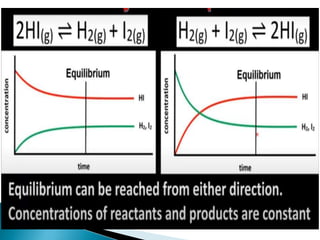
in place of H2 but with the same amounts and
exactly similar as before equilibrium is attained
containing D2 and ND3 in place of H2 and NH3 but
in the same amount.
 If the two reaction mixtures are mixed ,then after
sometime, it is found that the concentration of
ammonia and hydrogen are same except that now
all forms of ammonia and all forms of hydrogen
are present.
 This shows that an equilibrium , the reaction is
still going on i.e. equilibrium is dynamic in nature.
 When the equilibrium is reached, the
concentration of each of the reactants and
products become constant. In the reaction
between H2 and I2 to form HI , the colour
becomes constant because the concentration of
H2 , I2 and HI becomes constant.
 As much of the reactants react to form the
products ,the same amount of products react to
give back the reactants in the same time. Hence
the equilibrium is dynamic in nature and not
static.
Law of mass action:
It states that: Rate of a reaction is directly
proportional to concentration of reactants
raised to their respective moles.
Consider a reaction: aA + bB --> cC + dD
According to this law:
Where ‘K’ is rate constant or velocity constant.
We can attain equilibrium from both sides:
For forward reaction:
Therefore,
For backward reaction:
Therefore
At equilibrium: Rate of forward reaction = rate of
backward reaction
Kf[A]a[B]b = Kb[C]c[D]d
But, Kc=Kf/Kb (where Kc is equilibrium constant)
Kc = [A]a[B]b/[C]c[D]d
At particular instant of time: The equilibrium
constant is called as reaction quotient (Q).
 That is: Q=[C]c[D]d / [A]a[B]b
At equilibrium Q=Kc
For example:
In case of gases, we can also express it in terms of
their partial pressures :
 At equilibrium,
The rate of forward reaction = Rate of backward
reaction.
At equilibrium,
The rate of forward reaction = Rate of backward
reaction
 Law of chemical equilibrium:
At a given temperature, the product of
concentrations of the reaction products raised
to the respective stoichiometric coefficient in
the balanced chemical equation divided by the
product of concentration of the reactants raised
to their individual stoichiometric coefficients
has a constant value.
 The equlibrium constant for a general
reaction,
aA+bB cC+dD is expressed as,
 Kc=
[𝐶] 𝑐[𝐷] 𝑑
[𝐴] 𝑎[𝐵] 𝑏
 Where [A], [B], [C], [D] are the equilibrium
concentrations of the reactants and products.
 Equilibrium constant for the reaction .
4NH3(g)+5O24NO(g)+6H2O(g) is written as
 Molar concentrations of different species is
indicated by enclosing these in square
bracket and as mentioned above, it is implied
that these equilibrium concentrations.
 While writing expression for equilibrium
constant, symbol for phases(s,l,g) are
generally ignored.
Let us write the equilibrium constant for the
reaction,
=x
 The equilibrium constant for the reverse
reaction is the inverse of the equilibrium
constant for the reaction in the forward
direction.
K1
C=
1
𝐾 𝑐
Equilibrium constant for the reverse reaction is
the inverse of the equilibrium constant for the
reaction in the forward direction.
 As Kc and K1
C have different numerical values,
it is important to specify the form of the
balanced chemical equation when quoting the
value of an equilibrium constant.
 Characteristics of Equilibrium constant:
1.The value of the equilibrium constant for a
particular reaction is always constant depending
only upon the temperature of the reaction and is
independent of the concentration of the reactant
with which we start or the directions from which
the equilibrium is approached.
 If the reaction is reversed, the value of
equilibrium constant is reversed.
 If the equation having equilibrium constant K
is divided by 2 ,the equilibrium constant for
the new equation is the square root of K.
 If the equation having equilibrium constant is
multiplied by 2 ,the equilibrium constant for
the new equation is a square of equilibrium
constant.
 If the equation having equilibrium constant is
written in 2 steps then equilibrium then K=
K1 × K2
The value of equilibrium constant is not
affected by the addition of a catalyst.
This is because the catalyst increases the speed
of forward reaction and backward reaction to
same extent.
Types Of Chemical Equilibria
1) Homogeneous Equilibria
When in an equilibrium reaction, all the reactants
and the products are present in the same phase ,
it is called homogeneous equilibrium.
Type 1 : In which the number of moles of
products is equal to the number of moles of
reactants.
 H2 + I2  2HI
 N2 + O2  2NO
 CO + H2O  CO2 + H2
Type 2 : In which the number of moles of
products is not equal to the number of moles of
reactants
N2 + 3H2  2NH3
2SO2 + O2  2SO3
PCl5  PCl3 + Cl2
The reactions in the liquid phase are:
CH3COOH + C2H5OH  CH3COOC2H5 + H2O
 Equilibrium constant in gaseous systems:
Heterogeneous Equilibria:
When in an equilibrium reaction, all the
reactants and the products are present in two
or more than two phases , it is called
heterogeneous equilibrium.
CaCO3 ( s )  CaO ( s ) + CO2 ( g )
3Fe ( s ) + 4H2O ( g )  Fe3O4 (s ) + 4H2 ( g )
Expression and Units Of Equilibrium Constant:
For Homogeneous Equilibrium:
CH3COOH ( l ) + C2H5OH ( l )  CH3COOC2H5 ( l ) +
H2O ( l )
 NH3 ( g ) + 5O2 ( g ) 4NO ( g ) + 6H2O ( g )

For Heterogeneous Equilibrium:
Units of Equilibrium Constant:
Keq = ( mol L-1 ) c+d / ( mol L-1 ) a+b
Keq =( mol L-1 ) (c+d ) – (a + b )
Keq = (mol L-1 ) Δn
 Kp = (atm) (c+d) / (atm)a+b
 Kp = (bar) (c+d) / (bar)a+b
 Kp = ( atm or bar )(c+d) – (a+b)
 Kp = (atm)Δn or (bar)Δn
 If Δn =0 i.e. number of moles of products = number
of moles of reactants , Keq or Kp will have no units.
For Ex:
1) H2 ( g ) + I2 ( g ) 2HI ( g )
Δn =0 , Kc or Kp will have no units.
2) N2 ( g ) + 3H2 ( g ) 2NH3 ( g )
Δn = 2 – ( 1+ 3 ) = -2
The units will be ( mol L-1 )-2 or atm-2 or bar-2
 Important features of equilibrium constant:
1. Expression for equilibrium constant is
applicable only when concentration of the
reactants and products have attained constant
value at equilibrium state.
2. The value of equilibrium constant is
independent of initial concentrations of the
reactants and products.
3. Equilibrium constant is temperature
dependent having one unique value for a
particular reaction represented by a balanced
equation at given temperature.
4. The equilibrium constant for the reverse
reaction is equal to the inverse of the
equilibrium constant for the forward reaction.
Predicting the extent of reaction:
The magnitude of the equilibrium constant gives
an idea of the relative amount of the reactants
and the products.
a) larger value of the equilibrium constant ( >
103 ) shows that forward reaction is favoured i.e.
concentration of products is much larger than
that of the reactants at equilibrium.
For Ex:
1) H2 ( g ) + Br2 ( g ) 2HBr ( g) Kc = 5.4 ×
1018
2) H2 ( g ) + Cl2 (g ) 2HCl ( g ) Kc = 4 × 1031
3) H2 ( g ) + ½ O2 ( g ) H2O ( g ) Kc = 2.4 × 1047
This shows that at equilibrium , concentration of
the products is very high , i.e. reaction go almost
to completion.
b) Intermediate value of K ( 10-3 to 103 ) show that
the concentration of the reactants and products are
comparable.
For Ex:
1) Fe3+ (aq ) + SCN–( aq ) (Fe(SCN))2+ (aq)
Kc = 138 at 298 K
2) H2 ( g) + I2 ( g ) 2HI ( g )
Kc = 57 at 700 K
c) low value of K ( < 10 -3) shows that backward
reaction is favoured i.e. concentration of
reactants is much larger than that of products
i.e. the reaction proceeds to a very small extent
in the forward direction.
For Ex:
1) N2 ( g ) + O2 ( g ) 2NO ( g )
Kc =4.8 × 10 -31 at 298 K
2) H2O ( g ) H2 ( g ) + ½ O2 ( g )
Kc = 4.1 × 10 -48
Predicting the direction of a reaction:
At any stage of the reaction, other than the stage
of chemical equilibrium, concentration ratio, as
given by the expression for the law of chemical
equilibrium , is called concentration quotient or
reaction quotient.
It is usually represented by Qc or Q.
Thus,
1) If Q=Kc , the reaction is in equilibrium
2) If Q > Kc , Q will tend to decrease so as to
become equal to K. As a result, the reaction will
proceed in the backward direction.
3) If Q < Kc, Q will tend to increase so as to
become equal to K. As a result, the reaction will
proceed in the forward direction.
Consider the gaseous reaction of H2 with I2 ,
H2 (g) + I2 (g) ⇌ 2HI(g); Kc = 57.0 at 700 K
Suppose we have molar concentrations [H2 ]
t=0.10M, [I 2 ] t = 0.20 M and [HI]t = 0.40 M
Thus, the reaction quotient, Qc at this stage of
the reaction is given by,
Qc= [HI]t 2 / [H2 ] t [I2 ] t = (0.40)2/
(0.10)×(0.20) = =8.0
Now, in this case, Qc (8.0) does not equal Kc
(57.0), so the mixture of H2 (g), I2 (g) and HI(g)
is not at equilibrium.
If Qc < Kc , net reaction goes from left to right
• If Qc > Kc , net reaction goes from right to
left. • If Qc = Kc , no net reaction occurs.
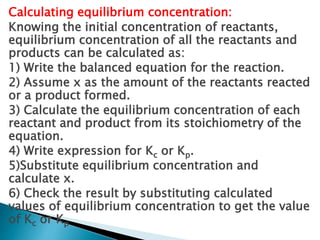
Calculating equilibrium concentration:
Knowing the initial concentration of reactants,
equilibrium concentration of all the reactants and
products can be calculated as:
1) Write the balanced equation for the reaction.
2) Assume x as the amount of the reactants reacted
or a product formed.
3) Calculate the equilibrium concentration of each
reactant and product from its stoichiometry of the
equation.
4) Write expression for Kc or Kp.
5)Substitute equilibrium concentration and
calculate x.
6) Check the result by substituting calculated
values of equilibrium concentration to get the value
of Kc or Kp
Relationship between equilibrium constant
reaction quotient Q and Gibbs energy G.
Factors affecting Equilibria:
Le-Chatelier’s principle:
It states that a change in any of the factors that
determine the equilibrium conditions of a
system will cause the system to change in such
a manner so as to reduce or to counteract the
effect of the change.
 Effect of concentration change:
When the concentration of any of the reactants or
products in a reaction at equilibrium is changed,
the composition of the equilibrium mixture
changes so as to minimize the effect of
concentration changes.
Let us take the reaction
H2(g)+I2(g)2HI(g)
If H2 is added to the reaction mixture at
equilibrium, then the equilibrium of the reaction is
disturbed. In order to restore it, the reaction
proceeds in a direction where in H2 is consumed,
more H2 and I2 react to form HI and equilibrium
shifts in forward direction.
Effect of concentration-An experiment:
 According to Le Chatelier's Principle, the system
will react to minimize the stress. Since Fe3+ is on
the reactant side of this reaction, the rate of the
forward reaction will increase in order to "use up"
the additional reactant. This will cause the
equilibrium to shift to the right, producing more
FeSCN2+. For this particular reaction we will be
able to see that this has happened, as the solution
will become a darker red color.
 There are a few different ways we can say what
happens here when we add more Fe3+; these all
mean the same thing:
 equilibrium shifts to the right
 equilibrium shifts to the product side
 the forward reaction is favored
 If we add more FeSCN2+
 Again, equilibrium will shift to use up the added
substance. In this case, equilibrium will shift to
favor the reverse reaction, since the reverse
reaction will use up the additional FeSCN2+.
 equilibrium shifts to the left
 equilibrium shifts to the reactant side
 the reverse reaction is favoured
 Effect of pressure change:
When pressure increases, equilibrium position
shifts in the direction that decreases the total
moles of gas
When pressure decreases, equilibrium position
shifts in the direction that increases the total
moles of gas.
Consider the reaction,
Here, 4 mol of gaseous reactant(CO+3H2)
become 2 mol of gaseous products (CH4
+H2O).
 Suppose equilibrium mixture kept in a cylinder
fitted with a piston at constant temperature is
compressed to one half of its original volume.
Then, total pressure will be doubled . The
reaction is no longer at equilibrium. The
direction in which the reaction goes to re-
establish equilibrium can be predicted by
applying the Le-Chatelier’s principle. Since
pressure has doubled, the equilibrium now
shifts in the forward direction , a direction in
which the number of moles of the gas or
pressure decreases .
 Effect of inert gas addition:
If the volume is kept constant and an inert gas
such as argon is added which does not take part
in the reaction, the equilibrium remains
undisturbed. It is because the addition of an inert
gas at constant volume does not change the
partial pressures or the molar concentrations of
the substances involved in the reaction. The
reaction quotient changes only if the added gas
is a reactant or product involved in the reaction.
 Effect of temperature change:
 Whenever an equilibrium is disturbed by a
change in the concentration, pressure or
volume, the composition of the equilibrium
mixture changes because the reaction quotient
Qc no longer equals to Kc.
 When a change in temperature occurs, the
value of equilibrium constant Kc is changed.
 The equilibrium constant for an exothermic
reaction (negative H) decreases as the
temperature increases.
 The equilibrium constant for an endothermic
reaction (positive H) increases as the
temperature increases.
 Ex: Production of Ammonia
Is an exothermic process. According to Le
chatelier’s principle, raising the temperature shifts
the equilibrium to left and decreases the
equilibrium concentration of ammonia.Low
temperature is favourable for high yield of
ammonia, but at very low temperature slow down
the reaction so we use the catalyst.
 Effect of Temperature-An experiment:
 The first tube is placed in a hot water bath.
 The second is placed in ice-water.
 The third is placed in a flask filled with dry-
ice/acetone slush.
 The fourth is placed in liquid nitrogen.
 NO2 is brown and N2O4 is colourless. The
intensity of the brown colour decreases as the
temperature decreases. Therefore, a decrease
in temperature yields and increase in N2O4.
Equilibrium is shifted to the N2O4 side upon a
decrease in temperature.
 2 NO2 (g) <=> N2O4 (g)
 Effect of a catalyst:
A catalyst increase the rate of the chemical
reaction by making available a new low energy
pathway for the conversion of reactants to
products.
It increase the rate of forward and reverse
reactions that pass through the same transition
state and does not affect equilibrium.
Catalyst lowers the activation energy for forward
and reverse reactions by exactly the same
amount.
Catalyst does not affect the equilibrium
composition of a reaction mixture.
 In the manufacture of sulphuric acid by
contact process.
 Platinum or V2O5 is used as a catalyst to
increase the rate of the reaction.
 2SO2(g)+O2(g)2SO3(g)
We classify substances in to two types:
 Electrolytes
 Non electrolytes
 Electrolytes: The substances which dissociate
into ions in solution on passing current.
 For example: ABA+ + B-
 Non electrolytes: The substances that do not
dissociate into ions, when current is passed
through them.
 That is AB à on passing current , nothing
happens.
Further we can classify electrolytes as:
 Strong electrolyte
 Weak electrolyte
 Strong electrolyte: The substances which
completely dissociate into ions, when current is
passed through them. It means if take an
example of AB then on passing current it
dissociate completely without leaving AB
anywhere in solution .
 Example: HCl,H2SO4 etc
 A strong electrolyte is defined as a substance
which dissociates almost completely into ions
in aqueous solution and hence is a very good
conductor of electricity.
 For Ex: NaOH , KOH, HCl, H2SO4 , NaCl
 HCl + H2O ———> H3O+ + Cl−
NaOH + aq ———> Na+ (aq ) + OH–
( aq)ionisation constant.
 A weak electrolyte is defined as a substance
which dissociates to small extent in aqueous
solution and hence conduct electricity also to
a small extent.
 For Ex: NH4OH , CH3COOH
 CH3COOH + H2O CH3COO‾ + H3O+
 NH4OH + aq NH4
+ ( aq ) + OH‾ (aq )
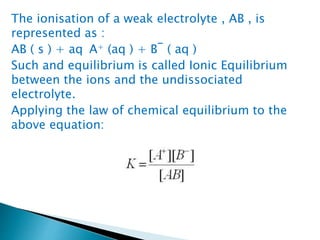
The ionisation of a weak electrolyte , AB , is
represented as :
AB ( s ) + aq A+ (aq ) + B‾ ( aq )
Such and equilibrium is called Ionic Equilibrium
between the ions and the undissociated
electrolyte.
Applying the law of chemical equilibrium to the
above equation:
 where K is the ionisation constant.
 When an ionic compound is dissolved in water
,the ions which are already present in the solid
compound separates out. The process is
called dissociation.
 When a neutral molecule which does not contain
ions but when dissolved in water splits to
produce ions in the solution, the process is
called ionization.
 An ionic compound is a cluster of positively and
negatively charged ions held together by
electrostatic force of attraction. When such an
ionic compound is put into water ,the high
dielectric constant of water reduces the
electrostatic forces of attraction. Thus, ions
become free to move in the solution.
Acids and bases and Salts:
Acid is a substance whose aqueous solution
possessed the following characteristic properties
1)conduct electricity
2) reacts with active metals like zinc ,magnesium to
give hydrogen
3) turns blue litmus to red
4) has a sour taste
5)whose acidic properties disappear on reaction
with a base
Base is a substance whose aqueous solution
possessed the following characteristic properties:
1)turns red litmus blue
2) has a bitter taste
3) has a soapy touch
Arrhenius concept of acids and bases:
 Arrhenius in 1884 put forward a theory
popularly known as Arrhenius theory of
ionization
 When an electrolyte is dissolved in water ,it
dissociates into positively and negatively
charged ions.
 An acid is defined as a substance which
contains hydrogen and which when dissolved
into water gives hydrogen ions (H+)
 Substances like HCl, HNO3 , H2SO4 containing
hydrogen, when dissolved in water dissociates
completely into H+ ions and negative ions.
HCl ———-> H+ + Cl‾
H2SO4 ————–> 2H+ + SO4
2-
HNO3 ———> H+ + NO3‾
Such acids are called strong acids.
Substance like acetic acid ,carbonic acid,
phosphoric acid when dissolved in water
dissociate into ions to a small extent.
CH3COOH CH3COO‾+ H+
H2CO3 2H+ + CO3
2‾
H3PO4 3H+ + PO4
3‾
Such acids are called weak acids.
A base is defined as a substance which contain
hydroxyl group, when dissolved in water gives
hydroxide ion (OH‾).
Substances like NaOH and KOH containing
hydroxyl group when dissolved into water,
dissociate completely to give OH‾ ions as:
NaOH ————> Na+ + OH‾
KOH —————> K+ + OH‾
These are called strong bases.
Substances like NH4OH , Ca(OH)2 , Mg(OH)2 ,
Al(OH)3 dissociates to a small extent as :
NH4OH NH4
+ + OH‾
Ca(OH)2 Ca2+ + 2OH¯
These are called weak bases.
H+ ion is simply a proton which is very small in
size. It has a strong electric field. It takes up a
lone pair of electrons from water molecule to
form called hydronium ion, H3O+.
The dissociation of an acid in water may be
expressed as :
HCl + water H+ (aq ) + Cl‾ (aq)
CH3COOH + water H+ (aq ) + CH3COO‾ (aq)
The dissociation of base may be expressed as
NaOH + water Na+ (aq ) + OH‾ (aq)
NH4OH NH4+(aq) + OH‾(aq)
When an acid and base are mixed together, they
react to form salt and water. The reaction is
called neutralization.
NaOH + HCl ———–> NaCl + H2O
Neutralization is defined as the process in
which hydrogen ions given by the acid and
hydroxyl Ion given by the base combine to form
unionized molecules of water.
Advantage of Arrhenius concept :
The Arrhenius concept of acids and bases was
able to explain a number of phenomena like
neutralization, salt hydrolysis ,strength of acids
and bases.
Limitation of Arrhenius concept
1) Nature of H+ and OH‾ ion
According to Arrhenius concept ,acids and
bases were defined as substances which gave
H+ ions and OH‾ ions in aqueous solution. But
these ions cannot exist as such in aqueous
solution but exist as hydrated ion.
2) Inability to explain acidic and basic character
of certain substances
Arrhenius concept says that an acid must contain
hydrogen and a base must contain hydroxyl
group. However a number of substances like
NH3 , Na2CO3, CaO are known to be basic but do
not contain any hydroxyl group. Similarly a
number of substances like CO2, SO2 ,SO3 etc are
known to be acidic but do not contain any
hydrogen.
NH3 (g) + H2O NH4
+ (aq) + OH‾ (aq)
CaO+ H2O Ca2+ (aq) + 2OH‾ (aq)
3)Inability to explain the reaction between an
acid and base in the absence of water.
NH3 (g) + HCl(g) ——> NH4Cl (s)
CaO(s) + SO3(g) ——–>CaSO4 (s)
Bronsted- lowry concept of acid and bases:
Bronsted and lowry in 1923 proposed concept
of acids and bases.
Acid is defined as a substance which has the
tendency to give a proton and base is defined
as a substance which has a tendency to accept a
proton.
An acid is a proton donor whereas base is
a Proton acceptor.
HCl +H2O H3O+ + Cl‾
CH3COOH + H2O H3O+ (aq ) + CH3COO‾
(aq)
 1.HCl and CH3COOH are acids because they
donate a proton to H2O.
 2) NH3 and CO3
2‾ are bases because they
accept a proton from water.
 3)Not only molecules but even the ions can act
as acids or bases.
 4)Water is accepting a proton and hence is
base.
Water acts both as an acid as well as base and
hence is called amphoteric.
5) Bronsted – lowry definition of acid and bases
are not restricted to aqueous solution. HCl is acid
because it gives a protons and NH3 is a base
because it accepts the proton.
6) The presence of hydroxyl group is not
essential for a substance to act as a base. The
only requirement is that it should have tendency
to accept a proton.
7) A substance acts as an acid i.e. gives a proton
only when another substance to accept the
proton i.e. a base is present.
8) The reverse reaction are also acid – base
reaction.
In reaction HCl +H2O H3O+ + Cl‾ ,the reverse
process H3O+ can give a proton and hence is an
acid while Cl‾ can accept the proton and hence
is a base.
There are two acid base pair in reaction.These
are HCl-Cl‾ and H3O+ -H2O .These acid base
pair are called conjugate acid – base pair.
Advantages of Bronsted-lowry concept
1) Bronsted-lowry concept is not limited to
molecules but includes even the ionic species to
act as acids or bases.
2) It can explain the basic character of the
substances like Na2CO3 , NH3 etc on the basis
that they are proton acceptor.
3) It can explain the acid base reaction in the non
aqueous medium or even in the absence of
solvent.
Disadvantage of Bronsted-lowry concept
1) It cannot explain the reaction between acidic
oxides like CO2 , SO2 , SO3 and the basic oxides
like CaO, BaO, MgO which takes place even in
the absence of solvent.
2) Substances like BF3 , AlCl3 etc do not have
any hydrogen and hence cannot give a proton
but are known to behave as Lewis acid.
Lewis concept of acids and bases:
G.N. Lewis in the same year i.e. 1923
,proposed:
An acid is defined as substance which is
capable of accepting a pair of electrons
and base is defined as a substance which is
capable of donating an unshared pair of
electrons.
An acid is an electron pair acceptor while a base
is an electron pair donor.
The reaction between an acid and base amount
to the formation of a co-ordinate Bond or
dative bond between them:
For Ex:
1) Reaction between BF3 and NH3
 Since NH3 can donate a lone pair of electron
while BF3 can accept a pair of electron , NH3 is
a base and BF3 is an acid.
Advantage of Lewis concept
1) It could explain even those acids and base
reactions which could not be explained by
others concepts.
Drawback of Lewis concept:
 1) Lewis concept is so general that it considers
every reaction forming a co-ordinate bond to
be acid base reaction. This however, may not
be always true.
 2) The requirement in Lewis concept is the
formation of a co-ordinate bond between the
acid and base. However acids like HCl and
H2SO4 do not form any co-ordinate Bond and
therefore should not be acids according to this
concept.
IONIZATION OF ACIDS AND BASES:
Hydrochloric acid (HCl), hydrobromic acid
(HBr), hyrdoiodic acid (HI), nitric acid (HNO3)
and sulphuric acid (H2SO4) are termed strong
because they are almost completely
dissociated into their constituent ions in an
aqueous medium, thereby acting as proton
(H+) donors.
Similarly, strong bases like lithium hydroxide
(LiOH), sodium hydroxide (NaOH), potassium
hydroxide (KOH), caesium
hydroxide (CsOH) and barium hydroxide Ba(OH)2
are almost completely dissociated into ions in an
aqueous medium giving hydroxyl ions, OH–.
According to Arrhenius concept
They are strong acids and bases as they are
able to completely dissociate and produce
H3O+
and OH– ions respectively in the medium.
Brönsted- Lowry concept of acids and bases,
wherein a strong acid means a good proton
donor and a strong base implies a good proton
acceptor. Consider, the acid-base dissociation
equilibrium of a weak acid HA.
 HA(aq) + H2O(l) H3O+(aq) + A–(aq)
conjugate
conjugate
acid base
Consider the two acids HA and H3O+ present
in the above mentioned acid-dissociation
equilibrium. We have to see which amongst
them is a stronger proton donor. Whichever
exceeds in its tendency of donating a proton
over the other shall be termed as the stronger
acid and the equilibrium will shift in the
direction of weaker acid.
Say, if HA is a stronger acid than H3O+, then
HA will donate protons and not H3O+, and the
solution will mainly contain A– and H3O+ ions.
The equilibrium moves in the direction of
formation of weaker acid and weaker base.
because the stronger acid donates a proton
to the stronger base. It follows that as a strong
acid dissociates completely in water, the resulting
base formed would be very weak i.e., strong acids
have very weak conjugate bases. Strong acids like
perchloric acid (HClO4), hydrochloric acid (HCl),
hydrobromic acid (HBr), hydroiodic acid (HI),
nitric acid (HNO3) and sulphuric acid (H2SO4) will
give conjugate base ions ClO4 –, Cl, Br–, I–, NO3 –
and HSO4 – , which are much weaker bases than
H2O.
Similarly a very strong base would give a very
weak conjugate acid.
On the other hand, a weak acid say HA is only
partially dissociated in aqueous medium and
thus, the solution mainly contains
undissociated HA molecules. Typical weak acids
are nitrous acid (HNO2), hydrofluoric acid (HF)
and acetic acid (CH3COOH). It should be noted
that the weak acids have very strong conjugate
bases.
For example, NH2 –, O 2– and H– are very good
proton acceptors and thus, much stronger
bases than H2O.
The Ionization Constant of Water and its Ionic
Product:
Some substances like water are unique in their
ability of acting both as an acid and a base.
In presence of an acid, HA it accepts a
proton and acts as the base while in the
presence of a base, B– it acts as an acid by
donating a proton. In pure water, one H2O
molecule donates proton and acts as an acid and
another water molecules accepts a proton and
acts as a base at the same time. The
following equilibrium exists:
H2O(l) + H2O(l) H3O+(aq) + OH–(aq)
acid base conjugate .A conjugate.B
The dissociation constant is represented by,
K = [H3O+] [OH–] / [H2O]
The concentration of water is omitted from
the denominator as water is a pure liquid and
its concentration remains constant. [H2O] is
incorporated within the equilibrium constant
to give a new constant, Kw, which is called the
ionic product of water.
Kw = [H+][OH–]
The concentration of H+ has been found
out experimentally as 1.0 × 10⁻⁷ M at 298 K.
And, as dissociation of water produces equal
number of H+ and OH– ions, the concentration
of hydroxyl ions, [OH–] = [H+] = 1.0 × 10⁻⁷ M.
Thus, the value of Kw at 298K,
Kw = [H3O+][OH–] = (1 × 10⁻⁷)2 = 1 × 10–14
M2
The value of Kw is temperature dependent as it is an
equilibrium constant.
The density of pure water is 1000 g / L and its molar
mass is 18.0 g /mol. From this the molarity of pure
water can be given as,
[H2O] = (1000 g /L)(1 mol/18.0 g) = 55.55 M.
Therefore, the ratio of dissociated water to that of
undissociated water can be given as:
10–7 / (55.55) = 1.8 × 10⁻⁹ or ~ 2 x 10⁻⁹ (thus,
equilibrium lies mainly towards undissociated water)
We can distinguish acidic, neutral and basic aqueous
solutions by the relative values of the H3O+ and OH–
concentrations:
Acidic: [H3O+] > [OH–]
Neutral: [H3O+] = [OH–]
Basic : [H3O+] < [OH–]
 The pH Scale:
The pH of a solution is defined as the negative
logarithm to base 10 of a (H+ ) of hydrogen ion.
Relationship between pH and pOH:
Ionization of weak acid:
When acetic acid is dissolved in water, it
dissociates partly into H+ and H3O+ and
CH3COO‾ ions as:
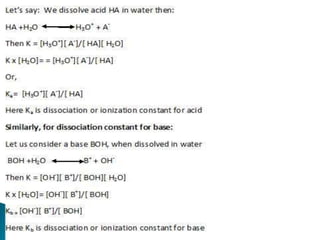
CH3COOH + H2O CH3COO‾ + H3O+
In dilute solution , concentration of water is
constant. The product of K and constant
 The product of K and is denoted by Ka,
the ionization constant or dissociation
constant of the acid.
 If C represents the initial concentration of the
acid in moles L-1 and α , the degree of
dissociation , then equilibrium concentration
of the ions ( H3O+ and CH3COO‾ ) is equal to
Cα and that of the undissociated acetic acid
= C ( 1- α ) i.e. we have
 In case of weak electrolyte, The value of α is
very small and can be neglected in
comparison to 1 i.e. 1-α =1.Hence we get
 α = √ Ka / C
 If V is the volume of the solution in litres
containing 1 mole of the electrolyte ,
C = 1/ V. Hence, we have,
 α = √ Ka × V
 For a weak electrolyte , the degree of
ionisation is inversely proportional to the
square root of molar concentration or
directly proportional to the square root of
volume containing one mole of solute. This is
called Ostwald’s dilution law.
 Relate Ka, Kw and Kb
Di-polybasic Acids and Di- and Polyacidic
bases:
 Factors affecting acid strength:
Common Ion Effect:
If to an ionic equilibrium, AB A+ + B‾ , a salt
containing a common ion is added, the equilibrium
shifts in the backward direction. This is
called common Ion effect.
Acetic acid being a weak acid, ionizes to a small
extent as:
CH3COOH  CH3COO‾ + H+
To this solution , suppose the salt of this weak acid
with a strong base is added. It ionizes almost
completely in the solution as follows and provides
the common acetate ions:
CH3COONa <————> CH3COO‾ + Na+
the concentration of CH3COO‾ ions increases and
by Le Chatelier’s principle, the dissociation
equilibrium shift backwards i.e. dissociation of
acetic acid is further suppressed.
2) To the solution of the weak base , NH4OH ,
NH4Cl is added which provides the common
NH4
+ ions ,dissociation of NH4OH is suppressed:
NH4OH NH4
+ +OH‾
NH4Cl ———->NH4
+ +Cl‾
3) To the solution of silver chloride in water, if NaCl is added
which provide the common Cl‾ ions, the solubility AgCl
decreases :
AgCl Ag+ + Cl‾
NaCl ——–> Na+ + Cl‾
Increase in the concentration of Cl‾ ions shifts the
equilibrium in the backward direction i.e. some solid AgCl
separates out.
If to the solution of a weak electrolyte, which ionises to a
small extent ,a strong electrolyte having a common ion is
added which ionizes almost completely, the ionization of the
weak electrolyte is further suppressed .
If to the solution of a sparingly soluble salt, if a soluble salt
having a common ion is added ,the solubility of the
sparingly soluble salt further decreases.
 Salt Hydrolysis
Salt hydrolysis is defined as the process in which a salt reacts
with water to give back the acid and the base.
Salt +water ———-> Acid + Base
BA + H2O ———> HA + BOH
All salts are strong electrolytes and thus ionize completely in
the aqueous solution.
(1) If the acid produced is strong and the base produced
is weak.
B+ + A‾ + H2O ——-> H+ + A‾ + BOH
or
B+ + H2O ——-> H+ + BOH
In this case the cation reacts with water to give an acidic
solution. This is called cationic hydrolysis.
(2) If the acid produced is weak and the base produced
is strong.
B+ + A‾ + H2O ——-> HA + B+ + OH‾
A‾ + H2O ——-> HA + OH‾
In this case the anion reacts with water to give
basic solution. This is called acidic hydrolysis.
Salt hydrolysis may be defined as the reaction
of the cation or the anion of the salt with water
to produce acidic or basic solution.
1) Salts of strong acid and strong base
NaCl, NaNO3, Na2SO4, KCl, KNO3 , K2SO4
NaCl + H2O ——-> NaOH + HCl
Na+ + Cl‾ + H2O ——-> Na+ + OH‾ + H+ + Cl‾
H2O ——->OH‾ + H+
It involves only ionization of water and no
hydrolysis. So the solution is neutral.
The salts of strong acids and strong bases do
not undergo hydrolysis and the resulting
solution is neutral.
Salts of weak acid and strong bases
CH3COONa, Na2CO3, K2CO3, Na3PO4
CH3COONa + H2O CH3COOH + NaOH
CH3COO‾ + Na+ + H2O CH3COOH +
Na+ + OH‾
 As it produces OH‾ ions, the solution of such
a salt is alkaline in nature.
 Salts of strong acid and weak base:
 NH4Cl , CuSO4, NH4NO3 , AlCl3, CaCl2
 NH4Cl + H2O NH4OH + HCl
 NH4
+ + Cl‾ + H2O NH4OH + H+ + Cl‾
 NH4
+ + H2O ——-> NH4OH + H+
 As it produces H+ ions, the solution of such a salt
is acidic in nature.
(4) Salts of weak acid and weak base:
CH3COONH4 + H2O CH3COOH + NH4OH
It involves both anionic and cationic hydrolysis.
The pKa of acetic acid and pKb of ammonium
hydroxide are 4.76 and 4.75 respectively. Calculate
the pH of ammonium acetate solution.
Solution
pH = 7 + ½ [pKa – pKb]
= 7 + ½ [4.76 – 4.75]
= 7 + ½ [0.01] = 7 + 0.005 = 7.005
BUFFER SOLUTIONS:
A buffer solution is defined as a solution which
resist any change in its pH value even when small
amount of acid or base are added to it.
Types of the buffer solution
1) Solution of single substance
The solution of the salt of weak acid and weak
base eg : ammonium acetate ( CH3COOH) act as a
buffer.
Solution of Mixture:
These are of 2 types:
Acidic buffer : It is the solution of mixture of
the weak acid and a salt of this weak acid with a
strong base.
For Ex: CH3COOH + CH3COONa or HCOOH +
HCOONa
Basic buffer : It is the solution of a mixture of
weak base and a salt of this weak base with a
strong acid.
For Ex: NH4OH + NH4Cl or NH4OH + NH4NO3
Buffer Action
The property of a buffer solution to resist any change in
its pH value even when small amount of the acid or the
base are added to it is called Buffer action.
Preparation of Acidic Buffer
To prepare a buffer of acidic pH we use weak
acid and its salt formed with strong base. We
develop the equation relating the pH, the
equilibrium constant, Ka of weak acid and ratio
of concentration of weak acid and its conjugate
base. For the general case where the weak acid
HA ionises in water,
 Preparation of Acidic Buffer To prepare a
buffer of acidic pH we use weak acid and its
salt formed with strong base. We develop the
equation relating the pH, the equilibrium
constant, Ka of weak acid and ratio of
concentration of weak acid and its conjugate
base. For the general case where the weak
acid HA ionises in water.
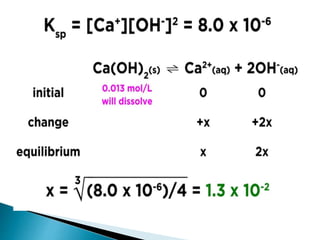
 AgCl (s) Ag+ (aq) + Cl‾ (aq)
 Ksp = [Ag+][Cl‾ ]
 where Ksp is the solubility product and is
equal to ionic product for a saturated
solution.
 BaSO4 (s ) Ba2+ + SO4
2‾
 AgSCN (aq) Ag+ (aq)+ SCN‾ (aq)
Equilibrium-class 12 chemistry

Equilibrium-class 12 chemistry

  • 1.
  • 2.
    Equilibrium 12 Periods Equilibriumin physical and chemical processes, dynamic nature of equilibrium, law of mass action, equilibrium constant, factors affecting equilibrium ‐ Le Chatelier's principle, ionic equilibrium‐ ionization of acids and bases, strong and weak electrolytes, degree of ionization, ionization of poly basic acids, acid strength, concept of pH, buffer solution, solubility product, common ion effect (with illustrative examples). Deleted :Hydrolysis of salts (elementary idea), Henderson Equation.
  • 3.
     Equilibrium isactually a state, when forces from both the side become equal. According to chemistry: It is a point in a chemical reaction, when rate of forward reaction becomes equal to rate of backward reaction. Or we can say, it is the state when concentration of reactants becomes equal to concentration of products.
  • 4.
    Equilibrium state: H2O(l)H2O(vap) Equilibrium inwhich the number of molecules leaving the liquid equals the number returning to liquid from the vapour. The system has reached equilibrium state at this stage. The mixture of reactants and products in the equilibrium state is called an equilibrium mixture. A dynamic equilibrium for a chemical reaction is the condition in which the rate of the forward reaction equals the rate of the reverse reaction.
  • 5.
     Chemical equilibriumin a chemical reaction may be classified in three groups. (i)The reactions that proceed nearly to completion and only negligible concentrations of the reactants are left. In some cases, it may not be even possible to detect these experimentally. (ii) The reactions in which only small amounts of products are formed and most of the reactants remain unchanged at equilibrium stage. (iii) The reactions in which the concentrations of the reactants and products are comparable, when the system is in equilibrium.
  • 6.
     Equilibrium involvingions in aqueous solutions which is called as ionic equilibrium. Equilibrium in Physical Processes: The most common equilibria involving physical processes are those which involve phase transformation:  Solid  Liquid  Liquid  Gas  Solid  Gas  Solid Solution  Gas solution
  • 7.
    Solid − liquidequilibrium: If some ice cubes along with some water at 0°C and normal atmospheric pressure are placed in a thermo flask so that no heat can enter or leave the system, the mass of ice and water is found to remain constant. At equilibrium Rate of melting of ice  Rate of freezing of water The temperature at which the solid and liquid form of a pure substance are in equilibrium at the atmospheric pressure is called the normal freezing point on melting point of that substance .
  • 8.
    Liquid − vapourequilibrium:  Consider a closed vessel connected to a manometer and having arrangement for evacuation and addition of liquid into it. Suppose the vessel is first evacuated. The level of mercury in both the limbs of the manometer will be same.  Now suppose water is added into the vessel and the whole apparatus is allowed to stay at room temperature. It is observed that the level of mercury in the left limb of the manometer begins to fall and that in the right limb begins to rise. After sometime, the levels become constant. The system is then said to have attained equilibrium.  The difference in the levels of mercury in the two limbs gives the equilibrium vapour pressure of the water at room temperature.
  • 10.
     In thebeginning, more and more of the water is changing into vapours i.e. number of water molecules in the vapour phase increases. Some of these molecules strike back on the surface of the water and are captured into it .The amount of water vapour becomes constant i.e. now as much water changes into vapours the same amount of water vapour change back into the liquid.  Rate of evaporation  Rate of condensation  The liquid with higher vapour pressure is more volatile and has lower boiling point.
  • 11.
    If we exposethree watch glasses containing separately 1ml each of acetone, ethyl alcohol and water to atmosphere and repeat the experiment with different volumes of the liquids in a warmer room, it is observed that in all cases the liquid disappears and time taken to complete evaporation depends on (i) Nature of the liquid (ii) The amount of the liquid (iii)The temperature.
  • 12.
     Solid Vapour Equilibrium  This type of equilibrium is attained for solids which undergo sublimation. If solid iodine is placed in a closed vessel , violet vapours start appearing in the vessel whose intensity increases with time and ultimately it becomes constant. At this stage ,equilibrium is attained i.e.  Rate of sublimation of solid I2 to form vapour  Rate of condensation of I2 vapour to give solid I2  I2 ( s ) I2 (vapour)
  • 13.
     Solid –Solution Equilibrium:  Suppose more and more of sugar is added into a fixed volume of water at room temperature and stirred thoroughly with a glass rod. The sugar will keep on dissolving but then a stage will come when no more sugar dissolves. Instead it settles down at the bottom. The solution is now said to be saturated and the state of equilibrium.  At this stage, as many molecules of sugar from the surface of the undissolved sugar go into the solution, the same number of molecules of sugar from the solution are deposited back on the surface of the undissolved sugar.
  • 14.
     As aresult ,the amount of an dissolved sugar and the concentration of sugar in solution remains constant.  Rate of dissolution Rate of precipitation  Rate of dissolution of sugar=Rate of Crystallisation of sugar  The amount of the solid in grams that dissolves in 100 gram of the solvent to form a saturated solution at a particular temperature is called the solubility of that solid in the given solvent at that temperature.
  • 15.
    Gas − solutionequilibrium: This type of equilibrium is found in soda water bottle. The equilibrium that exist within the bottle is: CO2 ( g )  CO2 ( solution) The amount of gas dissolved is governed by Henry’s law which states that : The mass of a gas dissolved in a given mass of a solvent at any temperature is directly proportional to the pressure of the gas above the solvent, i.e. m ∝ p or m=kp
  • 17.
     In asealed soda water bottle ,the pressure of the gas is very high above the liquid ,so the mass of the gas dissolved is also high. As soon as the bottle is opened ,the pressure tends to decrease to atmospheric pressure ,so the solubility decreases, i.e. the dissolved gas escapes out.
  • 18.
     For solid liquid equilibrium, there is only one temperature(melting point) at 1 atm at which two phases can coexist.  For liquid Vapour equilibrium, the vapour pressure is constant at a given temperature.  For dissolution of solids in liquids, the solubility is constant at a given temperature.  For dissolution of gases in liquids, the concentration of a gas in liquid is proportional to the pressure of the gas over the liquid.  Equilibrium will not reach in the open system.
  • 19.
    General characteristics ofphysical equilibrium  The measurable properties become constant.  It can be established only in closed vessel.  At equilibrium, the opposing forces become equal.  The equilibrium is dynamic in nature .That is the reaction keeps on going only the rate becomes constant.  At equilibrium, the concentration becomes constant.  The magnitude of equilibrium value, gives indication about the extent of reaction.
  • 20.
     A reactionin which not only the reactants react to form the products under certain conditions but also the products react to form reactants under the same conditions is called a reversible reaction.
  • 21.
    Irreversible reactions  Ifa reaction cannot takes place in the reverse direction i.e. the products formed do not react to give back the reactants under the same conditions, it is called irreversible reaction.  It is represented by putting a single arrow between the reactants and products, pointing from reactants towards products.  AgNO3 ( aq ) + NaCl ( aq ) ——> AgCl ( s ) + NaNO3 ( aq )  BaCl2 ( aq ) + Na2SO4 ( aq )—–> BaSO4 ( s ) + NaCl ( aq )  2Mg ( g ) + O2 ( g ) —-> 2MgO ( s )
  • 22.
     Concept ofChemical Equilibrium:
  • 23.
    1) In thebeginning the concentration of A and B are maximum and the concentration of C and D are minimum. 2) As the reaction proceeds, the concentration of A and B are decreasing with passage of time whereas the concentration of C and D are increasing. 3) The rate of forward reaction is decreasing while the rate of backward reaction goes on increasing. 4) A stage comes , when the rate of forward reaction becomes equal to rate of backward reaction. The reaction is then said to be in a state of chemical equilibrium.
  • 24.
     In theHaber’s process ,starting with definite amount of N2 and H2 and carrying out the reaction at a particular temperature, when equilibrium is attained ,the concentration of N2, H2 and NH3 become constant.  If the experiment is repeated by taking deuterium in place of H2 but with the same amounts and exactly similar as before equilibrium is attained containing D2 and ND3 in place of H2 and NH3 but in the same amount.  If the two reaction mixtures are mixed ,then after sometime, it is found that the concentration of ammonia and hydrogen are same except that now all forms of ammonia and all forms of hydrogen are present.  This shows that an equilibrium , the reaction is still going on i.e. equilibrium is dynamic in nature.
  • 26.
     When theequilibrium is reached, the concentration of each of the reactants and products become constant. In the reaction between H2 and I2 to form HI , the colour becomes constant because the concentration of H2 , I2 and HI becomes constant.  As much of the reactants react to form the products ,the same amount of products react to give back the reactants in the same time. Hence the equilibrium is dynamic in nature and not static.
  • 29.
    Law of massaction: It states that: Rate of a reaction is directly proportional to concentration of reactants raised to their respective moles. Consider a reaction: aA + bB --> cC + dD According to this law: Where ‘K’ is rate constant or velocity constant. We can attain equilibrium from both sides: For forward reaction: Therefore,
  • 30.
    For backward reaction: Therefore Atequilibrium: Rate of forward reaction = rate of backward reaction Kf[A]a[B]b = Kb[C]c[D]d But, Kc=Kf/Kb (where Kc is equilibrium constant) Kc = [A]a[B]b/[C]c[D]d At particular instant of time: The equilibrium constant is called as reaction quotient (Q).  That is: Q=[C]c[D]d / [A]a[B]b At equilibrium Q=Kc For example: In case of gases, we can also express it in terms of their partial pressures :
  • 31.
     At equilibrium, Therate of forward reaction = Rate of backward reaction.
  • 32.
    At equilibrium, The rateof forward reaction = Rate of backward reaction
  • 33.
     Law ofchemical equilibrium: At a given temperature, the product of concentrations of the reaction products raised to the respective stoichiometric coefficient in the balanced chemical equation divided by the product of concentration of the reactants raised to their individual stoichiometric coefficients has a constant value.
  • 36.
     The equlibriumconstant for a general reaction, aA+bB cC+dD is expressed as,  Kc= [𝐶] 𝑐[𝐷] 𝑑 [𝐴] 𝑎[𝐵] 𝑏  Where [A], [B], [C], [D] are the equilibrium concentrations of the reactants and products.  Equilibrium constant for the reaction . 4NH3(g)+5O24NO(g)+6H2O(g) is written as
  • 37.
     Molar concentrationsof different species is indicated by enclosing these in square bracket and as mentioned above, it is implied that these equilibrium concentrations.  While writing expression for equilibrium constant, symbol for phases(s,l,g) are generally ignored. Let us write the equilibrium constant for the reaction, =x
  • 38.
     The equilibriumconstant for the reverse reaction is the inverse of the equilibrium constant for the reaction in the forward direction. K1 C= 1 𝐾 𝑐 Equilibrium constant for the reverse reaction is the inverse of the equilibrium constant for the reaction in the forward direction.
  • 39.
     As Kcand K1 C have different numerical values, it is important to specify the form of the balanced chemical equation when quoting the value of an equilibrium constant.
  • 40.
     Characteristics ofEquilibrium constant: 1.The value of the equilibrium constant for a particular reaction is always constant depending only upon the temperature of the reaction and is independent of the concentration of the reactant with which we start or the directions from which the equilibrium is approached.
  • 41.
     If thereaction is reversed, the value of equilibrium constant is reversed.
  • 42.
     If theequation having equilibrium constant K is divided by 2 ,the equilibrium constant for the new equation is the square root of K.
  • 43.
     If theequation having equilibrium constant is multiplied by 2 ,the equilibrium constant for the new equation is a square of equilibrium constant.
  • 44.
     If theequation having equilibrium constant is written in 2 steps then equilibrium then K= K1 × K2
  • 45.
    The value ofequilibrium constant is not affected by the addition of a catalyst. This is because the catalyst increases the speed of forward reaction and backward reaction to same extent.
  • 46.
    Types Of ChemicalEquilibria 1) Homogeneous Equilibria When in an equilibrium reaction, all the reactants and the products are present in the same phase , it is called homogeneous equilibrium. Type 1 : In which the number of moles of products is equal to the number of moles of reactants.  H2 + I2  2HI  N2 + O2  2NO  CO + H2O  CO2 + H2
  • 47.
    Type 2 :In which the number of moles of products is not equal to the number of moles of reactants N2 + 3H2  2NH3 2SO2 + O2  2SO3 PCl5  PCl3 + Cl2 The reactions in the liquid phase are: CH3COOH + C2H5OH  CH3COOC2H5 + H2O
  • 48.
     Equilibrium constantin gaseous systems:
  • 49.
    Heterogeneous Equilibria: When inan equilibrium reaction, all the reactants and the products are present in two or more than two phases , it is called heterogeneous equilibrium. CaCO3 ( s )  CaO ( s ) + CO2 ( g ) 3Fe ( s ) + 4H2O ( g )  Fe3O4 (s ) + 4H2 ( g )
  • 51.
    Expression and UnitsOf Equilibrium Constant: For Homogeneous Equilibrium: CH3COOH ( l ) + C2H5OH ( l )  CH3COOC2H5 ( l ) + H2O ( l )  NH3 ( g ) + 5O2 ( g ) 4NO ( g ) + 6H2O ( g ) 
  • 53.
    For Heterogeneous Equilibrium: Unitsof Equilibrium Constant: Keq = ( mol L-1 ) c+d / ( mol L-1 ) a+b Keq =( mol L-1 ) (c+d ) – (a + b ) Keq = (mol L-1 ) Δn
  • 54.
     Kp =(atm) (c+d) / (atm)a+b  Kp = (bar) (c+d) / (bar)a+b  Kp = ( atm or bar )(c+d) – (a+b)  Kp = (atm)Δn or (bar)Δn  If Δn =0 i.e. number of moles of products = number of moles of reactants , Keq or Kp will have no units.
  • 55.
    For Ex: 1) H2( g ) + I2 ( g ) 2HI ( g ) Δn =0 , Kc or Kp will have no units. 2) N2 ( g ) + 3H2 ( g ) 2NH3 ( g ) Δn = 2 – ( 1+ 3 ) = -2 The units will be ( mol L-1 )-2 or atm-2 or bar-2
  • 56.
     Important featuresof equilibrium constant: 1. Expression for equilibrium constant is applicable only when concentration of the reactants and products have attained constant value at equilibrium state. 2. The value of equilibrium constant is independent of initial concentrations of the reactants and products. 3. Equilibrium constant is temperature dependent having one unique value for a particular reaction represented by a balanced equation at given temperature. 4. The equilibrium constant for the reverse reaction is equal to the inverse of the equilibrium constant for the forward reaction.
  • 57.
    Predicting the extentof reaction: The magnitude of the equilibrium constant gives an idea of the relative amount of the reactants and the products. a) larger value of the equilibrium constant ( > 103 ) shows that forward reaction is favoured i.e. concentration of products is much larger than that of the reactants at equilibrium. For Ex: 1) H2 ( g ) + Br2 ( g ) 2HBr ( g) Kc = 5.4 × 10¹⁸ 2) H2 ( g ) + Cl2 (g ) 2HCl ( g ) Kc = 4 × 1031
  • 58.
    3) H2 (g ) + ½ O2 ( g ) H2O ( g ) Kc = 2.4 × 1047 This shows that at equilibrium , concentration of the products is very high , i.e. reaction go almost to completion. b) Intermediate value of K ( 10-3 to 103 ) show that the concentration of the reactants and products are comparable. For Ex: 1) Fe3+ (aq ) + SCN–( aq ) (Fe(SCN))2+ (aq) Kc = 138 at 298 K 2) H2 ( g) + I2 ( g ) 2HI ( g ) Kc = 57 at 700 K
  • 59.
    c) low valueof K ( < 10 -3) shows that backward reaction is favoured i.e. concentration of reactants is much larger than that of products i.e. the reaction proceeds to a very small extent in the forward direction. For Ex: 1) N2 ( g ) + O2 ( g ) 2NO ( g ) Kc =4.8 × 10 -31 at 298 K 2) H2O ( g ) H2 ( g ) + ½ O2 ( g ) Kc = 4.1 × 10 -48
  • 60.
    Predicting the directionof a reaction: At any stage of the reaction, other than the stage of chemical equilibrium, concentration ratio, as given by the expression for the law of chemical equilibrium , is called concentration quotient or reaction quotient. It is usually represented by Qc or Q. Thus,
  • 61.
    1) If Q=Kc, the reaction is in equilibrium 2) If Q > Kc , Q will tend to decrease so as to become equal to K. As a result, the reaction will proceed in the backward direction. 3) If Q < Kc, Q will tend to increase so as to become equal to K. As a result, the reaction will proceed in the forward direction. Consider the gaseous reaction of H2 with I2 , H2 (g) + I2 (g) ⇌ 2HI(g); Kc = 57.0 at 700 K Suppose we have molar concentrations [H2 ] t=0.10M, [I 2 ] t = 0.20 M and [HI]t = 0.40 M
  • 62.
    Thus, the reactionquotient, Qc at this stage of the reaction is given by, Qc= [HI]t 2 / [H2 ] t [I2 ] t = (0.40)2/ (0.10)×(0.20) = =8.0 Now, in this case, Qc (8.0) does not equal Kc (57.0), so the mixture of H2 (g), I2 (g) and HI(g) is not at equilibrium. If Qc < Kc , net reaction goes from left to right • If Qc > Kc , net reaction goes from right to left. • If Qc = Kc , no net reaction occurs.
  • 63.
    Calculating equilibrium concentration: Knowingthe initial concentration of reactants, equilibrium concentration of all the reactants and products can be calculated as: 1) Write the balanced equation for the reaction. 2) Assume x as the amount of the reactants reacted or a product formed. 3) Calculate the equilibrium concentration of each reactant and product from its stoichiometry of the equation. 4) Write expression for Kc or Kp. 5)Substitute equilibrium concentration and calculate x. 6) Check the result by substituting calculated values of equilibrium concentration to get the value of Kc or Kp
  • 64.
    Relationship between equilibriumconstant reaction quotient Q and Gibbs energy G.
  • 66.
    Factors affecting Equilibria: Le-Chatelier’sprinciple: It states that a change in any of the factors that determine the equilibrium conditions of a system will cause the system to change in such a manner so as to reduce or to counteract the effect of the change.
  • 67.
     Effect ofconcentration change: When the concentration of any of the reactants or products in a reaction at equilibrium is changed, the composition of the equilibrium mixture changes so as to minimize the effect of concentration changes. Let us take the reaction H2(g)+I2(g)2HI(g) If H2 is added to the reaction mixture at equilibrium, then the equilibrium of the reaction is disturbed. In order to restore it, the reaction proceeds in a direction where in H2 is consumed, more H2 and I2 react to form HI and equilibrium shifts in forward direction.
  • 68.
    Effect of concentration-Anexperiment:  According to Le Chatelier's Principle, the system will react to minimize the stress. Since Fe3+ is on the reactant side of this reaction, the rate of the forward reaction will increase in order to "use up" the additional reactant. This will cause the equilibrium to shift to the right, producing more FeSCN2+. For this particular reaction we will be able to see that this has happened, as the solution will become a darker red color.  There are a few different ways we can say what happens here when we add more Fe3+; these all mean the same thing:  equilibrium shifts to the right  equilibrium shifts to the product side  the forward reaction is favored
  • 69.
     If weadd more FeSCN2+  Again, equilibrium will shift to use up the added substance. In this case, equilibrium will shift to favor the reverse reaction, since the reverse reaction will use up the additional FeSCN2+.  equilibrium shifts to the left  equilibrium shifts to the reactant side  the reverse reaction is favoured
  • 70.
     Effect ofpressure change: When pressure increases, equilibrium position shifts in the direction that decreases the total moles of gas When pressure decreases, equilibrium position shifts in the direction that increases the total moles of gas. Consider the reaction, Here, 4 mol of gaseous reactant(CO+3H2) become 2 mol of gaseous products (CH4 +H2O).
  • 71.
     Suppose equilibriummixture kept in a cylinder fitted with a piston at constant temperature is compressed to one half of its original volume. Then, total pressure will be doubled . The reaction is no longer at equilibrium. The direction in which the reaction goes to re- establish equilibrium can be predicted by applying the Le-Chatelier’s principle. Since pressure has doubled, the equilibrium now shifts in the forward direction , a direction in which the number of moles of the gas or pressure decreases .
  • 73.
     Effect ofinert gas addition: If the volume is kept constant and an inert gas such as argon is added which does not take part in the reaction, the equilibrium remains undisturbed. It is because the addition of an inert gas at constant volume does not change the partial pressures or the molar concentrations of the substances involved in the reaction. The reaction quotient changes only if the added gas is a reactant or product involved in the reaction.
  • 74.
     Effect oftemperature change:  Whenever an equilibrium is disturbed by a change in the concentration, pressure or volume, the composition of the equilibrium mixture changes because the reaction quotient Qc no longer equals to Kc.  When a change in temperature occurs, the value of equilibrium constant Kc is changed.  The equilibrium constant for an exothermic reaction (negative H) decreases as the temperature increases.
  • 75.
     The equilibriumconstant for an endothermic reaction (positive H) increases as the temperature increases.  Ex: Production of Ammonia Is an exothermic process. According to Le chatelier’s principle, raising the temperature shifts the equilibrium to left and decreases the equilibrium concentration of ammonia.Low temperature is favourable for high yield of ammonia, but at very low temperature slow down the reaction so we use the catalyst.
  • 76.
     Effect ofTemperature-An experiment:
  • 77.
     The firsttube is placed in a hot water bath.  The second is placed in ice-water.  The third is placed in a flask filled with dry- ice/acetone slush.  The fourth is placed in liquid nitrogen.  NO2 is brown and N2O4 is colourless. The intensity of the brown colour decreases as the temperature decreases. Therefore, a decrease in temperature yields and increase in N2O4. Equilibrium is shifted to the N2O4 side upon a decrease in temperature.  2 NO2 (g) <=> N2O4 (g)
  • 78.
     Effect ofa catalyst: A catalyst increase the rate of the chemical reaction by making available a new low energy pathway for the conversion of reactants to products. It increase the rate of forward and reverse reactions that pass through the same transition state and does not affect equilibrium. Catalyst lowers the activation energy for forward and reverse reactions by exactly the same amount. Catalyst does not affect the equilibrium composition of a reaction mixture.
  • 79.
     In themanufacture of sulphuric acid by contact process.  Platinum or V2O5 is used as a catalyst to increase the rate of the reaction.  2SO2(g)+O2(g)2SO3(g)
  • 80.
    We classify substancesin to two types:  Electrolytes  Non electrolytes  Electrolytes: The substances which dissociate into ions in solution on passing current.  For example: ABA+ + B-  Non electrolytes: The substances that do not dissociate into ions, when current is passed through them.  That is AB à on passing current , nothing happens.
  • 81.
    Further we canclassify electrolytes as:  Strong electrolyte  Weak electrolyte  Strong electrolyte: The substances which completely dissociate into ions, when current is passed through them. It means if take an example of AB then on passing current it dissociate completely without leaving AB anywhere in solution .  Example: HCl,H2SO4 etc
  • 82.
     A strongelectrolyte is defined as a substance which dissociates almost completely into ions in aqueous solution and hence is a very good conductor of electricity.  For Ex: NaOH , KOH, HCl, H2SO4 , NaCl  HCl + H2O ———> H3O+ + Cl− NaOH + aq ———> Na+ (aq ) + OH– ( aq)ionisation constant.
  • 83.
     A weakelectrolyte is defined as a substance which dissociates to small extent in aqueous solution and hence conduct electricity also to a small extent.  For Ex: NH4OH , CH3COOH  CH3COOH + H2O CH3COO‾ + H3O+  NH4OH + aq NH4 + ( aq ) + OH‾ (aq )
  • 84.
    The ionisation ofa weak electrolyte , AB , is represented as : AB ( s ) + aq A+ (aq ) + B‾ ( aq ) Such and equilibrium is called Ionic Equilibrium between the ions and the undissociated electrolyte. Applying the law of chemical equilibrium to the above equation:
  • 85.
     where Kis the ionisation constant.  When an ionic compound is dissolved in water ,the ions which are already present in the solid compound separates out. The process is called dissociation.  When a neutral molecule which does not contain ions but when dissolved in water splits to produce ions in the solution, the process is called ionization.  An ionic compound is a cluster of positively and negatively charged ions held together by electrostatic force of attraction. When such an ionic compound is put into water ,the high dielectric constant of water reduces the electrostatic forces of attraction. Thus, ions become free to move in the solution.
  • 86.
    Acids and basesand Salts: Acid is a substance whose aqueous solution possessed the following characteristic properties 1)conduct electricity 2) reacts with active metals like zinc ,magnesium to give hydrogen 3) turns blue litmus to red 4) has a sour taste 5)whose acidic properties disappear on reaction with a base Base is a substance whose aqueous solution possessed the following characteristic properties: 1)turns red litmus blue 2) has a bitter taste 3) has a soapy touch
  • 87.
    Arrhenius concept ofacids and bases:  Arrhenius in 1884 put forward a theory popularly known as Arrhenius theory of ionization  When an electrolyte is dissolved in water ,it dissociates into positively and negatively charged ions.  An acid is defined as a substance which contains hydrogen and which when dissolved into water gives hydrogen ions (H+)  Substances like HCl, HNO3 , H2SO4 containing hydrogen, when dissolved in water dissociates completely into H+ ions and negative ions.
  • 88.
    HCl ———-> H++ Cl‾ H2SO4 ————–> 2H+ + SO4 2- HNO3 ———> H+ + NO3‾ Such acids are called strong acids. Substance like acetic acid ,carbonic acid, phosphoric acid when dissolved in water dissociate into ions to a small extent. CH3COOH CH3COO‾+ H+ H2CO3 2H+ + CO3 2‾ H3PO4 3H+ + PO4 3‾ Such acids are called weak acids.
  • 89.
    A base isdefined as a substance which contain hydroxyl group, when dissolved in water gives hydroxide ion (OH‾). Substances like NaOH and KOH containing hydroxyl group when dissolved into water, dissociate completely to give OH‾ ions as: NaOH ————> Na+ + OH‾ KOH —————> K+ + OH‾ These are called strong bases. Substances like NH4OH , Ca(OH)2 , Mg(OH)2 , Al(OH)3 dissociates to a small extent as :
  • 90.
    NH4OH NH4 + +OH‾ Ca(OH)2 Ca2+ + 2OH¯ These are called weak bases. H+ ion is simply a proton which is very small in size. It has a strong electric field. It takes up a lone pair of electrons from water molecule to form called hydronium ion, H3O+. The dissociation of an acid in water may be expressed as : HCl + water H+ (aq ) + Cl‾ (aq) CH3COOH + water H+ (aq ) + CH3COO‾ (aq)
  • 91.
    The dissociation ofbase may be expressed as NaOH + water Na+ (aq ) + OH‾ (aq) NH4OH NH4+(aq) + OH‾(aq) When an acid and base are mixed together, they react to form salt and water. The reaction is called neutralization. NaOH + HCl ———–> NaCl + H2O Neutralization is defined as the process in which hydrogen ions given by the acid and hydroxyl Ion given by the base combine to form unionized molecules of water.
  • 92.
    Advantage of Arrheniusconcept : The Arrhenius concept of acids and bases was able to explain a number of phenomena like neutralization, salt hydrolysis ,strength of acids and bases. Limitation of Arrhenius concept 1) Nature of H+ and OH‾ ion According to Arrhenius concept ,acids and bases were defined as substances which gave H+ ions and OH‾ ions in aqueous solution. But these ions cannot exist as such in aqueous solution but exist as hydrated ion.
  • 93.
    2) Inability toexplain acidic and basic character of certain substances Arrhenius concept says that an acid must contain hydrogen and a base must contain hydroxyl group. However a number of substances like NH3 , Na2CO3, CaO are known to be basic but do not contain any hydroxyl group. Similarly a number of substances like CO2, SO2 ,SO3 etc are known to be acidic but do not contain any hydrogen. NH3 (g) + H2O NH4 + (aq) + OH‾ (aq) CaO+ H2O Ca2+ (aq) + 2OH‾ (aq)
  • 94.
    3)Inability to explainthe reaction between an acid and base in the absence of water. NH3 (g) + HCl(g) ——> NH4Cl (s) CaO(s) + SO3(g) ——–>CaSO4 (s)
  • 95.
    Bronsted- lowry conceptof acid and bases: Bronsted and lowry in 1923 proposed concept of acids and bases. Acid is defined as a substance which has the tendency to give a proton and base is defined as a substance which has a tendency to accept a proton. An acid is a proton donor whereas base is a Proton acceptor. HCl +H2O H3O+ + Cl‾ CH3COOH + H2O H3O+ (aq ) + CH3COO‾ (aq)
  • 96.
     1.HCl andCH3COOH are acids because they donate a proton to H2O.  2) NH3 and CO3 2‾ are bases because they accept a proton from water.  3)Not only molecules but even the ions can act as acids or bases.  4)Water is accepting a proton and hence is base. Water acts both as an acid as well as base and hence is called amphoteric.
  • 97.
    5) Bronsted –lowry definition of acid and bases are not restricted to aqueous solution. HCl is acid because it gives a protons and NH3 is a base because it accepts the proton. 6) The presence of hydroxyl group is not essential for a substance to act as a base. The only requirement is that it should have tendency to accept a proton. 7) A substance acts as an acid i.e. gives a proton only when another substance to accept the proton i.e. a base is present.
  • 98.
    8) The reversereaction are also acid – base reaction. In reaction HCl +H2O H3O+ + Cl‾ ,the reverse process H3O+ can give a proton and hence is an acid while Cl‾ can accept the proton and hence is a base. There are two acid base pair in reaction.These are HCl-Cl‾ and H3O+ -H2O .These acid base pair are called conjugate acid – base pair.
  • 101.
    Advantages of Bronsted-lowryconcept 1) Bronsted-lowry concept is not limited to molecules but includes even the ionic species to act as acids or bases. 2) It can explain the basic character of the substances like Na2CO3 , NH3 etc on the basis that they are proton acceptor. 3) It can explain the acid base reaction in the non aqueous medium or even in the absence of solvent.
  • 102.
    Disadvantage of Bronsted-lowryconcept 1) It cannot explain the reaction between acidic oxides like CO2 , SO2 , SO3 and the basic oxides like CaO, BaO, MgO which takes place even in the absence of solvent. 2) Substances like BF3 , AlCl3 etc do not have any hydrogen and hence cannot give a proton but are known to behave as Lewis acid.
  • 103.
    Lewis concept ofacids and bases: G.N. Lewis in the same year i.e. 1923 ,proposed: An acid is defined as substance which is capable of accepting a pair of electrons and base is defined as a substance which is capable of donating an unshared pair of electrons. An acid is an electron pair acceptor while a base is an electron pair donor. The reaction between an acid and base amount to the formation of a co-ordinate Bond or dative bond between them:
  • 104.
    For Ex: 1) Reactionbetween BF3 and NH3  Since NH3 can donate a lone pair of electron while BF3 can accept a pair of electron , NH3 is a base and BF3 is an acid.
  • 106.
    Advantage of Lewisconcept 1) It could explain even those acids and base reactions which could not be explained by others concepts. Drawback of Lewis concept:  1) Lewis concept is so general that it considers every reaction forming a co-ordinate bond to be acid base reaction. This however, may not be always true.  2) The requirement in Lewis concept is the formation of a co-ordinate bond between the acid and base. However acids like HCl and H2SO4 do not form any co-ordinate Bond and therefore should not be acids according to this concept.
  • 107.
    IONIZATION OF ACIDSAND BASES: Hydrochloric acid (HCl), hydrobromic acid (HBr), hyrdoiodic acid (HI), nitric acid (HNO3) and sulphuric acid (H2SO4) are termed strong because they are almost completely dissociated into their constituent ions in an aqueous medium, thereby acting as proton (H+) donors. Similarly, strong bases like lithium hydroxide (LiOH), sodium hydroxide (NaOH), potassium hydroxide (KOH), caesium hydroxide (CsOH) and barium hydroxide Ba(OH)2 are almost completely dissociated into ions in an aqueous medium giving hydroxyl ions, OH–.
  • 108.
    According to Arrheniusconcept They are strong acids and bases as they are able to completely dissociate and produce H3O+ and OH– ions respectively in the medium. Brönsted- Lowry concept of acids and bases, wherein a strong acid means a good proton donor and a strong base implies a good proton acceptor. Consider, the acid-base dissociation equilibrium of a weak acid HA.  HA(aq) + H2O(l) H3O+(aq) + A–(aq) conjugate conjugate acid base
  • 109.
    Consider the twoacids HA and H3O+ present in the above mentioned acid-dissociation equilibrium. We have to see which amongst them is a stronger proton donor. Whichever exceeds in its tendency of donating a proton over the other shall be termed as the stronger acid and the equilibrium will shift in the direction of weaker acid. Say, if HA is a stronger acid than H3O+, then HA will donate protons and not H3O+, and the solution will mainly contain A– and H3O+ ions. The equilibrium moves in the direction of formation of weaker acid and weaker base.
  • 110.
    because the strongeracid donates a proton to the stronger base. It follows that as a strong acid dissociates completely in water, the resulting base formed would be very weak i.e., strong acids have very weak conjugate bases. Strong acids like perchloric acid (HClO4), hydrochloric acid (HCl), hydrobromic acid (HBr), hydroiodic acid (HI), nitric acid (HNO3) and sulphuric acid (H2SO4) will give conjugate base ions ClO4 –, Cl, Br–, I–, NO3 – and HSO4 – , which are much weaker bases than H2O. Similarly a very strong base would give a very weak conjugate acid.
  • 111.
    On the otherhand, a weak acid say HA is only partially dissociated in aqueous medium and thus, the solution mainly contains undissociated HA molecules. Typical weak acids are nitrous acid (HNO2), hydrofluoric acid (HF) and acetic acid (CH3COOH). It should be noted that the weak acids have very strong conjugate bases. For example, NH2 –, O 2– and H– are very good proton acceptors and thus, much stronger bases than H2O.
  • 113.
    The Ionization Constantof Water and its Ionic Product: Some substances like water are unique in their ability of acting both as an acid and a base. In presence of an acid, HA it accepts a proton and acts as the base while in the presence of a base, B– it acts as an acid by donating a proton. In pure water, one H2O molecule donates proton and acts as an acid and another water molecules accepts a proton and acts as a base at the same time. The following equilibrium exists:
  • 114.
    H2O(l) + H2O(l)H3O+(aq) + OH–(aq) acid base conjugate .A conjugate.B The dissociation constant is represented by, K = [H3O+] [OH–] / [H2O] The concentration of water is omitted from the denominator as water is a pure liquid and its concentration remains constant. [H2O] is incorporated within the equilibrium constant to give a new constant, Kw, which is called the ionic product of water. Kw = [H+][OH–]
  • 115.
    The concentration ofH+ has been found out experimentally as 1.0 × 10⁻⁷ M at 298 K. And, as dissociation of water produces equal number of H+ and OH– ions, the concentration of hydroxyl ions, [OH–] = [H+] = 1.0 × 10⁻⁷ M. Thus, the value of Kw at 298K, Kw = [H3O+][OH–] = (1 × 10⁻⁷)2 = 1 × 10–14 M2
  • 116.
    The value ofKw is temperature dependent as it is an equilibrium constant. The density of pure water is 1000 g / L and its molar mass is 18.0 g /mol. From this the molarity of pure water can be given as, [H2O] = (1000 g /L)(1 mol/18.0 g) = 55.55 M. Therefore, the ratio of dissociated water to that of undissociated water can be given as: 10–7 / (55.55) = 1.8 × 10⁻⁹ or ~ 2 x 10⁻⁹ (thus, equilibrium lies mainly towards undissociated water) We can distinguish acidic, neutral and basic aqueous solutions by the relative values of the H3O+ and OH– concentrations: Acidic: [H3O+] > [OH–] Neutral: [H3O+] = [OH–] Basic : [H3O+] < [OH–]
  • 117.
     The pHScale: The pH of a solution is defined as the negative logarithm to base 10 of a (H+ ) of hydrogen ion. Relationship between pH and pOH:
  • 118.
    Ionization of weakacid: When acetic acid is dissolved in water, it dissociates partly into H+ and H3O+ and CH3COO‾ ions as: CH3COOH + H2O CH3COO‾ + H3O+ In dilute solution , concentration of water is constant. The product of K and constant
  • 119.
     The productof K and is denoted by Ka, the ionization constant or dissociation constant of the acid.  If C represents the initial concentration of the acid in moles L-1 and α , the degree of dissociation , then equilibrium concentration of the ions ( H3O+ and CH3COO‾ ) is equal to Cα and that of the undissociated acetic acid = C ( 1- α ) i.e. we have
  • 121.
     In caseof weak electrolyte, The value of α is very small and can be neglected in comparison to 1 i.e. 1-α =1.Hence we get  α = √ Ka / C  If V is the volume of the solution in litres containing 1 mole of the electrolyte , C = 1/ V. Hence, we have,  α = √ Ka × V
  • 122.
     For aweak electrolyte , the degree of ionisation is inversely proportional to the square root of molar concentration or directly proportional to the square root of volume containing one mole of solute. This is called Ostwald’s dilution law.
  • 124.
     Relate Ka,Kw and Kb
  • 125.
    Di-polybasic Acids andDi- and Polyacidic bases:
  • 127.
     Factors affectingacid strength:
  • 130.
    Common Ion Effect: Ifto an ionic equilibrium, AB A+ + B‾ , a salt containing a common ion is added, the equilibrium shifts in the backward direction. This is called common Ion effect. Acetic acid being a weak acid, ionizes to a small extent as: CH3COOH  CH3COO‾ + H+
  • 131.
    To this solution, suppose the salt of this weak acid with a strong base is added. It ionizes almost completely in the solution as follows and provides the common acetate ions: CH3COONa <————> CH3COO‾ + Na+ the concentration of CH3COO‾ ions increases and by Le Chatelier’s principle, the dissociation equilibrium shift backwards i.e. dissociation of acetic acid is further suppressed. 2) To the solution of the weak base , NH4OH , NH4Cl is added which provides the common NH4 + ions ,dissociation of NH4OH is suppressed:
  • 132.
    NH4OH NH4 + +OH‾ NH4Cl———->NH4 + +Cl‾ 3) To the solution of silver chloride in water, if NaCl is added which provide the common Cl‾ ions, the solubility AgCl decreases : AgCl Ag+ + Cl‾ NaCl ——–> Na+ + Cl‾ Increase in the concentration of Cl‾ ions shifts the equilibrium in the backward direction i.e. some solid AgCl separates out. If to the solution of a weak electrolyte, which ionises to a small extent ,a strong electrolyte having a common ion is added which ionizes almost completely, the ionization of the weak electrolyte is further suppressed . If to the solution of a sparingly soluble salt, if a soluble salt having a common ion is added ,the solubility of the sparingly soluble salt further decreases.
  • 133.
     Salt Hydrolysis Salthydrolysis is defined as the process in which a salt reacts with water to give back the acid and the base. Salt +water ———-> Acid + Base BA + H2O ———> HA + BOH All salts are strong electrolytes and thus ionize completely in the aqueous solution. (1) If the acid produced is strong and the base produced is weak. B+ + A‾ + H2O ——-> H+ + A‾ + BOH or B+ + H2O ——-> H+ + BOH In this case the cation reacts with water to give an acidic solution. This is called cationic hydrolysis. (2) If the acid produced is weak and the base produced is strong. B+ + A‾ + H2O ——-> HA + B+ + OH‾
  • 134.
    A‾ + H2O——-> HA + OH‾ In this case the anion reacts with water to give basic solution. This is called acidic hydrolysis. Salt hydrolysis may be defined as the reaction of the cation or the anion of the salt with water to produce acidic or basic solution.
  • 135.
    1) Salts ofstrong acid and strong base NaCl, NaNO3, Na2SO4, KCl, KNO3 , K2SO4 NaCl + H2O ——-> NaOH + HCl Na+ + Cl‾ + H2O ——-> Na+ + OH‾ + H+ + Cl‾ H2O ——->OH‾ + H+ It involves only ionization of water and no hydrolysis. So the solution is neutral. The salts of strong acids and strong bases do not undergo hydrolysis and the resulting solution is neutral.
  • 136.
    Salts of weakacid and strong bases CH3COONa, Na2CO3, K2CO3, Na3PO4 CH3COONa + H2O CH3COOH + NaOH CH3COO‾ + Na+ + H2O CH3COOH + Na+ + OH‾  As it produces OH‾ ions, the solution of such a salt is alkaline in nature.  Salts of strong acid and weak base:  NH4Cl , CuSO4, NH4NO3 , AlCl3, CaCl2  NH4Cl + H2O NH4OH + HCl  NH4 + + Cl‾ + H2O NH4OH + H+ + Cl‾  NH4 + + H2O ——-> NH4OH + H+
  • 137.
     As itproduces H+ ions, the solution of such a salt is acidic in nature. (4) Salts of weak acid and weak base: CH3COONH4 + H2O CH3COOH + NH4OH It involves both anionic and cationic hydrolysis. The pKa of acetic acid and pKb of ammonium hydroxide are 4.76 and 4.75 respectively. Calculate the pH of ammonium acetate solution. Solution pH = 7 + ½ [pKa – pKb] = 7 + ½ [4.76 – 4.75] = 7 + ½ [0.01] = 7 + 0.005 = 7.005
  • 138.
    BUFFER SOLUTIONS: A buffersolution is defined as a solution which resist any change in its pH value even when small amount of acid or base are added to it. Types of the buffer solution 1) Solution of single substance The solution of the salt of weak acid and weak base eg : ammonium acetate ( CH3COOH) act as a buffer.
  • 139.
    Solution of Mixture: Theseare of 2 types: Acidic buffer : It is the solution of mixture of the weak acid and a salt of this weak acid with a strong base. For Ex: CH3COOH + CH3COONa or HCOOH + HCOONa Basic buffer : It is the solution of a mixture of weak base and a salt of this weak base with a strong acid. For Ex: NH4OH + NH4Cl or NH4OH + NH4NO3
  • 140.
    Buffer Action The propertyof a buffer solution to resist any change in its pH value even when small amount of the acid or the base are added to it is called Buffer action. Preparation of Acidic Buffer To prepare a buffer of acidic pH we use weak acid and its salt formed with strong base. We develop the equation relating the pH, the equilibrium constant, Ka of weak acid and ratio of concentration of weak acid and its conjugate base. For the general case where the weak acid HA ionises in water,
  • 141.
     Preparation ofAcidic Buffer To prepare a buffer of acidic pH we use weak acid and its salt formed with strong base. We develop the equation relating the pH, the equilibrium constant, Ka of weak acid and ratio of concentration of weak acid and its conjugate base. For the general case where the weak acid HA ionises in water.
  • 146.
     AgCl (s)Ag+ (aq) + Cl‾ (aq)  Ksp = [Ag+][Cl‾ ]  where Ksp is the solubility product and is equal to ionic product for a saturated solution.  BaSO4 (s ) Ba2+ + SO4 2‾  AgSCN (aq) Ag+ (aq)+ SCN‾ (aq)