Vapor Pressure and BoilingVapor Pressure and Boiling
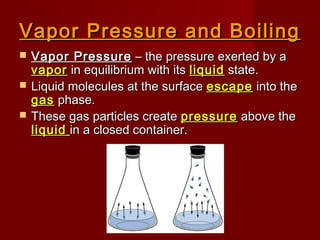
 Vapor PressureVapor Pressure – the pressure exerted by a– the pressure exerted by a
vaporvapor in equilibrium with itsin equilibrium with its liquidliquid state.state.
 Liquid molecules at the surfaceLiquid molecules at the surface escapeescape into theinto the
gasgas phase.phase.
 These gas particles createThese gas particles create pressurepressure above theabove the
liquidliquid in a closed container.in a closed container.
 Vapor PressureVapor Pressure increasesincreases withwith
increasing temperature.increasing temperature.
20o
C 80o
C
•As temperature increases, the amount of vapor
generated by a liquid in a closed container increases.
•This occurs because as the liquid gains kinetic
energy, the molecules can overcome the
intermolecular forces of attraction that are prevalent
in the liquid phase.
Evaporation vs BoilingEvaporation vs Boiling
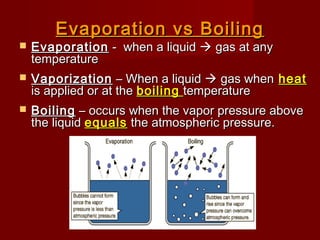
 EvaporationEvaporation - when a liquid- when a liquid  gas at anygas at any
temperaturetemperature
 VaporizationVaporization – When a liquid– When a liquid  gas whengas when heatheat
is applied or at theis applied or at the boilingboiling temperaturetemperature
 BoilingBoiling – occurs when the vapor pressure above– occurs when the vapor pressure above
the liquidthe liquid equalsequals the atmospheric pressure.the atmospheric pressure.
Normal Boiling PointNormal Boiling Point --
--boiling temperature when pressure is atboiling temperature when pressure is at
1atm1atm oror 760torr.760torr.
 Boiling Point is a physical constant. ItBoiling Point is a physical constant. It
depends on thedepends on the strengthstrength of the attractionof the attraction
between molecules.between molecules.
 Strong attraction between molecules =Strong attraction between molecules =
higherhigher boiling point.boiling point.
 Weaker attraction between molecules =Weaker attraction between molecules =
lowerlower boiling point.boiling point.
Vapor Pressure CurvesVapor Pressure Curves
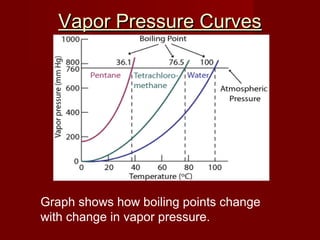
Graph shows how boiling points change
with change in vapor pressure.
 Boiling Points Change withBoiling Points Change with
pressure changes.pressure changes.
 Less pressureLess pressure == lower boiling pointlower boiling point
(example = water boils at(example = water boils at lowerlower
temperatures attemperatures at highhigh elevations- waterelevations- water
boils atboils at 7676oo
CC on Mt. Everest).on Mt. Everest).
 Higher PressureHigher Pressure == higherhigher boiling pointboiling point
(example = pressure cooker – cooks(example = pressure cooker – cooks
fasterfaster because you cook at abecause you cook at a higherhigher
temperature.)temperature.)
 Boiling Points Change withBoiling Points Change with
pressure changes.pressure changes.
 Less pressureLess pressure == lower boiling pointlower boiling point
(example = water boils at(example = water boils at lowerlower
temperatures attemperatures at highhigh elevations- waterelevations- water
boils atboils at 7676oo
CC on Mt. Everest).on Mt. Everest).
 Higher PressureHigher Pressure == higherhigher boiling pointboiling point
(example = pressure cooker – cooks(example = pressure cooker – cooks
fasterfaster because you cook at abecause you cook at a higherhigher
temperature.)temperature.)

Vapor pressure and boiling

  • 1.
    Vapor Pressure andBoilingVapor Pressure and Boiling  Vapor PressureVapor Pressure – the pressure exerted by a– the pressure exerted by a vaporvapor in equilibrium with itsin equilibrium with its liquidliquid state.state.  Liquid molecules at the surfaceLiquid molecules at the surface escapeescape into theinto the gasgas phase.phase.  These gas particles createThese gas particles create pressurepressure above theabove the liquidliquid in a closed container.in a closed container.
  • 2.
     Vapor PressureVaporPressure increasesincreases withwith increasing temperature.increasing temperature. 20o C 80o C •As temperature increases, the amount of vapor generated by a liquid in a closed container increases. •This occurs because as the liquid gains kinetic energy, the molecules can overcome the intermolecular forces of attraction that are prevalent in the liquid phase.
  • 3.
    Evaporation vs BoilingEvaporationvs Boiling  EvaporationEvaporation - when a liquid- when a liquid  gas at anygas at any temperaturetemperature  VaporizationVaporization – When a liquid– When a liquid  gas whengas when heatheat is applied or at theis applied or at the boilingboiling temperaturetemperature  BoilingBoiling – occurs when the vapor pressure above– occurs when the vapor pressure above the liquidthe liquid equalsequals the atmospheric pressure.the atmospheric pressure.
  • 4.
    Normal Boiling PointNormalBoiling Point -- --boiling temperature when pressure is atboiling temperature when pressure is at 1atm1atm oror 760torr.760torr.  Boiling Point is a physical constant. ItBoiling Point is a physical constant. It depends on thedepends on the strengthstrength of the attractionof the attraction between molecules.between molecules.  Strong attraction between molecules =Strong attraction between molecules = higherhigher boiling point.boiling point.  Weaker attraction between molecules =Weaker attraction between molecules = lowerlower boiling point.boiling point.
  • 5.
    Vapor Pressure CurvesVaporPressure Curves Graph shows how boiling points change with change in vapor pressure.
  • 6.
     Boiling PointsChange withBoiling Points Change with pressure changes.pressure changes.  Less pressureLess pressure == lower boiling pointlower boiling point (example = water boils at(example = water boils at lowerlower temperatures attemperatures at highhigh elevations- waterelevations- water boils atboils at 7676oo CC on Mt. Everest).on Mt. Everest).  Higher PressureHigher Pressure == higherhigher boiling pointboiling point (example = pressure cooker – cooks(example = pressure cooker – cooks fasterfaster because you cook at abecause you cook at a higherhigher temperature.)temperature.)
  • 7.
     Boiling PointsChange withBoiling Points Change with pressure changes.pressure changes.  Less pressureLess pressure == lower boiling pointlower boiling point (example = water boils at(example = water boils at lowerlower temperatures attemperatures at highhigh elevations- waterelevations- water boils atboils at 7676oo CC on Mt. Everest).on Mt. Everest).  Higher PressureHigher Pressure == higherhigher boiling pointboiling point (example = pressure cooker – cooks(example = pressure cooker – cooks fasterfaster because you cook at abecause you cook at a higherhigher temperature.)temperature.)