•TOPIC- GENERAL PRINCIPLESAND PROCEDURE INVOLVED IN SOLID PHASE EXTRACTION AND LIQUID- LIQUID
EXTRACTION
ADVANCED INSTRUMENTAL TECHNIQUES
Submitted to – Dr. Supriya Sahu mam
Presented by-
• Kapil Jyoti Nath (28)
• Joy Raj Sen (24)
• Mriganka Medhi (38)
• Mrinmoy Baishya (39)
• Piyanuj Phukan (43)
2.
Table of contents
1.Introduction to solid phase extraction
2. General principle involved in solid
phase extraction
3. Procedure involved in solid phase
extraction
4. introduction to Liquid-Liquid extraction
5. General principle involved in Liquid-
Liquid extraction
6. Procedure involved in Liquid-Liquid
extraction
3.
Introduction to solidphase extraction
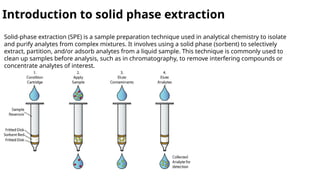
Solid-phase extraction (SPE) is a sample preparation technique used in analytical chemistry to isolate
and purify analytes from complex mixtures. It involves using a solid phase (sorbent) to selectively
extract, partition, and/or adsorb analytes from a liquid sample. This technique is commonly used to
clean up samples before analysis, such as in chromatography, to remove interfering compounds or
concentrate analytes of interest.
4.
General principle involvedin solid phase extraction
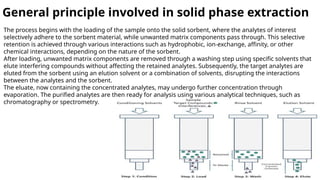
The process begins with the loading of the sample onto the solid sorbent, where the analytes of interest
selectively adhere to the sorbent material, while unwanted matrix components pass through. This selective
retention is achieved through various interactions such as hydrophobic, ion-exchange, affinity, or other
chemical interactions, depending on the nature of the sorbent.
After loading, unwanted matrix components are removed through a washing step using specific solvents that
elute interfering compounds without affecting the retained analytes. Subsequently, the target analytes are
eluted from the sorbent using an elution solvent or a combination of solvents, disrupting the interactions
between the analytes and the sorbent.
The eluate, now containing the concentrated analytes, may undergo further concentration through
evaporation. The purified analytes are then ready for analysis using various analytical techniques, such as
chromatography or spectrometry.
5.
Procedure involved insolid phase extraction
1. Sample pre-treatment
Purpose: To optimize the sample for effective analyte retention. Consider the following when pre-treating a
sample prior to application to the SPE product:
•Adjust sample/matrix composition for proper dilution/ionic strength
•Ensure that sample is at proper pH for optimum retention
•Confirm that analytes are free in solution
•Remove any unwanted particulates via filtration or centrifugation
2. Column conditioning
Purpose: Column conditioning prepares the sorbent for effective interaction(s) with the compounds of interest.
•An appropriate solvent conditions the column and activates the ligands on the chromatographic surface
•The solvent should have similar characteristics (solvent strength, pH, etc.) to the sample to ensure maximum
retention of analyte.
•Prevent the sorbent from drying during the conditioning step (dry sorbent can affect the ability of the analytes
to interact); allow about 1mm of last conditioning solvent to remain above the top tube frit
3. Column re-equilibration after column conditioning
Purpose: To re-equilibriate the column
•Use the same solvent that is used for the sample pre-treatment step (do not let the sorbent dry during the
conditioning step)
•Allow about 1mm of last conditioning solvent to remain above the top tube frit
6.
4. Sample application
Purpose:To apply the sample at an appropriate flow rate to maximize retention of the analyte to the
stationary phase.
•A typical flow rate is 1mL/minute.
•A high flow rate can lead to inconsistent extractions.
5. Solvent wash to remove interferences
Purpose: To wash the stationary phase using an intermediary solvent to remove impurities bound less
strongly to the sorbent than the compounds of interest.
•Select a wash solvent that is strong enough to remove the interferences, but weak enough to leave the
compounds of interest behind
•Selectively rinse away the less strongly bonded interferences
•Wash solvent selected according to phase mechanism and analyte properties (a typical wash solution
may contain less organic or inorganic salt than the final eluent)
6. Elute compounds of interest
Purpose: To elute and collect the analyte. This step is designed to selectively recover the analyte(s) by
disrupting the analyte-sorbent interaction.
•Selectively elute the analytes of interest using different solvents
•A smaller elution volume leads to a more concentrated extract
•Select an elution solvent that leaves the strongly retained impurities behind
•Select elution solvent according to phase mechanism and analyte properties
•For best results, elute compounds of interest using two small aliquots (rather than one large aliquot)
7.
Introduction to liquid-liquidextraction
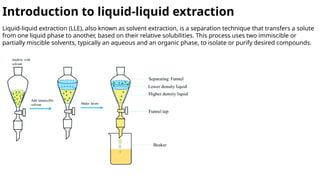
Liquid-liquid extraction (LLE), also known as solvent extraction, is a separation technique that transfers a solute
from one liquid phase to another, based on their relative solubilities. This process uses two immiscible or
partially miscible solvents, typically an aqueous and an organic phase, to isolate or purify desired compounds.
8.
General principle involvedin liquid-liquid extraction
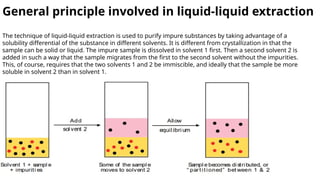
The technique of liquid-liquid extraction is used to purify impure substances by taking advantage of a
solubility differential of the substance in different solvents. It is different from crystallization in that the
sample can be solid or liquid. The impure sample is dissolved in solvent 1 first. Then a second solvent 2 is
added in such a way that the sample migrates from the first to the second solvent without the impurities.
This, of course, requires that the two solvents 1 and 2 be immiscible, and ideally that the sample be more
soluble in solvent 2 than in solvent 1.
9.
Procedure involved inliquid-liquid extraction
Liquid-liquid extraction is a widely used separation technique where compounds are distributed between two
immiscible liquid phases, typically an organic solvent and an aqueous solution. Here's the step-by-step
procedure involved:
1.Preparation of Solutions:
1. Prepare the feed solution (the liquid containing the compound to be extracted) and the solvent phase.
2. Select a suitable organic solvent that is immiscible with the aqueous phase and has good solubility for
the target compound.
2.Mixing the Phases:
1. Combine the two liquid phases in a container, such as a separatory funnel or an extraction apparatus.
2. Ensure thorough mixing by gentle agitation or stirring. This helps the compound to transfer from one
phase to the other.
3.Phase Separation:
1. Allow the mixture to settle. Immiscible liquids will separate into distinct layers due to their density
differences.
2. The compound of interest will partition between the two phases based on its relative solubility in each.
10.
4. Extraction:
•Depending onthe extraction process, remove the layer containing the compound of interest (either the organic or
aqueous phase).
5. Repetition (if necessary):
•Repeat the extraction process multiple times with fresh solvent to improve recovery of the target compound.
6. Recovery of Extracted Compound:
•Use techniques like distillation or evaporation to remove the solvent and isolate the compound.
•Analyze the extracted material for purity and composition.
7. Cleaning and Safety:
•Clean the apparatus after use to avoid cross-contamination.
•Dispose of solvents responsibly, following safety regulations.
11.
Summary
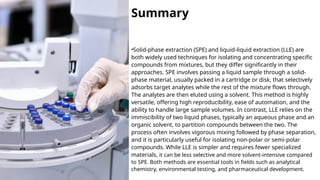
•Solid-phase extraction (SPE)and liquid-liquid extraction (LLE) are
both widely used techniques for isolating and concentrating specific
compounds from mixtures, but they differ significantly in their
approaches. SPE involves passing a liquid sample through a solid-
phase material, usually packed in a cartridge or disk, that selectively
adsorbs target analytes while the rest of the mixture flows through.
The analytes are then eluted using a solvent. This method is highly
versatile, offering high reproducibility, ease of automation, and the
ability to handle large sample volumes. In contrast, LLE relies on the
immiscibility of two liquid phases, typically an aqueous phase and an
organic solvent, to partition compounds between the two. The
process often involves vigorous mixing followed by phase separation,
and it is particularly useful for isolating non-polar or semi-polar
compounds. While LLE is simpler and requires fewer specialized
materials, it can be less selective and more solvent-intensive compared
to SPE. Both methods are essential tools in fields such as analytical
chemistry, environmental testing, and pharmaceutical development.




![Investigational use of drugs [ PHARMACY PRACTICE b. pharm 7th sem unit 5 ].pdf](https://cdn.slidesharecdn.com/ss_thumbnails/investigationaluseofdrugs-251003192923-291b6306-thumbnail.jpg?width=640&height=640&fit=bounds)


