Year: 2016-17
Subject: Process Calculation (2130504)
Topic: EXTRACTION
Name of the Students:
Patil Mayur 160283105009
Rohit Chetan 160283105010
Sindhav Jaydrath 160283105011
Vasava Yogesh 160283105012
Gujarat Technological University
L.D. College of Engineering
• Normally, the term extraction is used for liquid-liquid separation.
• When a mixture of liquid is not easily separable by distillation,
Extraction is employed.
• In this process, a solvent is added to the liquid-liquid mixture. As
a result, two immiscible layers are formed, both of which contain
varying amounts of different compounds.
• These isolated layers are removed as extract phase and Raffinate
phase using the density difference.
• But, distillation has to follow extraction for the solvent recovery
of the solvent for re-use.
Extraction
• For example, Furfural is common solvent in the extraction
operations in the petroleum industries.
• Another liquid phase according to the solubility. Extraction
becomes a very useful when a suitable extraction solvent is
chosen.
• Extraction can be used to separate a substance selectively from a
mixture Liquid-liquid extraction is based on the transfer of a
solute substance from one liquid phase into, or to remove
unwanted impurities from a solution.
Continue…
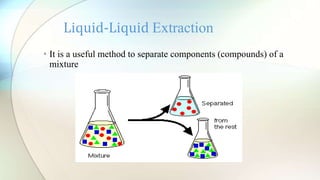
• It is a useful method to separate components (compounds) of a
mixture
Liquid-Liquid Extraction
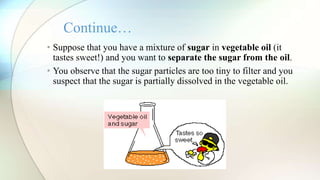
• Suppose that you have a mixture of sugar in vegetable oil (it
tastes sweet!) and you want to separate the sugar from the oil.
• You observe that the sugar particles are too tiny to filter and you
suspect that the sugar is partially dissolved in the vegetable oil.
Continue…
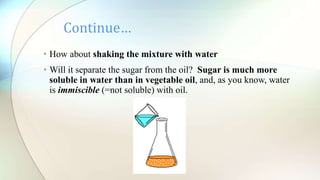
• How about shaking the mixture with water
• Will it separate the sugar from the oil? Sugar is much more
soluble in water than in vegetable oil, and, as you know, water
is immiscible (=not soluble) with oil.
Continue…
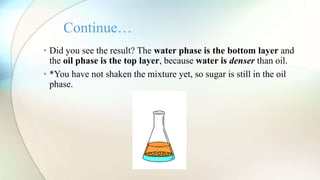
• Did you see the result? The water phase is the bottom layer and
the oil phase is the top layer, because water is denser than oil.
• *You have not shaken the mixture yet, so sugar is still in the oil
phase.
Continue…
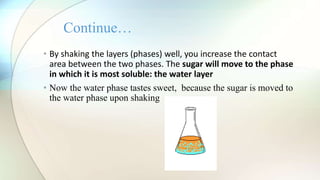
• By shaking the layers (phases) well, you increase the contact
area between the two phases. The sugar will move to the phase
in which it is most soluble: the water layer
• Now the water phase tastes sweet, because the sugar is moved to
the water phase upon shaking
Continue…
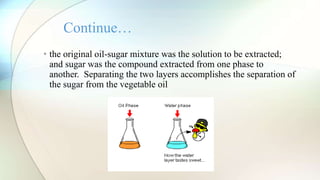
• the original oil-sugar mixture was the solution to be extracted;
and sugar was the compound extracted from one phase to
another. Separating the two layers accomplishes the separation of
the sugar from the vegetable oil
Continue…
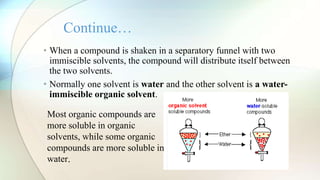
• When a compound is shaken in a separatory funnel with two
immiscible solvents, the compound will distribute itself between
the two solvents.
• Normally one solvent is water and the other solvent is a water-
immiscible organic solvent.
Continue…
Most organic compounds are
more soluble in organic
solvents, while some organic
compounds are more soluble in
water.
• The efficiency of a liquid liquid extraction can be enhanced by
adding one or more extractants to the solvent phase.
• The extractant interacts with component I increasing the
capacity of the solvent for i.
• To recover the solute from the extract phase the extractant-
solute complex has to be degraded.
Extractants
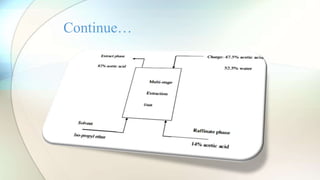
• A mixture containing 47.5 % acetic acid and 52.5 % water (by
mass) is being separated by the extraction in a counter multistage
unit. The operating temperature is 297 K and the solvent used is
iso-propyle ether. On the solvent free basis is to be found to be
82% by mass of the acetic acid. The Raffinate is to be found to
contain 14% by the mass of acetic acid on a solvent free basis.
Calculate the percentage of acetic acid of the original feed which
remains unextracted.
Example
Continue…
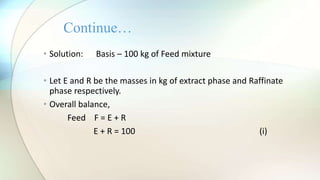
• Solution: Basis – 100 kg of Feed mixture
• Let E and R be the masses in kg of extract phase and Raffinate
phase respectively.
• Overall balance,
Feed F = E + R
E + R = 100 (i)
Continue…
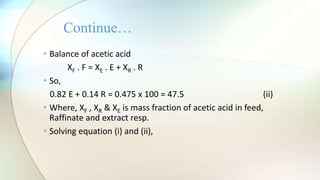
• Balance of acetic acid
XF . F = XE . E + XR . R
• So,
0.82 E + 0.14 R = 0.475 x 100 = 47.5 (ii)
• Where, XF , XR & XE is mass fraction of acetic acid in feed,
Raffinate and extract resp.
• Solving equation (i) and (ii),
Continue…
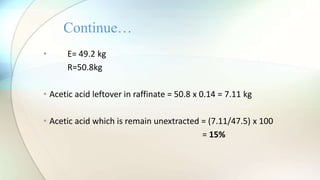
• E= 49.2 kg
R=50.8kg
• Acetic acid leftover in raffinate = 50.8 x 0.14 = 7.11 kg
• Acetic acid which is remain unextracted = (7.11/47.5) x 100
= 15%
Continue…
Thanks…

extraction for process calculation

  • 1.
    Year: 2016-17 Subject: ProcessCalculation (2130504) Topic: EXTRACTION Name of the Students: Patil Mayur 160283105009 Rohit Chetan 160283105010 Sindhav Jaydrath 160283105011 Vasava Yogesh 160283105012 Gujarat Technological University L.D. College of Engineering
  • 2.
    • Normally, theterm extraction is used for liquid-liquid separation. • When a mixture of liquid is not easily separable by distillation, Extraction is employed. • In this process, a solvent is added to the liquid-liquid mixture. As a result, two immiscible layers are formed, both of which contain varying amounts of different compounds. • These isolated layers are removed as extract phase and Raffinate phase using the density difference. • But, distillation has to follow extraction for the solvent recovery of the solvent for re-use. Extraction
  • 3.
    • For example,Furfural is common solvent in the extraction operations in the petroleum industries. • Another liquid phase according to the solubility. Extraction becomes a very useful when a suitable extraction solvent is chosen. • Extraction can be used to separate a substance selectively from a mixture Liquid-liquid extraction is based on the transfer of a solute substance from one liquid phase into, or to remove unwanted impurities from a solution. Continue…
  • 4.
    • It isa useful method to separate components (compounds) of a mixture Liquid-Liquid Extraction
  • 5.
    • Suppose thatyou have a mixture of sugar in vegetable oil (it tastes sweet!) and you want to separate the sugar from the oil. • You observe that the sugar particles are too tiny to filter and you suspect that the sugar is partially dissolved in the vegetable oil. Continue…
  • 6.
    • How aboutshaking the mixture with water • Will it separate the sugar from the oil? Sugar is much more soluble in water than in vegetable oil, and, as you know, water is immiscible (=not soluble) with oil. Continue…
  • 7.
    • Did yousee the result? The water phase is the bottom layer and the oil phase is the top layer, because water is denser than oil. • *You have not shaken the mixture yet, so sugar is still in the oil phase. Continue…
  • 8.
    • By shakingthe layers (phases) well, you increase the contact area between the two phases. The sugar will move to the phase in which it is most soluble: the water layer • Now the water phase tastes sweet, because the sugar is moved to the water phase upon shaking Continue…
  • 9.
    • the originaloil-sugar mixture was the solution to be extracted; and sugar was the compound extracted from one phase to another. Separating the two layers accomplishes the separation of the sugar from the vegetable oil Continue…
  • 10.
    • When acompound is shaken in a separatory funnel with two immiscible solvents, the compound will distribute itself between the two solvents. • Normally one solvent is water and the other solvent is a water- immiscible organic solvent. Continue… Most organic compounds are more soluble in organic solvents, while some organic compounds are more soluble in water.
  • 11.
    • The efficiencyof a liquid liquid extraction can be enhanced by adding one or more extractants to the solvent phase. • The extractant interacts with component I increasing the capacity of the solvent for i. • To recover the solute from the extract phase the extractant- solute complex has to be degraded. Extractants
  • 12.
    • A mixturecontaining 47.5 % acetic acid and 52.5 % water (by mass) is being separated by the extraction in a counter multistage unit. The operating temperature is 297 K and the solvent used is iso-propyle ether. On the solvent free basis is to be found to be 82% by mass of the acetic acid. The Raffinate is to be found to contain 14% by the mass of acetic acid on a solvent free basis. Calculate the percentage of acetic acid of the original feed which remains unextracted. Example
  • 13.
  • 14.
    • Solution: Basis– 100 kg of Feed mixture • Let E and R be the masses in kg of extract phase and Raffinate phase respectively. • Overall balance, Feed F = E + R E + R = 100 (i) Continue…
  • 15.
    • Balance ofacetic acid XF . F = XE . E + XR . R • So, 0.82 E + 0.14 R = 0.475 x 100 = 47.5 (ii) • Where, XF , XR & XE is mass fraction of acetic acid in feed, Raffinate and extract resp. • Solving equation (i) and (ii), Continue…
  • 16.
    • E= 49.2kg R=50.8kg • Acetic acid leftover in raffinate = 50.8 x 0.14 = 7.11 kg • Acetic acid which is remain unextracted = (7.11/47.5) x 100 = 15% Continue…
  • 17.