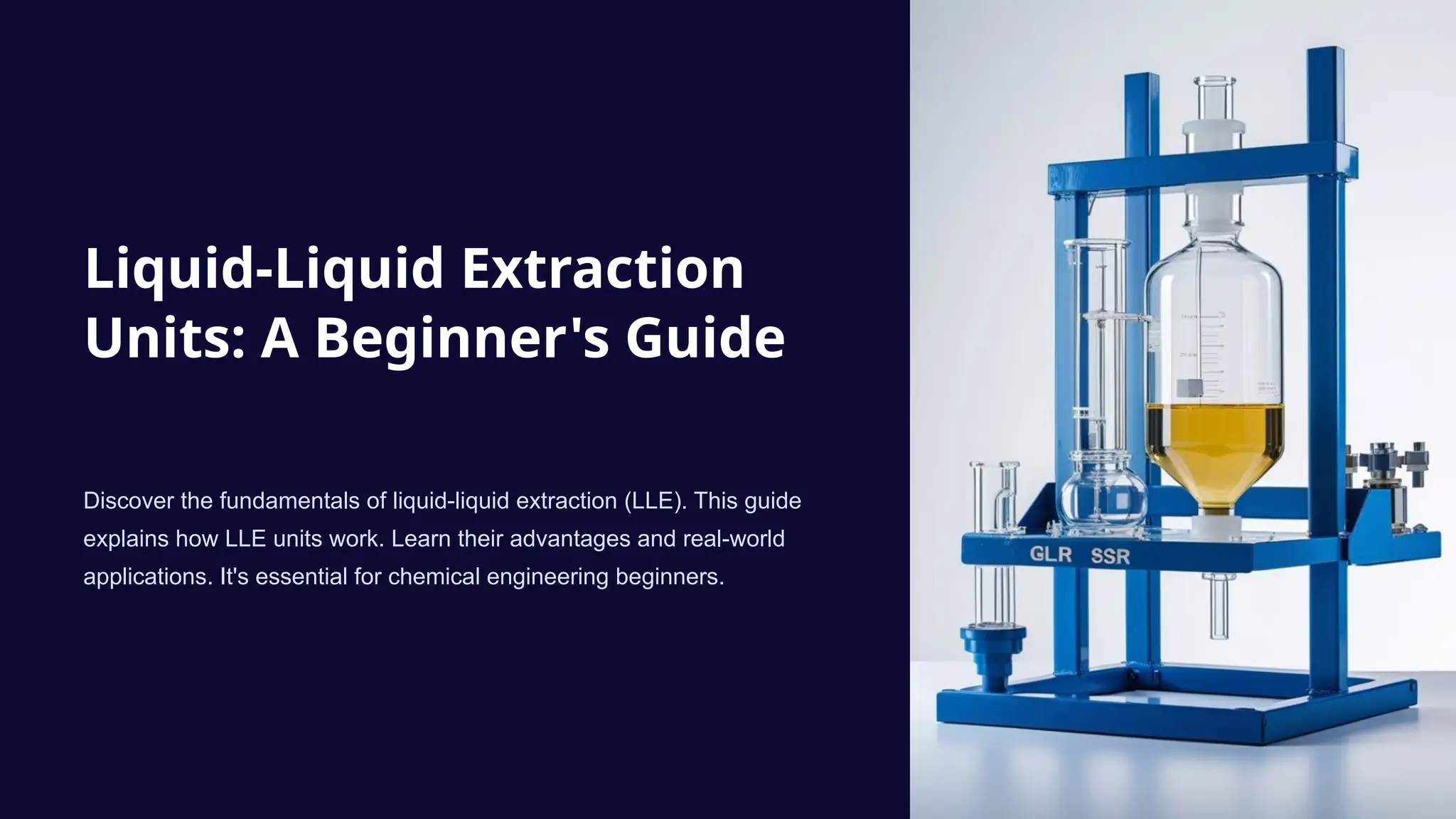
Liquid-Liquid Extraction
Units: ABeginner's Guide
Discover the fundamentals of liquid-liquid extraction (LLE). This guide
explains how LLE units work. Learn their advantages and real-world
applications. It's essential for chemical engineering beginners.
2.
Understanding Liquid-Liquid ExtractionUnits
Definition
An LLE unit separates mixture components. It uses
differential solubility in two immiscible liquids. Usually,
these are water and an organic solvent.
Basic Principle
A solute mixture contacts a second immiscible solvent. The
solute prefers the solvent phase. This allows separation
from the original mixture.
3.
How the ProcessWorks
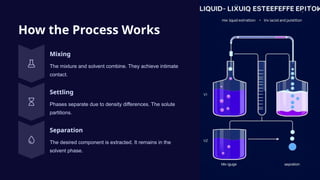
Mixing
The mixture and solvent combine. They achieve intimate
contact.
Settling
Phases separate due to density differences. The solute
partitions.
Separation
The desired component is extracted. It remains in the
solvent phase.
4.
Key Components ofan LLE Unit
Mixer
Brings the two liquids into
close contact. Ensures
efficient mass transfer.
Settler/Separator
Allows liquid phases to
separate. Based on
density differences.
Pumps
Moves liquids through the
system. Maintains
continuous flow.
Control System
Monitors and controls
operational parameters.
Ensures optimal
performance.
5.
Types of LLEUnits
Batch Extraction
Processes discrete quantities of
liquid. Simple for small-scale
operations.
Continuous Extraction
Handles steady flow rates.
Preferred for industrial
efficiency and scalability.
Centrifugal Extractors
Utilises centrifugal force for
rapid separation. Ideal for
sensitive or unstable mixtures.
6.
Advantages of Liquid-
LiquidExtraction
Temperature
Sensitivity
Good for heat-sensitive
compounds. Avoids
degradation from high
temperatures.
Separation of
Azeotropes
Effective for mixtures with
close boiling points.
Separates components
distillation cannot.
High Purity
Can achieve high purity products. Useful for pharmaceuticals and
fine chemicals.
7.
Real-World Applications
Pharmaceutical Antibioticpurification, drug
synthesis.
Chemical Petrochemical refining, acid
recovery.
Environmental Waste water treatment, heavy
metal removal.
Food & Beverage Flavour extraction, caffeine
removal.
8.
Key Takeaways andNext
Steps
Foundational Understanding
LLE is vital for separation. It uses solubility, not boiling points.
Practical Applications
LLE is used in diverse industries. It's crucial for many
processes.
Further Learning
Explore specific unit designs. Research advanced LLE
techniques.