



KEEN ORBIT
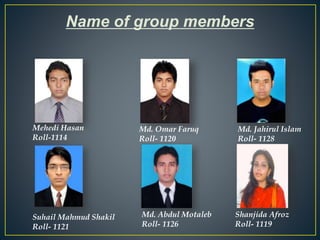
Name of group members
Md. Abdul Motaleb
Roll- 1126
Md. Omar Faruq
Roll- 1120
Md. Jahirul Islam
Roll- 1128
Suhail Mahmud Shakil
Roll- 1121
Shanjida Afroz
Roll- 1119
Mehedi Hasan
Roll-1114
Management science (MS), is an interdisciplinary
branch of applied mathematics, engineering and
sciences that uses various scientific research-based
principles, strategies, and analytical methods
including mathematical modeling, statistics and
algorithms to improve an organization's ability to
enact rational and meaningful management
decisions. The discipline is typically concerned with
maximizing profit, assembly line performance, crop
yield, bandwidth, etc. or minimizing expenses, loss,
risk, etc.
Management science is concerned with a number of different
areas of study including developing and applying models and
concepts that may prove useful in helping to illuminate
management issues and solve problems. Management
science research can be done on three levels:
A fundamental level that lies in three mathematical
disciplines: probability, optimization, and dynamic systems
theory,
A modeling level that builds models, gathers data, and
analyzes them mathematically, and
An application level, just as any other engineering
discipline that has strong aspirations to make a practical
impact in the real world.
Applications of management science are abundant in industry such as
airlines, manufacturing companies, service organizations, military branches,
and in government. The range of problems and issues to which
management science has contributed insights and solutions is vast. It
includes:
 scheduling airlines, both planes and crew,
 deciding the appropriate place to place new facilities such as a
warehouse or factory,
 managing the flow of water from reservoirs,
 identifying possible future development paths for parts of the
telecommunications industry,
 establishing the information needs and appropriate systems to supply
them within the health service, and
 identifying and understanding the strategies adopted by companies for
their information systems.
Linear programming (LP; also called linear optimization) is a method to
achieve the best outcome (such as maximum profit or lowest cost) in a
mathematical model whose requirements are represented by linear
relationships. Linear programming is a special case of mathematical
programming (mathematical optimization).
Linear programming is the process of taking various linear inequalities
relating to some situation, and finding the "best" value obtainable under
those conditions. A typical example would be taking the limitations of
materials and labor, and then determining the "best" production levels for
maximal profits under those conditions. In "real life", linear programming is
part of a very important area of mathematics called
"optimization techniques". This field of study (or at least the applied results
of it) are used every day in the organization and allocation of resources.
These "real life" systems can have dozens or hundreds of variables,
or more. In algebra, though, you'll only work with the simple (and graph
able) two-variable linear case. Applications of Linear Programming
Linear programming is used to solve
problems in many aspects of business
administration including:
product mix planning
distribution networks
truck routing
staff scheduling
financial portfolios
corporate restructuring
Businesses use linear programming methods to
determine the best ways to increase profits and
decrease operational costs. Linear programming
methods enable businesses to identify the
solutions they want for their operational problems,
define the issues that may alter the desired
outcome and figure out an answer that delivers the
results they seek. Although the phrase "linear
programming" came into use well before the
widespread use of computers, software packages
are available that replicate the linear programming
processes.
Production Planning
Linear programming methods are often
helpful at solving problems related to
production. A company that produces
multiple types of products can use linear
programming methods to calculate how
much of each product to produce to
maximize its profits. For instance, a
custom furniture shop that makes chairs
and tables can calculate how many of
each item they must sell to maximize their
profits by looking at the numbers of each
item previously sold and their prices.
Linear programming in Business
Marketing Mix
• A key aspect of marketing strategy is the
"marketing mix." The marketing mix
determines how much of a company's
marketing budget will go toward various
advertising and marketing channels. A linear
programming simulation can measure which
blend of marketing avenues deliver the most
qualified leads at the lowest cost. For
example, the custom furniture store can use
a linear programming method to examine
how many leads come from TV commercials,
newspaper display ads and online marketing
efforts. The solution will also compare the
Linear programming in Business
Product Distribution
• Manufacturers and distributors can use
linear programming methods to solve
distribution problems. These mathematical
exercises can help manufacturers
determine the most cost-effective way to
ship products from the factory to the
warehouse. Warehouse managers can
also use similar models to calculate the
most economical way to transport the
products from the warehouse to the retail
outlets. These models can also ensure
that warehouses maintain an optimal
Human resources planners can use linear programming
methods to determine when to hire more workers, which skill
sets the company needs and how much they can offer in
compensation. These methods can also be used to anticipate
times of increased demand for available workers. For example, a
department store can use linear programming methods to
calculate how many new hires they will make for the busy
holiday shopping season, as well as which departments will see
higher traffic and require more staff.
Linear programming is a branch of mathematics
and statistics that allows researchers to determine
solutions to problems of optimization. Linear
programming problems are distinctive in that they
are clearly defined in terms of an objective
function, constraints and linearity. The
characteristics of linear programming make it an
extremely useful field that has found use in applied
fields ranging from logistics to industrial planning.
• Optimization
All linear programming problems are
problems of optimization. This means
that the true purpose behind solving a
linear programming problem is to either
maximize or minimize some value.
Thus, linear programming problems are
often found in economics, business,
advertising and many other fields that
value efficiency and resource
conservation. Examples of items that
can be optimized are profit, resource
Charactaristics
• Linearity
As the name hints, linear programming
problems all have the trait of being linear.
However, this trait of linearity can be misleading,
as linearity only refers to variables being to the
first power (and therefore excluding power
functions, square roots and other non-linear
functions). Linearity does not, however, mean
that the functions of a linear programming
problem are only of one variable. In short,
linearity in linear programming problems allows
the variables to relate to each other as
coordinates on a line, excluding other shapes
and curves.
Charactaristics
• Objective Function
All linear programming problems have a
function called the "objective function." The
objective function is written in terms of the
variables that can be changed at will (e.g.,
time spent on a job, units produced and so
on). The objective function is the one that the
solver of a linear programming problem
wishes to maximize or minimize. The result of
a linear programming problem will be given in
terms of the objective function. The objective
function is written with the capital letter "Z" in
most linear programming problems.
Charactaristics
• Constraints
All linear programming problems have
constraints on the variables inside the
objective function. These constraints take
the form of inequalities (e.g., "b < 3" where b
may represent the units of books written by
an author per month). These inequalities
define how the objective function can be
maximized or minimized, as together they
determine the "domain" in which an
organization can make decisions about
resources.
Linear programming is a mathematical technique that helps
businesses solve some problems they face. It helps them deal
with constrained optimization situations in which they have to
make the best of their resources, such as labor, given certain
constraints. For instance, one constraint for a business is the
number of workers it can hire. Another could relate to the
amount of raw material it has available.
 Example
Consider a bicycle manufacturer that manufactures mountain bikes and
street bikes, each of which generates a different profit level. The
manufacturer would like to know how many bikes of each category to
produce so as to maximize profits, given that the business can sell its entire
output. Two different teams produce the mountain bikes and the street bikes
by hand, each with production constraints in terms of how many bikes it can
produce per day. The bikes also have to go through a machine finishing
process that has a limited processing capacity. The business could use the
Assumption of Linearity
The linear programming approach
is based on an assumption that the
world is linear. In the real world, this
is not always the case. There are
certain ways of mixing the inputs
that a linear programming approach
doesn't permit. For instance, the
bicycle manufacturer might find that
if it orders materials for the two
types of bicycles from the same
supplier, it could cut costs. This
effect can't be incorporated into a
linear programming model. Linear
models also don't account for
factors such as increased
production efficiency as the level of
production rises.
Fractional Values
The linear programming model
assumes that inputs and outputs can
be fractional. This is not always the
case in the real world. For instance,
if a business is trying to find out how
many people it should have on staff
during peak business hours, this
can't be a fraction. Similarly, if a taxi
business is trying to decide how
many cars it should buy, this can't be
a fraction, either. If even one
variable involved has to be in integer
form, linear programming is not a
suitable technique.
Even though linear programming has a number of
disadvantages, it's a versatile technique that can be used
to represent a number of real-world situations. Businesses
use the technique to solve problems that involve multiple
variables and constraints. The use of computers has made
this technique easier to apply.
Linear programming is one of the widely used modeling
techniques. Linear programming problems consist of an
objective function (also know as cost function) which has to
be minimized or maximized subject to a certain number of
constraints. The objective function consists of a certain
number of variables. The constraints are linear inequalities
of the variables used in the objective function. This
technique is closely related to linear algebra and uses
inequalities in the problem statement rather than equalities.
Thank You
Designed by- GreenLeaf...

Liner programming on Management Science

  • 1.
  • 2.
    Name of groupmembers Md. Abdul Motaleb Roll- 1126 Md. Omar Faruq Roll- 1120 Md. Jahirul Islam Roll- 1128 Suhail Mahmud Shakil Roll- 1121 Shanjida Afroz Roll- 1119 Mehedi Hasan Roll-1114
  • 3.
    Management science (MS),is an interdisciplinary branch of applied mathematics, engineering and sciences that uses various scientific research-based principles, strategies, and analytical methods including mathematical modeling, statistics and algorithms to improve an organization's ability to enact rational and meaningful management decisions. The discipline is typically concerned with maximizing profit, assembly line performance, crop yield, bandwidth, etc. or minimizing expenses, loss, risk, etc.
  • 4.
    Management science isconcerned with a number of different areas of study including developing and applying models and concepts that may prove useful in helping to illuminate management issues and solve problems. Management science research can be done on three levels: A fundamental level that lies in three mathematical disciplines: probability, optimization, and dynamic systems theory, A modeling level that builds models, gathers data, and analyzes them mathematically, and An application level, just as any other engineering discipline that has strong aspirations to make a practical impact in the real world.
  • 5.
    Applications of managementscience are abundant in industry such as airlines, manufacturing companies, service organizations, military branches, and in government. The range of problems and issues to which management science has contributed insights and solutions is vast. It includes:  scheduling airlines, both planes and crew,  deciding the appropriate place to place new facilities such as a warehouse or factory,  managing the flow of water from reservoirs,  identifying possible future development paths for parts of the telecommunications industry,  establishing the information needs and appropriate systems to supply them within the health service, and  identifying and understanding the strategies adopted by companies for their information systems.
  • 6.
    Linear programming (LP;also called linear optimization) is a method to achieve the best outcome (such as maximum profit or lowest cost) in a mathematical model whose requirements are represented by linear relationships. Linear programming is a special case of mathematical programming (mathematical optimization). Linear programming is the process of taking various linear inequalities relating to some situation, and finding the "best" value obtainable under those conditions. A typical example would be taking the limitations of materials and labor, and then determining the "best" production levels for maximal profits under those conditions. In "real life", linear programming is part of a very important area of mathematics called "optimization techniques". This field of study (or at least the applied results of it) are used every day in the organization and allocation of resources. These "real life" systems can have dozens or hundreds of variables, or more. In algebra, though, you'll only work with the simple (and graph able) two-variable linear case. Applications of Linear Programming
  • 7.
    Linear programming isused to solve problems in many aspects of business administration including: product mix planning distribution networks truck routing staff scheduling financial portfolios corporate restructuring
  • 8.
    Businesses use linearprogramming methods to determine the best ways to increase profits and decrease operational costs. Linear programming methods enable businesses to identify the solutions they want for their operational problems, define the issues that may alter the desired outcome and figure out an answer that delivers the results they seek. Although the phrase "linear programming" came into use well before the widespread use of computers, software packages are available that replicate the linear programming processes.
  • 9.
    Production Planning Linear programmingmethods are often helpful at solving problems related to production. A company that produces multiple types of products can use linear programming methods to calculate how much of each product to produce to maximize its profits. For instance, a custom furniture shop that makes chairs and tables can calculate how many of each item they must sell to maximize their profits by looking at the numbers of each item previously sold and their prices.
  • 10.
    Linear programming inBusiness Marketing Mix • A key aspect of marketing strategy is the "marketing mix." The marketing mix determines how much of a company's marketing budget will go toward various advertising and marketing channels. A linear programming simulation can measure which blend of marketing avenues deliver the most qualified leads at the lowest cost. For example, the custom furniture store can use a linear programming method to examine how many leads come from TV commercials, newspaper display ads and online marketing efforts. The solution will also compare the
  • 11.
    Linear programming inBusiness Product Distribution • Manufacturers and distributors can use linear programming methods to solve distribution problems. These mathematical exercises can help manufacturers determine the most cost-effective way to ship products from the factory to the warehouse. Warehouse managers can also use similar models to calculate the most economical way to transport the products from the warehouse to the retail outlets. These models can also ensure that warehouses maintain an optimal
  • 12.
    Human resources plannerscan use linear programming methods to determine when to hire more workers, which skill sets the company needs and how much they can offer in compensation. These methods can also be used to anticipate times of increased demand for available workers. For example, a department store can use linear programming methods to calculate how many new hires they will make for the busy holiday shopping season, as well as which departments will see higher traffic and require more staff.
  • 13.
    Linear programming isa branch of mathematics and statistics that allows researchers to determine solutions to problems of optimization. Linear programming problems are distinctive in that they are clearly defined in terms of an objective function, constraints and linearity. The characteristics of linear programming make it an extremely useful field that has found use in applied fields ranging from logistics to industrial planning.
  • 14.
    • Optimization All linearprogramming problems are problems of optimization. This means that the true purpose behind solving a linear programming problem is to either maximize or minimize some value. Thus, linear programming problems are often found in economics, business, advertising and many other fields that value efficiency and resource conservation. Examples of items that can be optimized are profit, resource
  • 15.
    Charactaristics • Linearity As thename hints, linear programming problems all have the trait of being linear. However, this trait of linearity can be misleading, as linearity only refers to variables being to the first power (and therefore excluding power functions, square roots and other non-linear functions). Linearity does not, however, mean that the functions of a linear programming problem are only of one variable. In short, linearity in linear programming problems allows the variables to relate to each other as coordinates on a line, excluding other shapes and curves.
  • 16.
    Charactaristics • Objective Function Alllinear programming problems have a function called the "objective function." The objective function is written in terms of the variables that can be changed at will (e.g., time spent on a job, units produced and so on). The objective function is the one that the solver of a linear programming problem wishes to maximize or minimize. The result of a linear programming problem will be given in terms of the objective function. The objective function is written with the capital letter "Z" in most linear programming problems.
  • 17.
    Charactaristics • Constraints All linearprogramming problems have constraints on the variables inside the objective function. These constraints take the form of inequalities (e.g., "b < 3" where b may represent the units of books written by an author per month). These inequalities define how the objective function can be maximized or minimized, as together they determine the "domain" in which an organization can make decisions about resources.
  • 18.
    Linear programming isa mathematical technique that helps businesses solve some problems they face. It helps them deal with constrained optimization situations in which they have to make the best of their resources, such as labor, given certain constraints. For instance, one constraint for a business is the number of workers it can hire. Another could relate to the amount of raw material it has available.  Example Consider a bicycle manufacturer that manufactures mountain bikes and street bikes, each of which generates a different profit level. The manufacturer would like to know how many bikes of each category to produce so as to maximize profits, given that the business can sell its entire output. Two different teams produce the mountain bikes and the street bikes by hand, each with production constraints in terms of how many bikes it can produce per day. The bikes also have to go through a machine finishing process that has a limited processing capacity. The business could use the
  • 19.
    Assumption of Linearity Thelinear programming approach is based on an assumption that the world is linear. In the real world, this is not always the case. There are certain ways of mixing the inputs that a linear programming approach doesn't permit. For instance, the bicycle manufacturer might find that if it orders materials for the two types of bicycles from the same supplier, it could cut costs. This effect can't be incorporated into a linear programming model. Linear models also don't account for factors such as increased production efficiency as the level of production rises. Fractional Values The linear programming model assumes that inputs and outputs can be fractional. This is not always the case in the real world. For instance, if a business is trying to find out how many people it should have on staff during peak business hours, this can't be a fraction. Similarly, if a taxi business is trying to decide how many cars it should buy, this can't be a fraction, either. If even one variable involved has to be in integer form, linear programming is not a suitable technique.
  • 20.
    Even though linearprogramming has a number of disadvantages, it's a versatile technique that can be used to represent a number of real-world situations. Businesses use the technique to solve problems that involve multiple variables and constraints. The use of computers has made this technique easier to apply.
  • 21.
    Linear programming isone of the widely used modeling techniques. Linear programming problems consist of an objective function (also know as cost function) which has to be minimized or maximized subject to a certain number of constraints. The objective function consists of a certain number of variables. The constraints are linear inequalities of the variables used in the objective function. This technique is closely related to linear algebra and uses inequalities in the problem statement rather than equalities.
  • 23.