Presented by:- Amit kumar
16PMM560
DOPM
NIPER S.A.S Nagar
Flow of Presentation
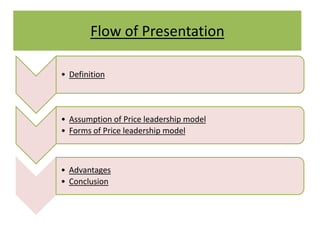
• Definition
• Assumption of Price leadership model
• Forms of Price leadership model
• Advantages
• Conclusion
Definition
 Price Leadership is an informal position of a firm in most oligopolistic
markets. It is an observation made of oligopolistic business behavior in
which one company, usually the dominant competitor among several,
leads the way in determining prices, the others soon following it
 Thus price leadership is “situation in which a market leader
sets the price of a product or services and competitors feel compelled
to match that price”
 The major objective is to avoid the uncertainty, uncertainty in terms of
getting the profit, uncertainty in term of being in the market or sustain in
the market
Assumption
Number of firms are small
Entry to the industry is restricted
Products are, by and large, homogeneous
Demand for industry is inelastic or, very low elasticity exists
Firms have almost similar cost curves
Technical reasons- Size, Efficiency(more efficient more innovative) ,
Economies of Scale(cheap product better leader), Firm’s Ability to forecast
market conditions accurately
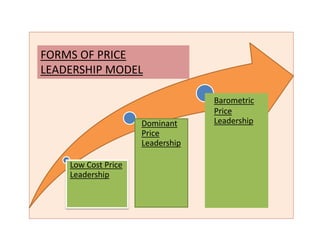
Low Cost Price
Leadership
Dominant
Price
Leadership
Barometric
Price
Leadership
FORMS OF PRICE
LEADERSHIP MODEL
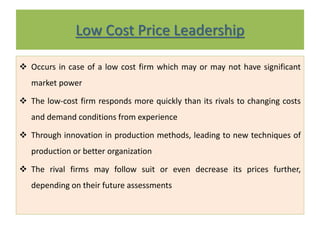
Low Cost Price Leadership
 Occurs in case of a low cost firm which may or may not have significant
market power
 The low-cost firm responds more quickly than its rivals to changing costs
and demand conditions from experience
 Through innovation in production methods, leading to new techniques of
production or better organization
 The rival firms may follow suit or even decrease its prices further,
depending on their future assessments
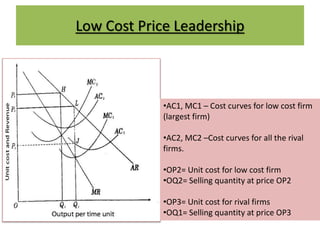
Low Cost Price Leadership
•AC1, MC1 – Cost curves for low cost firm
(largest firm)
•AC2, MC2 –Cost curves for all the rival
firms.
•OP2= Unit cost for low cost firm
•OQ2= Selling quantity at price OP2
•OP3= Unit cost for rival firms
•OQ1= Selling quantity at price OP3
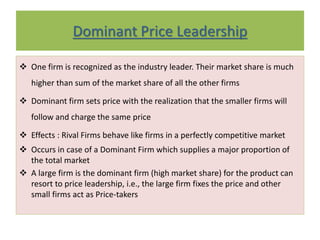
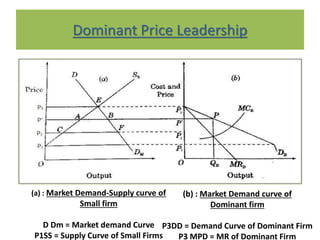
Dominant Price Leadership
 One firm is recognized as the industry leader. Their market share is much
higher than sum of the market share of all the other firms
 Dominant firm sets price with the realization that the smaller firms will
follow and charge the same price
 Effects : Rival Firms behave like firms in a perfectly competitive market
 Occurs in case of a Dominant Firm which supplies a major proportion of
the total market
 A large firm is the dominant firm (high market share) for the product can
resort to price leadership, i.e., the large firm fixes the price and other
small firms act as Price-takers
Dominant Price Leadership
(a) : Market Demand-Supply curve of
Small firm
D Dm = Market demand Curve
P1SS = Supply Curve of Small Firms
(b) : Market Demand curve of
Dominant firm
P3DD = Demand Curve of Dominant Firm
P3 MPD = MR of Dominant Firm
Barometric Price Leadership
 In Barometric price leadership, the most reliable firm emerges as the best
barometer of market conditions. The firm could be the one with lowest
cost of production, leading other firms the follow the suit
 The firm has better capability to forecast the economic changes
 The firm has a better knowledge of prevailing market scenario
 The firm initiates well publicized changes in price
 Number of Large firms is more than the number of Small firms
Advantages
 Small firms lack sufficient knowledge into the principle of costing. They
can utilize the big firm’s costing department by being price followers
 Leads to price stability avoiding price wars to an extent
 Price will not be too high during boom periods and not too low during
recessions (as price leaders take a long run point of view)
Conclusion
 All the Price Leadership models are controlled by a strict MRTP Act
 MRTP Act : Monopoly Restricted Trade Practices Act (India 1969)
 The MRTP Act restricts the firms from misusing the Price Leadership
Model to engage in illegal practices
Thank You

Price Leadership Model

  • 1.
    Presented by:- Amitkumar 16PMM560 DOPM NIPER S.A.S Nagar
  • 2.
    Flow of Presentation •Definition • Assumption of Price leadership model • Forms of Price leadership model • Advantages • Conclusion
  • 3.
    Definition  Price Leadershipis an informal position of a firm in most oligopolistic markets. It is an observation made of oligopolistic business behavior in which one company, usually the dominant competitor among several, leads the way in determining prices, the others soon following it  Thus price leadership is “situation in which a market leader sets the price of a product or services and competitors feel compelled to match that price”  The major objective is to avoid the uncertainty, uncertainty in terms of getting the profit, uncertainty in term of being in the market or sustain in the market
  • 4.
    Assumption Number of firmsare small Entry to the industry is restricted Products are, by and large, homogeneous Demand for industry is inelastic or, very low elasticity exists Firms have almost similar cost curves Technical reasons- Size, Efficiency(more efficient more innovative) , Economies of Scale(cheap product better leader), Firm’s Ability to forecast market conditions accurately
  • 5.
  • 6.
    Low Cost PriceLeadership  Occurs in case of a low cost firm which may or may not have significant market power  The low-cost firm responds more quickly than its rivals to changing costs and demand conditions from experience  Through innovation in production methods, leading to new techniques of production or better organization  The rival firms may follow suit or even decrease its prices further, depending on their future assessments
  • 7.
    Low Cost PriceLeadership •AC1, MC1 – Cost curves for low cost firm (largest firm) •AC2, MC2 –Cost curves for all the rival firms. •OP2= Unit cost for low cost firm •OQ2= Selling quantity at price OP2 •OP3= Unit cost for rival firms •OQ1= Selling quantity at price OP3
  • 8.
    Dominant Price Leadership One firm is recognized as the industry leader. Their market share is much higher than sum of the market share of all the other firms  Dominant firm sets price with the realization that the smaller firms will follow and charge the same price  Effects : Rival Firms behave like firms in a perfectly competitive market  Occurs in case of a Dominant Firm which supplies a major proportion of the total market  A large firm is the dominant firm (high market share) for the product can resort to price leadership, i.e., the large firm fixes the price and other small firms act as Price-takers
  • 9.
    Dominant Price Leadership (a): Market Demand-Supply curve of Small firm D Dm = Market demand Curve P1SS = Supply Curve of Small Firms (b) : Market Demand curve of Dominant firm P3DD = Demand Curve of Dominant Firm P3 MPD = MR of Dominant Firm
  • 10.
    Barometric Price Leadership In Barometric price leadership, the most reliable firm emerges as the best barometer of market conditions. The firm could be the one with lowest cost of production, leading other firms the follow the suit  The firm has better capability to forecast the economic changes  The firm has a better knowledge of prevailing market scenario  The firm initiates well publicized changes in price  Number of Large firms is more than the number of Small firms
  • 11.
    Advantages  Small firmslack sufficient knowledge into the principle of costing. They can utilize the big firm’s costing department by being price followers  Leads to price stability avoiding price wars to an extent  Price will not be too high during boom periods and not too low during recessions (as price leaders take a long run point of view)
  • 12.
    Conclusion  All thePrice Leadership models are controlled by a strict MRTP Act  MRTP Act : Monopoly Restricted Trade Practices Act (India 1969)  The MRTP Act restricts the firms from misusing the Price Leadership Model to engage in illegal practices
  • 13.