Spreadsheet Modeling
& Decision Analysis
A Practical Introduction to
Management Science
5th
edition
Cliff T. Ragsdale
Introduction to Modeling
& Problem Solving
Chapter 1
Introduction
ļ‚§ We face numerous decisions in life &
business.
ļ‚§ We can use computers to analyze the
potential outcomes of decision
alternatives.
ļ‚§ Spreadsheets are the tool of choice for
today’s managers.
What is Management Science?
ļ‚§ A field of study that uses computers,
statistics, and mathematics to solve
business problems.
ļ‚§ Also known as:
– Operations research
– Decision science
Home Runs
in Management Science
ļ‚§ Motorola
– Procurement of goods and services
account for 50% of its costs
– Developed an Internet-based auction
system for negotiations with suppliers
– The system optimized multi-product, multi-
vendor contract awards
– Benefits:
$600 million in savings
Home Runs
in Management Science
ļ‚§ Waste Management
– Leading waste collection company in North
America
– 26,000 vehicles service 20 million residential &
2 million commercial customers
– Developed vehicle routing optimization system
– Benefits:
Eliminated 1,000 routes
Annual savings of $44 million
Home Runs
in Management Science
ļ‚§ Hong Kong International Terminals
– Busiest container terminal in the world
– 122 yard cranes serve 125 ships per week
– Thousands of trucks move containers in &
out of storage yard
– Used DSS to optimize operational decisions
involving trucks, cranes & storage locations
– Benefits:
35% reduction in container handling costs
50% increase in throughput
30% improvement in vessel turnaround time
Home Runs in
Management Science
ļ‚§ John Deere Company
– 2500 dealers sell lawn equipment &
tractors with support of 5 warehouses
– Each dealer stocks 100 products, creating
250,000 product-stocking locations
– Demand is highly seasonal and erratic
– Developed inventory system to optimize
stocking levels over a 26-week horizon
– Benefits:
 $1 billion in reduced inventory
 Improved customer-service levels
What is a ā€œComputer Modelā€?
ļ‚§ A set of mathematical relationships and
logical assumptions implemented in a
computer as an abstract representation of
a real-world object of phenomenon.
ļ‚§ Spreadsheets provide the most
convenient way for business people to
build computer models.
The Modeling Approach
to Decision Making
ļ‚§ Everyone uses models to make
decisions.
ļ‚§ Types of models:
– Mental (arranging furniture)
– Visual (blueprints, road maps)
– Physical/Scale (aerodynamics, buildings)
– Mathematical (what we’ll be studying)
Characteristics of Models
ļ‚§ Models are usually simplified versions of
the things they represent
ļ‚§ A valid model accurately represents the
relevant characteristics of the object or
decision being studied
Benefits of Modeling
ļ‚§ Economy - It is often less costly to
analyze decision problems using
models.
ļ‚§ Timeliness - Models often deliver
needed information more quickly than
their real-world counterparts.
ļ‚§ Feasibility - Models can be used to do
things that would be impossible.
ļ‚§ Models give us insight & understanding
that improves decision making.
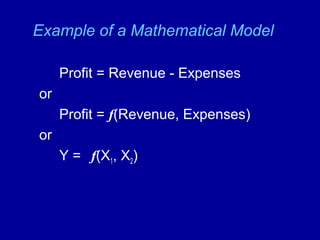
Example of a Mathematical Model
Profit = Revenue - Expenses
or
Profit = f(Revenue, Expenses)
or
Y = f(X1, X2)
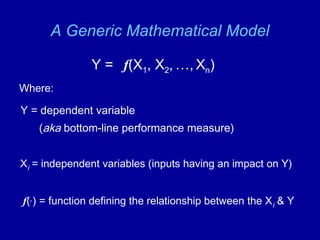
A Generic Mathematical Model
Y = f(X1, X2, …, Xn)
Y = dependent variable
(aka bottom-line performance measure)
Xi = independent variables (inputs having an impact on Y)
f(.) = function defining the relationship between the Xi & Y
Where:
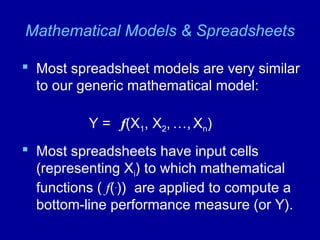
Mathematical Models & Spreadsheets
ļ‚§ Most spreadsheet models are very similar
to our generic mathematical model:
Y = f(X1, X2, …, Xn)
ļ‚§ Most spreadsheets have input cells
(representing Xi) to which mathematical
functions ( f(.
)) are applied to compute a
bottom-line performance measure (or Y).
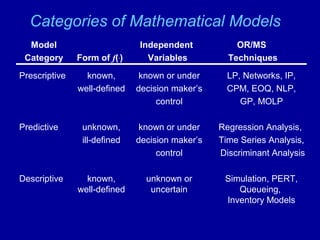
Categories of Mathematical Models
Prescriptive known, known or under LP, Networks, IP,
well-defined decision maker’s CPM, EOQ, NLP,
control GP, MOLP
Predictive unknown, known or under Regression Analysis,
ill-defined decision maker’s Time Series Analysis,
control Discriminant Analysis
Descriptive known, unknown or Simulation, PERT,
well-defined uncertain Queueing,
Inventory Models
Model Independent OR/MS
Category Form of f(.) Variables Techniques
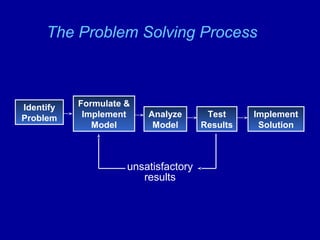
The Problem Solving Process
Identify
Problem
Formulate &
Implement
Model
Analyze
Model
Test
Results
Implement
Solution
unsatisfactory
results
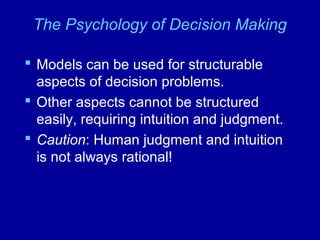
The Psychology of Decision Making
ļ‚§ Models can be used for structurable
aspects of decision problems.
ļ‚§ Other aspects cannot be structured
easily, requiring intuition and judgment.
ļ‚§ Caution: Human judgment and intuition
is not always rational!
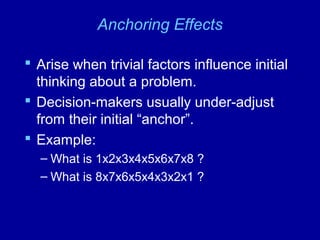
Anchoring Effects
ļ‚§ Arise when trivial factors influence initial
thinking about a problem.
ļ‚§ Decision-makers usually under-adjust
from their initial ā€œanchorā€.
ļ‚§ Example:
– What is 1x2x3x4x5x6x7x8 ?
– What is 8x7x6x5x4x3x2x1 ?
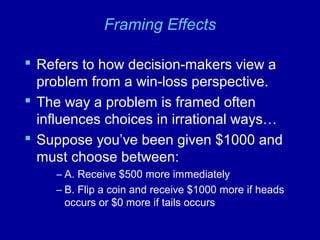
Framing Effects
ļ‚§ Refers to how decision-makers view a
problem from a win-loss perspective.
ļ‚§ The way a problem is framed often
influences choices in irrational ways…
ļ‚§ Suppose you’ve been given $1000 and
must choose between:
– A. Receive $500 more immediately
– B. Flip a coin and receive $1000 more if heads
occurs or $0 more if tails occurs
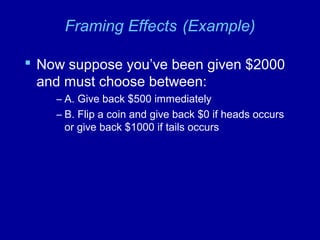
Framing Effects (Example)
ļ‚§ Now suppose you’ve been given $2000
and must choose between:
– A. Give back $500 immediately
– B. Flip a coin and give back $0 if heads occurs
or give back $1000 if tails occurs
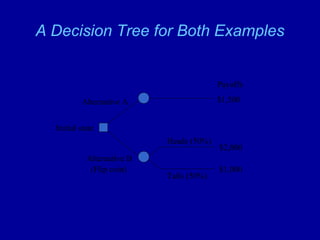
A Decision Tree for Both Examples
Initial state
$1,500
Heads (50%)
Tails (50%)
$2,000
$1,000
Alternative A
Alternative B
(Flip coin)
Payoffs
Good Decisions vs. Good Outcomes
ļ‚§ Good decisions do not always lead to good
outcomes...
ļ‚§ A structured, modeling approach to
decision making helps us make good
decisions, but can’t guarantee good
outcomes.
End of Chapter 1

Introduction to Decision Science

  • 1.
    Spreadsheet Modeling & DecisionAnalysis A Practical Introduction to Management Science 5th edition Cliff T. Ragsdale
  • 2.
    Introduction to Modeling &Problem Solving Chapter 1
  • 3.
    Introduction ļ‚§ We facenumerous decisions in life & business. ļ‚§ We can use computers to analyze the potential outcomes of decision alternatives. ļ‚§ Spreadsheets are the tool of choice for today’s managers.
  • 4.
    What is ManagementScience? ļ‚§ A field of study that uses computers, statistics, and mathematics to solve business problems. ļ‚§ Also known as: – Operations research – Decision science
  • 5.
    Home Runs in ManagementScience ļ‚§ Motorola – Procurement of goods and services account for 50% of its costs – Developed an Internet-based auction system for negotiations with suppliers – The system optimized multi-product, multi- vendor contract awards – Benefits: $600 million in savings
  • 6.
    Home Runs in ManagementScience ļ‚§ Waste Management – Leading waste collection company in North America – 26,000 vehicles service 20 million residential & 2 million commercial customers – Developed vehicle routing optimization system – Benefits: Eliminated 1,000 routes Annual savings of $44 million
  • 7.
    Home Runs in ManagementScience ļ‚§ Hong Kong International Terminals – Busiest container terminal in the world – 122 yard cranes serve 125 ships per week – Thousands of trucks move containers in & out of storage yard – Used DSS to optimize operational decisions involving trucks, cranes & storage locations – Benefits: 35% reduction in container handling costs 50% increase in throughput 30% improvement in vessel turnaround time
  • 8.
    Home Runs in ManagementScience ļ‚§ John Deere Company – 2500 dealers sell lawn equipment & tractors with support of 5 warehouses – Each dealer stocks 100 products, creating 250,000 product-stocking locations – Demand is highly seasonal and erratic – Developed inventory system to optimize stocking levels over a 26-week horizon – Benefits:  $1 billion in reduced inventory  Improved customer-service levels
  • 9.
    What is aā€œComputer Modelā€? ļ‚§ A set of mathematical relationships and logical assumptions implemented in a computer as an abstract representation of a real-world object of phenomenon. ļ‚§ Spreadsheets provide the most convenient way for business people to build computer models.
  • 10.
    The Modeling Approach toDecision Making ļ‚§ Everyone uses models to make decisions. ļ‚§ Types of models: – Mental (arranging furniture) – Visual (blueprints, road maps) – Physical/Scale (aerodynamics, buildings) – Mathematical (what we’ll be studying)
  • 11.
    Characteristics of Models ļ‚§Models are usually simplified versions of the things they represent ļ‚§ A valid model accurately represents the relevant characteristics of the object or decision being studied
  • 12.
    Benefits of Modeling ļ‚§Economy - It is often less costly to analyze decision problems using models. ļ‚§ Timeliness - Models often deliver needed information more quickly than their real-world counterparts. ļ‚§ Feasibility - Models can be used to do things that would be impossible. ļ‚§ Models give us insight & understanding that improves decision making.
  • 13.
    Example of aMathematical Model Profit = Revenue - Expenses or Profit = f(Revenue, Expenses) or Y = f(X1, X2)
  • 14.
    A Generic MathematicalModel Y = f(X1, X2, …, Xn) Y = dependent variable (aka bottom-line performance measure) Xi = independent variables (inputs having an impact on Y) f(.) = function defining the relationship between the Xi & Y Where:
  • 15.
    Mathematical Models &Spreadsheets ļ‚§ Most spreadsheet models are very similar to our generic mathematical model: Y = f(X1, X2, …, Xn) ļ‚§ Most spreadsheets have input cells (representing Xi) to which mathematical functions ( f(. )) are applied to compute a bottom-line performance measure (or Y).
  • 16.
    Categories of MathematicalModels Prescriptive known, known or under LP, Networks, IP, well-defined decision maker’s CPM, EOQ, NLP, control GP, MOLP Predictive unknown, known or under Regression Analysis, ill-defined decision maker’s Time Series Analysis, control Discriminant Analysis Descriptive known, unknown or Simulation, PERT, well-defined uncertain Queueing, Inventory Models Model Independent OR/MS Category Form of f(.) Variables Techniques
  • 17.
    The Problem SolvingProcess Identify Problem Formulate & Implement Model Analyze Model Test Results Implement Solution unsatisfactory results
  • 18.
    The Psychology ofDecision Making ļ‚§ Models can be used for structurable aspects of decision problems. ļ‚§ Other aspects cannot be structured easily, requiring intuition and judgment. ļ‚§ Caution: Human judgment and intuition is not always rational!
  • 19.
    Anchoring Effects ļ‚§ Arisewhen trivial factors influence initial thinking about a problem. ļ‚§ Decision-makers usually under-adjust from their initial ā€œanchorā€. ļ‚§ Example: – What is 1x2x3x4x5x6x7x8 ? – What is 8x7x6x5x4x3x2x1 ?
  • 20.
    Framing Effects ļ‚§ Refersto how decision-makers view a problem from a win-loss perspective. ļ‚§ The way a problem is framed often influences choices in irrational ways… ļ‚§ Suppose you’ve been given $1000 and must choose between: – A. Receive $500 more immediately – B. Flip a coin and receive $1000 more if heads occurs or $0 more if tails occurs
  • 21.
    Framing Effects (Example) ļ‚§Now suppose you’ve been given $2000 and must choose between: – A. Give back $500 immediately – B. Flip a coin and give back $0 if heads occurs or give back $1000 if tails occurs
  • 22.
    A Decision Treefor Both Examples Initial state $1,500 Heads (50%) Tails (50%) $2,000 $1,000 Alternative A Alternative B (Flip coin) Payoffs
  • 23.
    Good Decisions vs.Good Outcomes ļ‚§ Good decisions do not always lead to good outcomes... ļ‚§ A structured, modeling approach to decision making helps us make good decisions, but can’t guarantee good outcomes.
  • 24.