Demand Theory and
Its Implications In
Managerial Economics
Group
Members

Anam Arif
MB-12-03

Omer Shahzad
MB-12-08
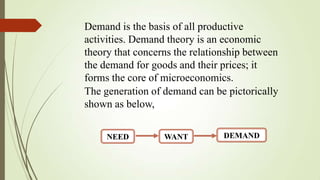
Demand is the basis of all productive
activities. Demand theory is an economic
theory that concerns the relationship between
the demand for goods and their prices; it
forms the core of microeconomics.
The generation of demand can be pictorically
shown as below,
NEED

WANT

DEMAND
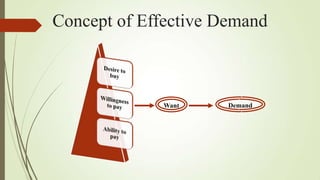
Concept of Effective Demand

Want

Demand
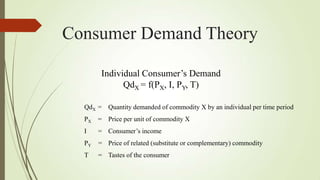
Consumer Demand Theory
Individual Consumer’s Demand
QdX = f(PX, I, PY, T)
QdX = Quantity demanded of commodity X by an individual per time period
PX

= Price per unit of commodity X

I

= Consumer’s income

PY

= Price of related (substitute or complementary) commodity

T

= Tastes of the consumer
Consumer Demand Theory
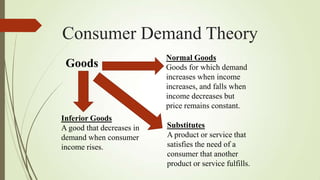
Goods

Inferior Goods
A good that decreases in
demand when consumer
income rises.

Normal Goods
Goods for which demand
increases when income
increases, and falls when
income decreases but
price remains constant.
Substitutes
A product or service that
satisfies the need of a
consumer that another
product or service fulfills.
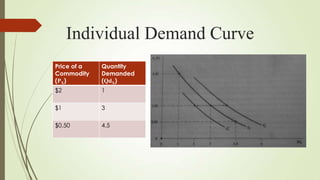
Individual Demand Curve
Price of a
Commodity
(PX)

Quantity
Demanded
(QdX)

$2

1

$1

3

$0.50

4.5
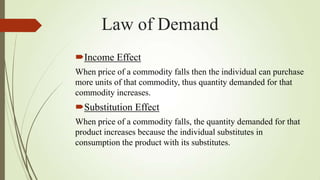
Law of Demand
The law of demand states that the quantity demanded
and the price of a commodity are inversely
related, other things remaining constant. If
the income of the consumer, prices of the
related goods, and preferences of the consumer remain
unchanged, then the change in quantity of good
demanded by the consumer will be negatively
correlated to the change in the price of the good.
Law of Demand
There is an inverse relationship between the price
of a good and the quantity of the good demanded
per time period.
Substitution Effect
Income Effect
Law of Demand
Income Effect
When price of a commodity falls then the individual can purchase
more units of that commodity, thus quantity demanded for that
commodity increases.

Substitution Effect
When price of a commodity falls, the quantity demanded for that
product increases because the individual substitutes in
consumption the product with its substitutes.
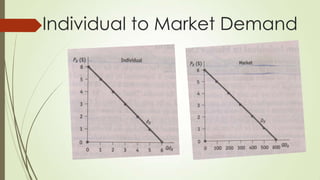
Market Demand Curve
Horizontal summation of demand curves of individual
consumers
Individual to Market Demand
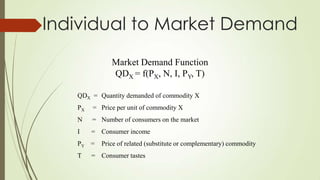
Market Demand Function
QDX = f(PX, N, I, PY, T)
QDX = Quantity demanded of commodity X
PX

= Price per unit of commodity X

N

= Number of consumers on the market

I

= Consumer income

PY =
T

Price of related (substitute or complementary) commodity

= Consumer tastes
Individual to Market Demand
Bandwagon Effect
People tend to purchase a commodity which others are using or in
order to follow the fashion.

Snob Effect
Situation where the demand for a product by a high income
segment varies inversely with its demand by the lower income
segment.
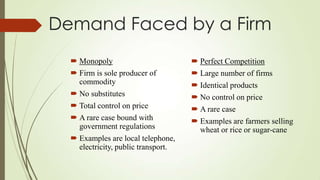
Demand Faced by a Firm
Market Structure
Monopoly
Perfect Competition
Oligopoly
Monopolistic Competition
Demand Faced by a Firm
 Monopoly
 Firm is sole producer of
commodity
 No substitutes
 Total control on price
 A rare case bound with
government regulations
 Examples are local telephone,
electricity, public transport.

 Perfect Competition
 Large number of firms
 Identical products
 No control on price
 A rare case
 Examples are farmers selling
wheat or rice or sugar-cane
Demand Faced by a Firm
 Oligopoly
 Firms producing
homogeneous or standardized
products like cement
 Firms producing
heterogeneous or
differentiated products like
soft drinks
 Examples are firms in
production sector of the
economy

 Monopolistic Competition
 Involves elements of
monopoly and perfect
competition
 Firm has somehow control
over price
 Examples are firms in service
sector like gasoline stations or
barber shops
Demand Faced by a Firm
Type of Good
Durable Goods
Nondurable Goods

Producers’ Goods - Derived Demand
Demand Faced by a Firm
 Durable Goods

 Non-Durable Goods

 Goods that provide services
not only during the year when
they are purchased but also in
following years

 Goods that cannot be stored
and can be used within a year

 Firm faces a more volatile or
unstable demand
 Examples are
automobiles, electric
appliances

 Firm faces a stable demand

 Examples are food, cosmetics
and cleaning products
Demand Faced by a Firm
 Non-Durable Goods

 Producer’s Goods

 Goods that cannot be stored
and can be used within a year

 Goods, such as raw materials
and tools, used to make
consumer goods

 Firm faces a stable demand
 Examples are food, cosmetics
and cleaning products

 The demand for such goods is
derived demand because it
depends upon the demand for
goods and services it sells
 Firm’s demand for producers
goods is also more volatile and
unstable
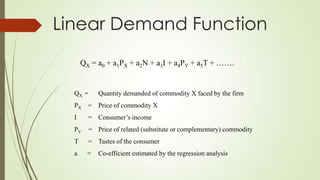
Linear Demand Function
QX = a0 + a1PX + a2N + a3I + a4PY + a5T + …….

QX =

Quantity demanded of commodity X faced by the firm

PX

= Price of commodity X

I

= Consumer’s income

PY

= Price of related (substitute or complementary) commodity

T

= Tastes of the consumer

a

=

Co-efficient estimated by the regression analysis
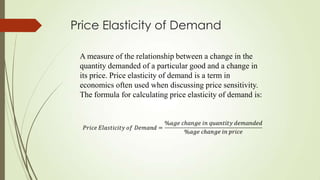
Price Elasticity of Demand
A measure of the relationship between a change in the
quantity demanded of a particular good and a change in
its price. Price elasticity of demand is a term in
economics often used when discussing price sensitivity.
The formula for calculating price elasticity of demand is:
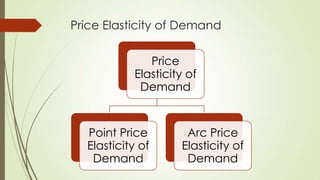
Price Elasticity of Demand
Price
Elasticity of
Demand

Point Price
Elasticity of
Demand

Arc Price
Elasticity of
Demand
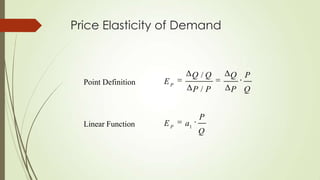
Price Elasticity of Demand

Point Definition

Linear Function

Q /Q
P/P

EP

EP

a1

Q P
P Q

P
Q
Price Elasticity of Demand

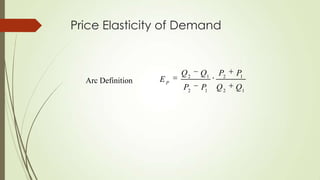
Arc Definition

EP

Q2

Q1

P2

P1

P2

P1

Q2

Q1
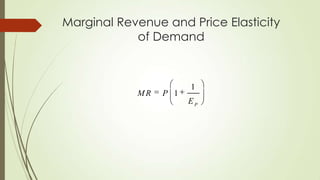
Marginal Revenue and Price Elasticity
of Demand

MR

P 1

1
EP
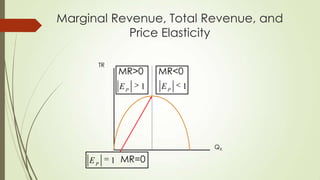
Marginal Revenue, Total Revenue, and
Price Elasticity
TR

MR>0
EP

1

MR<0
EP

1

QX

EP

1 MR=0
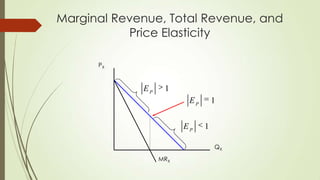
Marginal Revenue, Total Revenue, and
Price Elasticity
PX

EP

1
EP
EP

1
1
QX

MRX
Determinants of Price Elasticity of
Demand
Demand for a commodity will be more elastic if:
It has many close substitutes
It is narrowly defined
More time is available to adjust to a price change
Determinants of Price Elasticity of
Demand
Demand for a commodity will be less elastic if:
It has few substitutes

It is broadly defined
Less time is available to adjust to a price change
Managerial economics -demand theory

Managerial economics -demand theory

  • 2.
    Demand Theory and ItsImplications In Managerial Economics Group Members Anam Arif MB-12-03 Omer Shahzad MB-12-08
  • 4.
    Demand is thebasis of all productive activities. Demand theory is an economic theory that concerns the relationship between the demand for goods and their prices; it forms the core of microeconomics. The generation of demand can be pictorically shown as below, NEED WANT DEMAND
  • 5.
    Concept of EffectiveDemand Want Demand
  • 6.
    Consumer Demand Theory IndividualConsumer’s Demand QdX = f(PX, I, PY, T) QdX = Quantity demanded of commodity X by an individual per time period PX = Price per unit of commodity X I = Consumer’s income PY = Price of related (substitute or complementary) commodity T = Tastes of the consumer
  • 7.
    Consumer Demand Theory Goods InferiorGoods A good that decreases in demand when consumer income rises. Normal Goods Goods for which demand increases when income increases, and falls when income decreases but price remains constant. Substitutes A product or service that satisfies the need of a consumer that another product or service fulfills.
  • 8.
    Individual Demand Curve Priceof a Commodity (PX) Quantity Demanded (QdX) $2 1 $1 3 $0.50 4.5
  • 9.
    Law of Demand Thelaw of demand states that the quantity demanded and the price of a commodity are inversely related, other things remaining constant. If the income of the consumer, prices of the related goods, and preferences of the consumer remain unchanged, then the change in quantity of good demanded by the consumer will be negatively correlated to the change in the price of the good.
  • 10.
    Law of Demand Thereis an inverse relationship between the price of a good and the quantity of the good demanded per time period. Substitution Effect Income Effect
  • 11.
    Law of Demand IncomeEffect When price of a commodity falls then the individual can purchase more units of that commodity, thus quantity demanded for that commodity increases. Substitution Effect When price of a commodity falls, the quantity demanded for that product increases because the individual substitutes in consumption the product with its substitutes.
  • 12.
    Market Demand Curve Horizontalsummation of demand curves of individual consumers
  • 13.
  • 14.
    Individual to MarketDemand Market Demand Function QDX = f(PX, N, I, PY, T) QDX = Quantity demanded of commodity X PX = Price per unit of commodity X N = Number of consumers on the market I = Consumer income PY = T Price of related (substitute or complementary) commodity = Consumer tastes
  • 15.
    Individual to MarketDemand Bandwagon Effect People tend to purchase a commodity which others are using or in order to follow the fashion. Snob Effect Situation where the demand for a product by a high income segment varies inversely with its demand by the lower income segment.
  • 16.
    Demand Faced bya Firm Market Structure Monopoly Perfect Competition Oligopoly Monopolistic Competition
  • 17.
    Demand Faced bya Firm  Monopoly  Firm is sole producer of commodity  No substitutes  Total control on price  A rare case bound with government regulations  Examples are local telephone, electricity, public transport.  Perfect Competition  Large number of firms  Identical products  No control on price  A rare case  Examples are farmers selling wheat or rice or sugar-cane
  • 18.
    Demand Faced bya Firm  Oligopoly  Firms producing homogeneous or standardized products like cement  Firms producing heterogeneous or differentiated products like soft drinks  Examples are firms in production sector of the economy  Monopolistic Competition  Involves elements of monopoly and perfect competition  Firm has somehow control over price  Examples are firms in service sector like gasoline stations or barber shops
  • 19.
    Demand Faced bya Firm Type of Good Durable Goods Nondurable Goods Producers’ Goods - Derived Demand
  • 20.
    Demand Faced bya Firm  Durable Goods  Non-Durable Goods  Goods that provide services not only during the year when they are purchased but also in following years  Goods that cannot be stored and can be used within a year  Firm faces a more volatile or unstable demand  Examples are automobiles, electric appliances  Firm faces a stable demand  Examples are food, cosmetics and cleaning products
  • 21.
    Demand Faced bya Firm  Non-Durable Goods  Producer’s Goods  Goods that cannot be stored and can be used within a year  Goods, such as raw materials and tools, used to make consumer goods  Firm faces a stable demand  Examples are food, cosmetics and cleaning products  The demand for such goods is derived demand because it depends upon the demand for goods and services it sells  Firm’s demand for producers goods is also more volatile and unstable
  • 22.
    Linear Demand Function QX= a0 + a1PX + a2N + a3I + a4PY + a5T + ……. QX = Quantity demanded of commodity X faced by the firm PX = Price of commodity X I = Consumer’s income PY = Price of related (substitute or complementary) commodity T = Tastes of the consumer a = Co-efficient estimated by the regression analysis
  • 24.
    Price Elasticity ofDemand A measure of the relationship between a change in the quantity demanded of a particular good and a change in its price. Price elasticity of demand is a term in economics often used when discussing price sensitivity. The formula for calculating price elasticity of demand is:
  • 25.
    Price Elasticity ofDemand Price Elasticity of Demand Point Price Elasticity of Demand Arc Price Elasticity of Demand
  • 26.
    Price Elasticity ofDemand Point Definition Linear Function Q /Q P/P EP EP a1 Q P P Q P Q
  • 27.
    Price Elasticity ofDemand Arc Definition EP Q2 Q1 P2 P1 P2 P1 Q2 Q1
  • 28.
    Marginal Revenue andPrice Elasticity of Demand MR P 1 1 EP
  • 29.
    Marginal Revenue, TotalRevenue, and Price Elasticity TR MR>0 EP 1 MR<0 EP 1 QX EP 1 MR=0
  • 30.
    Marginal Revenue, TotalRevenue, and Price Elasticity PX EP 1 EP EP 1 1 QX MRX
  • 31.
    Determinants of PriceElasticity of Demand Demand for a commodity will be more elastic if: It has many close substitutes It is narrowly defined More time is available to adjust to a price change
  • 32.
    Determinants of PriceElasticity of Demand Demand for a commodity will be less elastic if: It has few substitutes It is broadly defined Less time is available to adjust to a price change