P. MURUGAN M.Com [CA]., M.Phil., SET., [P.hD]
Assistant Professor in B.Com (CA)
Vivekananda College
Tiruvedakam West
Madurai.
Standard cost
• The word "Standard" means a "Yardstick" or "Bench
Mark." The term "Standard Costs" refers to Pre-
determined costs. Brown and Howard define Standard
Cost as a Pre-determined Cost which determines what
each product or service should cost under given
circumstances.
• This definition states that standard costs represent
planned cost of a product. Standard Cost as defined by
the Institute of Cost and Management Accountant,
London "is the Predetermined Cost based on technical
estimate for materials, labour and overhead for a
selected period of time and for a prescribed set of
working conditions."
Standard Costing
• Standard Costing is a concept of accounting
for determination of standard for each
element of costs. These predetermined costs
are compared with actual costs to find out the
deviations known as "Variances."
Identification and analysis of causes for such
variances and remedial measures should be
taken in order to overcome the reasons for
Variances.
The Technique of Standard Costing
• Determination of appropriate standards for each
element of cost.
• Ascertainment of information about actual and
use of Standard Costs.
• Comparison of actual costs with Standard Costs,
the differences known as Variances.
• Analysis of Variances to find out the causes of
Variances.
• Reporting to the responsible authority for taking
remedial measures.
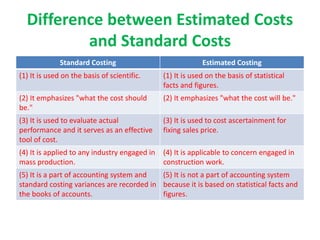
Difference between Estimated Costs
and Standard Costs
Standard Costing Estimated Costing
(1) It is used on the basis of scientific. (1) It is used on the basis of statistical
facts and figures.
(2) It emphasizes "what the cost should
be."
(2) It emphasizes "what the cost will be."
(3) It is used to evaluate actual
performance and it serves as an effective
tool of cost.
(3) It is used to cost ascertainment for
fixing sales price.
(4) It is applied to any industry engaged in
mass production.
(4) It is applicable to concern engaged in
construction work.
(5) It is a part of accounting system and
standard costing variances are recorded in
the books of accounts.
(5) It is not a part of accounting system
because it is based on statistical facts and
figures.
Advantages of Standard Costing
• It guides the management to evaluate the production performance.
• It helps the management in fixing standards.
• Standard costing is useful in formulating production planning and
price policies.
• It guides as a measuring rod for determination of variances.
• It facilitates eliminating inefficiencies by taking corrective measures.
• It acts as an effective tool of cost control.
• It helps the management in taking important decisions.
• It facilitates the principle of "Management by Exception."
• Effective cost reporting system is possible.
Limitations of Standard Costing
• Standard costing is expensive and a small concern may not
meet the cost.
• Due to lack of technical aspects, it is difficult to establish
standards.
• Standard costing cannot be applied in the case of a-
concern where non-standardised products are produced.
Fixing of responsibility is 'difficult. Responsibility cannot be
fixed in the case of uncontrollable variances.
• Frequent revision is required while insufficient staff is
incapable of operating this system.
• Adverse psychological effects and frequent technological
changes will not be suitable for standard costing system.
Types of Variances
• Direct Material Cost Variance (DMCV)
• Direct Labour Cost Variance (DLCV)
• Overhead Cost Variance (OCV)
Variance Analysis
• Standard Costing guides as a measuring rod to the management for
determination of "Variances" in order to evaluate the production
performance.
• The term "Variances" may be defined as the difference between
Standard Cost and actual cost for each element of cost incurred
during a particular period.
• The term "Variance Analysis" may be defined as the process of
analyzing variance by subdividing the total variance in such a way
that management can assign responsibility for off-Standard
Performance.
• The variance may be favourable variance or unfavourable variance.
When the actual performance is better than the Standard, it resents
"Favourable Variance." Similarly, where actual performance is
below the standard it is called as "Unfavourable Variance."
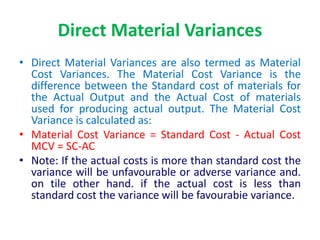
Direct Material Variances
• Direct Material Variances are also termed as Material
Cost Variances. The Material Cost Variance is the
difference between the Standard cost of materials for
the Actual Output and the Actual Cost of materials
used for producing actual output. The Material Cost
Variance is calculated as:
• Material Cost Variance = Standard Cost - Actual Cost
MCV = SC-AC
• Note: If the actual costs is more than standard cost the
variance will be unfavourable or adverse variance and.
on tile other hand. if the actual cost is less than
standard cost the variance will be favourabie variance.
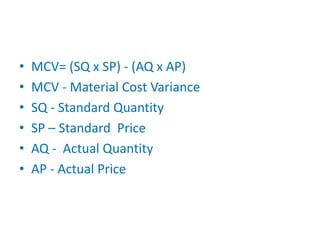
• MCV= (SQ x SP) - (AQ x AP)
• MCV - Material Cost Variance
• SQ - Standard Quantity
• SP – Standard Price
• AQ - Actual Quantity
• AP - Actual Price
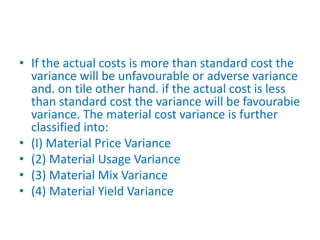
• If the actual costs is more than standard cost the
variance will be unfavourable or adverse variance
and. on tile other hand. if the actual cost is less
than standard cost the variance will be favourabie
variance. The material cost variance is further
classified into:
• (I) Material Price Variance
• (2) Material Usage Variance
• (3) Material Mix Variance
• (4) Material Yield Variance
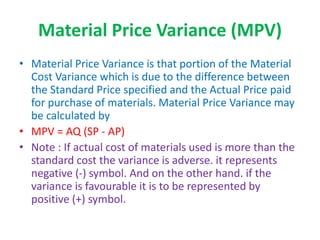
Material Price Variance (MPV)
• Material Price Variance is that portion of the Material
Cost Variance which is due to the difference between
the Standard Price specified and the Actual Price paid
for purchase of materials. Material Price Variance may
be calculated by
• MPV = AQ (SP - AP)
• Note : If actual cost of materials used is more than the
standard cost the variance is adverse. it represents
negative (-) symbol. And on the other hand. if the
variance is favourable it is to be represented by
positive (+) symbol.
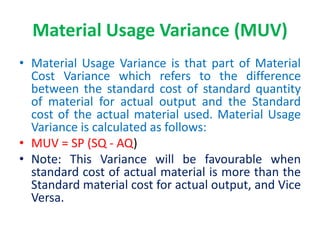
Material Usage Variance (MUV)
• Material Usage Variance is that part of Material
Cost Variance which refers to the difference
between the standard cost of standard quantity
of material for actual output and the Standard
cost of the actual material used. Material Usage
Variance is calculated as follows:
• MUV = SP (SQ - AQ)
• Note: This Variance will be favourable when
standard cost of actual material is more than the
Standard material cost for actual output, and Vice
Versa.
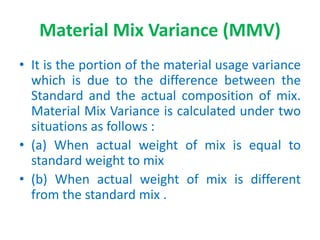
Material Mix Variance (MMV)
• It is the portion of the material usage variance
which is due to the difference between the
Standard and the actual composition of mix.
Material Mix Variance is calculated under two
situations as follows :
• (a) When actual weight of mix is equal to
standard weight to mix
• (b) When actual weight of mix is different
from the standard mix .
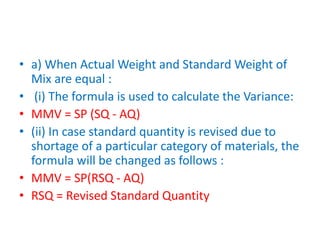
• a) When Actual Weight and Standard Weight of
Mix are equal :
• (i) The formula is used to calculate the Variance:
• MMV = SP (SQ - AQ)
• (ii) In case standard quantity is revised due to
shortage of a particular category of materials, the
formula will be changed as follows :
• MMV = SP(RSQ - AQ)
• RSQ = Revised Standard Quantity
Materials Yield Variance (MYV)
• It is the portion of Material Usage Variance. This
variance arises due to spoilage, low quality of
materials and defective production planning etc.
Materials Yield Variance may be defined as "the
difference between the Standard Yield Specified
and the Actual Yield Obtained." This variance may
be calculated as under:
• Material Yield Variance =Standard Rate x { Actual
Yield -Standard Yield }
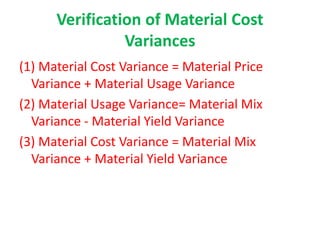
Verification of Material Cost
Variances
(1) Material Cost Variance = Material Price
Variance + Material Usage Variance
(2) Material Usage Variance= Material Mix
Variance - Material Yield Variance
(3) Material Cost Variance = Material Mix
Variance + Material Yield Variance
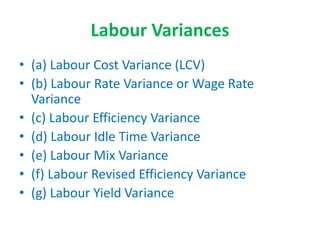
Labour Variances
• (a) Labour Cost Variance (LCV)
• (b) Labour Rate Variance or Wage Rate
Variance
• (c) Labour Efficiency Variance
• (d) Labour Idle Time Variance
• (e) Labour Mix Variance
• (f) Labour Revised Efficiency Variance
• (g) Labour Yield Variance
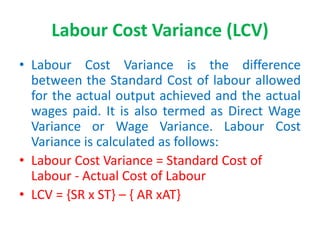
Labour Cost Variance (LCV)
• Labour Cost Variance is the difference
between the Standard Cost of labour allowed
for the actual output achieved and the actual
wages paid. It is also termed as Direct Wage
Variance or Wage Variance. Labour Cost
Variance is calculated as follows:
• Labour Cost Variance = Standard Cost of
Labour - Actual Cost of Labour
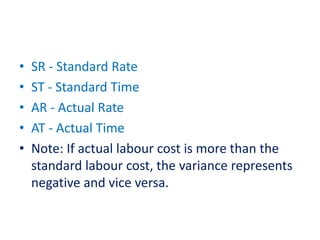
• LCV = {SR x ST} – { AR xAT}
• SR - Standard Rate
• ST - Standard Time
• AR - Actual Rate
• AT - Actual Time
• Note: If actual labour cost is more than the
standard labour cost, the variance represents
negative and vice versa.
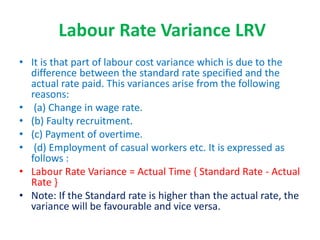
Labour Rate Variance LRV
• It is that part of labour cost variance which is due to the
difference between the standard rate specified and the
actual rate paid. This variances arise from the following
reasons:
• (a) Change in wage rate.
• (b) Faulty recruitment.
• (c) Payment of overtime.
• (d) Employment of casual workers etc. It is expressed as
follows :
• Labour Rate Variance = Actual Time { Standard Rate - Actual
Rate }
• Note: If the Standard rate is higher than the actual rate, the
variance will be favourable and vice versa.
Labour Idle Time Variance LTV
• Labour Idle Time Variance arises due to
abnormal situations like strikes, lockout,
breakdown of machinery etc. In other words,
idle time occurs due to the difference
between the time for which workers are paid
and that which they actually expend upon
production. It is calculated as follows :
• Idle Time Variance = Idle Hours x Standard
Rate
Labour Mix Variance LMV
• It is otherwise known as Gang Composition
Variance. This variance arises due to the
differences between the actual gang composition
than the standard gang composition. Labour Mix
Variance is calculated in the same way of
Materials Mix Variance. This variance is calculated
in two ways:
• Labour Mix Variance = { Standard Cost of
Standard Labour Mix - Standard Cost of Actual
Labour Mix
• Labour Yield Variance: 'This variance is calculated in the
same way as Material Yield Variance. Labour Yield Variance
arises due to the variation in labour cost on account of
increase or decrease in yield or output as compared to
relative standard. The formula for this purpose is as follows:
• Labour Yield Variance = Standard Labour Cost per unit of
output x { Standard output for Actual Time - Actual Output}
• Note: If actual output is more than Standard output for
actual time, the variance is favourable and vice versa.
• Verification: Labour Cost Variance = Labour Rate Variance +
Labour Efficiency Variance

Standard costing PPT

  • 1.
    P. MURUGAN M.Com[CA]., M.Phil., SET., [P.hD] Assistant Professor in B.Com (CA) Vivekananda College Tiruvedakam West Madurai.
  • 2.
    Standard cost • Theword "Standard" means a "Yardstick" or "Bench Mark." The term "Standard Costs" refers to Pre- determined costs. Brown and Howard define Standard Cost as a Pre-determined Cost which determines what each product or service should cost under given circumstances. • This definition states that standard costs represent planned cost of a product. Standard Cost as defined by the Institute of Cost and Management Accountant, London "is the Predetermined Cost based on technical estimate for materials, labour and overhead for a selected period of time and for a prescribed set of working conditions."
  • 3.
    Standard Costing • StandardCosting is a concept of accounting for determination of standard for each element of costs. These predetermined costs are compared with actual costs to find out the deviations known as "Variances." Identification and analysis of causes for such variances and remedial measures should be taken in order to overcome the reasons for Variances.
  • 4.
    The Technique ofStandard Costing • Determination of appropriate standards for each element of cost. • Ascertainment of information about actual and use of Standard Costs. • Comparison of actual costs with Standard Costs, the differences known as Variances. • Analysis of Variances to find out the causes of Variances. • Reporting to the responsible authority for taking remedial measures.
  • 5.
    Difference between EstimatedCosts and Standard Costs Standard Costing Estimated Costing (1) It is used on the basis of scientific. (1) It is used on the basis of statistical facts and figures. (2) It emphasizes "what the cost should be." (2) It emphasizes "what the cost will be." (3) It is used to evaluate actual performance and it serves as an effective tool of cost. (3) It is used to cost ascertainment for fixing sales price. (4) It is applied to any industry engaged in mass production. (4) It is applicable to concern engaged in construction work. (5) It is a part of accounting system and standard costing variances are recorded in the books of accounts. (5) It is not a part of accounting system because it is based on statistical facts and figures.
  • 6.
    Advantages of StandardCosting • It guides the management to evaluate the production performance. • It helps the management in fixing standards. • Standard costing is useful in formulating production planning and price policies. • It guides as a measuring rod for determination of variances. • It facilitates eliminating inefficiencies by taking corrective measures. • It acts as an effective tool of cost control. • It helps the management in taking important decisions. • It facilitates the principle of "Management by Exception." • Effective cost reporting system is possible.
  • 7.
    Limitations of StandardCosting • Standard costing is expensive and a small concern may not meet the cost. • Due to lack of technical aspects, it is difficult to establish standards. • Standard costing cannot be applied in the case of a- concern where non-standardised products are produced. Fixing of responsibility is 'difficult. Responsibility cannot be fixed in the case of uncontrollable variances. • Frequent revision is required while insufficient staff is incapable of operating this system. • Adverse psychological effects and frequent technological changes will not be suitable for standard costing system.
  • 8.
    Types of Variances •Direct Material Cost Variance (DMCV) • Direct Labour Cost Variance (DLCV) • Overhead Cost Variance (OCV)
  • 9.
    Variance Analysis • StandardCosting guides as a measuring rod to the management for determination of "Variances" in order to evaluate the production performance. • The term "Variances" may be defined as the difference between Standard Cost and actual cost for each element of cost incurred during a particular period. • The term "Variance Analysis" may be defined as the process of analyzing variance by subdividing the total variance in such a way that management can assign responsibility for off-Standard Performance. • The variance may be favourable variance or unfavourable variance. When the actual performance is better than the Standard, it resents "Favourable Variance." Similarly, where actual performance is below the standard it is called as "Unfavourable Variance."
  • 10.
    Direct Material Variances •Direct Material Variances are also termed as Material Cost Variances. The Material Cost Variance is the difference between the Standard cost of materials for the Actual Output and the Actual Cost of materials used for producing actual output. The Material Cost Variance is calculated as: • Material Cost Variance = Standard Cost - Actual Cost MCV = SC-AC • Note: If the actual costs is more than standard cost the variance will be unfavourable or adverse variance and. on tile other hand. if the actual cost is less than standard cost the variance will be favourabie variance.
  • 11.
    • MCV= (SQx SP) - (AQ x AP) • MCV - Material Cost Variance • SQ - Standard Quantity • SP – Standard Price • AQ - Actual Quantity • AP - Actual Price
  • 12.
    • If theactual costs is more than standard cost the variance will be unfavourable or adverse variance and. on tile other hand. if the actual cost is less than standard cost the variance will be favourabie variance. The material cost variance is further classified into: • (I) Material Price Variance • (2) Material Usage Variance • (3) Material Mix Variance • (4) Material Yield Variance
  • 13.
    Material Price Variance(MPV) • Material Price Variance is that portion of the Material Cost Variance which is due to the difference between the Standard Price specified and the Actual Price paid for purchase of materials. Material Price Variance may be calculated by • MPV = AQ (SP - AP) • Note : If actual cost of materials used is more than the standard cost the variance is adverse. it represents negative (-) symbol. And on the other hand. if the variance is favourable it is to be represented by positive (+) symbol.
  • 14.
    Material Usage Variance(MUV) • Material Usage Variance is that part of Material Cost Variance which refers to the difference between the standard cost of standard quantity of material for actual output and the Standard cost of the actual material used. Material Usage Variance is calculated as follows: • MUV = SP (SQ - AQ) • Note: This Variance will be favourable when standard cost of actual material is more than the Standard material cost for actual output, and Vice Versa.
  • 15.
    Material Mix Variance(MMV) • It is the portion of the material usage variance which is due to the difference between the Standard and the actual composition of mix. Material Mix Variance is calculated under two situations as follows : • (a) When actual weight of mix is equal to standard weight to mix • (b) When actual weight of mix is different from the standard mix .
  • 16.
    • a) WhenActual Weight and Standard Weight of Mix are equal : • (i) The formula is used to calculate the Variance: • MMV = SP (SQ - AQ) • (ii) In case standard quantity is revised due to shortage of a particular category of materials, the formula will be changed as follows : • MMV = SP(RSQ - AQ) • RSQ = Revised Standard Quantity
  • 17.
    Materials Yield Variance(MYV) • It is the portion of Material Usage Variance. This variance arises due to spoilage, low quality of materials and defective production planning etc. Materials Yield Variance may be defined as "the difference between the Standard Yield Specified and the Actual Yield Obtained." This variance may be calculated as under: • Material Yield Variance =Standard Rate x { Actual Yield -Standard Yield }
  • 18.
    Verification of MaterialCost Variances (1) Material Cost Variance = Material Price Variance + Material Usage Variance (2) Material Usage Variance= Material Mix Variance - Material Yield Variance (3) Material Cost Variance = Material Mix Variance + Material Yield Variance
  • 19.
    Labour Variances • (a)Labour Cost Variance (LCV) • (b) Labour Rate Variance or Wage Rate Variance • (c) Labour Efficiency Variance • (d) Labour Idle Time Variance • (e) Labour Mix Variance • (f) Labour Revised Efficiency Variance • (g) Labour Yield Variance
  • 20.
    Labour Cost Variance(LCV) • Labour Cost Variance is the difference between the Standard Cost of labour allowed for the actual output achieved and the actual wages paid. It is also termed as Direct Wage Variance or Wage Variance. Labour Cost Variance is calculated as follows: • Labour Cost Variance = Standard Cost of Labour - Actual Cost of Labour • LCV = {SR x ST} – { AR xAT}
  • 21.
    • SR -Standard Rate • ST - Standard Time • AR - Actual Rate • AT - Actual Time • Note: If actual labour cost is more than the standard labour cost, the variance represents negative and vice versa.
  • 22.
    Labour Rate VarianceLRV • It is that part of labour cost variance which is due to the difference between the standard rate specified and the actual rate paid. This variances arise from the following reasons: • (a) Change in wage rate. • (b) Faulty recruitment. • (c) Payment of overtime. • (d) Employment of casual workers etc. It is expressed as follows : • Labour Rate Variance = Actual Time { Standard Rate - Actual Rate } • Note: If the Standard rate is higher than the actual rate, the variance will be favourable and vice versa.
  • 23.
    Labour Idle TimeVariance LTV • Labour Idle Time Variance arises due to abnormal situations like strikes, lockout, breakdown of machinery etc. In other words, idle time occurs due to the difference between the time for which workers are paid and that which they actually expend upon production. It is calculated as follows : • Idle Time Variance = Idle Hours x Standard Rate
  • 24.
    Labour Mix VarianceLMV • It is otherwise known as Gang Composition Variance. This variance arises due to the differences between the actual gang composition than the standard gang composition. Labour Mix Variance is calculated in the same way of Materials Mix Variance. This variance is calculated in two ways: • Labour Mix Variance = { Standard Cost of Standard Labour Mix - Standard Cost of Actual Labour Mix
  • 25.
    • Labour YieldVariance: 'This variance is calculated in the same way as Material Yield Variance. Labour Yield Variance arises due to the variation in labour cost on account of increase or decrease in yield or output as compared to relative standard. The formula for this purpose is as follows: • Labour Yield Variance = Standard Labour Cost per unit of output x { Standard output for Actual Time - Actual Output} • Note: If actual output is more than Standard output for actual time, the variance is favourable and vice versa. • Verification: Labour Cost Variance = Labour Rate Variance + Labour Efficiency Variance