4 E’s to Addressing Corporate
Strategy
Extend
Expand
Exit
Enhance
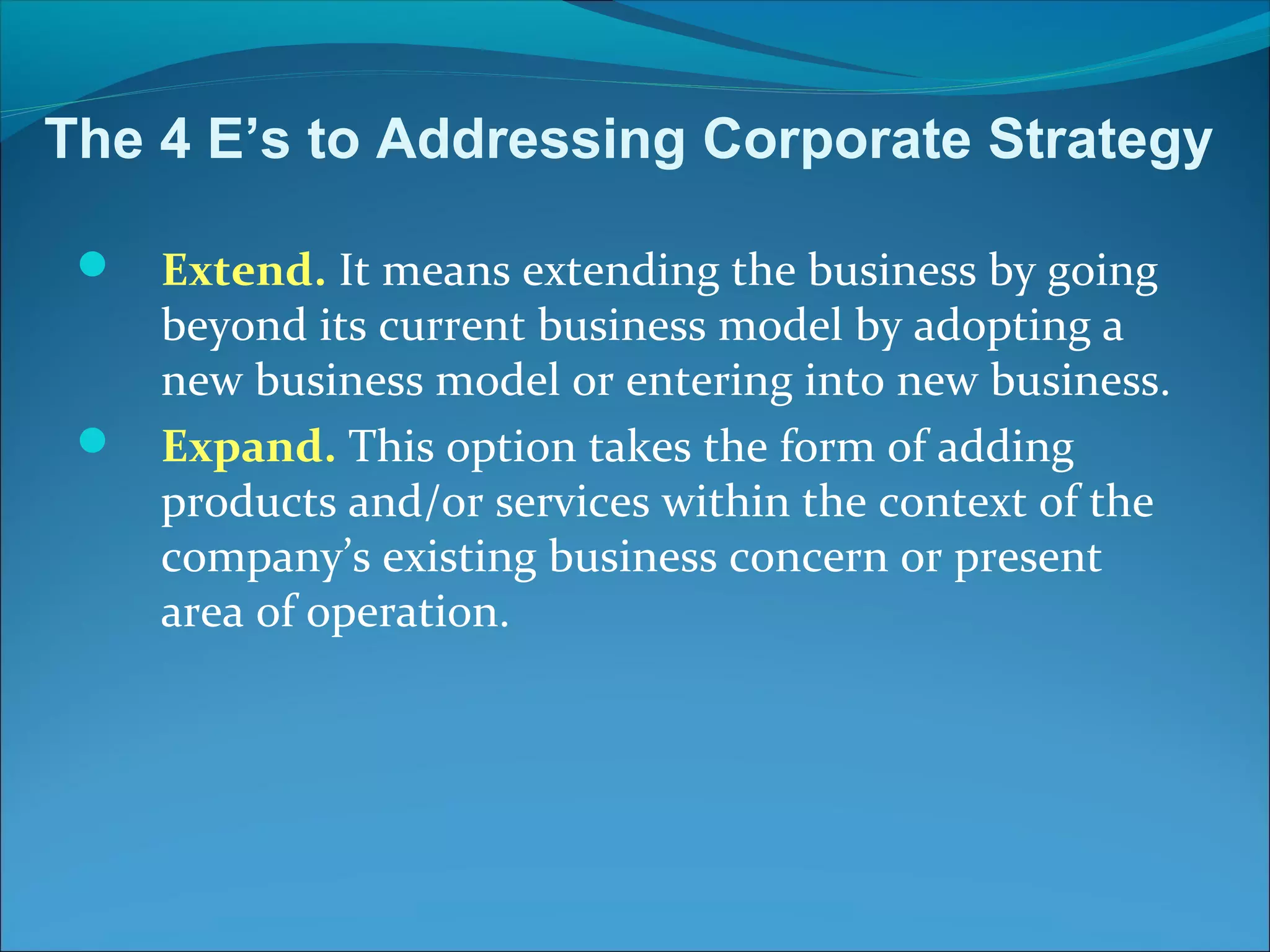
The 4 E’s to Addressing Corporate Strategy
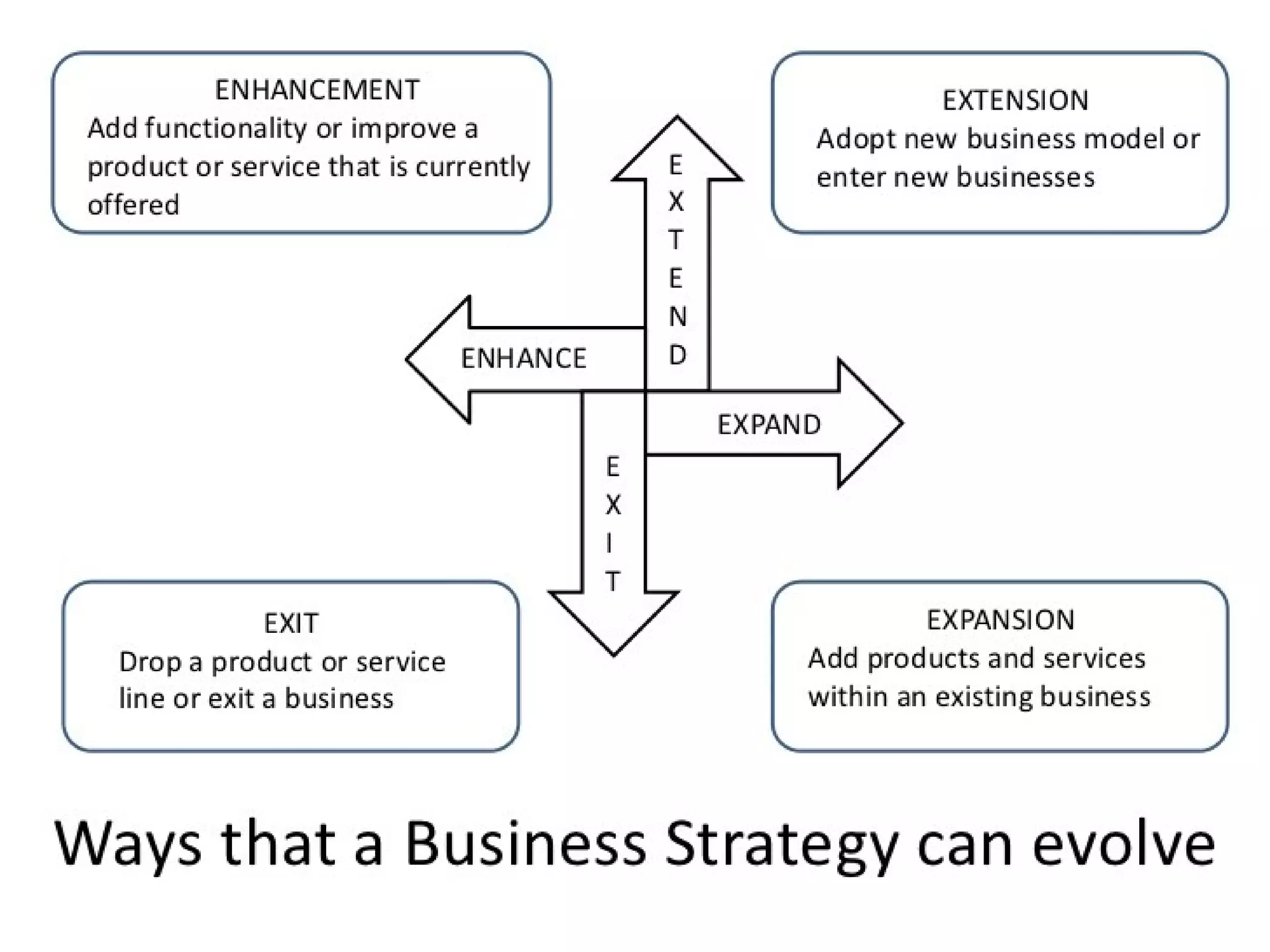
 Extend. It means extending the business by going
beyond its current business model by adopting a
new business model or entering into new business.
 Expand. This option takes the form of adding
products and/or services within the context of the
company’s existing business concern or present
area of operation.
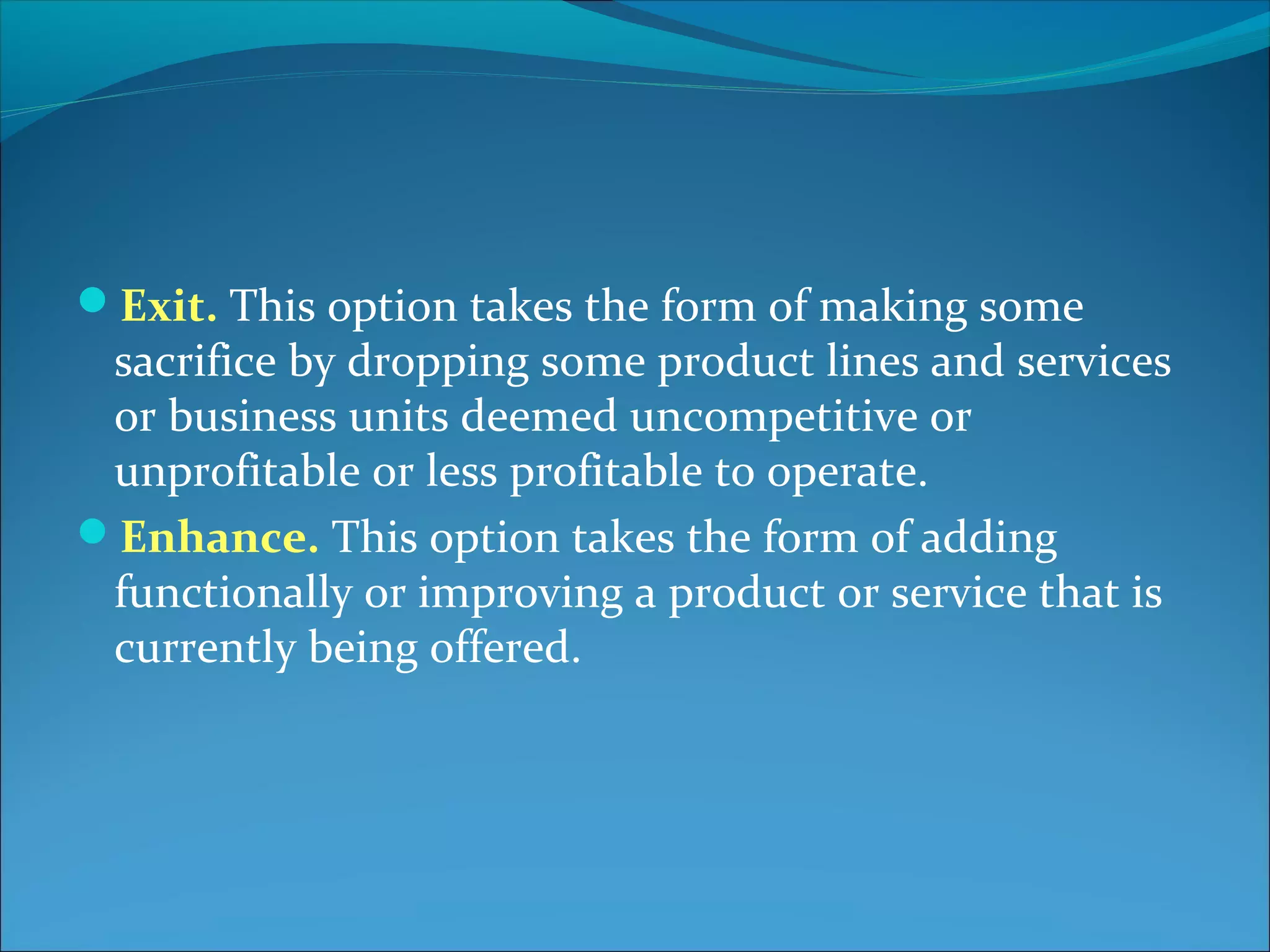
Exit. This option takes the form of making some
sacrifice by dropping some product lines and services
or business units deemed uncompetitive or
unprofitable or less profitable to operate.
Enhance. This option takes the form of adding
functionally or improving a product or service that is
currently being offered.
Key Issues is Corporate Level Strategy
Directional Strategy: The firm’s overall orientation
towards growth, stability or retrenchment
Portfolio Strategy: The industries or markets in which
the firm competes through its products and business
units.
Parenting Strategy: The manner in which management
coordinates activities, the transfers resources, and
cultivates capabilities among product lines and business
units
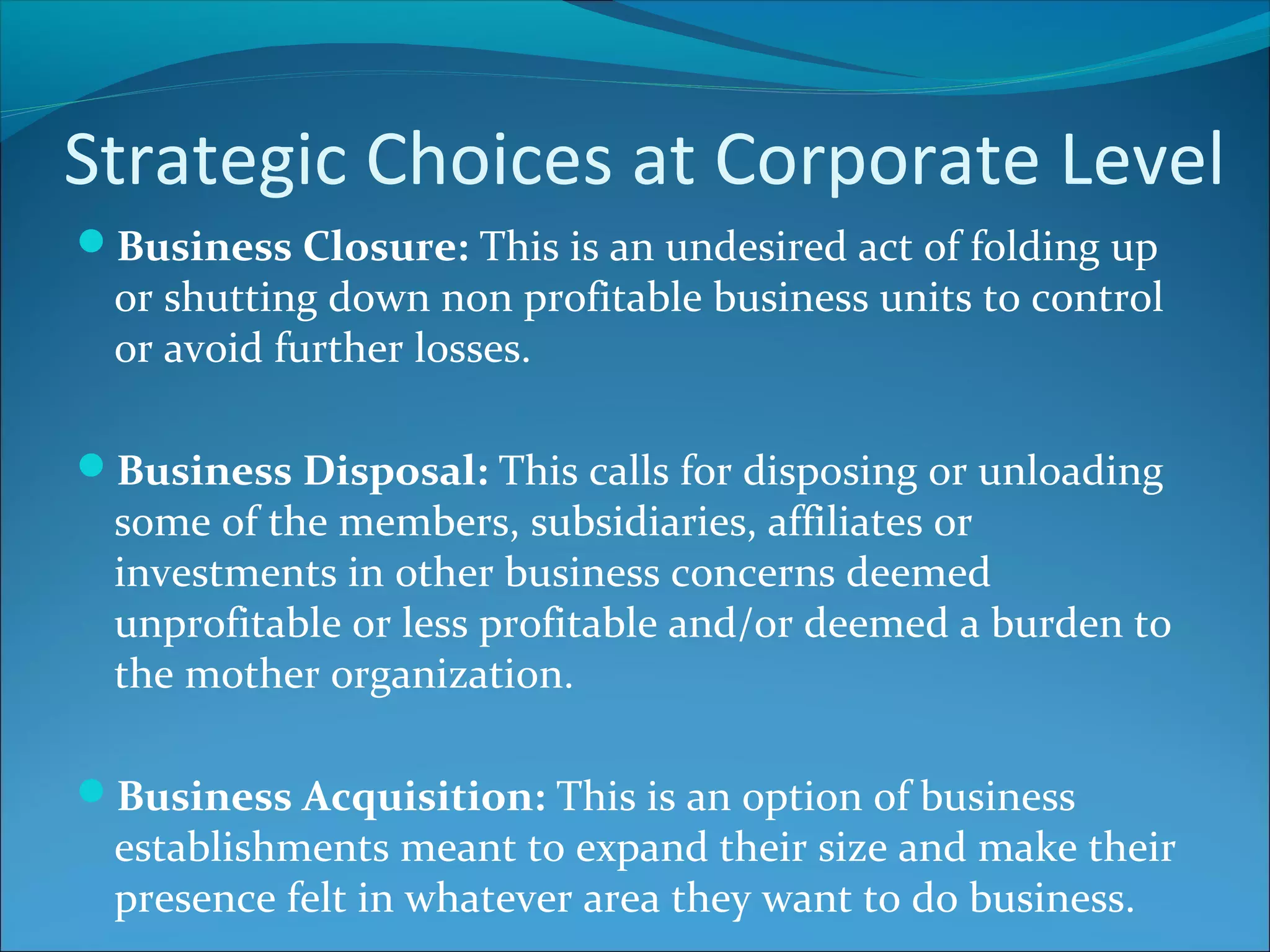
Strategic Choices at Corporate Level
Business Closure: This is an undesired act of folding up
or shutting down non profitable business units to control
or avoid further losses.
Business Disposal: This calls for disposing or unloading
some of the members, subsidiaries, affiliates or
investments in other business concerns deemed
unprofitable or less profitable and/or deemed a burden to
the mother organization.
Business Acquisition: This is an option of business
establishments meant to expand their size and make their
presence felt in whatever area they want to do business.
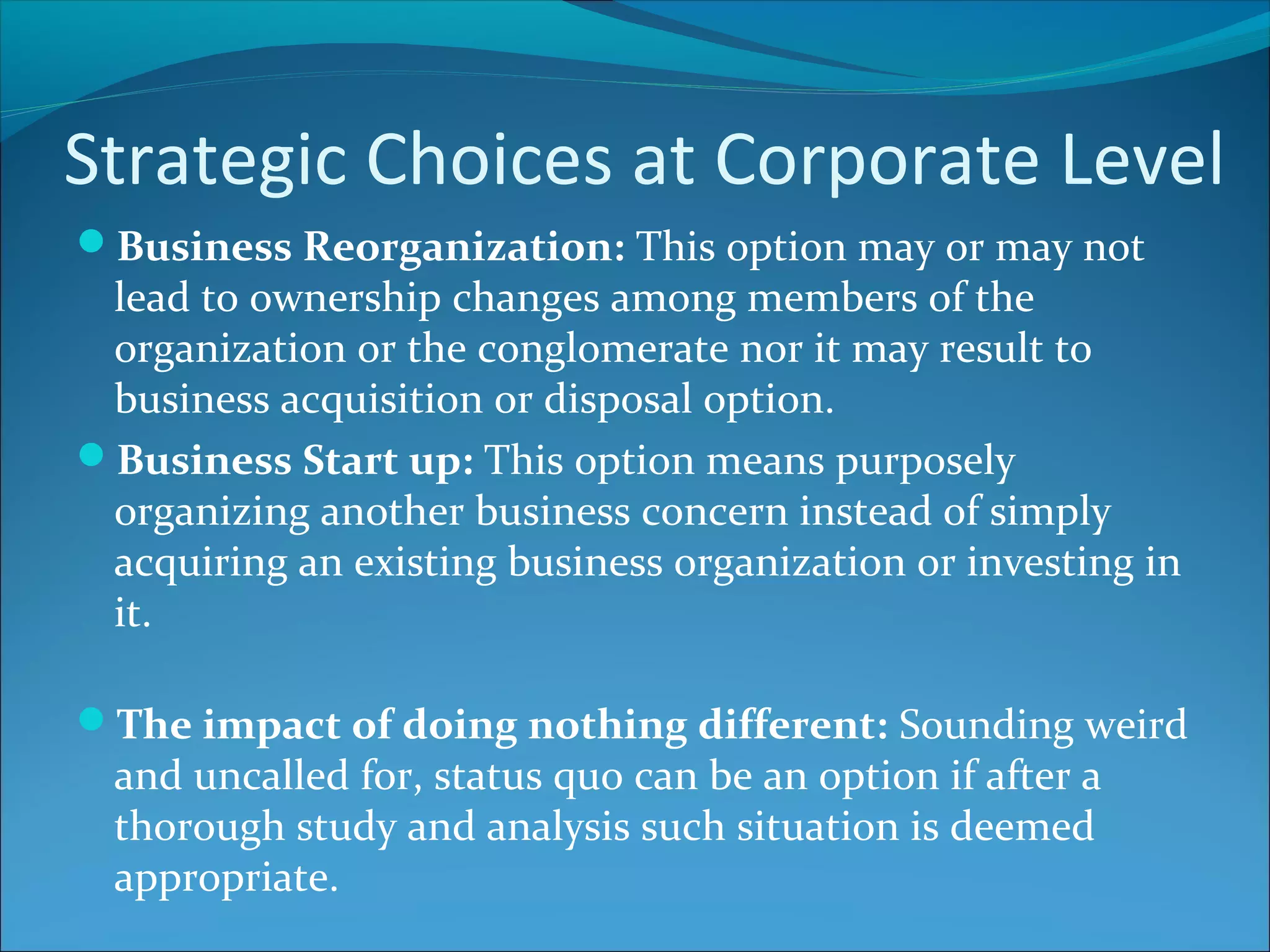
Strategic Choices at Corporate Level
Business Reorganization: This option may or may not
lead to ownership changes among members of the
organization or the conglomerate nor it may result to
business acquisition or disposal option.
Business Start up: This option means purposely
organizing another business concern instead of simply
acquiring an existing business organization or investing in
it.
The impact of doing nothing different: Sounding weird
and uncalled for, status quo can be an option if after a
thorough study and analysis such situation is deemed
appropriate.
Basic Model for Integration and Diversification Options
V
E
R
T
I
C
A
L
I
N
T
E
G
R
A
T
I
O
N
The
Compan
y
Horizontal
integration
Forward
integration
Backward
integration
Horizontal
diversification
Horizontal integration/diversification
Customers/End
Users
Suppliers
Vertical integrationVertical integration
It iIt is the degree to which a firm owns its upstream
suppliers and its downstream buyers.
The term VI describes a style of management control.
Involves engaging in business activities to the level of
sources of supply or forward in the direction of final
consumers.
Vertical integrationVertical integration
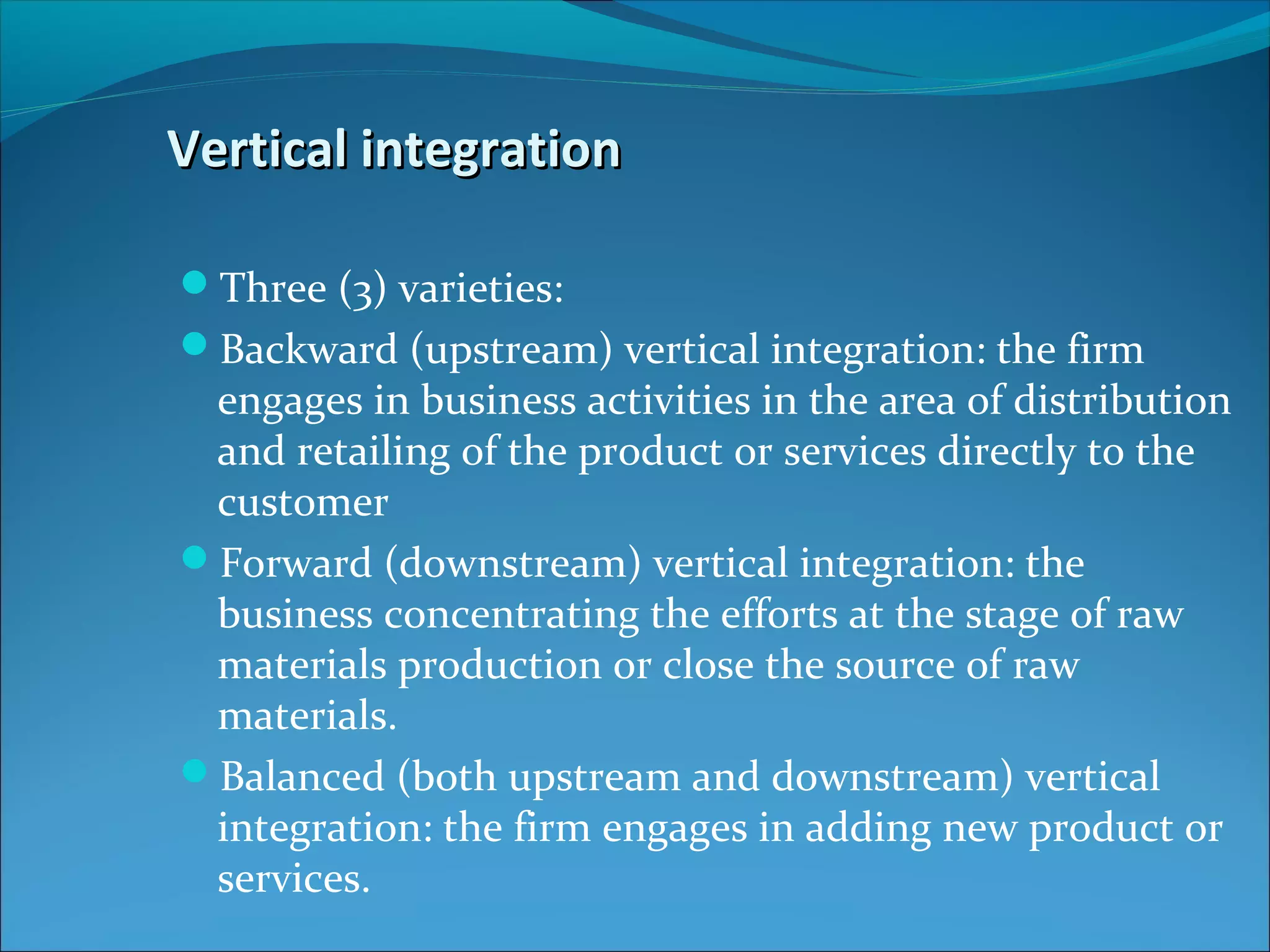
Three (3) varieties:
Backward (upstream) vertical integration: the firm
engages in business activities in the area of distribution
and retailing of the product or services directly to the
customer
Forward (downstream) vertical integration: the
business concentrating the efforts at the stage of raw
materials production or close the source of raw
materials.
Balanced (both upstream and downstream) vertical
integration: the firm engages in adding new product or
services.
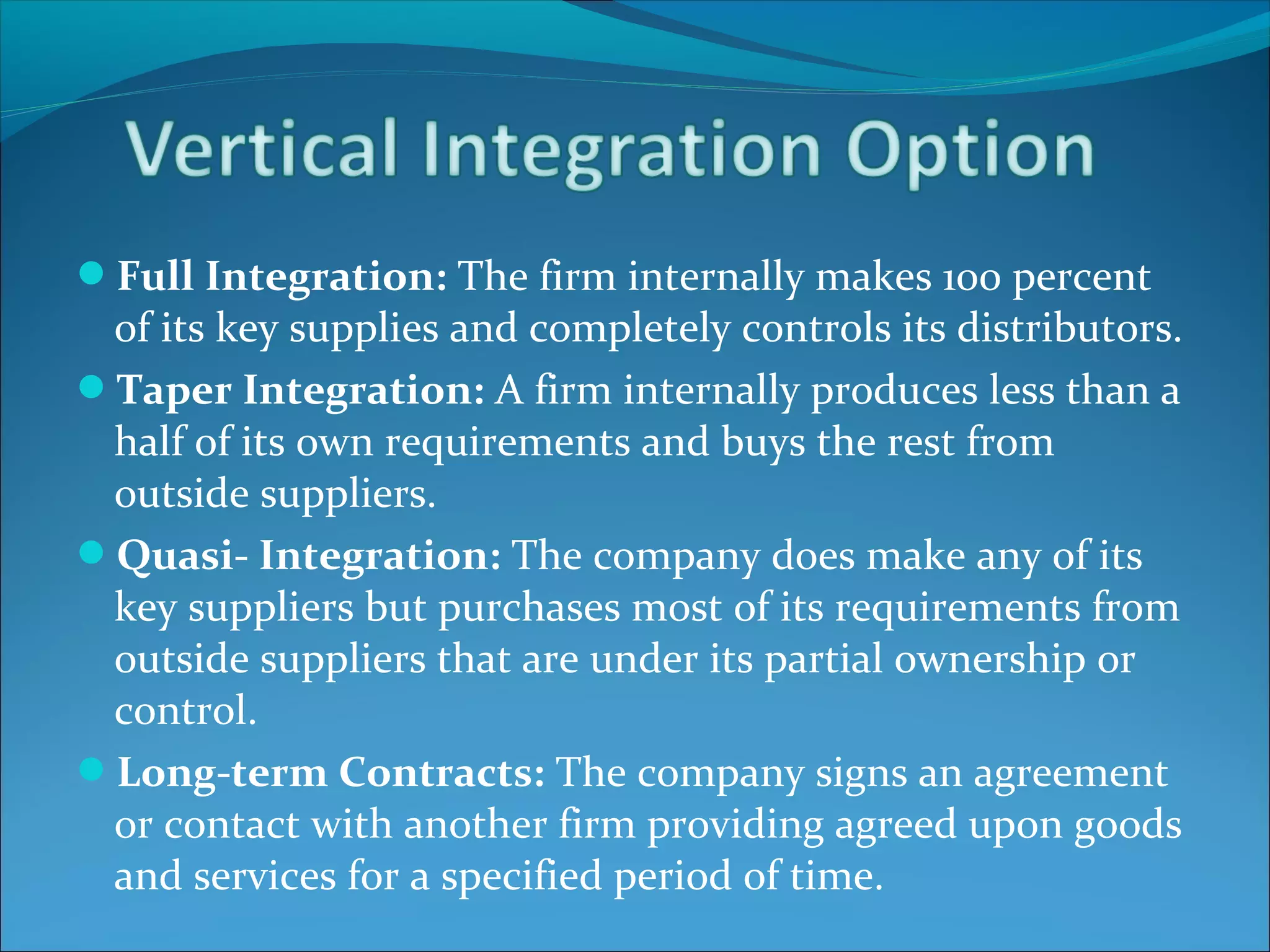
Full Integration: The firm internally makes 100 percent
of its key supplies and completely controls its distributors.
Taper Integration: A firm internally produces less than a
half of its own requirements and buys the rest from
outside suppliers.
Quasi- Integration: The company does make any of its
key suppliers but purchases most of its requirements from
outside suppliers that are under its partial ownership or
control.
Long-term Contracts: The company signs an agreement
or contact with another firm providing agreed upon goods
and services for a specified period of time.
Horizontal integrationHorizontal integration
It is a strategy where a company acquires, mergers or
takes over another company in the same industry
value chain.
Merger is the joining of two similar sizes,
independent companies to make one joint entity.
Acquisition is the purchase of another company.
Hostile takeover is the acquisition of the company,
which does not want to be acquired.
Horizontal Diversification
Generally perceived as a strategy that
evolves
around the idea of seeking ownership or
increased control over the direct and indirect
competitors of the business.
Direct and Indirect competitors
Direct competitors can be classified as:
Offering the same products and/or services as you are
offering to your clients and/or customers.
Having the same targeted field of clients, customers
and/or demographics.
Using the same tactics in advertising or bringing
news/informations of products/services to your targeted
demographics.
Indirect competitors can be classified as “wanting to
have a share of the pie”
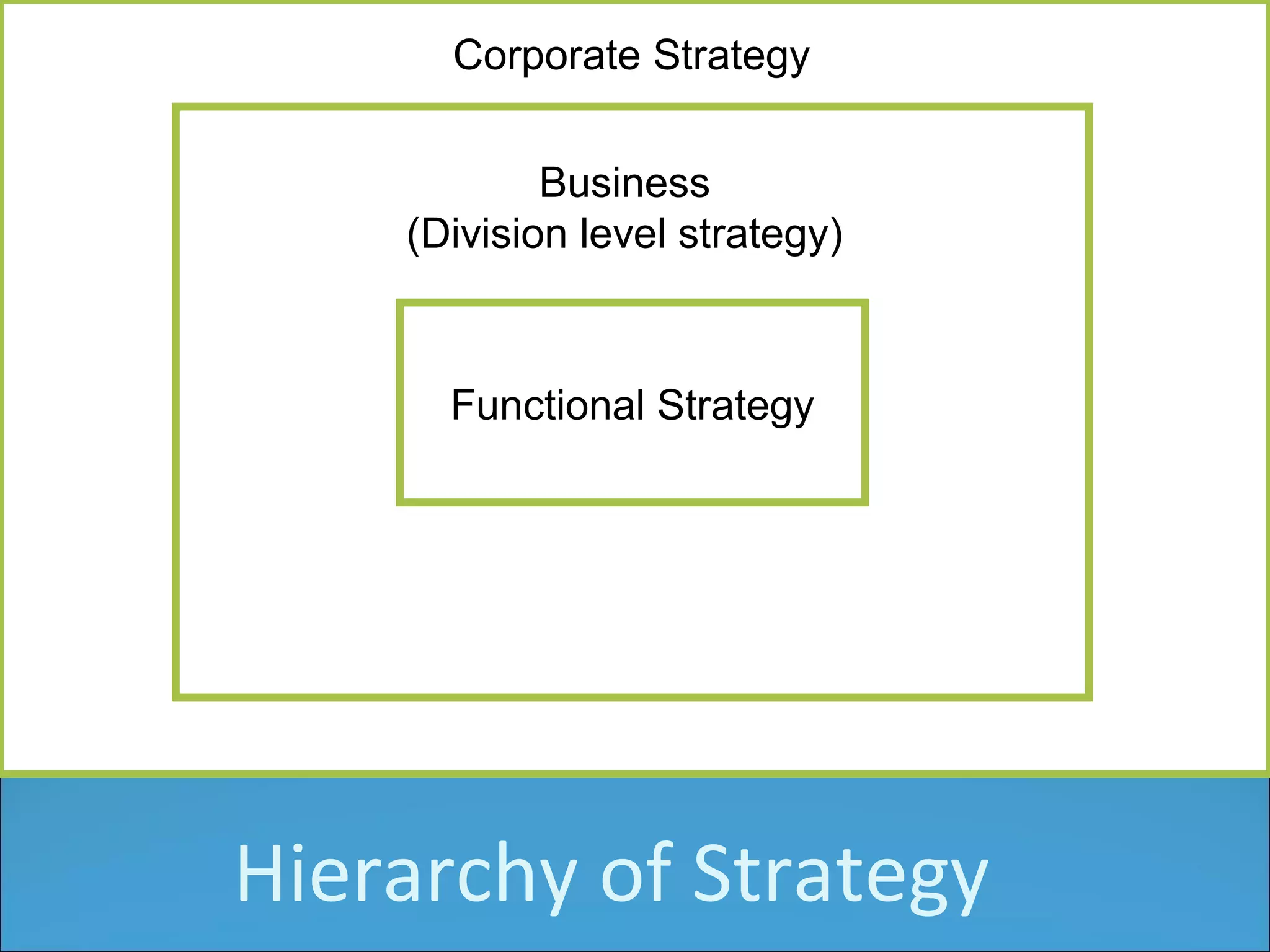
Hierarchy of Strategy
Functional Strategy
Corporate Strategy
Business
(Division level strategy)
Corporate strategy —this strategy seeks to determine
what businesses a company should be in or wants to be in.
Corporate strategy determines the direction that the
organization is going and the roles that each business unit
in the organization will plan in pursuing that direction.
Business strategy —this strategy seeks to determine how
an organization should compete in each of its businesses.
Functional strategy —this strategy seeks to determine
how to support the business strategy.
• Conglomerate Diversification: Involves in dealing
with product s or services that have nothing to do or
not related to the kind of product or services it is
presently dealing with.
• Concentric Diversification: involves in dealing with
the product or services that are somehow related with
what the firm is presently handling
Situations favouring conglomerate
diversification
In an effort to extend growth beyond its turf, large
companies dream of expanding their image beyond profit
objectives .
Fame and corporate image beyond the boundaries of the
industry or sector they are known for are among the
motivations that drive corporate giants to go into
conglomerate diversification.
Concentric Diversification
It is a corporate diversification option that involves
engaging or dealing with products or services that are
somehow related to or associated with what the firm
is presently handling.
Situations favouring concentric
diversification
When an organization competes in a no-growth or a
slow-growth industry;
When adding new, but related products significantly
would enhance the sales of current products;
When new, but related, products could be offered at
highly competitive prices;
 When new, but related, products have seasonal sales
levels that counterbalance an organization’s existing
peaks and valley;
When an organization’s products are currently in the
decline stage of the product life cycle; and
When an organization has a strong management team.
The Need for Strategic Fit
Product Fit: Is achieved when distribution channels, sales
forces, promotion techniques, or customers can be handled
at the same time for more than one product or service.
Operating Fit: Involves economies being realized in certain
areas like purchasing, warehousing, production and
operations, research and development, or personnel from
more than one product or services.
Management Fit: Occurs when managers are given
responsibility over areas of accumulated exposure from one
line of business to another.
Directions of Corporate Level Strategies
Growth Strategy expands the company’s
activities
Stability Strategies make no chance to the
company’s current activities
Retrenchment Strategies reduce the company’s
level of activities
Growth Strategy Options
Merger- Involves a transaction involving two or more
corporations in which a stock is exchanged or swapped
among independent business organizations from which
only one company services
Acquisition- Is an option that involves the purchase of a
company then completely absorbed as in operating
subsidiary or division of the acquiring corporation.
Strategic alliance- is another option involving a
partnership among two or more corporations or business
units to achieved strategically significant objectives that
are mutually beneficial.
Stability Strategies
Pause/proceed with caution: This is in effect, a sort
of time out. It is an opportunity to rest before
continuing a growth or retrenchment strategy.
No change strategy: It involves a decision to do
nothing new.
Profit strategy: It involves a decision to do nothing
new in a worsening situation and instead, to act as
though the company’s problems are only temporary.
Retrenchment strategies
Turnaround strategy: This strategy emphasizes on the
improvement of operational efficiency and is probably most
appropriate when a corporation’s problems are pervasive but
not yet critical.
Contraction
Consolidation
Sell-out/Divestment strategy: This strategy is resorted to
when a company has a weak competitive position in its
industry.
Bankruptcy strategy: Involves giving up management of
the firm to the courts in return for some settlement of the
corporation’s obligations.
Liquidation strategy: Is the termination of the firm’s
business operation.

4 E of corporate strategy

  • 1.
    4 E’s toAddressing Corporate Strategy Extend Expand Exit Enhance
  • 2.
    The 4 E’sto Addressing Corporate Strategy  Extend. It means extending the business by going beyond its current business model by adopting a new business model or entering into new business.  Expand. This option takes the form of adding products and/or services within the context of the company’s existing business concern or present area of operation.
  • 3.
    Exit. This optiontakes the form of making some sacrifice by dropping some product lines and services or business units deemed uncompetitive or unprofitable or less profitable to operate. Enhance. This option takes the form of adding functionally or improving a product or service that is currently being offered.
  • 5.
    Key Issues isCorporate Level Strategy Directional Strategy: The firm’s overall orientation towards growth, stability or retrenchment Portfolio Strategy: The industries or markets in which the firm competes through its products and business units. Parenting Strategy: The manner in which management coordinates activities, the transfers resources, and cultivates capabilities among product lines and business units
  • 6.
    Strategic Choices atCorporate Level Business Closure: This is an undesired act of folding up or shutting down non profitable business units to control or avoid further losses. Business Disposal: This calls for disposing or unloading some of the members, subsidiaries, affiliates or investments in other business concerns deemed unprofitable or less profitable and/or deemed a burden to the mother organization. Business Acquisition: This is an option of business establishments meant to expand their size and make their presence felt in whatever area they want to do business.
  • 7.
    Strategic Choices atCorporate Level Business Reorganization: This option may or may not lead to ownership changes among members of the organization or the conglomerate nor it may result to business acquisition or disposal option. Business Start up: This option means purposely organizing another business concern instead of simply acquiring an existing business organization or investing in it. The impact of doing nothing different: Sounding weird and uncalled for, status quo can be an option if after a thorough study and analysis such situation is deemed appropriate.
  • 8.
    Basic Model forIntegration and Diversification Options V E R T I C A L I N T E G R A T I O N The Compan y Horizontal integration Forward integration Backward integration Horizontal diversification Horizontal integration/diversification Customers/End Users Suppliers
  • 9.
    Vertical integrationVertical integration ItiIt is the degree to which a firm owns its upstream suppliers and its downstream buyers. The term VI describes a style of management control. Involves engaging in business activities to the level of sources of supply or forward in the direction of final consumers.
  • 10.
    Vertical integrationVertical integration Three(3) varieties: Backward (upstream) vertical integration: the firm engages in business activities in the area of distribution and retailing of the product or services directly to the customer Forward (downstream) vertical integration: the business concentrating the efforts at the stage of raw materials production or close the source of raw materials. Balanced (both upstream and downstream) vertical integration: the firm engages in adding new product or services.
  • 11.
    Full Integration: Thefirm internally makes 100 percent of its key supplies and completely controls its distributors. Taper Integration: A firm internally produces less than a half of its own requirements and buys the rest from outside suppliers. Quasi- Integration: The company does make any of its key suppliers but purchases most of its requirements from outside suppliers that are under its partial ownership or control. Long-term Contracts: The company signs an agreement or contact with another firm providing agreed upon goods and services for a specified period of time.
  • 12.
    Horizontal integrationHorizontal integration Itis a strategy where a company acquires, mergers or takes over another company in the same industry value chain. Merger is the joining of two similar sizes, independent companies to make one joint entity. Acquisition is the purchase of another company. Hostile takeover is the acquisition of the company, which does not want to be acquired.
  • 13.
    Horizontal Diversification Generally perceivedas a strategy that evolves around the idea of seeking ownership or increased control over the direct and indirect competitors of the business.
  • 14.
    Direct and Indirectcompetitors Direct competitors can be classified as: Offering the same products and/or services as you are offering to your clients and/or customers. Having the same targeted field of clients, customers and/or demographics. Using the same tactics in advertising or bringing news/informations of products/services to your targeted demographics. Indirect competitors can be classified as “wanting to have a share of the pie”
  • 15.
    Hierarchy of Strategy FunctionalStrategy Corporate Strategy Business (Division level strategy)
  • 16.
    Corporate strategy —thisstrategy seeks to determine what businesses a company should be in or wants to be in. Corporate strategy determines the direction that the organization is going and the roles that each business unit in the organization will plan in pursuing that direction. Business strategy —this strategy seeks to determine how an organization should compete in each of its businesses. Functional strategy —this strategy seeks to determine how to support the business strategy.
  • 17.
    • Conglomerate Diversification:Involves in dealing with product s or services that have nothing to do or not related to the kind of product or services it is presently dealing with. • Concentric Diversification: involves in dealing with the product or services that are somehow related with what the firm is presently handling
  • 18.
    Situations favouring conglomerate diversification Inan effort to extend growth beyond its turf, large companies dream of expanding their image beyond profit objectives . Fame and corporate image beyond the boundaries of the industry or sector they are known for are among the motivations that drive corporate giants to go into conglomerate diversification.
  • 19.
    Concentric Diversification It isa corporate diversification option that involves engaging or dealing with products or services that are somehow related to or associated with what the firm is presently handling.
  • 20.
    Situations favouring concentric diversification Whenan organization competes in a no-growth or a slow-growth industry; When adding new, but related products significantly would enhance the sales of current products; When new, but related, products could be offered at highly competitive prices;  When new, but related, products have seasonal sales levels that counterbalance an organization’s existing peaks and valley; When an organization’s products are currently in the decline stage of the product life cycle; and When an organization has a strong management team.
  • 21.
    The Need forStrategic Fit Product Fit: Is achieved when distribution channels, sales forces, promotion techniques, or customers can be handled at the same time for more than one product or service. Operating Fit: Involves economies being realized in certain areas like purchasing, warehousing, production and operations, research and development, or personnel from more than one product or services. Management Fit: Occurs when managers are given responsibility over areas of accumulated exposure from one line of business to another.
  • 22.
    Directions of CorporateLevel Strategies Growth Strategy expands the company’s activities Stability Strategies make no chance to the company’s current activities Retrenchment Strategies reduce the company’s level of activities
  • 23.
    Growth Strategy Options Merger-Involves a transaction involving two or more corporations in which a stock is exchanged or swapped among independent business organizations from which only one company services Acquisition- Is an option that involves the purchase of a company then completely absorbed as in operating subsidiary or division of the acquiring corporation. Strategic alliance- is another option involving a partnership among two or more corporations or business units to achieved strategically significant objectives that are mutually beneficial.
  • 24.
    Stability Strategies Pause/proceed withcaution: This is in effect, a sort of time out. It is an opportunity to rest before continuing a growth or retrenchment strategy. No change strategy: It involves a decision to do nothing new. Profit strategy: It involves a decision to do nothing new in a worsening situation and instead, to act as though the company’s problems are only temporary.
  • 25.
    Retrenchment strategies Turnaround strategy:This strategy emphasizes on the improvement of operational efficiency and is probably most appropriate when a corporation’s problems are pervasive but not yet critical. Contraction Consolidation Sell-out/Divestment strategy: This strategy is resorted to when a company has a weak competitive position in its industry. Bankruptcy strategy: Involves giving up management of the firm to the courts in return for some settlement of the corporation’s obligations. Liquidation strategy: Is the termination of the firm’s business operation.