Understanding
            Standard Work

Reducing Variation, Eliminating Waste,
 and Creating a Firm Foundation for
  Planned, Predictable Performance


   Jerry Linnins, Director – Performance Improvement
STANDARD WORK – Building YOUR
       Organization on A Firm Foundation
 Standard Work is the
  “one best way” to
  accomplish a specific
  task or operation. It is
  the current best, safest,
  most compliant method
  identified. It is the
  “standard” or model for
  how something gets
  done.
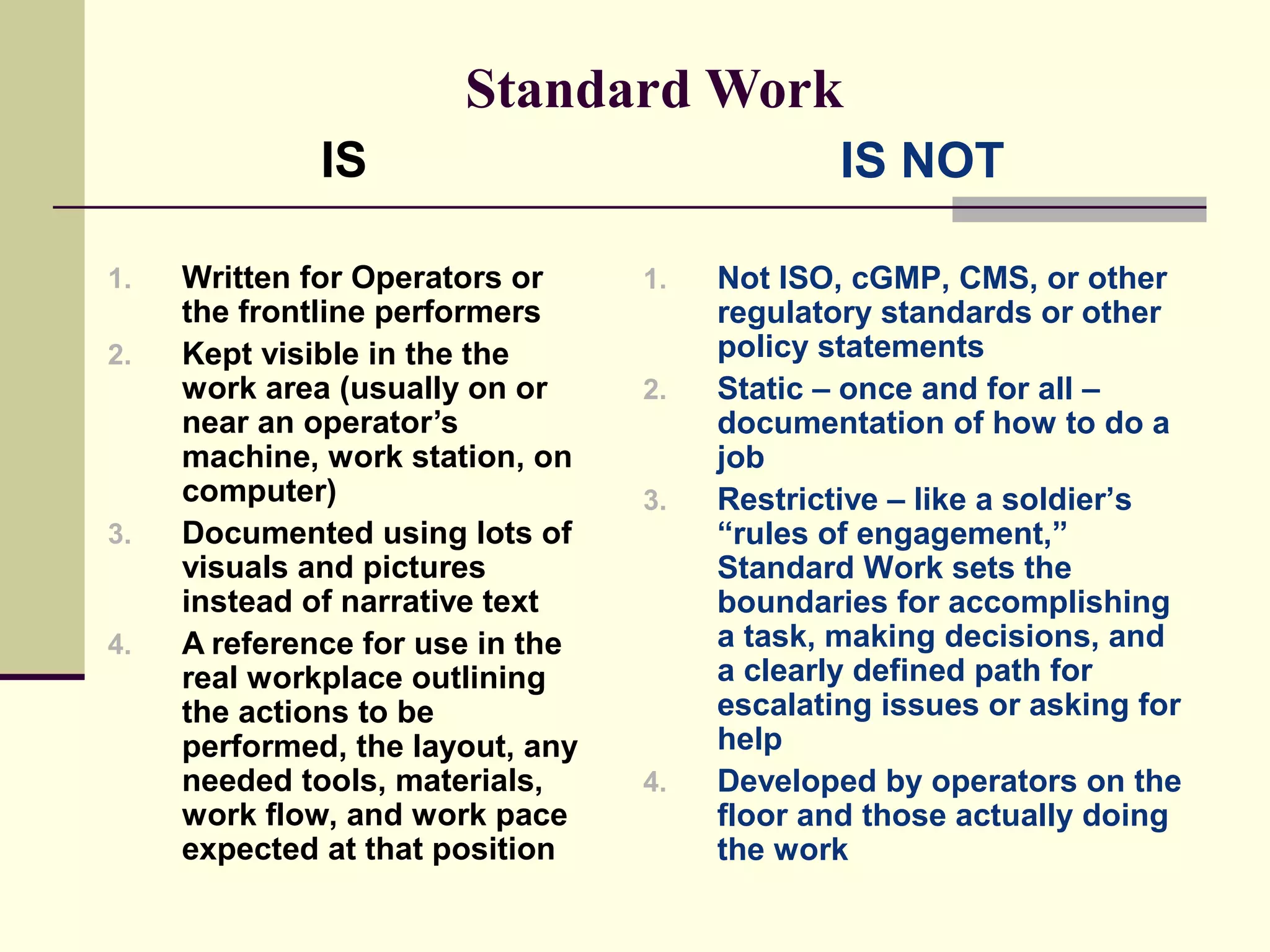
Standard Work
              IS                               IS NOT

1.   Written for Operators or     1.   Not ISO, cGMP, CMS, or other
     the frontline performers          regulatory standards or other
2.   Kept visible in the the           policy statements
     work area (usually on or     2.   Static – once and for all –
     near an operator’s                documentation of how to do a
     machine, work station, on         job
     computer)                    3.   Restrictive – like a soldier’s
3.   Documented using lots of          “rules of engagement,”
     visuals and pictures              Standard Work sets the
     instead of narrative text         boundaries for accomplishing
4.   A reference for use in the        a task, making decisions, and
     real workplace outlining          a clearly defined path for
     the actions to be                 escalating issues or asking for
     performed, the layout, any        help
     needed tools, materials,     4.   Developed by operators on the
     work flow, and work pace          floor and those actually doing
     expected at that position         the work
Standard Work - Purpose/Benefits

 Work Combination is the mixture of people, processes,
    materials, and technology working together to enable the
    completion of a work process. Standard Work is the most
    efficient work combination that a company or workgroup can
    put together at the present time.
   Employees use Standard Work as a guide to consistently
    accomplish planned, predictable performance in their work
    tasks.
   Standard Work serves as the basis for training, performance
    measurement-monitoring, and continuous improvement
   Standard work helps reduces variation and makes the seven
    wastes of Lean visible so that they can be addressed
   Standard work helps ensure Safety, Compliance, reduces
    Risk, and increases Quality and Workplace Morale!
   Provides a structure to work that enables higher productivity,
    a more positive work environment, and the ability to quickly
    identify when standards are not being followed, and
    facilitates root cause analysis
Creating Standard Work

 Establish an improvement (Standard Work) team
 Determine the TAKT time for your process (customer demand)
 Determine your Cycle Time
 Determine your work sequence
 Determine your SWIP (standard quantity of Work in Progress)
 Prepare a standard workflow diagram (swim lane, spaghetti chart, etc)
 Prepare a standard operations sheet (This is chart that identifies the
  What, When, Where, Who, Why, and How of a specific work
  task/operation)*
 Measure – Monitor – Improve the “standard”

                                   REMEMBER
    Standard Work should be developed BY the people doing the work, FOR the
        people doing the work. Use supervisors, SME’s as needed. But, let the
                 language, the visuals, the format be “user friendly.”


   *Examples can be found in the Lean Enterprise Memory Jogger
Four Kinds of Standard Work

1.     Standardized Work – Charts the steps carried out by an operator in a
       process, making a product, or providing a service. Includes all the
       information needed to document work completion as defined by the
       approved standard sequenced to ensure planned, predictable performance
       by a given operator
2.     Standardized Production Capacity – Maps out standard work times into
       the daily standard capacity. This is measured against TAKT time (the
       customer demand). Basically, how much CAN we produce/deliver?
3.     Standardized Work Combination – A chart showing an operator the time
       to load, unload, walk between machines, and machine cycles. An operator
       MUST be able to complete their work cycle within the TAKT time. Outlines
       the work, the turnover, turnaround time, etc. Reinforces safety AND Quality
       in all work activities. Be safe, be accurate, only then get fast!
4.     Managerial/Operational Standards – This includes expectations for
       meetings, safety, the escalation processes, expected shift activities for
       manager/supervisors, etc.*


     *An excellent example of this is found in CREATING A LEAN CULTURE
Standard Work – Good News/Bad News

 Standard work is simply the best way to do the job; it is the easiest, safest,
  most efficient (i.e., waste-free), most effective method currently known.
  Unfortunately, standard work is also the most difficult, time-
  consuming stage in making work flow. Learning how to improve new
  processes and reduce them to standard work is not a quickly
  developed skill.
 Standard work allows you to sustain your gains, serving as a baseline for
  continuous improvement. Standard work demands documenting the steps
  carried out by people and machines to preserve know-how and expertise.
  It is not static or unchanging, but rather a platform from which
  operators can redesign their own work, achieving the next level of
  advance. The idea is to perform the work according to standard but
  to be constantly challenging that standard to rise to higher and
  higher levels of performance.
 Without standardizing work, variations in performance will hide the cause
  and effect link between how the work is done and the desired results,
  rendering attempts at improvement unsustainable.
Thought to Grow On…

 People will perform with excellence IF they:
   Have well-defined jobs
   Are capable of doing the job
   Know what is expected of them
   Have the necessary skills and knowledge
   Receive feedback on how well they perform
   Perceive and receive rewards for performing
    as desired
 Bob Powers, INSTRUCTOR EXCELLENCE

Standard work

  • 1.
    Understanding Standard Work Reducing Variation, Eliminating Waste, and Creating a Firm Foundation for Planned, Predictable Performance Jerry Linnins, Director – Performance Improvement
  • 2.
    STANDARD WORK –Building YOUR Organization on A Firm Foundation  Standard Work is the “one best way” to accomplish a specific task or operation. It is the current best, safest, most compliant method identified. It is the “standard” or model for how something gets done.
  • 3.
    Standard Work IS IS NOT 1. Written for Operators or 1. Not ISO, cGMP, CMS, or other the frontline performers regulatory standards or other 2. Kept visible in the the policy statements work area (usually on or 2. Static – once and for all – near an operator’s documentation of how to do a machine, work station, on job computer) 3. Restrictive – like a soldier’s 3. Documented using lots of “rules of engagement,” visuals and pictures Standard Work sets the instead of narrative text boundaries for accomplishing 4. A reference for use in the a task, making decisions, and real workplace outlining a clearly defined path for the actions to be escalating issues or asking for performed, the layout, any help needed tools, materials, 4. Developed by operators on the work flow, and work pace floor and those actually doing expected at that position the work
  • 4.
    Standard Work -Purpose/Benefits  Work Combination is the mixture of people, processes, materials, and technology working together to enable the completion of a work process. Standard Work is the most efficient work combination that a company or workgroup can put together at the present time.  Employees use Standard Work as a guide to consistently accomplish planned, predictable performance in their work tasks.  Standard Work serves as the basis for training, performance measurement-monitoring, and continuous improvement  Standard work helps reduces variation and makes the seven wastes of Lean visible so that they can be addressed  Standard work helps ensure Safety, Compliance, reduces Risk, and increases Quality and Workplace Morale!  Provides a structure to work that enables higher productivity, a more positive work environment, and the ability to quickly identify when standards are not being followed, and facilitates root cause analysis
  • 5.
    Creating Standard Work Establish an improvement (Standard Work) team  Determine the TAKT time for your process (customer demand)  Determine your Cycle Time  Determine your work sequence  Determine your SWIP (standard quantity of Work in Progress)  Prepare a standard workflow diagram (swim lane, spaghetti chart, etc)  Prepare a standard operations sheet (This is chart that identifies the What, When, Where, Who, Why, and How of a specific work task/operation)*  Measure – Monitor – Improve the “standard” REMEMBER Standard Work should be developed BY the people doing the work, FOR the people doing the work. Use supervisors, SME’s as needed. But, let the language, the visuals, the format be “user friendly.”  *Examples can be found in the Lean Enterprise Memory Jogger
  • 6.
    Four Kinds ofStandard Work 1. Standardized Work – Charts the steps carried out by an operator in a process, making a product, or providing a service. Includes all the information needed to document work completion as defined by the approved standard sequenced to ensure planned, predictable performance by a given operator 2. Standardized Production Capacity – Maps out standard work times into the daily standard capacity. This is measured against TAKT time (the customer demand). Basically, how much CAN we produce/deliver? 3. Standardized Work Combination – A chart showing an operator the time to load, unload, walk between machines, and machine cycles. An operator MUST be able to complete their work cycle within the TAKT time. Outlines the work, the turnover, turnaround time, etc. Reinforces safety AND Quality in all work activities. Be safe, be accurate, only then get fast! 4. Managerial/Operational Standards – This includes expectations for meetings, safety, the escalation processes, expected shift activities for manager/supervisors, etc.* *An excellent example of this is found in CREATING A LEAN CULTURE
  • 7.
    Standard Work –Good News/Bad News  Standard work is simply the best way to do the job; it is the easiest, safest, most efficient (i.e., waste-free), most effective method currently known. Unfortunately, standard work is also the most difficult, time- consuming stage in making work flow. Learning how to improve new processes and reduce them to standard work is not a quickly developed skill.  Standard work allows you to sustain your gains, serving as a baseline for continuous improvement. Standard work demands documenting the steps carried out by people and machines to preserve know-how and expertise. It is not static or unchanging, but rather a platform from which operators can redesign their own work, achieving the next level of advance. The idea is to perform the work according to standard but to be constantly challenging that standard to rise to higher and higher levels of performance.  Without standardizing work, variations in performance will hide the cause and effect link between how the work is done and the desired results, rendering attempts at improvement unsustainable.
  • 8.
    Thought to GrowOn…  People will perform with excellence IF they:  Have well-defined jobs  Are capable of doing the job  Know what is expected of them  Have the necessary skills and knowledge  Receive feedback on how well they perform  Perceive and receive rewards for performing as desired  Bob Powers, INSTRUCTOR EXCELLENCE