PRODUCTION ENGINEERING & OPERATIONS MANAGEMENT LAB
Process–Flow Analysis
Dr. Muhammad Rizwan Khan
1
Process
• A "process" refers to a series of interconnected steps or activities that
take inputs, add value to them through various transformations, and
produce outputs to fulfill specific objectives or deliver a particular product
or service.
• These processes are designed and managed to ensure efficiency, quality,
and consistency in the delivery of goods or services within an organization.
• Examples of processes include:
• Manufacturing processes (like assembly lines),
• Service delivery processes (such as customer support workflows), and
• Administrative processes (like inventory management or procurement).
• Efficiently managed processes are crucial for organizations as they optimize
resource utilization, reduce costs, improve quality, enhance customer
satisfaction, and contribute to overall operational effectiveness and
competitiveness. 2
Key characteristics of a Process
3
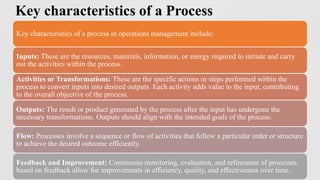
Key characteristics of a process in operations management include:
Inputs: These are the resources, materials, information, or energy required to initiate and carry
out the activities within the process.
Activities or Transformations: These are the specific actions or steps performed within the
process to convert inputs into desired outputs. Each activity adds value to the input, contributing
to the overall objective of the process.
Outputs: The result or product generated by the process after the input has undergone the
necessary transformations. Outputs should align with the intended goals of the process.
Flow: Processes involve a sequence or flow of activities that follow a particular order or structure
to achieve the desired outcome efficiently.
Feedback and Improvement: Continuous monitoring, evaluation, and refinement of processes
based on feedback allow for improvements in efficiency, quality, and effectiveness over time.
Process
Analysis
Analysis
• A detailed examination of anything
complex to understand its nature or to
determine its essential features.
• The process of breaking a complex topic
or substance into smaller parts to gain a
better understanding of it.
What is
Process
Analysis?
• The documentation and detailed
understanding of how work is performed
and how it can be redesigned.
• Process analysis begins with
identifying and defining a new
opportunity for improvement and ends
with implementing and controlling a
revised process.
Process-flow
analysis
• Process-flow analysis is about viewing and analyzing the
transformation process as a sequence of steps
connecting inputs to outputs.
• It is used to discover better methods or procedures for
producing and delivering a product or a service deemed
to be of value to customers.
• Measuring process flows is essential to process-flow
analysis and to improving transformation processes.
• Several process measures are described, including:
• Processing time,
• Throughput time,
• Flow rate,
• Inventory,
• Capacity.
• Bottlenecks are defined and methods for calculating
these measures are provided.
6
Process
Measures
• Processing Time:
• This is the time spent transforming raw
materials into finished goods.
• The actual time a person spends
working on a specific item or task.
• The time a unit is worked on to convert
from raw material to a completed unit.
• The time it takes to complete a
prescribed procedure.
• The time a product is being worked on
in a machine or work area.
7
Process
Measures
• Throughput Time:
• Throughput time or cycle time is the amount of
time it takes for a manufacturer to make a
product including process time, inspection time,
move time, and wait time.
• The throughput time of a product formula is
calculated by adding the four steps of the
manufacturing process:
• Process time,
• Inspection time,
• Move time,
• Wait time.
• Thoughtput Time = Process time + Inspection time
+ Move time + Wait time
8
Process
Measures
• Inspection Time:
• This is the time spent inspecting raw
materials, work-in-process, and finished
goods, possibly at multiple stages of the
production process.
• Move Time:
• This is the time required to move items
into and out of the manufacturing area, as
well as between workstations within the
production area.
• Queue Time:
• This is the time spent waiting prior to the
processing, inspection, and move
activities.
9
Process
Measures
• Inventory:
• The number of flow units that are currently
handled by a business process, e.g., the number
of customers in a store, the number of enrolled
students in a university etc.
• Flow rate / throughput:
• The number of flow units (e.g., customers,
money, produced goods/services) going through
the business process per unit time, e.g., served
customers per hour or produced parts per
minute. The flow rate usually is an average rate.
• Flow time:
• The amount of time a flow unit spends in a
business process from beginning to end, also
known as the total processing time. If there is
more than one path through the process, the
flow time is equivalent to the length of the
longest path.
Process
Measures
• Capacity:
• Capacity is defined as the ability to achieve, store
or produce.
• For an organization, capacity would be the ability
of a given system to produce output within the
specific time period.
• In operations, management capacity is referred as
an amount of the input resources available to
produce relative output over period of time.
• Capacity is the maximum level of output that a
company can sustain to make a product or provide
a service.
• In general, terms capacity is referred as maximum
production capacity, which can be attained within
a normal working schedule.
11
Process
Measures
• Bottleneck:
• A problem that delays progress.
• A bottleneck in production is a point where an
operation meets or exceeds the capacity of the
facility.
• In other words, the factory or department can’t
produce enough units fast enough to keep the rest
of the production schedule or other daily
operations flowing at the same rate.
• Like how a glass bottle tapers at one end, the
production process funnels units from fast moving
departments and processes to slower, more time-
consuming ones that slow down production.
12
FLOWCHART
13
The flowchart (often referred to as a process map) is an essential tool to
facilitate process-flow analysis.
Flowcharts should consider not only process flows but customers, suppliers,
and employee inputs in designing better processes.
A flowchart for a high-contact service process, such as surgery often reflects
the customer’s perspective, mapping the activities performed on the patient.
In manufacturing, a flowchart often shows the activities performed on
inventory as it moves through the production system.
PROCESS
FLOWCHARTING
14
Process flowcharting refers to the creation of a visual diagram
to describe a transformation process.
Flowchart – A diagram that traces the flow of information,
customers, equipment, or materials through the various steps
of a process.
Service Blueprint – A special flowchart of a service process
that shows which steps have high customer contact.
Flowcharting is known by several names: process mapping,
flow process charting, and in a service operations context as
service blueprinting.
Value stream mapping is yet another approach to process
flowcharting popularized by firms that implement lean
systems and lean thinking.
Creating a visual diagram can be invaluable in documenting
what happens within a transformation process.
PROCESS
FLOW
DIAGRAM
(FLOW
CHART)
• A Flowchart is a diagram that uses graphic
symbols to represent the nature and flow of the
steps in a process / system.
• Deciding when & where to collect data.
• Analyzing The Process:
1. Evaluate the process performance (Cost and Cycle
time) at each step.
2. Determine where process bottlenecks occur.
3. Identify non–value added activities which should
be deleted or modified.
4. Identify new process steps to be added to improve
overall performance.
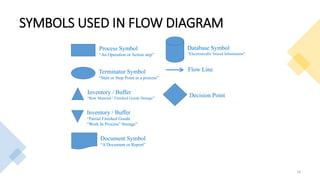
SYMBOLS USED IN FLOW DIAGRAM
16
Process Symbol
“An Operation or Action step”
Terminator Symbol
“Start or Stop Point in a process”
Inventory / Buffer
“Raw Material / Finished Goods Storage”
Inventory / Buffer
“Partial Finished Goods
“Work In Process” Storage”
Document Symbol
“A Document or Report”
Database Symbol
“Electronically Stored Information”
Flow Line
Decision Point
PROCESS FLOWCHARTING
• The pictorial documentation, when it includes process measurements,
can help to identify how the transformation process can be improved by
changing some or all the following elements:
• Raw materials
• Product or service design
• Job design
• Processing steps or activities used
• Management control information
• Equipment or tools
• Suppliers
17
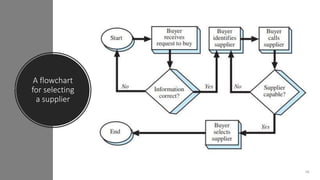
A flowchart
for selecting
a supplier
18
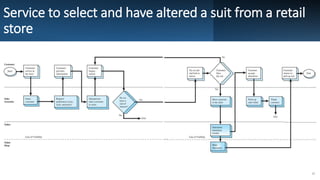
Service to select and have altered a suit from a retail
store
19
Principles to create a Flowchart
• For any type of flowchart, several principles should be followed to
create a flowchart. The principles are as follows:
• Identify and select a relevant transformation process (or system) to
study.
• Identify an individual or a team of individuals to be responsible for
developing the flowchart and for subsequent analyses.
• Specify the boundaries of the transformation process. The boundaries
denote:
• Where the selected transformation process begins and ends,
• Identify the customer(s) and the supplier(s) of the transformation process,
• Determine how many processing steps or activities are to be evaluated.
• In some cases, a function or department within an organization is the customer
or supplier; in other cases, another firm is the customer or supplier.
20
Principles to create a Flowchart
• Identify and sequence the operational steps or the activities necessary
to complete the output for the customer(s).
• Once the “as it is” flowchart has been created and the transformation process
has been analyzed, creating a “to be” flowchart may help show what the
transformation process should look like when improvement changes have been
implemented.
• Identify the performance metrics for the operational steps or the
activities within the selected transformation process.
• These metrics should be tied to the performance of the overall transformation
process.
• For example, if delivery performance is of interest, it may be useful to track the
processing times for each operational step or activity.
• Alternatively, if quality performance is of interest, it may be useful to track the
defect rate for each operational step or activity.
• Draw the flowchart, defining and using symbols in a consistent manner.
21
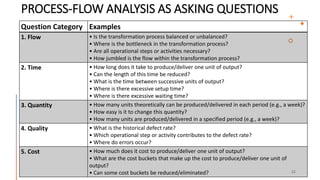
PROCESS-FLOW ANALYSIS AS ASKING QUESTIONS
Question Category Examples
1. Flow • Is the transformation process balanced or unbalanced?
• Where is the bottleneck in the transformation process?
• Are all operational steps or activities necessary?
• How jumbled is the flow within the transformation process?
2. Time • How long does it take to produce/deliver one unit of output?
• Can the length of this time be reduced?
• What is the time between successive units of output?
• Where is there excessive setup time?
• Where is there excessive waiting time?
3. Quantity • How many units theoretically can be produced/delivered in each period (e.g., a week)?
• How easy is it to change this quantity?
• How many units are produced/delivered in a specified period (e.g., a week)?
4. Quality • What is the historical defect rate?
• Which operational step or activity contributes to the defect rate?
• Where do errors occur?
5. Cost • How much does it cost to produce/deliver one unit of output?
• What are the cost buckets that make up the cost to produce/deliver one unit of
output?
• Can some cost buckets be reduced/eliminated?
PROCESS-FLOW ANALYSIS AS ASKING QUESTIONS
• Looking at the service blueprint for the service of helping a customer
purchase a suit from a retail store and asking questions might lead to
suggestions for improvement such as the following:
• If sales associates can be trained to listen better to customer requests, will
customers be more likely to find a suit of interest?
• Can customers call ahead and ask to have some suggested suits waiting for
examination, reducing their search time?
• Is the tailor available while the customer is trying on the suit to provide
suggestions on how the suit can be tailored to fit better?
• Does the layout of the retail store make it easy for customers to search and
find what they want?
23
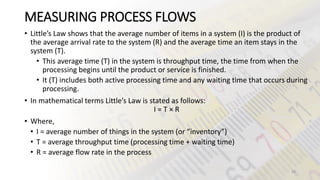
MEASURING PROCESS FLOWS
• Little’s Law shows that the average number of items in a system (I) is the product of
the average arrival rate to the system (R) and the average time an item stays in the
system (T).
• This average time (T) in the system is throughput time, the time from when the
processing begins until the product or service is finished.
• It (T) includes both active processing time and any waiting time that occurs during
processing.
• In mathematical terms Little’s Law is stated as follows:
I = T × R
• Where,
• I = average number of things in the system (or “inventory”)
• T = average throughput time (processing time + waiting time)
• R = average flow rate in the process
24
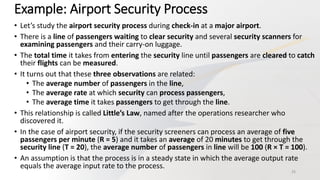
Example: Airport Security Process
• Let’s study the airport security process during check-in at a major airport.
• There is a line of passengers waiting to clear security and several security scanners for
examining passengers and their carry-on luggage.
• The total time it takes from entering the security line until passengers are cleared to catch
their flights can be measured.
• It turns out that these three observations are related:
• The average number of passengers in the line,
• The average rate at which security can process passengers,
• The average time it takes passengers to get through the line.
• This relationship is called Little’s Law, named after the operations researcher who
discovered it.
• In the case of airport security, if the security screeners can process an average of five
passengers per minute (R = 5) and it takes an average of 20 minutes to get through the
security line (T = 20), the average number of passengers in line will be 100 (R × T = 100).
• An assumption is that the process is in a steady state in which the average output rate
equals the average input rate to the process.
25
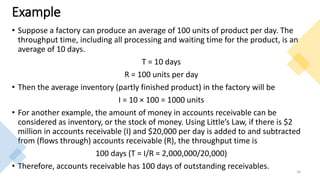
Example
• Suppose a factory can produce an average of 100 units of product per day. The
throughput time, including all processing and waiting time for the product, is an
average of 10 days.
T = 10 days
R = 100 units per day
• Then the average inventory (partly finished product) in the factory will be
I = 10 × 100 = 1000 units
• For another example, the amount of money in accounts receivable can be
considered as inventory, or the stock of money. Using Little’s Law, if there is $2
million in accounts receivable (I) and $20,000 per day is added to and subtracted
from (flows through) accounts receivable (R), the throughput time is
100 days (T = I/R = 2,000,000/20,000)
• Therefore, accounts receivable has 100 days of outstanding receivables. 26
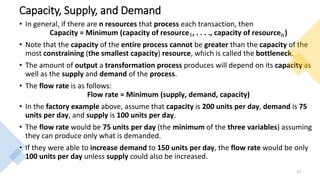
Capacity, Supply, and Demand
• In general, if there are n resources that process each transaction, then
Capacity = Minimum (capacity of resource₁, . . . ., capacity of resourcen)
• Note that the capacity of the entire process cannot be greater than the capacity of the
most constraining (the smallest capacity) resource, which is called the bottleneck.
• The amount of output a transformation process produces will depend on its capacity as
well as the supply and demand of the process.
• The flow rate is as follows:
Flow rate = Minimum (supply, demand, capacity)
• In the factory example above, assume that capacity is 200 units per day, demand is 75
units per day, and supply is 100 units per day.
• The flow rate would be 75 units per day (the minimum of the three variables) assuming
they can produce only what is demanded.
• If they were able to increase demand to 150 units per day, the flow rate would be only
100 units per day unless supply could also be increased.
27
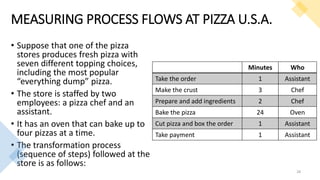
MEASURING PROCESS FLOWS AT PIZZA U.S.A.
• Suppose that one of the pizza
stores produces fresh pizza with
seven different topping choices,
including the most popular
“everything dump” pizza.
• The store is staffed by two
employees: a pizza chef and an
assistant.
• It has an oven that can bake up to
four pizzas at a time.
• The transformation process
(sequence of steps) followed at the
store is as follows:
28
Minutes Who
Take the order 1 Assistant
Make the crust 3 Chef
Prepare and add ingredients 2 Chef
Bake the pizza 24 Oven
Cut pizza and box the order 1 Assistant
Take payment 1 Assistant
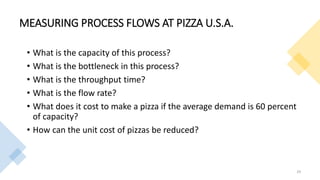
MEASURING PROCESS FLOWS AT PIZZA U.S.A.
• What is the capacity of this process?
• What is the bottleneck in this process?
• What is the throughput time?
• What is the flow rate?
• What does it cost to make a pizza if the average demand is 60 percent
of capacity?
• How can the unit cost of pizzas be reduced?
29
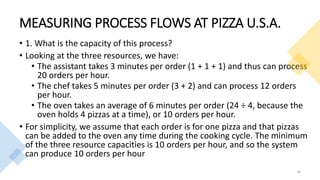
MEASURING PROCESS FLOWS AT PIZZA U.S.A.
• 1. What is the capacity of this process?
• Looking at the three resources, we have:
• The assistant takes 3 minutes per order (1 + 1 + 1) and thus can process
20 orders per hour.
• The chef takes 5 minutes per order (3 + 2) and can process 12 orders
per hour.
• The oven takes an average of 6 minutes per order (24 ÷ 4, because the
oven holds 4 pizzas at a time), or 10 orders per hour.
• For simplicity, we assume that each order is for one pizza and that pizzas
can be added to the oven any time during the cooking cycle. The minimum
of the three resource capacities is 10 orders per hour, and so the system
can produce 10 orders per hour
30
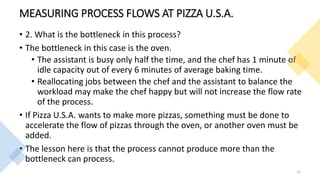
MEASURING PROCESS FLOWS AT PIZZA U.S.A.
• 2. What is the bottleneck in this process?
• The bottleneck in this case is the oven.
• The assistant is busy only half the time, and the chef has 1 minute of
idle capacity out of every 6 minutes of average baking time.
• Reallocating jobs between the chef and the assistant to balance the
workload may make the chef happy but will not increase the flow rate
of the process.
• If Pizza U.S.A. wants to make more pizzas, something must be done to
accelerate the flow of pizzas through the oven, or another oven must be
added.
• The lesson here is that the process cannot produce more than the
bottleneck can process.
31
MEASURING PROCESS FLOWS AT PIZZA U.S.A.
• 3. What is the throughput time?
• If we assume there is no waiting time in this system, we simply add the
times of all the steps to fill an order:
1 + 3 + 2 + 24 + 1 + 1 = 32 minutes
• It takes 32 minutes to complete all the steps and make one pizza.
• Note that adding an oven will increase the capacity and move the
bottleneck to the chef, but it will not change the throughput time.
• Changes would have to be made in the actual process of cooking,
preparation, or other flow times to reduce throughput time.
32
MEASURING PROCESS FLOWS AT PIZZA U.S.A.
• 4. What is the flow rate?
• Assuming that demand and supply exceed capacity, the flow
rate is determined by the bottleneck capacity of 10 orders per
hour.
• However, this is the maximum flow rate; the actual flow rate
could be much less.
• If either demand or supply is less than capacity, then the
smaller of the two will determine the flow rate.
• In the following question, we assume demand is only 60
percent of capacity, for a flow rate of six pizzas per hour.
33
MEASURING PROCESS FLOWS AT PIZZA U.S.A.
• 5. What does it cost to make a pizza if the average demand is 60 percent
of capacity?
• Assume the chef gets paid $15 per hour, the assistant gets paid $11 per
hour, and overhead cost is 50 percent of direct labor cost.
• At 60 percent of capacity, the average flow rate is six pizzas per hour.
• The cost per hour of operations is $15 + $11 = $26 for labor plus 50
percent added for overhead = $39 per hour, or $39 ÷ 6 = $6.50 per pizza.
• Assume the cost of ingredients is $2.00 per pizza. Therefore, the total
cost is $6.50 + $2.00 = $8.50 per pizza.
34
MEASURING PROCESS FLOWS AT PIZZA U.S.A.
• 6. How can the unit cost of pizzas be reduced?
• Three possibilities are:
• Increase demand through pricing, advertising, or other
means.
• If demand increases to exceed capacity, increase the flow
rate of the entire transformation process by means of
automation or process improvements.
• Reduce the unit cost of labor, materials, or overhead.
35
PROCESS REDESIGN
• Process redesign is radical redesign when processes simply cannot be improved in small steps
and require a complete rethinking and rearrangement of process activities to improve them in
a major way.
• Process redesign usually starts with identifying critical processes required to meet the
customers’ needs.
• Changes are often made to these processes as a result of the insight from process-flow
analysis.
• To pursue a successful radical redesign requires four principles:
1. Organize around outcomes, not tasks.
2. Have the people who do the work process their own information.
3. Put the decision point where the work is performed and build control into the process.
It is better to push decision making to the lowest possible level. This will eliminate
layers of bureaucracy and speed up the decision-making process.
4. Eliminate unnecessary steps in the process. Simplifying the processes frequently
means that unnecessary steps and paperwork are eliminated. Every step is examined
by using the flowcharting techniques discussed earlier, and only those that add value
for the customer should be retained. Process redesign can be used to streamline and
simplify workflows.
36
Example 1:
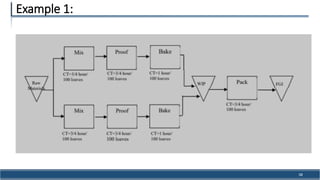
• Assume a bakery produces and sells only one type of bread (white
bread). The bakery operates two parallel baking lines, each equipped
with a mixer, a proofer and an oven. In addition, the bakery operates a
single packaging line which is shared by the two baking lines. Raw
materials are stored in a (single) separate area (a raw materials buffer)
which feeds the start of each baking line. After baking is completed
move into a work-in-process (WIP) buffer; followed directly by a
packaging activity step. When packaging is completed, the finished
products are held in a storage area (a finished-goods buffer) until trucks
arrive to pick them up for delivery.
• Draw a process flow diagram of the bread making process.
37
Example 1:
38
Example 2:
• A ticket line for a Minnesota Vikings football game
has an average of 100 fans waiting to buy tickets
and an average flow rate of 5 fans per minute. What
is the average time that a ticket buyer can expect to
wait in line?
• Using Little’s Law I = T × R, solve for T:
T = I ÷ R = 100 ÷ 5 = 20
• A ticket buyer can expect to spend an average of 20
minutes in line.
39
Example 3:
• Joe’s commercial laundry has contracts to wash bedsheets for hotels.
Joe intakes each batch of sheets, which takes 1 minute, and then the
sheets are washed, taking 20 minutes, and dried, taking 30 minutes. The
batch of sheets is ironed, taking 10 minutes for one employee to
complete each batch, and there are two employees ironing sheets.
Finally, Joe packages the sheets and bills the customer, taking 2 minutes.
Joe has five washing machines and seven dryers that can process one
batch of sheets each.
a. What is the capacity of the laundry system, and what is the
bottleneck?
b. What is the average throughput time of a batch of sheets?
c. If the flow rate is 10 batches per hour, what is the average
number of batches of sheets in the system (inventory)?
40
Example 3:
a. The capacity of each resource is as follows:
• Joe takes 3 minutes for each batch and can thus handle 20 batches per hour.
• Ironing takes 10 minutes, and so each employee can handle 6 batches per hour
and the total capacity for two employees is 12 batches per hour.
• Washing machines take 20 minutes per batch or three loads per hour for each
machine, and there are five machines, for a total capacity of 15 batches per hour.
• Dryers take 30 minutes per batch or two loads per hour from each machine ×
seven machines for a capacity of 14 batches per hour.
• The most constraining (minimum capacity) resource is the ironing, and so the system
capacity is 12 batches per hour and ironing is the bottleneck.
b. The average throughput time (assuming no waiting time) of the system for each
batch of sheets is:
T = 1 + 20 + 30 + 10 + 2 = 63 minutes
c. I = T × R = (63 ÷ 60) × 10 = 10.5 batches (note, that the 63 minutes must be
converted to hours using 60 minutes in an hour).
41
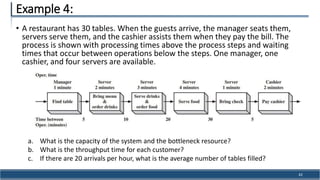
• A restaurant has 30 tables. When the guests arrive, the manager seats them,
servers serve them, and the cashier assists them when they pay the bill. The
process is shown with processing times above the process steps and waiting
times that occur between operations below the steps. One manager, one
cashier, and four servers are available.
a. What is the capacity of the system and the bottleneck resource?
b. What is the throughput time for each customer?
c. If there are 20 arrivals per hour, what is the average number of tables filled?
Example 4:
42
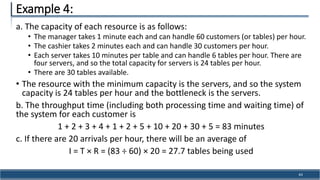
a. The capacity of each resource is as follows:
• The manager takes 1 minute each and can handle 60 customers (or tables) per hour.
• The cashier takes 2 minutes each and can handle 30 customers per hour.
• Each server takes 10 minutes per table and can handle 6 tables per hour. There are
four servers, and so the total capacity for servers is 24 tables per hour.
• There are 30 tables available.
• The resource with the minimum capacity is the servers, and so the system
capacity is 24 tables per hour and the bottleneck is the servers.
b. The throughput time (including both processing time and waiting time) of
the system for each customer is
1 + 2 + 3 + 4 + 1 + 2 + 5 + 10 + 20 + 30 + 5 = 83 minutes
c. If there are 20 arrivals per hour, there will be an average of
I = T × R = (83 ÷ 60) × 20 = 27.7 tables being used
Example 4:
43
44
QUESTIONS

6. Process-Flow Analysis.pdf

  • 1.
    PRODUCTION ENGINEERING &OPERATIONS MANAGEMENT LAB Process–Flow Analysis Dr. Muhammad Rizwan Khan 1
  • 2.
    Process • A "process"refers to a series of interconnected steps or activities that take inputs, add value to them through various transformations, and produce outputs to fulfill specific objectives or deliver a particular product or service. • These processes are designed and managed to ensure efficiency, quality, and consistency in the delivery of goods or services within an organization. • Examples of processes include: • Manufacturing processes (like assembly lines), • Service delivery processes (such as customer support workflows), and • Administrative processes (like inventory management or procurement). • Efficiently managed processes are crucial for organizations as they optimize resource utilization, reduce costs, improve quality, enhance customer satisfaction, and contribute to overall operational effectiveness and competitiveness. 2
  • 3.
    Key characteristics ofa Process 3 Key characteristics of a process in operations management include: Inputs: These are the resources, materials, information, or energy required to initiate and carry out the activities within the process. Activities or Transformations: These are the specific actions or steps performed within the process to convert inputs into desired outputs. Each activity adds value to the input, contributing to the overall objective of the process. Outputs: The result or product generated by the process after the input has undergone the necessary transformations. Outputs should align with the intended goals of the process. Flow: Processes involve a sequence or flow of activities that follow a particular order or structure to achieve the desired outcome efficiently. Feedback and Improvement: Continuous monitoring, evaluation, and refinement of processes based on feedback allow for improvements in efficiency, quality, and effectiveness over time.
  • 4.
    Process Analysis Analysis • A detailedexamination of anything complex to understand its nature or to determine its essential features. • The process of breaking a complex topic or substance into smaller parts to gain a better understanding of it.
  • 5.
    What is Process Analysis? • Thedocumentation and detailed understanding of how work is performed and how it can be redesigned. • Process analysis begins with identifying and defining a new opportunity for improvement and ends with implementing and controlling a revised process.
  • 6.
    Process-flow analysis • Process-flow analysisis about viewing and analyzing the transformation process as a sequence of steps connecting inputs to outputs. • It is used to discover better methods or procedures for producing and delivering a product or a service deemed to be of value to customers. • Measuring process flows is essential to process-flow analysis and to improving transformation processes. • Several process measures are described, including: • Processing time, • Throughput time, • Flow rate, • Inventory, • Capacity. • Bottlenecks are defined and methods for calculating these measures are provided. 6
  • 7.
    Process Measures • Processing Time: •This is the time spent transforming raw materials into finished goods. • The actual time a person spends working on a specific item or task. • The time a unit is worked on to convert from raw material to a completed unit. • The time it takes to complete a prescribed procedure. • The time a product is being worked on in a machine or work area. 7
  • 8.
    Process Measures • Throughput Time: •Throughput time or cycle time is the amount of time it takes for a manufacturer to make a product including process time, inspection time, move time, and wait time. • The throughput time of a product formula is calculated by adding the four steps of the manufacturing process: • Process time, • Inspection time, • Move time, • Wait time. • Thoughtput Time = Process time + Inspection time + Move time + Wait time 8
  • 9.
    Process Measures • Inspection Time: •This is the time spent inspecting raw materials, work-in-process, and finished goods, possibly at multiple stages of the production process. • Move Time: • This is the time required to move items into and out of the manufacturing area, as well as between workstations within the production area. • Queue Time: • This is the time spent waiting prior to the processing, inspection, and move activities. 9
  • 10.
    Process Measures • Inventory: • Thenumber of flow units that are currently handled by a business process, e.g., the number of customers in a store, the number of enrolled students in a university etc. • Flow rate / throughput: • The number of flow units (e.g., customers, money, produced goods/services) going through the business process per unit time, e.g., served customers per hour or produced parts per minute. The flow rate usually is an average rate. • Flow time: • The amount of time a flow unit spends in a business process from beginning to end, also known as the total processing time. If there is more than one path through the process, the flow time is equivalent to the length of the longest path.
  • 11.
    Process Measures • Capacity: • Capacityis defined as the ability to achieve, store or produce. • For an organization, capacity would be the ability of a given system to produce output within the specific time period. • In operations, management capacity is referred as an amount of the input resources available to produce relative output over period of time. • Capacity is the maximum level of output that a company can sustain to make a product or provide a service. • In general, terms capacity is referred as maximum production capacity, which can be attained within a normal working schedule. 11
  • 12.
    Process Measures • Bottleneck: • Aproblem that delays progress. • A bottleneck in production is a point where an operation meets or exceeds the capacity of the facility. • In other words, the factory or department can’t produce enough units fast enough to keep the rest of the production schedule or other daily operations flowing at the same rate. • Like how a glass bottle tapers at one end, the production process funnels units from fast moving departments and processes to slower, more time- consuming ones that slow down production. 12
  • 13.
    FLOWCHART 13 The flowchart (oftenreferred to as a process map) is an essential tool to facilitate process-flow analysis. Flowcharts should consider not only process flows but customers, suppliers, and employee inputs in designing better processes. A flowchart for a high-contact service process, such as surgery often reflects the customer’s perspective, mapping the activities performed on the patient. In manufacturing, a flowchart often shows the activities performed on inventory as it moves through the production system.
  • 14.
    PROCESS FLOWCHARTING 14 Process flowcharting refersto the creation of a visual diagram to describe a transformation process. Flowchart – A diagram that traces the flow of information, customers, equipment, or materials through the various steps of a process. Service Blueprint – A special flowchart of a service process that shows which steps have high customer contact. Flowcharting is known by several names: process mapping, flow process charting, and in a service operations context as service blueprinting. Value stream mapping is yet another approach to process flowcharting popularized by firms that implement lean systems and lean thinking. Creating a visual diagram can be invaluable in documenting what happens within a transformation process.
  • 15.
    PROCESS FLOW DIAGRAM (FLOW CHART) • A Flowchartis a diagram that uses graphic symbols to represent the nature and flow of the steps in a process / system. • Deciding when & where to collect data. • Analyzing The Process: 1. Evaluate the process performance (Cost and Cycle time) at each step. 2. Determine where process bottlenecks occur. 3. Identify non–value added activities which should be deleted or modified. 4. Identify new process steps to be added to improve overall performance.
  • 16.
    SYMBOLS USED INFLOW DIAGRAM 16 Process Symbol “An Operation or Action step” Terminator Symbol “Start or Stop Point in a process” Inventory / Buffer “Raw Material / Finished Goods Storage” Inventory / Buffer “Partial Finished Goods “Work In Process” Storage” Document Symbol “A Document or Report” Database Symbol “Electronically Stored Information” Flow Line Decision Point
  • 17.
    PROCESS FLOWCHARTING • Thepictorial documentation, when it includes process measurements, can help to identify how the transformation process can be improved by changing some or all the following elements: • Raw materials • Product or service design • Job design • Processing steps or activities used • Management control information • Equipment or tools • Suppliers 17
  • 18.
  • 19.
    Service to selectand have altered a suit from a retail store 19
  • 20.
    Principles to createa Flowchart • For any type of flowchart, several principles should be followed to create a flowchart. The principles are as follows: • Identify and select a relevant transformation process (or system) to study. • Identify an individual or a team of individuals to be responsible for developing the flowchart and for subsequent analyses. • Specify the boundaries of the transformation process. The boundaries denote: • Where the selected transformation process begins and ends, • Identify the customer(s) and the supplier(s) of the transformation process, • Determine how many processing steps or activities are to be evaluated. • In some cases, a function or department within an organization is the customer or supplier; in other cases, another firm is the customer or supplier. 20
  • 21.
    Principles to createa Flowchart • Identify and sequence the operational steps or the activities necessary to complete the output for the customer(s). • Once the “as it is” flowchart has been created and the transformation process has been analyzed, creating a “to be” flowchart may help show what the transformation process should look like when improvement changes have been implemented. • Identify the performance metrics for the operational steps or the activities within the selected transformation process. • These metrics should be tied to the performance of the overall transformation process. • For example, if delivery performance is of interest, it may be useful to track the processing times for each operational step or activity. • Alternatively, if quality performance is of interest, it may be useful to track the defect rate for each operational step or activity. • Draw the flowchart, defining and using symbols in a consistent manner. 21
  • 22.
    PROCESS-FLOW ANALYSIS ASASKING QUESTIONS Question Category Examples 1. Flow • Is the transformation process balanced or unbalanced? • Where is the bottleneck in the transformation process? • Are all operational steps or activities necessary? • How jumbled is the flow within the transformation process? 2. Time • How long does it take to produce/deliver one unit of output? • Can the length of this time be reduced? • What is the time between successive units of output? • Where is there excessive setup time? • Where is there excessive waiting time? 3. Quantity • How many units theoretically can be produced/delivered in each period (e.g., a week)? • How easy is it to change this quantity? • How many units are produced/delivered in a specified period (e.g., a week)? 4. Quality • What is the historical defect rate? • Which operational step or activity contributes to the defect rate? • Where do errors occur? 5. Cost • How much does it cost to produce/deliver one unit of output? • What are the cost buckets that make up the cost to produce/deliver one unit of output? • Can some cost buckets be reduced/eliminated?
  • 23.
    PROCESS-FLOW ANALYSIS ASASKING QUESTIONS • Looking at the service blueprint for the service of helping a customer purchase a suit from a retail store and asking questions might lead to suggestions for improvement such as the following: • If sales associates can be trained to listen better to customer requests, will customers be more likely to find a suit of interest? • Can customers call ahead and ask to have some suggested suits waiting for examination, reducing their search time? • Is the tailor available while the customer is trying on the suit to provide suggestions on how the suit can be tailored to fit better? • Does the layout of the retail store make it easy for customers to search and find what they want? 23
  • 24.
    MEASURING PROCESS FLOWS •Little’s Law shows that the average number of items in a system (I) is the product of the average arrival rate to the system (R) and the average time an item stays in the system (T). • This average time (T) in the system is throughput time, the time from when the processing begins until the product or service is finished. • It (T) includes both active processing time and any waiting time that occurs during processing. • In mathematical terms Little’s Law is stated as follows: I = T × R • Where, • I = average number of things in the system (or “inventory”) • T = average throughput time (processing time + waiting time) • R = average flow rate in the process 24
  • 25.
    Example: Airport SecurityProcess • Let’s study the airport security process during check-in at a major airport. • There is a line of passengers waiting to clear security and several security scanners for examining passengers and their carry-on luggage. • The total time it takes from entering the security line until passengers are cleared to catch their flights can be measured. • It turns out that these three observations are related: • The average number of passengers in the line, • The average rate at which security can process passengers, • The average time it takes passengers to get through the line. • This relationship is called Little’s Law, named after the operations researcher who discovered it. • In the case of airport security, if the security screeners can process an average of five passengers per minute (R = 5) and it takes an average of 20 minutes to get through the security line (T = 20), the average number of passengers in line will be 100 (R × T = 100). • An assumption is that the process is in a steady state in which the average output rate equals the average input rate to the process. 25
  • 26.
    Example • Suppose afactory can produce an average of 100 units of product per day. The throughput time, including all processing and waiting time for the product, is an average of 10 days. T = 10 days R = 100 units per day • Then the average inventory (partly finished product) in the factory will be I = 10 × 100 = 1000 units • For another example, the amount of money in accounts receivable can be considered as inventory, or the stock of money. Using Little’s Law, if there is $2 million in accounts receivable (I) and $20,000 per day is added to and subtracted from (flows through) accounts receivable (R), the throughput time is 100 days (T = I/R = 2,000,000/20,000) • Therefore, accounts receivable has 100 days of outstanding receivables. 26
  • 27.
    Capacity, Supply, andDemand • In general, if there are n resources that process each transaction, then Capacity = Minimum (capacity of resource₁, . . . ., capacity of resourcen) • Note that the capacity of the entire process cannot be greater than the capacity of the most constraining (the smallest capacity) resource, which is called the bottleneck. • The amount of output a transformation process produces will depend on its capacity as well as the supply and demand of the process. • The flow rate is as follows: Flow rate = Minimum (supply, demand, capacity) • In the factory example above, assume that capacity is 200 units per day, demand is 75 units per day, and supply is 100 units per day. • The flow rate would be 75 units per day (the minimum of the three variables) assuming they can produce only what is demanded. • If they were able to increase demand to 150 units per day, the flow rate would be only 100 units per day unless supply could also be increased. 27
  • 28.
    MEASURING PROCESS FLOWSAT PIZZA U.S.A. • Suppose that one of the pizza stores produces fresh pizza with seven different topping choices, including the most popular “everything dump” pizza. • The store is staffed by two employees: a pizza chef and an assistant. • It has an oven that can bake up to four pizzas at a time. • The transformation process (sequence of steps) followed at the store is as follows: 28 Minutes Who Take the order 1 Assistant Make the crust 3 Chef Prepare and add ingredients 2 Chef Bake the pizza 24 Oven Cut pizza and box the order 1 Assistant Take payment 1 Assistant
  • 29.
    MEASURING PROCESS FLOWSAT PIZZA U.S.A. • What is the capacity of this process? • What is the bottleneck in this process? • What is the throughput time? • What is the flow rate? • What does it cost to make a pizza if the average demand is 60 percent of capacity? • How can the unit cost of pizzas be reduced? 29
  • 30.
    MEASURING PROCESS FLOWSAT PIZZA U.S.A. • 1. What is the capacity of this process? • Looking at the three resources, we have: • The assistant takes 3 minutes per order (1 + 1 + 1) and thus can process 20 orders per hour. • The chef takes 5 minutes per order (3 + 2) and can process 12 orders per hour. • The oven takes an average of 6 minutes per order (24 ÷ 4, because the oven holds 4 pizzas at a time), or 10 orders per hour. • For simplicity, we assume that each order is for one pizza and that pizzas can be added to the oven any time during the cooking cycle. The minimum of the three resource capacities is 10 orders per hour, and so the system can produce 10 orders per hour 30
  • 31.
    MEASURING PROCESS FLOWSAT PIZZA U.S.A. • 2. What is the bottleneck in this process? • The bottleneck in this case is the oven. • The assistant is busy only half the time, and the chef has 1 minute of idle capacity out of every 6 minutes of average baking time. • Reallocating jobs between the chef and the assistant to balance the workload may make the chef happy but will not increase the flow rate of the process. • If Pizza U.S.A. wants to make more pizzas, something must be done to accelerate the flow of pizzas through the oven, or another oven must be added. • The lesson here is that the process cannot produce more than the bottleneck can process. 31
  • 32.
    MEASURING PROCESS FLOWSAT PIZZA U.S.A. • 3. What is the throughput time? • If we assume there is no waiting time in this system, we simply add the times of all the steps to fill an order: 1 + 3 + 2 + 24 + 1 + 1 = 32 minutes • It takes 32 minutes to complete all the steps and make one pizza. • Note that adding an oven will increase the capacity and move the bottleneck to the chef, but it will not change the throughput time. • Changes would have to be made in the actual process of cooking, preparation, or other flow times to reduce throughput time. 32
  • 33.
    MEASURING PROCESS FLOWSAT PIZZA U.S.A. • 4. What is the flow rate? • Assuming that demand and supply exceed capacity, the flow rate is determined by the bottleneck capacity of 10 orders per hour. • However, this is the maximum flow rate; the actual flow rate could be much less. • If either demand or supply is less than capacity, then the smaller of the two will determine the flow rate. • In the following question, we assume demand is only 60 percent of capacity, for a flow rate of six pizzas per hour. 33
  • 34.
    MEASURING PROCESS FLOWSAT PIZZA U.S.A. • 5. What does it cost to make a pizza if the average demand is 60 percent of capacity? • Assume the chef gets paid $15 per hour, the assistant gets paid $11 per hour, and overhead cost is 50 percent of direct labor cost. • At 60 percent of capacity, the average flow rate is six pizzas per hour. • The cost per hour of operations is $15 + $11 = $26 for labor plus 50 percent added for overhead = $39 per hour, or $39 ÷ 6 = $6.50 per pizza. • Assume the cost of ingredients is $2.00 per pizza. Therefore, the total cost is $6.50 + $2.00 = $8.50 per pizza. 34
  • 35.
    MEASURING PROCESS FLOWSAT PIZZA U.S.A. • 6. How can the unit cost of pizzas be reduced? • Three possibilities are: • Increase demand through pricing, advertising, or other means. • If demand increases to exceed capacity, increase the flow rate of the entire transformation process by means of automation or process improvements. • Reduce the unit cost of labor, materials, or overhead. 35
  • 36.
    PROCESS REDESIGN • Processredesign is radical redesign when processes simply cannot be improved in small steps and require a complete rethinking and rearrangement of process activities to improve them in a major way. • Process redesign usually starts with identifying critical processes required to meet the customers’ needs. • Changes are often made to these processes as a result of the insight from process-flow analysis. • To pursue a successful radical redesign requires four principles: 1. Organize around outcomes, not tasks. 2. Have the people who do the work process their own information. 3. Put the decision point where the work is performed and build control into the process. It is better to push decision making to the lowest possible level. This will eliminate layers of bureaucracy and speed up the decision-making process. 4. Eliminate unnecessary steps in the process. Simplifying the processes frequently means that unnecessary steps and paperwork are eliminated. Every step is examined by using the flowcharting techniques discussed earlier, and only those that add value for the customer should be retained. Process redesign can be used to streamline and simplify workflows. 36
  • 37.
    Example 1: • Assumea bakery produces and sells only one type of bread (white bread). The bakery operates two parallel baking lines, each equipped with a mixer, a proofer and an oven. In addition, the bakery operates a single packaging line which is shared by the two baking lines. Raw materials are stored in a (single) separate area (a raw materials buffer) which feeds the start of each baking line. After baking is completed move into a work-in-process (WIP) buffer; followed directly by a packaging activity step. When packaging is completed, the finished products are held in a storage area (a finished-goods buffer) until trucks arrive to pick them up for delivery. • Draw a process flow diagram of the bread making process. 37
  • 38.
  • 39.
    Example 2: • Aticket line for a Minnesota Vikings football game has an average of 100 fans waiting to buy tickets and an average flow rate of 5 fans per minute. What is the average time that a ticket buyer can expect to wait in line? • Using Little’s Law I = T × R, solve for T: T = I ÷ R = 100 ÷ 5 = 20 • A ticket buyer can expect to spend an average of 20 minutes in line. 39
  • 40.
    Example 3: • Joe’scommercial laundry has contracts to wash bedsheets for hotels. Joe intakes each batch of sheets, which takes 1 minute, and then the sheets are washed, taking 20 minutes, and dried, taking 30 minutes. The batch of sheets is ironed, taking 10 minutes for one employee to complete each batch, and there are two employees ironing sheets. Finally, Joe packages the sheets and bills the customer, taking 2 minutes. Joe has five washing machines and seven dryers that can process one batch of sheets each. a. What is the capacity of the laundry system, and what is the bottleneck? b. What is the average throughput time of a batch of sheets? c. If the flow rate is 10 batches per hour, what is the average number of batches of sheets in the system (inventory)? 40
  • 41.
    Example 3: a. Thecapacity of each resource is as follows: • Joe takes 3 minutes for each batch and can thus handle 20 batches per hour. • Ironing takes 10 minutes, and so each employee can handle 6 batches per hour and the total capacity for two employees is 12 batches per hour. • Washing machines take 20 minutes per batch or three loads per hour for each machine, and there are five machines, for a total capacity of 15 batches per hour. • Dryers take 30 minutes per batch or two loads per hour from each machine × seven machines for a capacity of 14 batches per hour. • The most constraining (minimum capacity) resource is the ironing, and so the system capacity is 12 batches per hour and ironing is the bottleneck. b. The average throughput time (assuming no waiting time) of the system for each batch of sheets is: T = 1 + 20 + 30 + 10 + 2 = 63 minutes c. I = T × R = (63 ÷ 60) × 10 = 10.5 batches (note, that the 63 minutes must be converted to hours using 60 minutes in an hour). 41
  • 42.
    • A restauranthas 30 tables. When the guests arrive, the manager seats them, servers serve them, and the cashier assists them when they pay the bill. The process is shown with processing times above the process steps and waiting times that occur between operations below the steps. One manager, one cashier, and four servers are available. a. What is the capacity of the system and the bottleneck resource? b. What is the throughput time for each customer? c. If there are 20 arrivals per hour, what is the average number of tables filled? Example 4: 42
  • 43.
    a. The capacityof each resource is as follows: • The manager takes 1 minute each and can handle 60 customers (or tables) per hour. • The cashier takes 2 minutes each and can handle 30 customers per hour. • Each server takes 10 minutes per table and can handle 6 tables per hour. There are four servers, and so the total capacity for servers is 24 tables per hour. • There are 30 tables available. • The resource with the minimum capacity is the servers, and so the system capacity is 24 tables per hour and the bottleneck is the servers. b. The throughput time (including both processing time and waiting time) of the system for each customer is 1 + 2 + 3 + 4 + 1 + 2 + 5 + 10 + 20 + 30 + 5 = 83 minutes c. If there are 20 arrivals per hour, there will be an average of I = T × R = (83 ÷ 60) × 20 = 27.7 tables being used Example 4: 43
  • 44.