Lean Thinking and Just-
in-Time Systems
What is Lean?
 Lean = Doing More with Less
 Less Time, Inventory, Space, Labor and Money
 Systematic Elimination of Waste
 Lean – organization focuses on its core
capabilities and devoid of any waste
 Lean Enterprise – approaches that focus on the
elimination of waste in all forms and smooth,
efficient flow of materials and information
throughout the value chain to obtain faster
customer response, higher quality and lower
costs
‘The key principle of lean operations is relatively
straightforward to understand: it means moving
towards the elimination of all waste in order to
develop an operation that is faster and more
dependable, produces higher quality products
and services and, above all, operates at low cost.’
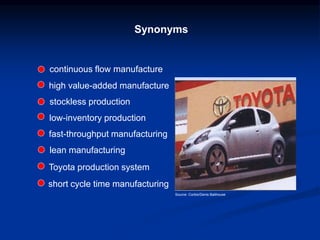
Synonyms
continuous flow manufacture
high value-added manufacture
stockless production
low-inventory production
fast-throughput manufacturing
lean manufacturing
Toyota production system
short cycle time manufacturing
Source: Corbis/Denis Balihouse
Four Basic Lean Principles
1. Elimination of Waste: eliminate any activities that do
not add value in an organization. Includes
overproduction, waiting time, processing, inventory, and
motion.
2. Increased Speed and Response: better process
designs allow efficient responses to customers needs
and the competitive environment.
3. Improved Quality: Poor quality creates waste, so
improving quality is essential to the lean environment.
4. Reduced Cost: simplifying processes and improving
efficiency translates to reduced costs.
Seven Wastes to be Eliminated
 Overproduction or Early Production
producing over customer requirements, producing unnecessary
materials/products
 Waiting
time delays, idle time (time during which value is not added to the
product)
 Transportation
multiple handling, delay in materials handling, unnecessary handling
 Inventory
holding or purchasing unnecessary raw materials, work in process,
and finished goods
 Motion
actions of people or equipment that do not add value to the product
 Over processing
unnecessary steps or work elements / procedures (non added value
work)
 Defective units
production of a part that is scrapped or requires rework
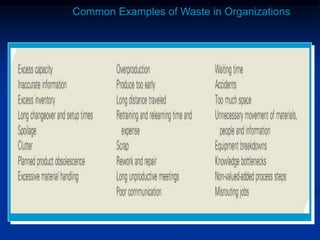
Common Examples of Waste in Organizations
Lean Tools and Approaches
VALUE STREAM MAPPING
• difference between value stream mapping (VSM) and
traditional flowcharting analysis and service
blueprinting is that VSM tries to highlight value-added
and non-value-added work activities, that is, the
economics of process flow.
• All other aspects of VSM are identical to traditional
process flowcharting and flow analysis such as
identifying numerically bottleneck work activities and
work stations, evaluating process and wait times, and
evaluating information flows that accompany physical
goods flows.
‘Value stream’ mapping focuses on value-adding activities. It
distinguishes between value-adding and non-value-adding activities.
It is similar to process mapping but different in four ways:
It uses a broader range of information than most process
maps.
It is usually at a higher level (5–10 activities) than most
process maps.
It often has a wider scope, frequently spanning the whole
supply chain.
It can be used to identify where to focus future improvement
activities.
‘Value stream’ mapping
Lean Tools and Approaches
SMALL BATCH & SINGLE PIECE FLOW
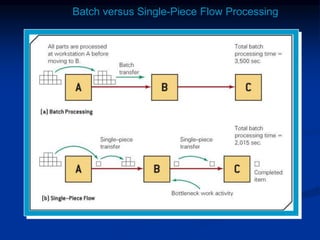
• Batching is the process of producing large
quantities of items as a group before being
transferred to the next operation.
• Lean operating systems seek to reduce batch
sizes using single-piece flow.
• A transfer batch is part of the original
batch (lot) size that is completed at one
workstation and moved to the next
downstream workstation.
Batch versus Single-Piece Flow Processing
Lean Tools and Approaches
Small Bath and Single-Piece Flow
• Single-piece flow allows companies to better
match production to customer demand, avoid
large inventory buildups, and ensure
uninterrupted movement of WIP through the
production system.
• To utilize single-piece flow, a company must be
able to change between products quickly and
inexpensively by reducing setup times.
Lean Tools and Approaches
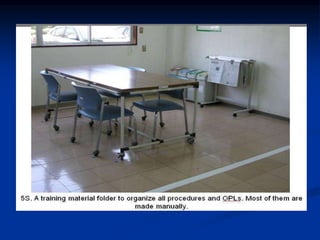
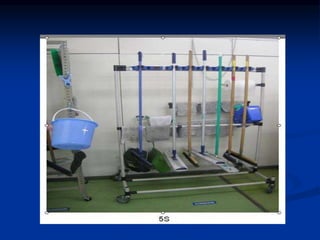
The 5Ss
• 5S Principles are used to create a clean and
well-organized work environment.
• Messy and disorganized workplaces waste
time, energy, and resources.
Lean Tools and Approaches
The 5S principles are as follows:
1. Sort: each item is in the proper place.
2. Set in order: arrange materials so that they
are easy-to-use.
3. Shine: clean work area.
4. Standardize: formalize procedures and
practices.
5. Sustain: keep the process going.
Lean Tools and Approaches
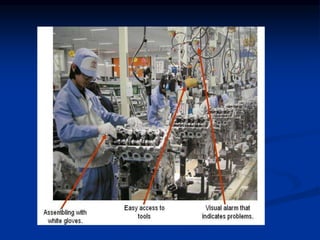
VISUAL CONTROLS
• Visual controls are indicators for operating activities
that are placed in plain sight of all employees so
that everyone can quickly and easily understand
the status and performance of the work system.
• Examples: electronic scoreboards in production
processes, painted areas on the floor where certain
boxes and pallets should be placed, employee pull
cords to stop production, signal lights on machines,
and even Kanban cards.
Lean Tools and Approaches
EFFICIENT LAYOUT & STANDARDIZED
OPERATIONS
• The layout, process, equipment, workstations,
and jobs must be integrated and arranged in an
efficient way.
SUPPLIER RELATIONSHIP MANAGEMENT
• Lean systems require suppliers that will deliver on
time and provide high quality products.
Lean Tools and Approaches
SINGLE MINUTE EXCHANGE OF DIES (SMED)
• SMED refers to quick setup or changeover of
tolling and fixtures in processes so that multiple
products in smaller batches can be run on the
same equipment.
• Reducing setup time frees up capacity that can
be producing output, and therefore, generating
revenue.
• Example: Yammar Diesel reduced machine setup
from 9.3 hours to 9 minutes!
Lean Tools and Approaches
STABLE PRODUCTION SCHEDULES
Lean operating systems require uniform and
stable production plans and schedules.
QUALITY AT THE SOURCE
Quality at the source focuses on doing it
right the first time.
CONTINUOUS IMPROVEMENT
Six Sigma compliments lean systems to assure
high-quality output.
Lean Tools and Approaches
Six Sigma and Lean concepts and methods are
often combined into Lean Six Sigma.
• Both are driven by customer requirements.
• Both try to eliminate waste, reduce costs,
speed things up, and improve quality.
• Both focus on real dollar savings.
• Both rely on a systematic methodology.
Differences between Lean and Six Sigma
• Lean addresses more visible problems in the
processes while Six Sigma focuses on problems
like process variation.
• Lean tools are intuitive, simple, and easy to
apply; Six Sigma tools include more advanced
statistical analysis.
• Lean requires less training, whereas Six Sigma
requires advance training and expertise in
statistics, control charts, and Black or Master
Black Belt specialists.
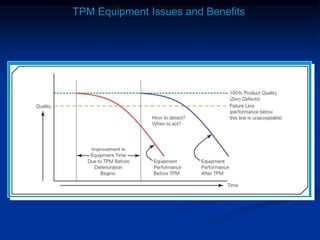
TPM Equipment Issues and Benefits
Lean Tools and Approaches
Total Productive Maintenance (TPM)
• TPM is focused on ensuring that operating
systems will perform their intended function
reliably.
• TPM works to prevent equipment failures and
downtime, maximizing equipment effectiveness
and uptime.
• TPM tries to predict equipment failure rates and
perform maintenance before a problem arises.
• The principles of TPM also include employee
“ownership” of the equipment.
Lean Tools and Approaches
Manufactured Good Recovery
• In an effort to reduce costs, many companies
are actively recovering and recycling parts.
• Options include repairing, refurbishing,
remanufacturing, cannibalizing, and recycling.
• This can occur as various points of the supply
chain, as shown in the following slide.
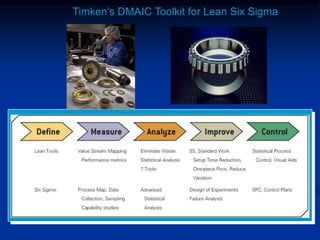
Lean Manufacturing Tours
• Timken Company is a leading manufacturer of highly
engineered bearings and alloy steels and related
products.
• Lean tools that Timken utilized are as follows:
• Eliminate waste: using kaizen to eliminate non-
value-added steps from processes.
• Increase speed and response: radically reduce cycle
time for new products with integrated supply chain.
• Improve quality: utilizing Six Sigma process
variation tools and ISO 9000 quality standards.
• Reduce cost: using technology to reduce costs.
Timken’s DMAIC Toolkit for Lean Six Sigma
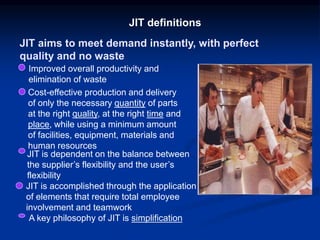
JIT aims to meet demand instantly, with perfect
quality and no waste
JIT definitions
Improved overall productivity and
elimination of waste
Cost-effective production and delivery
of only the necessary quantity of parts
at the right quality, at the right time and
place, while using a minimum amount
of facilities, equipment, materials and
human resources
JIT is dependent on the balance between
the supplier’s flexibility and the user’s
flexibility
JIT is accomplished through the application
of elements that require total employee
involvement and teamwork
A key philosophy of JIT is simplification
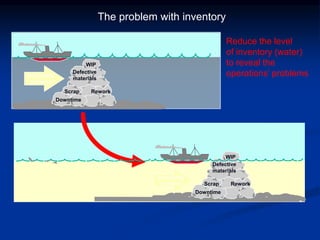
WIP
Defective
materials
ReworkScrap
Downtime
productivity
problems
WIP
Defective
materials
ReworkScrap
Downtime
productivity
problems
Reduce the level
of inventory (water)
to reveal the
operations’ problems
The problem with inventory
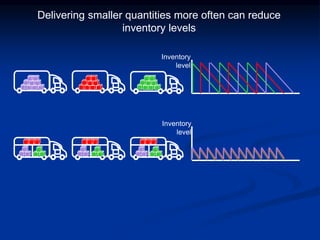
Inventory
level
Delivering smaller quantities more often can reduce
inventory levels
Inventory
level
Just-in-Time Systems (JIT)
• In a pull system, employees at a given operation
(work station) go to the source of the required
parts, such as machining or subassembly, and
withdraw the units as they need them.
• By pulling parts from each preceding workstation,
the entire manufacturing process is synchronized to
the final-assembly schedule.
• Finished goods are made to coincide with the
actual rate of customer demand, resulting in
minimal inventories and maximum responsiveness.
Just-in-Time Systems (JIT)
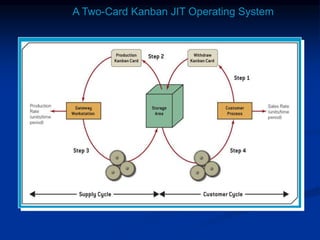
• JIT systems are sometimes called a Kanban
system.
• A kanban is a flag or a piece of paper that
contains all relevant information for an order.
• Slips, called kanban cards, are circulated within
the system to initiate withdrawal and production
items through the production process.
• The Kanban cards are simple visual controls.
A Two-Card Kanban JIT Operating System
JIT in Service Organizations
• JIT implementations can impact service
organizations by increasing service levels
at lower costs, thus improving profits.
• In implementing a JIT system, the entire
value chain synchronizes its activities and
speeds up.
• For information-intensive organizations the
Internet is the enabler
Designing Effective JIT Systems
• JIT implementations can impact service
organizations by increasing service levels
at lower costs, thus improving profits.
• In implementing a JIT system, the entire
value chain must synchronize its activities.
• JIT is an integrative operating system that
demands the best ideas, methods, and
management practices.
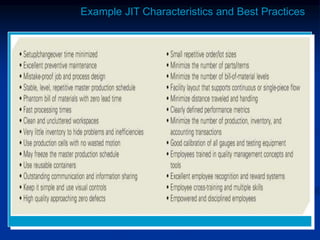
Example JIT Characteristics and Best Practices
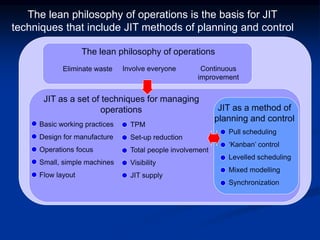
The lean philosophy of operations is the basis for JIT
techniques that include JIT methods of planning and control
The lean philosophy of operations
Eliminate waste Involve everyone Continuous
improvement
JIT as a set of techniques for managing
operations
Basic working practices
Design for manufacture
Operations focus
Small, simple machines
Flow layout
TPM
Set-up reduction
Total people involvement
Visibility
JIT supply
JIT as a method of
planning and control
Pull scheduling
‘Kanban’ control
Levelled scheduling
Mixed modelling
Synchronization

3 lean thinking & jit

  • 1.
    Lean Thinking andJust- in-Time Systems
  • 2.
    What is Lean? Lean = Doing More with Less  Less Time, Inventory, Space, Labor and Money  Systematic Elimination of Waste  Lean – organization focuses on its core capabilities and devoid of any waste  Lean Enterprise – approaches that focus on the elimination of waste in all forms and smooth, efficient flow of materials and information throughout the value chain to obtain faster customer response, higher quality and lower costs
  • 3.
    ‘The key principleof lean operations is relatively straightforward to understand: it means moving towards the elimination of all waste in order to develop an operation that is faster and more dependable, produces higher quality products and services and, above all, operates at low cost.’
  • 4.
    Synonyms continuous flow manufacture highvalue-added manufacture stockless production low-inventory production fast-throughput manufacturing lean manufacturing Toyota production system short cycle time manufacturing Source: Corbis/Denis Balihouse
  • 5.
    Four Basic LeanPrinciples 1. Elimination of Waste: eliminate any activities that do not add value in an organization. Includes overproduction, waiting time, processing, inventory, and motion. 2. Increased Speed and Response: better process designs allow efficient responses to customers needs and the competitive environment. 3. Improved Quality: Poor quality creates waste, so improving quality is essential to the lean environment. 4. Reduced Cost: simplifying processes and improving efficiency translates to reduced costs.
  • 6.
    Seven Wastes tobe Eliminated  Overproduction or Early Production producing over customer requirements, producing unnecessary materials/products  Waiting time delays, idle time (time during which value is not added to the product)  Transportation multiple handling, delay in materials handling, unnecessary handling  Inventory holding or purchasing unnecessary raw materials, work in process, and finished goods  Motion actions of people or equipment that do not add value to the product  Over processing unnecessary steps or work elements / procedures (non added value work)  Defective units production of a part that is scrapped or requires rework
  • 7.
    Common Examples ofWaste in Organizations
  • 8.
    Lean Tools andApproaches VALUE STREAM MAPPING • difference between value stream mapping (VSM) and traditional flowcharting analysis and service blueprinting is that VSM tries to highlight value-added and non-value-added work activities, that is, the economics of process flow. • All other aspects of VSM are identical to traditional process flowcharting and flow analysis such as identifying numerically bottleneck work activities and work stations, evaluating process and wait times, and evaluating information flows that accompany physical goods flows.
  • 9.
    ‘Value stream’ mappingfocuses on value-adding activities. It distinguishes between value-adding and non-value-adding activities. It is similar to process mapping but different in four ways: It uses a broader range of information than most process maps. It is usually at a higher level (5–10 activities) than most process maps. It often has a wider scope, frequently spanning the whole supply chain. It can be used to identify where to focus future improvement activities. ‘Value stream’ mapping
  • 10.
    Lean Tools andApproaches SMALL BATCH & SINGLE PIECE FLOW • Batching is the process of producing large quantities of items as a group before being transferred to the next operation. • Lean operating systems seek to reduce batch sizes using single-piece flow. • A transfer batch is part of the original batch (lot) size that is completed at one workstation and moved to the next downstream workstation.
  • 11.
  • 12.
    Lean Tools andApproaches Small Bath and Single-Piece Flow • Single-piece flow allows companies to better match production to customer demand, avoid large inventory buildups, and ensure uninterrupted movement of WIP through the production system. • To utilize single-piece flow, a company must be able to change between products quickly and inexpensively by reducing setup times.
  • 13.
    Lean Tools andApproaches The 5Ss • 5S Principles are used to create a clean and well-organized work environment. • Messy and disorganized workplaces waste time, energy, and resources.
  • 14.
    Lean Tools andApproaches The 5S principles are as follows: 1. Sort: each item is in the proper place. 2. Set in order: arrange materials so that they are easy-to-use. 3. Shine: clean work area. 4. Standardize: formalize procedures and practices. 5. Sustain: keep the process going.
  • 17.
    Lean Tools andApproaches VISUAL CONTROLS • Visual controls are indicators for operating activities that are placed in plain sight of all employees so that everyone can quickly and easily understand the status and performance of the work system. • Examples: electronic scoreboards in production processes, painted areas on the floor where certain boxes and pallets should be placed, employee pull cords to stop production, signal lights on machines, and even Kanban cards.
  • 18.
    Lean Tools andApproaches EFFICIENT LAYOUT & STANDARDIZED OPERATIONS • The layout, process, equipment, workstations, and jobs must be integrated and arranged in an efficient way. SUPPLIER RELATIONSHIP MANAGEMENT • Lean systems require suppliers that will deliver on time and provide high quality products.
  • 19.
    Lean Tools andApproaches SINGLE MINUTE EXCHANGE OF DIES (SMED) • SMED refers to quick setup or changeover of tolling and fixtures in processes so that multiple products in smaller batches can be run on the same equipment. • Reducing setup time frees up capacity that can be producing output, and therefore, generating revenue. • Example: Yammar Diesel reduced machine setup from 9.3 hours to 9 minutes!
  • 20.
    Lean Tools andApproaches STABLE PRODUCTION SCHEDULES Lean operating systems require uniform and stable production plans and schedules. QUALITY AT THE SOURCE Quality at the source focuses on doing it right the first time. CONTINUOUS IMPROVEMENT Six Sigma compliments lean systems to assure high-quality output.
  • 22.
    Lean Tools andApproaches Six Sigma and Lean concepts and methods are often combined into Lean Six Sigma. • Both are driven by customer requirements. • Both try to eliminate waste, reduce costs, speed things up, and improve quality. • Both focus on real dollar savings. • Both rely on a systematic methodology.
  • 23.
    Differences between Leanand Six Sigma • Lean addresses more visible problems in the processes while Six Sigma focuses on problems like process variation. • Lean tools are intuitive, simple, and easy to apply; Six Sigma tools include more advanced statistical analysis. • Lean requires less training, whereas Six Sigma requires advance training and expertise in statistics, control charts, and Black or Master Black Belt specialists.
  • 24.
  • 25.
    Lean Tools andApproaches Total Productive Maintenance (TPM) • TPM is focused on ensuring that operating systems will perform their intended function reliably. • TPM works to prevent equipment failures and downtime, maximizing equipment effectiveness and uptime. • TPM tries to predict equipment failure rates and perform maintenance before a problem arises. • The principles of TPM also include employee “ownership” of the equipment.
  • 26.
    Lean Tools andApproaches Manufactured Good Recovery • In an effort to reduce costs, many companies are actively recovering and recycling parts. • Options include repairing, refurbishing, remanufacturing, cannibalizing, and recycling. • This can occur as various points of the supply chain, as shown in the following slide.
  • 27.
    Lean Manufacturing Tours •Timken Company is a leading manufacturer of highly engineered bearings and alloy steels and related products. • Lean tools that Timken utilized are as follows: • Eliminate waste: using kaizen to eliminate non- value-added steps from processes. • Increase speed and response: radically reduce cycle time for new products with integrated supply chain. • Improve quality: utilizing Six Sigma process variation tools and ISO 9000 quality standards. • Reduce cost: using technology to reduce costs.
  • 28.
    Timken’s DMAIC Toolkitfor Lean Six Sigma
  • 29.
    JIT aims tomeet demand instantly, with perfect quality and no waste JIT definitions Improved overall productivity and elimination of waste Cost-effective production and delivery of only the necessary quantity of parts at the right quality, at the right time and place, while using a minimum amount of facilities, equipment, materials and human resources JIT is dependent on the balance between the supplier’s flexibility and the user’s flexibility JIT is accomplished through the application of elements that require total employee involvement and teamwork A key philosophy of JIT is simplification
  • 30.
  • 31.
    Inventory level Delivering smaller quantitiesmore often can reduce inventory levels Inventory level
  • 32.
    Just-in-Time Systems (JIT) •In a pull system, employees at a given operation (work station) go to the source of the required parts, such as machining or subassembly, and withdraw the units as they need them. • By pulling parts from each preceding workstation, the entire manufacturing process is synchronized to the final-assembly schedule. • Finished goods are made to coincide with the actual rate of customer demand, resulting in minimal inventories and maximum responsiveness.
  • 33.
    Just-in-Time Systems (JIT) •JIT systems are sometimes called a Kanban system. • A kanban is a flag or a piece of paper that contains all relevant information for an order. • Slips, called kanban cards, are circulated within the system to initiate withdrawal and production items through the production process. • The Kanban cards are simple visual controls.
  • 34.
    A Two-Card KanbanJIT Operating System
  • 35.
    JIT in ServiceOrganizations • JIT implementations can impact service organizations by increasing service levels at lower costs, thus improving profits. • In implementing a JIT system, the entire value chain synchronizes its activities and speeds up. • For information-intensive organizations the Internet is the enabler
  • 36.
    Designing Effective JITSystems • JIT implementations can impact service organizations by increasing service levels at lower costs, thus improving profits. • In implementing a JIT system, the entire value chain must synchronize its activities. • JIT is an integrative operating system that demands the best ideas, methods, and management practices.
  • 37.
    Example JIT Characteristicsand Best Practices
  • 38.
    The lean philosophyof operations is the basis for JIT techniques that include JIT methods of planning and control The lean philosophy of operations Eliminate waste Involve everyone Continuous improvement JIT as a set of techniques for managing operations Basic working practices Design for manufacture Operations focus Small, simple machines Flow layout TPM Set-up reduction Total people involvement Visibility JIT supply JIT as a method of planning and control Pull scheduling ‘Kanban’ control Levelled scheduling Mixed modelling Synchronization