Calculus
For Computer Science @ BUKC
Topics for Week 5 (Lecture 1)
•Derivative; Rules – How to find derivative of various
(types of) functions
Derivatives of Polynomials
and Exponential Functions
Derivatives of Polynomials and Exponential Functions
• In this section we learn how to differentiate constant functions, power
functions, polynomials, and exponential functions.
• Let’s start with the simplest
of all functions, the constant
function f(x) = c.
• The graph of this function is
the horizontal line y = c,
which has slope 0, so we
must have f'(x) = 0.
(See Figure 1.)
Figure 1
The graph of f(x) = c is the
line y = c, so f(x) = 0.
Derivatives of Polynomials and Exponential Functions
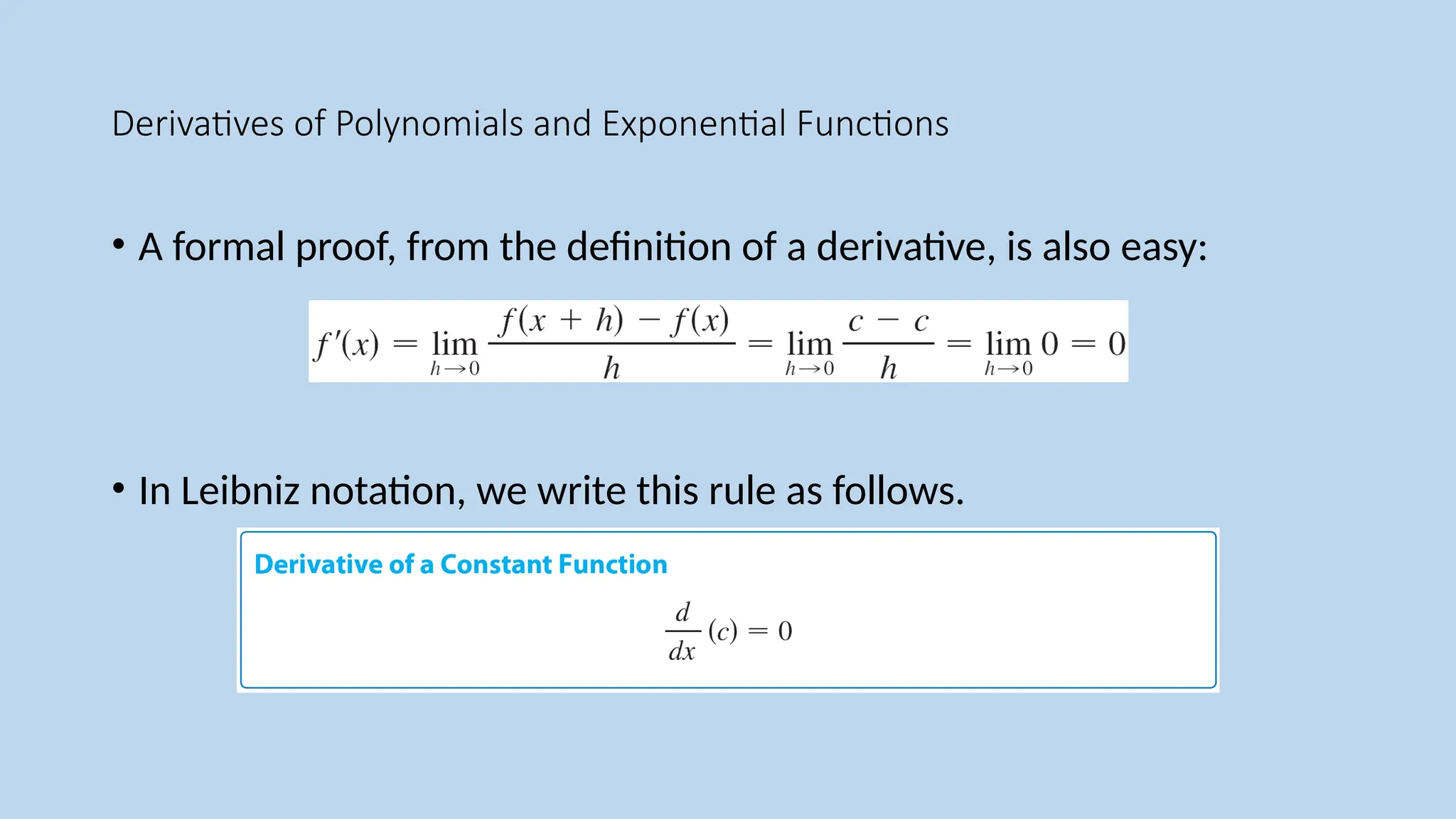
• A formal proof, from the definition of a derivative, is also easy:
• In Leibniz notation, we write this rule as follows.
Power Functions
Power Functions
• We next look at the functions f(x) = xn
, where n is a positive integer.
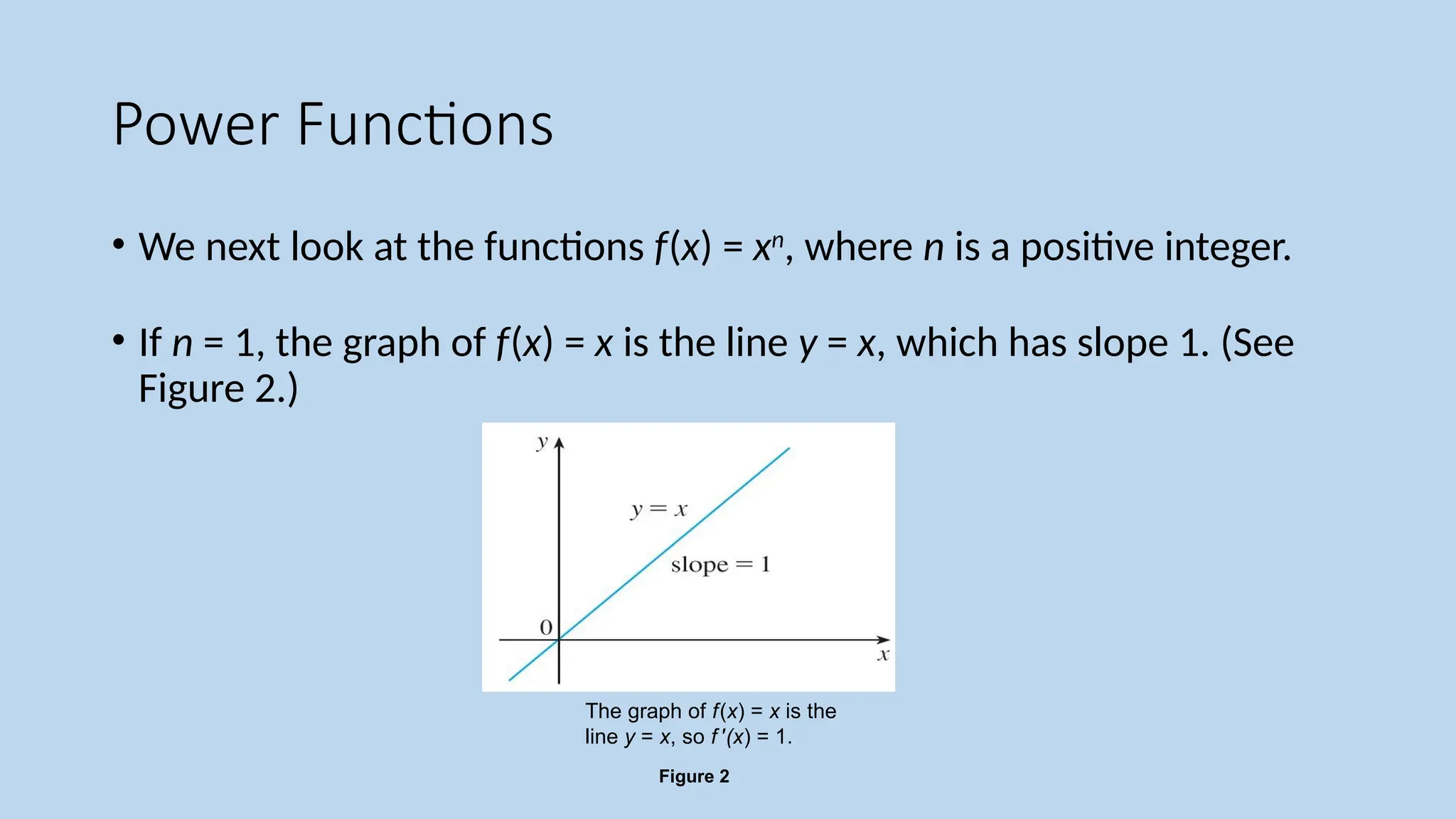
• If n = 1, the graph of f(x) = x is the line y = x, which has slope 1. (See
Figure 2.)
Figure 2
The graph of f(x) = x is the
line y = x, so f '(x) = 1.
Power Functions
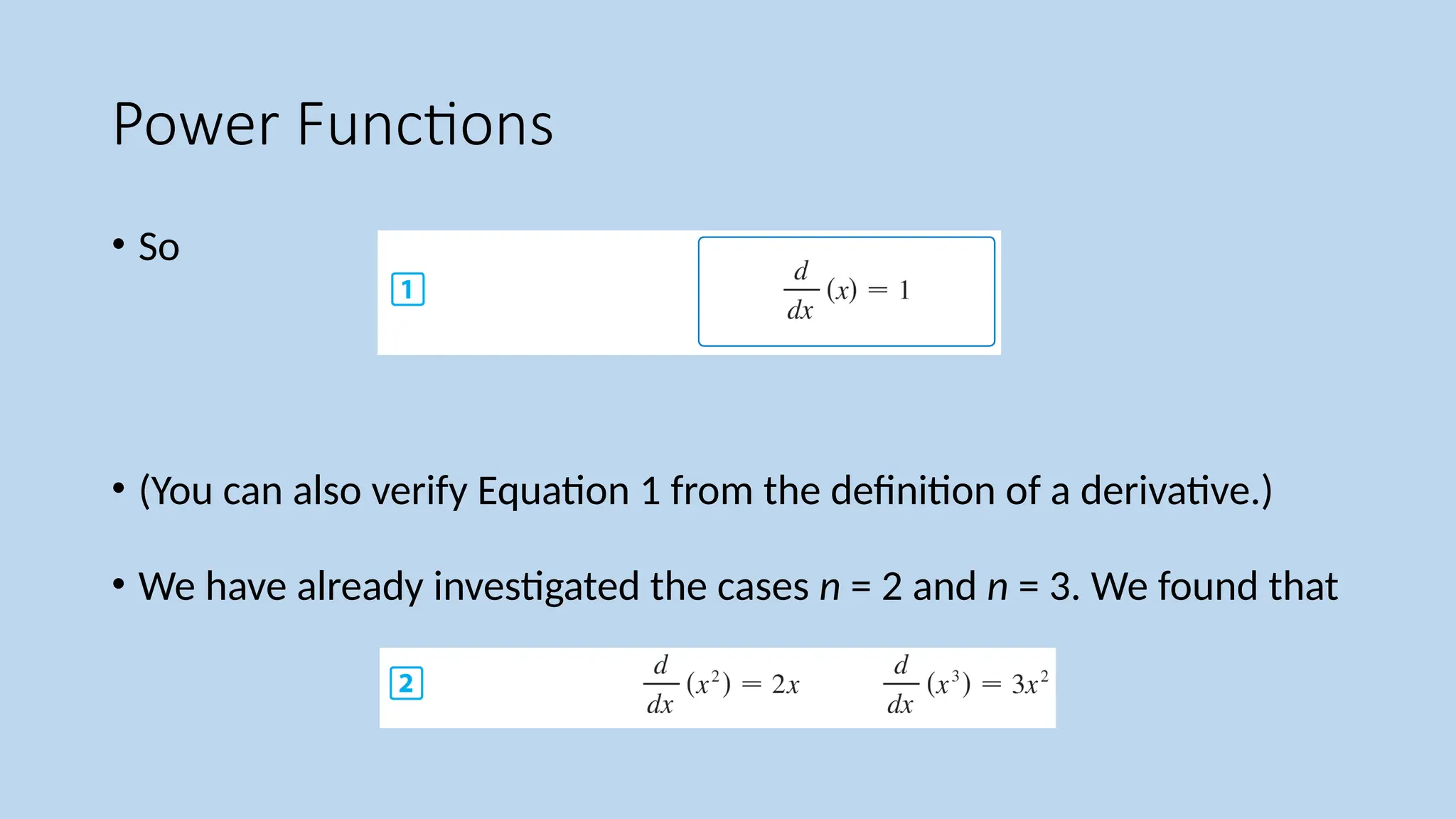
• So
• (You can also verify Equation 1 from the definition of a derivative.)
• We have already investigated the cases n = 2 and n = 3. We found that
Power Functions
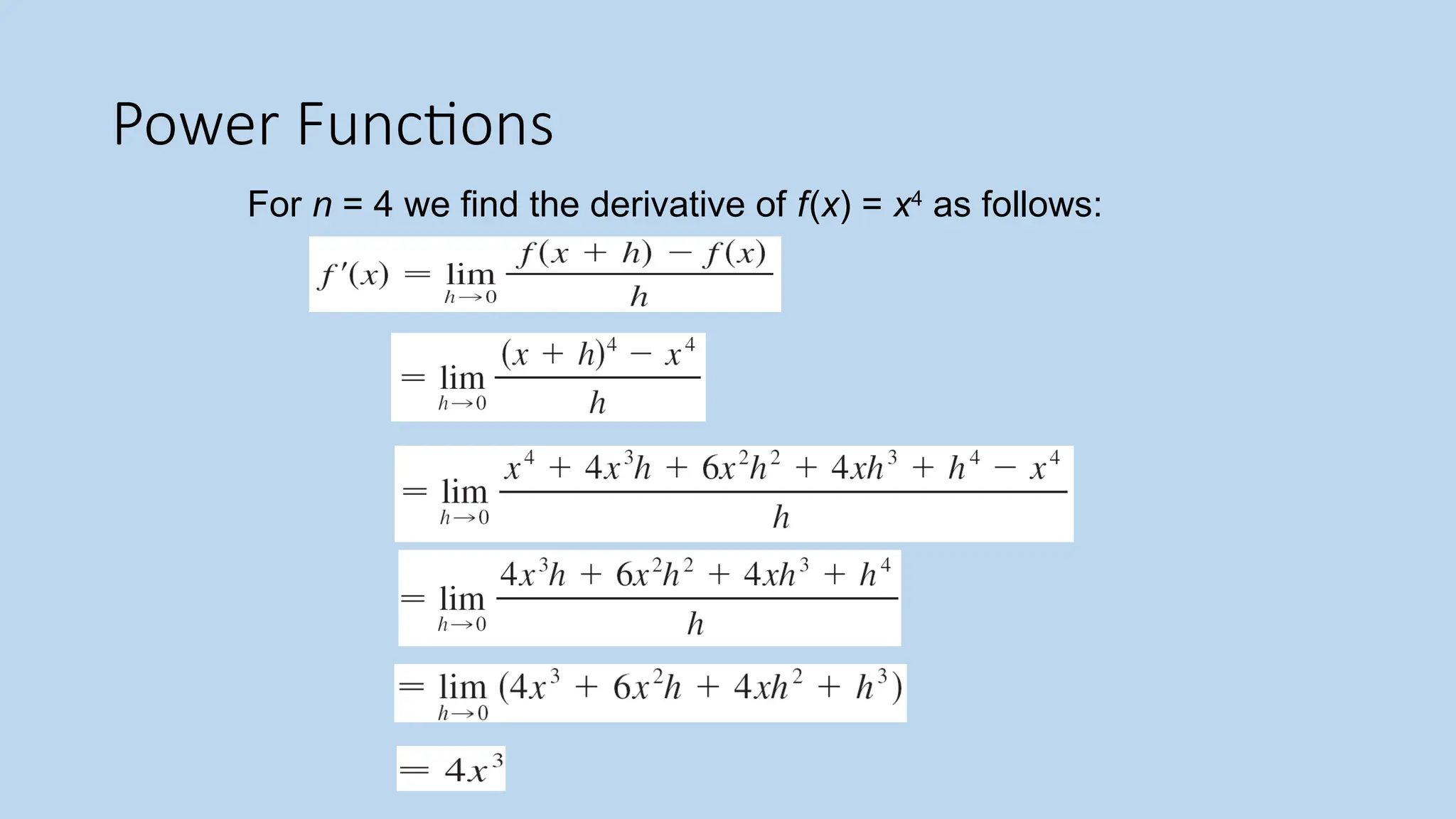
For n = 4 we find the derivative of f(x) = x4
as follows:
Power Functions
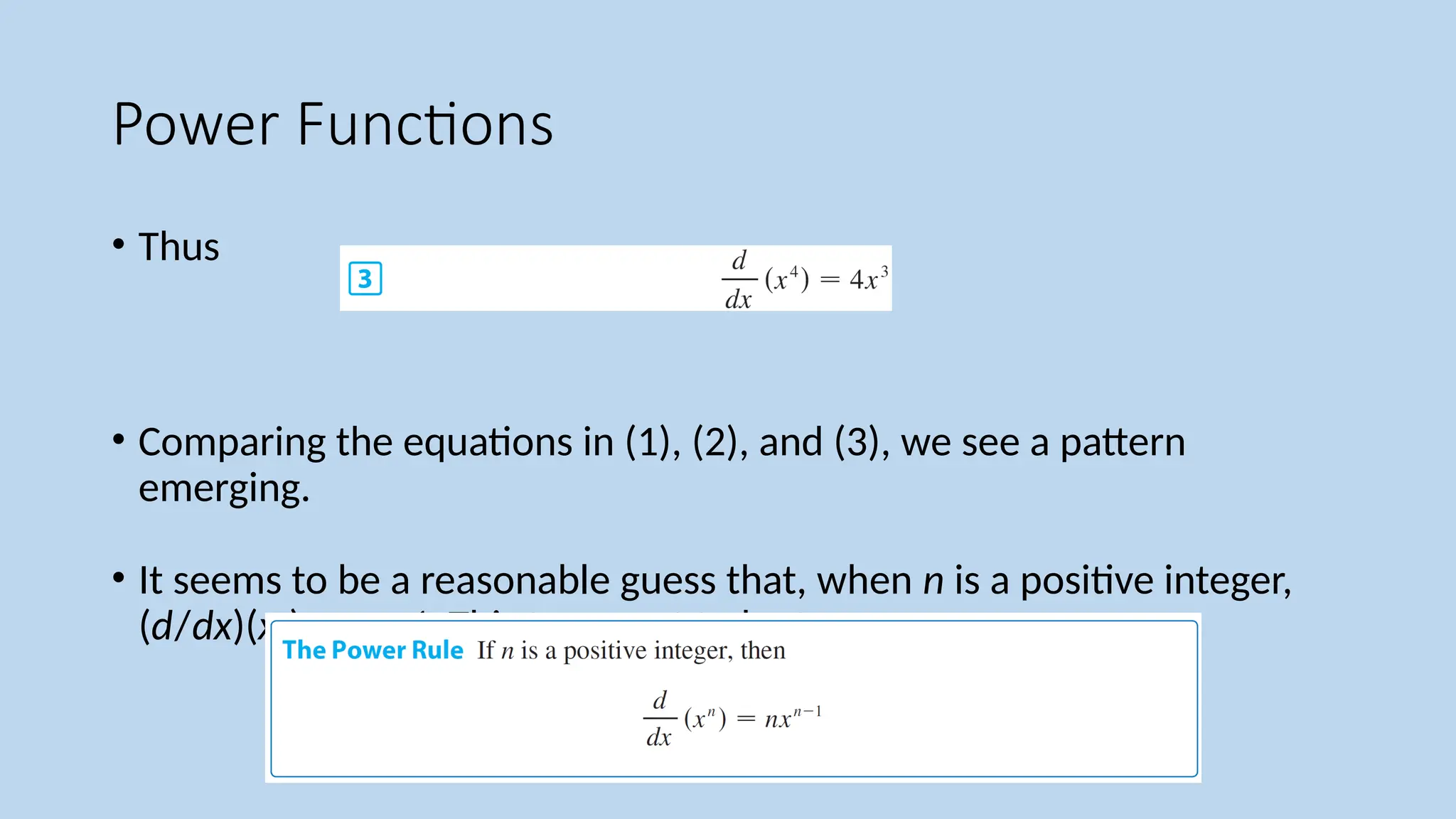
• Thus
• Comparing the equations in (1), (2), and (3), we see a pattern
emerging.
• It seems to be a reasonable guess that, when n is a positive integer,
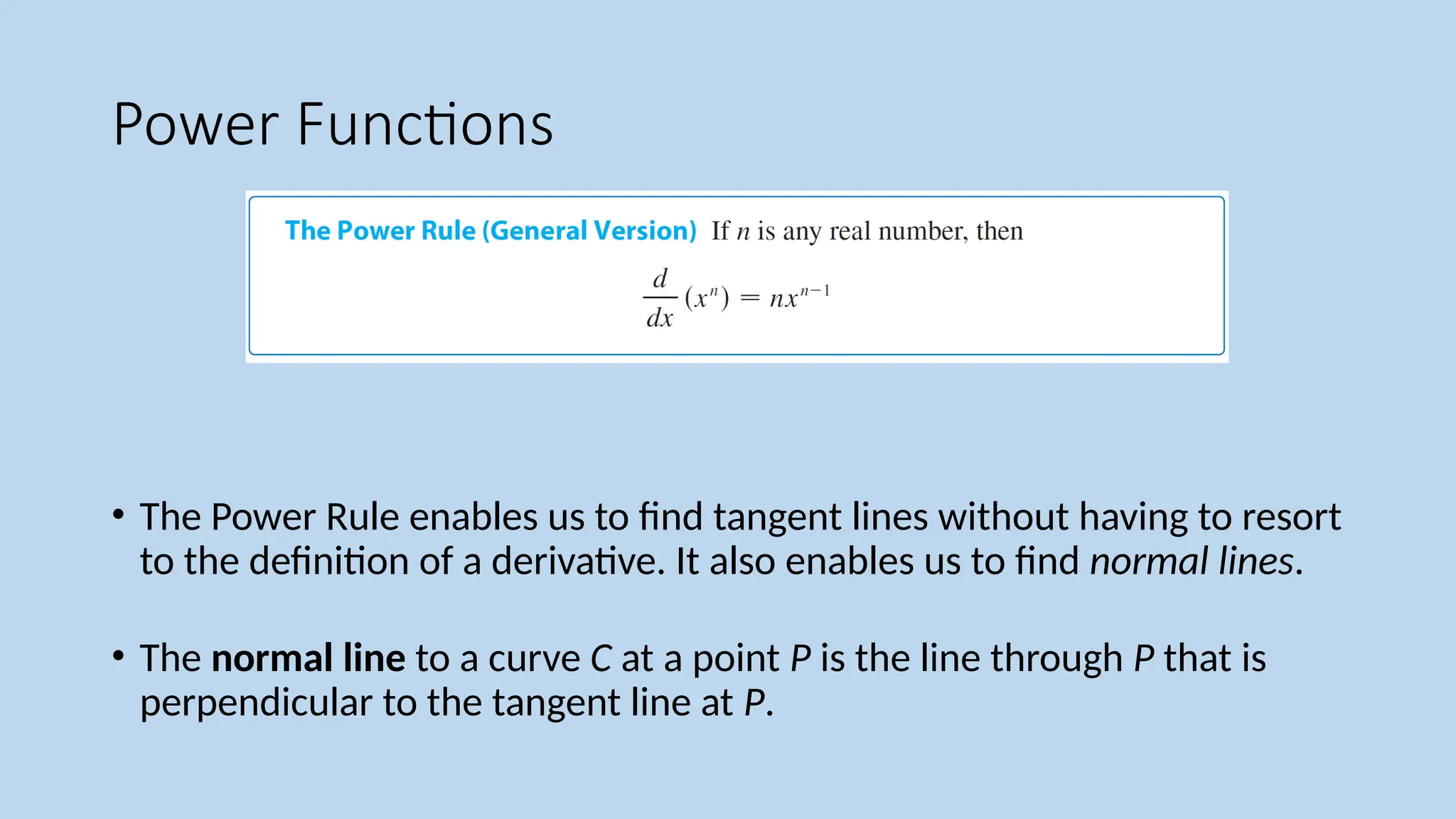
(d/dx)(xn
) = nxn –1
. This turns out to be true.
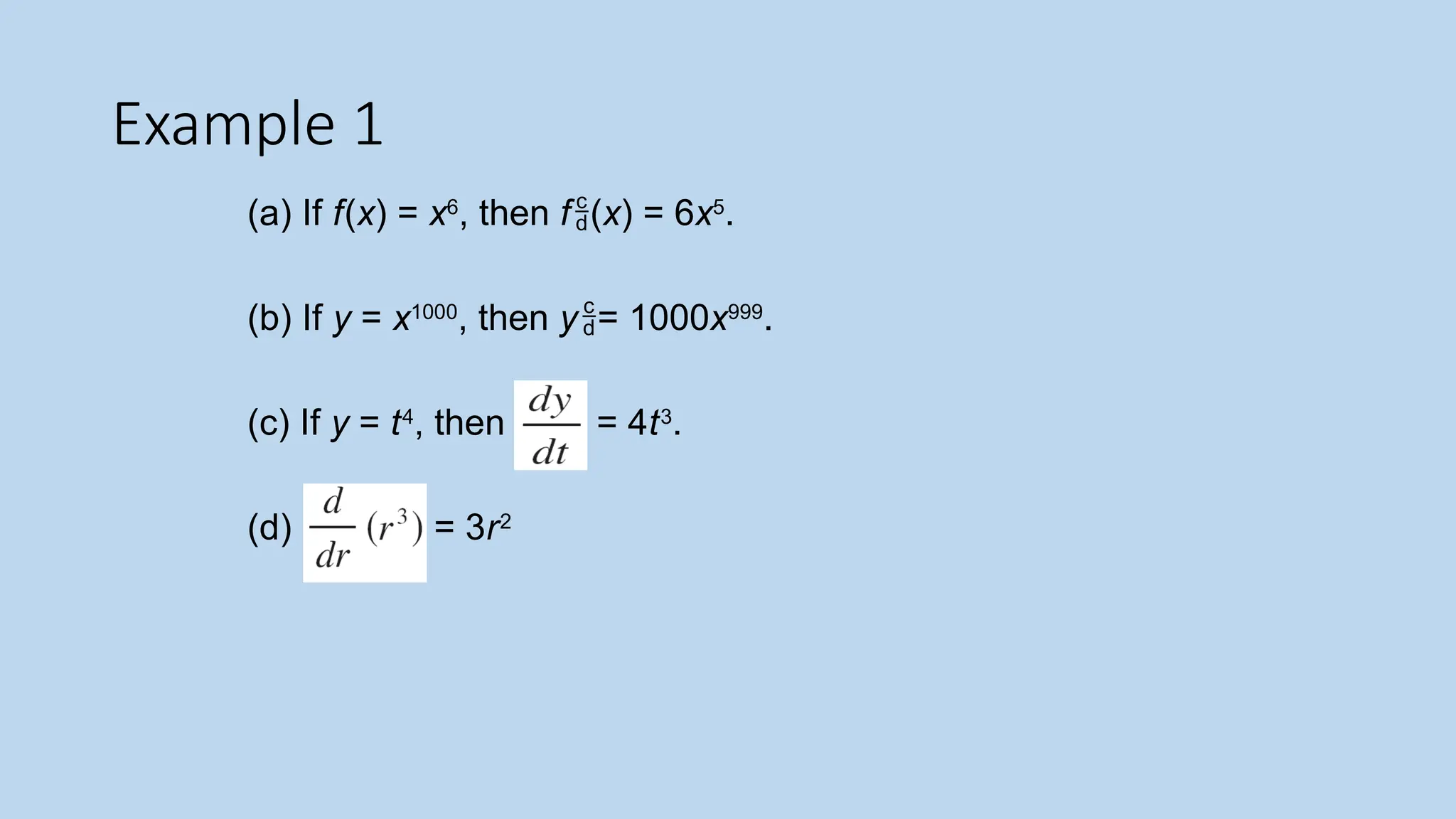
Example 1
(a) If f(x) = x6
, then f(x) = 6x5
.
(b) If y = x1000
, then y= 1000x999
.
(c) If y = t4
, then = 4t3
.
(d) = 3r2
Power Functions
• The Power Rule enables us to find tangent lines without having to resort
to the definition of a derivative. It also enables us to find normal lines.
• The normal line to a curve C at a point P is the line through P that is
perpendicular to the tangent line at P.
New Derivatives from Old
• When new functions are formed from old functions by addition,
subtraction, or multiplication by a constant, their derivatives can be
calculated in terms of derivatives of the old functions.
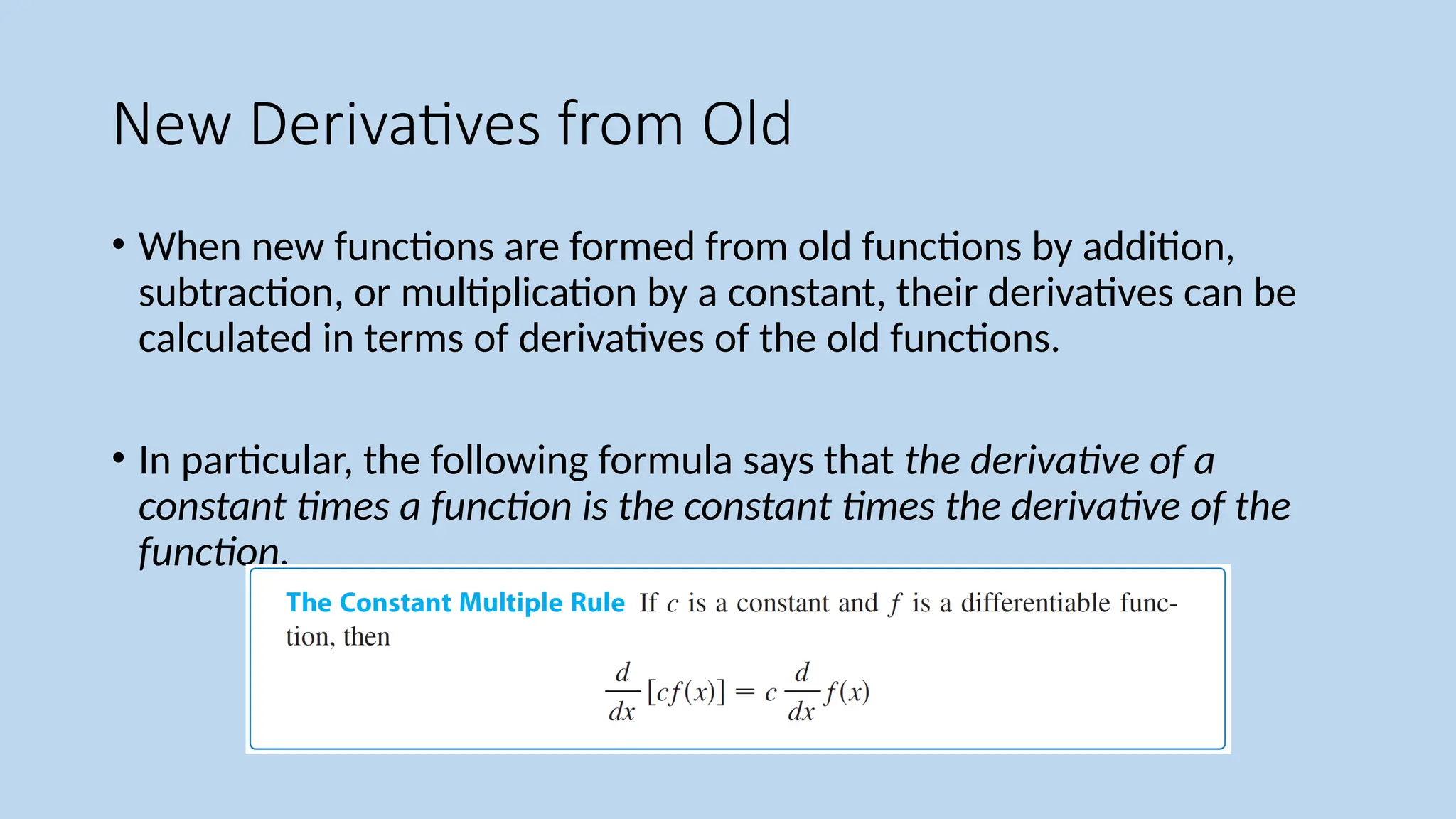
• In particular, the following formula says that the derivative of a
constant times a function is the constant times the derivative of the
function.
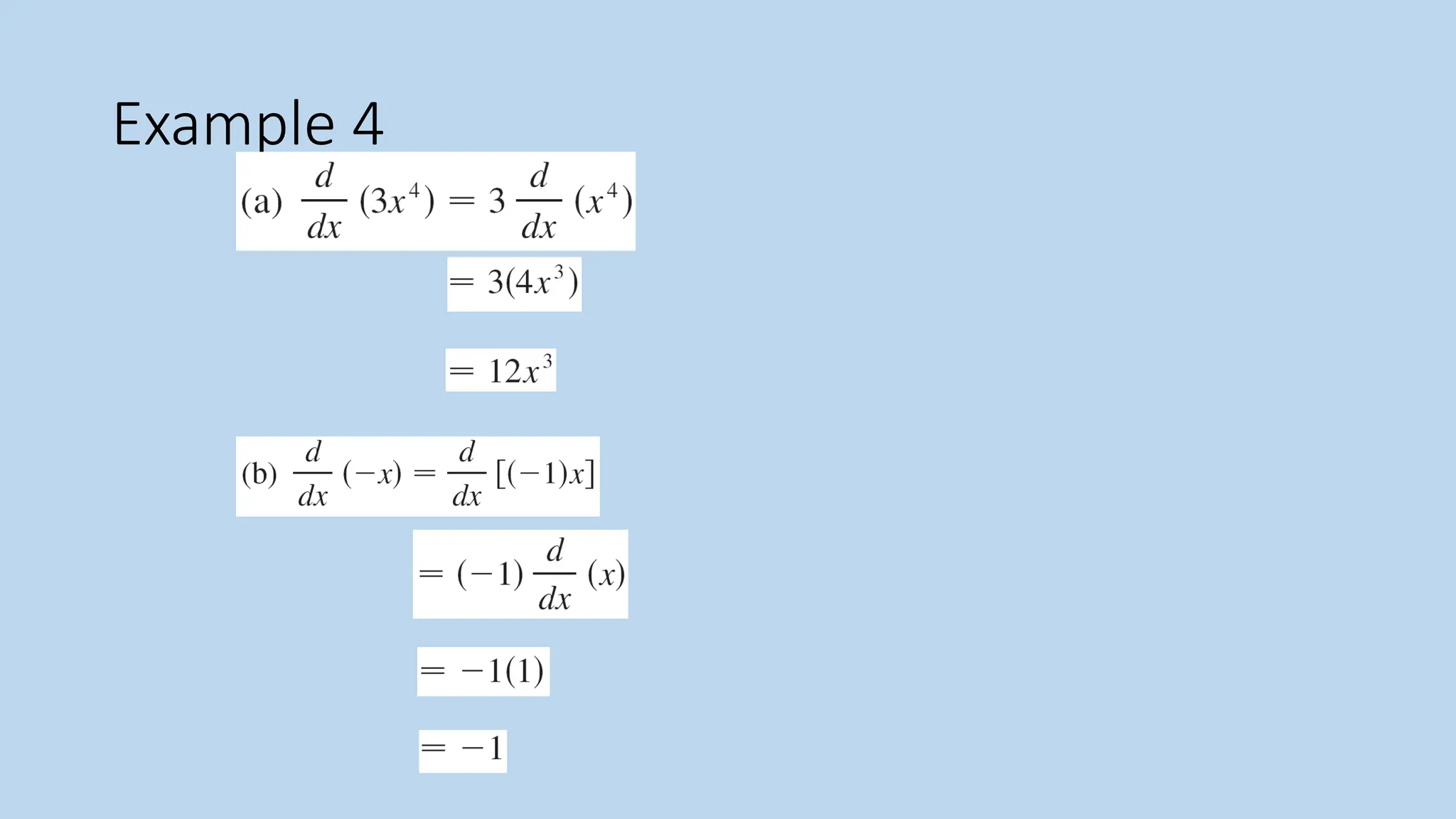
Example 4
New Derivatives from Old
• The next rule tells us that the derivative of a sum of functions is the sum of the derivatives.
• The Sum Rule can be extended to the sum of any number of functions. For instance, using
this theorem twice, we get
• (f + g + h) = [(f + g) + h)] = (f + g) + h = f + g + h
New Derivatives from Old
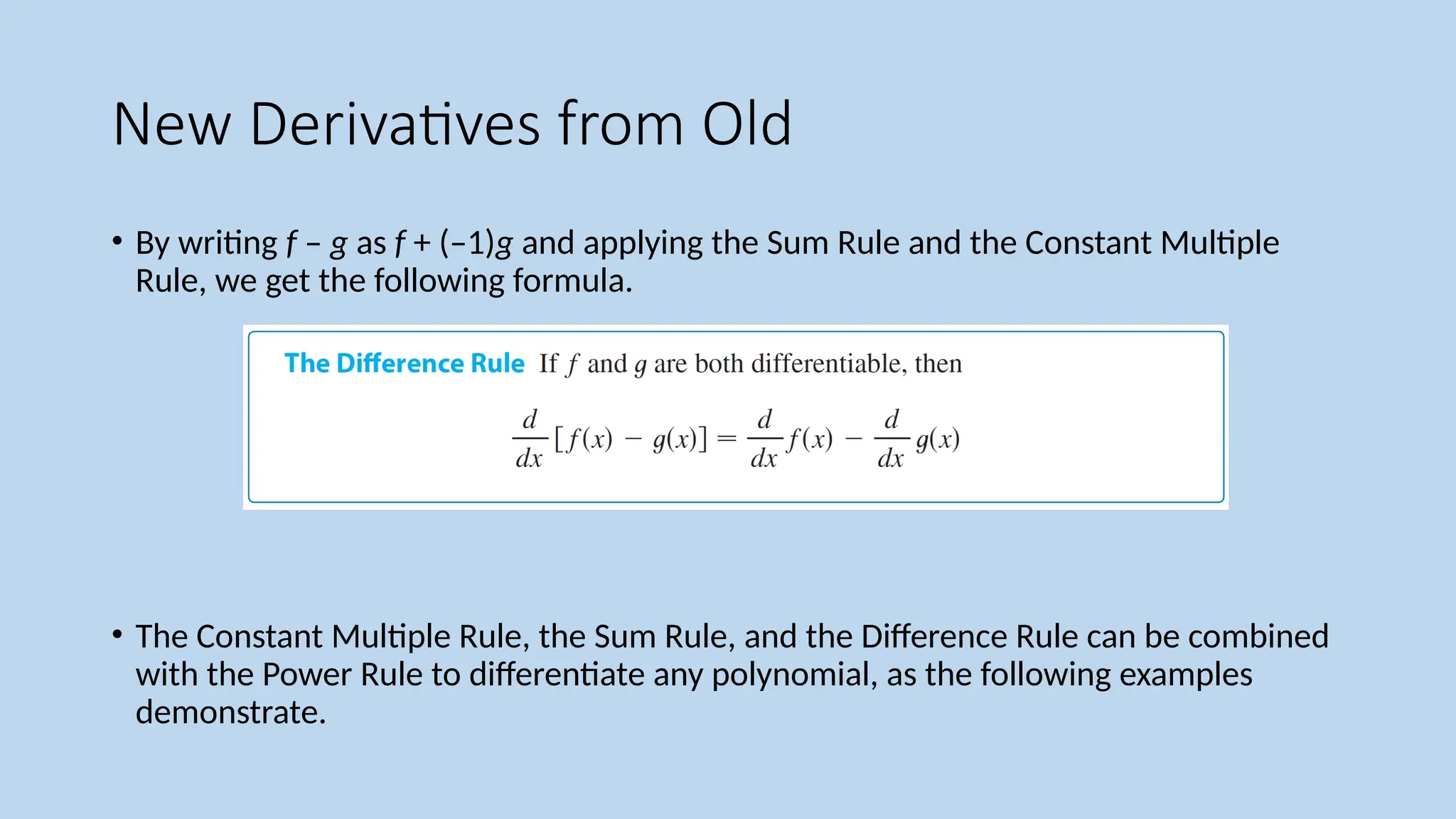
• By writing f – g as f + (–1)g and applying the Sum Rule and the Constant Multiple
Rule, we get the following formula.
• The Constant Multiple Rule, the Sum Rule, and the Difference Rule can be combined
with the Power Rule to differentiate any polynomial, as the following examples
demonstrate.
Exponential Functions
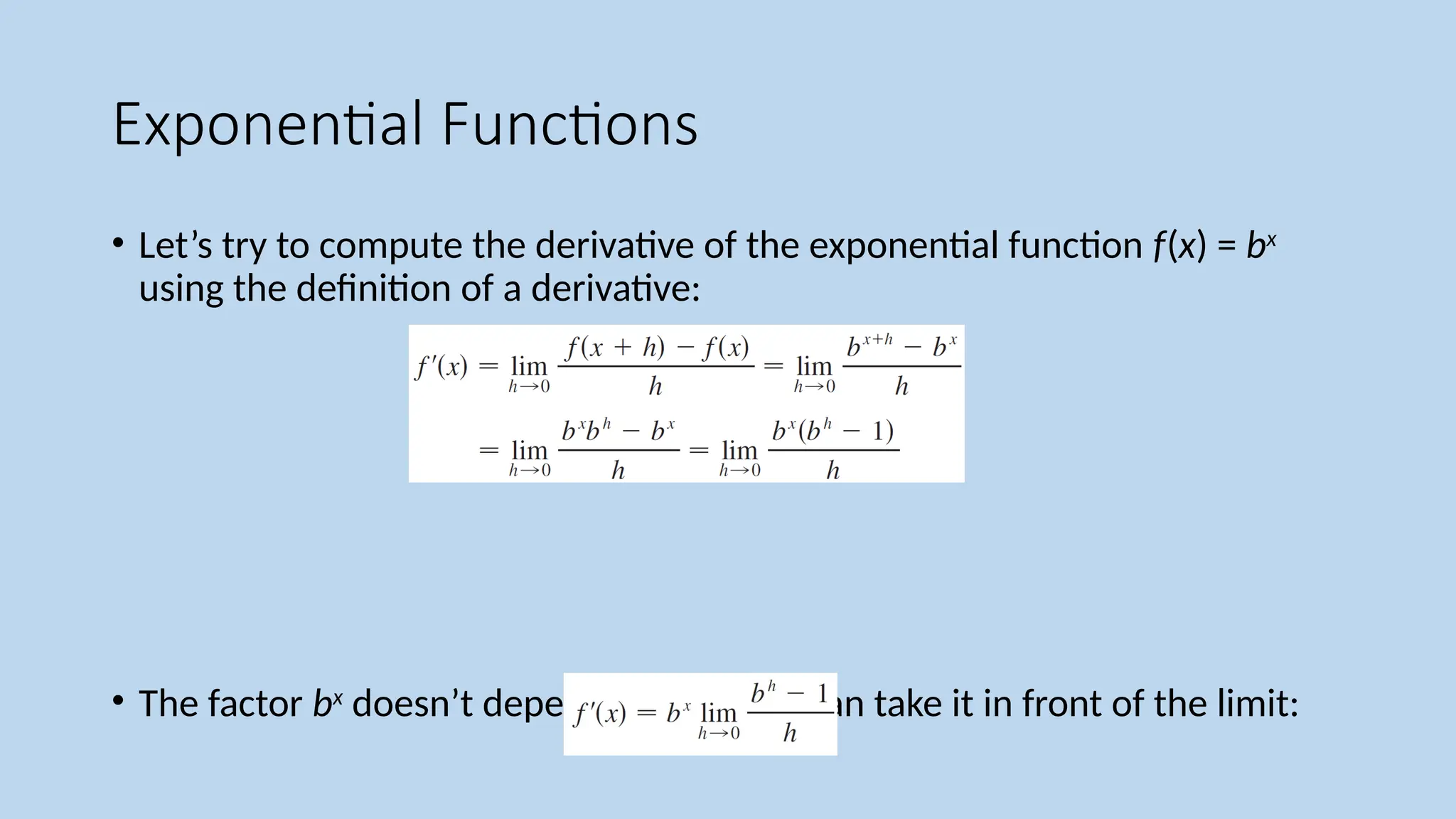
• Let’s try to compute the derivative of the exponential function f(x) = bx
using the definition of a derivative:
• The factor bx
doesn’t depend on h, so we can take it in front of the limit:
Exponential Functions
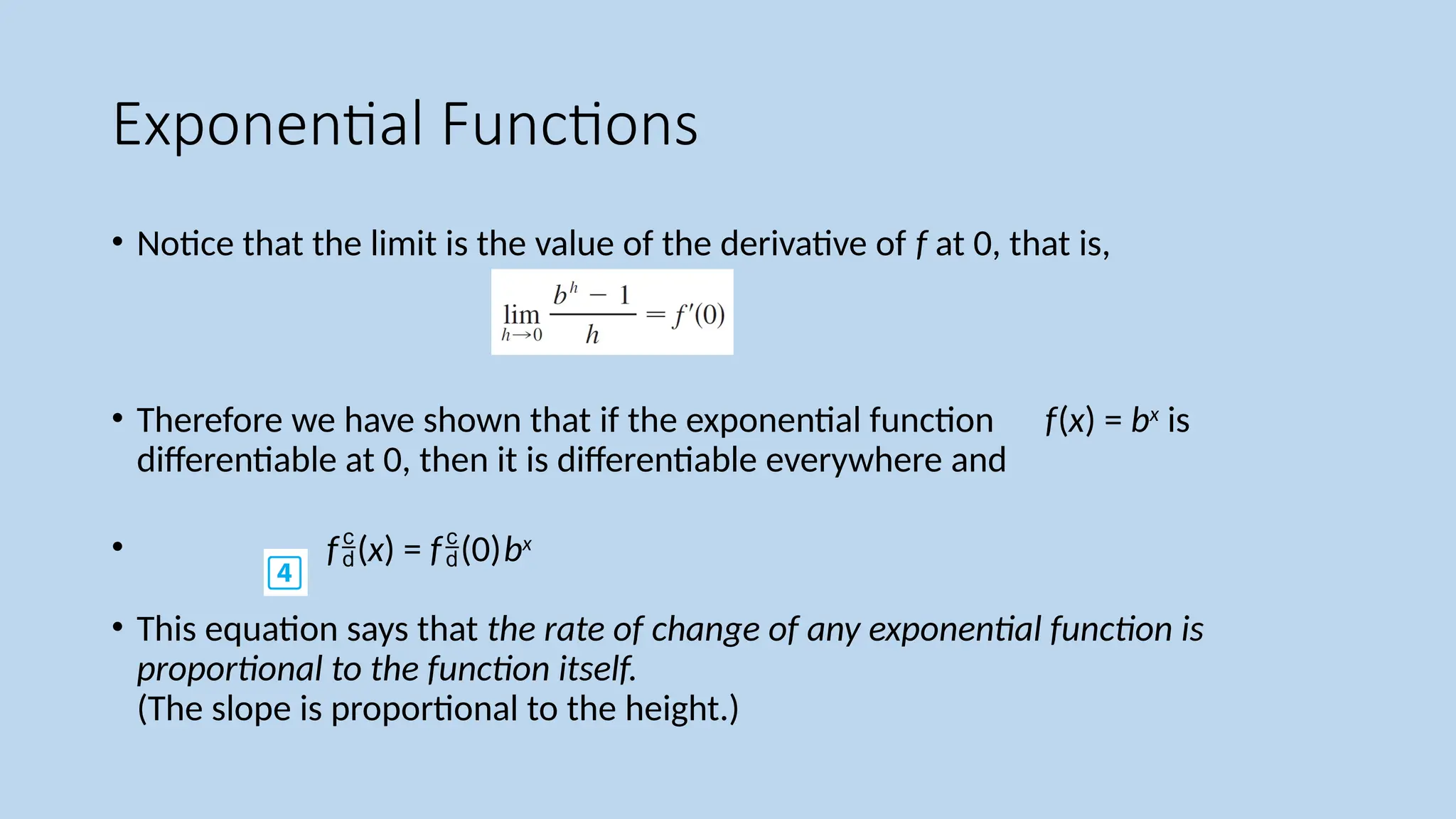
• Notice that the limit is the value of the derivative of f at 0, that is,
• Therefore we have shown that if the exponential function f(x) = bx
is
differentiable at 0, then it is differentiable everywhere and
• f(x) = f(0)bx
• This equation says that the rate of change of any exponential function is
proportional to the function itself.
(The slope is proportional to the height.)
Exponential Functions
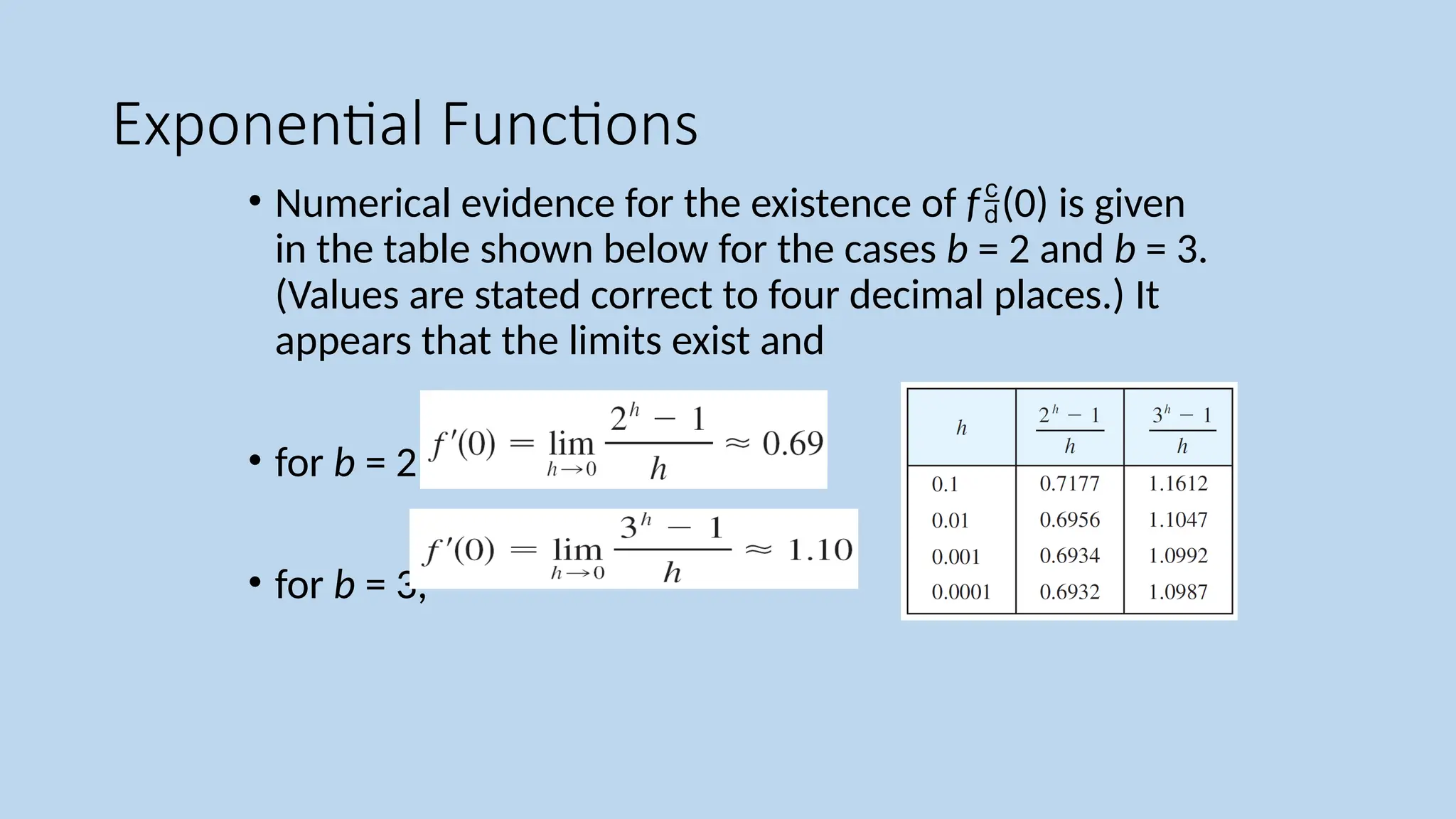
• Numerical evidence for the existence of f(0) is given
in the table shown below for the cases b = 2 and b = 3.
(Values are stated correct to four decimal places.) It
appears that the limits exist and
• for b = 2,
• for b = 3,
Exponential Functions
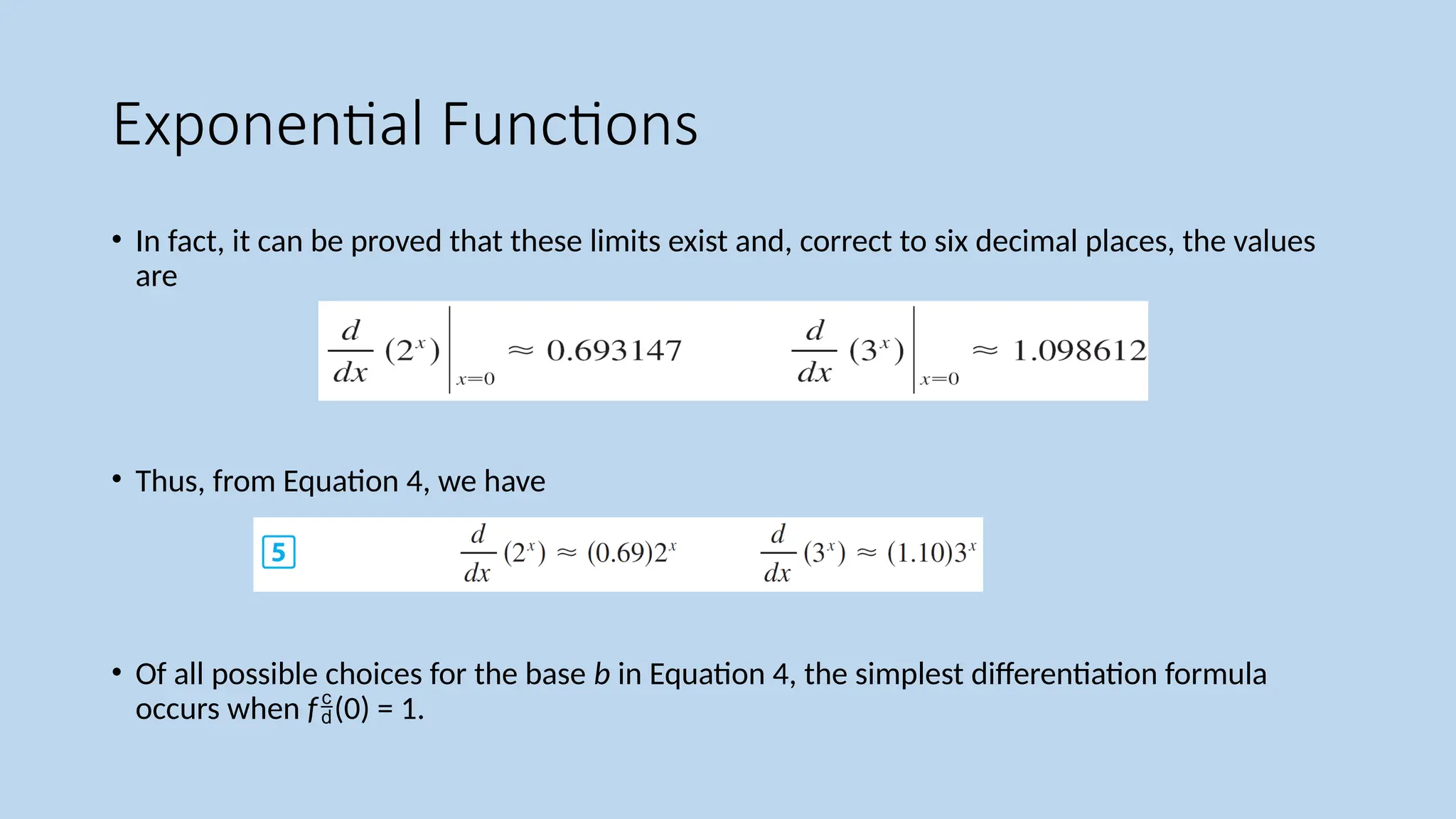
• In fact, it can be proved that these limits exist and, correct to six decimal places, the values
are
• Thus, from Equation 4, we have
• Of all possible choices for the base b in Equation 4, the simplest differentiation formula
occurs when f(0) = 1.
Exponential Functions
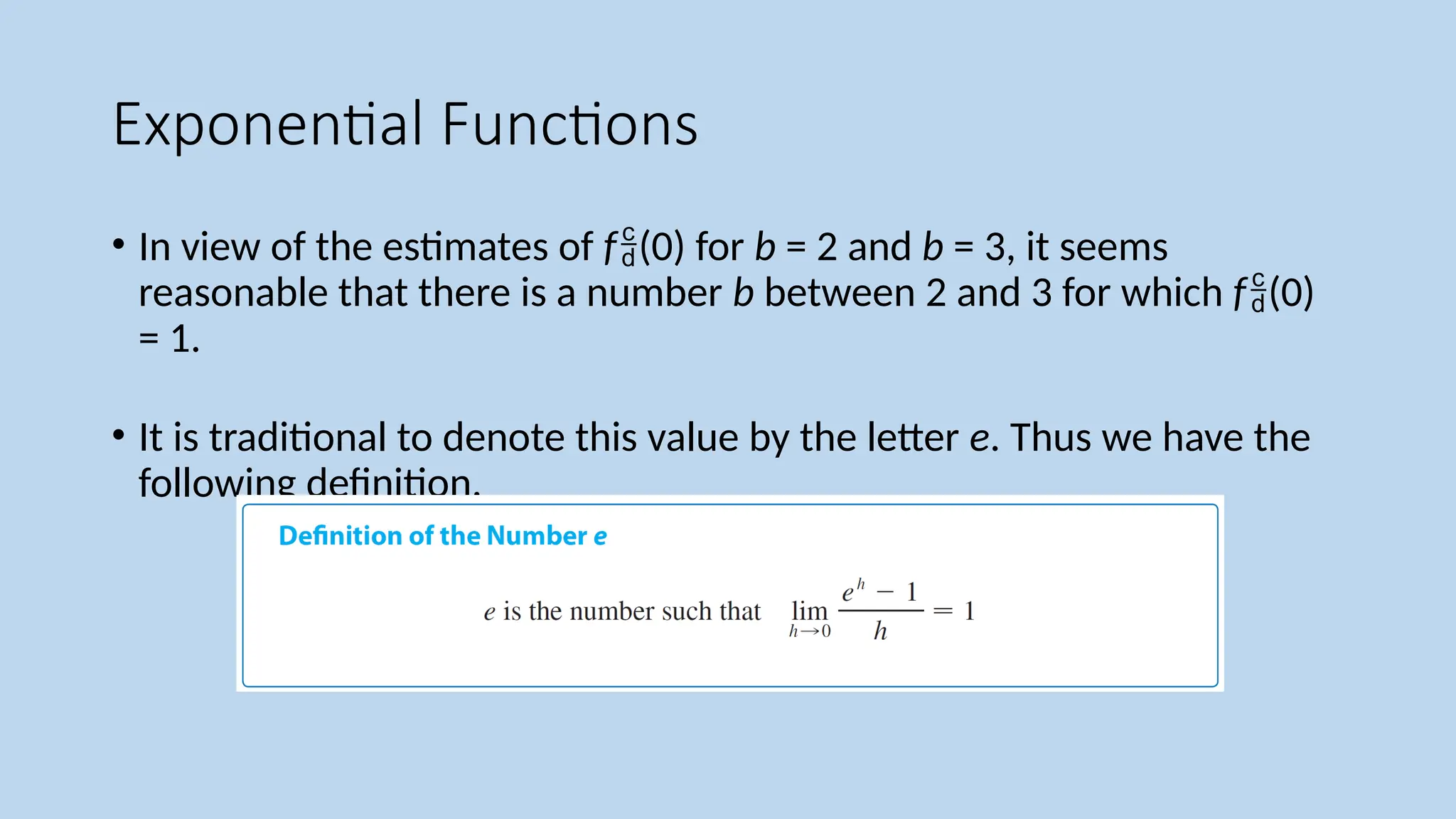
• In view of the estimates of f(0) for b = 2 and b = 3, it seems
reasonable that there is a number b between 2 and 3 for which f(0)
= 1.
• It is traditional to denote this value by the letter e. Thus we have the
following definition.
Exponential Functions
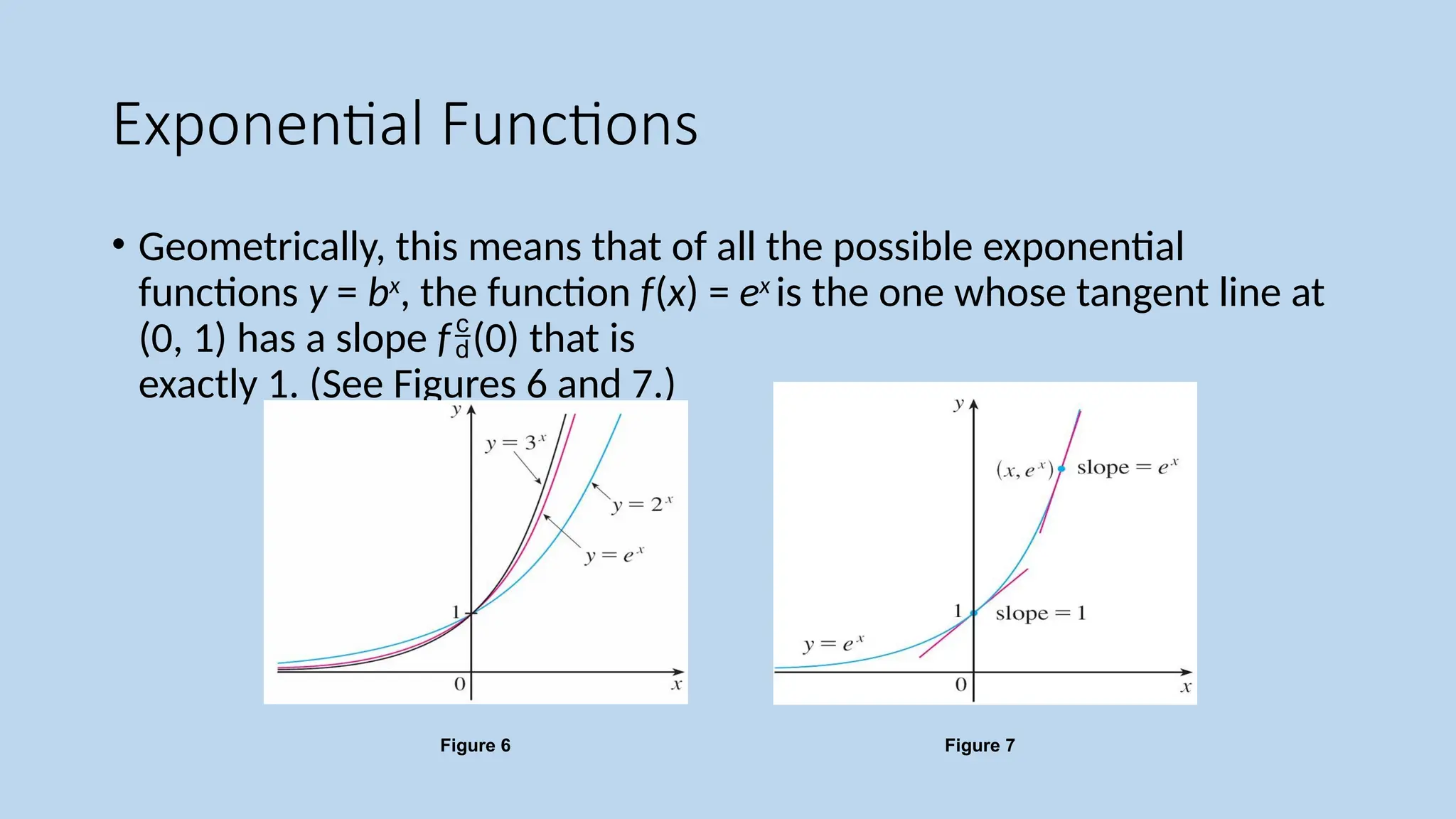
• Geometrically, this means that of all the possible exponential
functions y = bx
, the function f(x) = ex
is the one whose tangent line at
(0, 1) has a slope f(0) that is
exactly 1. (See Figures 6 and 7.)
Figure 6 Figure 7
Exponential Functions
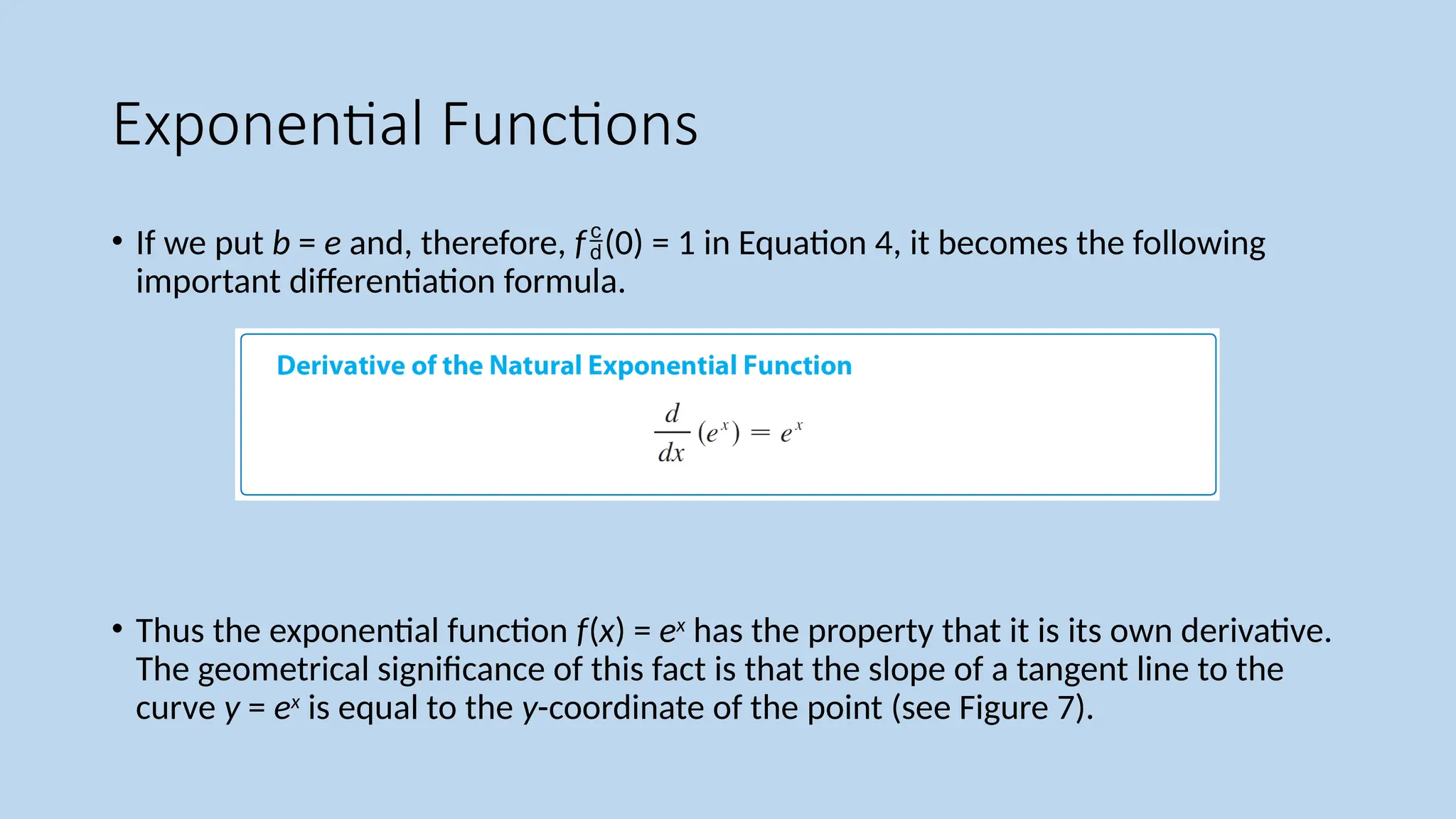
• If we put b = e and, therefore, f(0) = 1 in Equation 4, it becomes the following
important differentiation formula.
• Thus the exponential function f(x) = ex
has the property that it is its own derivative.
The geometrical significance of this fact is that the slope of a tangent line to the
curve y = ex
is equal to the y-coordinate of the point (see Figure 7).
Example 8
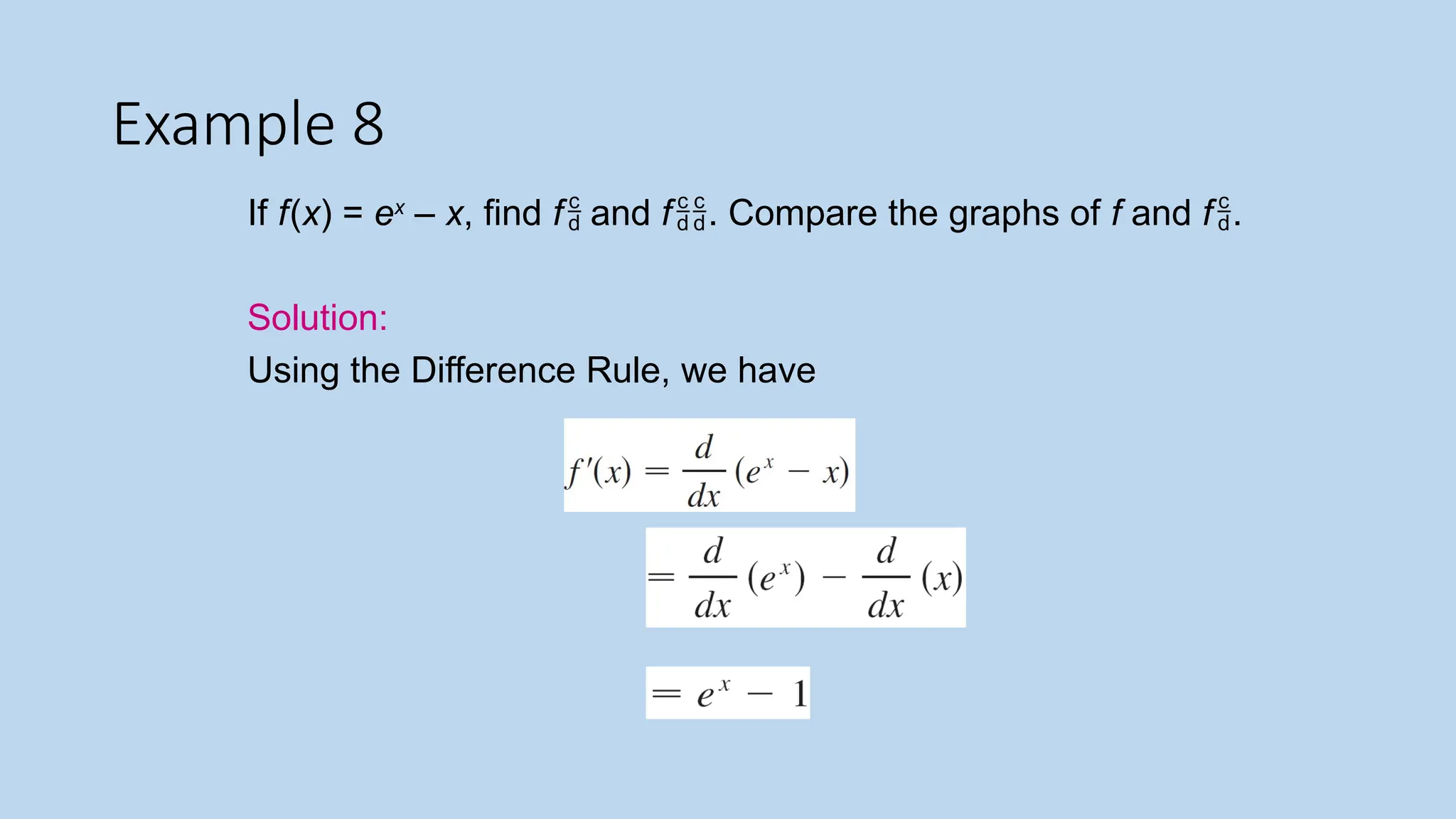
If f(x) = ex
– x, find f and f. Compare the graphs of f and f.
Solution:
Using the Difference Rule, we have
Example 8 – Solution
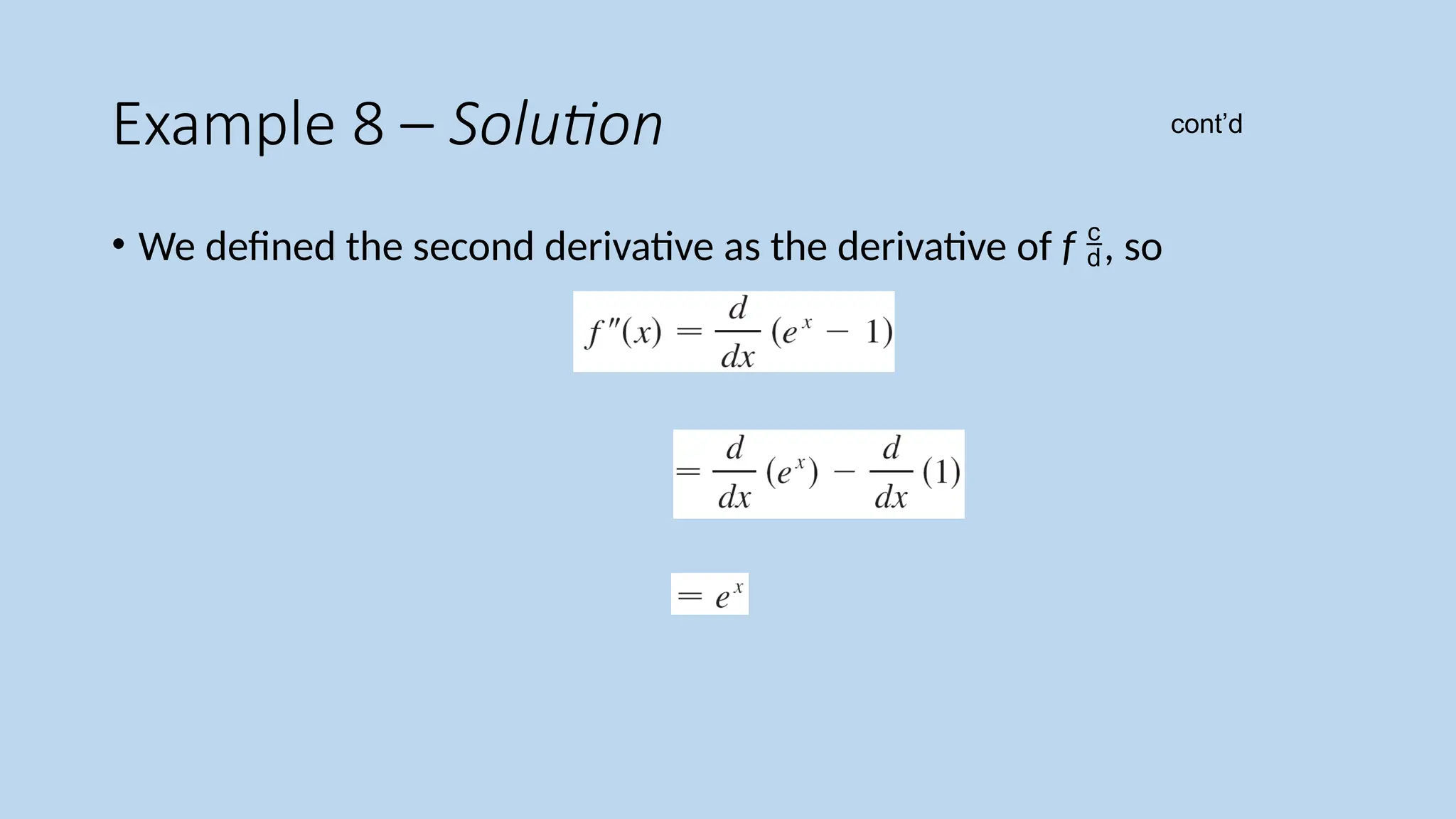
• We defined the second derivative as the derivative of f , so
cont’d
Example 8 – Solution
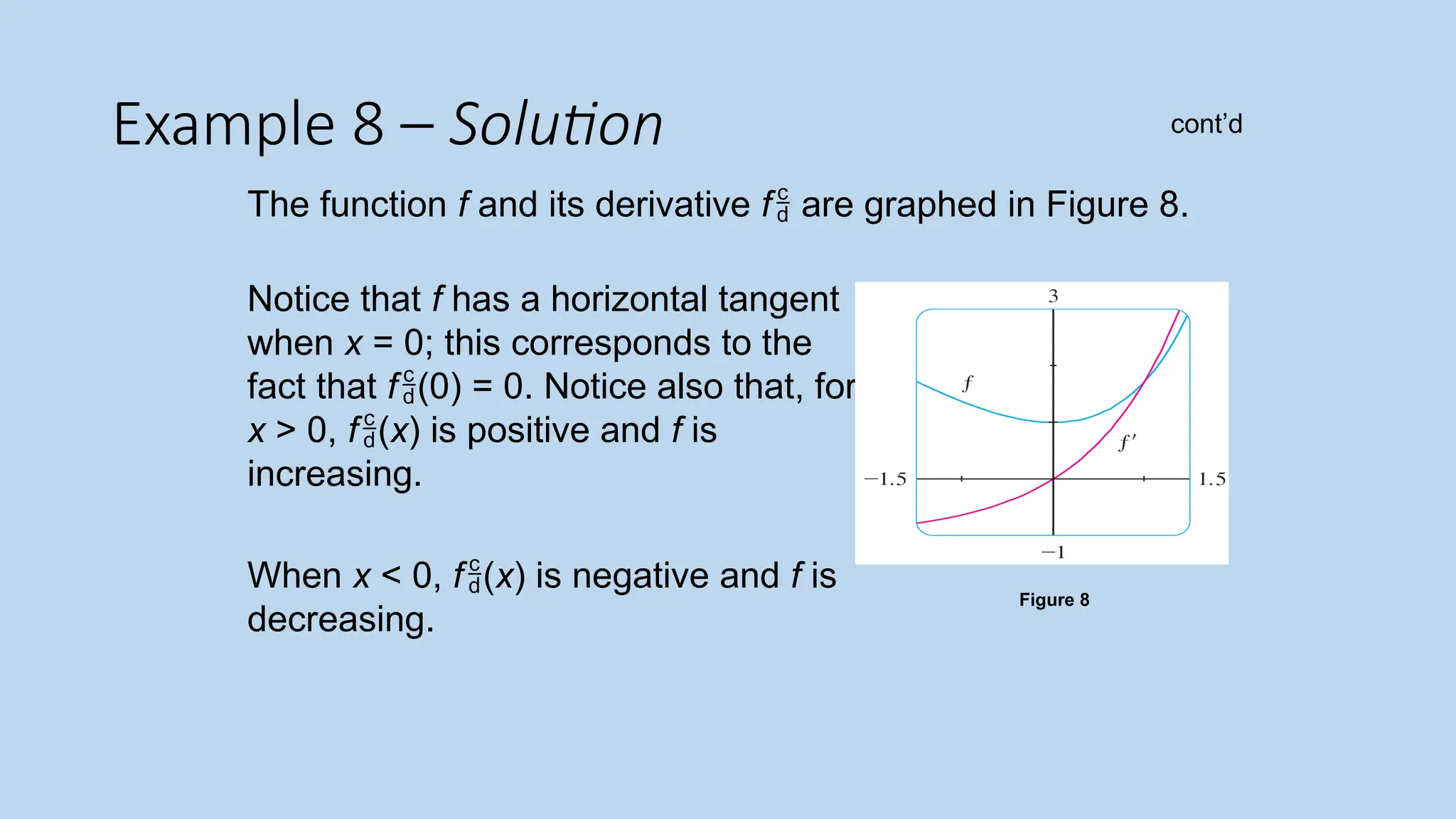
The function f and its derivative f are graphed in Figure 8.
Notice that f has a horizontal tangent
when x = 0; this corresponds to the
fact that f(0) = 0. Notice also that, for
x > 0, f(x) is positive and f is
increasing.
When x < 0, f(x) is negative and f is
decreasing.
Figure 8
cont’d
The Product and Quotient
Rules
The Product Rule
The Product Rule
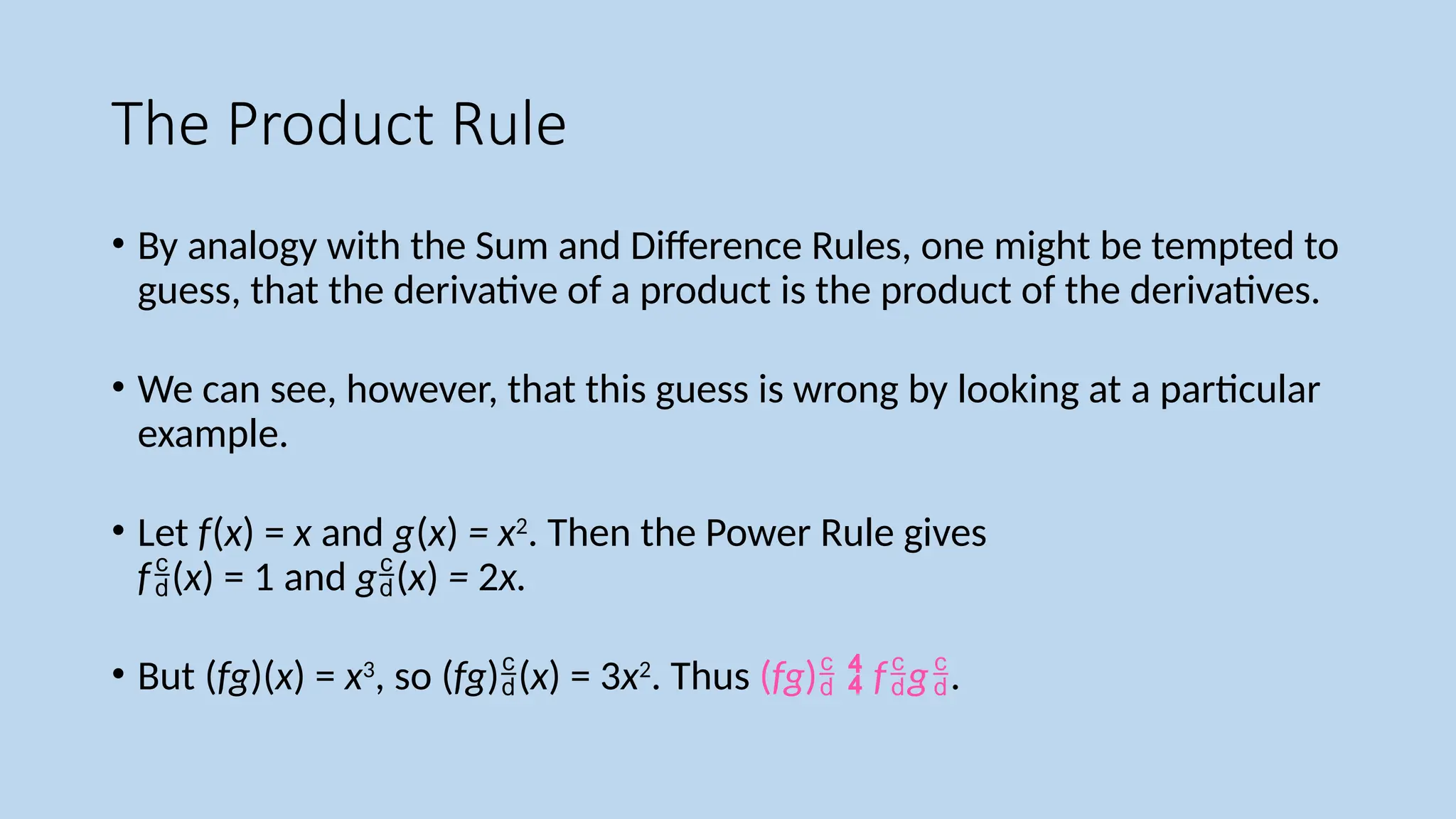
• By analogy with the Sum and Difference Rules, one might be tempted to
guess, that the derivative of a product is the product of the derivatives.
• We can see, however, that this guess is wrong by looking at a particular
example.
• Let f(x) = x and g(x) = x2
. Then the Power Rule gives
f(x) = 1 and g(x) = 2x.
• But (fg)(x) = x3
, so (fg)(x) = 3x2
. Thus (fg)  fg.
The Product Rule
• The correct formula was discovered by Leibniz and is called the
Product Rule.
• Before stating the Product Rule, let’s see how we might discover it.
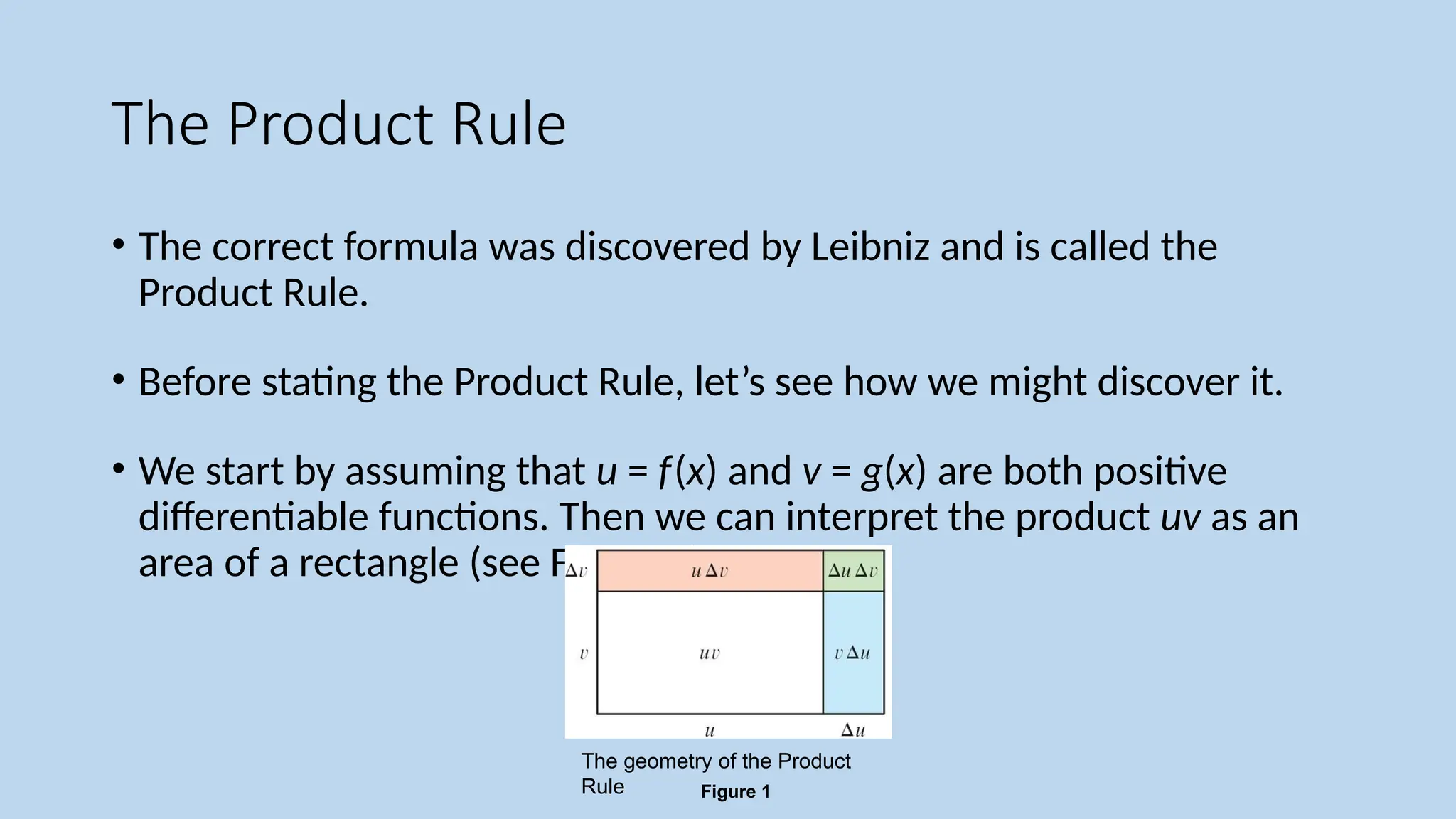
• We start by assuming that u = f(x) and v = g(x) are both positive
differentiable functions. Then we can interpret the product uv as an
area of a rectangle (see Figure 1).
Figure 1
The geometry of the Product
Rule
The Product Rule
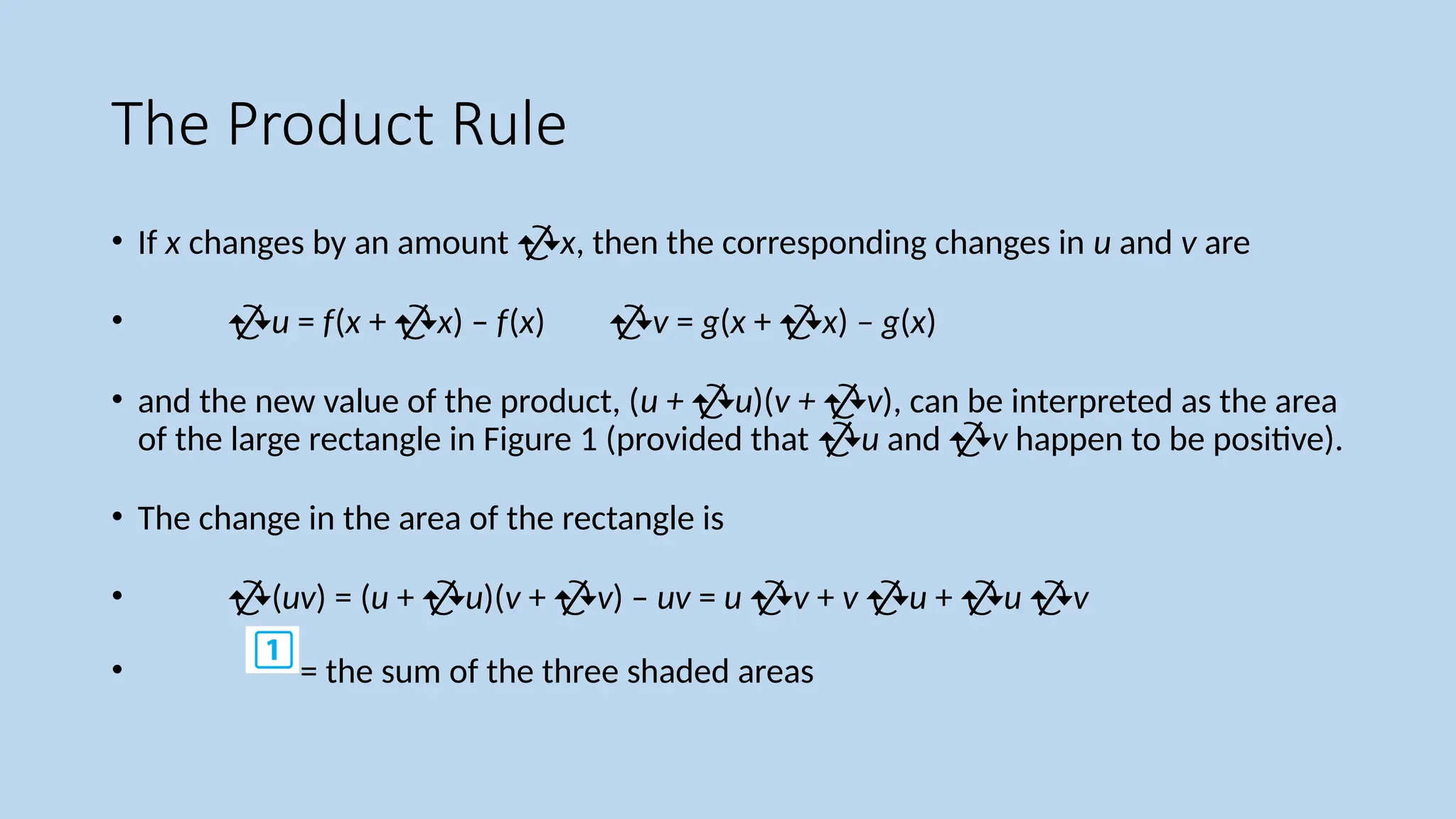
• If x changes by an amount x, then the corresponding changes in u and v are
• u = f(x + x) – f(x) v = g(x + x) – g(x)
• and the new value of the product, (u + u)(v + v), can be interpreted as the area
of the large rectangle in Figure 1 (provided that u and v happen to be positive).
• The change in the area of the rectangle is
• (uv) = (u + u)(v + v) – uv = u v + v u + u v
• = the sum of the three shaded areas
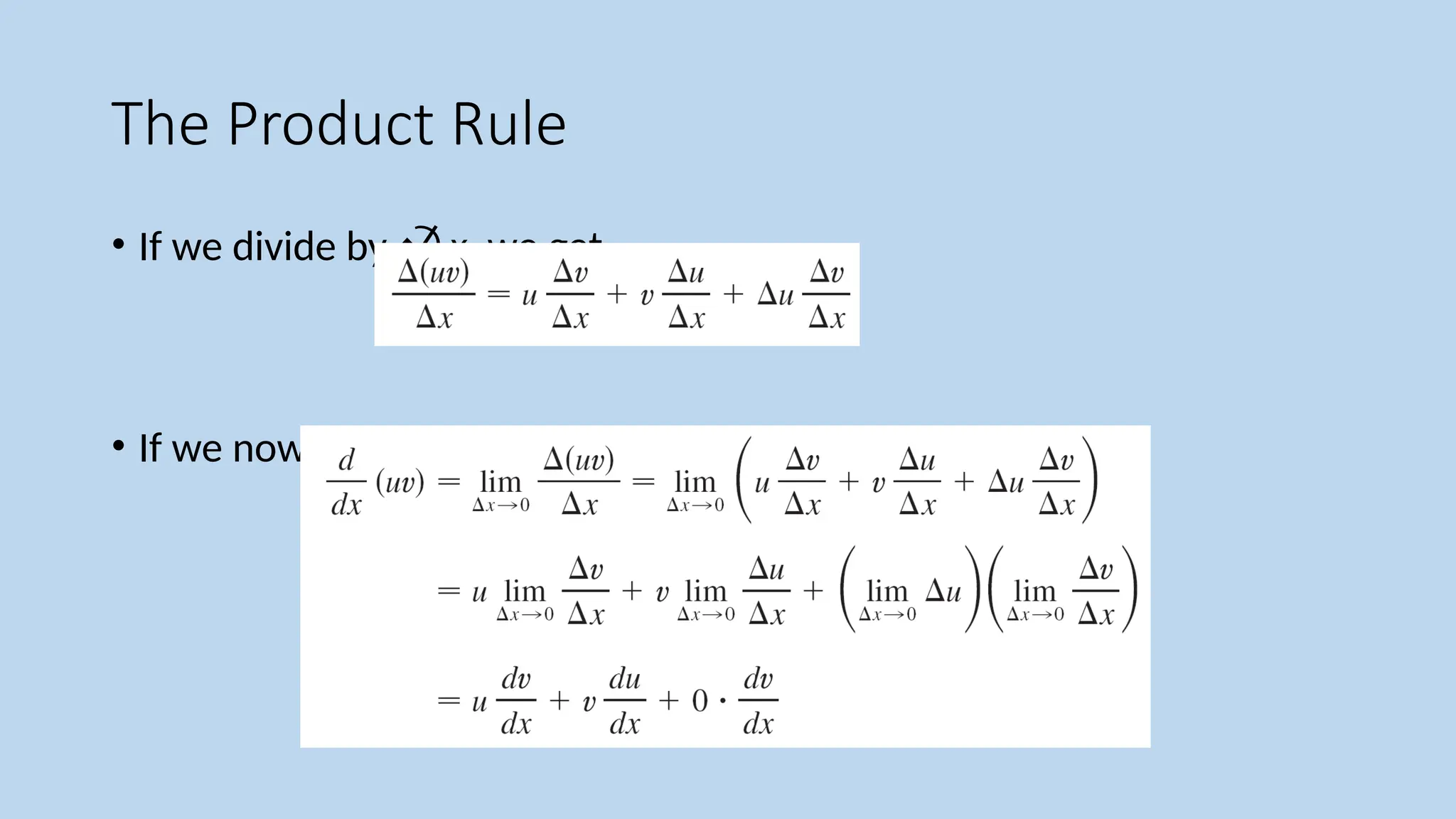
• If we divide by x, we get
• If we now let x  0, we get the derivative of uv:
The Product Rule
The Product Rule
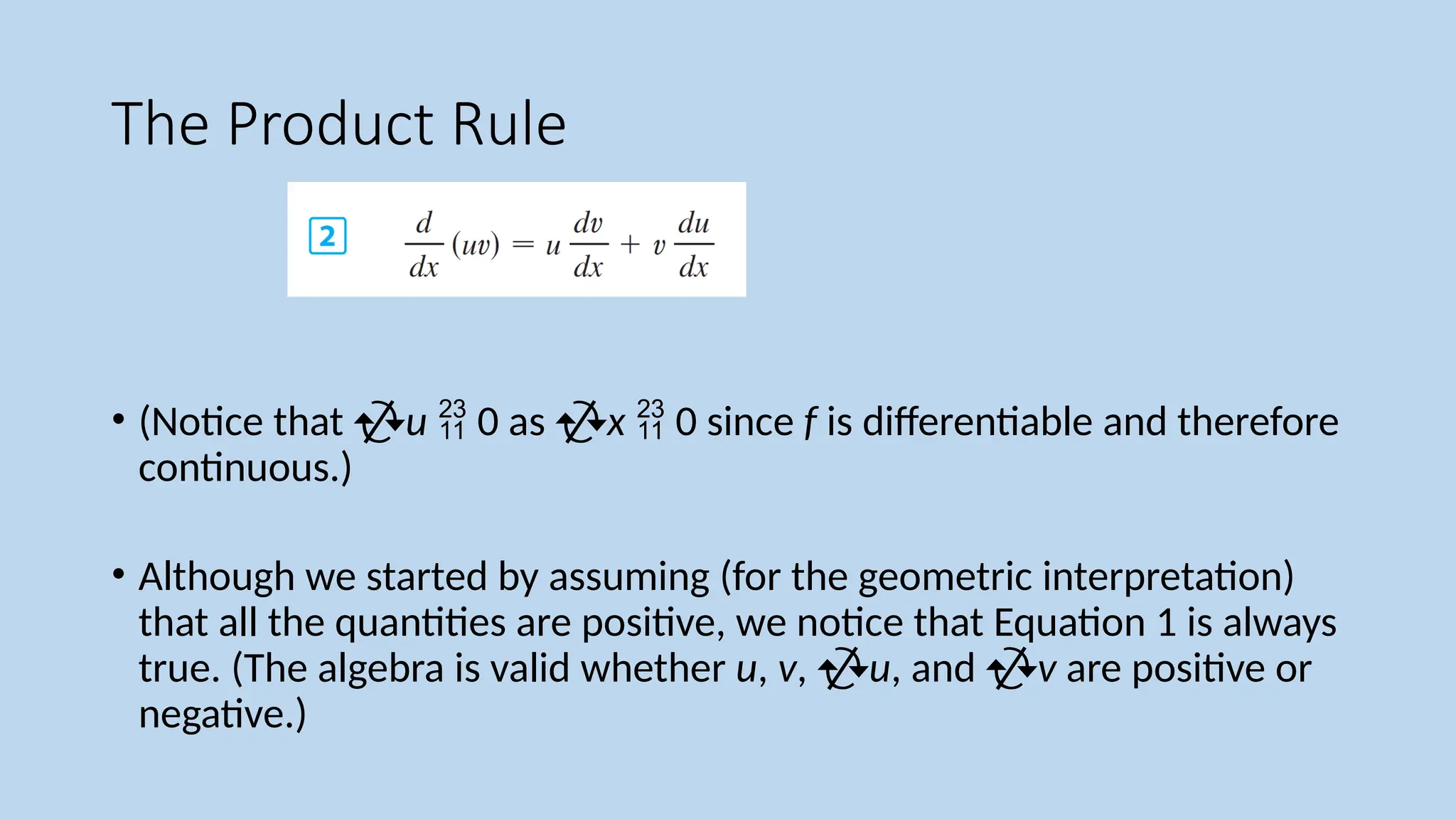
• (Notice that u  0 as x  0 since f is differentiable and therefore
continuous.)
• Although we started by assuming (for the geometric interpretation)
that all the quantities are positive, we notice that Equation 1 is always
true. (The algebra is valid whether u, v, u, and v are positive or
negative.)
The Product Rule
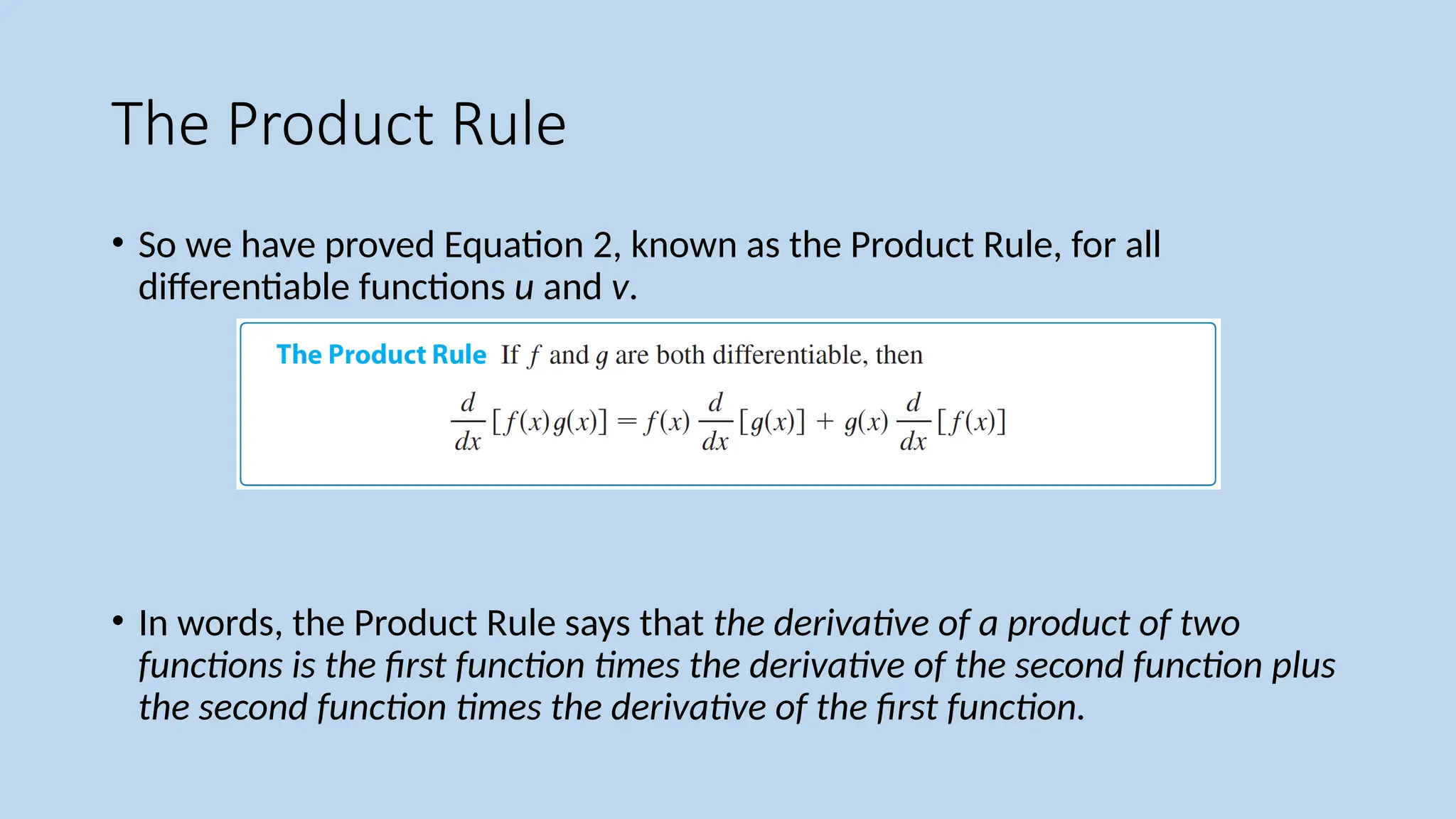
• So we have proved Equation 2, known as the Product Rule, for all
differentiable functions u and v.
• In words, the Product Rule says that the derivative of a product of two
functions is the first function times the derivative of the second function plus
the second function times the derivative of the first function.
Example 1
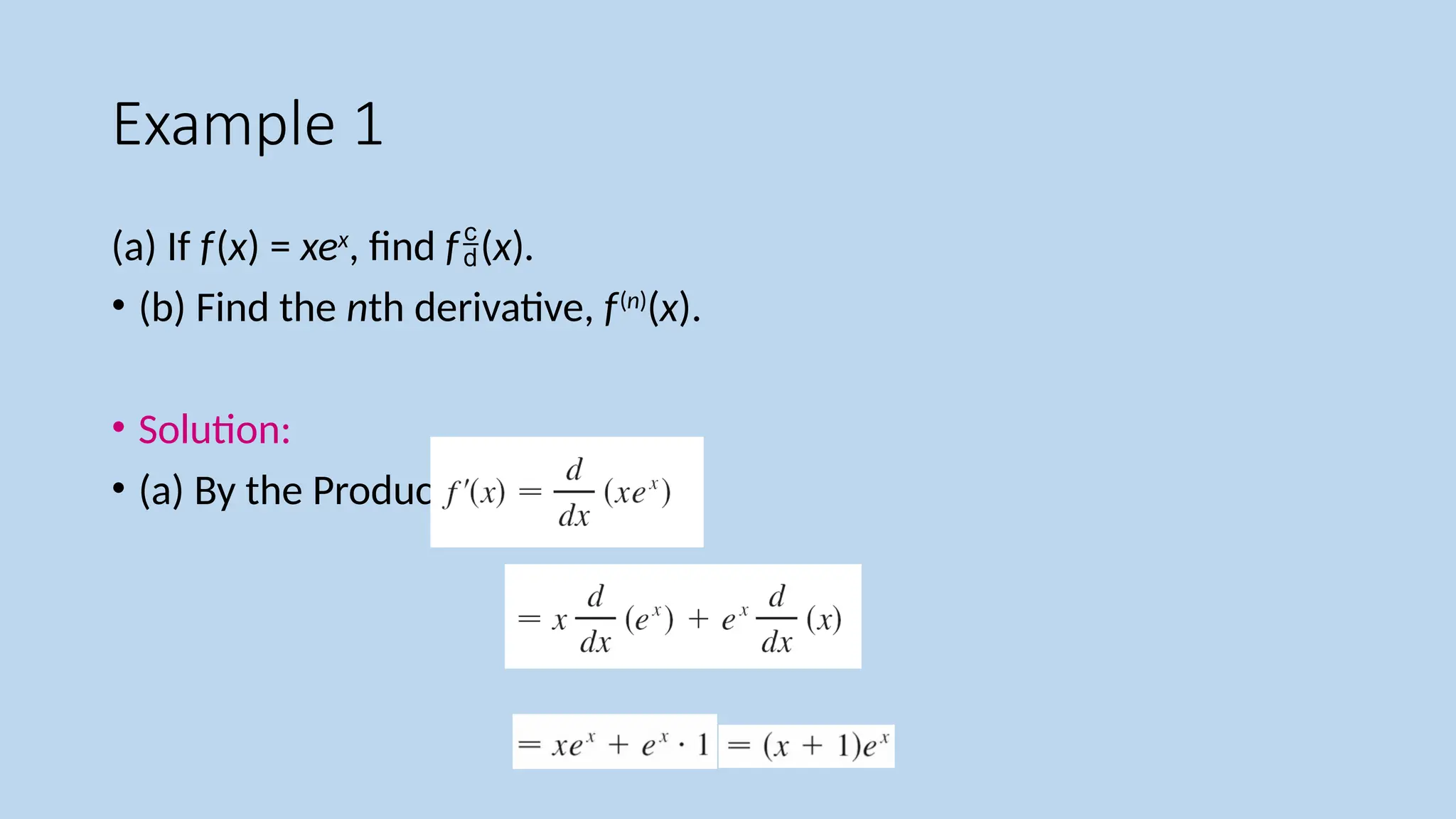
(a) If f(x) = xex
, find f(x).
• (b) Find the nth derivative, f(n)
(x).
• Solution:
• (a) By the Product Rule, we have
Example 1 – Solution
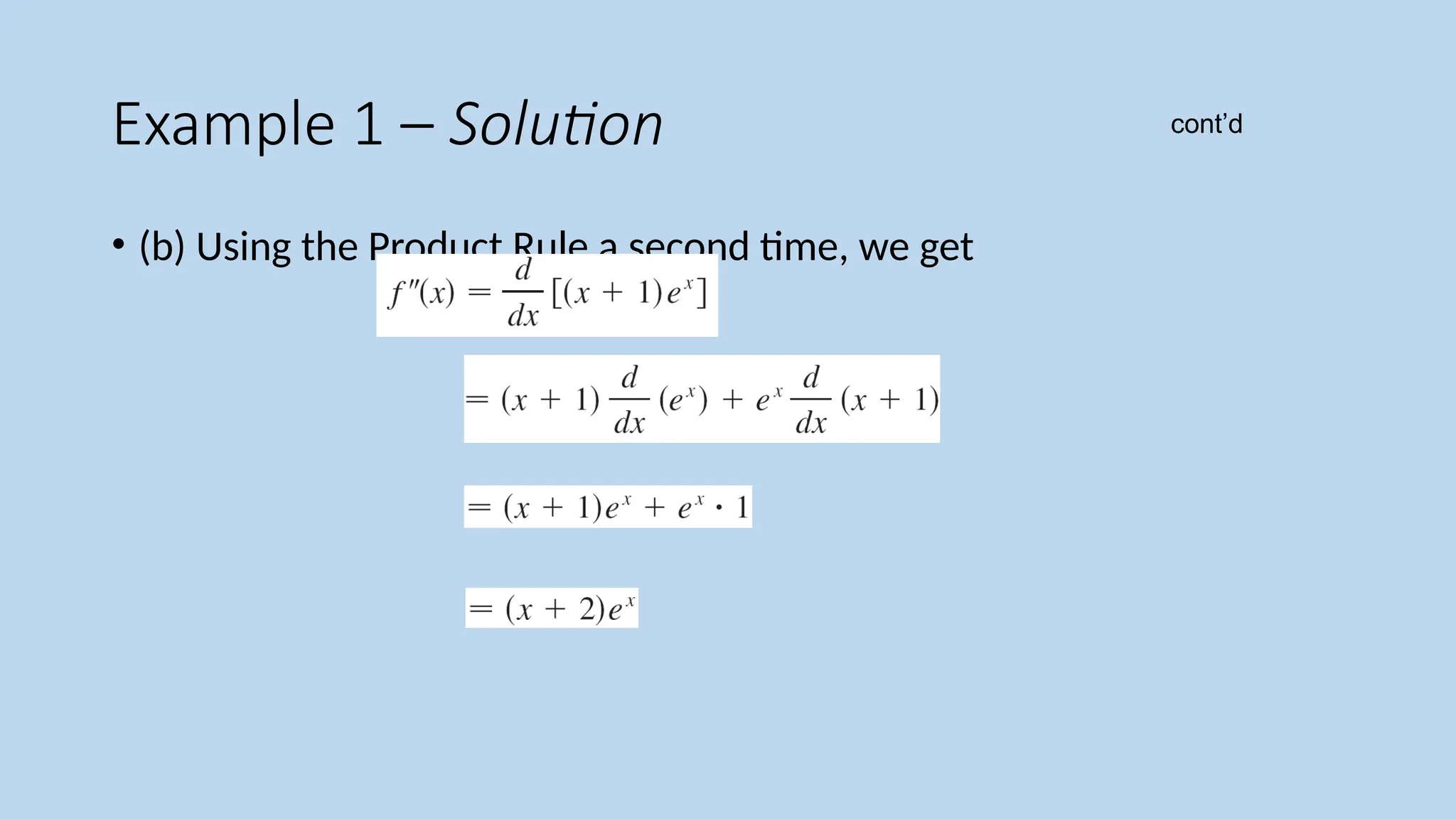
• (b) Using the Product Rule a second time, we get
cont’d
Example 1 – Solution
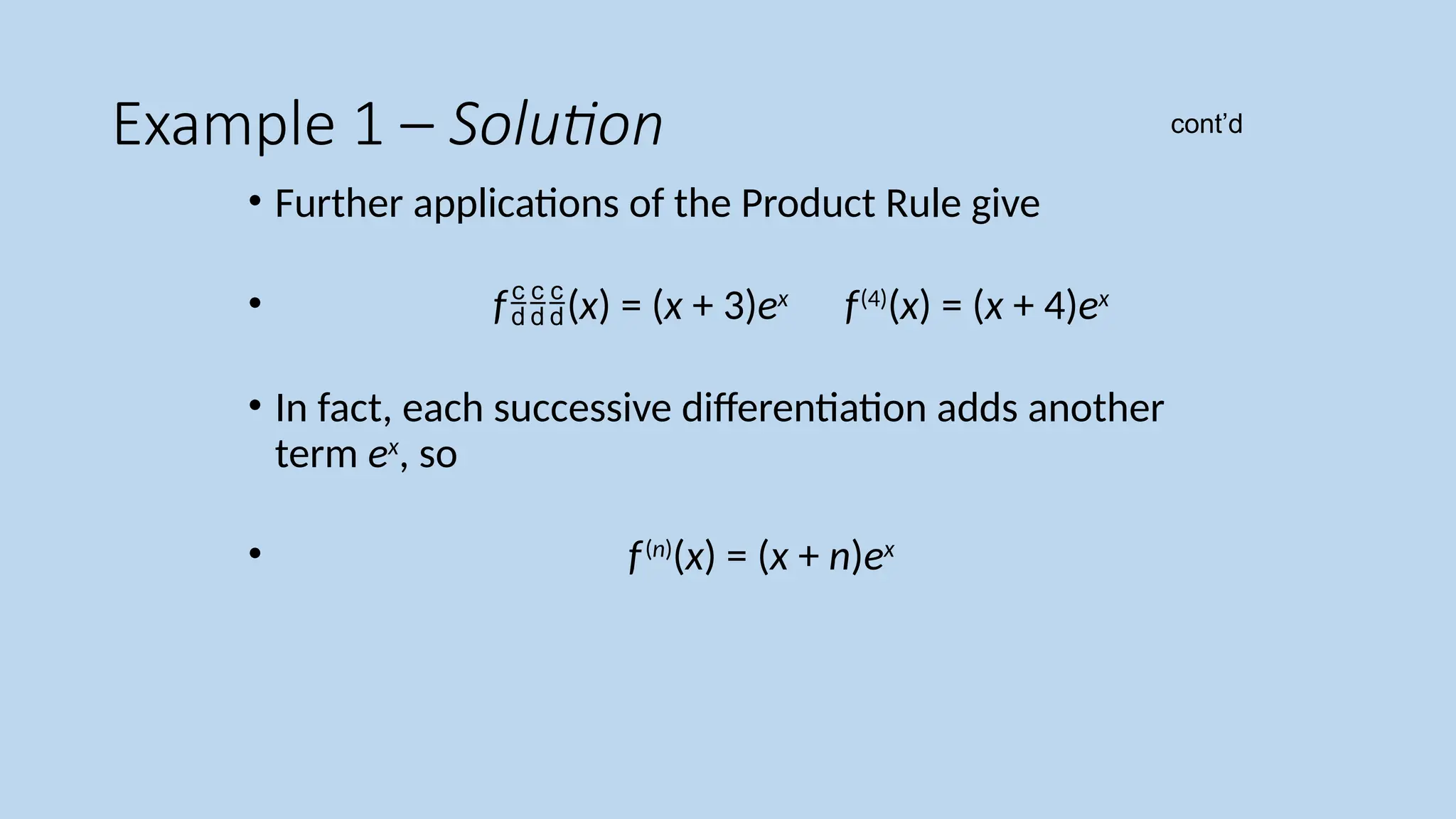
• Further applications of the Product Rule give
• f(x) = (x + 3)ex
f(4)
(x) = (x + 4)ex
• In fact, each successive differentiation adds another
term ex
, so
• f(n)
(x) = (x + n)ex
cont’d
The Quotient Rule
The Quotient Rule
• We find a rule for differentiating the quotient of two differentiable
functions u = f(x) and v = g(x) in much the same way that we found
the Product Rule.
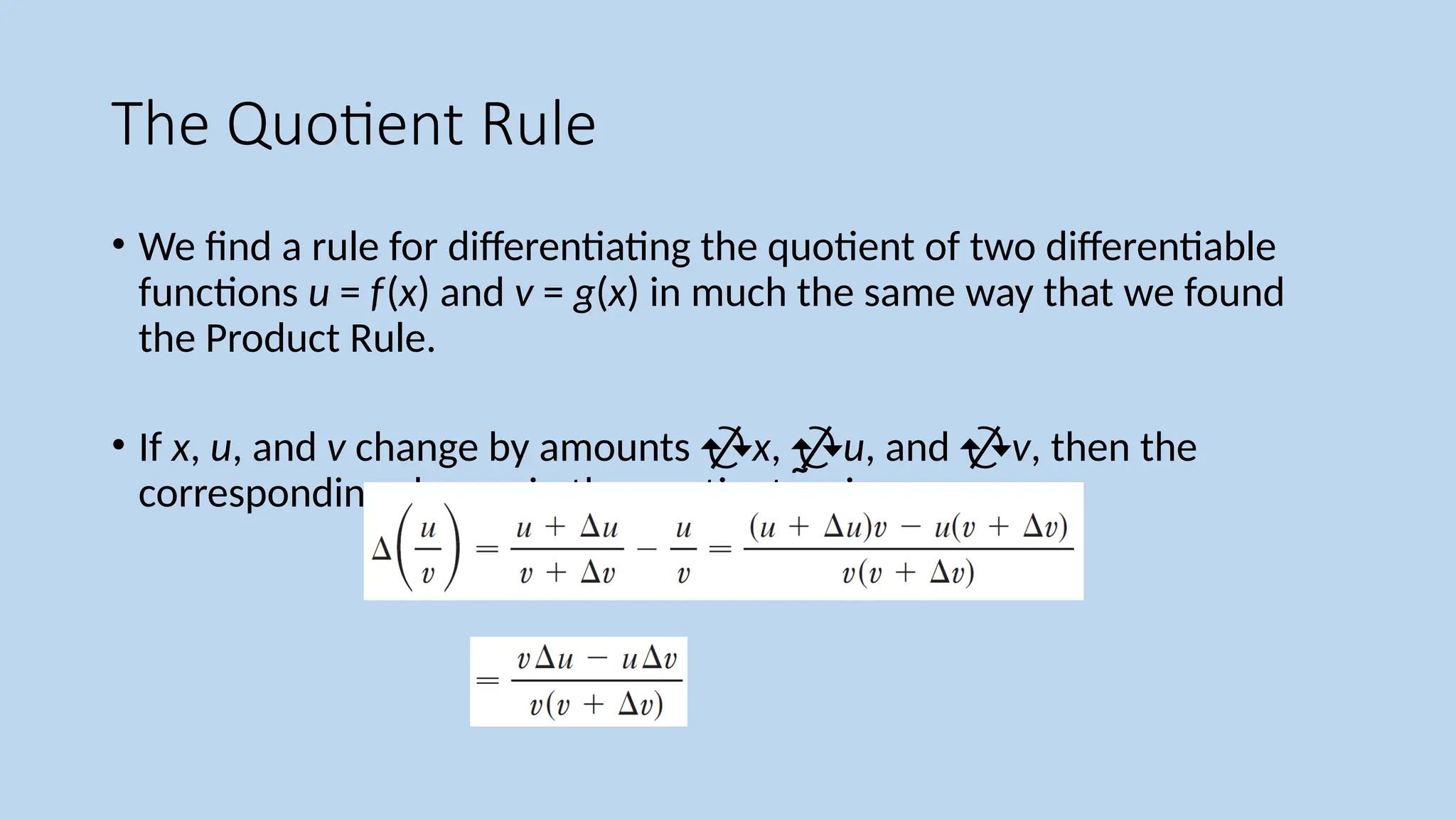
• If x, u, and v change by amounts x, u, and v, then the
corresponding change in the quotient uv is
The Quotient Rule
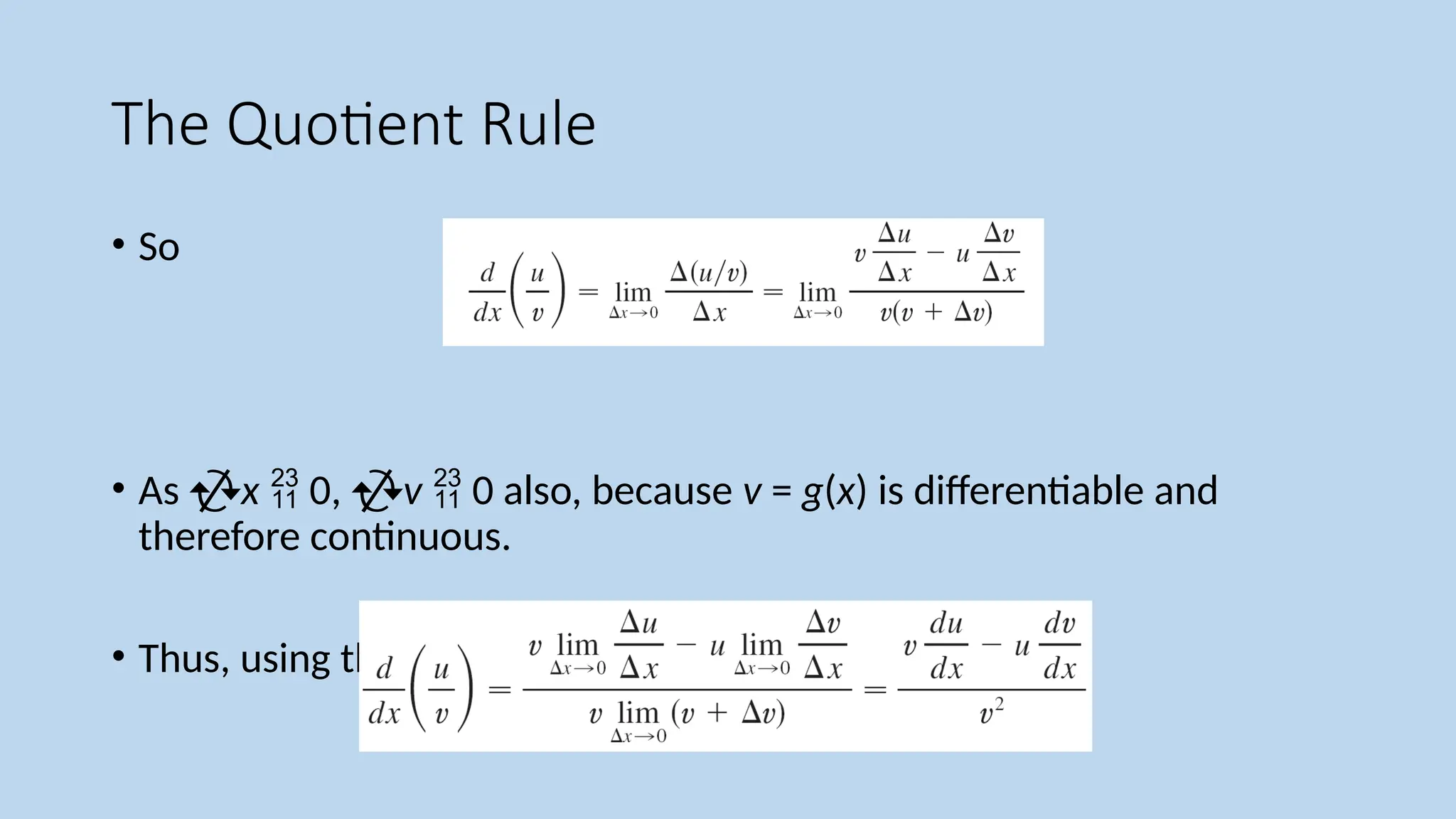
• So
• As x  0, v  0 also, because v = g(x) is differentiable and
therefore continuous.
• Thus, using the Limit Laws, we get
The Quotient Rule
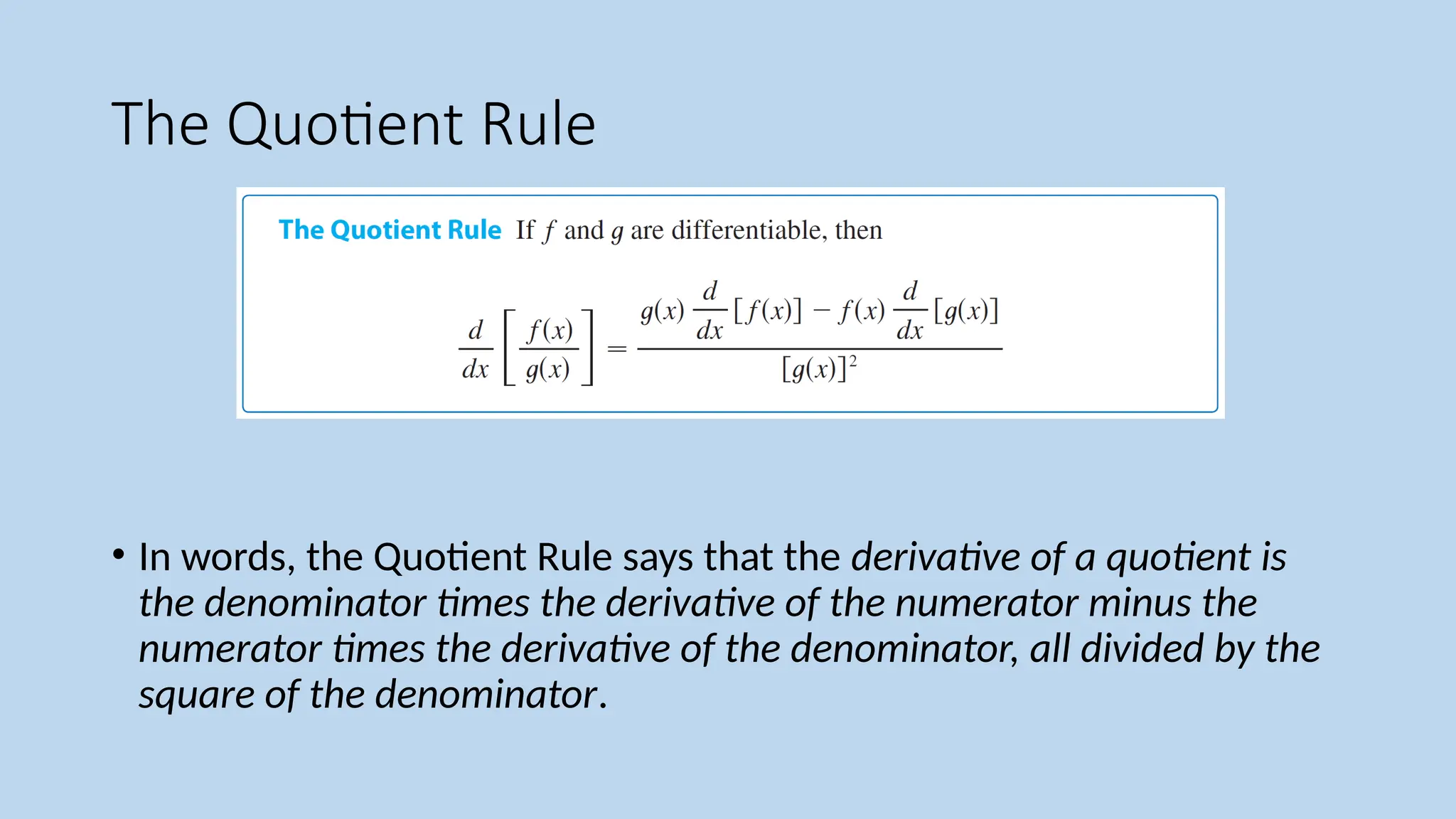
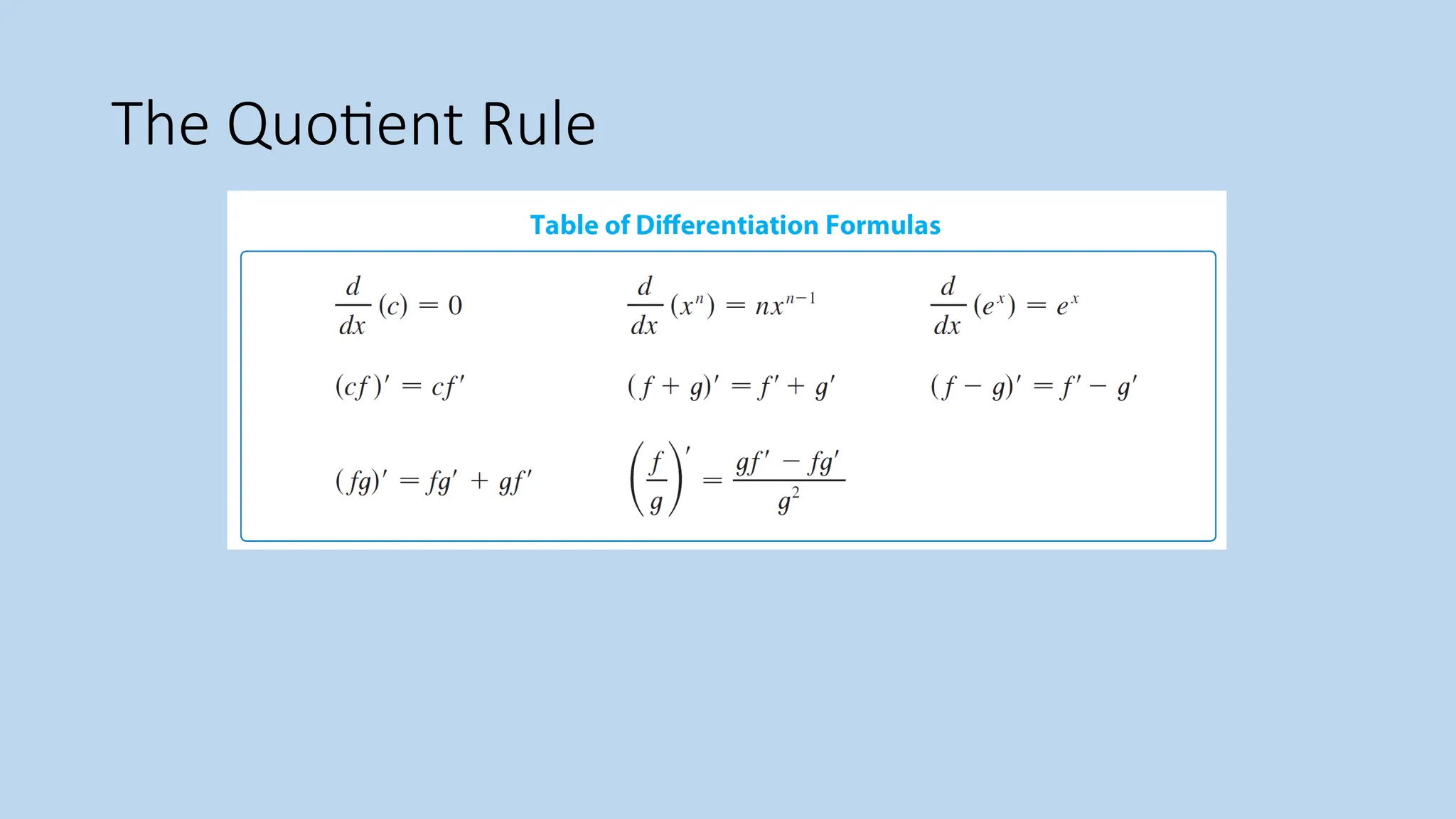
• In words, the Quotient Rule says that the derivative of a quotient is
the denominator times the derivative of the numerator minus the
numerator times the derivative of the denominator, all divided by the
square of the denominator.
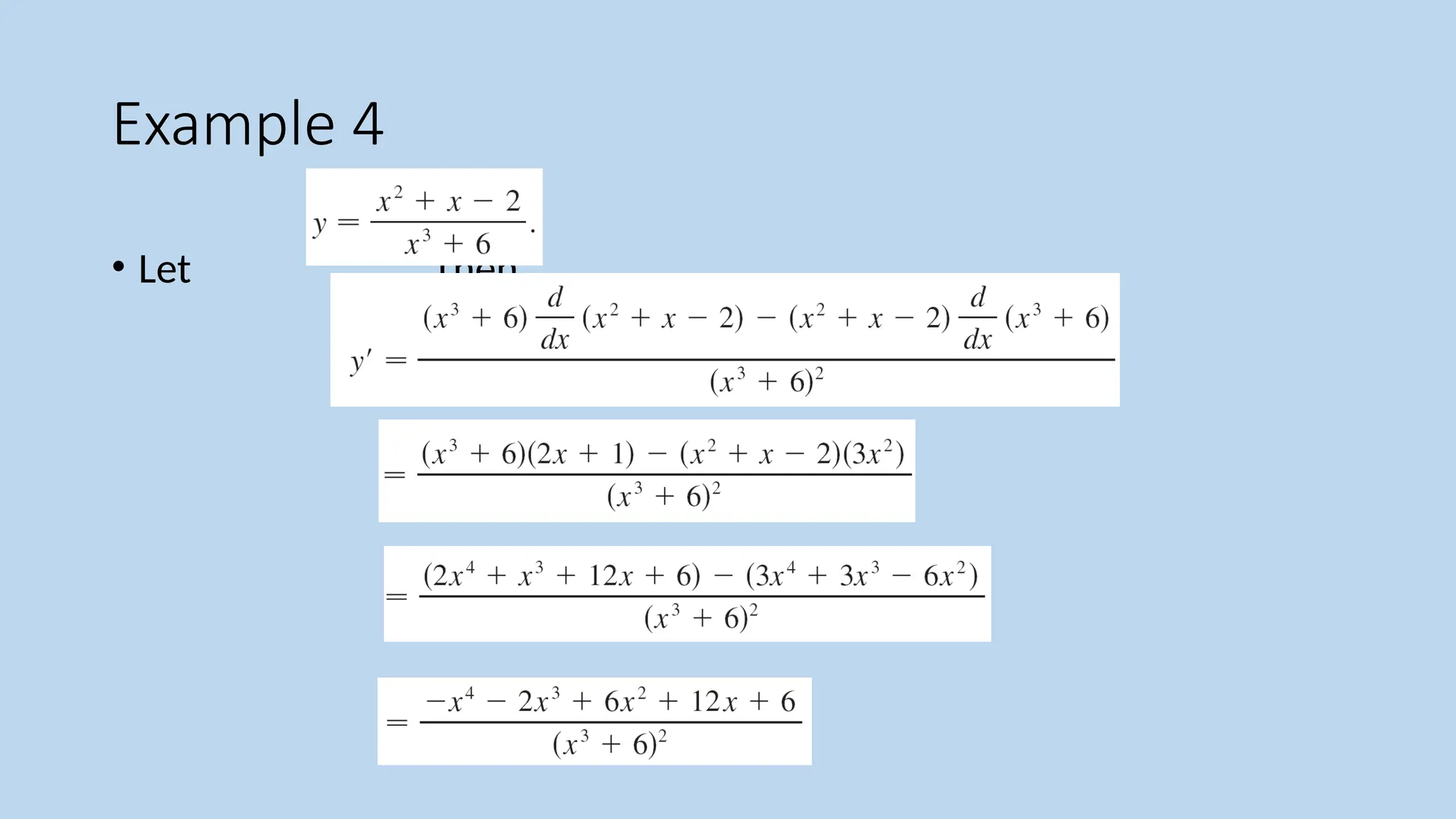
Example 4
• Let Then
The Quotient Rule
Derivatives of Trigonometric
Functions
Derivatives of Trigonometric Functions
• In particular, it is important to remember that when we talk about the
function f defined for all real numbers x by
• f(x) = sin x
• it is understood that sin x means the sine of the angle whose radian
measure is x. A similar convention holds for the other trigonometric
functions cos, tan, csc, sec, and cot.
• All of the trigonometric functions are continuous at every number in their
domains.
Derivatives of Trigonometric Functions
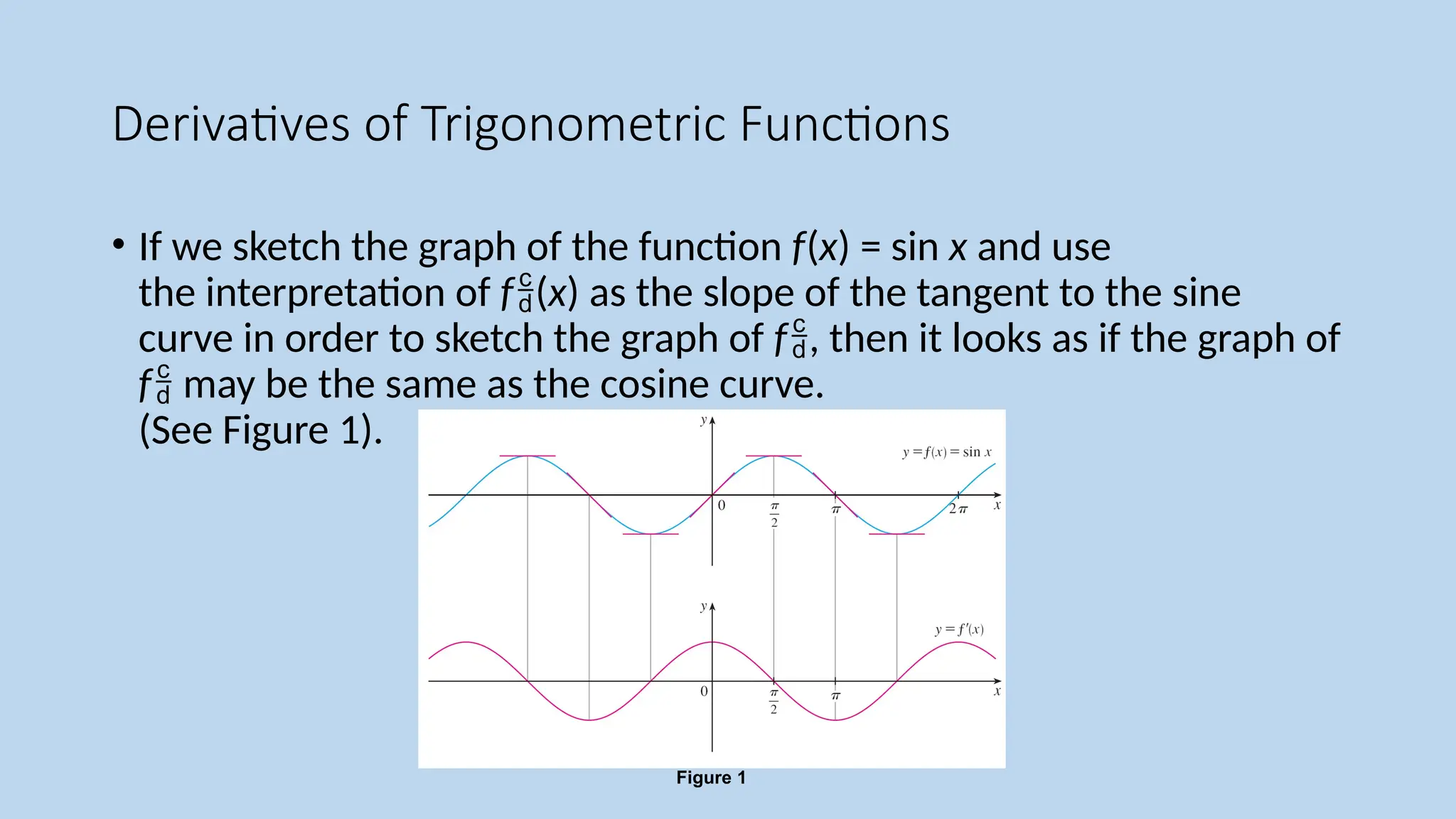
• If we sketch the graph of the function f(x) = sin x and use
the interpretation of f(x) as the slope of the tangent to the sine
curve in order to sketch the graph of f, then it looks as if the graph of
f may be the same as the cosine curve.
(See Figure 1).
Figure 1
Derivatives of Trigonometric Functions
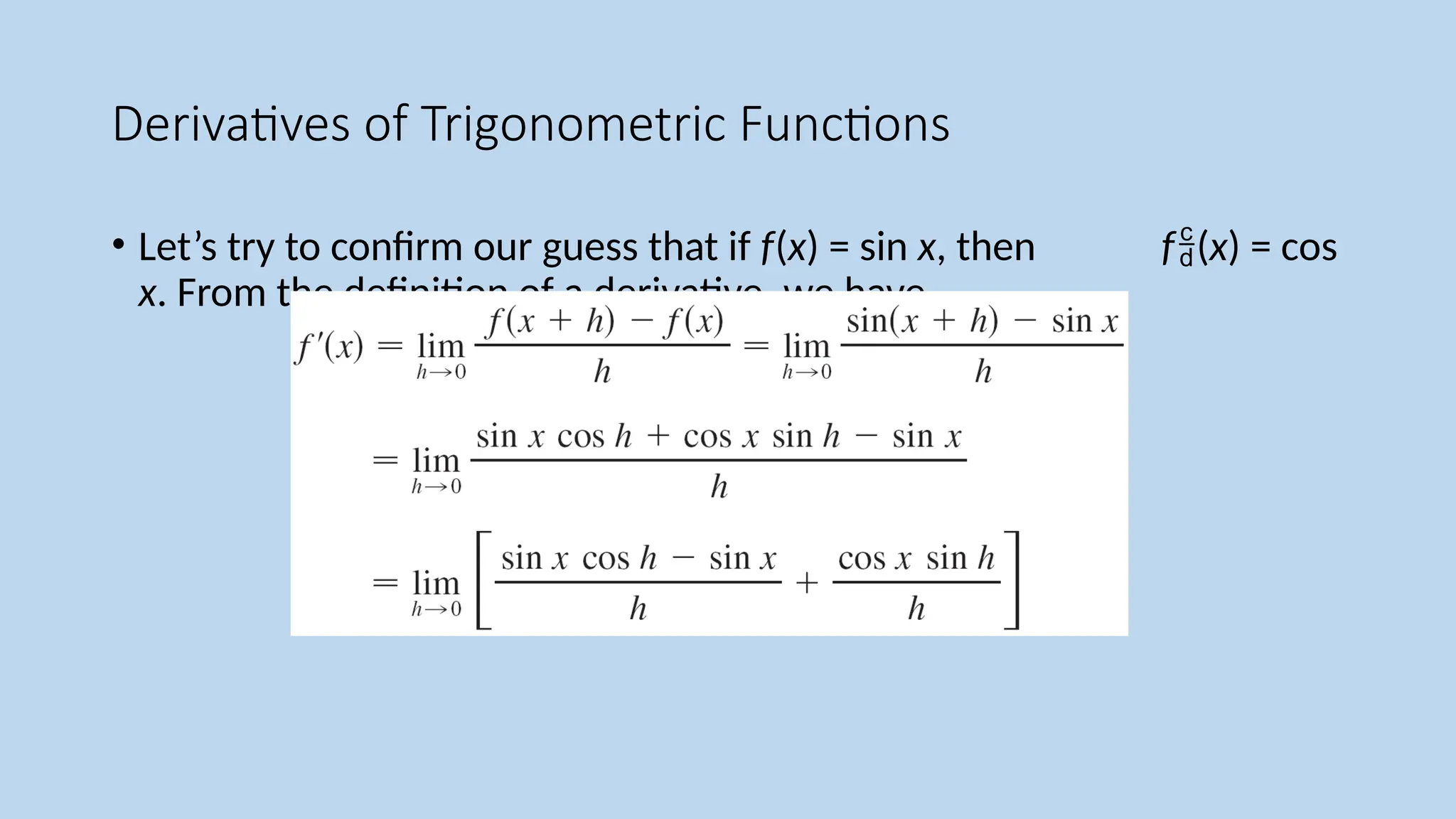
• Let’s try to confirm our guess that if f(x) = sin x, then f(x) = cos
x. From the definition of a derivative, we have
Derivatives of Trigonometric Functions
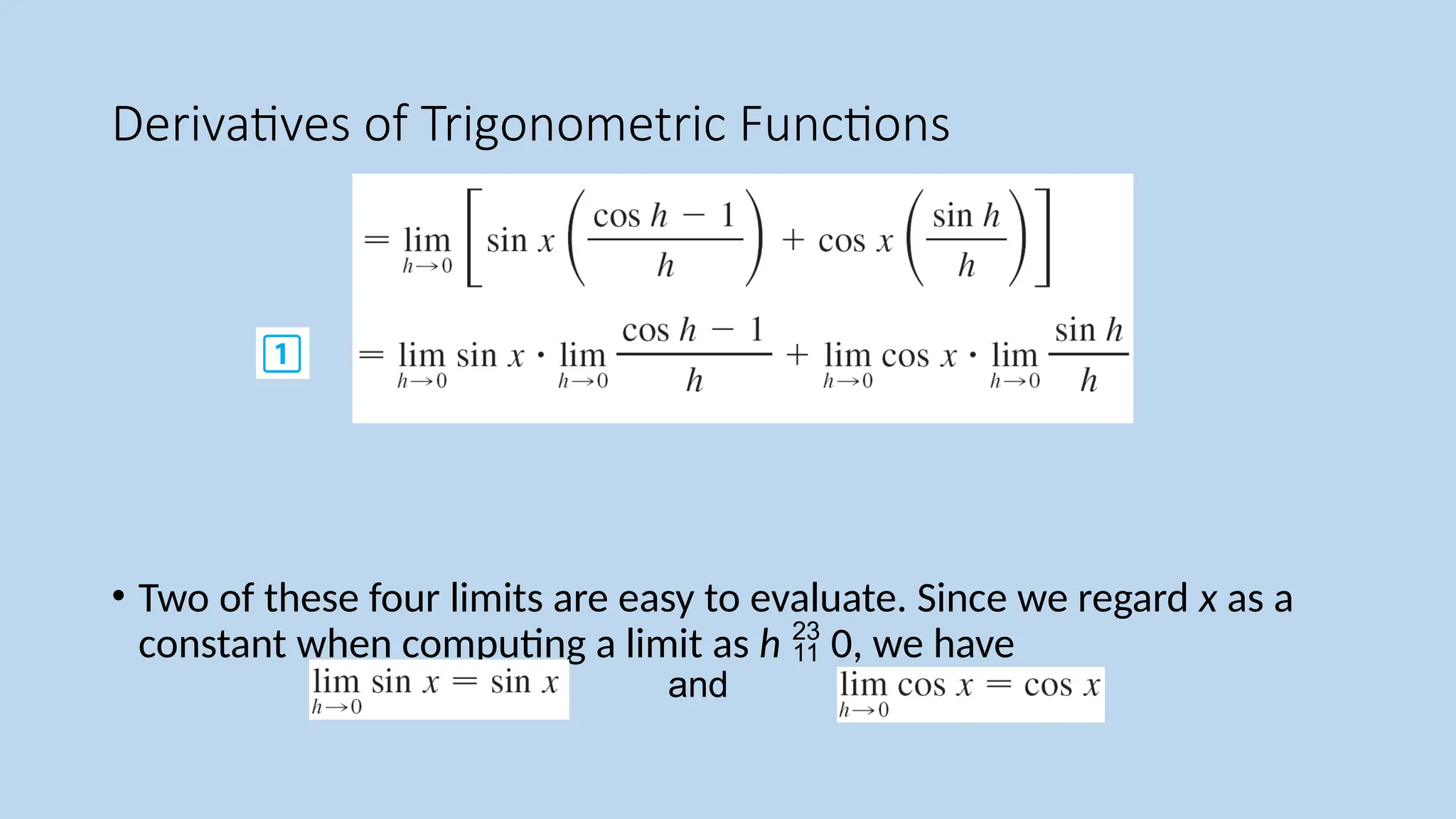
• Two of these four limits are easy to evaluate. Since we regard x as a
constant when computing a limit as h  0, we have
and
Derivatives of Trigonometric Functions
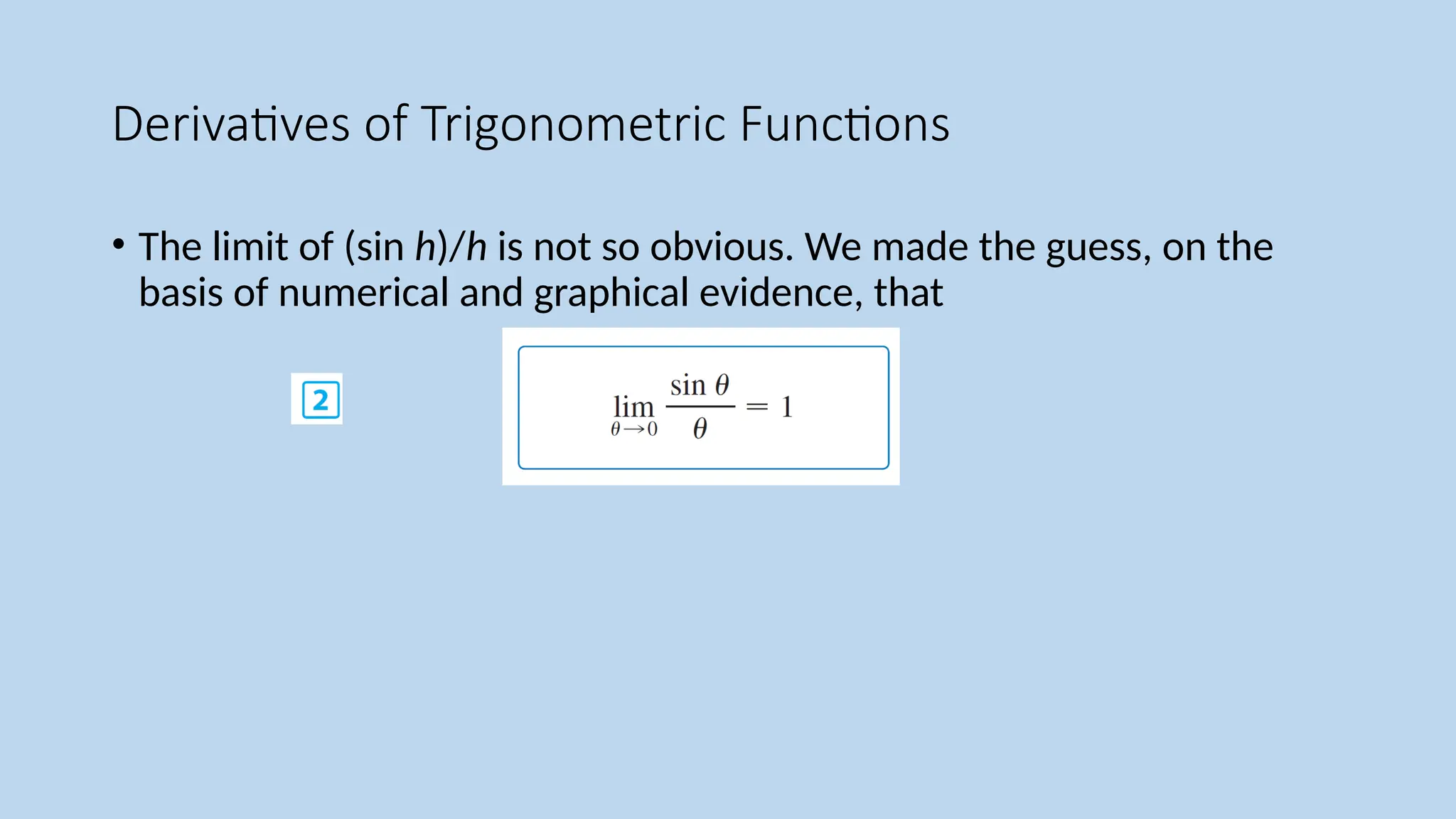
• The limit of (sin h)/h is not so obvious. We made the guess, on the
basis of numerical and graphical evidence, that
Derivatives of Trigonometric Functions
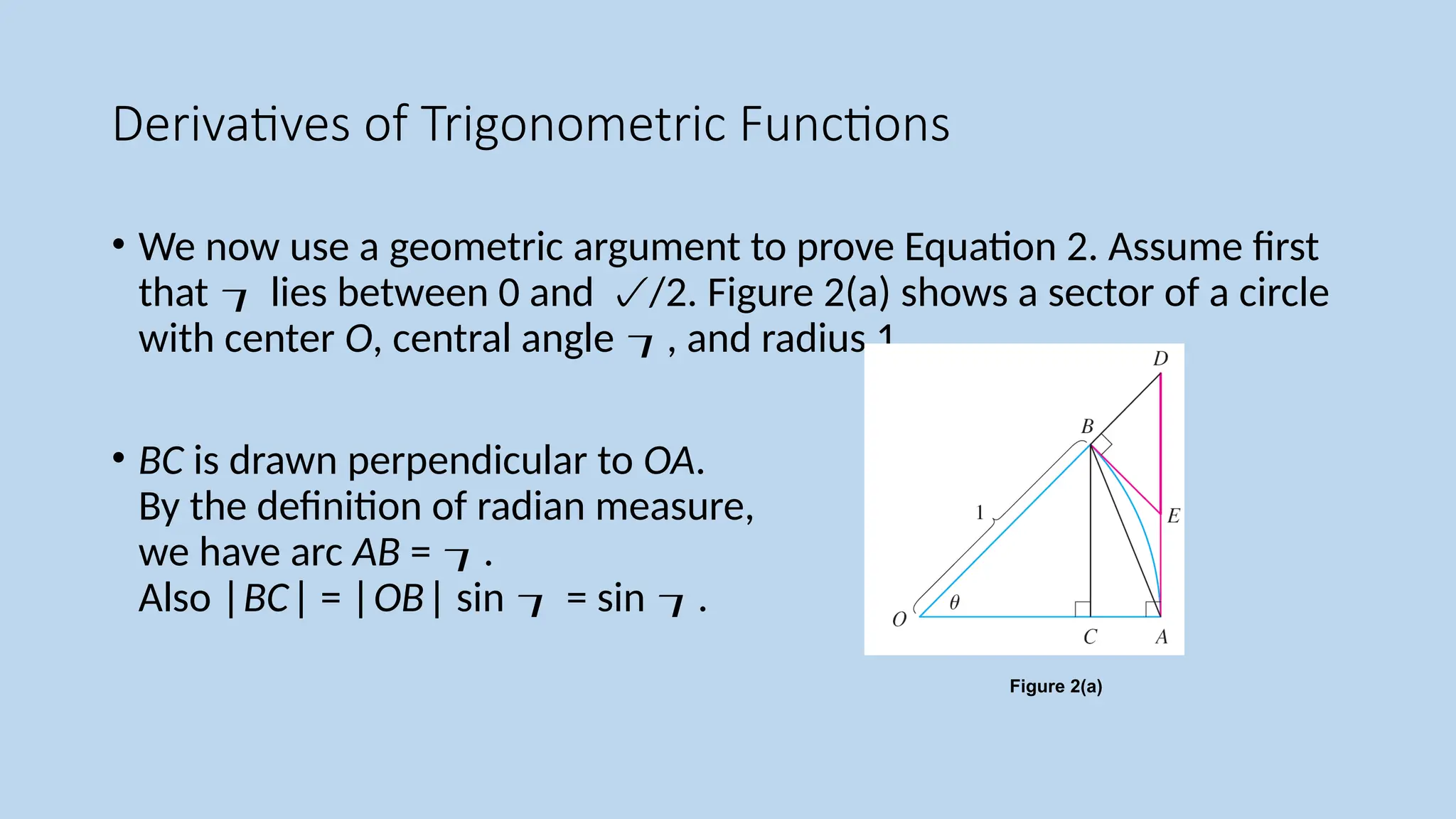
• We now use a geometric argument to prove Equation 2. Assume first
that  lies between 0 and /2. Figure 2(a) shows a sector of a circle
with center O, central angle , and radius 1.
• BC is drawn perpendicular to OA.
By the definition of radian measure,
we have arc AB = .
Also |BC| = |OB| sin  = sin .
Figure 2(a)
Derivatives of Trigonometric Functions
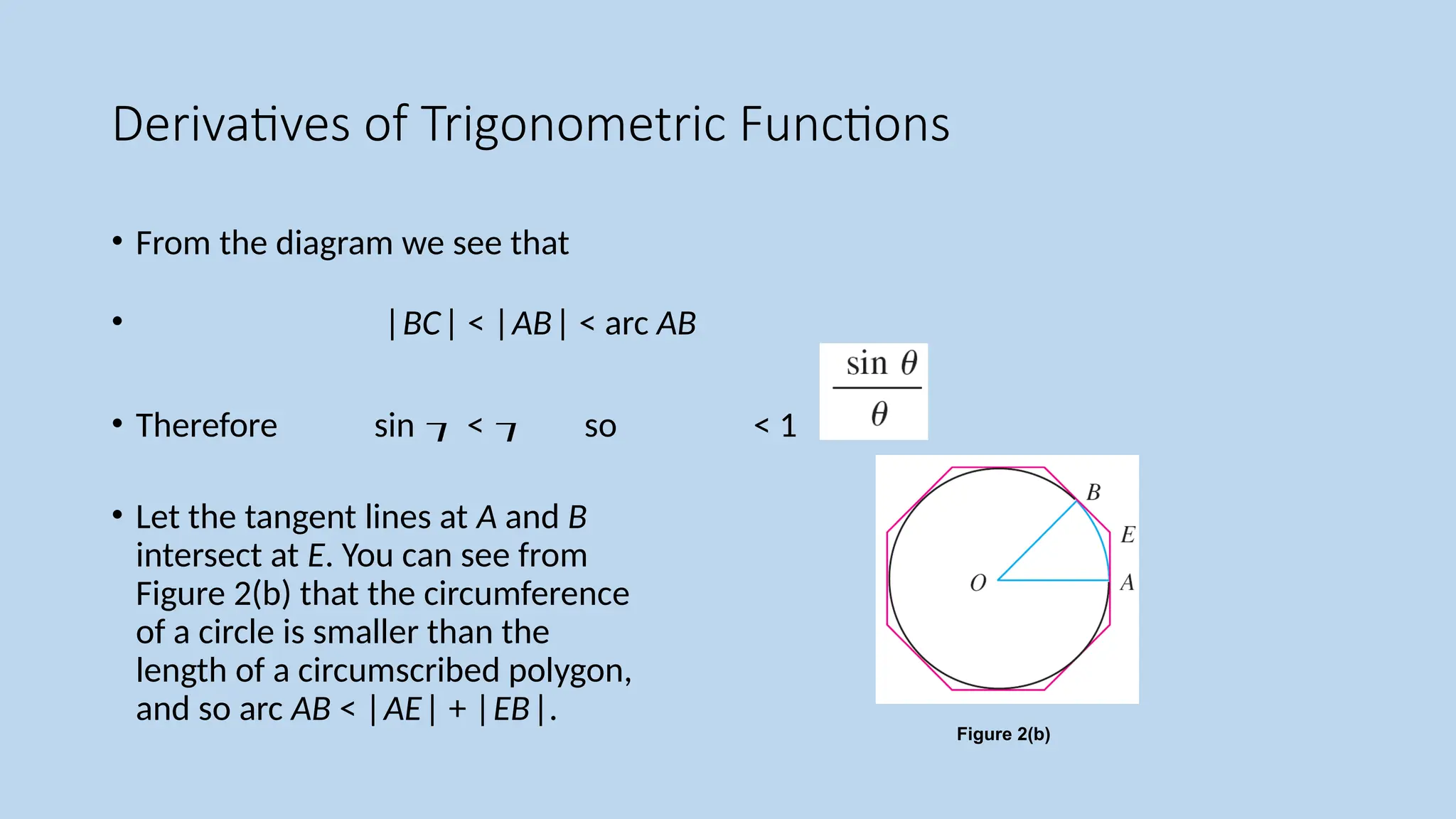
• From the diagram we see that
• |BC| < |AB| < arc AB
• Therefore sin  <  so < 1
• Let the tangent lines at A and B
intersect at E. You can see from
Figure 2(b) that the circumference
of a circle is smaller than the
length of a circumscribed polygon,
and so arc AB < |AE| + |EB|.
Figure 2(b)
Derivatives of Trigonometric Functions
• Thus
•  = arc AB < |AE| + |EB|
• < |AE| + |ED|
• = |AD| = |OA| tan 
• = tan 
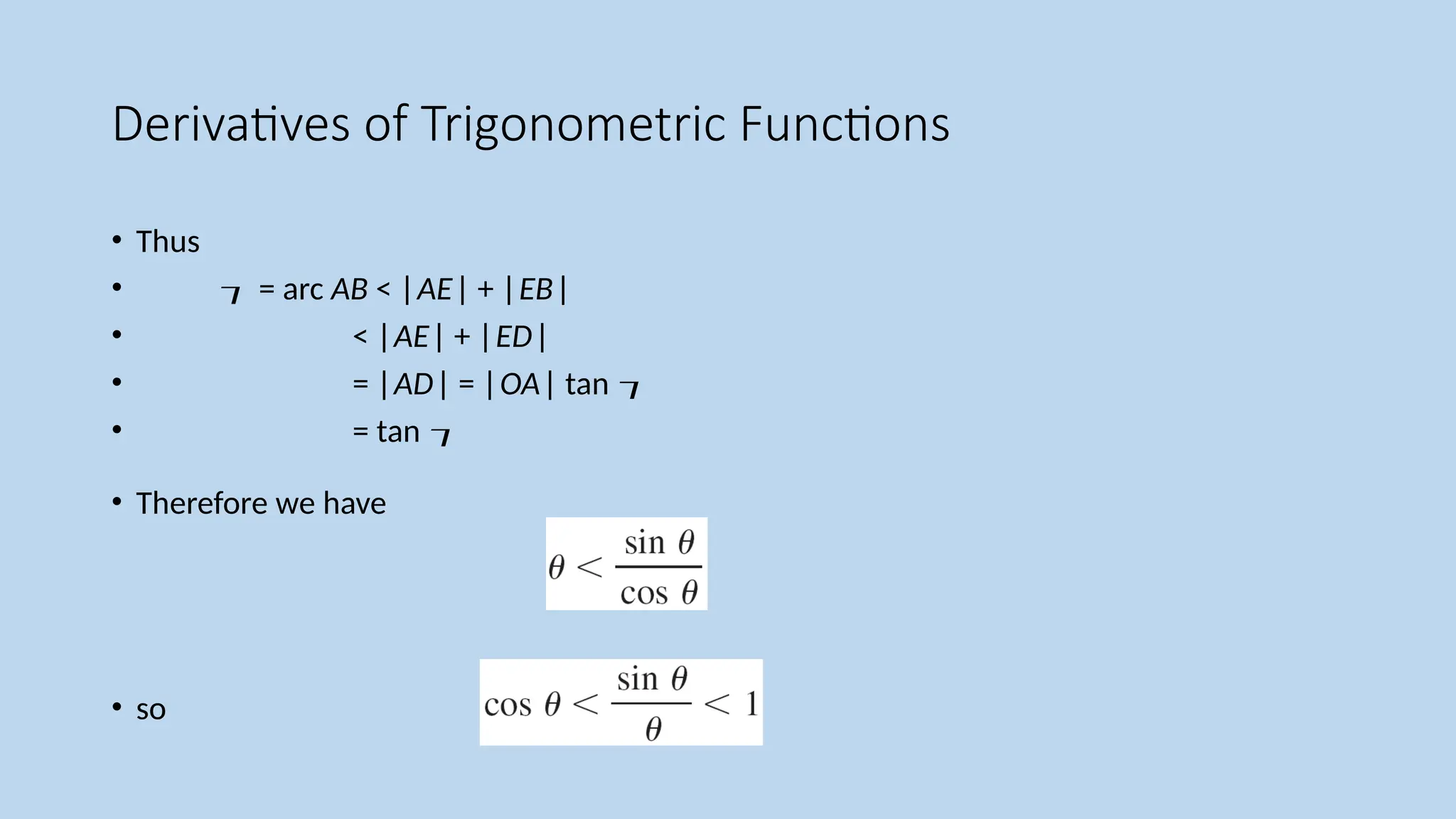
• Therefore we have
• so
Derivatives of Trigonometric Functions
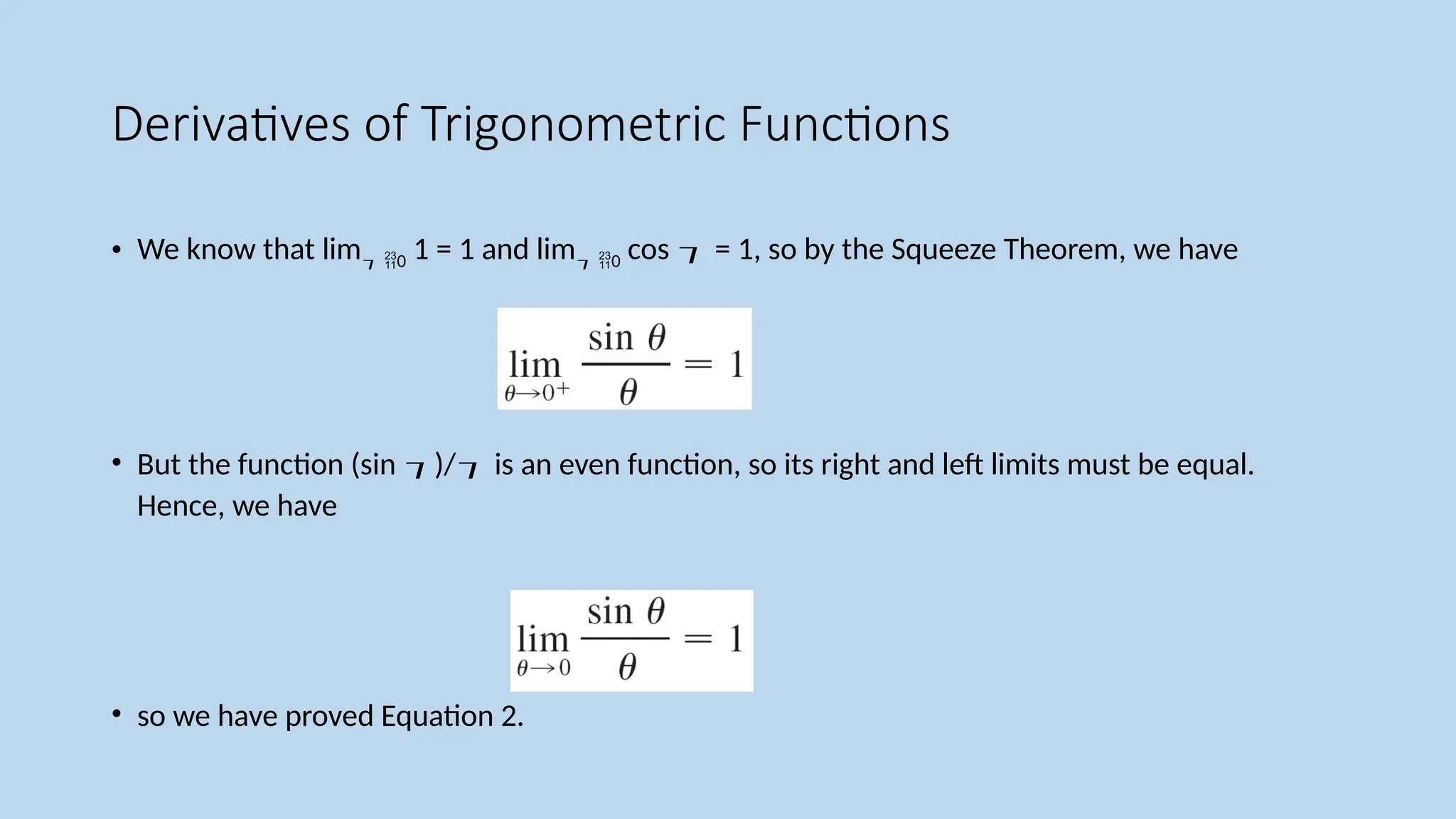
• We know that lim 0 1 = 1 and lim 0 cos  = 1, so by the Squeeze Theorem, we have
• But the function (sin )/ is an even function, so its right and left limits must be equal.
Hence, we have
• so we have proved Equation 2.
Derivatives of Trigonometric Functions
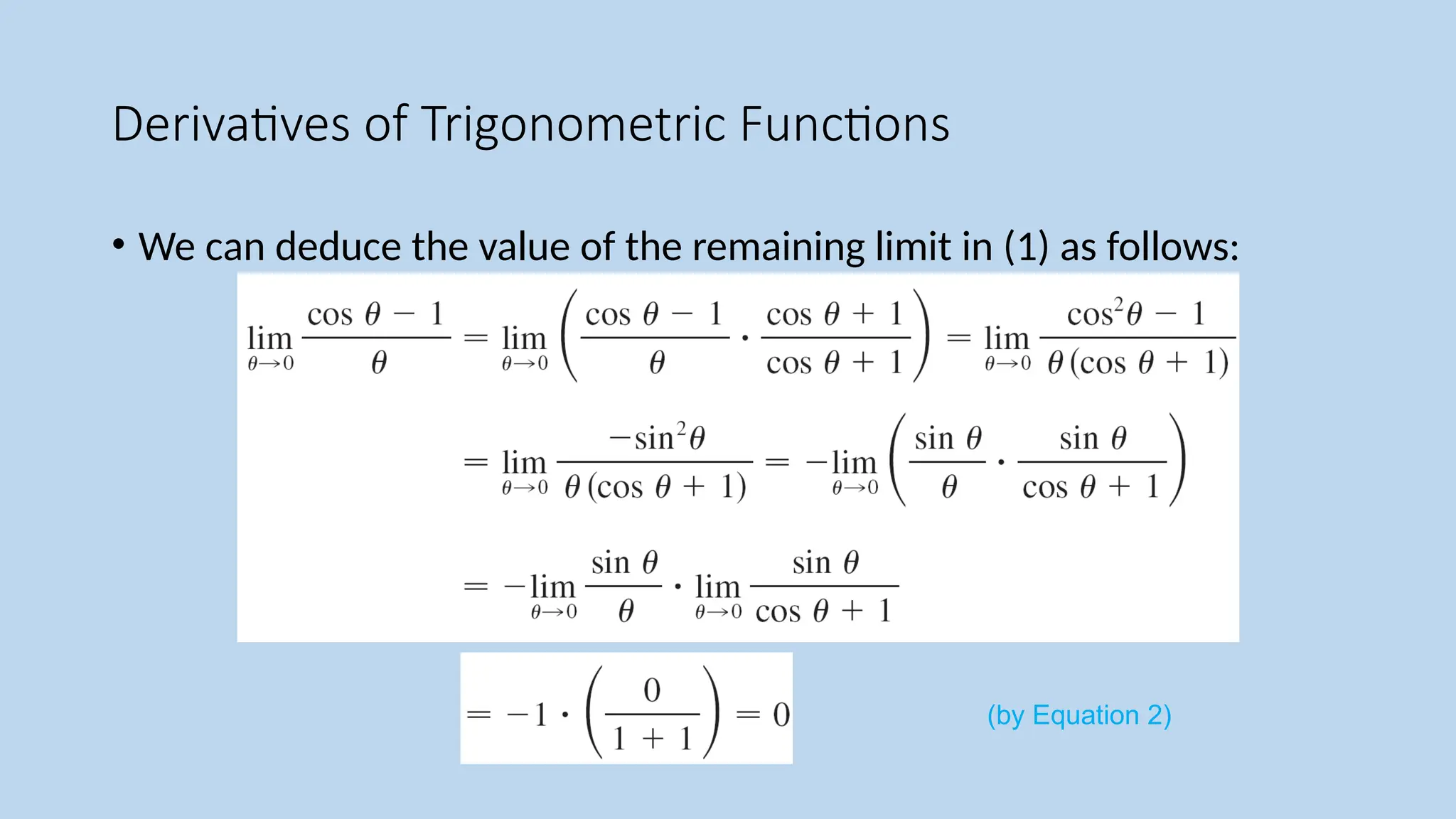
• We can deduce the value of the remaining limit in (1) as follows:
(by Equation 2)
Derivatives of Trigonometric Functions
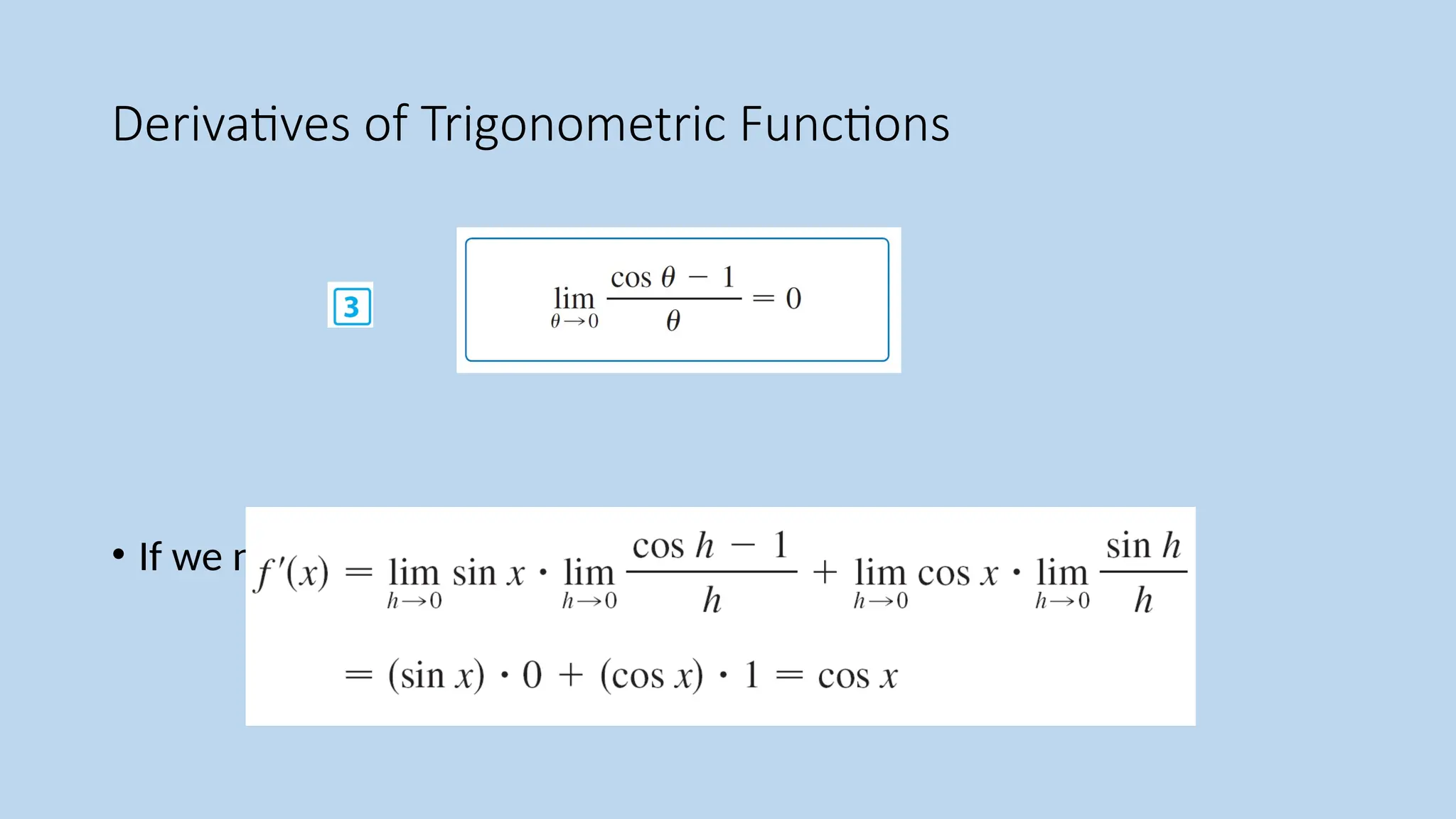
• If we now put the limits (2) and (3) in (1), we get
Derivatives of Trigonometric Functions
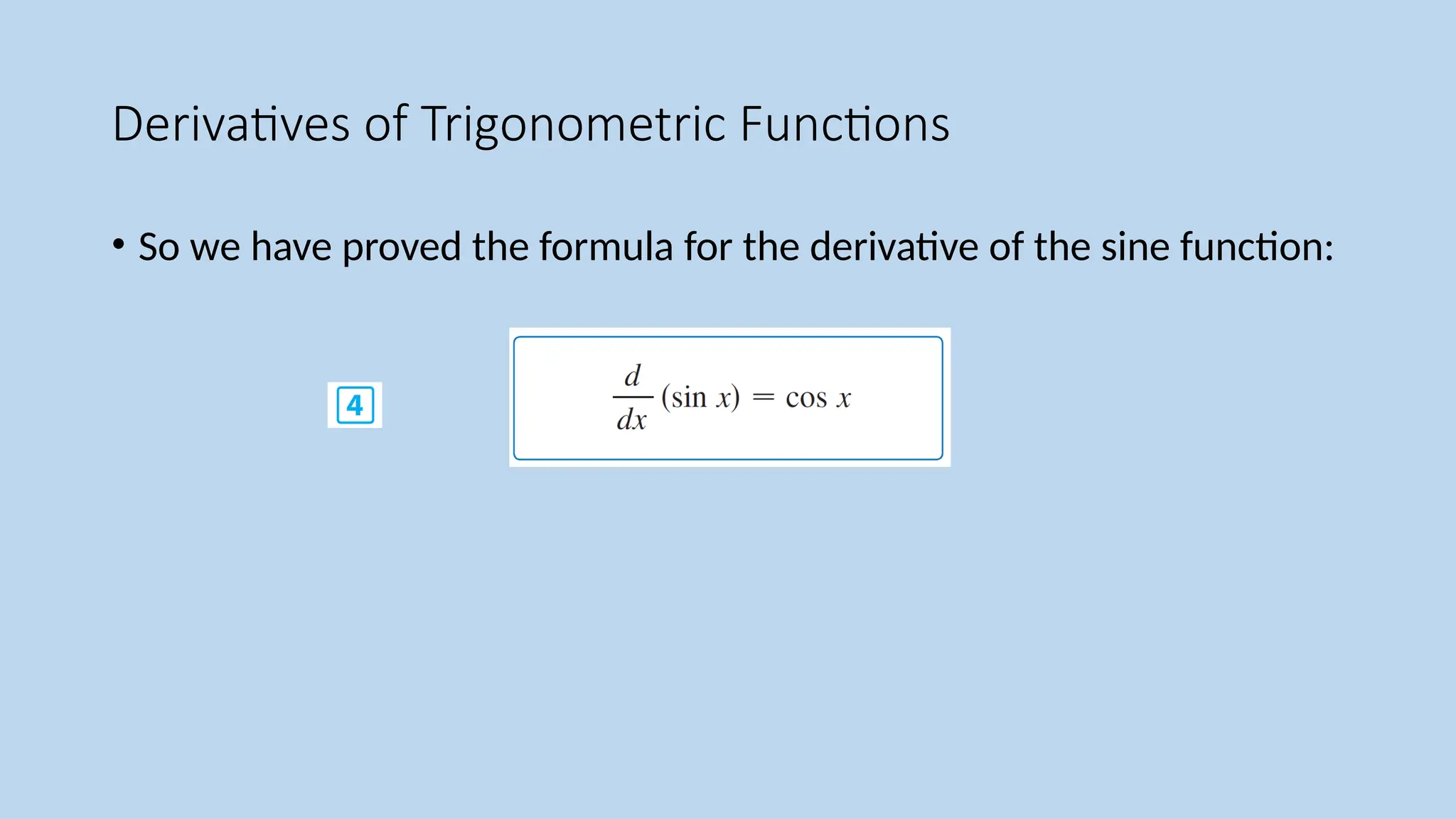
• So we have proved the formula for the derivative of the sine function:
Example 1
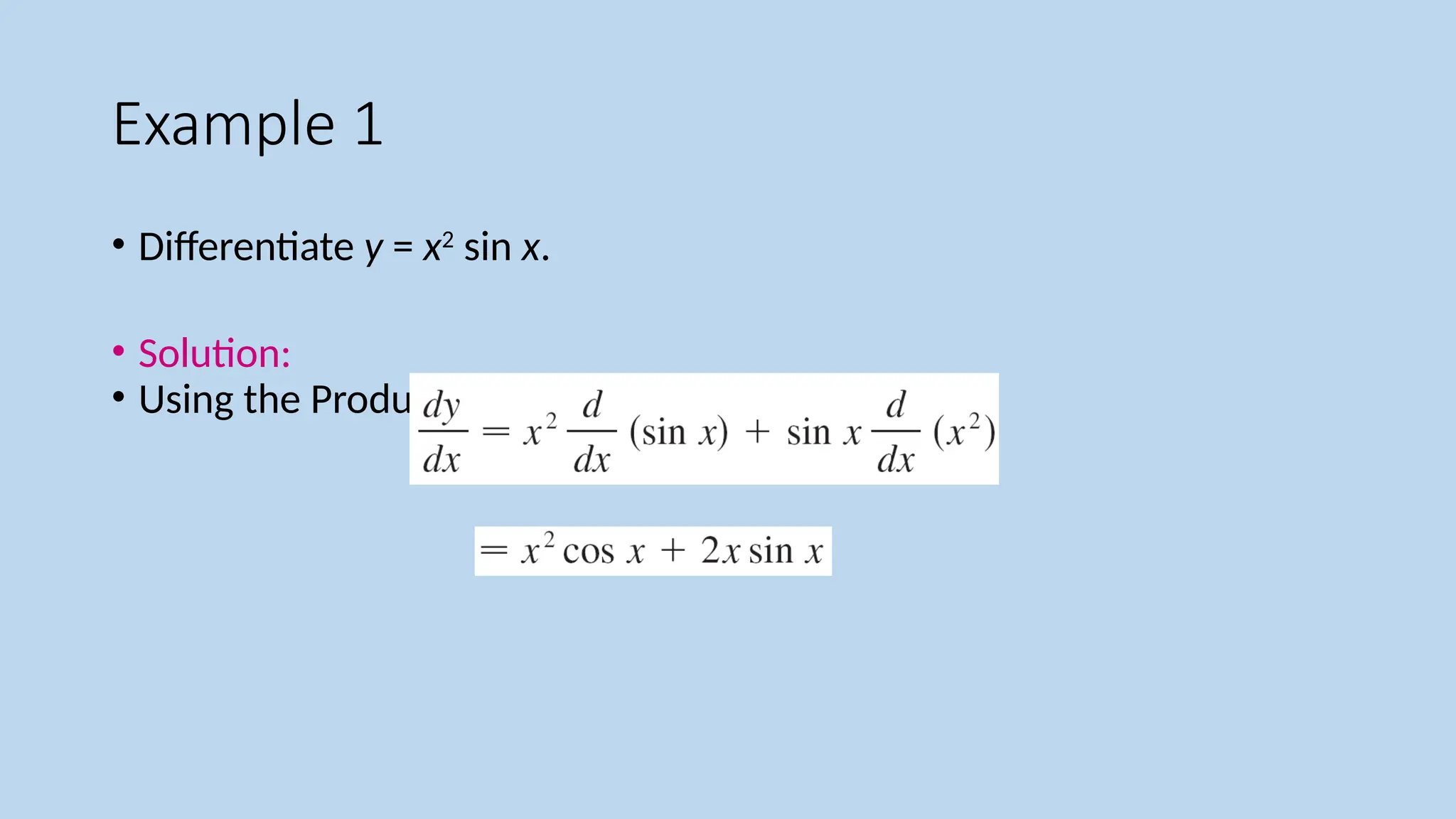
• Differentiate y = x2
sin x.
• Solution:
• Using the Product Rule and Formula 4, we have
Derivatives of Trigonometric Functions
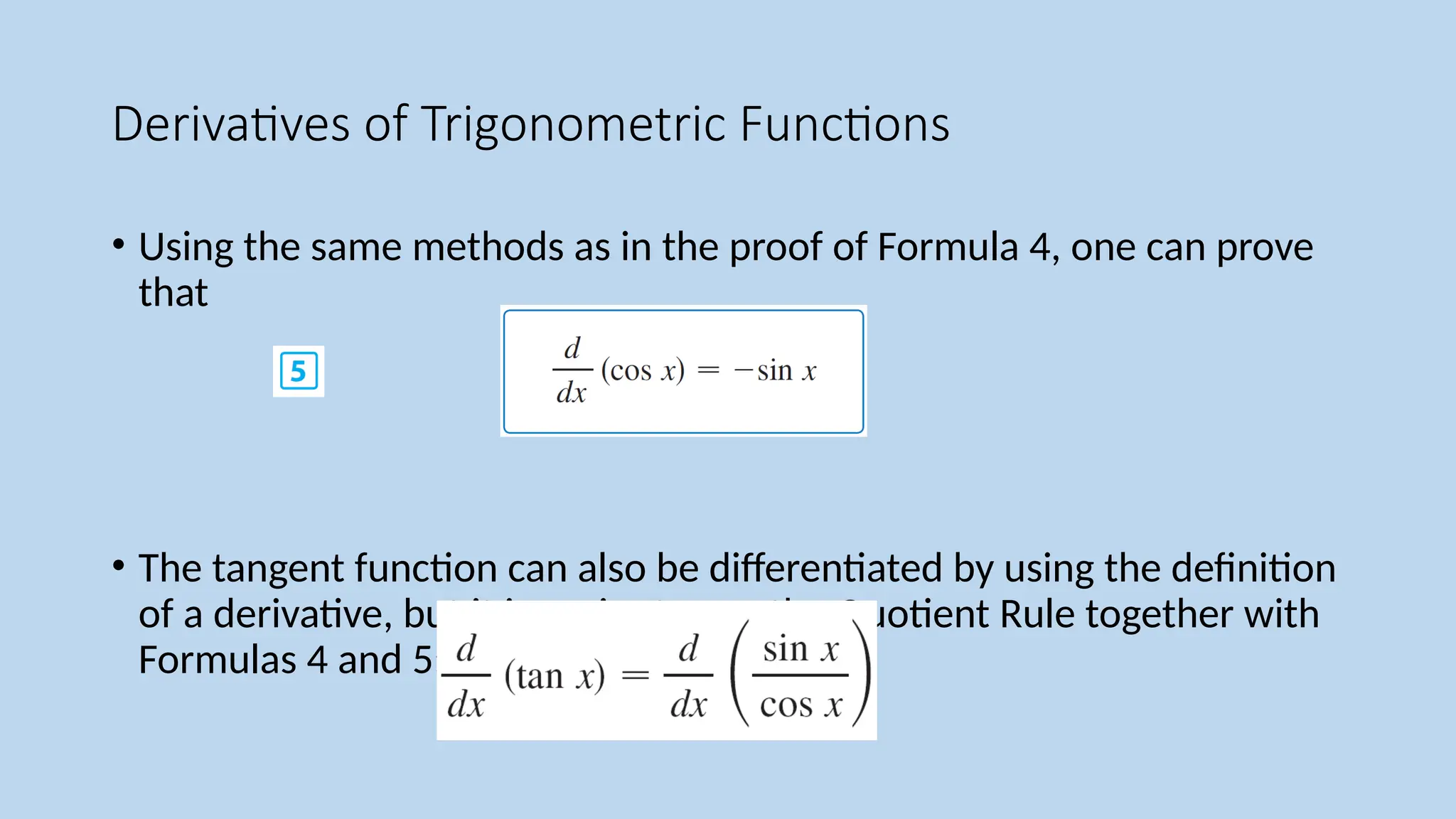
• Using the same methods as in the proof of Formula 4, one can prove
that
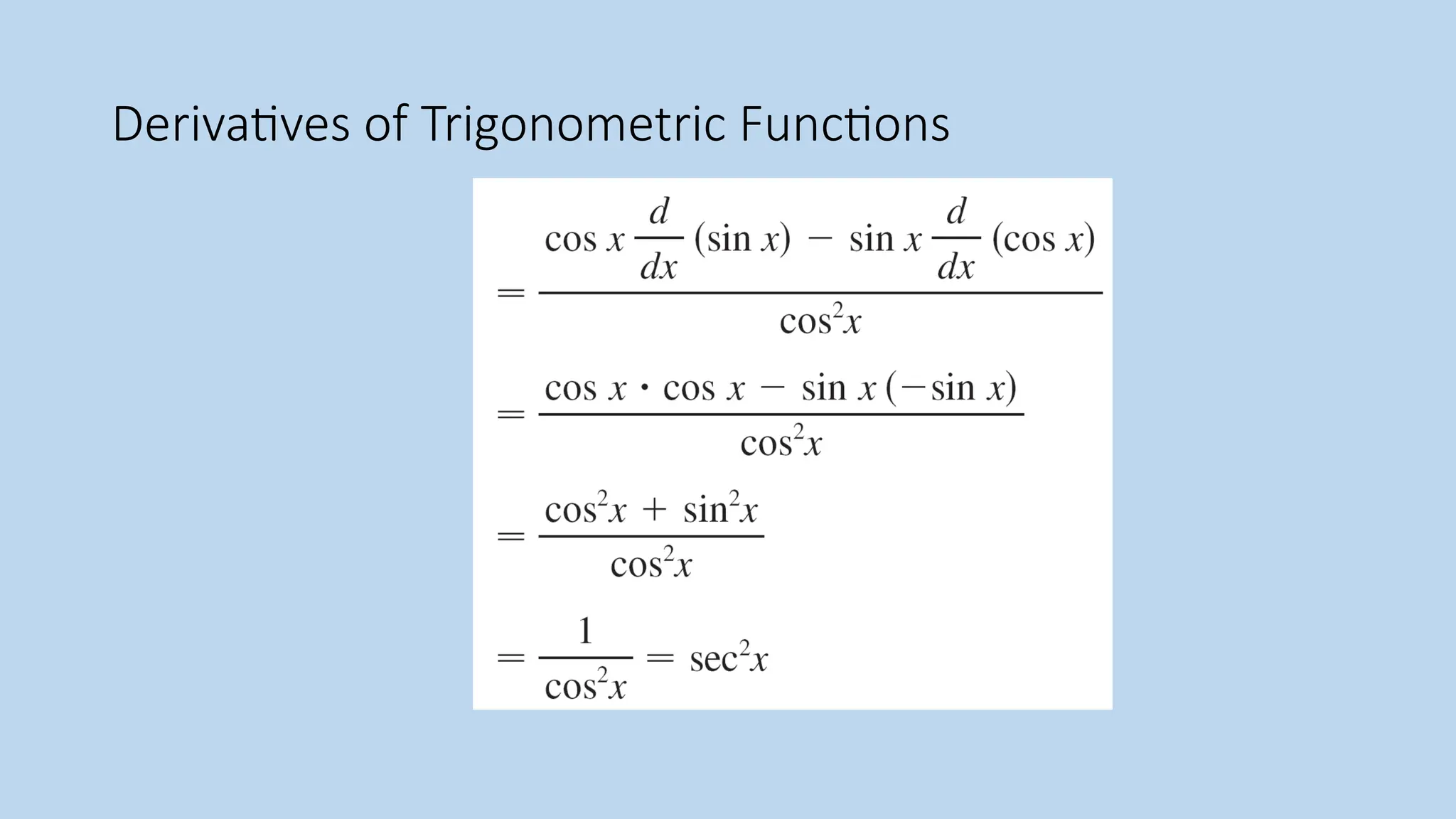
• The tangent function can also be differentiated by using the definition
of a derivative, but it is easier to use the Quotient Rule together with
Formulas 4 and 5:
Derivatives of Trigonometric Functions
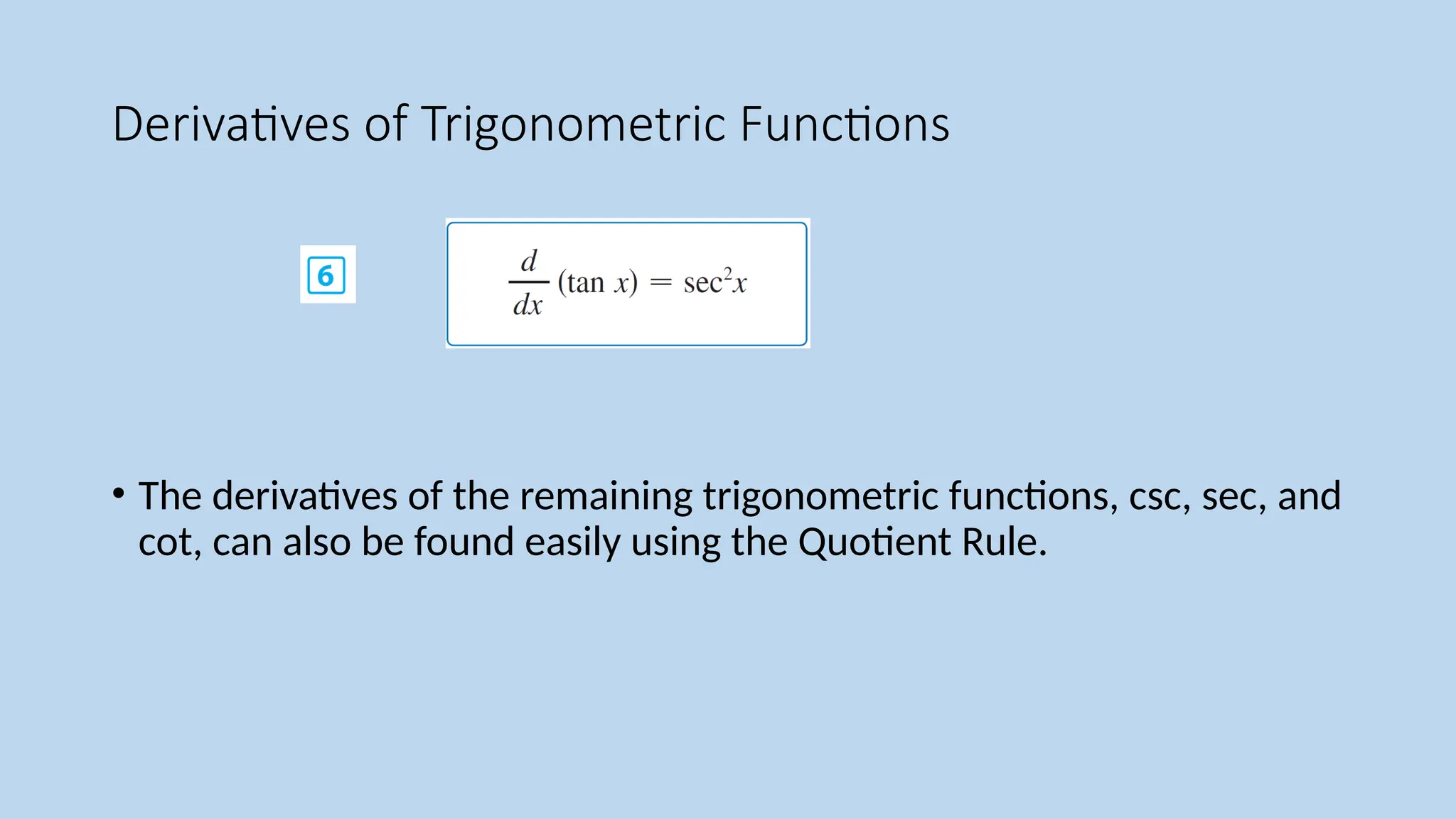
• The derivatives of the remaining trigonometric functions, csc, sec, and
cot, can also be found easily using the Quotient Rule.
Derivatives of Trigonometric Functions
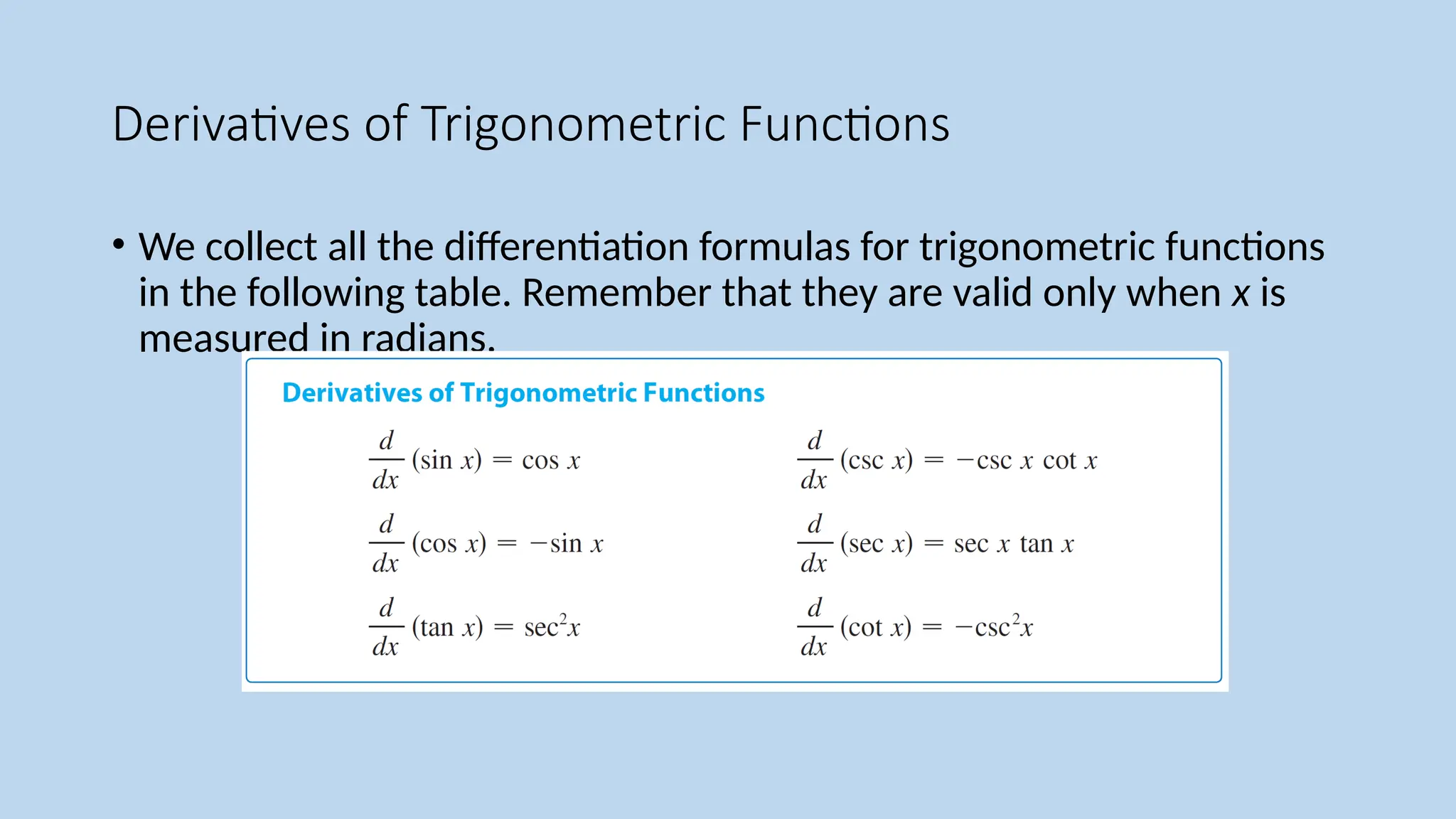
• We collect all the differentiation formulas for trigonometric functions
in the following table. Remember that they are valid only when x is
measured in radians.
Derivatives of Trigonometric Functions
• Trigonometric functions are often used in modeling
real-world phenomena. In particular, vibrations, waves, elastic
motions, and other quantities that vary in a periodic manner can be
described using trigonometric functions. In the next example we
discuss an instance of simple harmonic motion.
Example 3
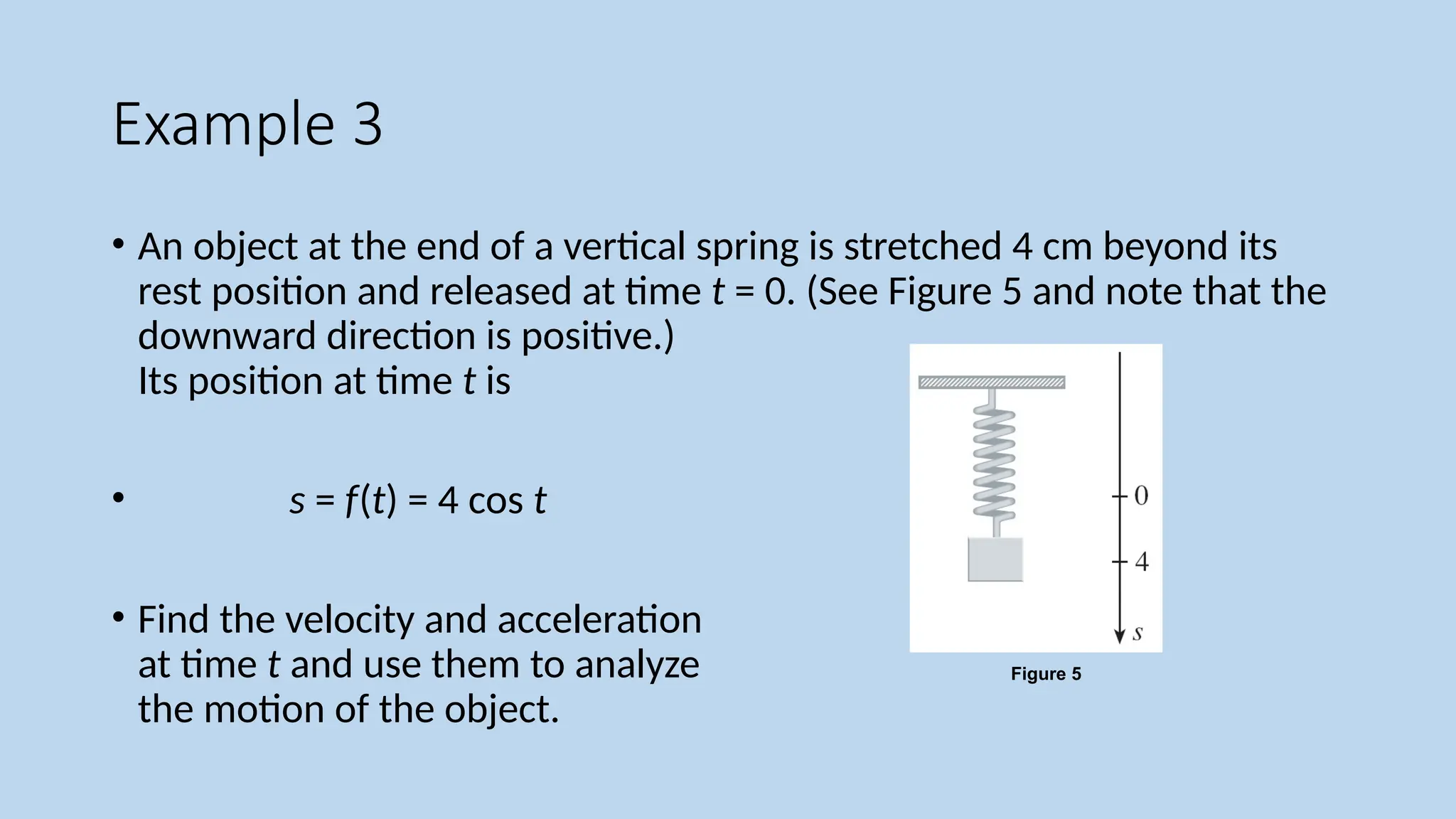
• An object at the end of a vertical spring is stretched 4 cm beyond its
rest position and released at time t = 0. (See Figure 5 and note that the
downward direction is positive.)
Its position at time t is
• s = f(t) = 4 cos t
• Find the velocity and acceleration
at time t and use them to analyze
the motion of the object.
Figure 5
Example 3 – Solution
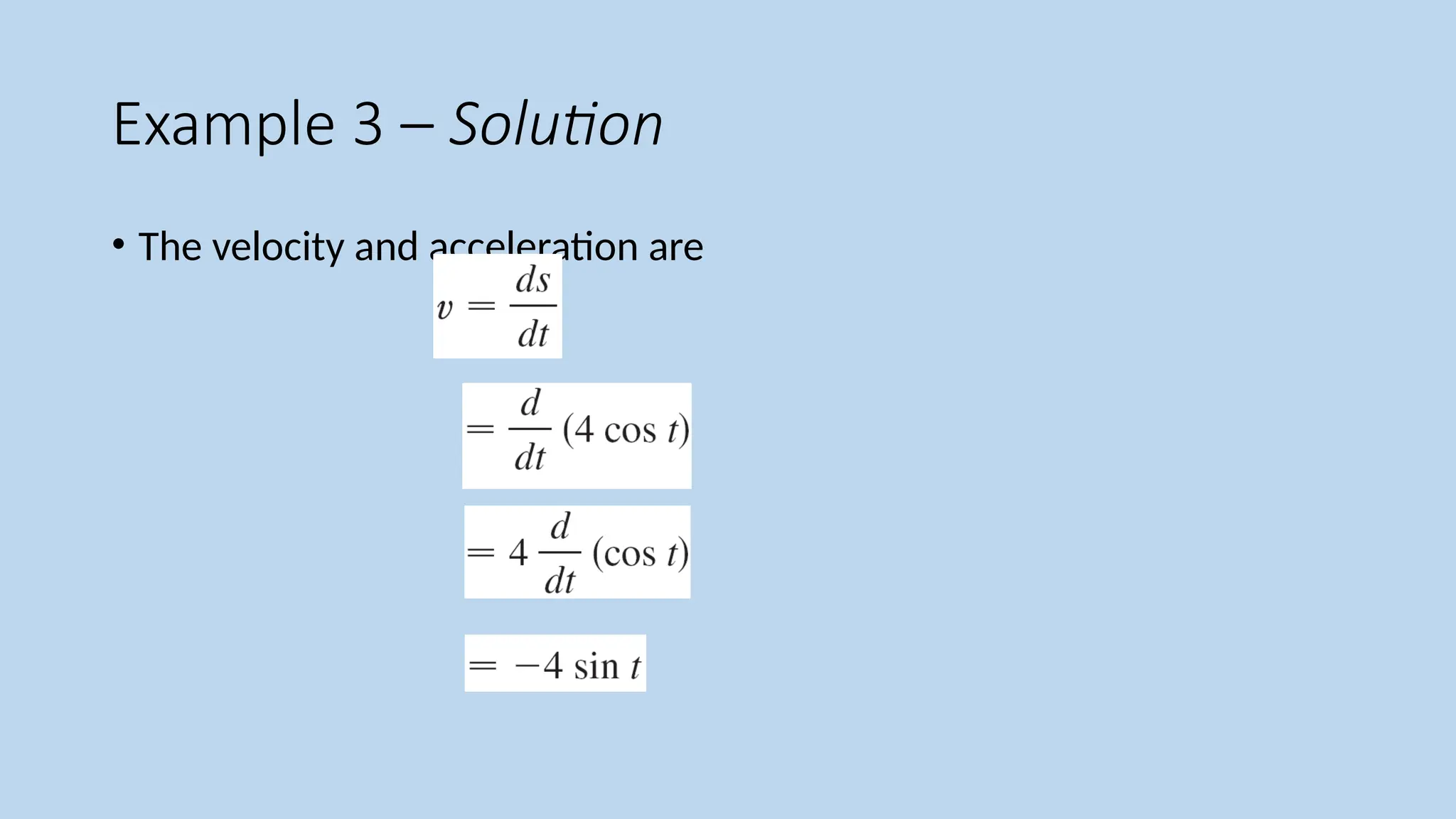
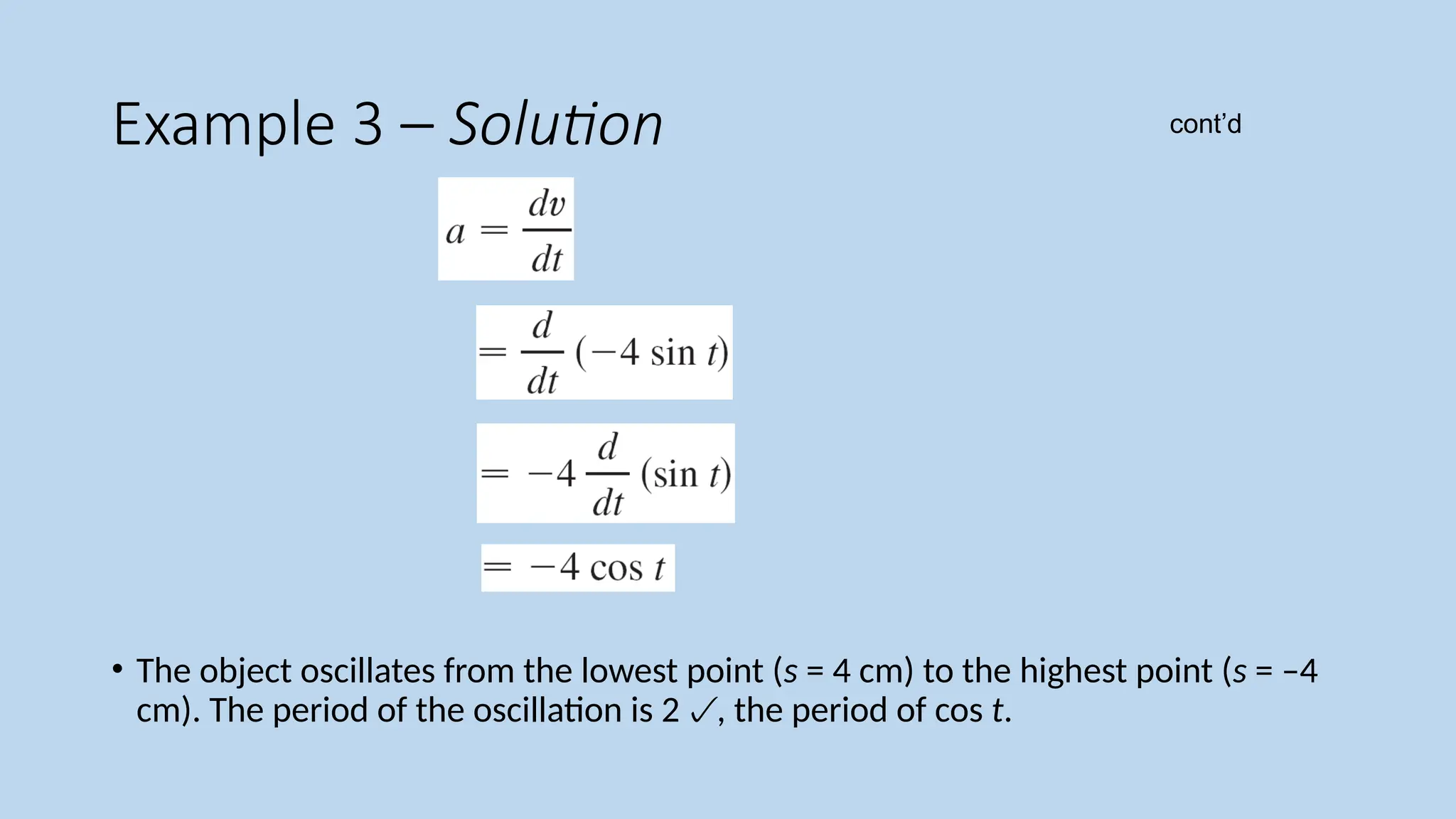
• The velocity and acceleration are
Example 3 – Solution
• The object oscillates from the lowest point (s = 4 cm) to the highest point (s = –4
cm). The period of the oscillation is 2, the period of cos t.
cont’d
Example 3 – Solution
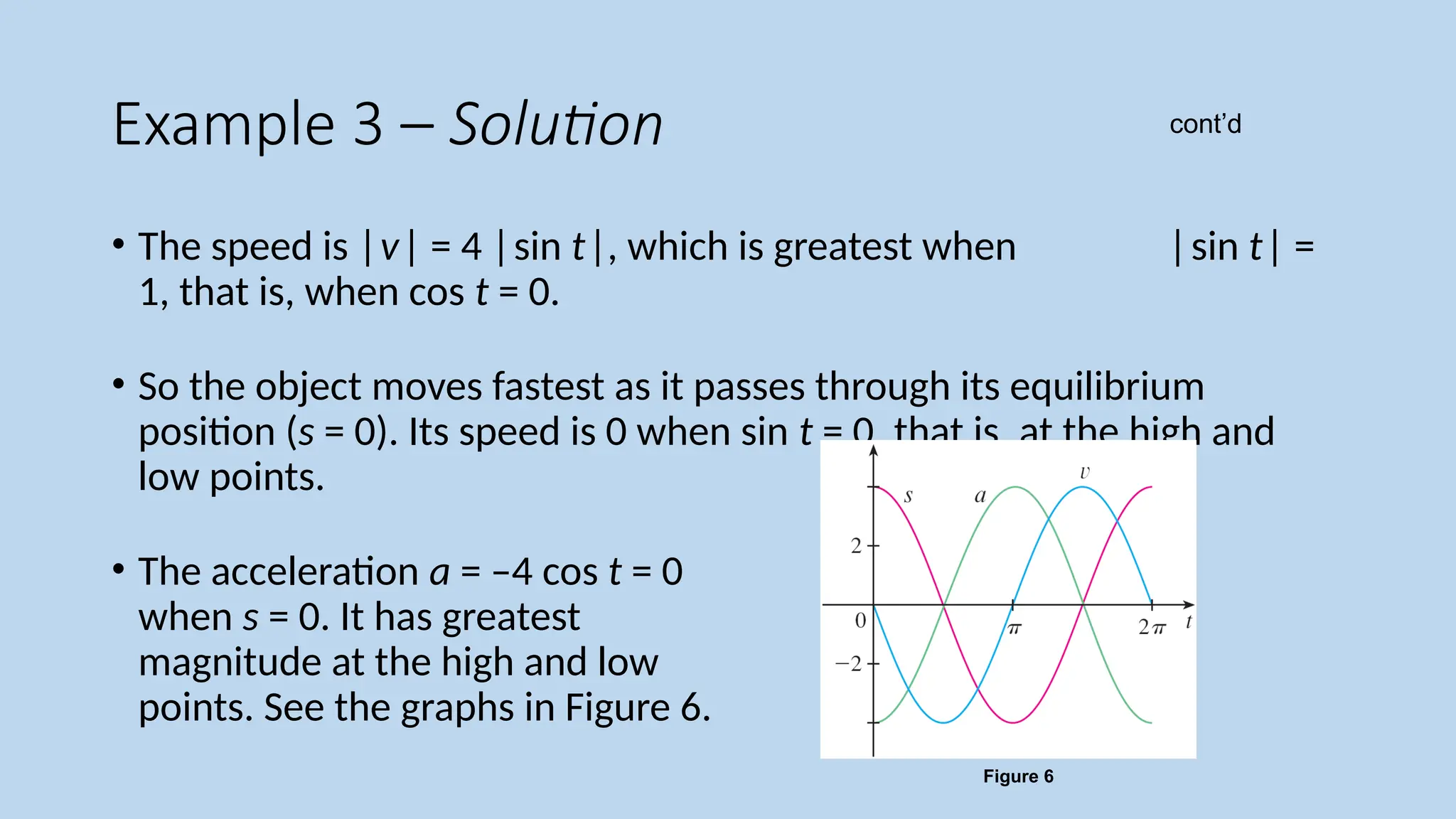
• The speed is |v| = 4 |sin t|, which is greatest when |sin t| =
1, that is, when cos t = 0.
• So the object moves fastest as it passes through its equilibrium
position (s = 0). Its speed is 0 when sin t = 0, that is, at the high and
low points.
• The acceleration a = –4 cos t = 0
when s = 0. It has greatest
magnitude at the high and low
points. See the graphs in Figure 6.
Figure 6
cont’d
Week 5 lecture 1 of Calculus course in unergraduate

  • 1.
  • 2.
    Topics for Week5 (Lecture 1) •Derivative; Rules – How to find derivative of various (types of) functions
  • 3.
    Derivatives of Polynomials andExponential Functions
  • 4.
    Derivatives of Polynomialsand Exponential Functions • In this section we learn how to differentiate constant functions, power functions, polynomials, and exponential functions. • Let’s start with the simplest of all functions, the constant function f(x) = c. • The graph of this function is the horizontal line y = c, which has slope 0, so we must have f'(x) = 0. (See Figure 1.) Figure 1 The graph of f(x) = c is the line y = c, so f(x) = 0.
  • 5.
    Derivatives of Polynomialsand Exponential Functions • A formal proof, from the definition of a derivative, is also easy: • In Leibniz notation, we write this rule as follows.
  • 6.
  • 7.
    Power Functions • Wenext look at the functions f(x) = xn , where n is a positive integer. • If n = 1, the graph of f(x) = x is the line y = x, which has slope 1. (See Figure 2.) Figure 2 The graph of f(x) = x is the line y = x, so f '(x) = 1.
  • 8.
    Power Functions • So •(You can also verify Equation 1 from the definition of a derivative.) • We have already investigated the cases n = 2 and n = 3. We found that
  • 9.
    Power Functions For n= 4 we find the derivative of f(x) = x4 as follows:
  • 10.
    Power Functions • Thus •Comparing the equations in (1), (2), and (3), we see a pattern emerging. • It seems to be a reasonable guess that, when n is a positive integer, (d/dx)(xn ) = nxn –1 . This turns out to be true.
  • 11.
    Example 1 (a) Iff(x) = x6 , then f(x) = 6x5 . (b) If y = x1000 , then y= 1000x999 . (c) If y = t4 , then = 4t3 . (d) = 3r2
  • 12.
    Power Functions • ThePower Rule enables us to find tangent lines without having to resort to the definition of a derivative. It also enables us to find normal lines. • The normal line to a curve C at a point P is the line through P that is perpendicular to the tangent line at P.
  • 13.
  • 14.
    New Derivatives fromOld • When new functions are formed from old functions by addition, subtraction, or multiplication by a constant, their derivatives can be calculated in terms of derivatives of the old functions. • In particular, the following formula says that the derivative of a constant times a function is the constant times the derivative of the function.
  • 15.
  • 16.
    New Derivatives fromOld • The next rule tells us that the derivative of a sum of functions is the sum of the derivatives. • The Sum Rule can be extended to the sum of any number of functions. For instance, using this theorem twice, we get • (f + g + h) = [(f + g) + h)] = (f + g) + h = f + g + h
  • 17.
    New Derivatives fromOld • By writing f – g as f + (–1)g and applying the Sum Rule and the Constant Multiple Rule, we get the following formula. • The Constant Multiple Rule, the Sum Rule, and the Difference Rule can be combined with the Power Rule to differentiate any polynomial, as the following examples demonstrate.
  • 18.
  • 19.
    Exponential Functions • Let’stry to compute the derivative of the exponential function f(x) = bx using the definition of a derivative: • The factor bx doesn’t depend on h, so we can take it in front of the limit:
  • 20.
    Exponential Functions • Noticethat the limit is the value of the derivative of f at 0, that is, • Therefore we have shown that if the exponential function f(x) = bx is differentiable at 0, then it is differentiable everywhere and • f(x) = f(0)bx • This equation says that the rate of change of any exponential function is proportional to the function itself. (The slope is proportional to the height.)
  • 21.
    Exponential Functions • Numericalevidence for the existence of f(0) is given in the table shown below for the cases b = 2 and b = 3. (Values are stated correct to four decimal places.) It appears that the limits exist and • for b = 2, • for b = 3,
  • 22.
    Exponential Functions • Infact, it can be proved that these limits exist and, correct to six decimal places, the values are • Thus, from Equation 4, we have • Of all possible choices for the base b in Equation 4, the simplest differentiation formula occurs when f(0) = 1.
  • 23.
    Exponential Functions • Inview of the estimates of f(0) for b = 2 and b = 3, it seems reasonable that there is a number b between 2 and 3 for which f(0) = 1. • It is traditional to denote this value by the letter e. Thus we have the following definition.
  • 24.
    Exponential Functions • Geometrically,this means that of all the possible exponential functions y = bx , the function f(x) = ex is the one whose tangent line at (0, 1) has a slope f(0) that is exactly 1. (See Figures 6 and 7.) Figure 6 Figure 7
  • 25.
    Exponential Functions • Ifwe put b = e and, therefore, f(0) = 1 in Equation 4, it becomes the following important differentiation formula. • Thus the exponential function f(x) = ex has the property that it is its own derivative. The geometrical significance of this fact is that the slope of a tangent line to the curve y = ex is equal to the y-coordinate of the point (see Figure 7).
  • 26.
    Example 8 If f(x)= ex – x, find f and f. Compare the graphs of f and f. Solution: Using the Difference Rule, we have
  • 27.
    Example 8 –Solution • We defined the second derivative as the derivative of f , so cont’d
  • 28.
    Example 8 –Solution The function f and its derivative f are graphed in Figure 8. Notice that f has a horizontal tangent when x = 0; this corresponds to the fact that f(0) = 0. Notice also that, for x > 0, f(x) is positive and f is increasing. When x < 0, f(x) is negative and f is decreasing. Figure 8 cont’d
  • 29.
    The Product andQuotient Rules
  • 30.
  • 31.
    The Product Rule •By analogy with the Sum and Difference Rules, one might be tempted to guess, that the derivative of a product is the product of the derivatives. • We can see, however, that this guess is wrong by looking at a particular example. • Let f(x) = x and g(x) = x2 . Then the Power Rule gives f(x) = 1 and g(x) = 2x. • But (fg)(x) = x3 , so (fg)(x) = 3x2 . Thus (fg)  fg.
  • 32.
    The Product Rule •The correct formula was discovered by Leibniz and is called the Product Rule. • Before stating the Product Rule, let’s see how we might discover it. • We start by assuming that u = f(x) and v = g(x) are both positive differentiable functions. Then we can interpret the product uv as an area of a rectangle (see Figure 1). Figure 1 The geometry of the Product Rule
  • 33.
    The Product Rule •If x changes by an amount x, then the corresponding changes in u and v are • u = f(x + x) – f(x) v = g(x + x) – g(x) • and the new value of the product, (u + u)(v + v), can be interpreted as the area of the large rectangle in Figure 1 (provided that u and v happen to be positive). • The change in the area of the rectangle is • (uv) = (u + u)(v + v) – uv = u v + v u + u v • = the sum of the three shaded areas
  • 34.
    • If wedivide by x, we get • If we now let x  0, we get the derivative of uv: The Product Rule
  • 35.
    The Product Rule •(Notice that u  0 as x  0 since f is differentiable and therefore continuous.) • Although we started by assuming (for the geometric interpretation) that all the quantities are positive, we notice that Equation 1 is always true. (The algebra is valid whether u, v, u, and v are positive or negative.)
  • 36.
    The Product Rule •So we have proved Equation 2, known as the Product Rule, for all differentiable functions u and v. • In words, the Product Rule says that the derivative of a product of two functions is the first function times the derivative of the second function plus the second function times the derivative of the first function.
  • 37.
    Example 1 (a) Iff(x) = xex , find f(x). • (b) Find the nth derivative, f(n) (x). • Solution: • (a) By the Product Rule, we have
  • 38.
    Example 1 –Solution • (b) Using the Product Rule a second time, we get cont’d
  • 39.
    Example 1 –Solution • Further applications of the Product Rule give • f(x) = (x + 3)ex f(4) (x) = (x + 4)ex • In fact, each successive differentiation adds another term ex , so • f(n) (x) = (x + n)ex cont’d
  • 40.
  • 41.
    The Quotient Rule •We find a rule for differentiating the quotient of two differentiable functions u = f(x) and v = g(x) in much the same way that we found the Product Rule. • If x, u, and v change by amounts x, u, and v, then the corresponding change in the quotient uv is
  • 42.
    The Quotient Rule •So • As x  0, v  0 also, because v = g(x) is differentiable and therefore continuous. • Thus, using the Limit Laws, we get
  • 43.
    The Quotient Rule •In words, the Quotient Rule says that the derivative of a quotient is the denominator times the derivative of the numerator minus the numerator times the derivative of the denominator, all divided by the square of the denominator.
  • 44.
  • 45.
  • 46.
  • 47.
    Derivatives of TrigonometricFunctions • In particular, it is important to remember that when we talk about the function f defined for all real numbers x by • f(x) = sin x • it is understood that sin x means the sine of the angle whose radian measure is x. A similar convention holds for the other trigonometric functions cos, tan, csc, sec, and cot. • All of the trigonometric functions are continuous at every number in their domains.
  • 48.
    Derivatives of TrigonometricFunctions • If we sketch the graph of the function f(x) = sin x and use the interpretation of f(x) as the slope of the tangent to the sine curve in order to sketch the graph of f, then it looks as if the graph of f may be the same as the cosine curve. (See Figure 1). Figure 1
  • 49.
    Derivatives of TrigonometricFunctions • Let’s try to confirm our guess that if f(x) = sin x, then f(x) = cos x. From the definition of a derivative, we have
  • 50.
    Derivatives of TrigonometricFunctions • Two of these four limits are easy to evaluate. Since we regard x as a constant when computing a limit as h  0, we have and
  • 51.
    Derivatives of TrigonometricFunctions • The limit of (sin h)/h is not so obvious. We made the guess, on the basis of numerical and graphical evidence, that
  • 52.
    Derivatives of TrigonometricFunctions • We now use a geometric argument to prove Equation 2. Assume first that  lies between 0 and /2. Figure 2(a) shows a sector of a circle with center O, central angle , and radius 1. • BC is drawn perpendicular to OA. By the definition of radian measure, we have arc AB = . Also |BC| = |OB| sin  = sin . Figure 2(a)
  • 53.
    Derivatives of TrigonometricFunctions • From the diagram we see that • |BC| < |AB| < arc AB • Therefore sin  <  so < 1 • Let the tangent lines at A and B intersect at E. You can see from Figure 2(b) that the circumference of a circle is smaller than the length of a circumscribed polygon, and so arc AB < |AE| + |EB|. Figure 2(b)
  • 54.
    Derivatives of TrigonometricFunctions • Thus •  = arc AB < |AE| + |EB| • < |AE| + |ED| • = |AD| = |OA| tan  • = tan  • Therefore we have • so
  • 55.
    Derivatives of TrigonometricFunctions • We know that lim 0 1 = 1 and lim 0 cos  = 1, so by the Squeeze Theorem, we have • But the function (sin )/ is an even function, so its right and left limits must be equal. Hence, we have • so we have proved Equation 2.
  • 56.
    Derivatives of TrigonometricFunctions • We can deduce the value of the remaining limit in (1) as follows: (by Equation 2)
  • 57.
    Derivatives of TrigonometricFunctions • If we now put the limits (2) and (3) in (1), we get
  • 58.
    Derivatives of TrigonometricFunctions • So we have proved the formula for the derivative of the sine function:
  • 59.
    Example 1 • Differentiatey = x2 sin x. • Solution: • Using the Product Rule and Formula 4, we have
  • 60.
    Derivatives of TrigonometricFunctions • Using the same methods as in the proof of Formula 4, one can prove that • The tangent function can also be differentiated by using the definition of a derivative, but it is easier to use the Quotient Rule together with Formulas 4 and 5:
  • 61.
  • 62.
    Derivatives of TrigonometricFunctions • The derivatives of the remaining trigonometric functions, csc, sec, and cot, can also be found easily using the Quotient Rule.
  • 63.
    Derivatives of TrigonometricFunctions • We collect all the differentiation formulas for trigonometric functions in the following table. Remember that they are valid only when x is measured in radians.
  • 64.
    Derivatives of TrigonometricFunctions • Trigonometric functions are often used in modeling real-world phenomena. In particular, vibrations, waves, elastic motions, and other quantities that vary in a periodic manner can be described using trigonometric functions. In the next example we discuss an instance of simple harmonic motion.
  • 65.
    Example 3 • Anobject at the end of a vertical spring is stretched 4 cm beyond its rest position and released at time t = 0. (See Figure 5 and note that the downward direction is positive.) Its position at time t is • s = f(t) = 4 cos t • Find the velocity and acceleration at time t and use them to analyze the motion of the object. Figure 5
  • 66.
    Example 3 –Solution • The velocity and acceleration are
  • 67.
    Example 3 –Solution • The object oscillates from the lowest point (s = 4 cm) to the highest point (s = –4 cm). The period of the oscillation is 2, the period of cos t. cont’d
  • 68.
    Example 3 –Solution • The speed is |v| = 4 |sin t|, which is greatest when |sin t| = 1, that is, when cos t = 0. • So the object moves fastest as it passes through its equilibrium position (s = 0). Its speed is 0 when sin t = 0, that is, at the high and low points. • The acceleration a = –4 cos t = 0 when s = 0. It has greatest magnitude at the high and low points. See the graphs in Figure 6. Figure 6 cont’d