Capstone Project
Science, Technology, Engineering, and Mathematics
Basic Calculus
Science, Technology, Engineering, and Mathematics
Lesson 5.1
The Basic Differentiation
Rules
2
A car speedometer
tells us our current
speed when we drive.
However, this speed is
not either our
constant speed nor
our average speed
when we drive.
3
This speed is called the instantaneous rate of
change, or simply the instantaneous speed.
This concept is related to limits and
derivatives.
4
In this lesson, we are going to derive basic
differentiation rules with the aid of the limit
definition of derivative to enable us to solve for the
derivatives of algebraic functions.
5
How do we differentiate
functions without the use of the
limit definition of derivative?
Learning Competencies
At the end of the lesson, you should be able to do the following:
6
● Derive the differentiation rules (STEM_BC11D-
IIIf-2).
● Apply the differentiation rules in computing
the derivative of an algebraic, exponential,
and trigonometric functions (STEM_BC11D-IIIf-
3).
Learning Objectives
At the end of the lesson, you should be able to do the following:
7
● Derive the basic differentiation rules (Constant
Rule, Power Rule, Constant Multiple Rule, Sum or
Difference Rule).
● Apply the basic differentiation rules in solving for
the derivatives of functions.
8
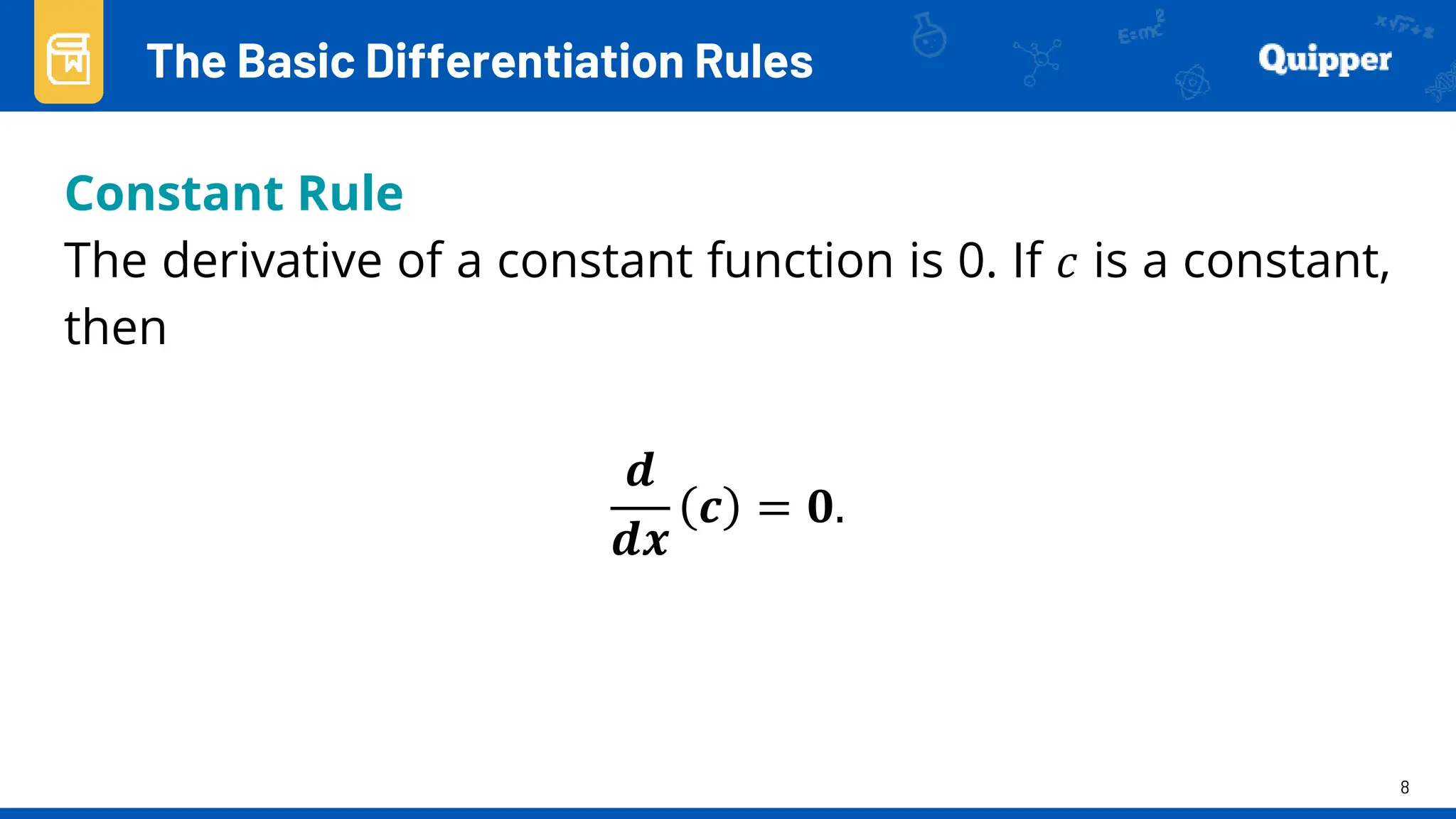
Constant Rule
The derivative of a constant function is 0. If 𝑐 is a constant,
then
𝒅
𝒅𝒙
𝒄 = 𝟎.
The Basic Differentiation Rules
9
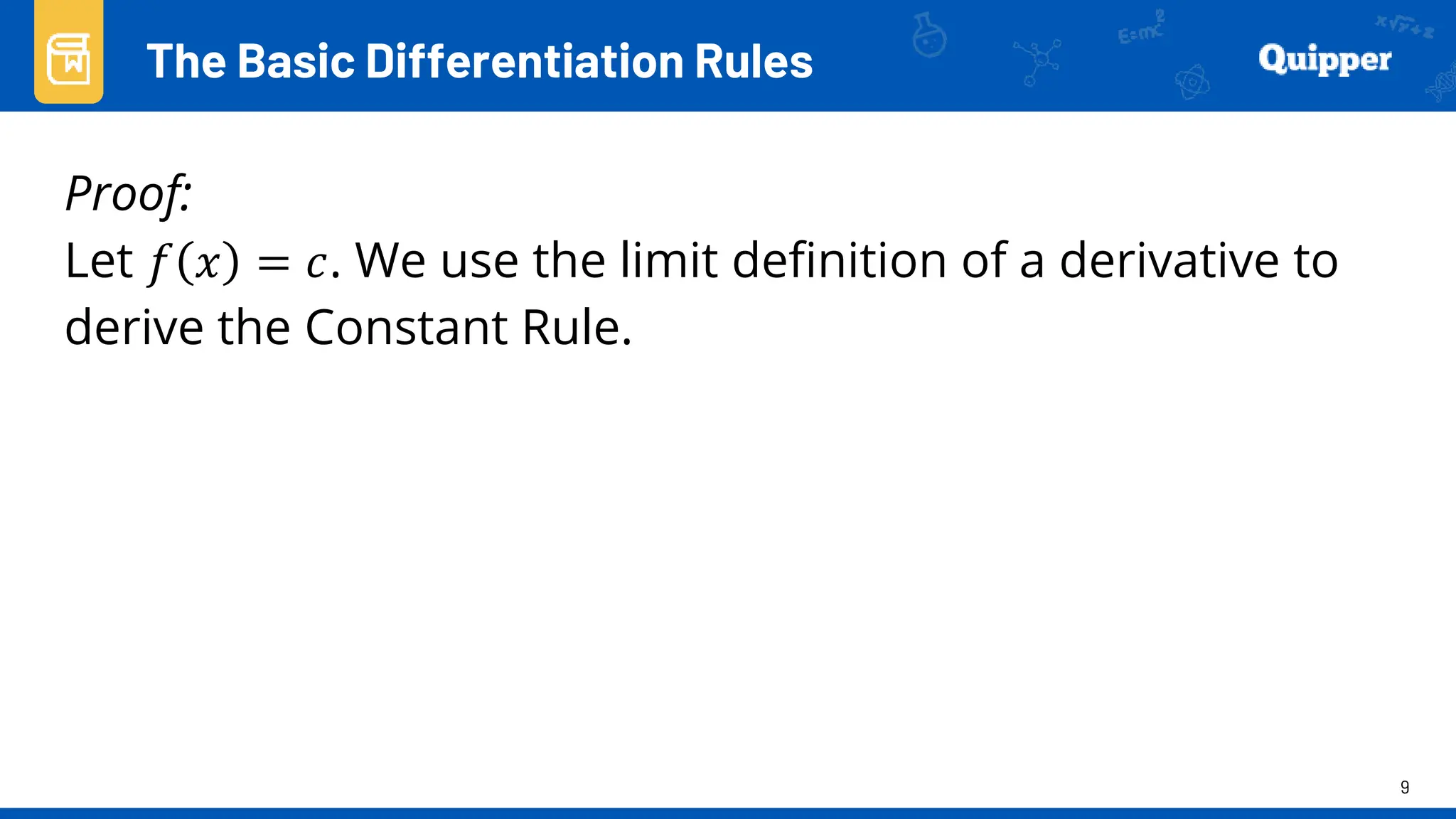
Proof:
Let 𝑓 𝑥 = 𝑐. We use the limit definition of a derivative to
derive the Constant Rule.
The Basic Differentiation Rules
10
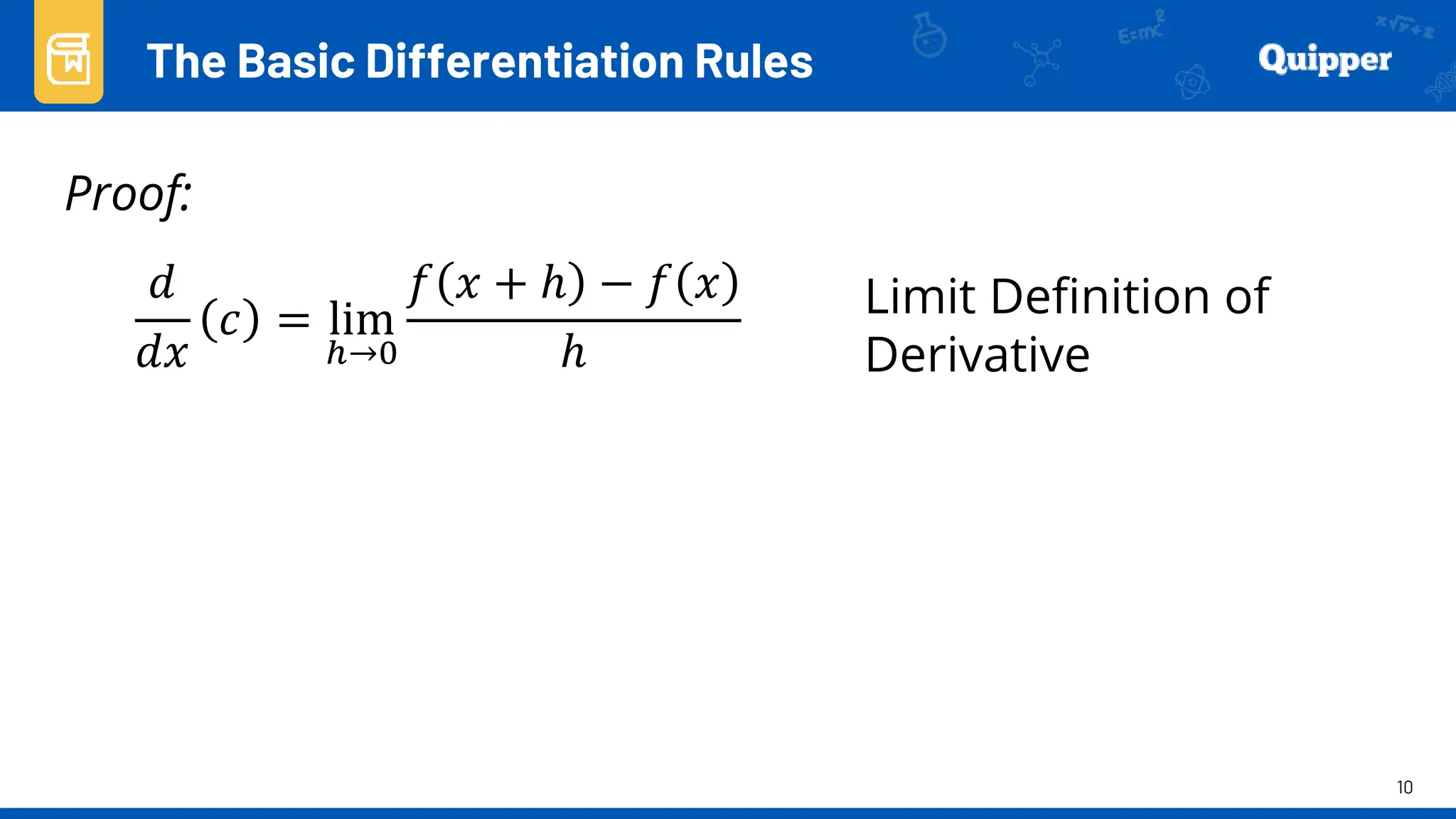
Proof:
The Basic Differentiation Rules
𝑑
𝑑𝑥
𝑐 = lim
ℎ→0
𝑓 𝑥 + ℎ − 𝑓 𝑥
ℎ
Limit Definition of
Derivative
11
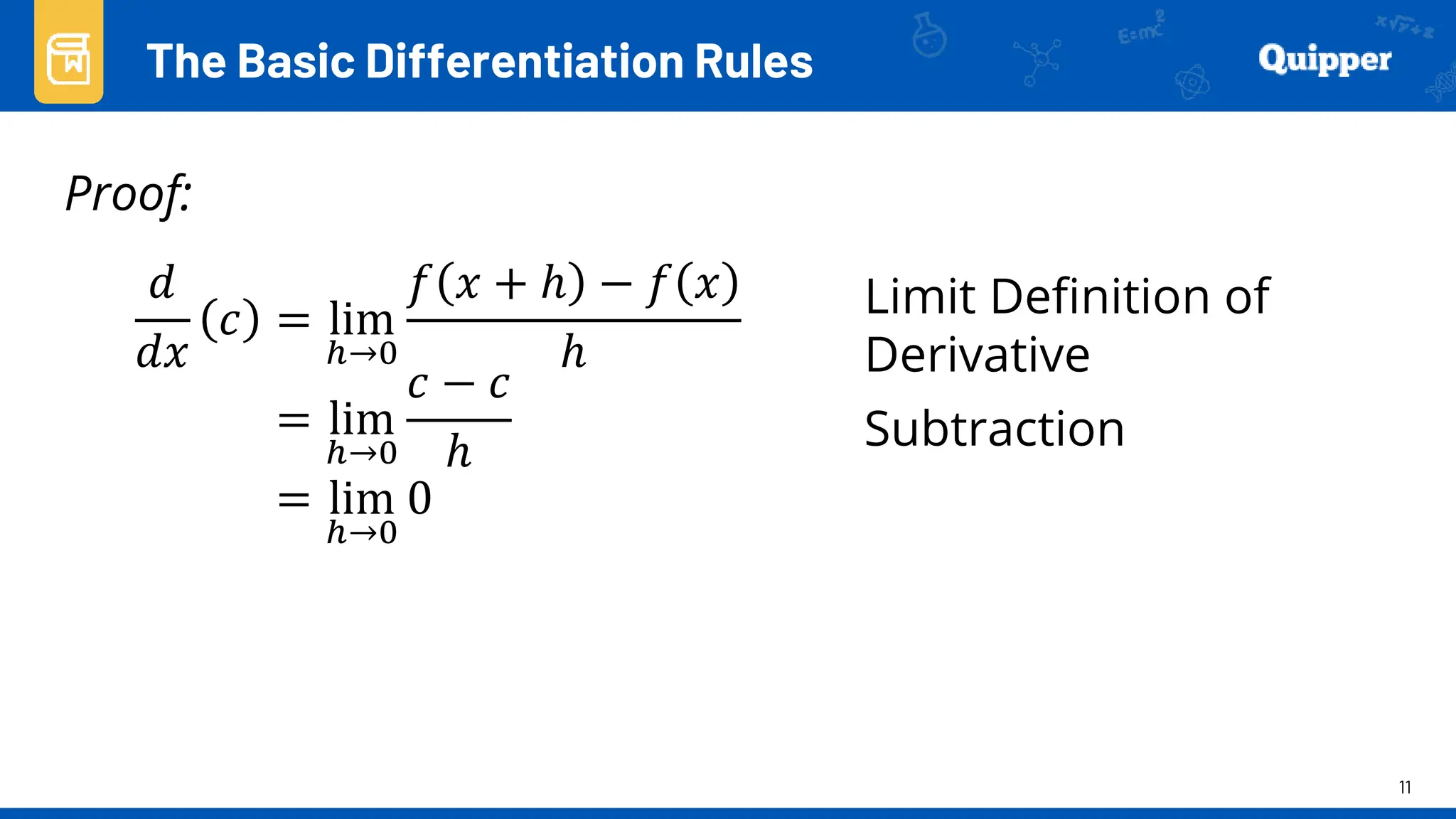
Proof:
The Basic Differentiation Rules
𝑑
𝑑𝑥
𝑐 = lim
ℎ→0
𝑓 𝑥 + ℎ − 𝑓 𝑥
ℎ
= lim
ℎ→0
𝑐 − 𝑐
ℎ
= lim
ℎ→0
0
Limit Definition of
Derivative
Subtraction
12
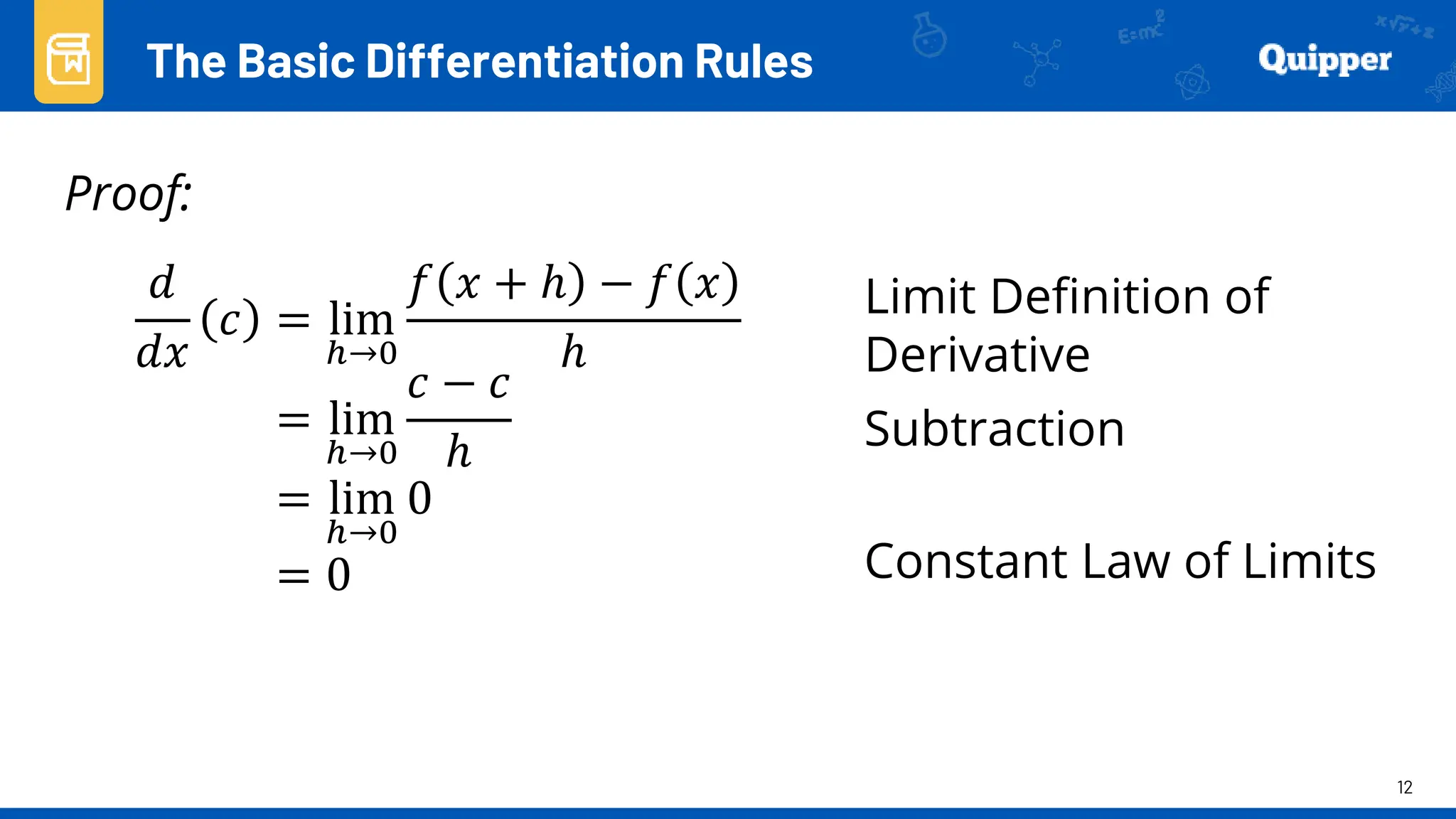
Proof:
The Basic Differentiation Rules
𝑑
𝑑𝑥
𝑐 = lim
ℎ→0
𝑓 𝑥 + ℎ − 𝑓 𝑥
ℎ
= lim
ℎ→0
𝑐 − 𝑐
ℎ
= lim
ℎ→0
0
= 0
Limit Definition of
Derivative
Subtraction
Constant Law of Limits
13
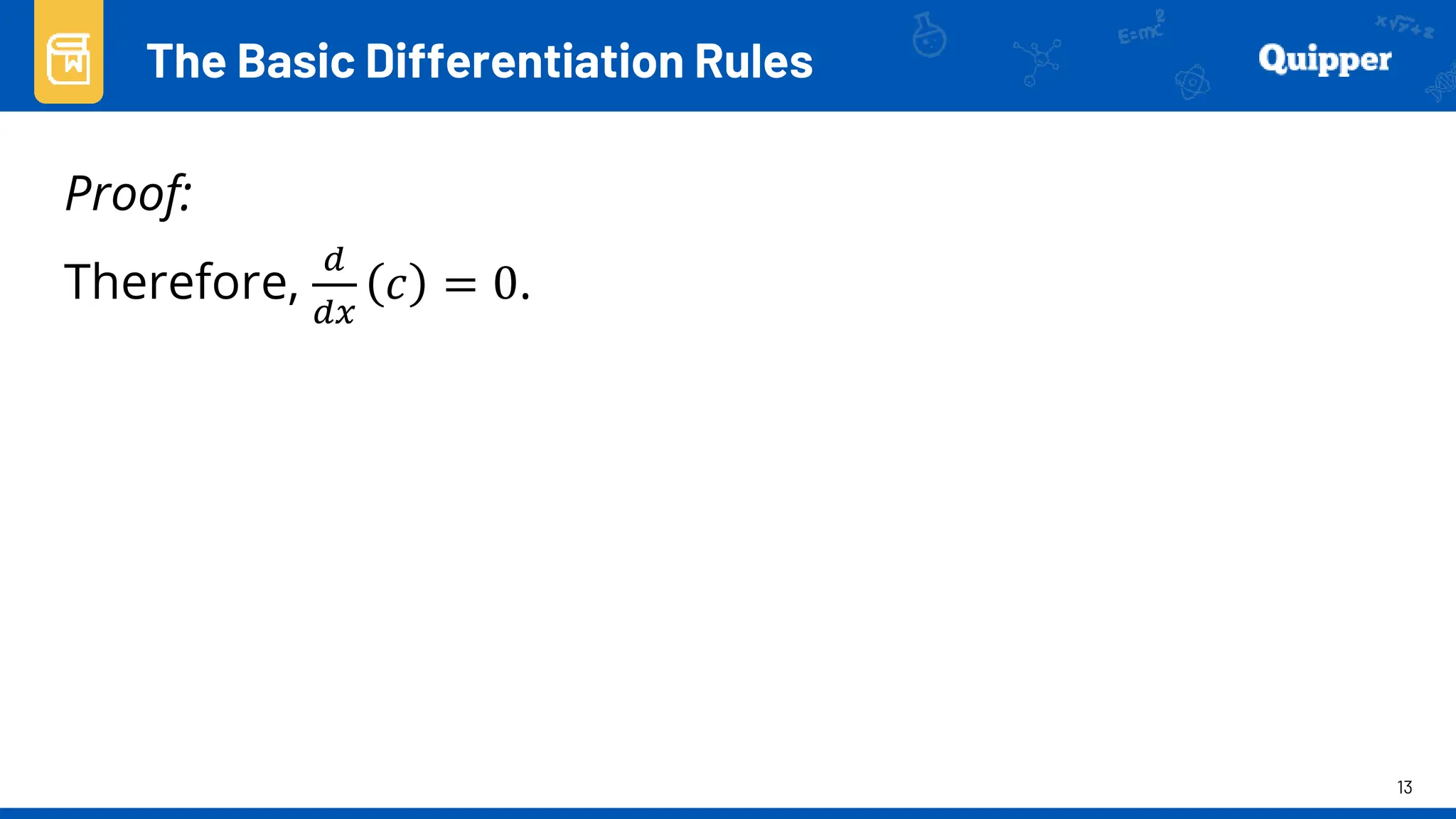
Proof:
Therefore,
𝑑
𝑑𝑥
𝑐 = 0.
The Basic Differentiation Rules
14
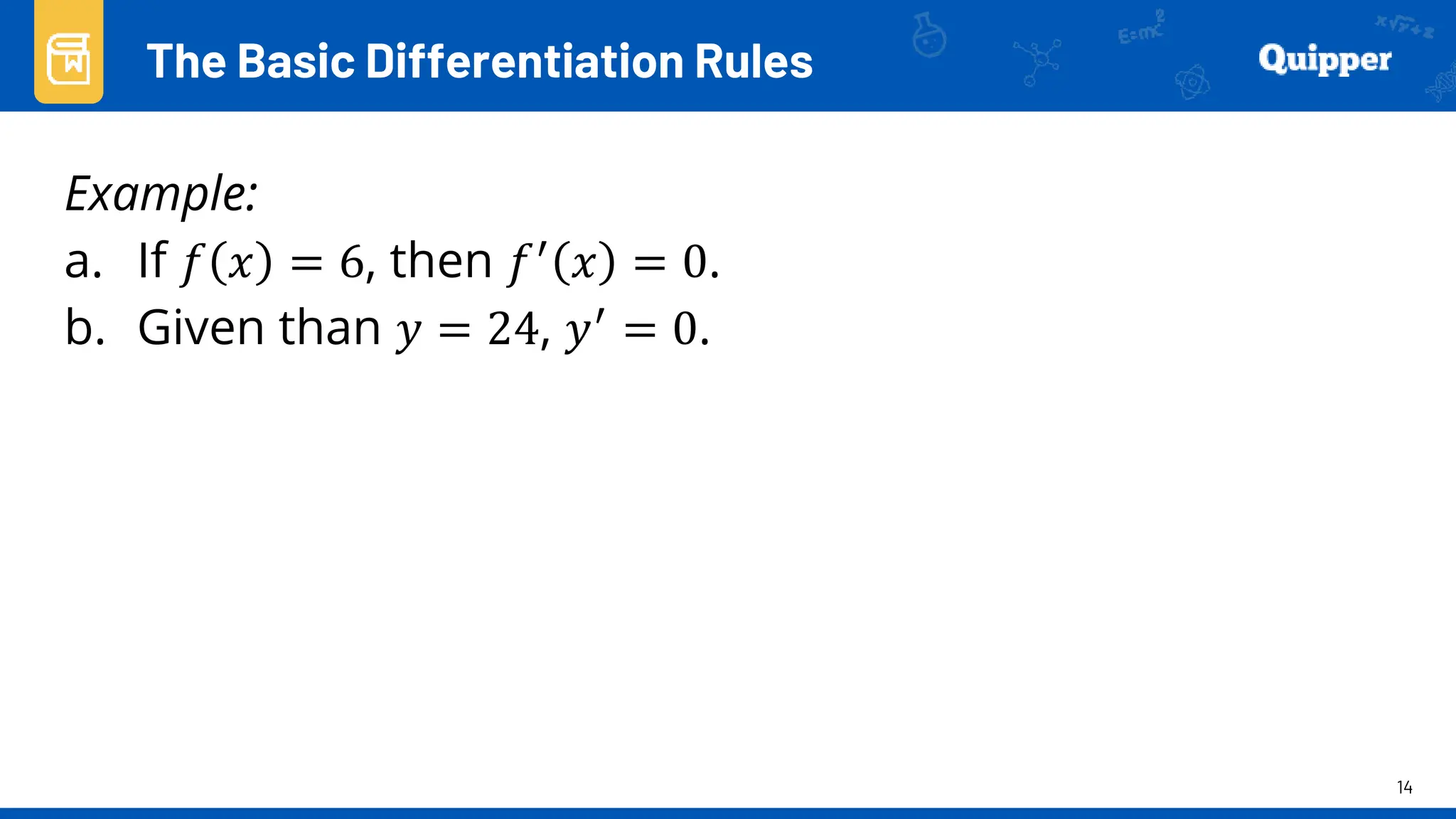
Example:
a. If 𝑓 𝑥 = 6, then 𝑓′ 𝑥 = 0.
b. Given than 𝑦 = 24, 𝑦′ = 0.
The Basic Differentiation Rules
15
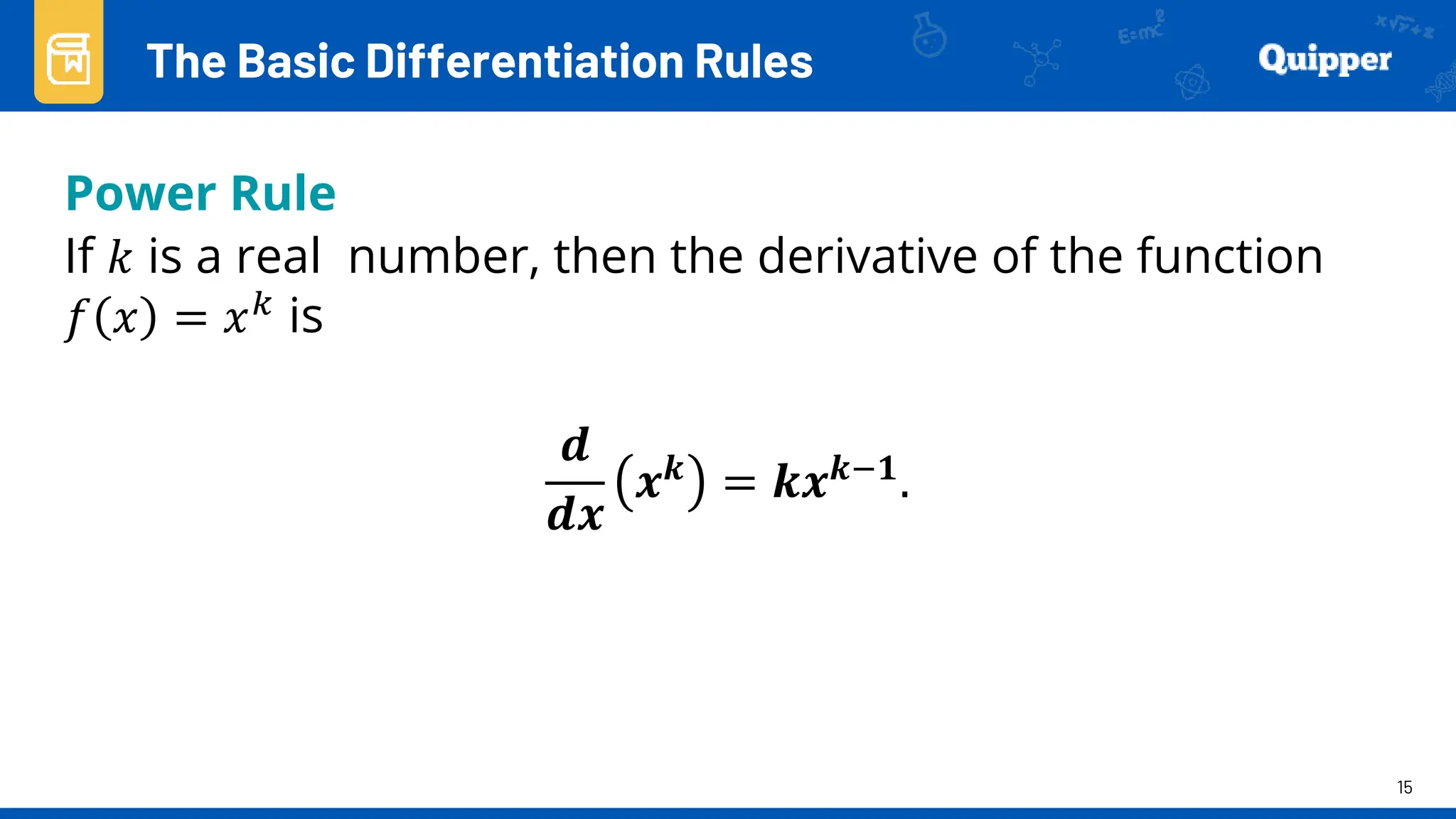
Power Rule
If 𝑘 is a real number, then the derivative of the function
𝑓 𝑥 = 𝑥𝑘
is
𝒅
𝒅𝒙
𝒙𝒌
= 𝒌𝒙𝒌−𝟏
.
The Basic Differentiation Rules
16
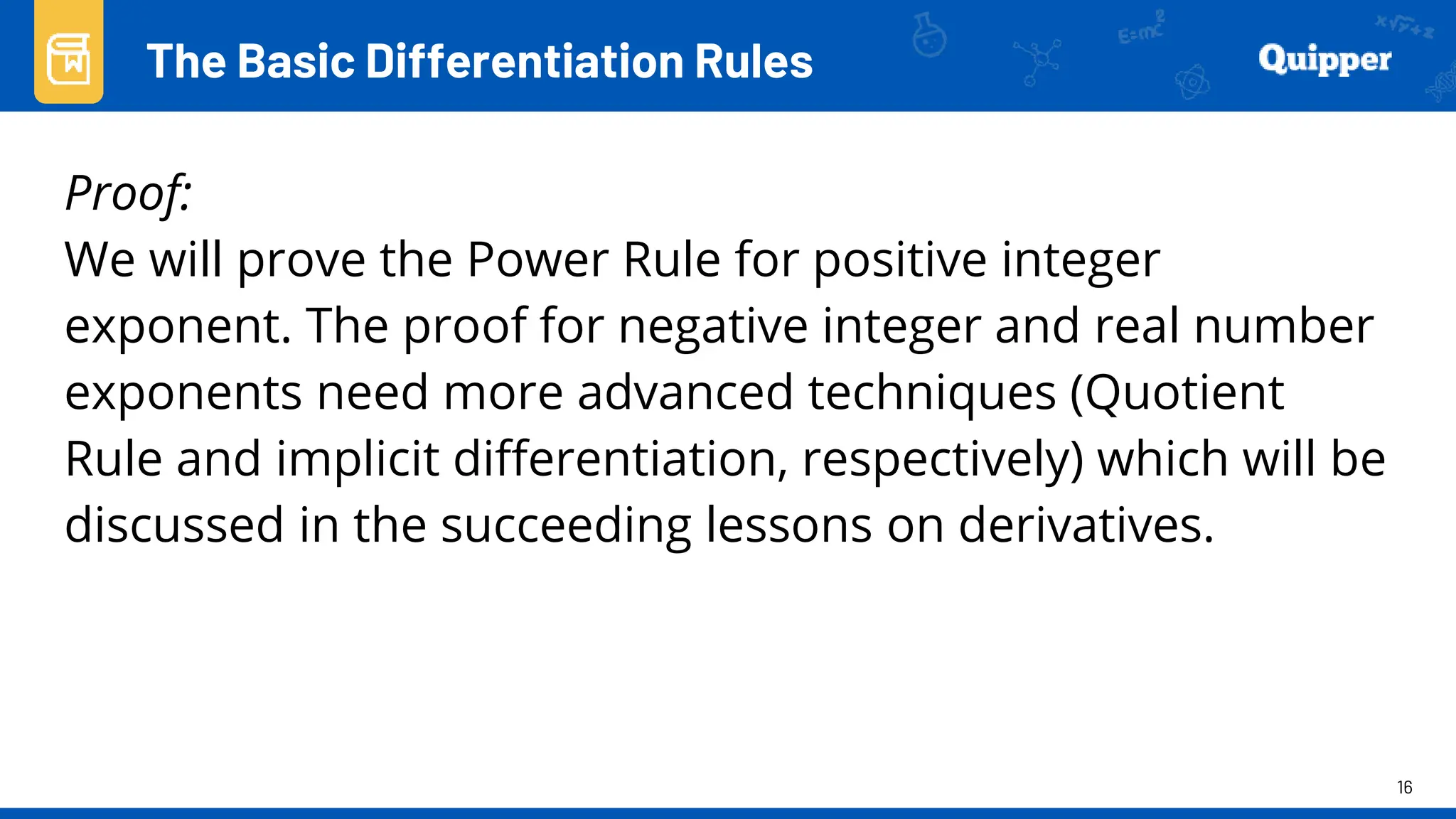
Proof:
We will prove the Power Rule for positive integer
exponent. The proof for negative integer and real number
exponents need more advanced techniques (Quotient
Rule and implicit differentiation, respectively) which will be
discussed in the succeeding lessons on derivatives.
The Basic Differentiation Rules
17
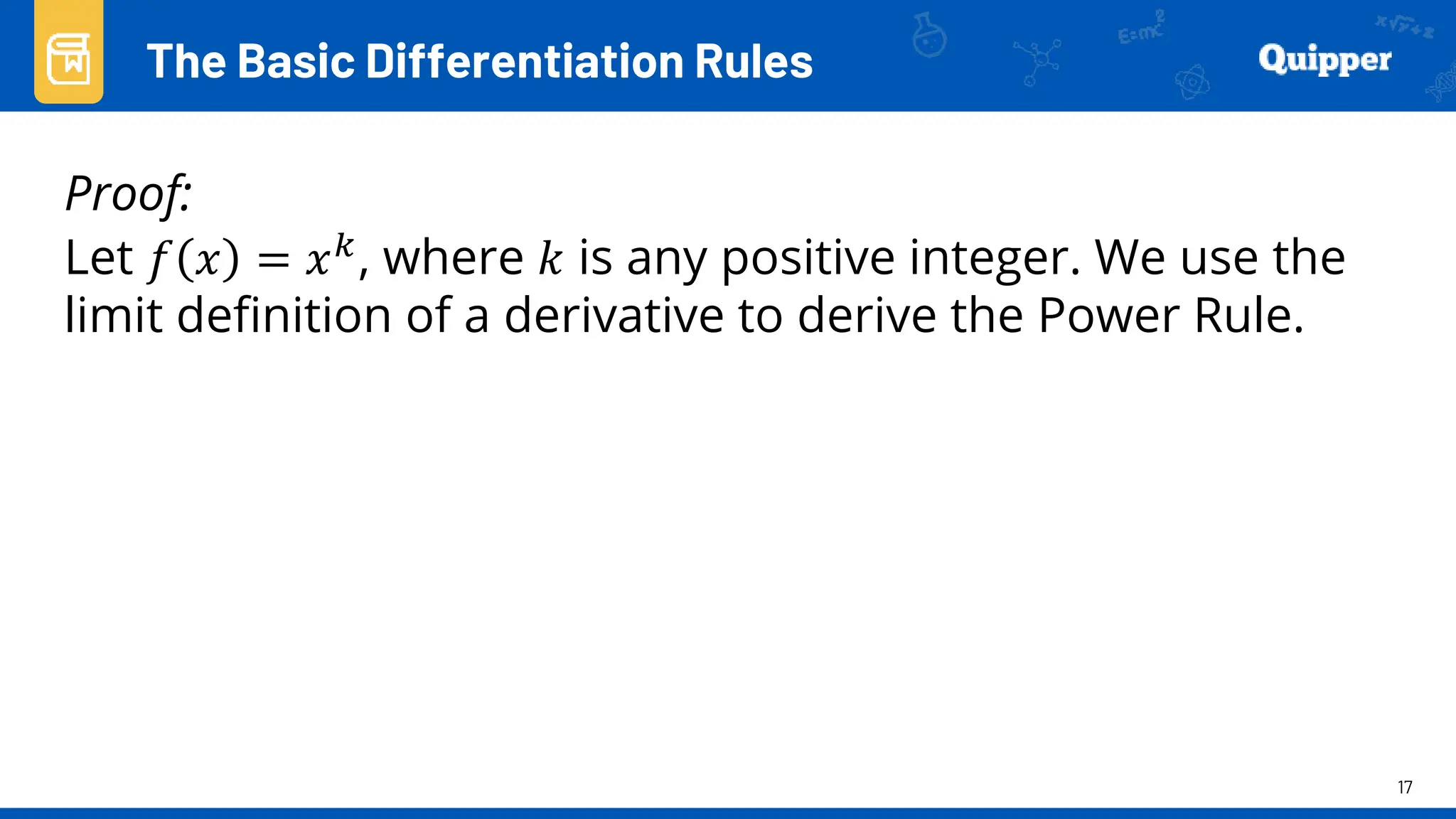
Proof:
Let 𝑓 𝑥 = 𝑥𝑘, where 𝑘 is any positive integer. We use the
limit definition of a derivative to derive the Power Rule.
The Basic Differentiation Rules
18
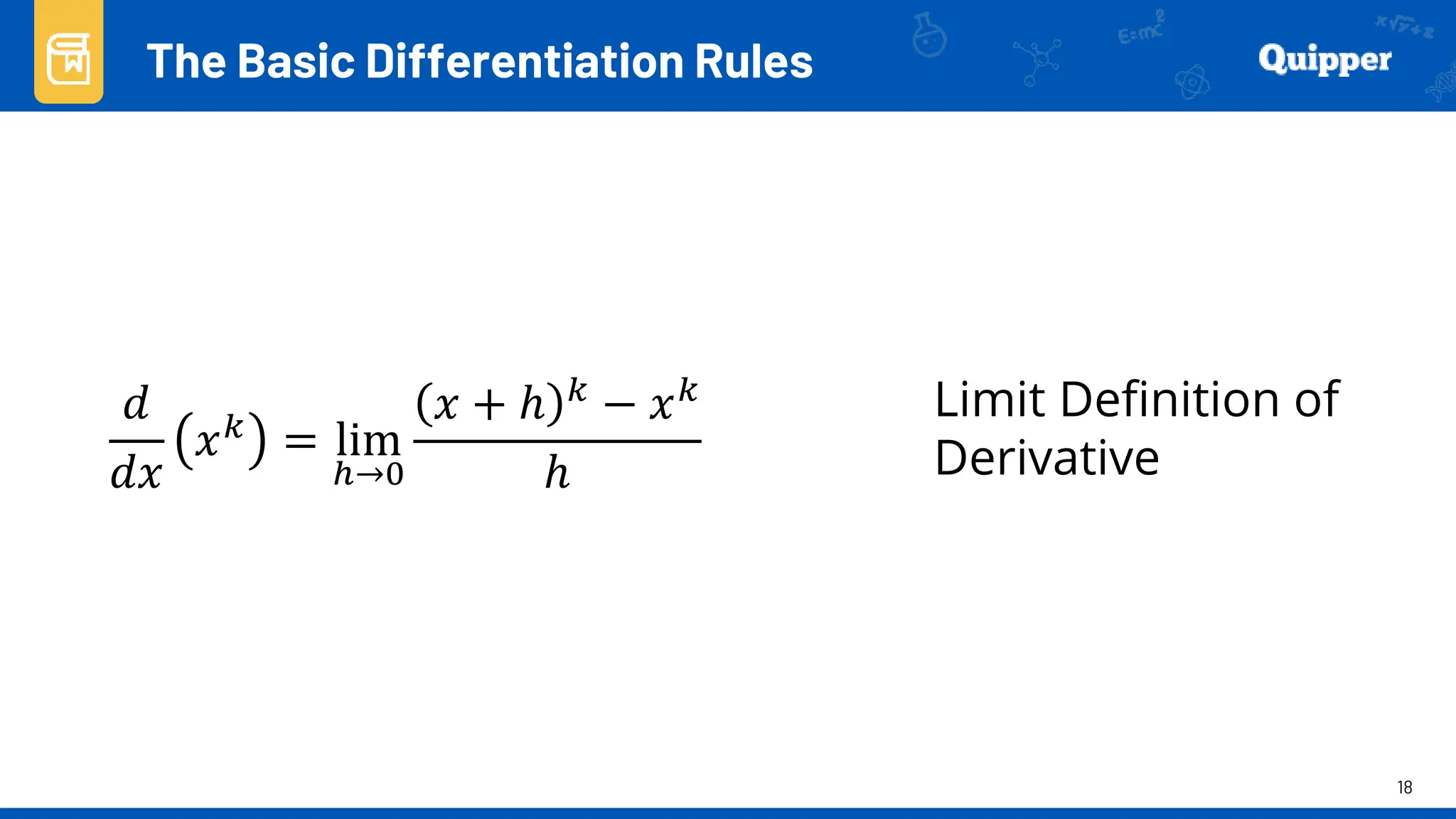
The Basic Differentiation Rules
𝑑
𝑑𝑥
𝑥𝑘 = lim
ℎ→0
𝑥 + ℎ 𝑘
− 𝑥𝑘
ℎ
Limit Definition of
Derivative
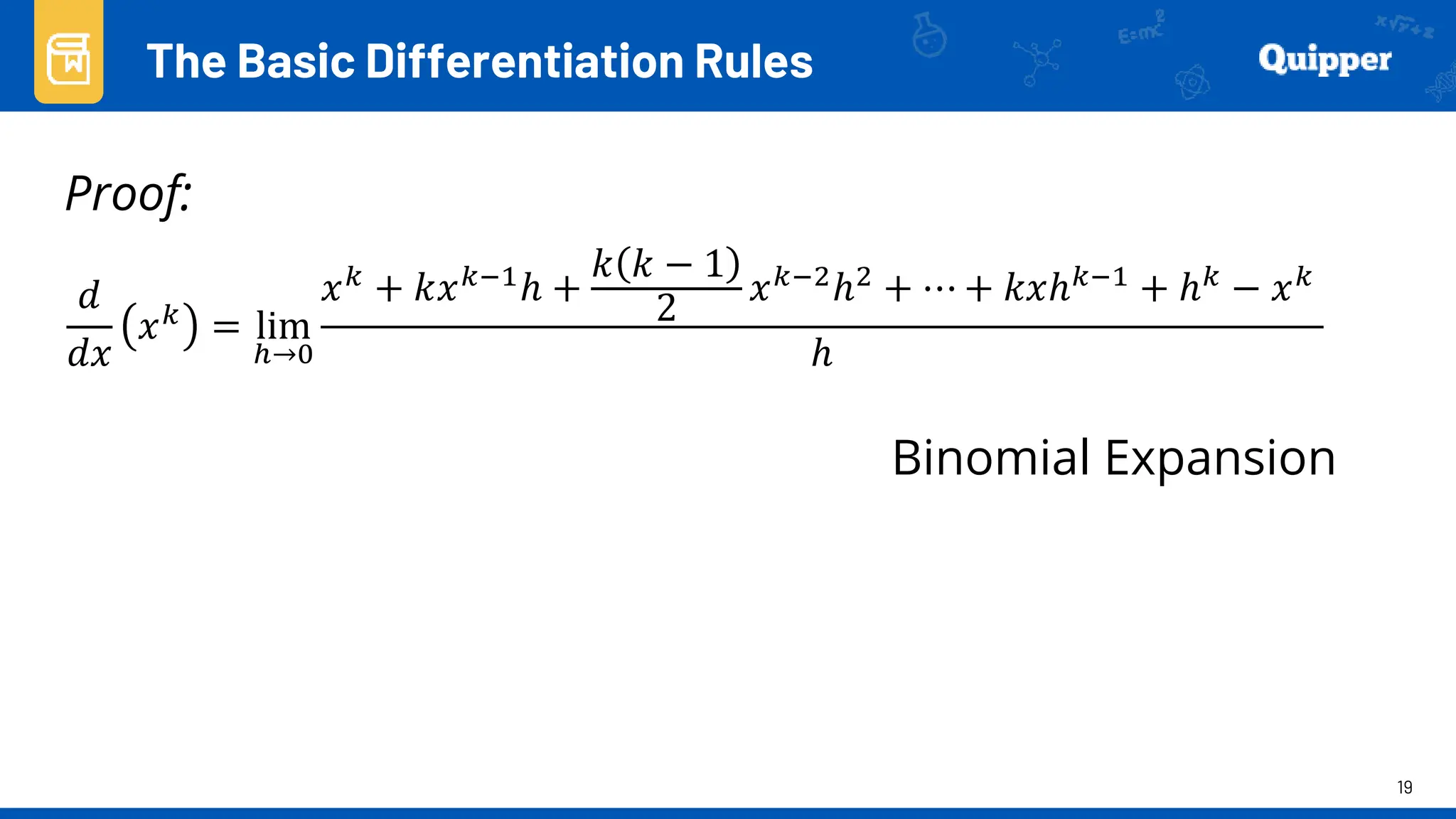
19
Proof:
The Basic Differentiation Rules
𝑑
𝑑𝑥
𝑥𝑘
= lim
ℎ→0
𝑥𝑘
+ 𝑘𝑥𝑘−1
ℎ +
𝑘 𝑘 − 1
2
𝑥𝑘−2
ℎ2
+ ⋯ + 𝑘𝑥ℎ𝑘−1
+ ℎ𝑘
− 𝑥𝑘
ℎ
Binomial Expansion
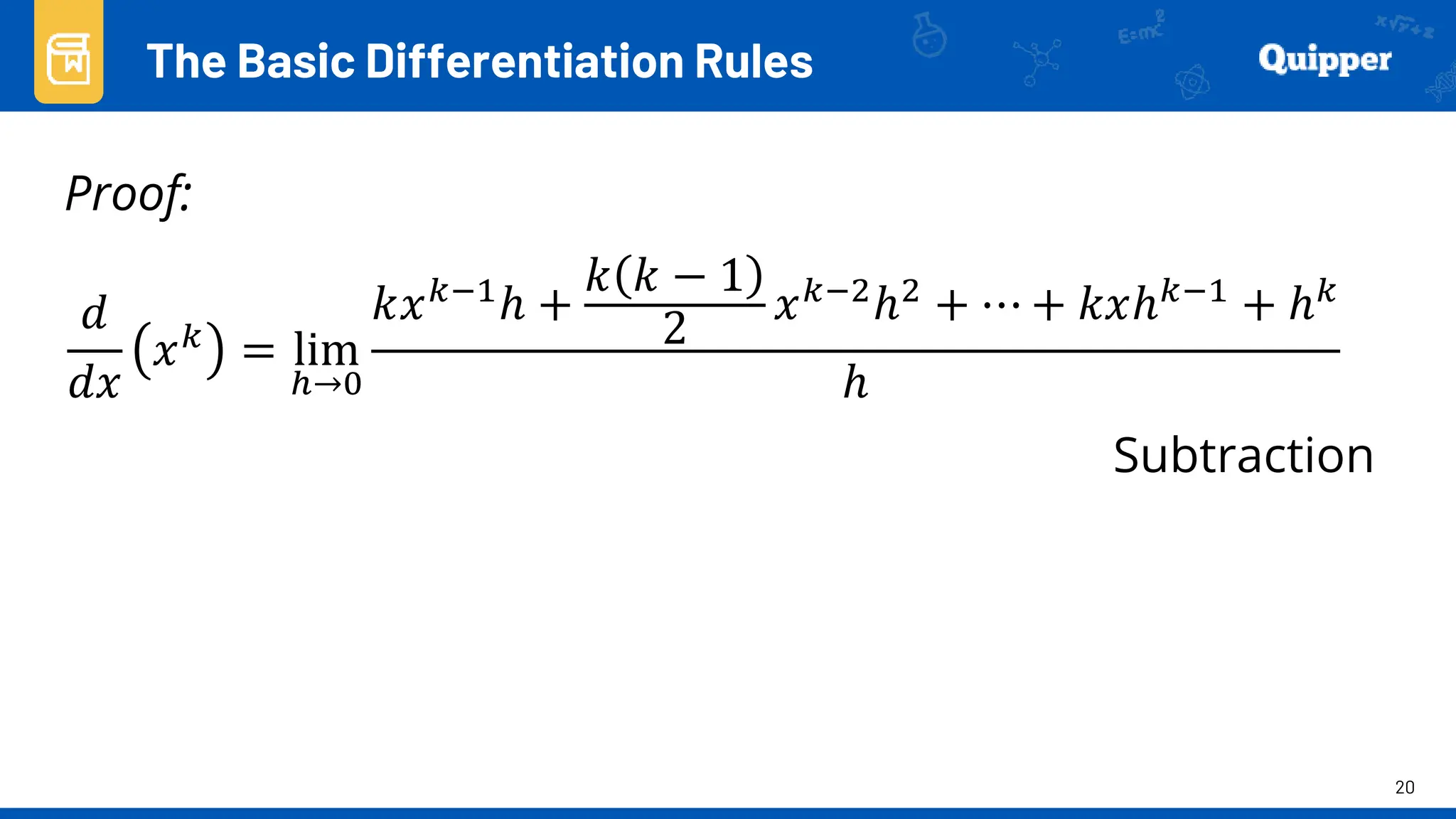
20
Proof:
The Basic Differentiation Rules
𝑑
𝑑𝑥
𝑥𝑘 = lim
ℎ→0
𝑘𝑥𝑘−1ℎ +
𝑘 𝑘 − 1
2
𝑥𝑘−2ℎ2 + ⋯ + 𝑘𝑥ℎ𝑘−1 + ℎ𝑘
ℎ
Subtraction
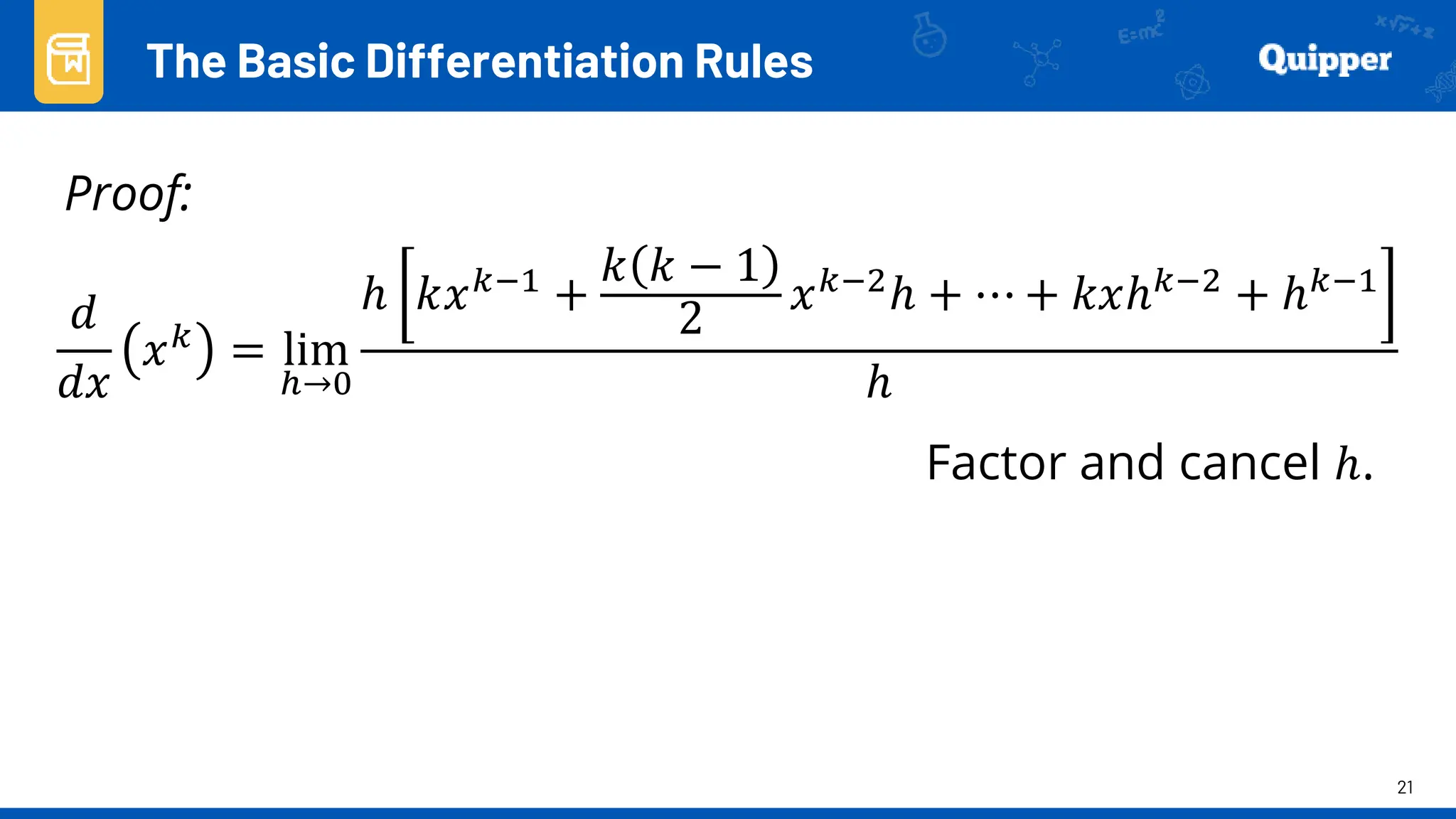
21
Proof:
The Basic Differentiation Rules
𝑑
𝑑𝑥
𝑥𝑘 = lim
ℎ→0
ℎ 𝑘𝑥𝑘−1 +
𝑘 𝑘 − 1
2
𝑥𝑘−2ℎ + ⋯ + 𝑘𝑥ℎ𝑘−2 + ℎ𝑘−1
ℎ
Factor and cancel ℎ.
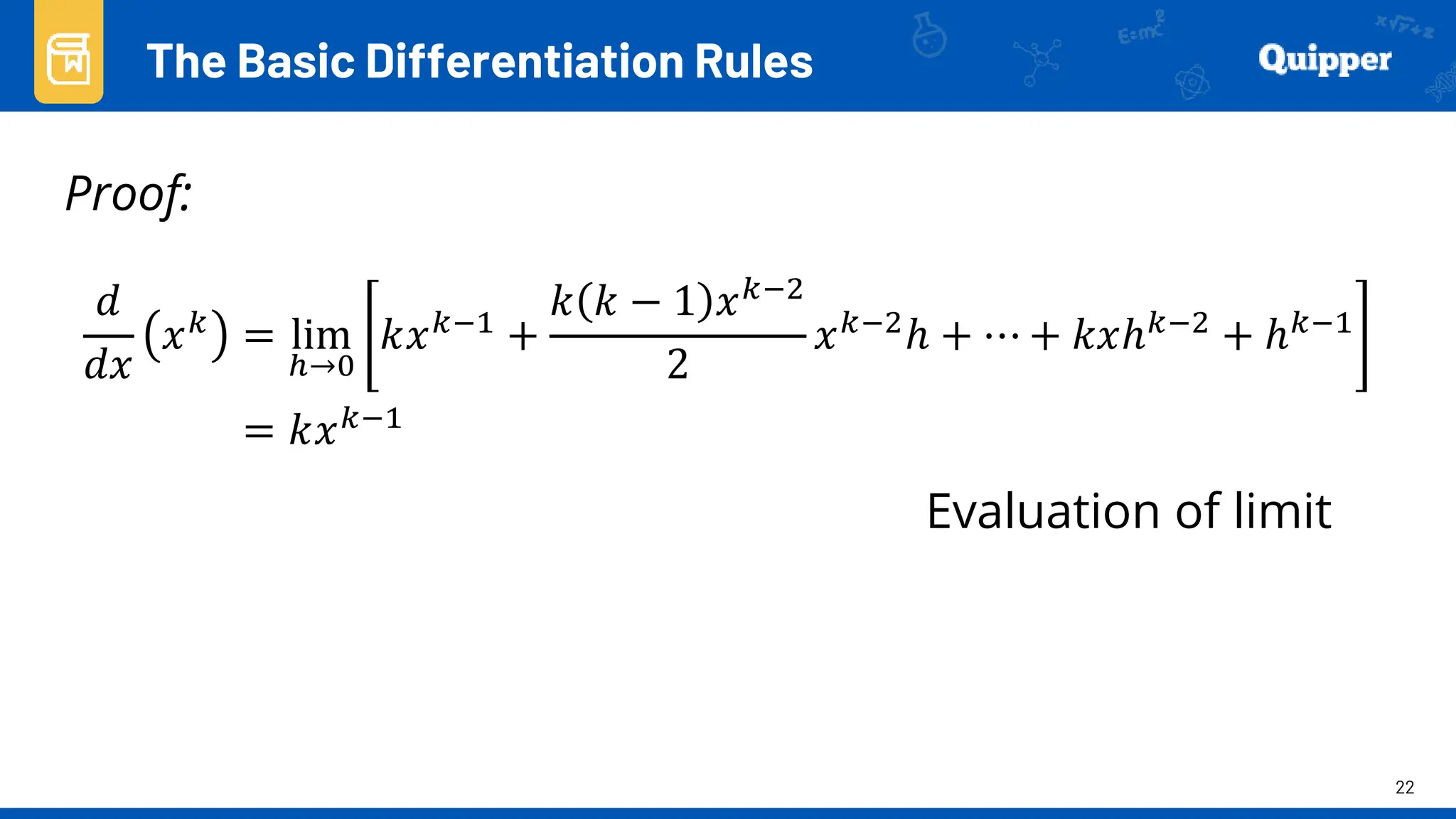
22
Proof:
The Basic Differentiation Rules
𝑑
𝑑𝑥
𝑥𝑘
= lim
ℎ→0
𝑘𝑥𝑘−1
+
𝑘 𝑘 − 1 𝑥𝑘−2
2
𝑥𝑘−2
ℎ + ⋯ + 𝑘𝑥ℎ𝑘−2
+ ℎ𝑘−1
= 𝑘𝑥𝑘−1
Evaluation of limit
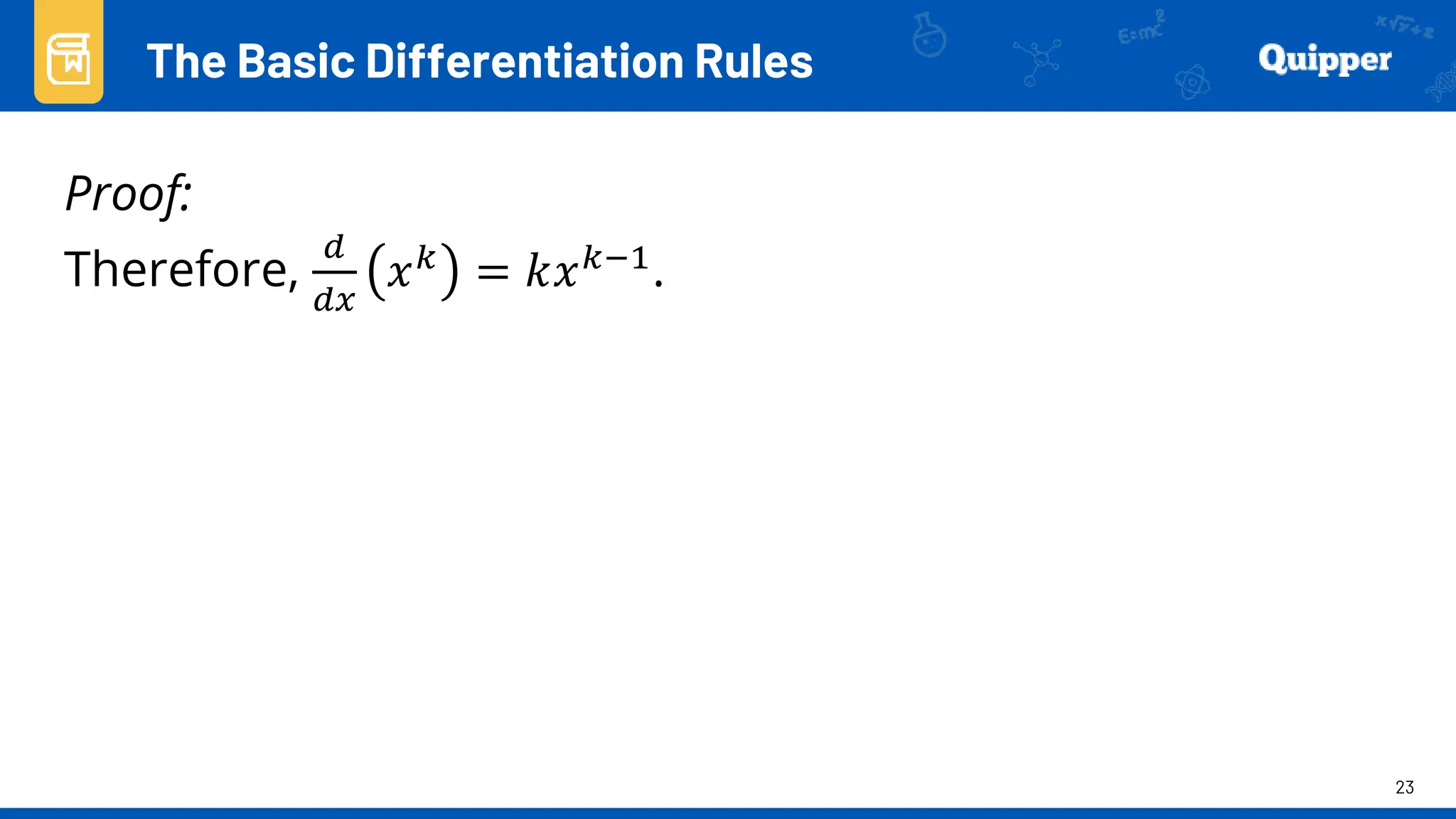
23
Proof:
Therefore,
𝑑
𝑑𝑥
𝑥𝑘 = 𝑘𝑥𝑘−1.
The Basic Differentiation Rules
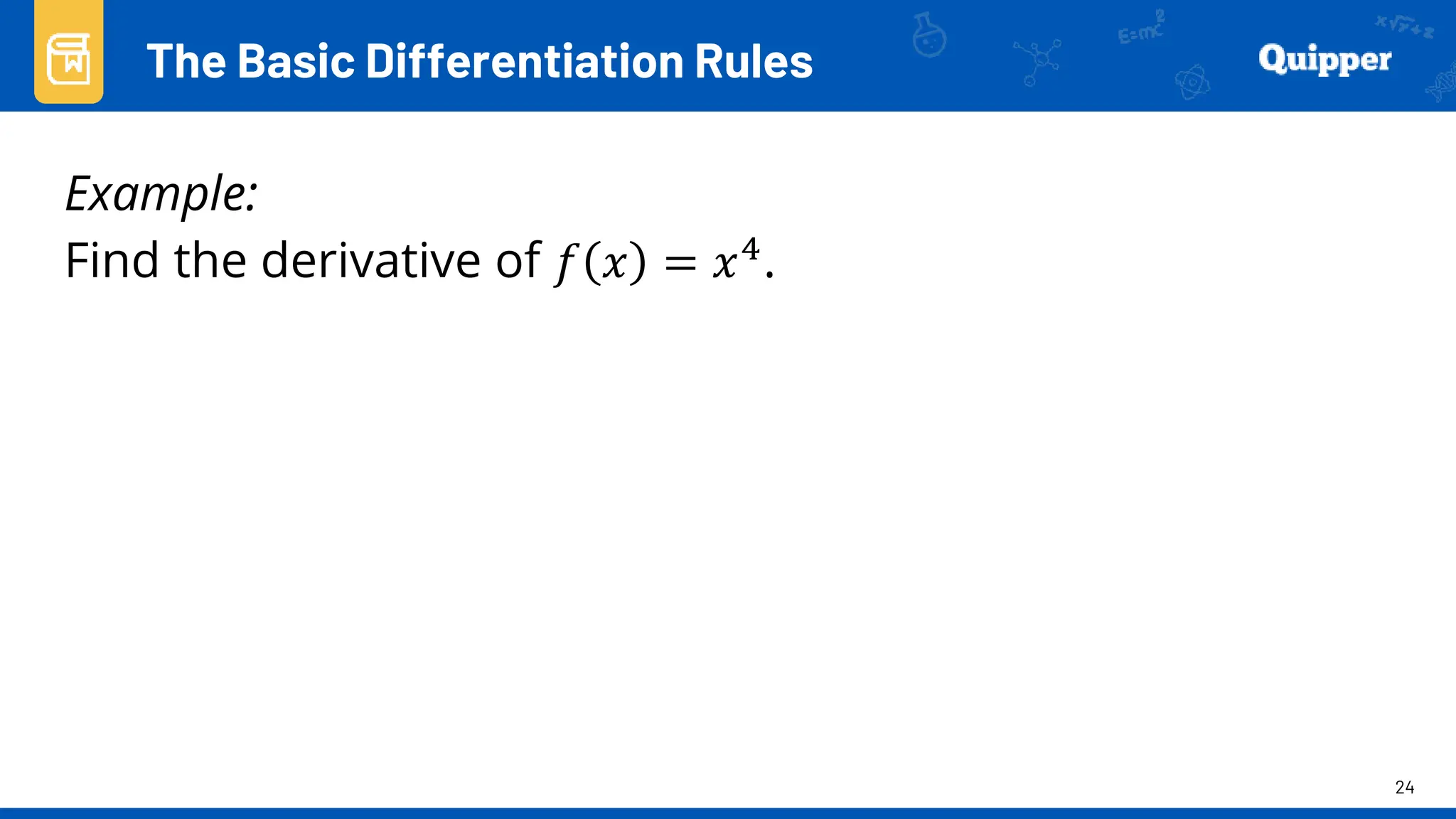
24
Example:
Find the derivative of 𝑓 𝑥 = 𝑥4.
The Basic Differentiation Rules
25
Example:
Find the derivative of 𝑓 𝑥 = 𝑥4.
The derivative of 𝑓 𝑥 = 𝑥4
is 𝑓′
𝑥 = 4𝑥3
.
The Basic Differentiation Rules
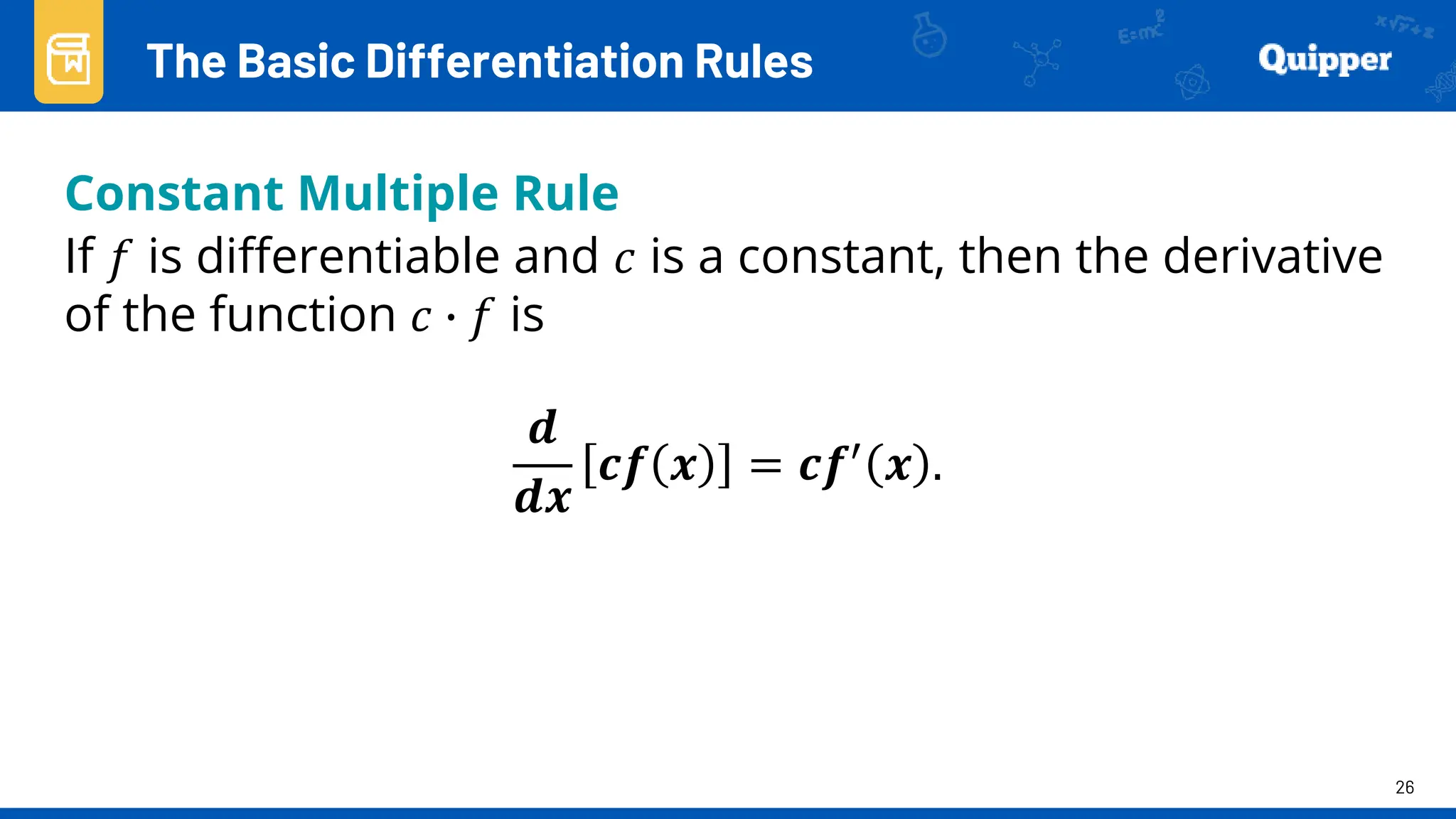
26
Constant Multiple Rule
If 𝑓 is differentiable and 𝑐 is a constant, then the derivative
of the function 𝑐 ∙ 𝑓 is
𝒅
𝒅𝒙
𝒄𝒇 𝒙 = 𝒄𝒇′ 𝒙 .
The Basic Differentiation Rules
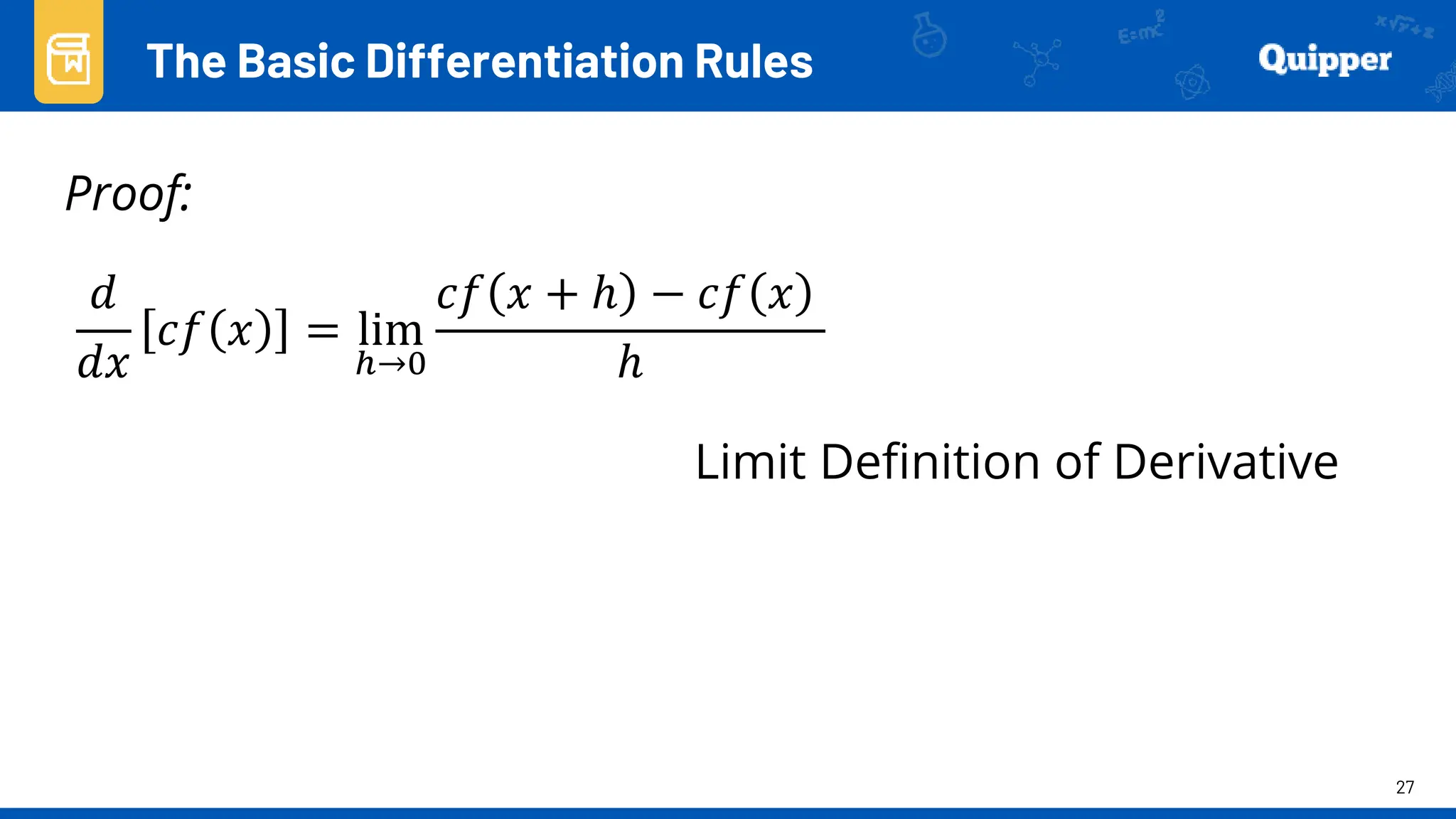
27
Proof:
The Basic Differentiation Rules
𝑑
𝑑𝑥
𝑐𝑓 𝑥 = lim
ℎ→0
𝑐𝑓 𝑥 + ℎ − 𝑐𝑓 𝑥
ℎ
Limit Definition of Derivative
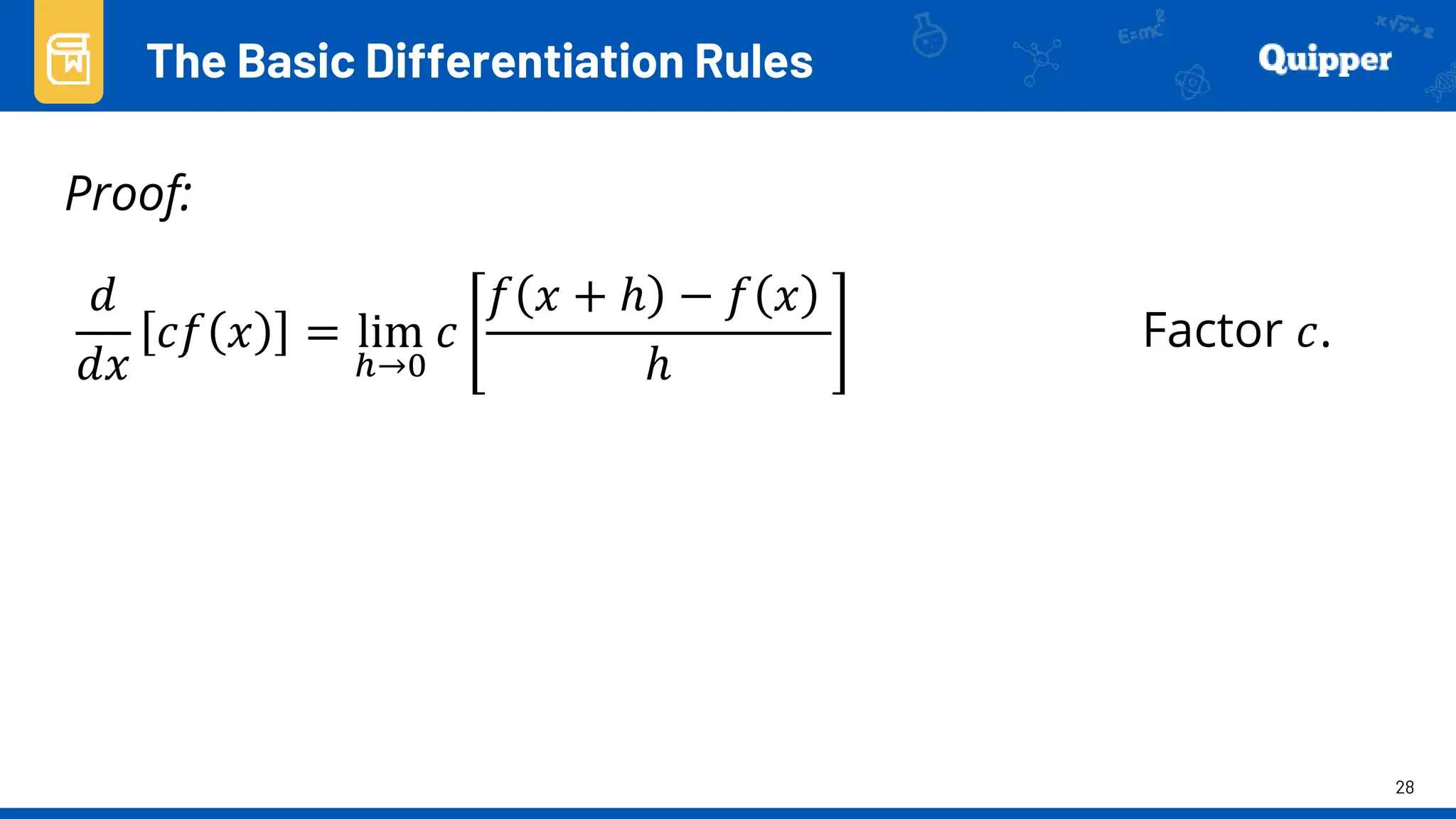
28
Proof:
The Basic Differentiation Rules
𝑑
𝑑𝑥
𝑐𝑓 𝑥 = lim
ℎ→0
𝑐
𝑓 𝑥 + ℎ − 𝑓 𝑥
ℎ
Factor 𝑐.
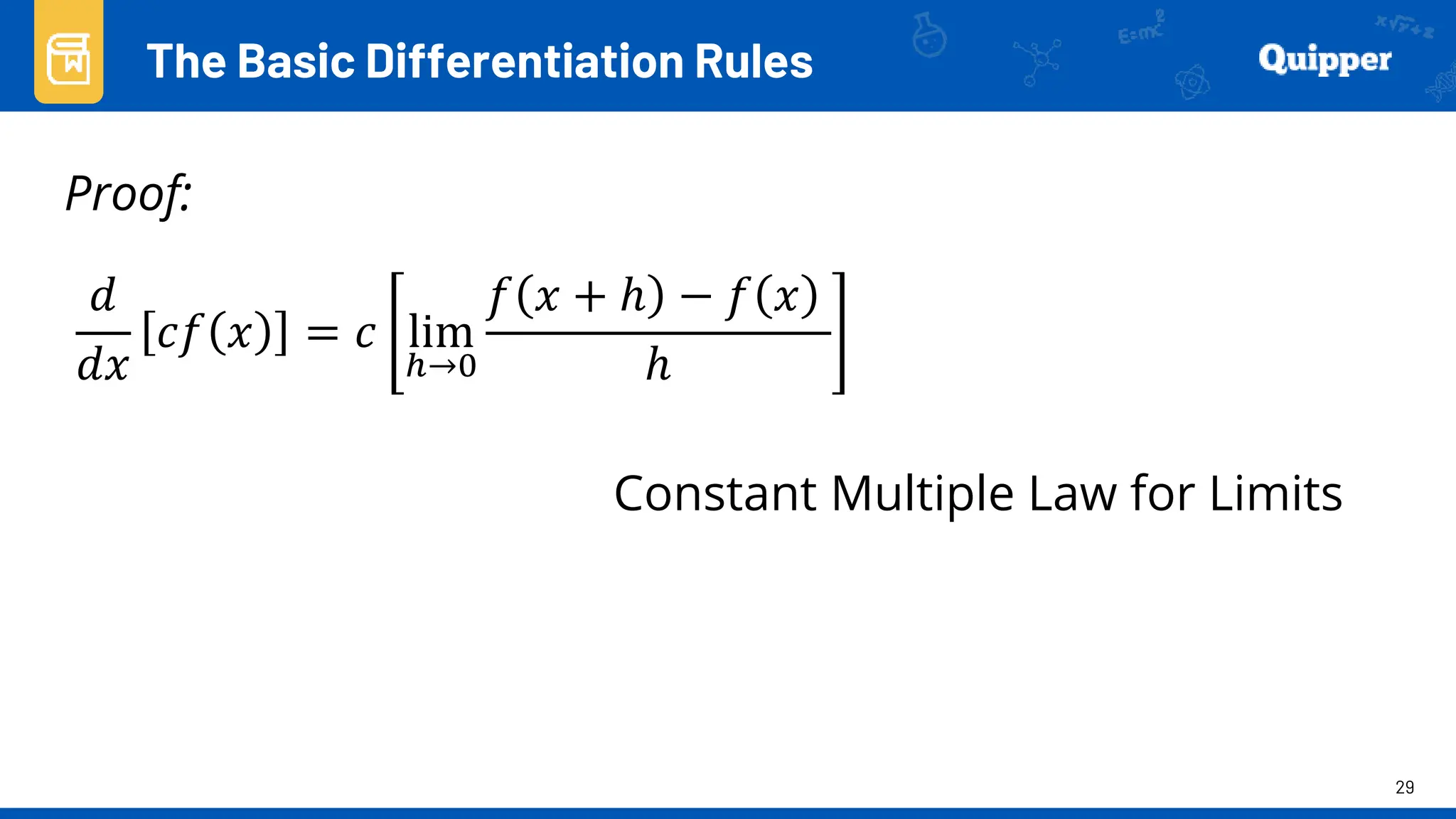
29
Proof:
The Basic Differentiation Rules
𝑑
𝑑𝑥
𝑐𝑓 𝑥 = 𝑐 lim
ℎ→0
𝑓 𝑥 + ℎ − 𝑓 𝑥
ℎ
Constant Multiple Law for Limits
30
Proof:
The Basic Differentiation Rules
𝑑
𝑑𝑥
𝑐𝑓 𝑥 = 𝑐𝑓′
𝑥
Substitution:
𝑓′ 𝑥 = lim
ℎ→0
𝑓 𝑥 + ℎ − 𝑓 𝑥
ℎ
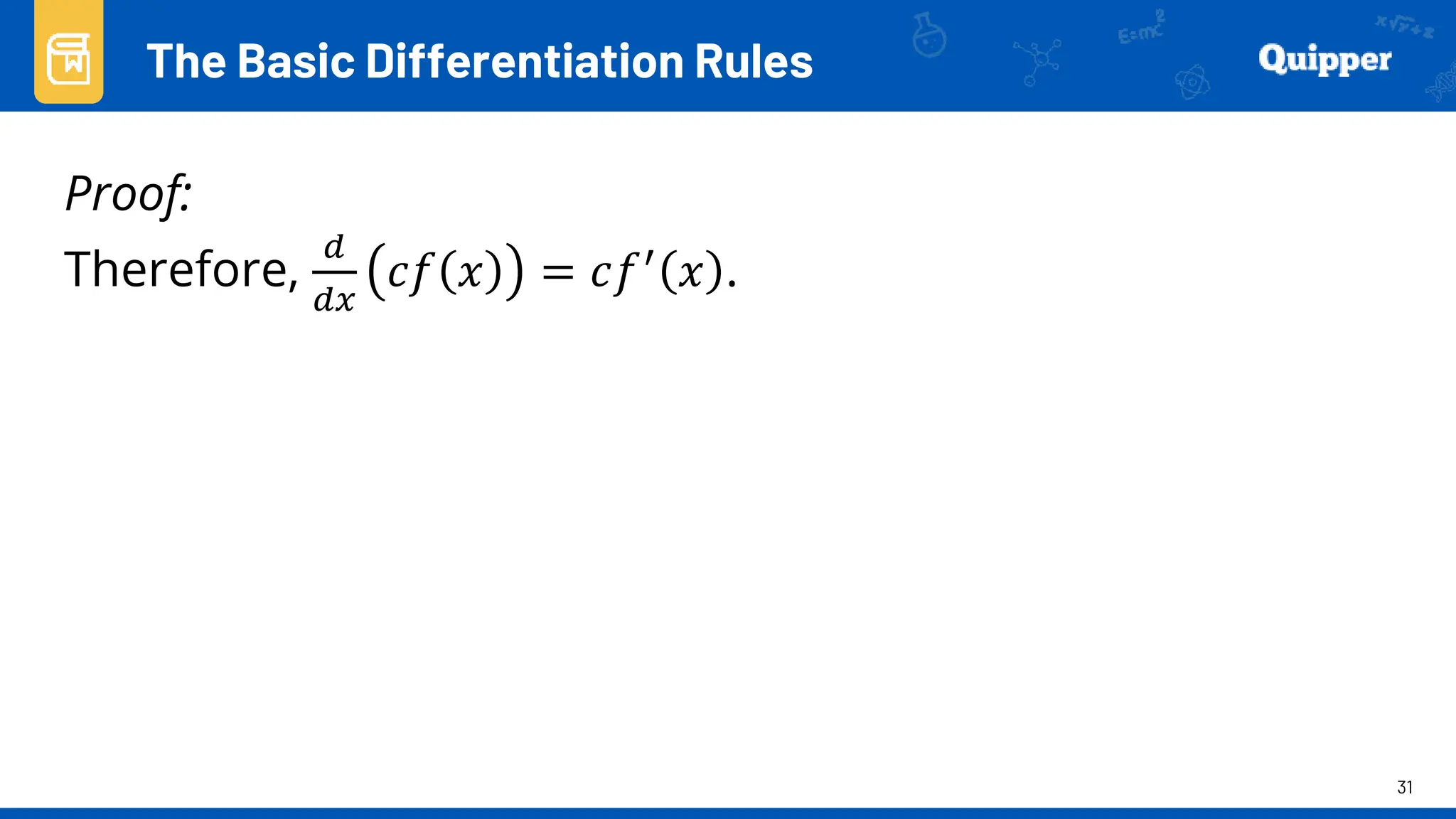
31
Proof:
Therefore,
𝑑
𝑑𝑥
𝑐𝑓 𝑥 = 𝑐𝑓′ 𝑥 .
The Basic Differentiation Rules
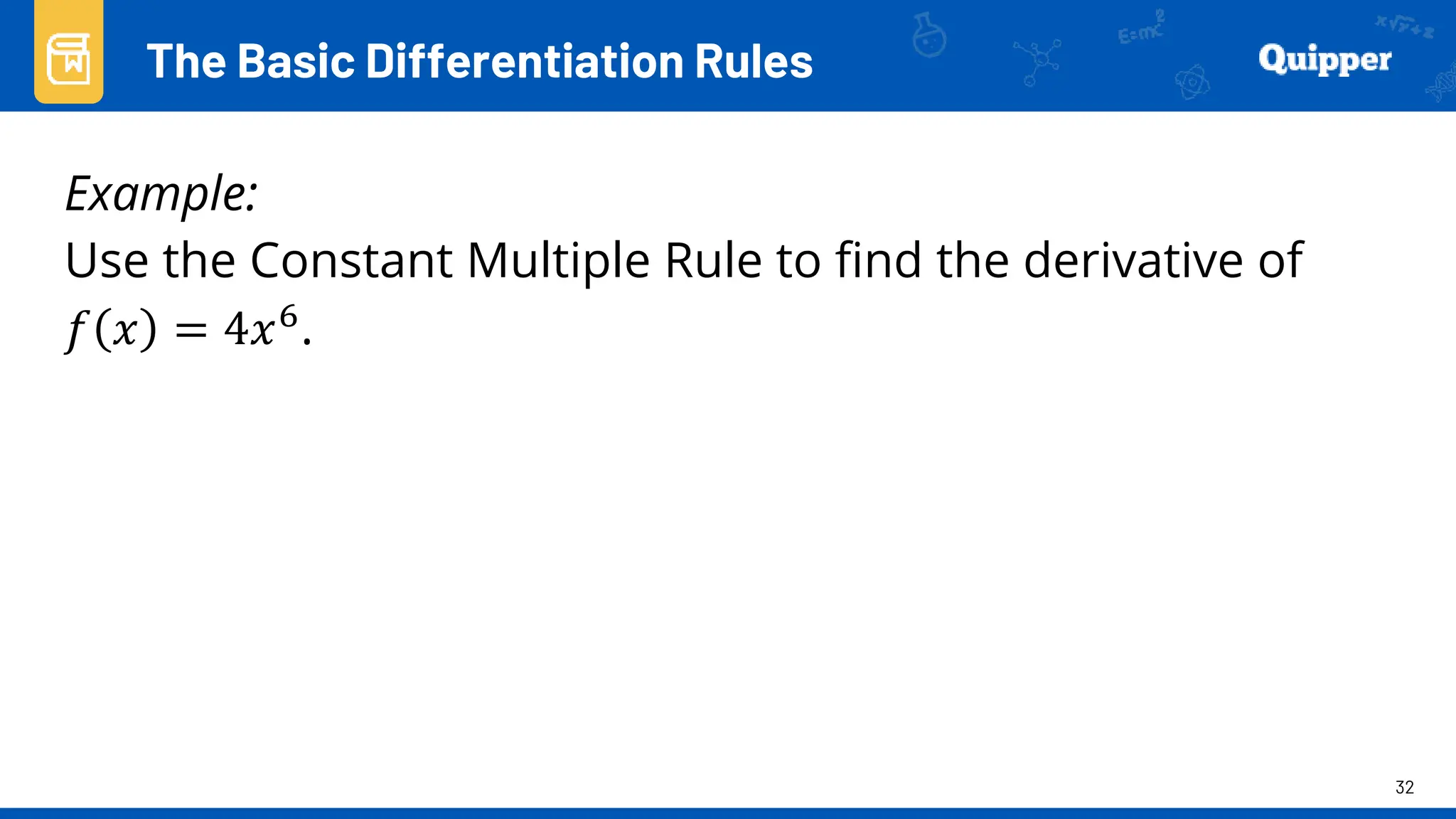
32
Example:
Use the Constant Multiple Rule to find the derivative of
𝑓 𝑥 = 4𝑥6.
The Basic Differentiation Rules
33
Example:
Use the Constant Multiple Rule to find the derivative of
𝑓 𝑥 = 4𝑥6.
The derivative of 𝑓 𝑥 = 4𝑥6 is 𝑓′ 𝑥 = 24𝑥5.
The Basic Differentiation Rules
34
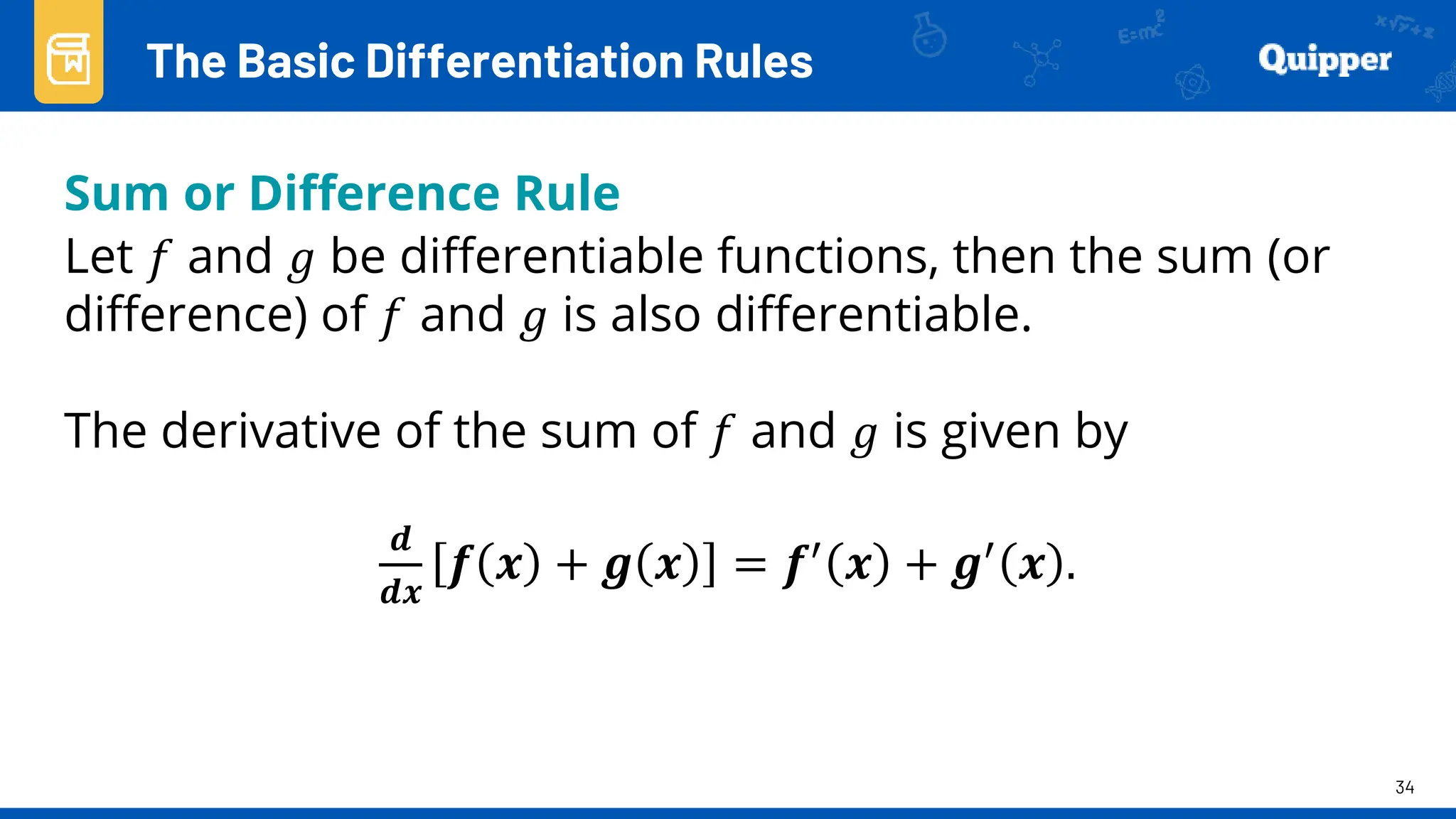
Sum or Difference Rule
Let 𝑓 and 𝑔 be differentiable functions, then the sum (or
difference) of 𝑓 and 𝑔 is also differentiable.
The derivative of the sum of 𝑓 and 𝑔 is given by
𝒅
𝒅𝒙
𝒇 𝒙 + 𝒈 𝒙 = 𝒇′ 𝒙 + 𝒈′ 𝒙 .
The Basic Differentiation Rules
35
Sum or Difference Rule
The derivative of the sum of 𝑓 and 𝑔 is given by
𝒅
𝒅𝒙
𝒇 𝒙 − 𝒈 𝒙 = 𝒇′
𝒙 − 𝒈′
𝒙 .
The Basic Differentiation Rules
36
Proof:
The Basic Differentiation Rules
𝑑
𝑑𝑥
𝑓 𝑥 + 𝑔 𝑥 = lim
ℎ→0
𝑓 𝑥 + ℎ + 𝑔 𝑥 + ℎ − 𝑓 𝑥 + 𝑔 𝑥
ℎ
Limit Definition of Derivative
37
Proof:
The Basic Differentiation Rules
𝑑
𝑑𝑥
𝑓 𝑥 + 𝑔 𝑥 = lim
ℎ→0
𝑓 𝑥 + ℎ + 𝑔 𝑥 + ℎ − 𝑓 𝑥 − 𝑔 𝑥
ℎ
Distributivity
38
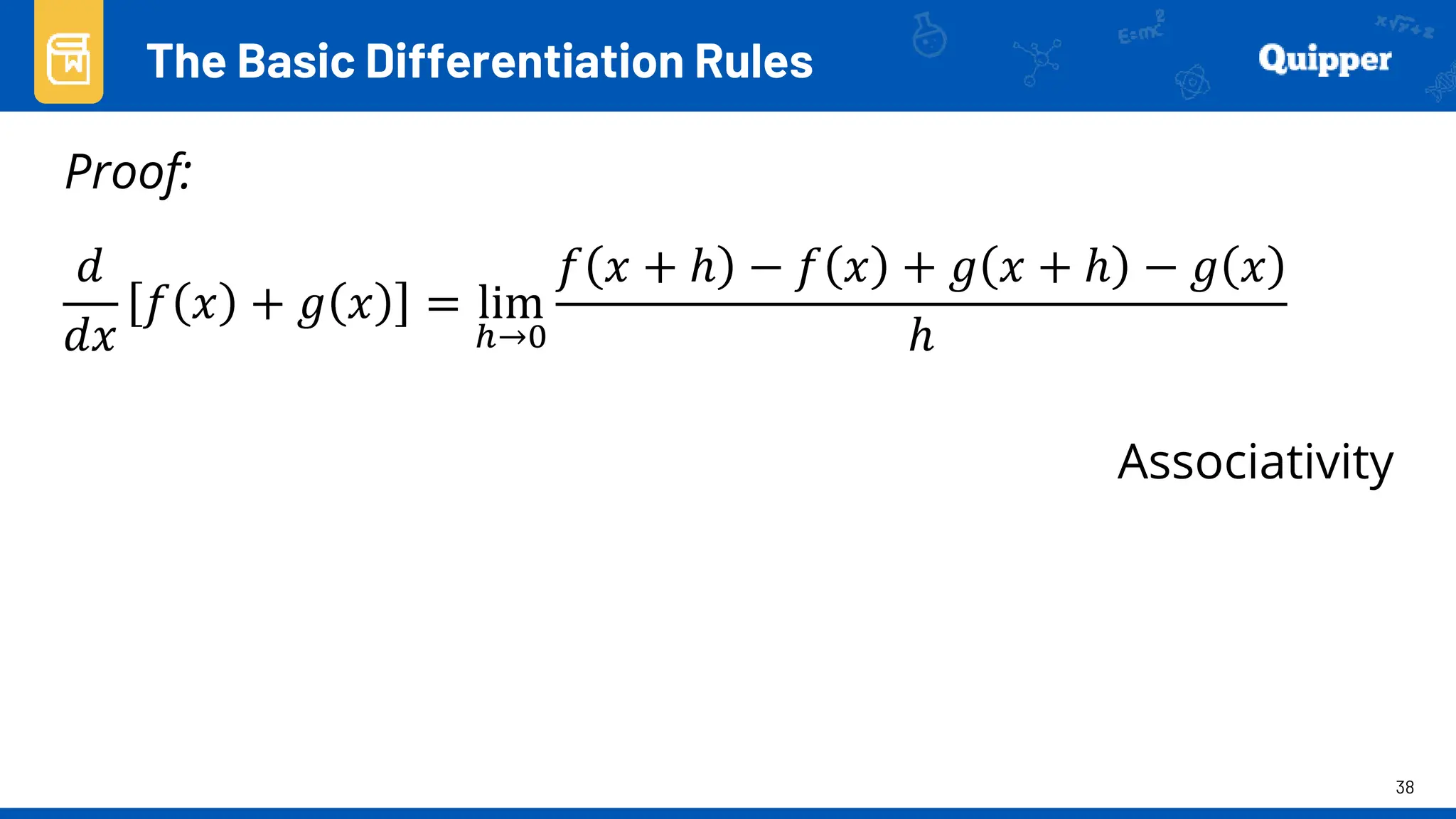
Proof:
The Basic Differentiation Rules
𝑑
𝑑𝑥
𝑓 𝑥 + 𝑔 𝑥 = lim
ℎ→0
𝑓 𝑥 + ℎ − 𝑓 𝑥 + 𝑔 𝑥 + ℎ − 𝑔 𝑥
ℎ
Associativity
39
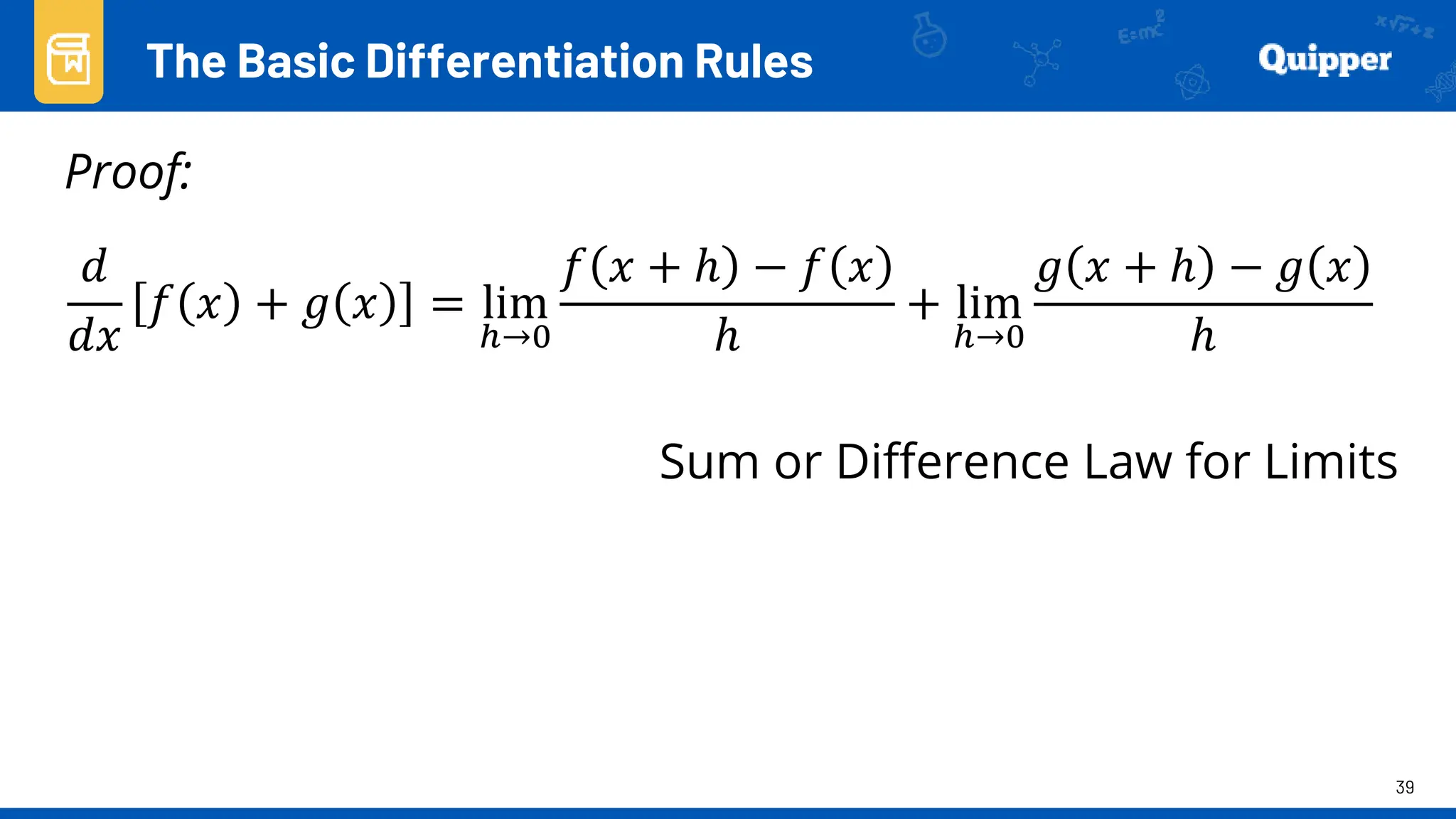
Proof:
The Basic Differentiation Rules
𝑑
𝑑𝑥
𝑓 𝑥 + 𝑔 𝑥 = lim
ℎ→0
𝑓 𝑥 + ℎ − 𝑓 𝑥
ℎ
+ lim
ℎ→0
𝑔 𝑥 + ℎ − 𝑔 𝑥
ℎ
Sum or Difference Law for Limits
40
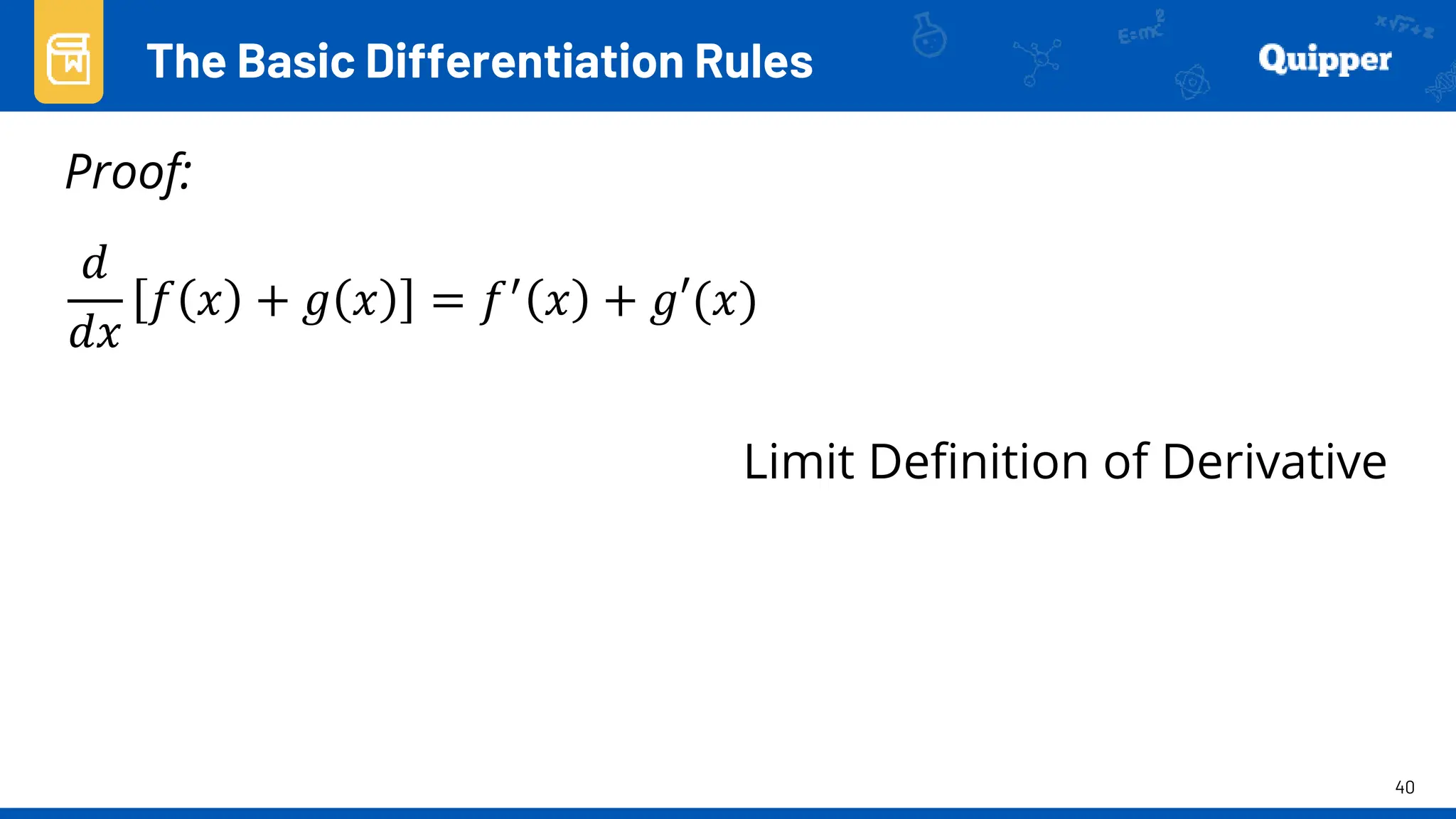
Proof:
The Basic Differentiation Rules
𝑑
𝑑𝑥
𝑓 𝑥 + 𝑔 𝑥 = 𝑓′
𝑥 + 𝑔′(𝑥)
Limit Definition of Derivative
41
Example:
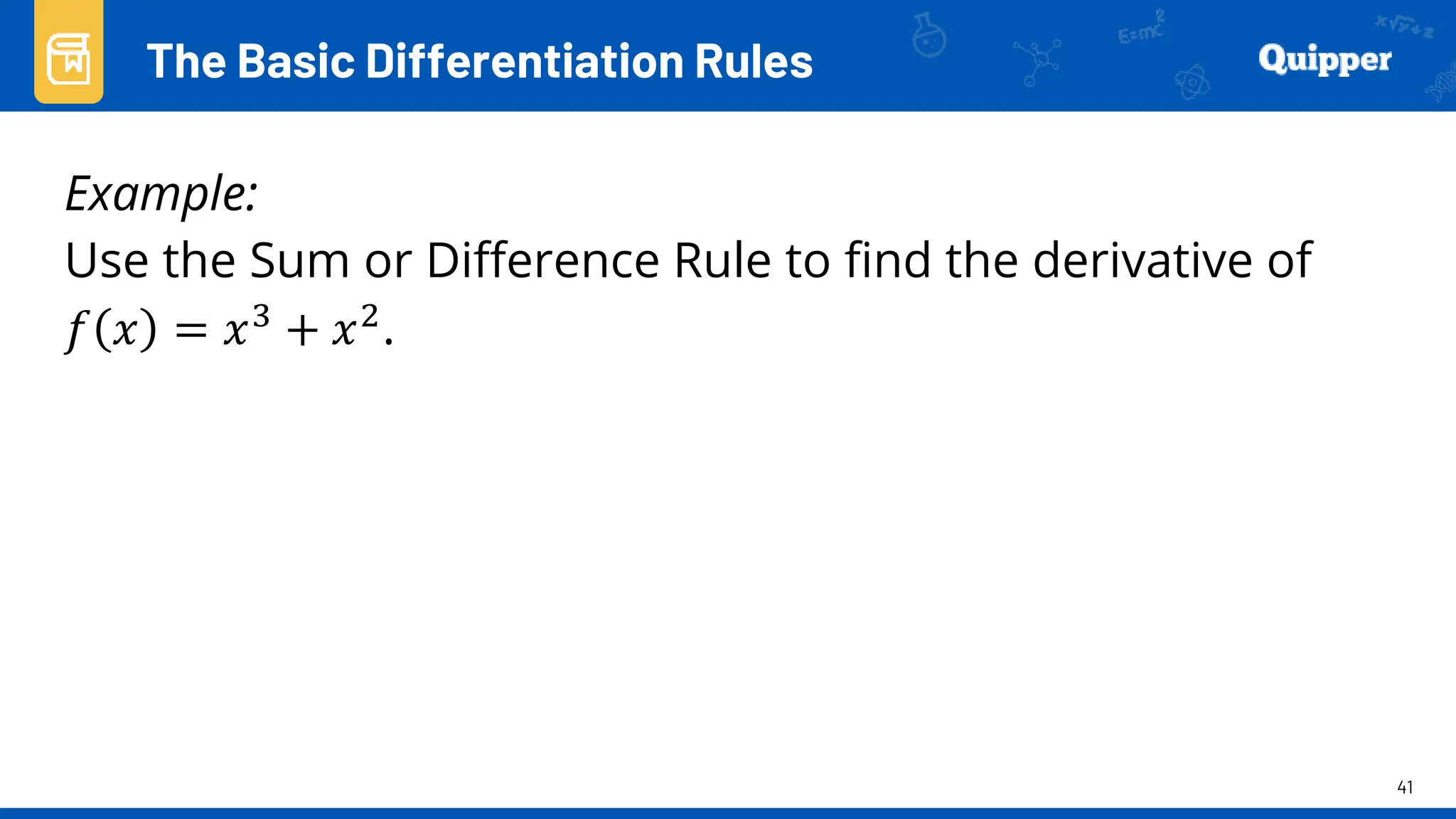
Use the Sum or Difference Rule to find the derivative of
𝑓 𝑥 = 𝑥3 + 𝑥2.
The Basic Differentiation Rules
42
Example:
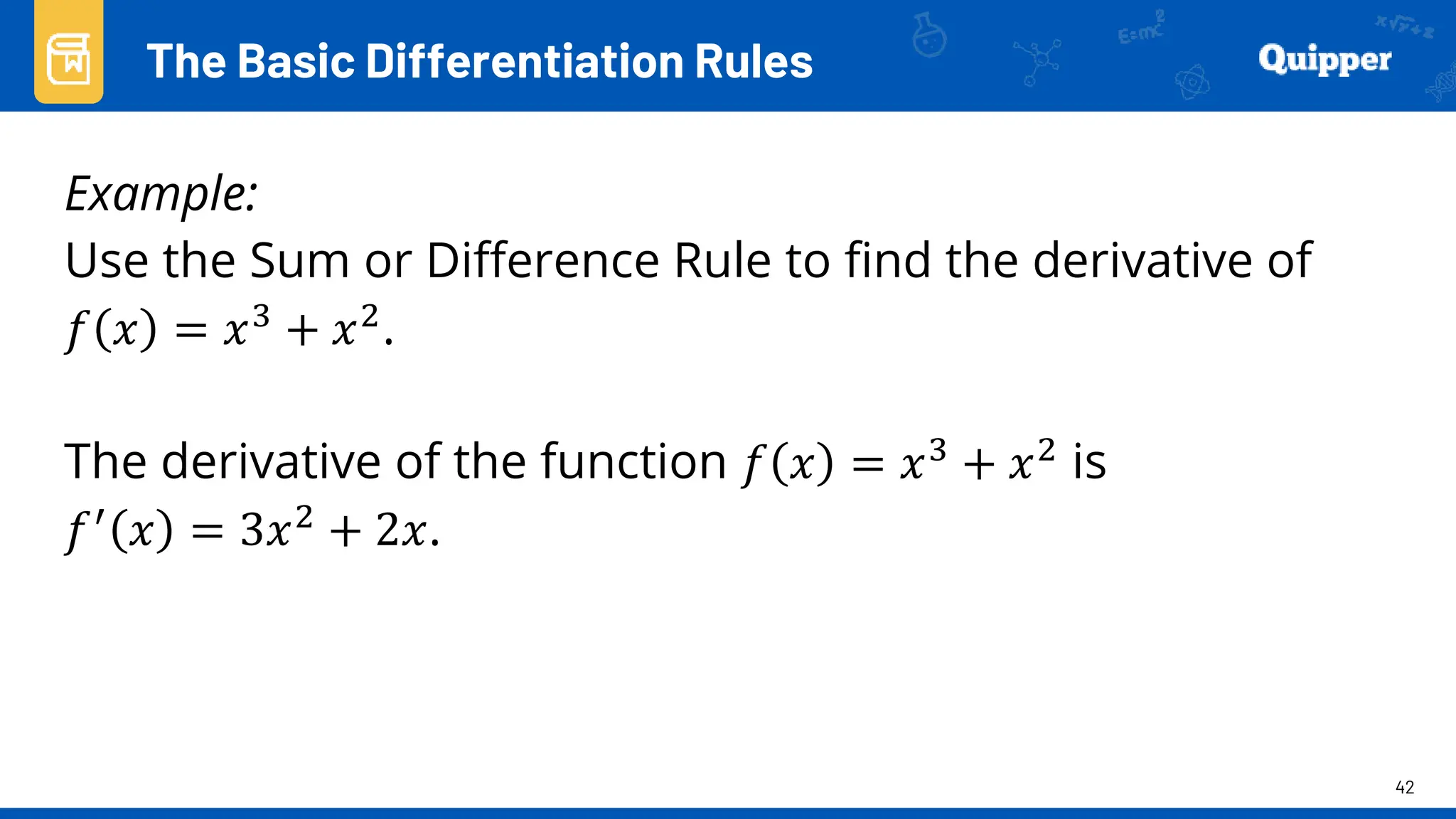
Use the Sum or Difference Rule to find the derivative of
𝑓 𝑥 = 𝑥3 + 𝑥2.
The derivative of the function 𝑓 𝑥 = 𝑥3 + 𝑥2 is
𝑓′ 𝑥 = 3𝑥2 + 2𝑥.
The Basic Differentiation Rules
43
What differentiation rules can
be used to get the derivative of
𝒇 𝒙 = 𝒙𝟑
+ 𝟑𝒙𝟐
+ 𝟓?
Let’s Practice!
44
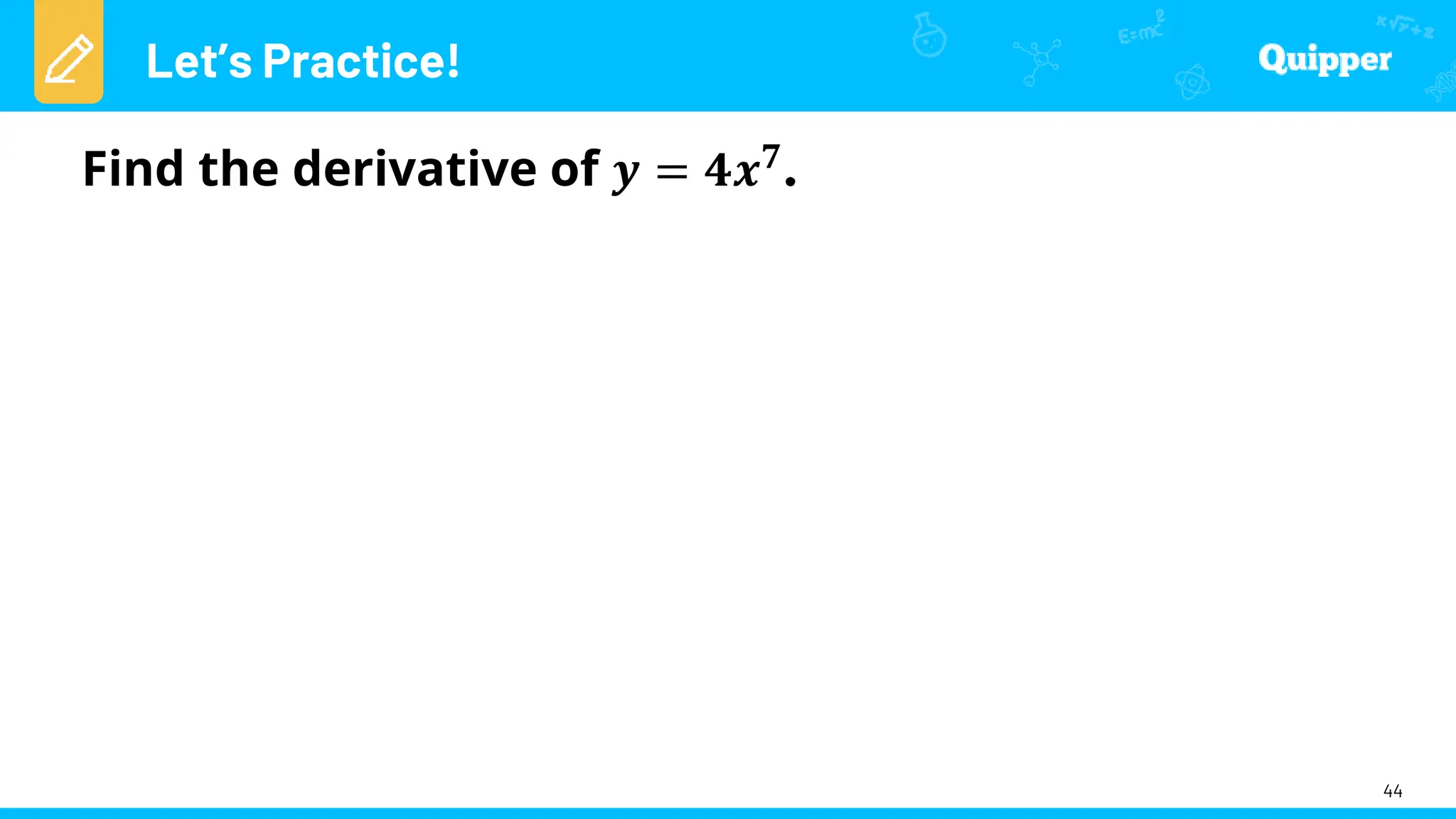
Find the derivative of 𝒚 = 𝟒𝒙𝟕
Let’s Practice!
45
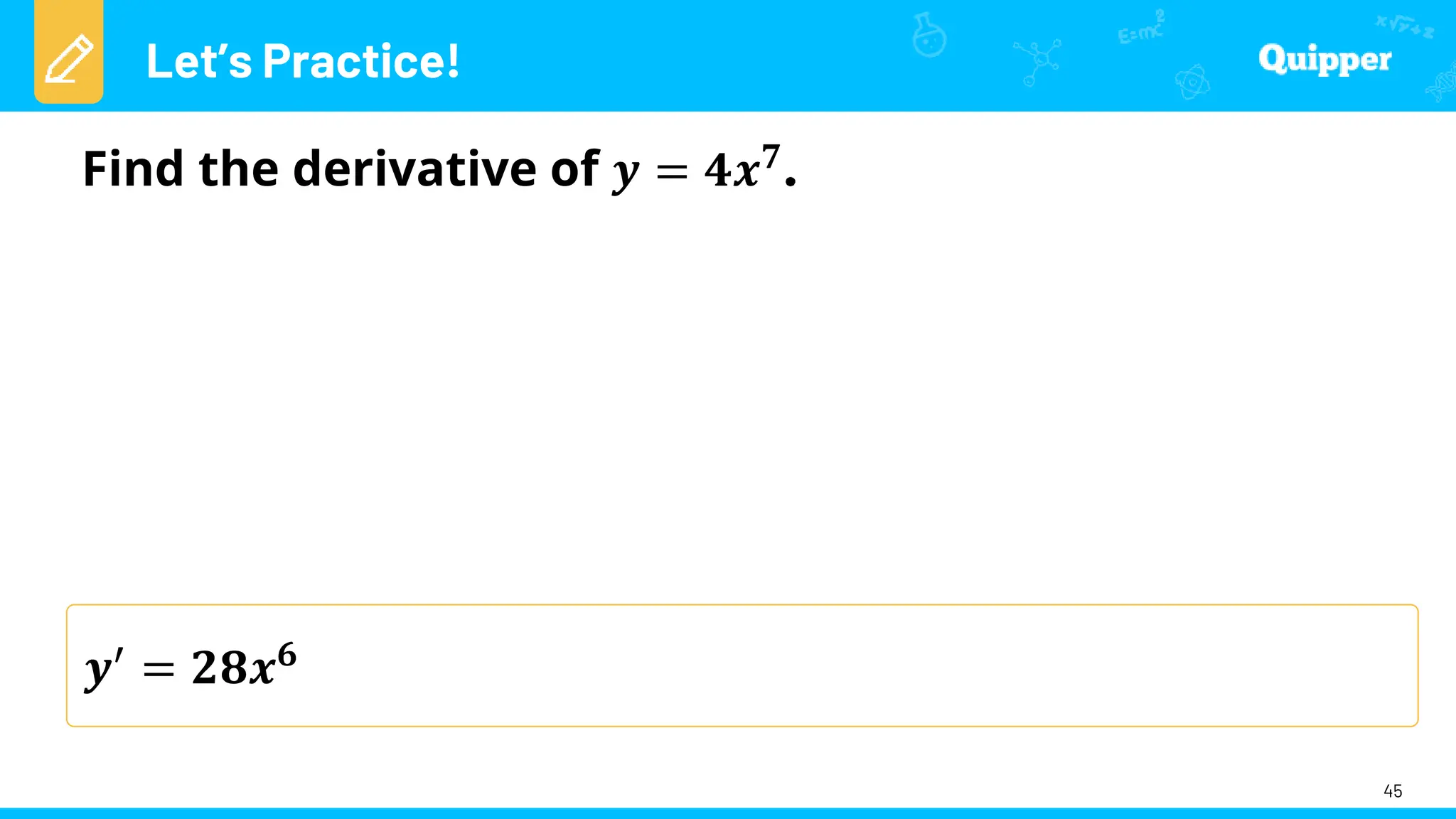
Find the derivative of 𝒚 = 𝟒𝒙𝟕
𝒚′
= 𝟐𝟖𝒙𝟔
Try It!
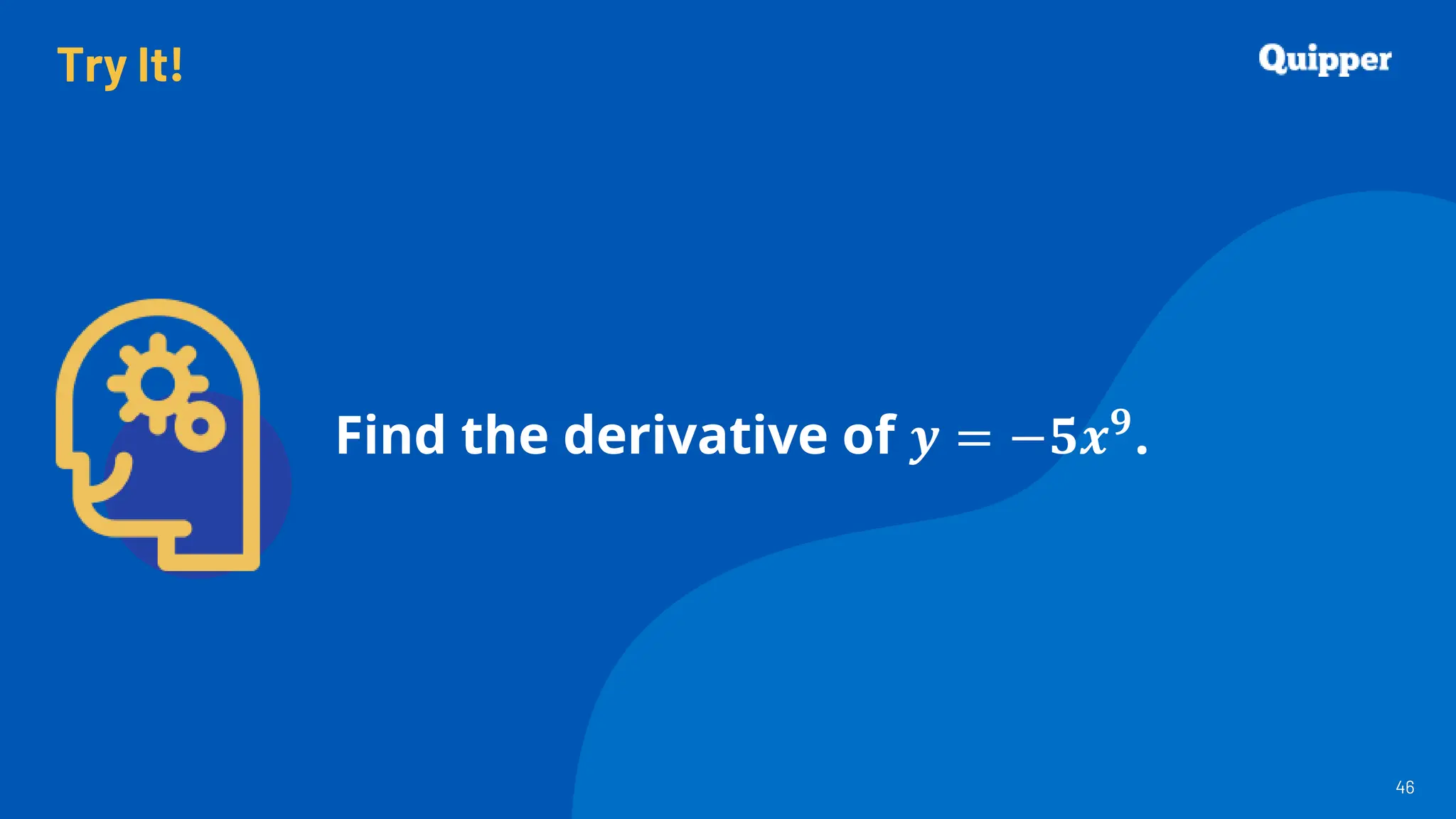
46
46
Find the derivative of 𝒚 = −𝟓𝒙𝟗
.
Tips
47
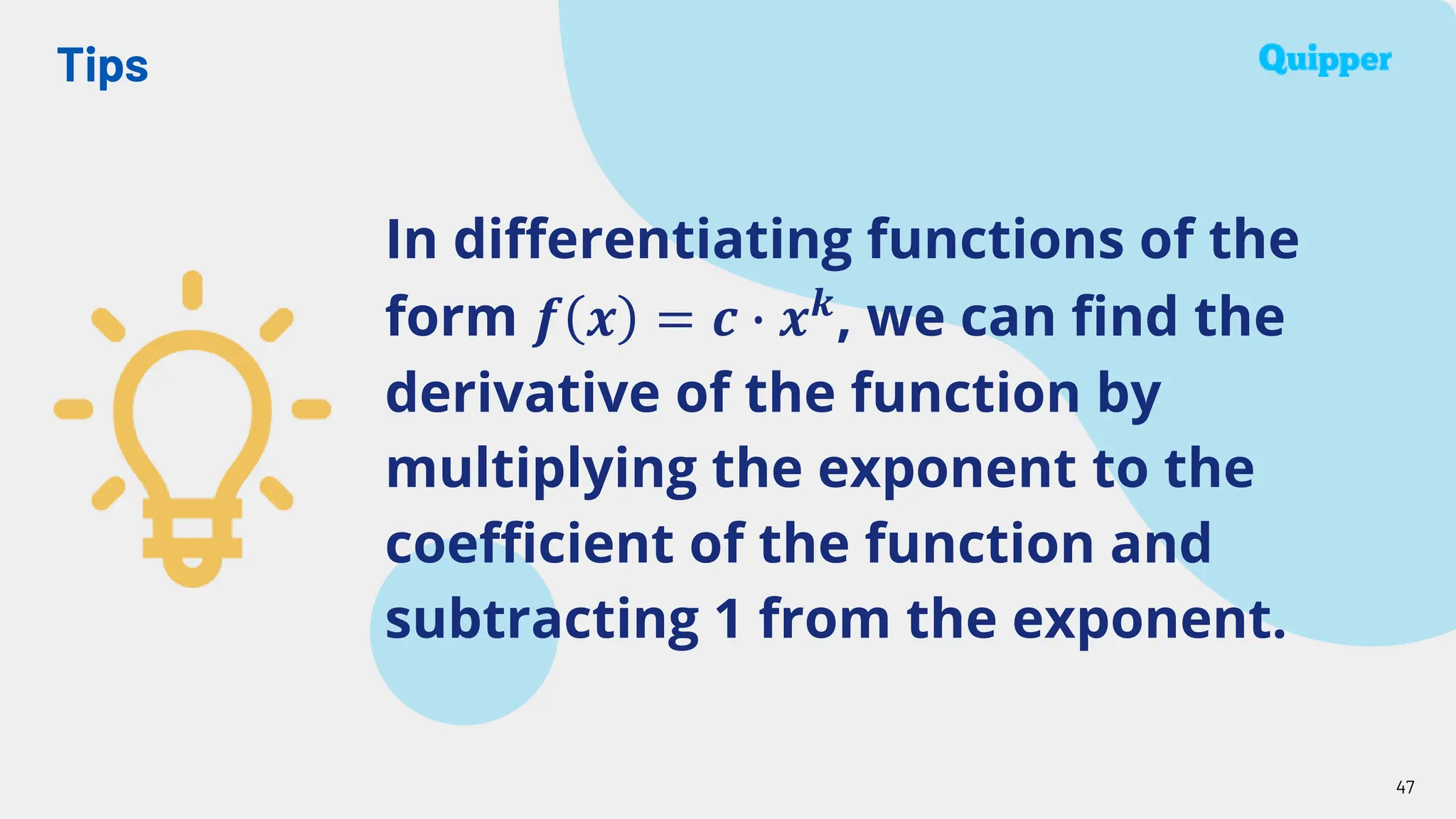
In differentiating functions of the
form 𝒇 𝒙 = 𝒄 ∙ 𝒙𝒌
, we can find the
derivative of the function by
multiplying the exponent to the
coefficient of the function and
subtracting 1 from the exponent.
Tips
48
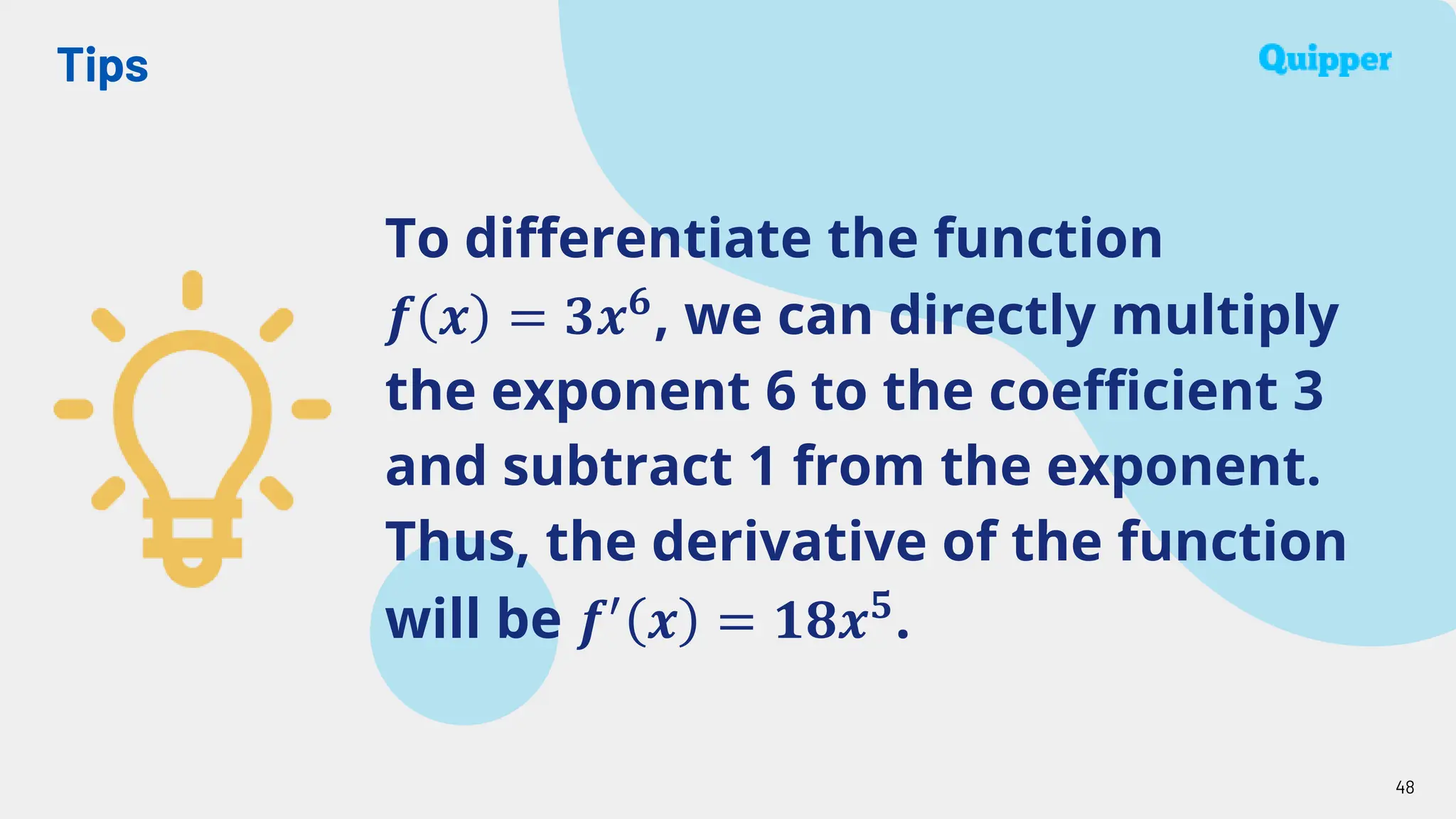
To differentiate the function
𝒇 𝒙 = 𝟑𝒙𝟔, we can directly multiply
the exponent 6 to the coefficient 3
and subtract 1 from the exponent.
Thus, the derivative of the function
will be 𝒇′
𝒙 = 𝟏𝟖𝒙𝟓
.
Let’s Practice!
49
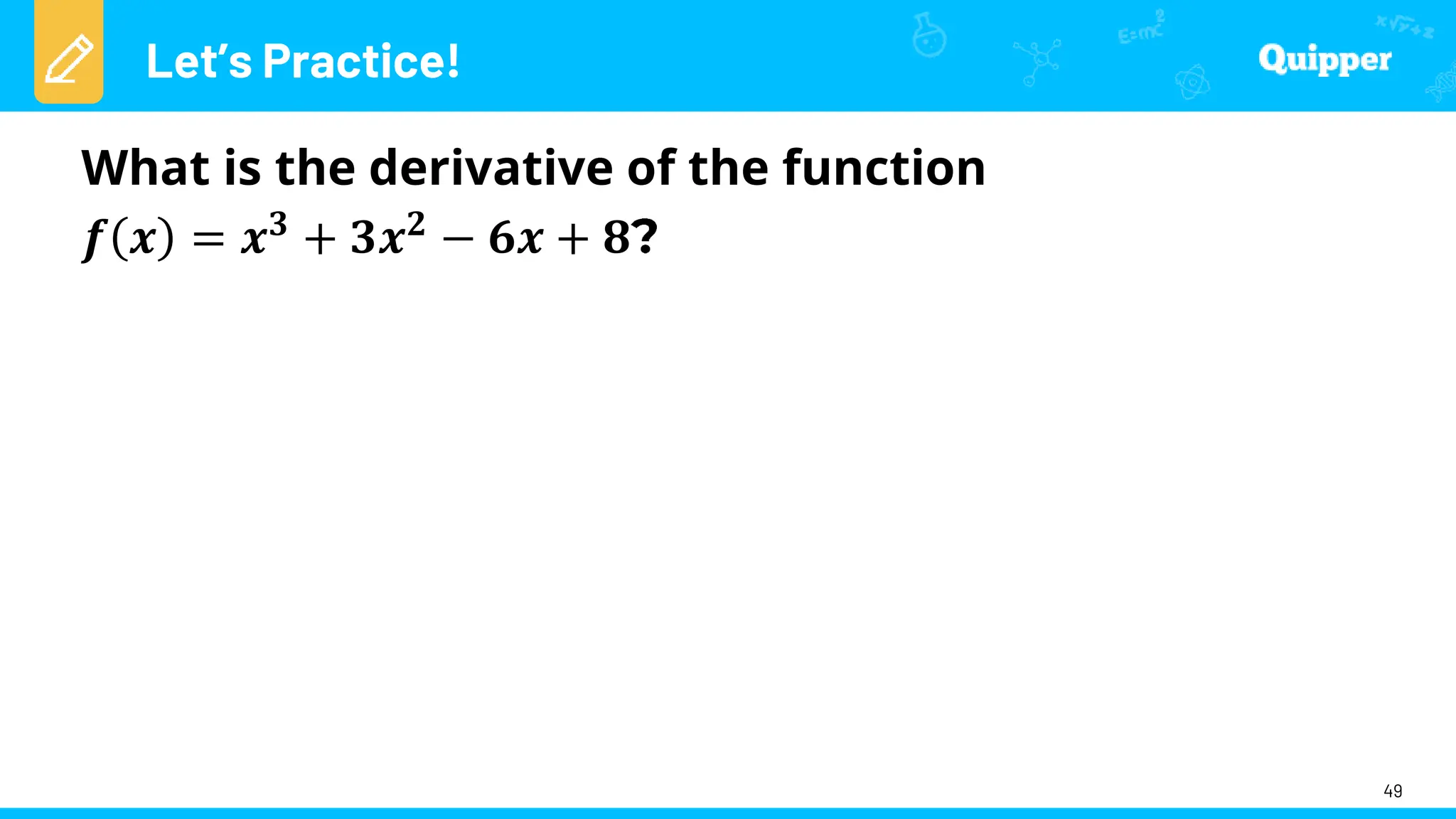
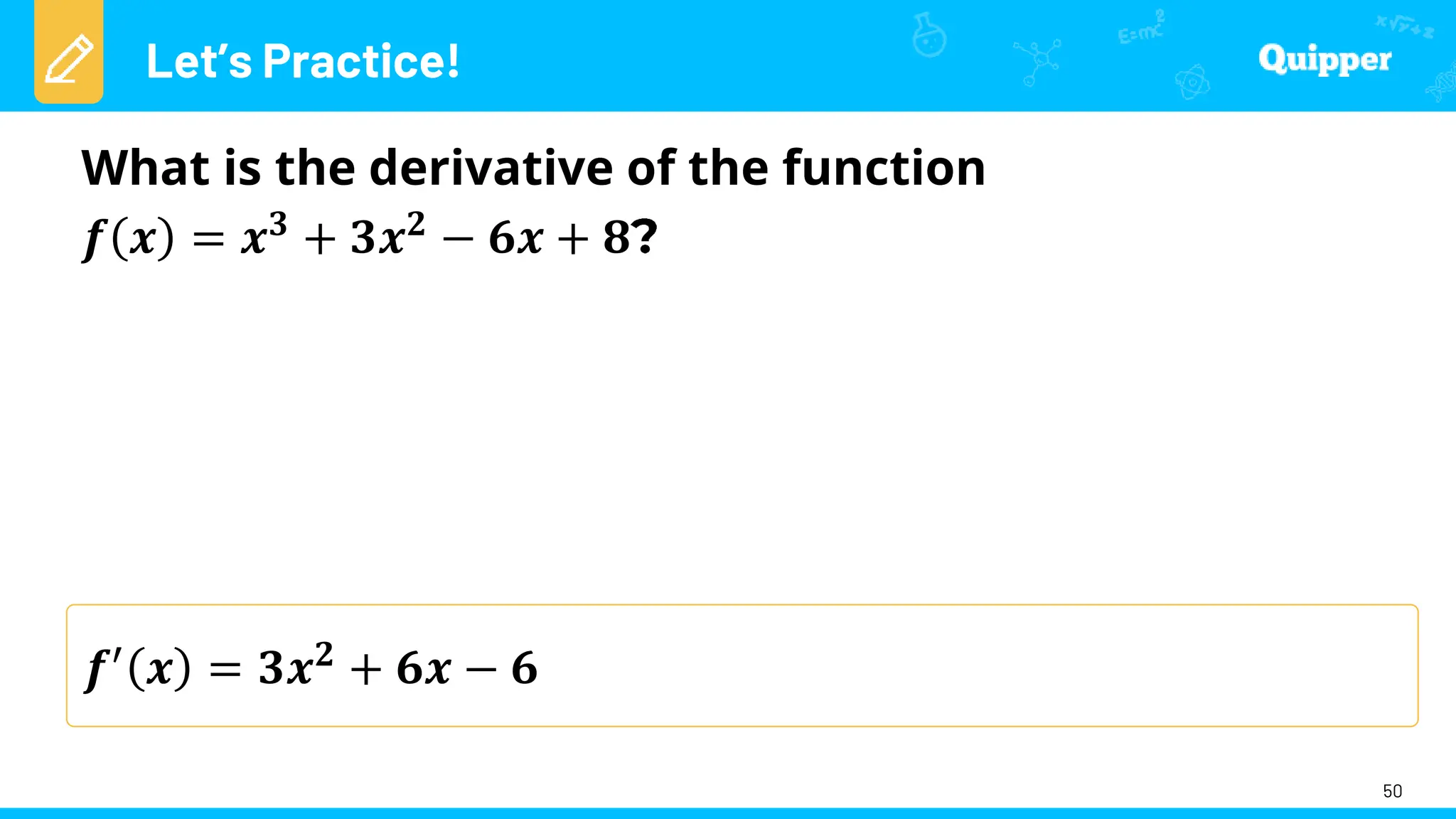
What is the derivative of the function
𝒇 𝒙 = 𝒙𝟑 + 𝟑𝒙𝟐 − 𝟔𝒙 + 𝟖
Let’s Practice!
50
What is the derivative of the function
𝒇 𝒙 = 𝒙𝟑 + 𝟑𝒙𝟐 − 𝟔𝒙 + 𝟖
𝒇′
𝒙 = 𝟑𝒙𝟐
+ 𝟔𝒙 − 𝟔
Try It!
51
51
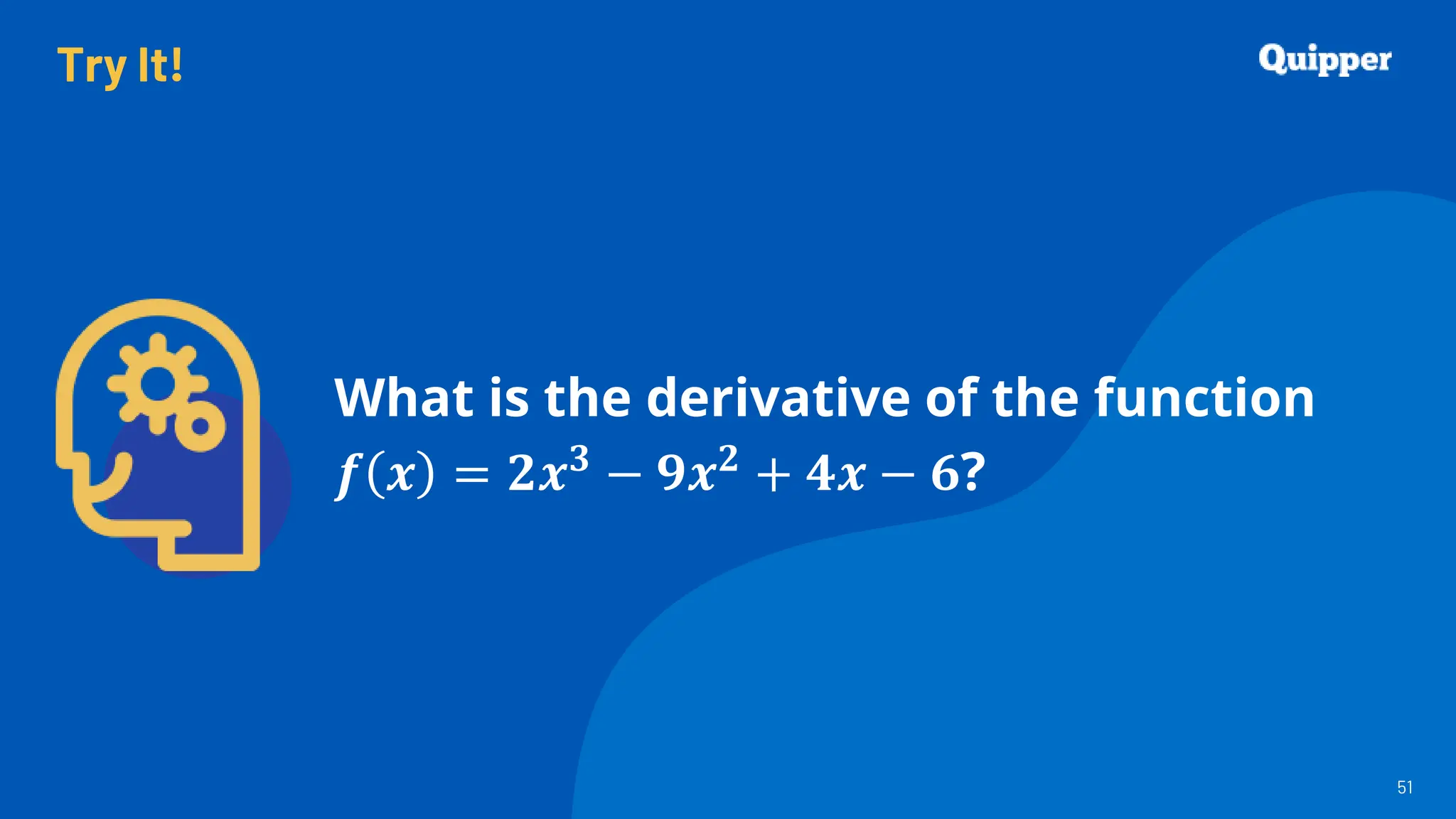
What is the derivative of the function
𝒇 𝒙 = 𝟐𝒙𝟑 − 𝟗𝒙𝟐 + 𝟒𝒙 − 𝟔?
Let’s Practice!
52
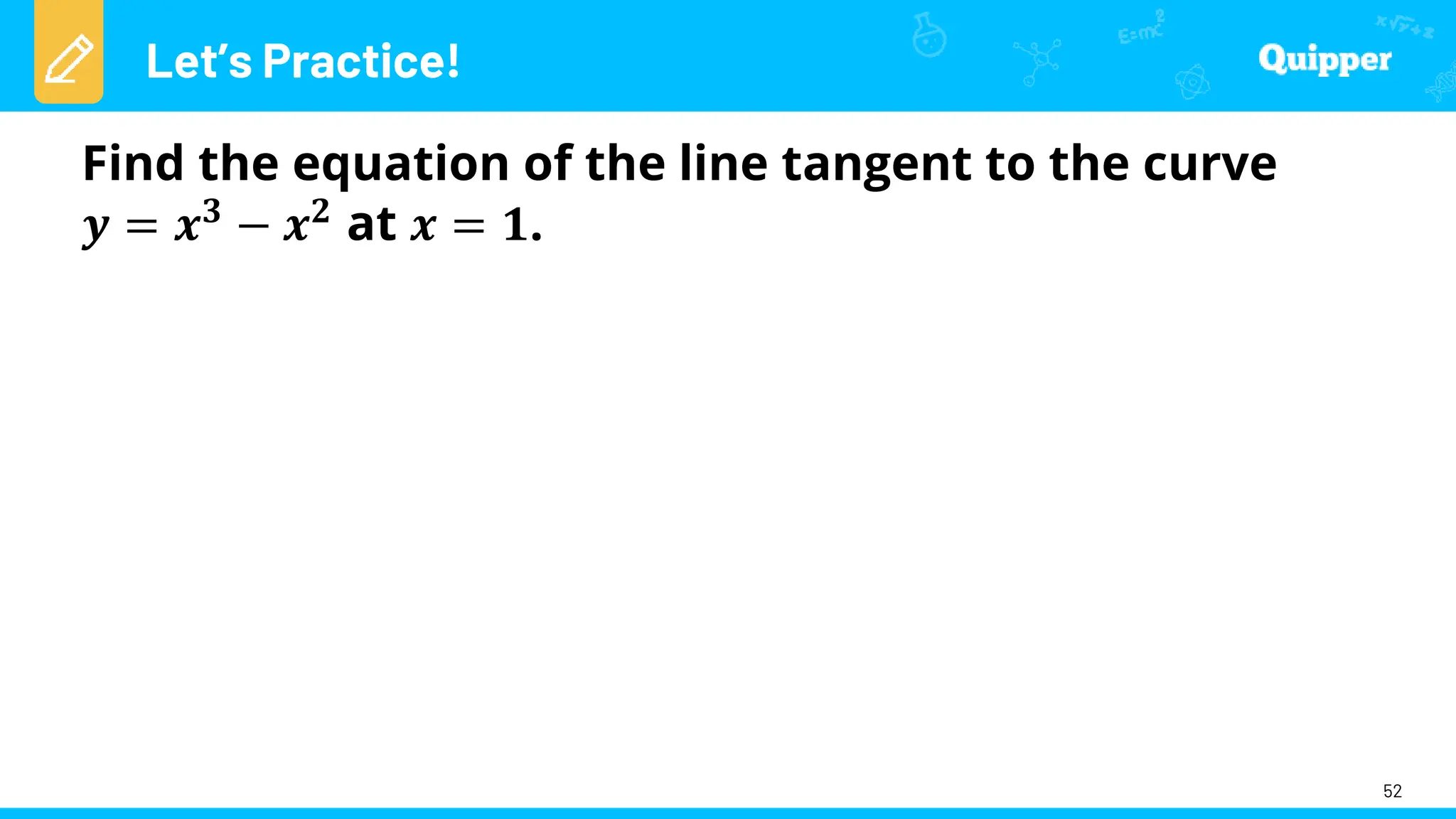
Find the equation of the line tangent to the curve
𝒚 = 𝒙𝟑 − 𝒙𝟐 at 𝒙 = 𝟏.
Let’s Practice!
53
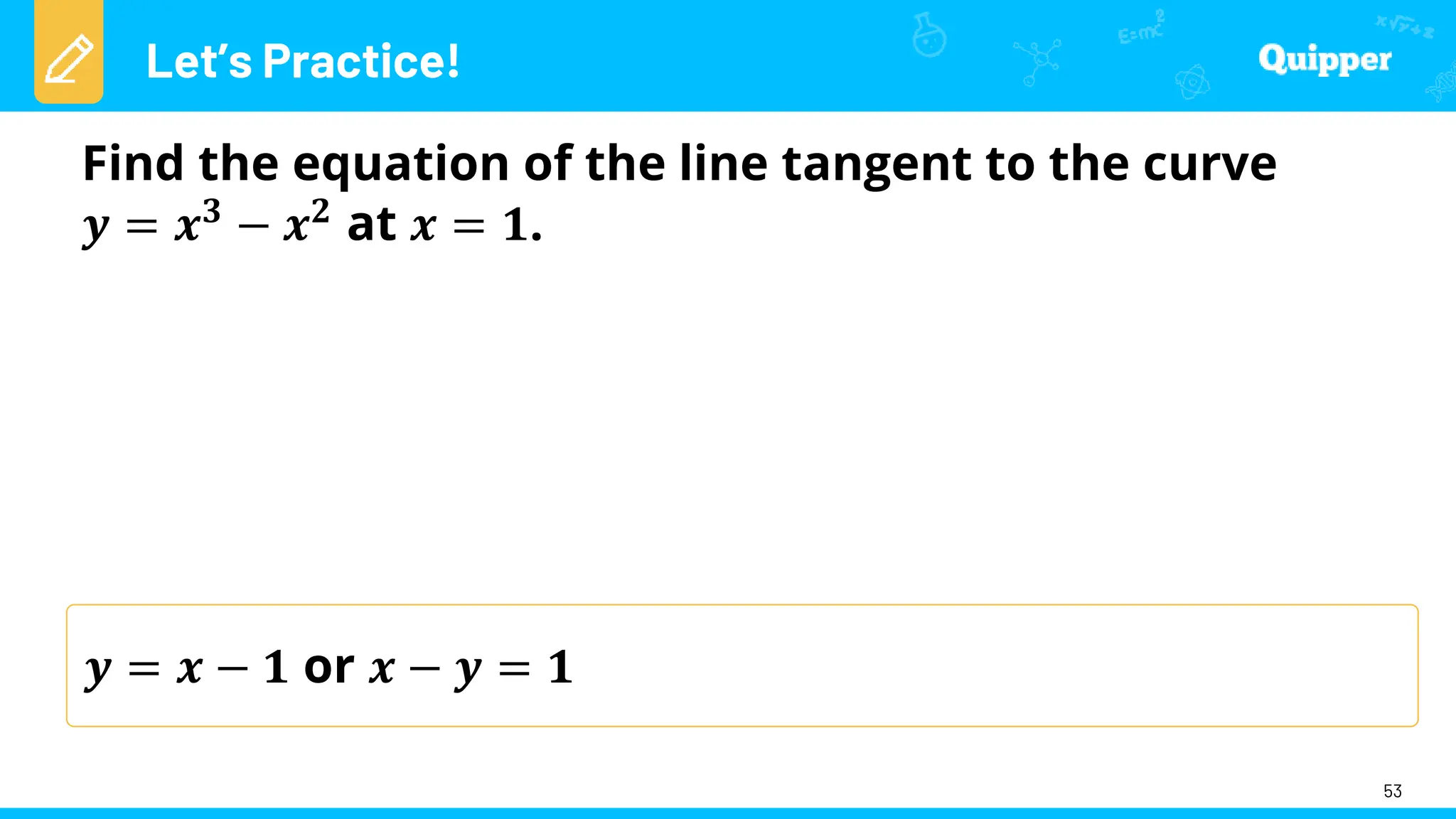
Find the equation of the line tangent to the curve
𝒚 = 𝒙𝟑 − 𝒙𝟐 at 𝒙 = 𝟏.
𝒚 = 𝒙 − 𝟏 or 𝒙 − 𝒚 = 𝟏
Try It!
54
54
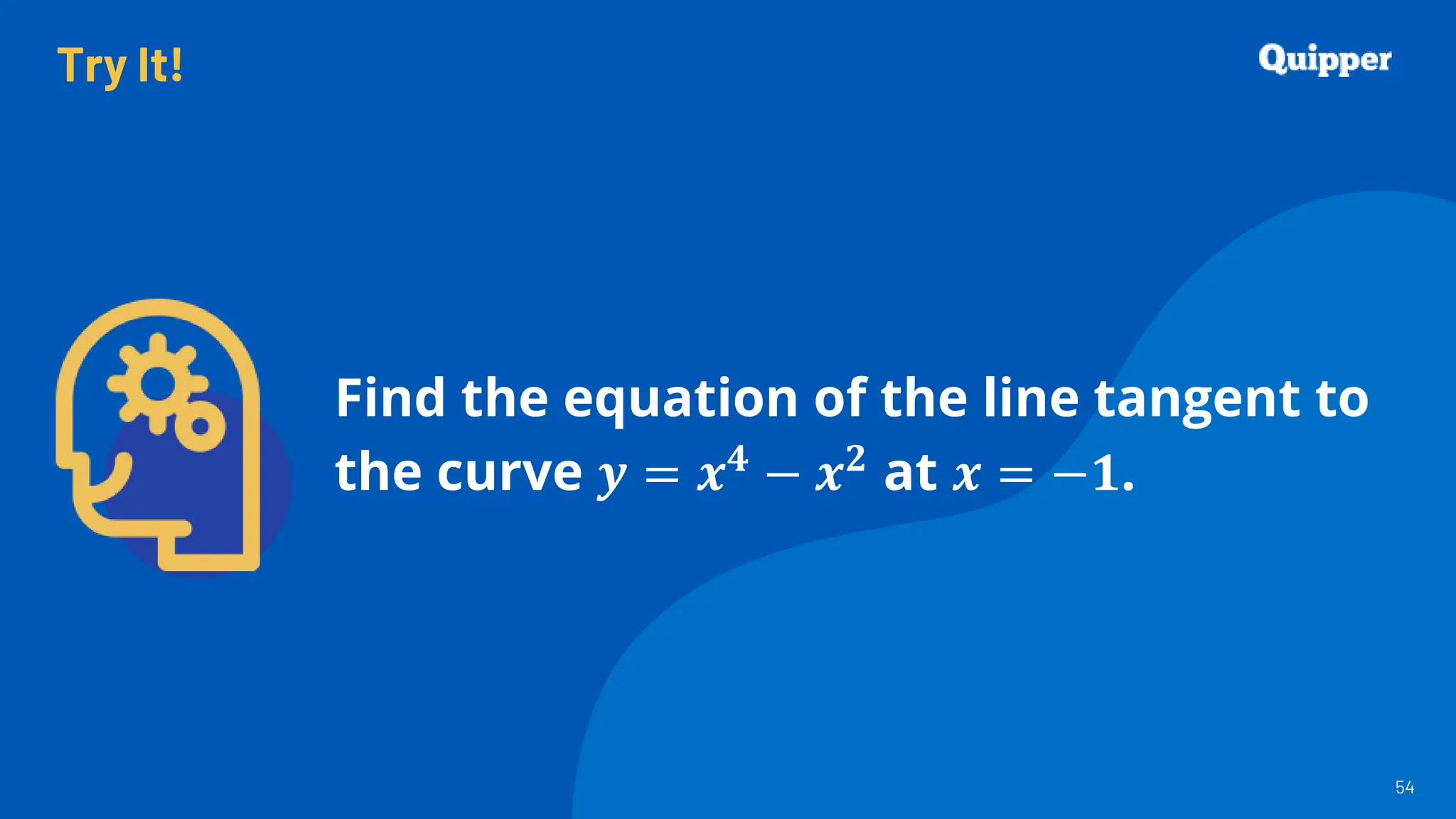
Find the equation of the line tangent to
the curve 𝒚 = 𝒙𝟒 − 𝒙𝟐 at 𝒙 = −𝟏.
Let’s Practice!
55
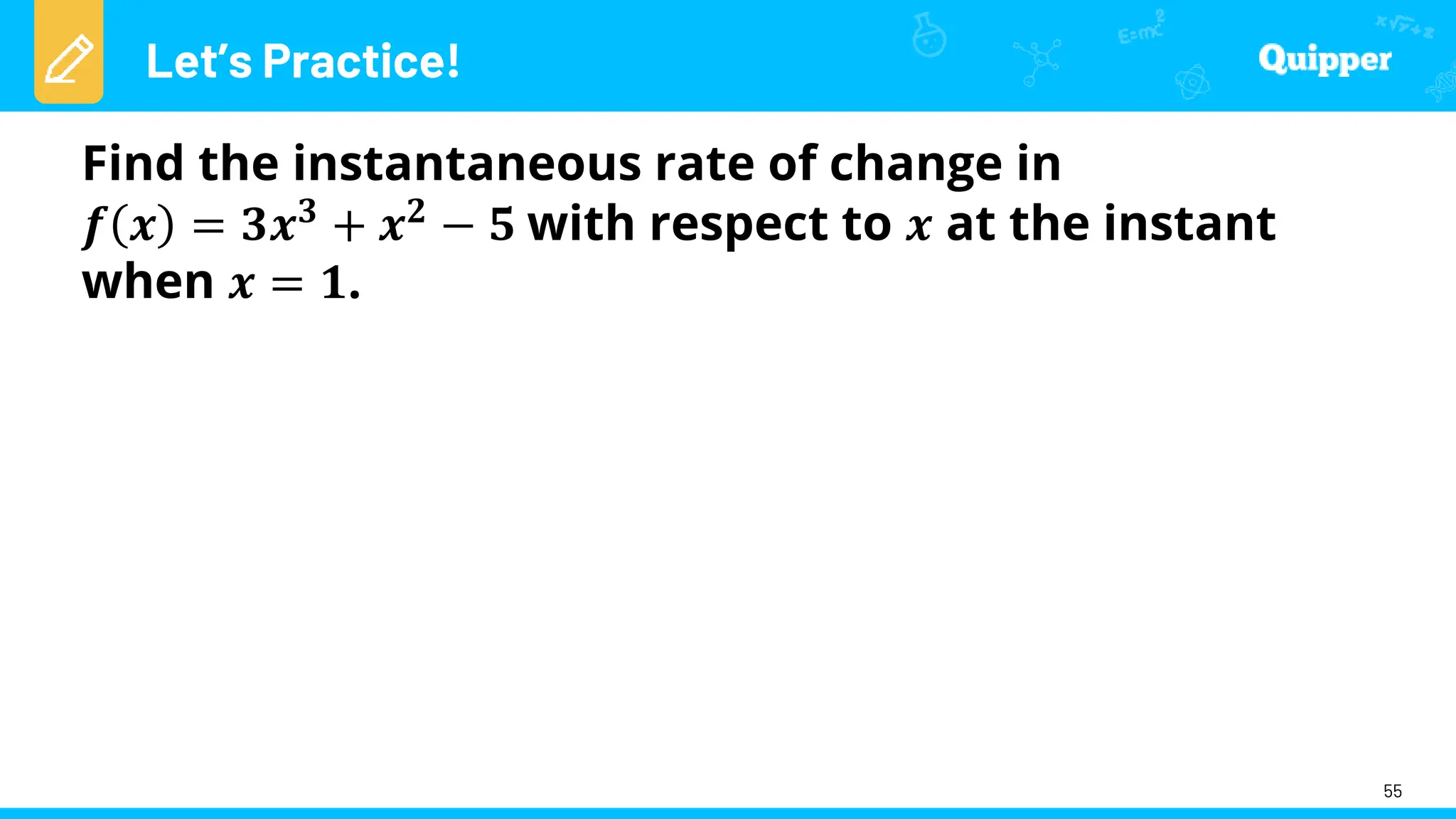
Find the instantaneous rate of change in
𝒇 𝒙 = 𝟑𝒙𝟑 + 𝒙𝟐 − 𝟓 with respect to 𝒙 at the instant
when 𝒙 = 𝟏.
Let’s Practice!
56
Find the instantaneous rate of change in
𝒇 𝒙 = 𝟑𝒙𝟑 + 𝒙𝟐 − 𝟓 with respect to 𝒙 at the instant
when 𝒙 = 𝟏.
𝟏𝟏
Try It!
57
57
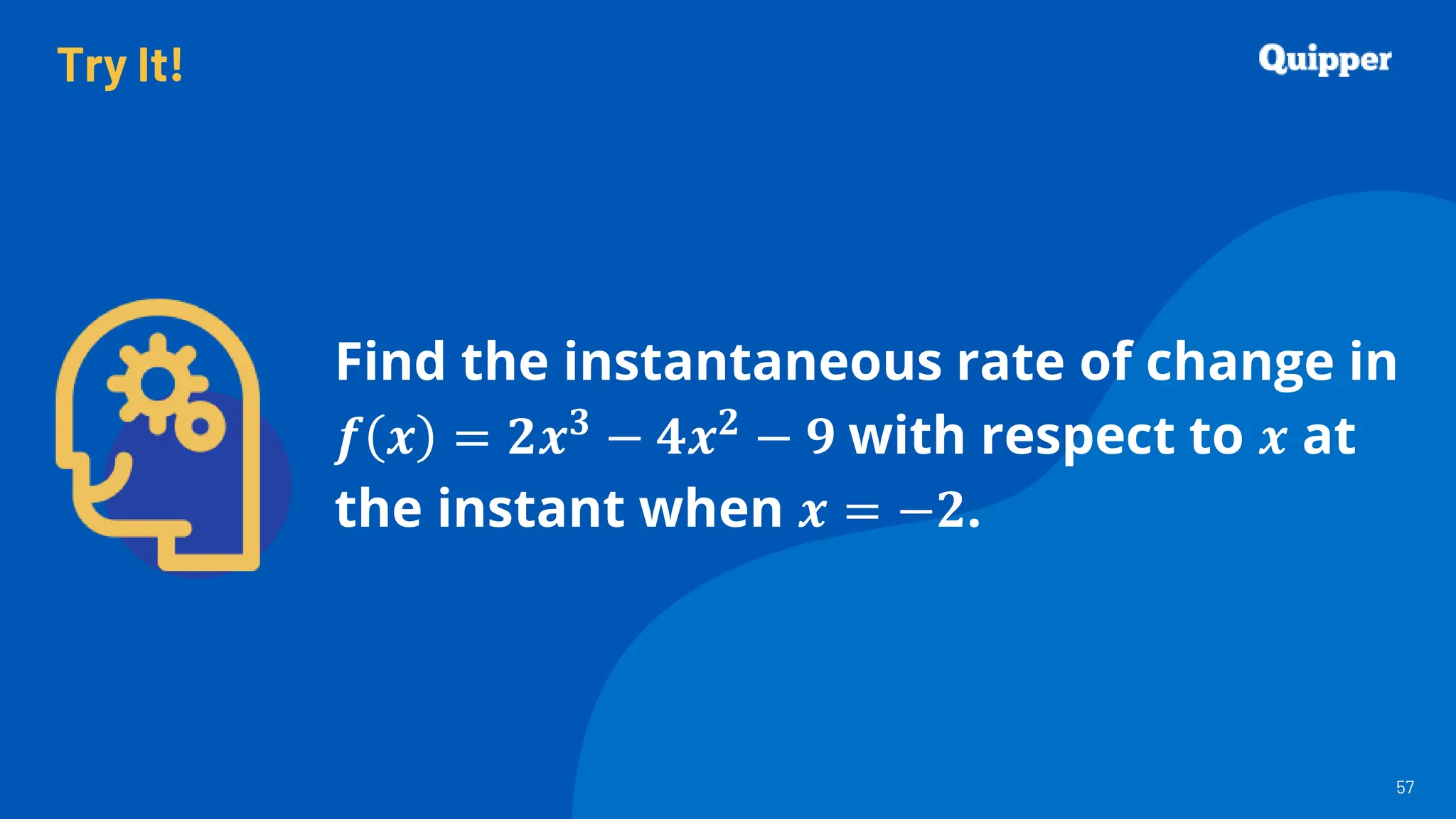
Find the instantaneous rate of change in
𝒇 𝒙 = 𝟐𝒙𝟑
− 𝟒𝒙𝟐
− 𝟗 with respect to 𝒙 at
the instant when 𝒙 = −𝟐.
Remember
58
The first derivative of the function 𝒇 𝒙
tells us about the instantaneous rate of
change when 𝒙 = 𝒄, where 𝒄 is a constant.
● If 𝒇′ 𝒙 > 𝟎, the function is increasing
at the instant when 𝒙 = 𝒄.
● If 𝒇′ 𝒙 < 𝟎, the function is decreasing
at the instant when 𝒙 = 𝒄.
Check Your Understanding
59
Find the derivative of each function.
1. 𝑓 𝑥 = 26
2. 𝑦 = 4 − 2𝑥
3. 𝑔 𝑥 = −9𝑥18
4. 𝑓 𝑥 =
1
𝑥3
5. 𝑦 = 𝑥2
+ 𝑥 + 1 𝑥 − 1
Check Your Understanding
60
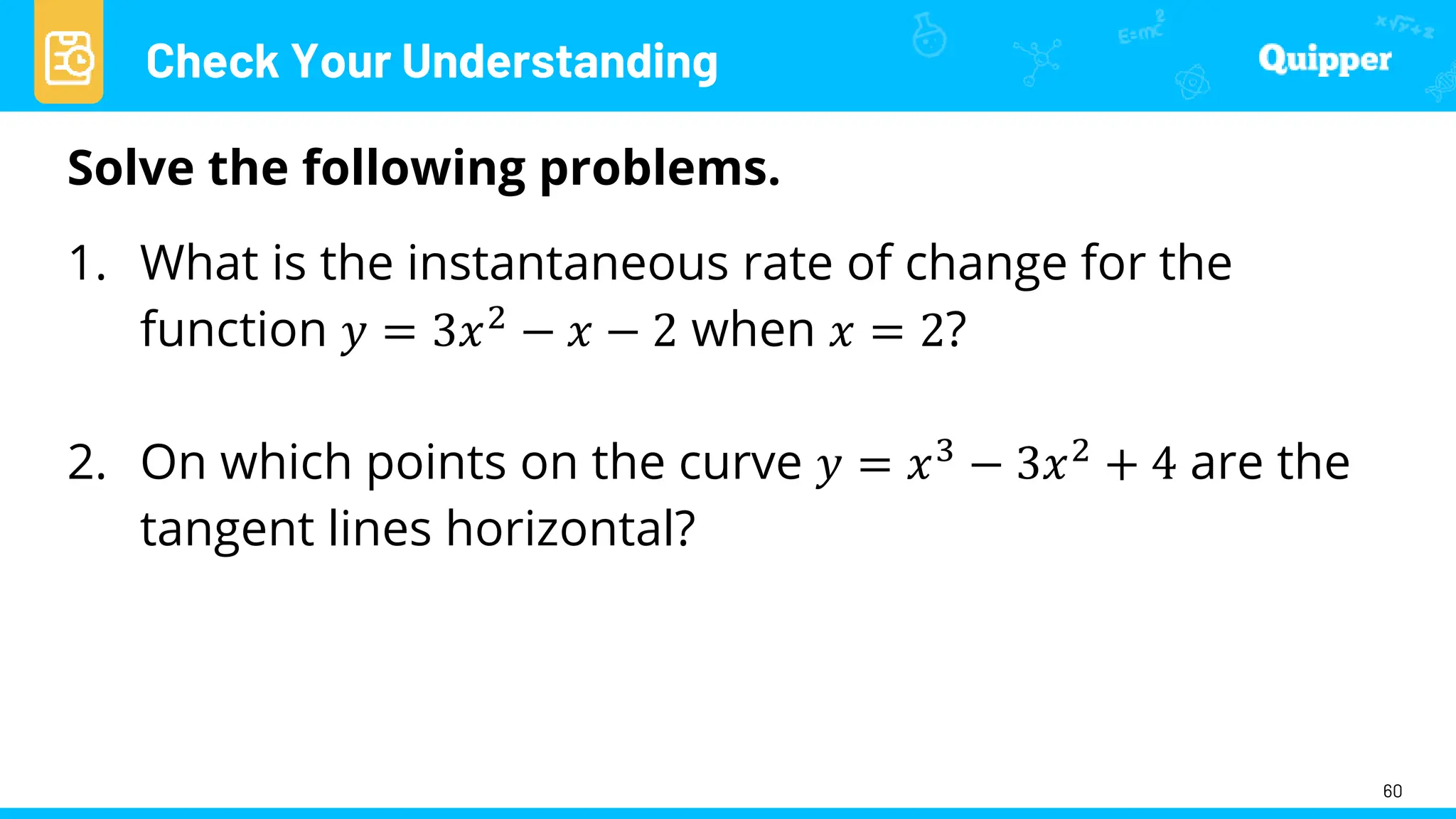
Solve the following problems.
1. What is the instantaneous rate of change for the
function 𝑦 = 3𝑥2 − 𝑥 − 2 when 𝑥 = 2?
2. On which points on the curve 𝑦 = 𝑥3
− 3𝑥2
+ 4 are the
tangent lines horizontal?
Let’s Sum It Up!
61
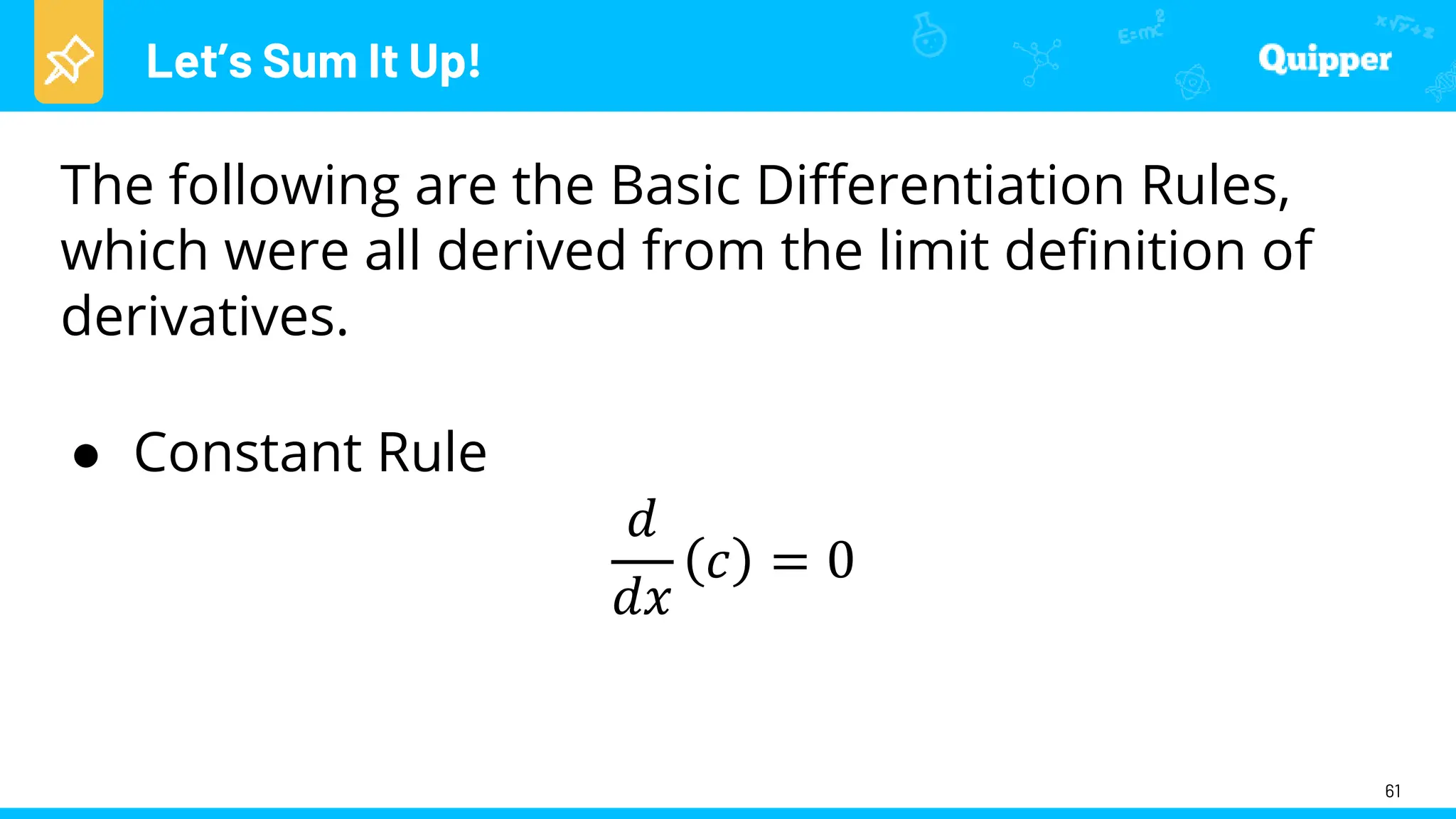
The following are the Basic Differentiation Rules,
which were all derived from the limit definition of
derivatives.
● Constant Rule
𝑑
𝑑𝑥
𝑐 = 0
Let’s Sum It Up!
62
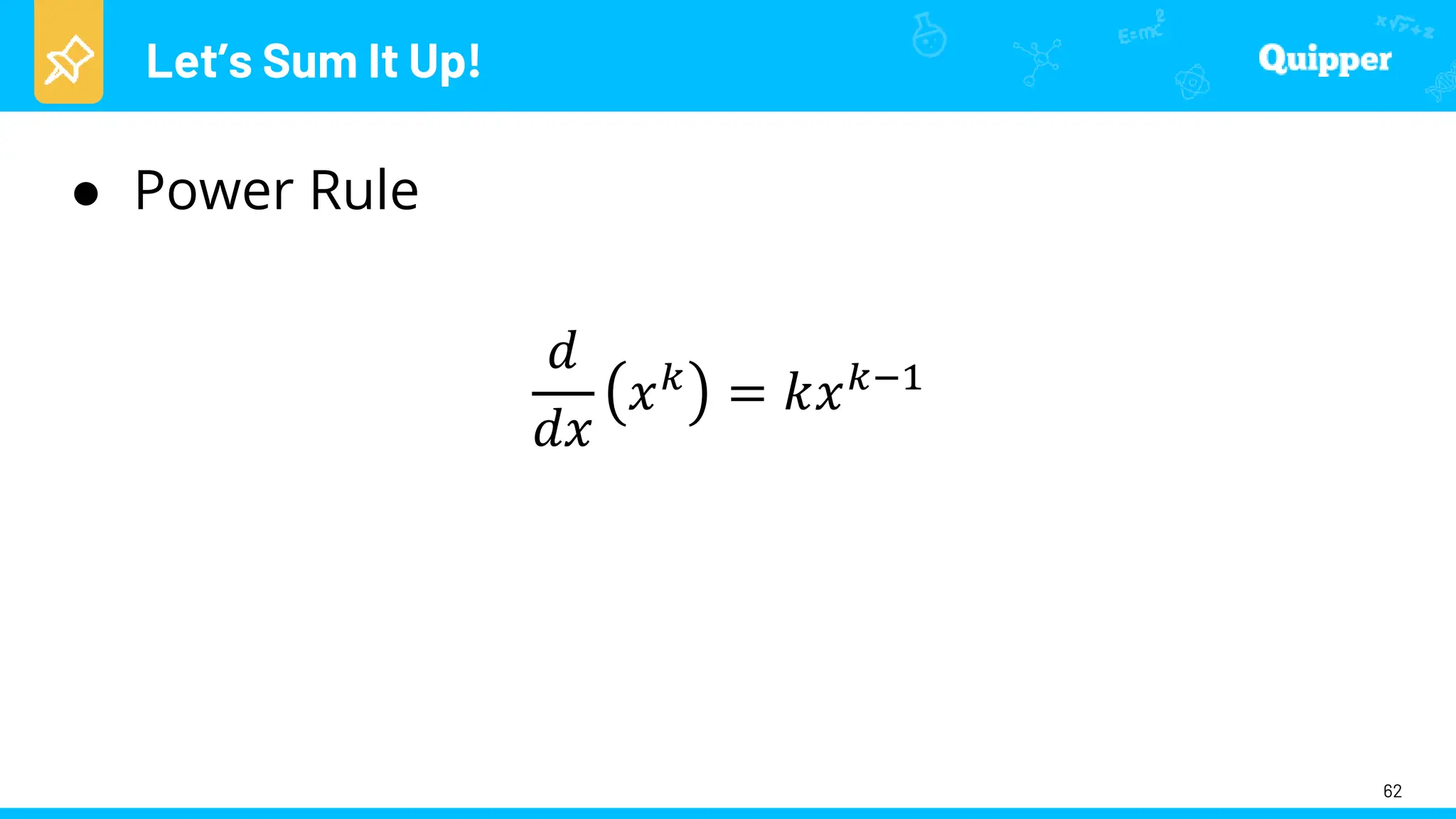
● Power Rule
𝑑
𝑑𝑥
𝑥𝑘
= 𝑘𝑥𝑘−1
Let’s Sum It Up!
63
● Constant Multiple Rule
𝑑
𝑑𝑥
𝑐𝑓 𝑥 = 𝑐 ∙ 𝑓′
𝑥
Let’s Sum It Up!
64
● Sum or Difference Rule
𝑑
𝑑𝑥
𝑓 𝑥 + 𝑔 𝑥 = 𝑓′
𝑥 + 𝑔′
𝑥
𝑑
𝑑𝑥
𝑓 𝑥 − 𝑔 𝑥 = 𝑓′
𝑥 − 𝑔′
𝑥
Key Formulas
65
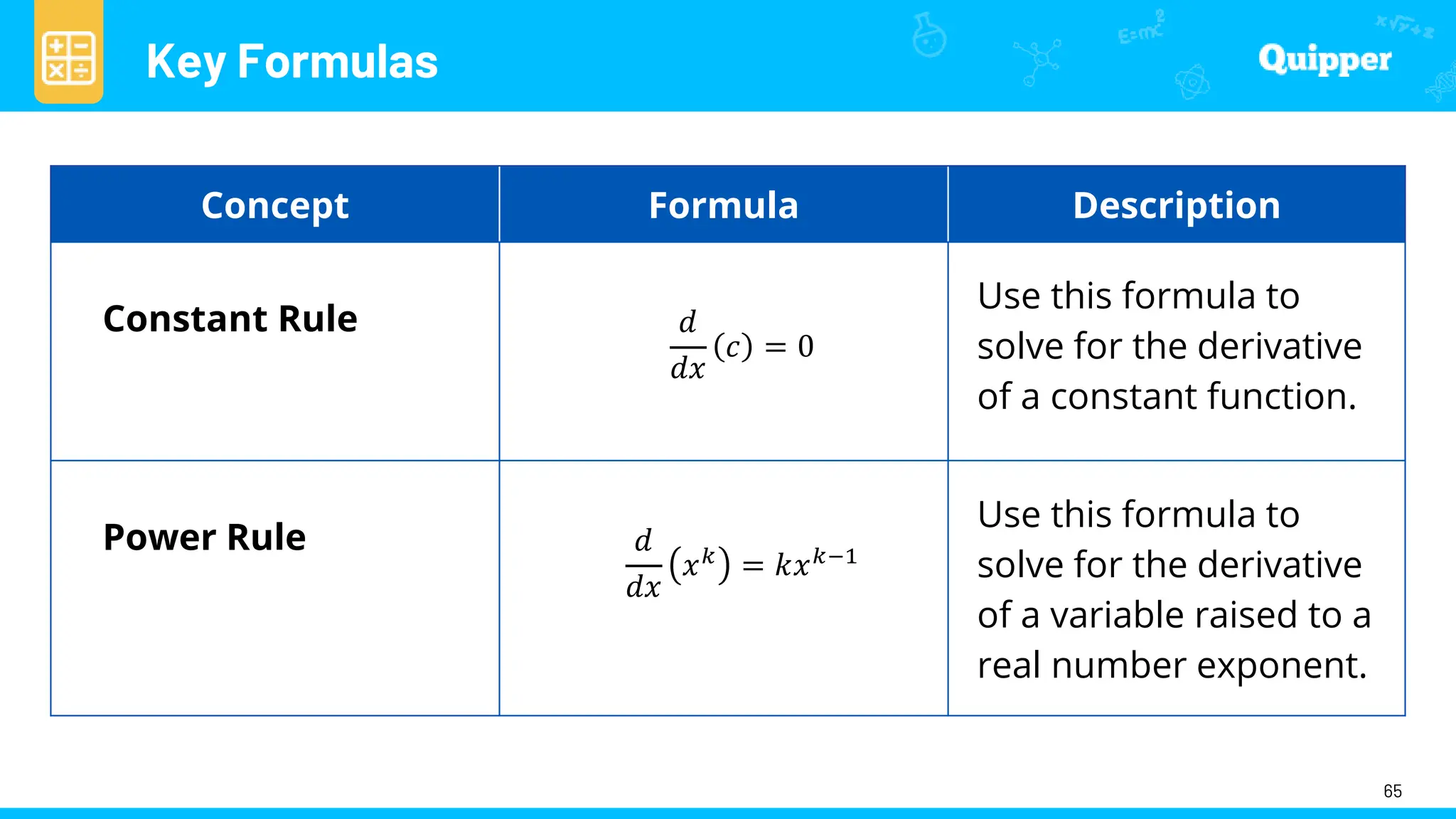
Concept Formula Description
Constant Rule 𝑑
𝑑𝑥
𝑐 = 0
Use this formula to
solve for the derivative
of a constant function.
Power Rule 𝑑
𝑑𝑥
𝑥𝑘
= 𝑘𝑥𝑘−1
Use this formula to
solve for the derivative
of a variable raised to a
real number exponent.
Key Formulas
66
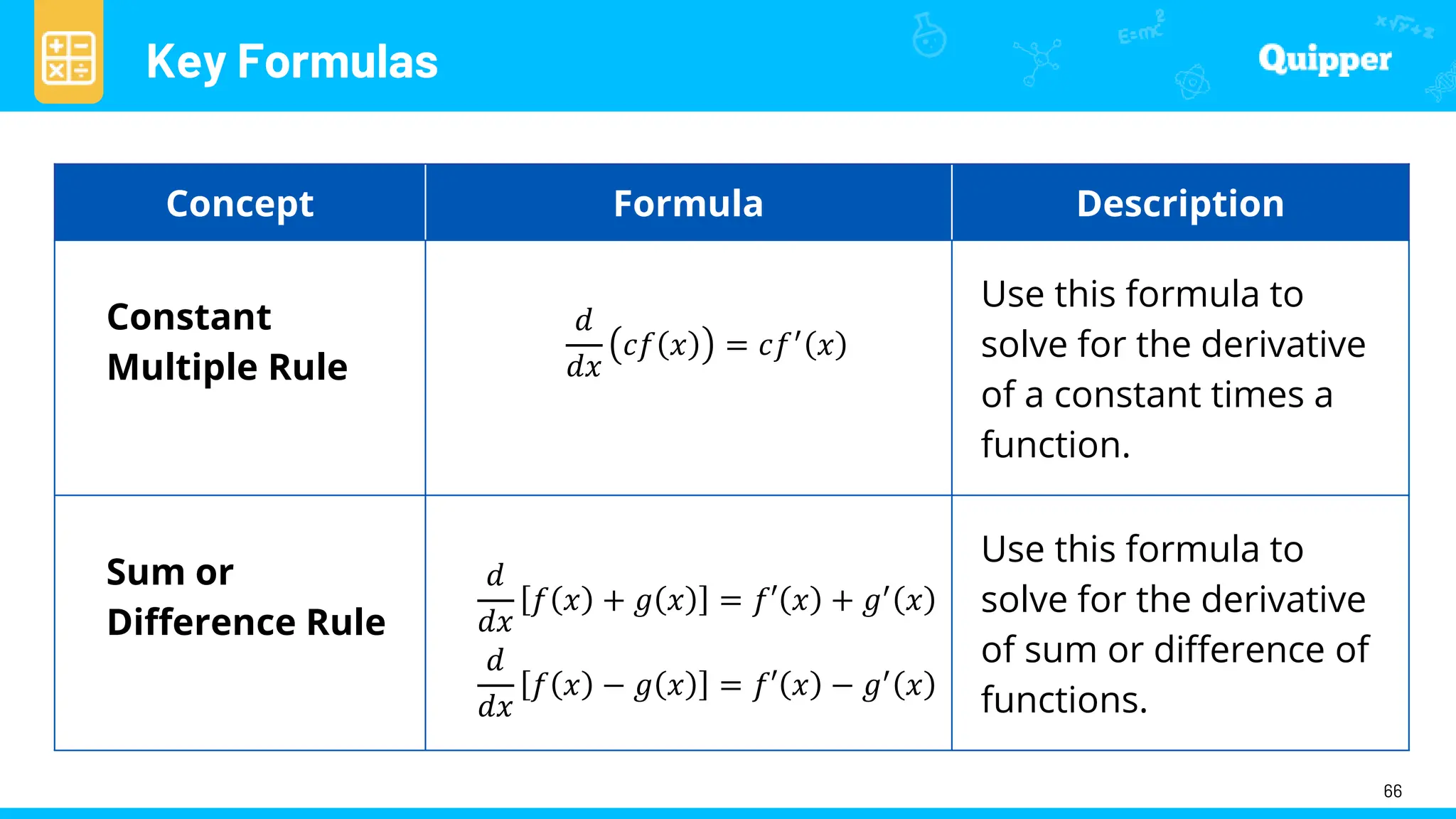
Concept Formula Description
Constant
Multiple Rule
𝑑
𝑑𝑥
𝑐𝑓 𝑥 = 𝑐𝑓′
𝑥
Use this formula to
solve for the derivative
of a constant times a
function.
Sum or
Difference Rule
𝑑
𝑑𝑥
𝑓 𝑥 + 𝑔 𝑥 = 𝑓′ 𝑥 + 𝑔′
𝑥
𝑑
𝑑𝑥
𝑓 𝑥 − 𝑔 𝑥 = 𝑓′ 𝑥 − 𝑔′
𝑥
Use this formula to
solve for the derivative
of sum or difference of
functions.
Challenge Yourself
67
67
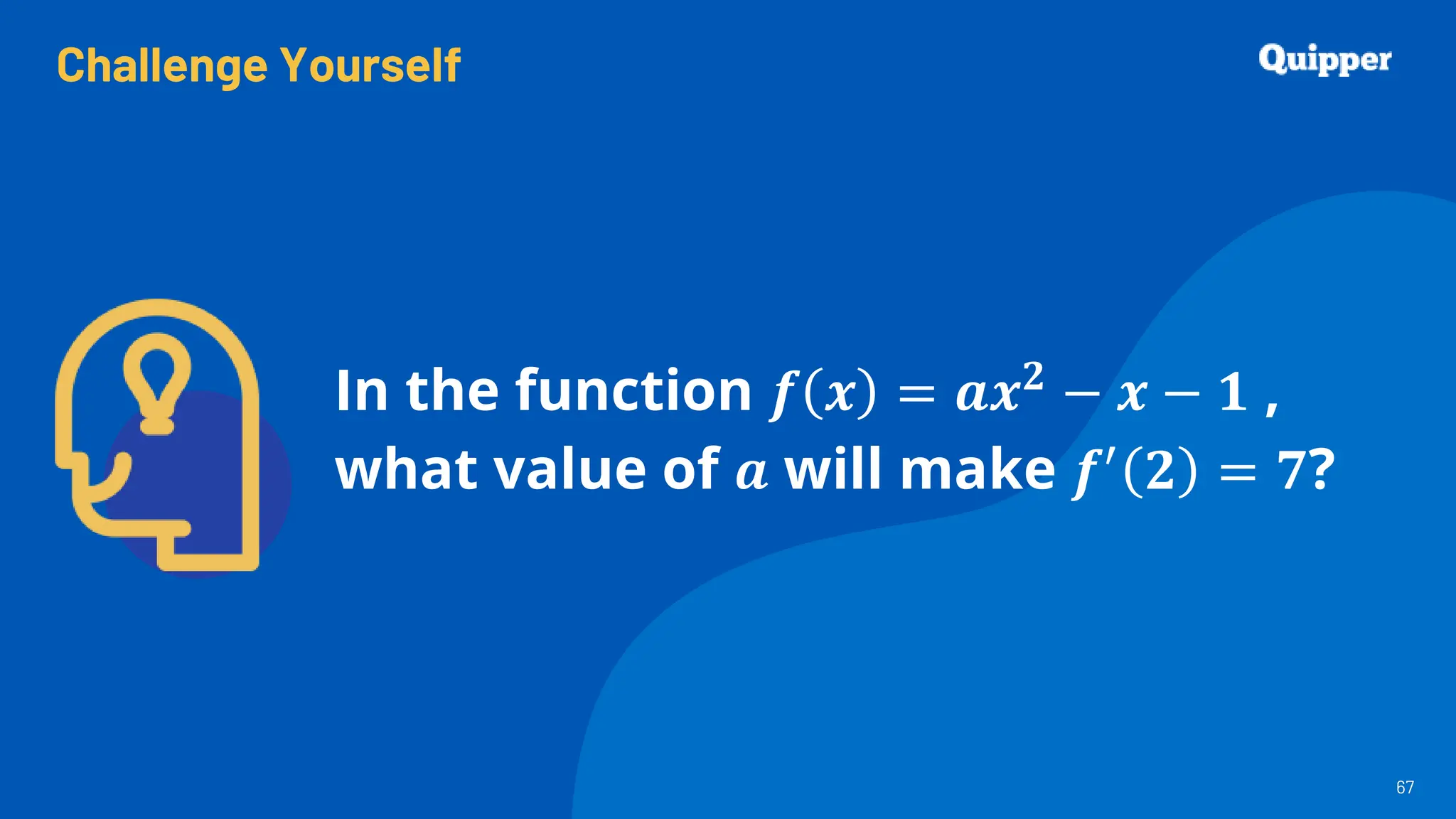
In the function 𝒇 𝒙 = 𝒂𝒙𝟐
− 𝒙 − 𝟏 ,
what value of 𝒂 will make 𝒇′ 𝟐 = 𝟕?
Bibliography
68
Edwards, C.H., and David E. Penney. Calculus: Early Transcendentals. 7th ed. Upper Saddle River, New
Jersey: Pearson/Prentice Hall, 2008.
Larson, Ron H., and Bruce H. Edwards. Essential Calculus: Early Transcendental Functions. Boston:
Houghton Mifflin, 2008.
Leithold, Louis. The Calculus 7. New York: HarperCollins College Publ., 1997.
Smith, Robert T., and Roland B. Milton. Calculus. New York: McGraw Hill, 2012.
Tan, Soo T. Applied Calculus for the Managerial, Life, and Social Sciences: A Brief Approach. Australia:
Brooks/Cole Cengage Learning, 2012.

Basic Calculus Basic Differentiation Rules

  • 1.
    Capstone Project Science, Technology,Engineering, and Mathematics Basic Calculus Science, Technology, Engineering, and Mathematics Lesson 5.1 The Basic Differentiation Rules
  • 2.
    2 A car speedometer tellsus our current speed when we drive. However, this speed is not either our constant speed nor our average speed when we drive.
  • 3.
    3 This speed iscalled the instantaneous rate of change, or simply the instantaneous speed. This concept is related to limits and derivatives.
  • 4.
    4 In this lesson,we are going to derive basic differentiation rules with the aid of the limit definition of derivative to enable us to solve for the derivatives of algebraic functions.
  • 5.
    5 How do wedifferentiate functions without the use of the limit definition of derivative?
  • 6.
    Learning Competencies At theend of the lesson, you should be able to do the following: 6 ● Derive the differentiation rules (STEM_BC11D- IIIf-2). ● Apply the differentiation rules in computing the derivative of an algebraic, exponential, and trigonometric functions (STEM_BC11D-IIIf- 3).
  • 7.
    Learning Objectives At theend of the lesson, you should be able to do the following: 7 ● Derive the basic differentiation rules (Constant Rule, Power Rule, Constant Multiple Rule, Sum or Difference Rule). ● Apply the basic differentiation rules in solving for the derivatives of functions.
  • 8.
    8 Constant Rule The derivativeof a constant function is 0. If 𝑐 is a constant, then 𝒅 𝒅𝒙 𝒄 = 𝟎. The Basic Differentiation Rules
  • 9.
    9 Proof: Let 𝑓 𝑥= 𝑐. We use the limit definition of a derivative to derive the Constant Rule. The Basic Differentiation Rules
  • 10.
    10 Proof: The Basic DifferentiationRules 𝑑 𝑑𝑥 𝑐 = lim ℎ→0 𝑓 𝑥 + ℎ − 𝑓 𝑥 ℎ Limit Definition of Derivative
  • 11.
    11 Proof: The Basic DifferentiationRules 𝑑 𝑑𝑥 𝑐 = lim ℎ→0 𝑓 𝑥 + ℎ − 𝑓 𝑥 ℎ = lim ℎ→0 𝑐 − 𝑐 ℎ = lim ℎ→0 0 Limit Definition of Derivative Subtraction
  • 12.
    12 Proof: The Basic DifferentiationRules 𝑑 𝑑𝑥 𝑐 = lim ℎ→0 𝑓 𝑥 + ℎ − 𝑓 𝑥 ℎ = lim ℎ→0 𝑐 − 𝑐 ℎ = lim ℎ→0 0 = 0 Limit Definition of Derivative Subtraction Constant Law of Limits
  • 13.
  • 14.
    14 Example: a. If 𝑓𝑥 = 6, then 𝑓′ 𝑥 = 0. b. Given than 𝑦 = 24, 𝑦′ = 0. The Basic Differentiation Rules
  • 15.
    15 Power Rule If 𝑘is a real number, then the derivative of the function 𝑓 𝑥 = 𝑥𝑘 is 𝒅 𝒅𝒙 𝒙𝒌 = 𝒌𝒙𝒌−𝟏 . The Basic Differentiation Rules
  • 16.
    16 Proof: We will provethe Power Rule for positive integer exponent. The proof for negative integer and real number exponents need more advanced techniques (Quotient Rule and implicit differentiation, respectively) which will be discussed in the succeeding lessons on derivatives. The Basic Differentiation Rules
  • 17.
    17 Proof: Let 𝑓 𝑥= 𝑥𝑘, where 𝑘 is any positive integer. We use the limit definition of a derivative to derive the Power Rule. The Basic Differentiation Rules
  • 18.
    18 The Basic DifferentiationRules 𝑑 𝑑𝑥 𝑥𝑘 = lim ℎ→0 𝑥 + ℎ 𝑘 − 𝑥𝑘 ℎ Limit Definition of Derivative
  • 19.
    19 Proof: The Basic DifferentiationRules 𝑑 𝑑𝑥 𝑥𝑘 = lim ℎ→0 𝑥𝑘 + 𝑘𝑥𝑘−1 ℎ + 𝑘 𝑘 − 1 2 𝑥𝑘−2 ℎ2 + ⋯ + 𝑘𝑥ℎ𝑘−1 + ℎ𝑘 − 𝑥𝑘 ℎ Binomial Expansion
  • 20.
    20 Proof: The Basic DifferentiationRules 𝑑 𝑑𝑥 𝑥𝑘 = lim ℎ→0 𝑘𝑥𝑘−1ℎ + 𝑘 𝑘 − 1 2 𝑥𝑘−2ℎ2 + ⋯ + 𝑘𝑥ℎ𝑘−1 + ℎ𝑘 ℎ Subtraction
  • 21.
    21 Proof: The Basic DifferentiationRules 𝑑 𝑑𝑥 𝑥𝑘 = lim ℎ→0 ℎ 𝑘𝑥𝑘−1 + 𝑘 𝑘 − 1 2 𝑥𝑘−2ℎ + ⋯ + 𝑘𝑥ℎ𝑘−2 + ℎ𝑘−1 ℎ Factor and cancel ℎ.
  • 22.
    22 Proof: The Basic DifferentiationRules 𝑑 𝑑𝑥 𝑥𝑘 = lim ℎ→0 𝑘𝑥𝑘−1 + 𝑘 𝑘 − 1 𝑥𝑘−2 2 𝑥𝑘−2 ℎ + ⋯ + 𝑘𝑥ℎ𝑘−2 + ℎ𝑘−1 = 𝑘𝑥𝑘−1 Evaluation of limit
  • 23.
  • 24.
    24 Example: Find the derivativeof 𝑓 𝑥 = 𝑥4. The Basic Differentiation Rules
  • 25.
    25 Example: Find the derivativeof 𝑓 𝑥 = 𝑥4. The derivative of 𝑓 𝑥 = 𝑥4 is 𝑓′ 𝑥 = 4𝑥3 . The Basic Differentiation Rules
  • 26.
    26 Constant Multiple Rule If𝑓 is differentiable and 𝑐 is a constant, then the derivative of the function 𝑐 ∙ 𝑓 is 𝒅 𝒅𝒙 𝒄𝒇 𝒙 = 𝒄𝒇′ 𝒙 . The Basic Differentiation Rules
  • 27.
    27 Proof: The Basic DifferentiationRules 𝑑 𝑑𝑥 𝑐𝑓 𝑥 = lim ℎ→0 𝑐𝑓 𝑥 + ℎ − 𝑐𝑓 𝑥 ℎ Limit Definition of Derivative
  • 28.
    28 Proof: The Basic DifferentiationRules 𝑑 𝑑𝑥 𝑐𝑓 𝑥 = lim ℎ→0 𝑐 𝑓 𝑥 + ℎ − 𝑓 𝑥 ℎ Factor 𝑐.
  • 29.
    29 Proof: The Basic DifferentiationRules 𝑑 𝑑𝑥 𝑐𝑓 𝑥 = 𝑐 lim ℎ→0 𝑓 𝑥 + ℎ − 𝑓 𝑥 ℎ Constant Multiple Law for Limits
  • 30.
    30 Proof: The Basic DifferentiationRules 𝑑 𝑑𝑥 𝑐𝑓 𝑥 = 𝑐𝑓′ 𝑥 Substitution: 𝑓′ 𝑥 = lim ℎ→0 𝑓 𝑥 + ℎ − 𝑓 𝑥 ℎ
  • 31.
    31 Proof: Therefore, 𝑑 𝑑𝑥 𝑐𝑓 𝑥 =𝑐𝑓′ 𝑥 . The Basic Differentiation Rules
  • 32.
    32 Example: Use the ConstantMultiple Rule to find the derivative of 𝑓 𝑥 = 4𝑥6. The Basic Differentiation Rules
  • 33.
    33 Example: Use the ConstantMultiple Rule to find the derivative of 𝑓 𝑥 = 4𝑥6. The derivative of 𝑓 𝑥 = 4𝑥6 is 𝑓′ 𝑥 = 24𝑥5. The Basic Differentiation Rules
  • 34.
    34 Sum or DifferenceRule Let 𝑓 and 𝑔 be differentiable functions, then the sum (or difference) of 𝑓 and 𝑔 is also differentiable. The derivative of the sum of 𝑓 and 𝑔 is given by 𝒅 𝒅𝒙 𝒇 𝒙 + 𝒈 𝒙 = 𝒇′ 𝒙 + 𝒈′ 𝒙 . The Basic Differentiation Rules
  • 35.
    35 Sum or DifferenceRule The derivative of the sum of 𝑓 and 𝑔 is given by 𝒅 𝒅𝒙 𝒇 𝒙 − 𝒈 𝒙 = 𝒇′ 𝒙 − 𝒈′ 𝒙 . The Basic Differentiation Rules
  • 36.
    36 Proof: The Basic DifferentiationRules 𝑑 𝑑𝑥 𝑓 𝑥 + 𝑔 𝑥 = lim ℎ→0 𝑓 𝑥 + ℎ + 𝑔 𝑥 + ℎ − 𝑓 𝑥 + 𝑔 𝑥 ℎ Limit Definition of Derivative
  • 37.
    37 Proof: The Basic DifferentiationRules 𝑑 𝑑𝑥 𝑓 𝑥 + 𝑔 𝑥 = lim ℎ→0 𝑓 𝑥 + ℎ + 𝑔 𝑥 + ℎ − 𝑓 𝑥 − 𝑔 𝑥 ℎ Distributivity
  • 38.
    38 Proof: The Basic DifferentiationRules 𝑑 𝑑𝑥 𝑓 𝑥 + 𝑔 𝑥 = lim ℎ→0 𝑓 𝑥 + ℎ − 𝑓 𝑥 + 𝑔 𝑥 + ℎ − 𝑔 𝑥 ℎ Associativity
  • 39.
    39 Proof: The Basic DifferentiationRules 𝑑 𝑑𝑥 𝑓 𝑥 + 𝑔 𝑥 = lim ℎ→0 𝑓 𝑥 + ℎ − 𝑓 𝑥 ℎ + lim ℎ→0 𝑔 𝑥 + ℎ − 𝑔 𝑥 ℎ Sum or Difference Law for Limits
  • 40.
    40 Proof: The Basic DifferentiationRules 𝑑 𝑑𝑥 𝑓 𝑥 + 𝑔 𝑥 = 𝑓′ 𝑥 + 𝑔′(𝑥) Limit Definition of Derivative
  • 41.
    41 Example: Use the Sumor Difference Rule to find the derivative of 𝑓 𝑥 = 𝑥3 + 𝑥2. The Basic Differentiation Rules
  • 42.
    42 Example: Use the Sumor Difference Rule to find the derivative of 𝑓 𝑥 = 𝑥3 + 𝑥2. The derivative of the function 𝑓 𝑥 = 𝑥3 + 𝑥2 is 𝑓′ 𝑥 = 3𝑥2 + 2𝑥. The Basic Differentiation Rules
  • 43.
    43 What differentiation rulescan be used to get the derivative of 𝒇 𝒙 = 𝒙𝟑 + 𝟑𝒙𝟐 + 𝟓?
  • 44.
    Let’s Practice! 44 Find thederivative of 𝒚 = 𝟒𝒙𝟕
  • 45.
    Let’s Practice! 45 Find thederivative of 𝒚 = 𝟒𝒙𝟕 𝒚′ = 𝟐𝟖𝒙𝟔
  • 46.
    Try It! 46 46 Find thederivative of 𝒚 = −𝟓𝒙𝟗 .
  • 47.
    Tips 47 In differentiating functionsof the form 𝒇 𝒙 = 𝒄 ∙ 𝒙𝒌 , we can find the derivative of the function by multiplying the exponent to the coefficient of the function and subtracting 1 from the exponent.
  • 48.
    Tips 48 To differentiate thefunction 𝒇 𝒙 = 𝟑𝒙𝟔, we can directly multiply the exponent 6 to the coefficient 3 and subtract 1 from the exponent. Thus, the derivative of the function will be 𝒇′ 𝒙 = 𝟏𝟖𝒙𝟓 .
  • 49.
    Let’s Practice! 49 What isthe derivative of the function 𝒇 𝒙 = 𝒙𝟑 + 𝟑𝒙𝟐 − 𝟔𝒙 + 𝟖
  • 50.
    Let’s Practice! 50 What isthe derivative of the function 𝒇 𝒙 = 𝒙𝟑 + 𝟑𝒙𝟐 − 𝟔𝒙 + 𝟖 𝒇′ 𝒙 = 𝟑𝒙𝟐 + 𝟔𝒙 − 𝟔
  • 51.
    Try It! 51 51 What isthe derivative of the function 𝒇 𝒙 = 𝟐𝒙𝟑 − 𝟗𝒙𝟐 + 𝟒𝒙 − 𝟔?
  • 52.
    Let’s Practice! 52 Find theequation of the line tangent to the curve 𝒚 = 𝒙𝟑 − 𝒙𝟐 at 𝒙 = 𝟏.
  • 53.
    Let’s Practice! 53 Find theequation of the line tangent to the curve 𝒚 = 𝒙𝟑 − 𝒙𝟐 at 𝒙 = 𝟏. 𝒚 = 𝒙 − 𝟏 or 𝒙 − 𝒚 = 𝟏
  • 54.
    Try It! 54 54 Find theequation of the line tangent to the curve 𝒚 = 𝒙𝟒 − 𝒙𝟐 at 𝒙 = −𝟏.
  • 55.
    Let’s Practice! 55 Find theinstantaneous rate of change in 𝒇 𝒙 = 𝟑𝒙𝟑 + 𝒙𝟐 − 𝟓 with respect to 𝒙 at the instant when 𝒙 = 𝟏.
  • 56.
    Let’s Practice! 56 Find theinstantaneous rate of change in 𝒇 𝒙 = 𝟑𝒙𝟑 + 𝒙𝟐 − 𝟓 with respect to 𝒙 at the instant when 𝒙 = 𝟏. 𝟏𝟏
  • 57.
    Try It! 57 57 Find theinstantaneous rate of change in 𝒇 𝒙 = 𝟐𝒙𝟑 − 𝟒𝒙𝟐 − 𝟗 with respect to 𝒙 at the instant when 𝒙 = −𝟐.
  • 58.
    Remember 58 The first derivativeof the function 𝒇 𝒙 tells us about the instantaneous rate of change when 𝒙 = 𝒄, where 𝒄 is a constant. ● If 𝒇′ 𝒙 > 𝟎, the function is increasing at the instant when 𝒙 = 𝒄. ● If 𝒇′ 𝒙 < 𝟎, the function is decreasing at the instant when 𝒙 = 𝒄.
  • 59.
    Check Your Understanding 59 Findthe derivative of each function. 1. 𝑓 𝑥 = 26 2. 𝑦 = 4 − 2𝑥 3. 𝑔 𝑥 = −9𝑥18 4. 𝑓 𝑥 = 1 𝑥3 5. 𝑦 = 𝑥2 + 𝑥 + 1 𝑥 − 1
  • 60.
    Check Your Understanding 60 Solvethe following problems. 1. What is the instantaneous rate of change for the function 𝑦 = 3𝑥2 − 𝑥 − 2 when 𝑥 = 2? 2. On which points on the curve 𝑦 = 𝑥3 − 3𝑥2 + 4 are the tangent lines horizontal?
  • 61.
    Let’s Sum ItUp! 61 The following are the Basic Differentiation Rules, which were all derived from the limit definition of derivatives. ● Constant Rule 𝑑 𝑑𝑥 𝑐 = 0
  • 62.
    Let’s Sum ItUp! 62 ● Power Rule 𝑑 𝑑𝑥 𝑥𝑘 = 𝑘𝑥𝑘−1
  • 63.
    Let’s Sum ItUp! 63 ● Constant Multiple Rule 𝑑 𝑑𝑥 𝑐𝑓 𝑥 = 𝑐 ∙ 𝑓′ 𝑥
  • 64.
    Let’s Sum ItUp! 64 ● Sum or Difference Rule 𝑑 𝑑𝑥 𝑓 𝑥 + 𝑔 𝑥 = 𝑓′ 𝑥 + 𝑔′ 𝑥 𝑑 𝑑𝑥 𝑓 𝑥 − 𝑔 𝑥 = 𝑓′ 𝑥 − 𝑔′ 𝑥
  • 65.
    Key Formulas 65 Concept FormulaDescription Constant Rule 𝑑 𝑑𝑥 𝑐 = 0 Use this formula to solve for the derivative of a constant function. Power Rule 𝑑 𝑑𝑥 𝑥𝑘 = 𝑘𝑥𝑘−1 Use this formula to solve for the derivative of a variable raised to a real number exponent.
  • 66.
    Key Formulas 66 Concept FormulaDescription Constant Multiple Rule 𝑑 𝑑𝑥 𝑐𝑓 𝑥 = 𝑐𝑓′ 𝑥 Use this formula to solve for the derivative of a constant times a function. Sum or Difference Rule 𝑑 𝑑𝑥 𝑓 𝑥 + 𝑔 𝑥 = 𝑓′ 𝑥 + 𝑔′ 𝑥 𝑑 𝑑𝑥 𝑓 𝑥 − 𝑔 𝑥 = 𝑓′ 𝑥 − 𝑔′ 𝑥 Use this formula to solve for the derivative of sum or difference of functions.
  • 67.
    Challenge Yourself 67 67 In thefunction 𝒇 𝒙 = 𝒂𝒙𝟐 − 𝒙 − 𝟏 , what value of 𝒂 will make 𝒇′ 𝟐 = 𝟕?
  • 68.
    Bibliography 68 Edwards, C.H., andDavid E. Penney. Calculus: Early Transcendentals. 7th ed. Upper Saddle River, New Jersey: Pearson/Prentice Hall, 2008. Larson, Ron H., and Bruce H. Edwards. Essential Calculus: Early Transcendental Functions. Boston: Houghton Mifflin, 2008. Leithold, Louis. The Calculus 7. New York: HarperCollins College Publ., 1997. Smith, Robert T., and Roland B. Milton. Calculus. New York: McGraw Hill, 2012. Tan, Soo T. Applied Calculus for the Managerial, Life, and Social Sciences: A Brief Approach. Australia: Brooks/Cole Cengage Learning, 2012.