
ALKALOID: AN OVERVIEW
Presented by
Mr. O. P. Verma
Associate Professor
Dept. of Pharmacognosy
Goel Institute of Pharmacy and Sciences,
Lucknow
Content
➢Metabolites
➢Definition
➢Exceptions with respect to definition
➢Distribution, occurence & forms of alkaloids.
➢Physical & chemical properties
➢Classification of alkaloids
➢Chemical test for alkaloids
➢Extraction, isolation & purification of alkaloids
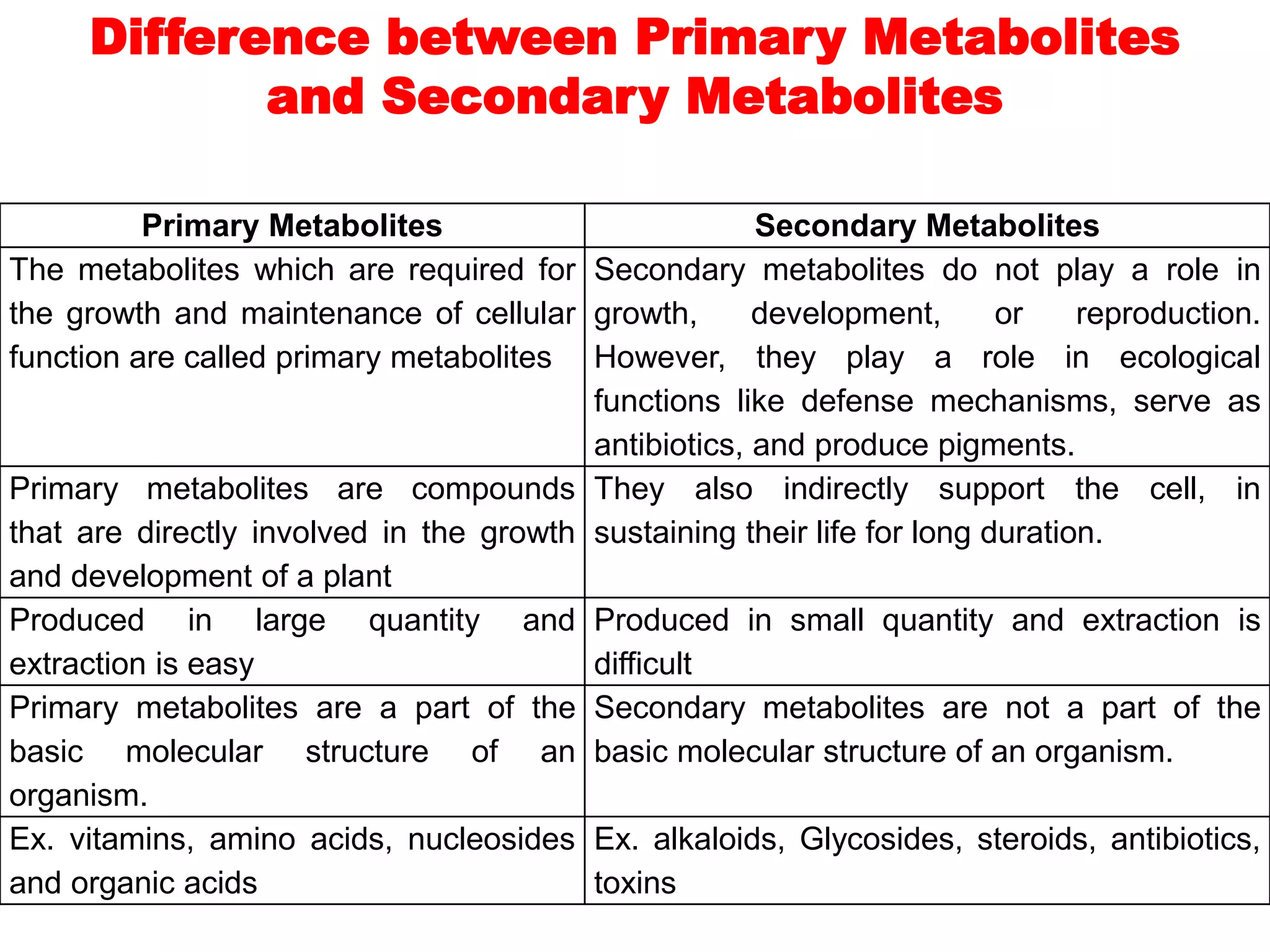
Primary Metabolites Secondary Metabolites
The metabolites which are required for
the growth and maintenance of cellular
function are called primary metabolites
Secondary metabolites do not play a role in
growth, development, or reproduction.
However, they play a role in ecological
functions like defense mechanisms, serve as
antibiotics, and produce pigments.
Primary metabolites are compounds
that are directly involved in the growth
and development of a plant
They also indirectly support the cell, in
sustaining their life for long duration.
Produced in large quantity and
extraction is easy
Produced in small quantity and extraction is
difficult
Primary metabolites are a part of the
basic molecular structure of an
organism.
Secondary metabolites are not a part of the
basic molecular structure of an organism.
Ex. vitamins, amino acids, nucleosides
and organic acids
Ex. alkaloids, Glycosides, steroids, antibiotics,
toxins
Difference between Primary Metabolites
and Secondary Metabolites
Alkaloids
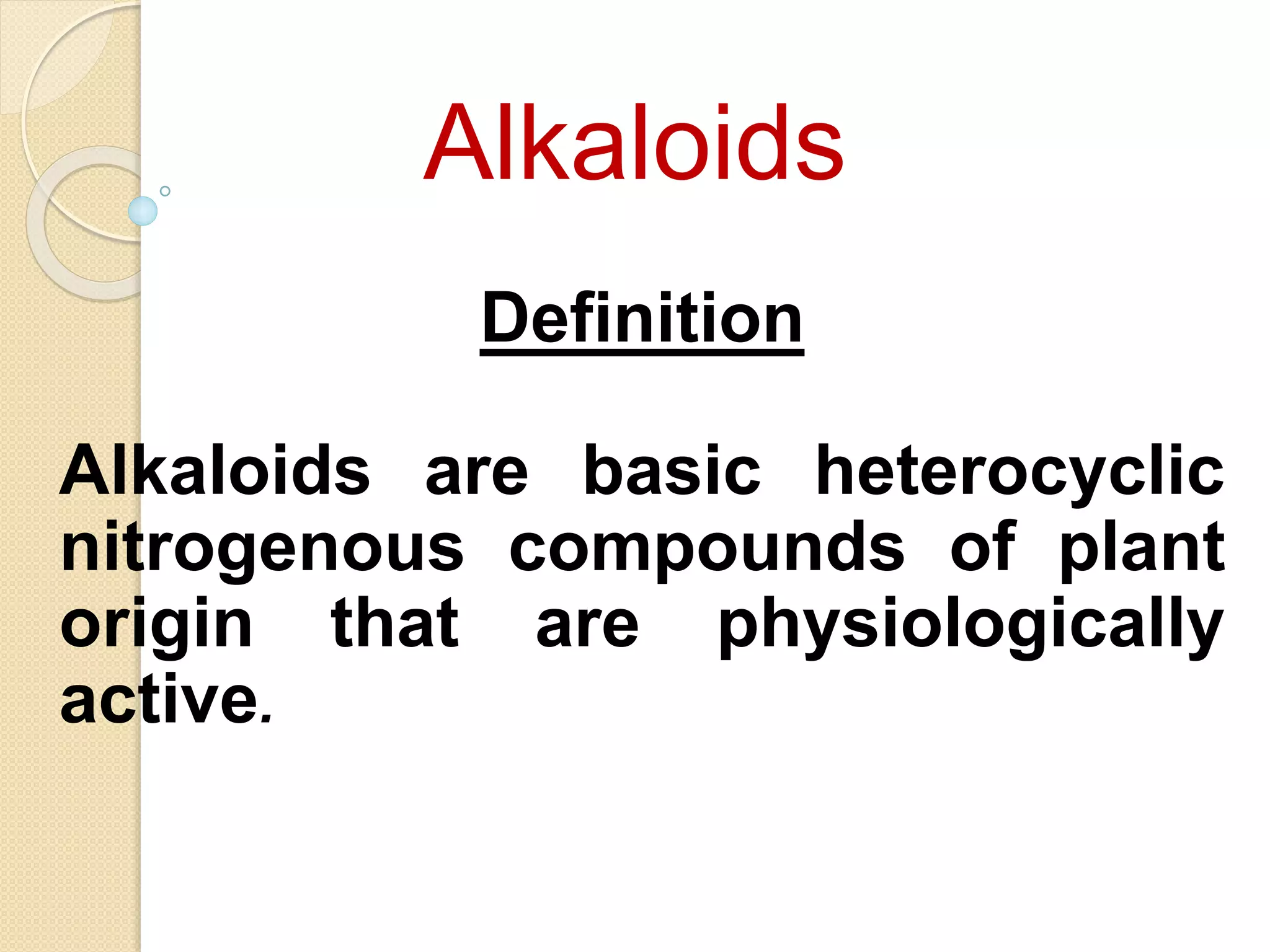
Definition
Alkaloids are basic heterocyclic
nitrogenous compounds of plant
origin that are physiologically
active.
Modified Definition:
Alkaloids are cyclic organic
compounds containing nitrogen in a
negative state of oxidation with limited
distribution among living organisms.
Exceptions with respect to definition:
➢Basicity: Some alkaloids are not basic e.g.
Colchicine, Piperine, Quaternary alkaloids.
➢Nitrogen: The nitrogen in some alkaloids is
not in a heterocyclic ring e.g. Ephedrine,
Colchicine, Mescaline.
➢Plant Origin: Some alkaloids are derived
from Bacteria, Fungi, Insects, Frogs,
Animals.
Distribution and occurence:
Rare in lower plants.
Families rich in Alkaloids: Apocynaceae,
Rubiaceae, Solanaceae and Papaveracea.
Families free from Alkaloids: Rosaceae,
Labiatae.
Distribution in Plant:
➢All Parts e.g. Datura.
➢Barks e.g. Cinchona
➢Seeds e.g. Nux vomica
➢Roots e.g. Aconite
➢Fruits e.g. Black pepper
➢Leaves e.g. Tobacco
➢Latex e.g. Opium
Forms of Alkaloids:
➢Free bases
➢Salts with Organic acids e.g. Oxalic,
acetic acids
➢Salts with inorganic acids e.g. HCl, H2SO4.
➢Salts with special acids: e.g.
Meconic acid in Opium
Quinic acid in Cinchona
➢Glycosidal form e.g. Solanine in Solanum.
Function in Plants
➢Protective.
➢Detoxification.
➢Source of nitrogen.
➢Growth regulators.
➢Source of energy.
Physical Properties:
I- State:
➢ Most alkaloids are crystalline solids.
➢ Few alkaloids are amorphous solids e.g. emetine.
➢ Some are liquids that are either:
Volatile e.g. nicotine and coniine, or
Non-volatile e.g. pilocarpine and
hyoscine.
II- Colour:
The majority of alkaloids are colorless but some are
colored e.g.:
➢ Colchicine and berberine are yellow.
➢ Canadine is orange.
➢ Betanedine is red.
III- Solubility:
➢ Both alkaloidal bases and their salts are soluble in alcohol.
➢ Generally, the bases are soluble in organic solvents and
insoluble in water
Exceptions:
➢ Bases soluble in water: caffeine, ephedrine, codeine,
colchicine, pilocarpine and quaternary ammonium bases.
➢ Bases insoluble or sparingly soluble in certain organic
solvents: morphine in ether, theobromine and theophylline in
benzene.
➢ Salts are usually soluble in water and, insoluble or sparingly
soluble in organic solvents.
Exceptions:
➢ Salts insoluble in water: quinine monosulphate.
➢ Salts soluble in organic solvents: lobeline and apoatropine hydrochlorides
are soluble in chloroform.
Chemical Properties:
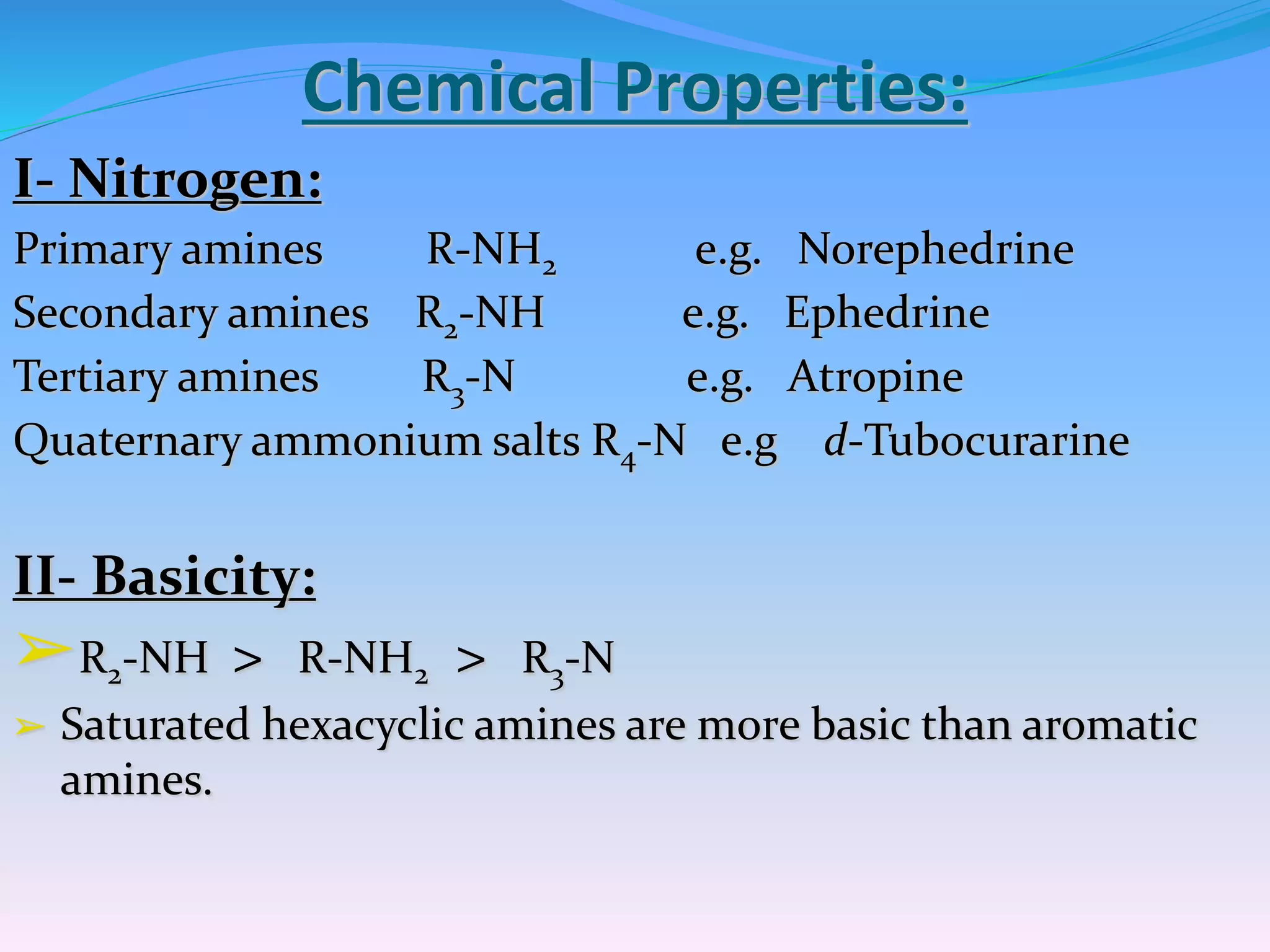
I- Nitrogen:
Primary amines R-NH2 e.g. Norephedrine
Secondary amines R2-NH e.g. Ephedrine
Tertiary amines R3-N e.g. Atropine
Quaternary ammonium salts R4-N e.g d-Tubocurarine
II- Basicity:
➢R2-NH > R-NH2 > R3-N
➢ Saturated hexacyclic amines are more basic than aromatic
amines.
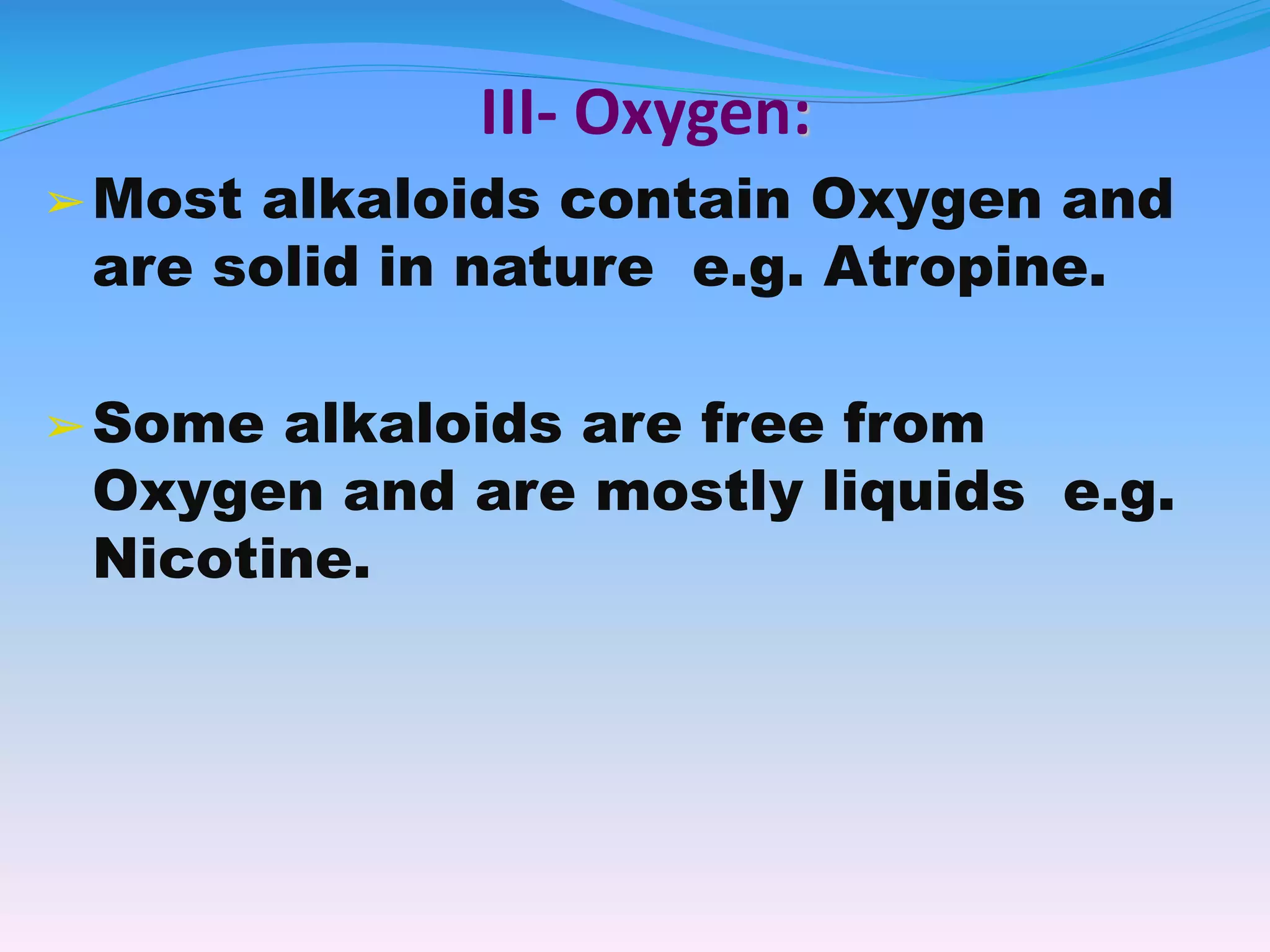
III- Oxygen:
➢Most alkaloids contain Oxygen and
are solid in nature e.g. Atropine.
➢Some alkaloids are free from
Oxygen and are mostly liquids e.g.
Nicotine.
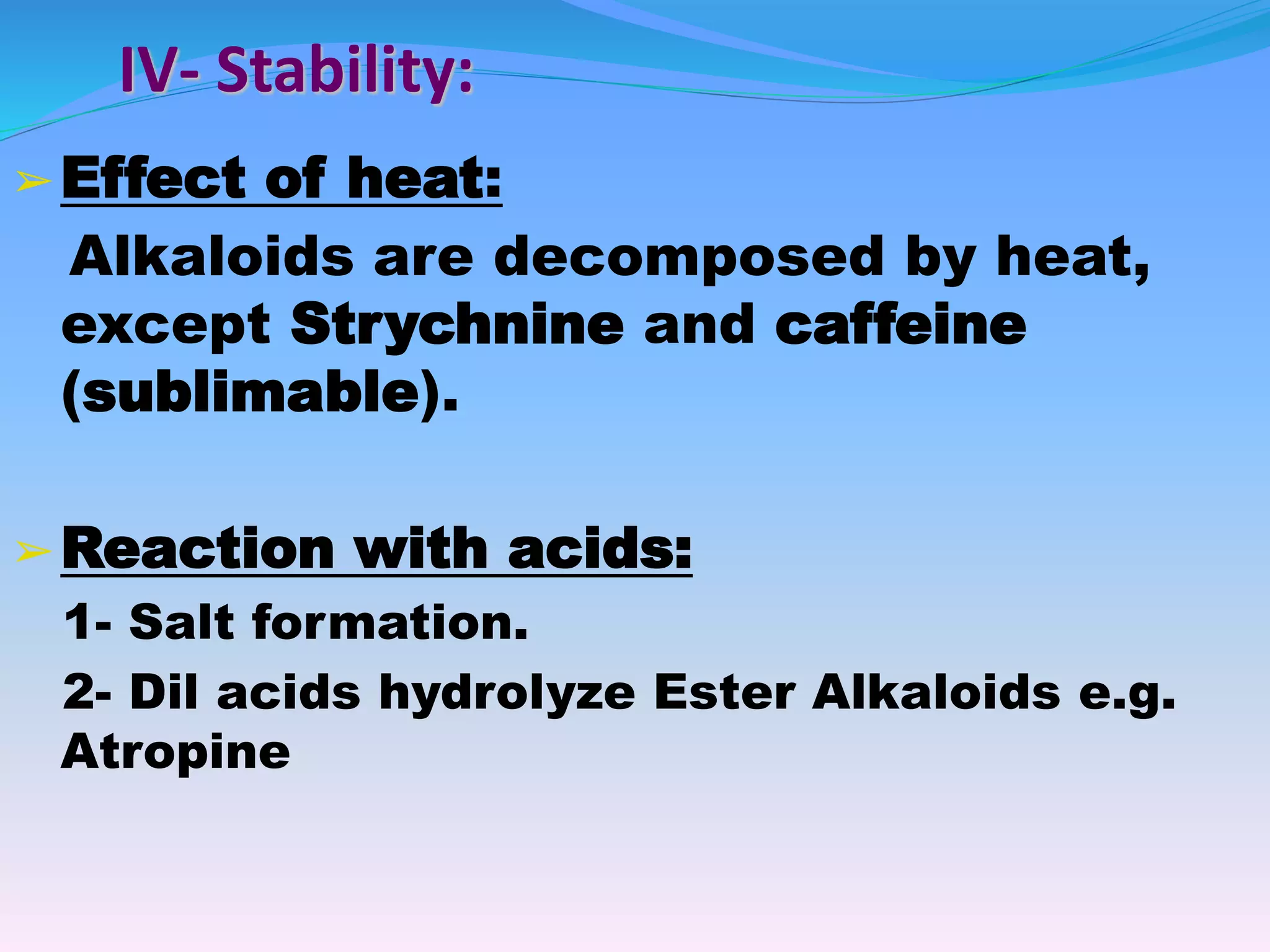
IV- Stability:
➢Effect of heat:
Alkaloids are decomposed by heat,
except Strychnine and caffeine
(sublimable).
➢Reaction with acids:
1- Salt formation.
2- Dil acids hydrolyze Ester Alkaloids e.g.
Atropine
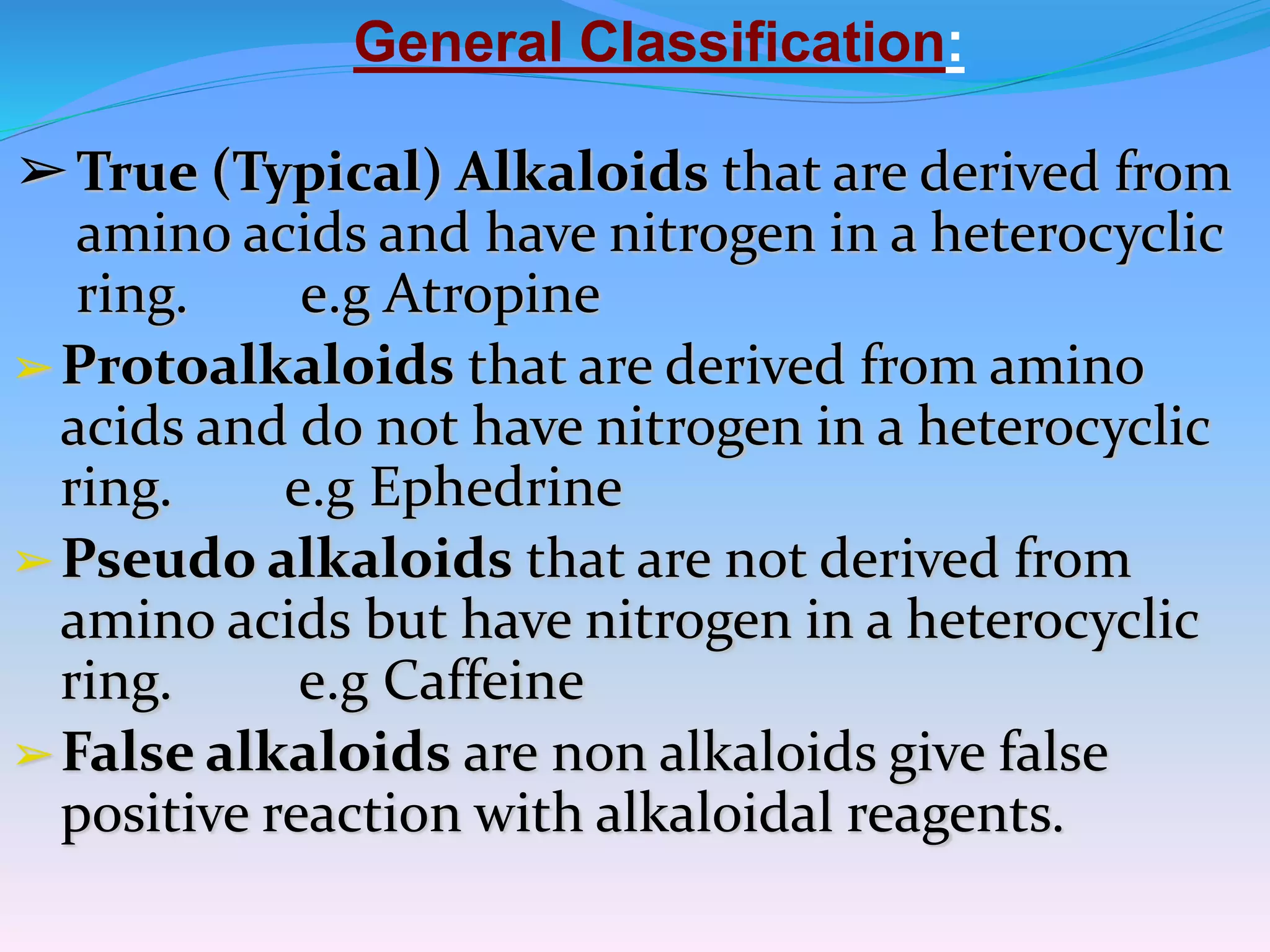
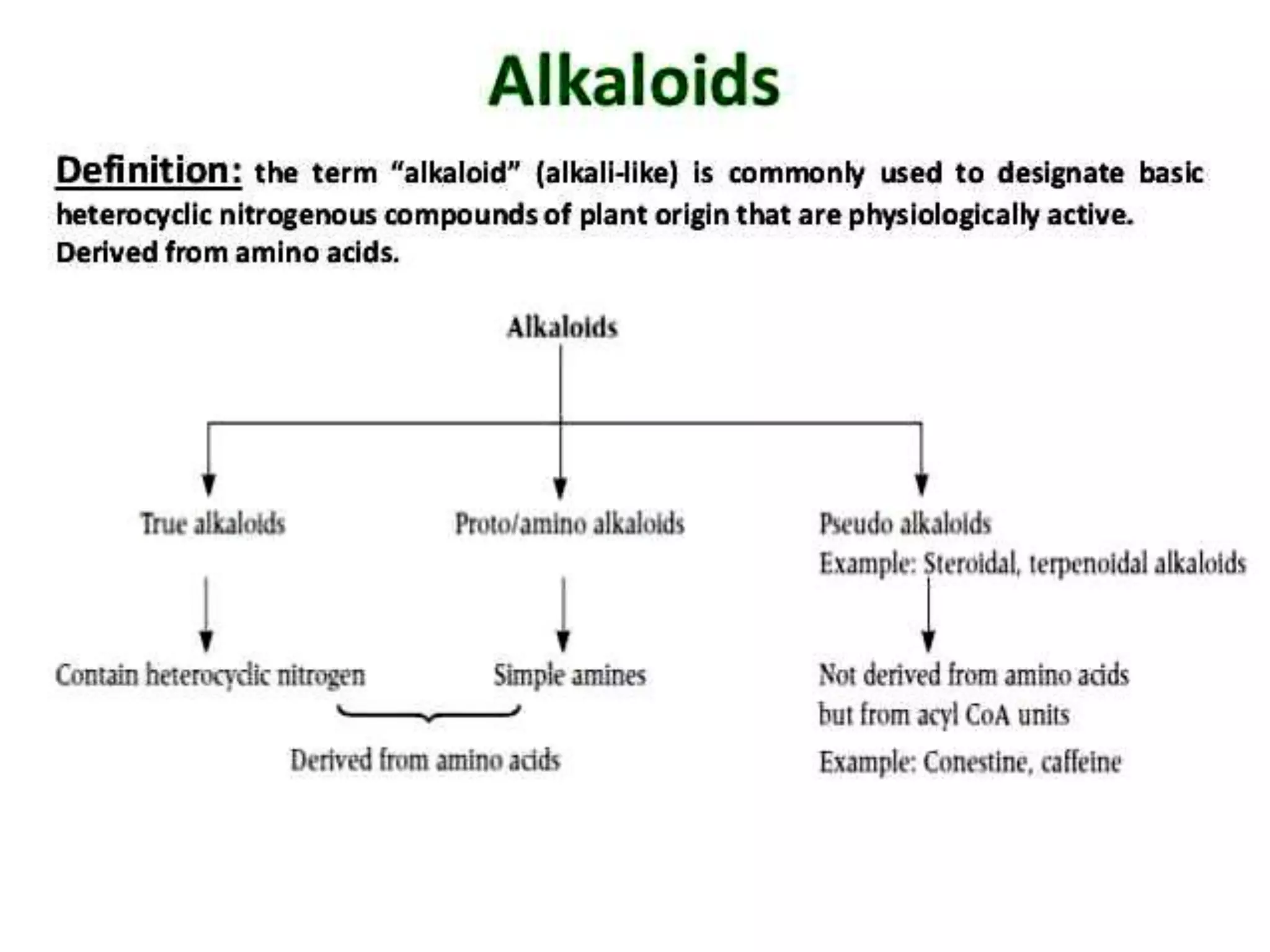
General Classification:
➢True (Typical) Alkaloids that are derived from
amino acids and have nitrogen in a heterocyclic
ring. e.g Atropine
➢Protoalkaloids that are derived from amino
acids and do not have nitrogen in a heterocyclic
ring. e.g Ephedrine
➢Pseudo alkaloids that are not derived from
amino acids but have nitrogen in a heterocyclic
ring. e.g Caffeine
➢False alkaloids are non alkaloids give false
positive reaction with alkaloidal reagents.
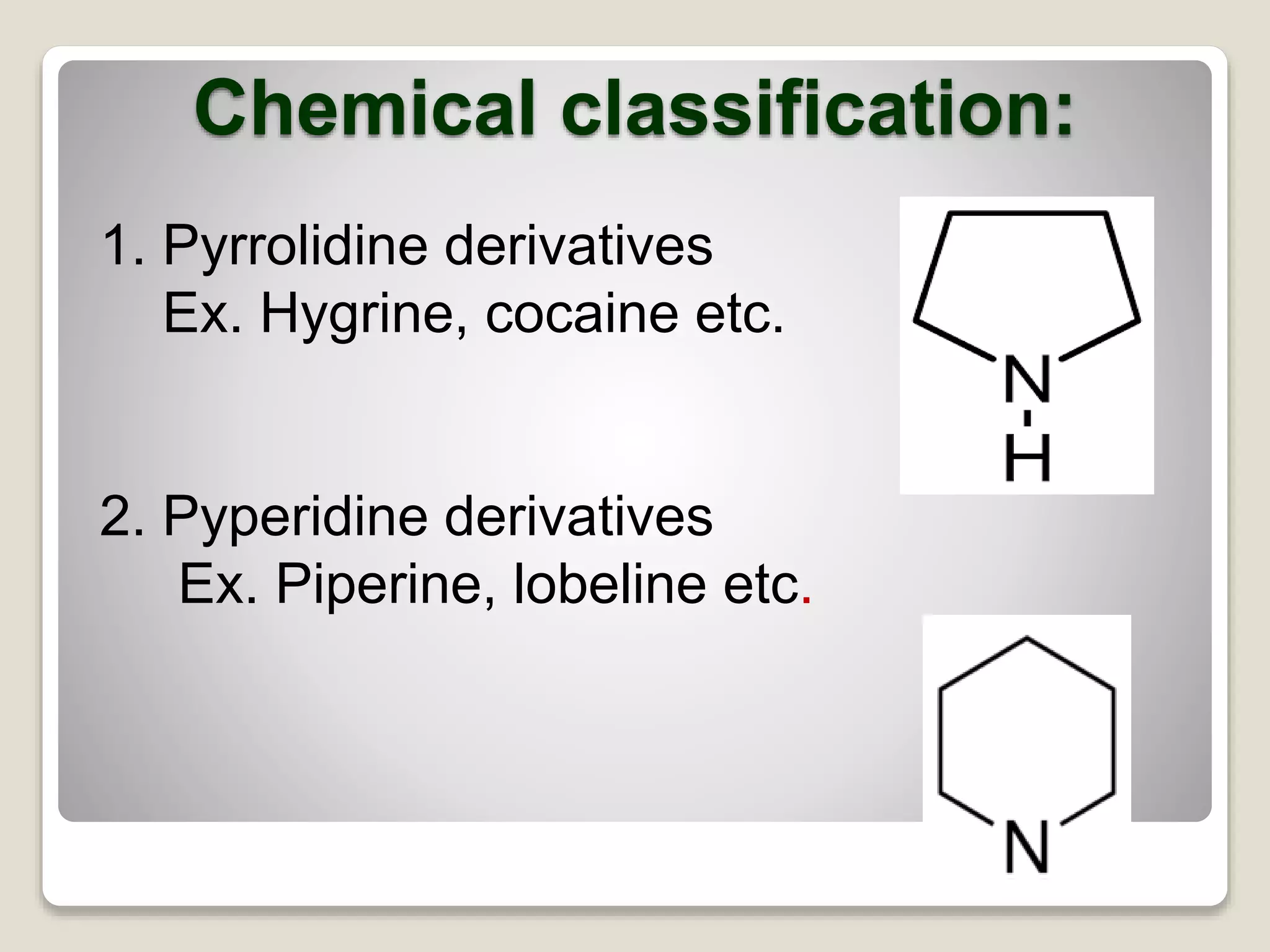
Chemical classification:
1. Pyrrolidine derivatives
Ex. Hygrine, cocaine etc.
2. Pyperidine derivatives
Ex. Piperine, lobeline etc.
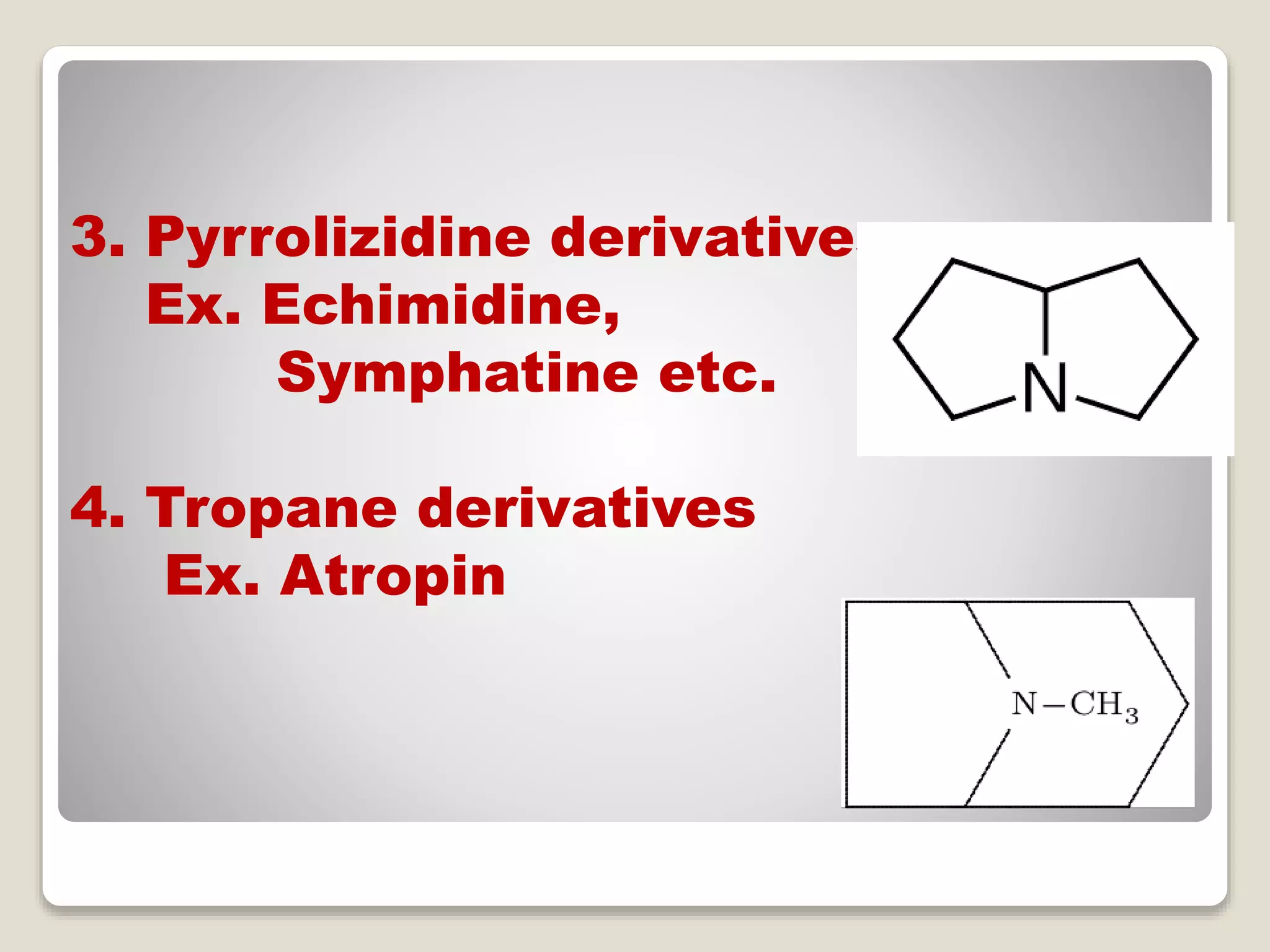
3. Pyrrolizidine derivatives
Ex. Echimidine,
Symphatine etc.
4. Tropane derivatives
Ex. Atropin
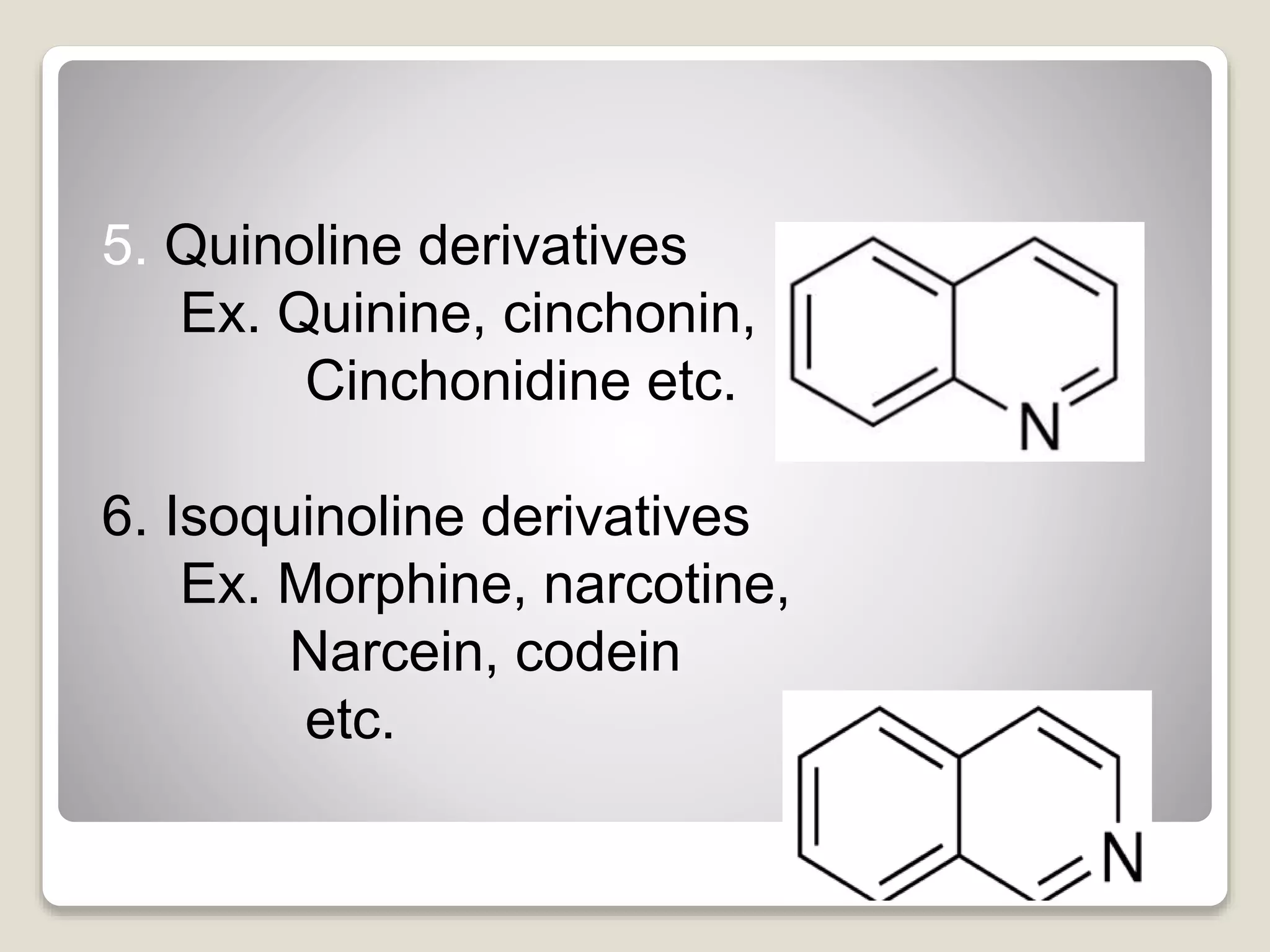
5. Quinoline derivatives
Ex. Quinine, cinchonin,
Cinchonidine etc.
6. Isoquinoline derivatives
Ex. Morphine, narcotine,
Narcein, codein
etc.
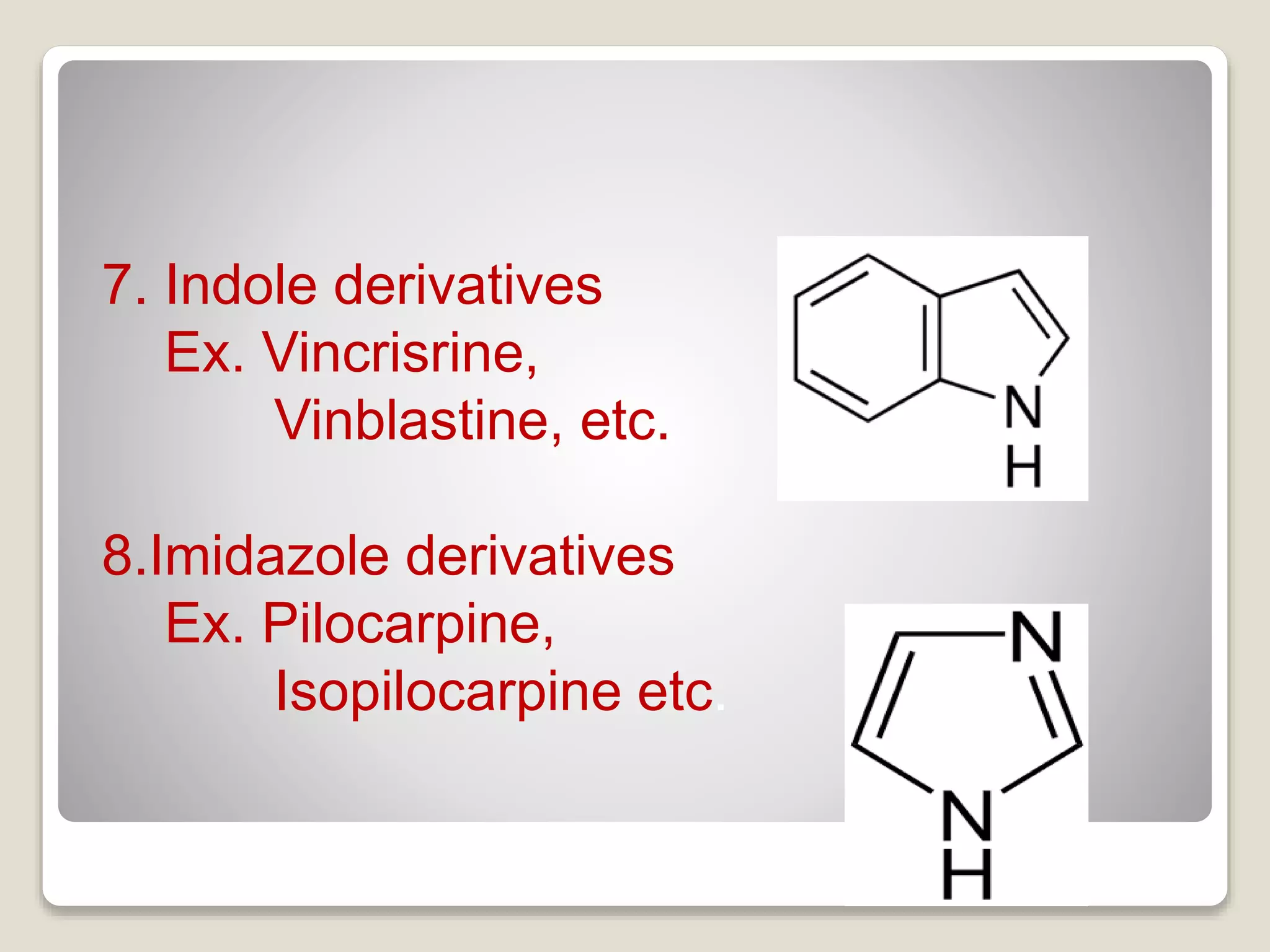
7. Indole derivatives
Ex. Vincrisrine,
Vinblastine, etc.
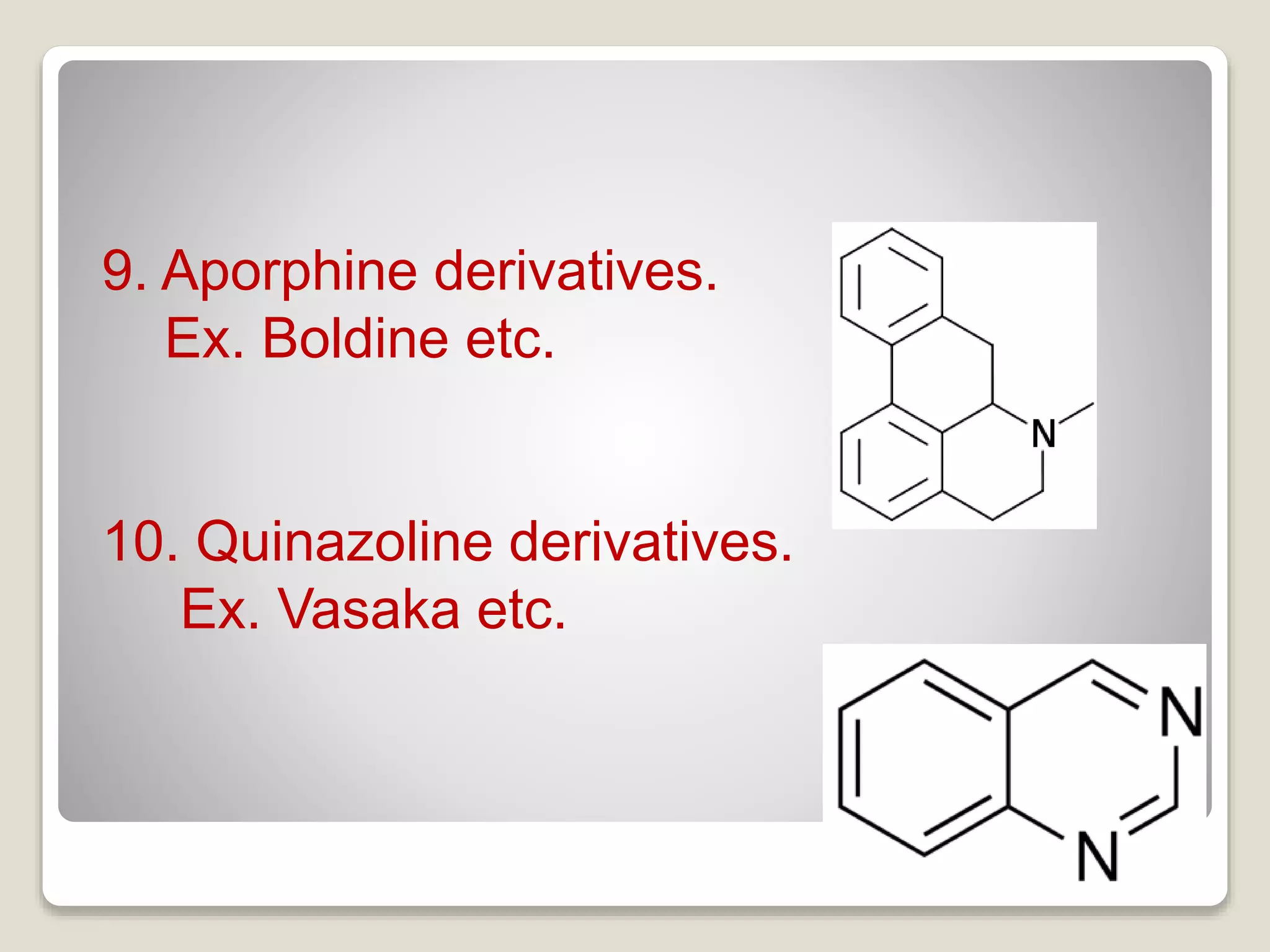
8.Imidazole derivatives
Ex. Pilocarpine,
Isopilocarpine etc.
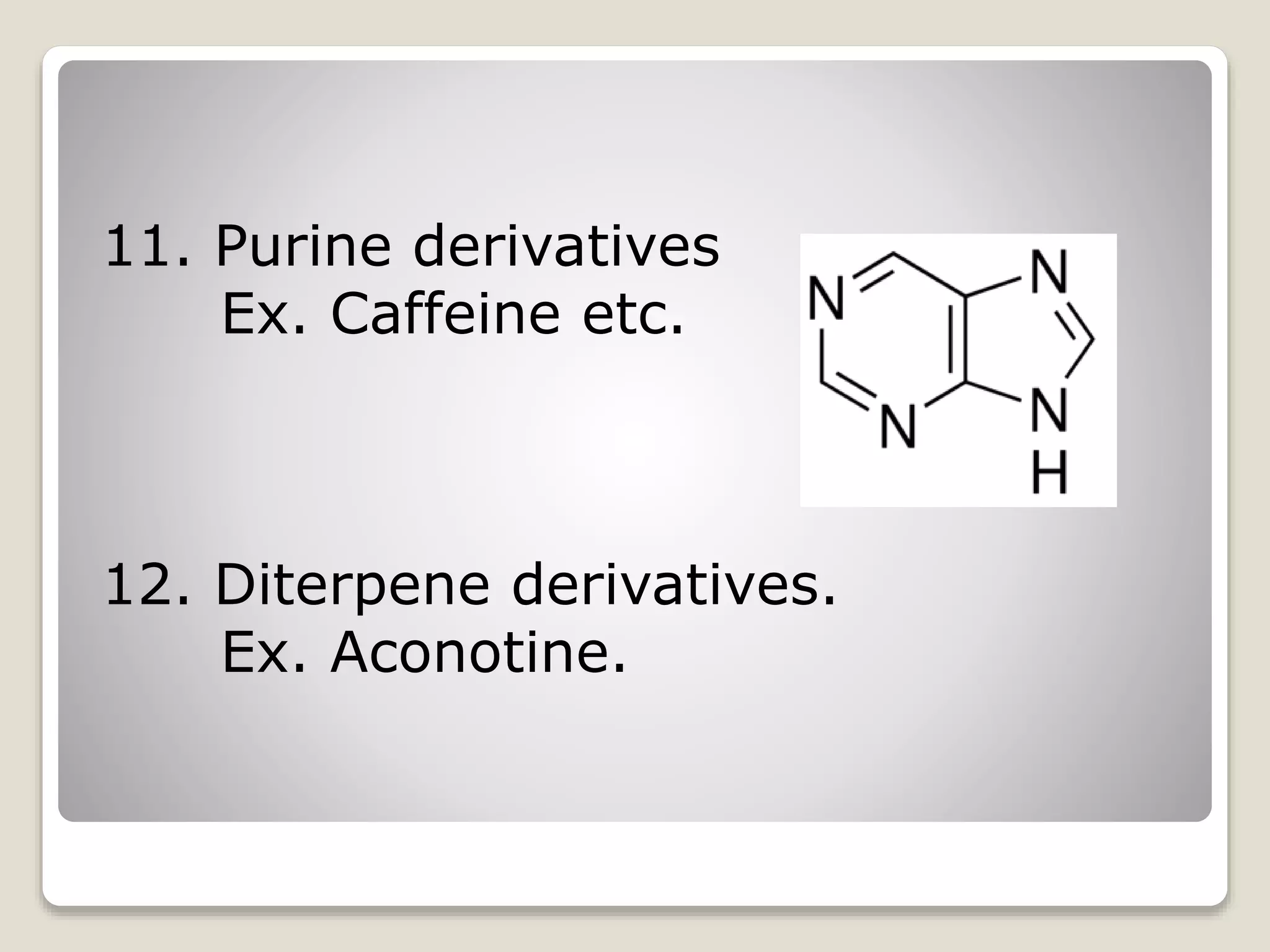
9. Aporphine derivatives.
Ex. Boldine etc.
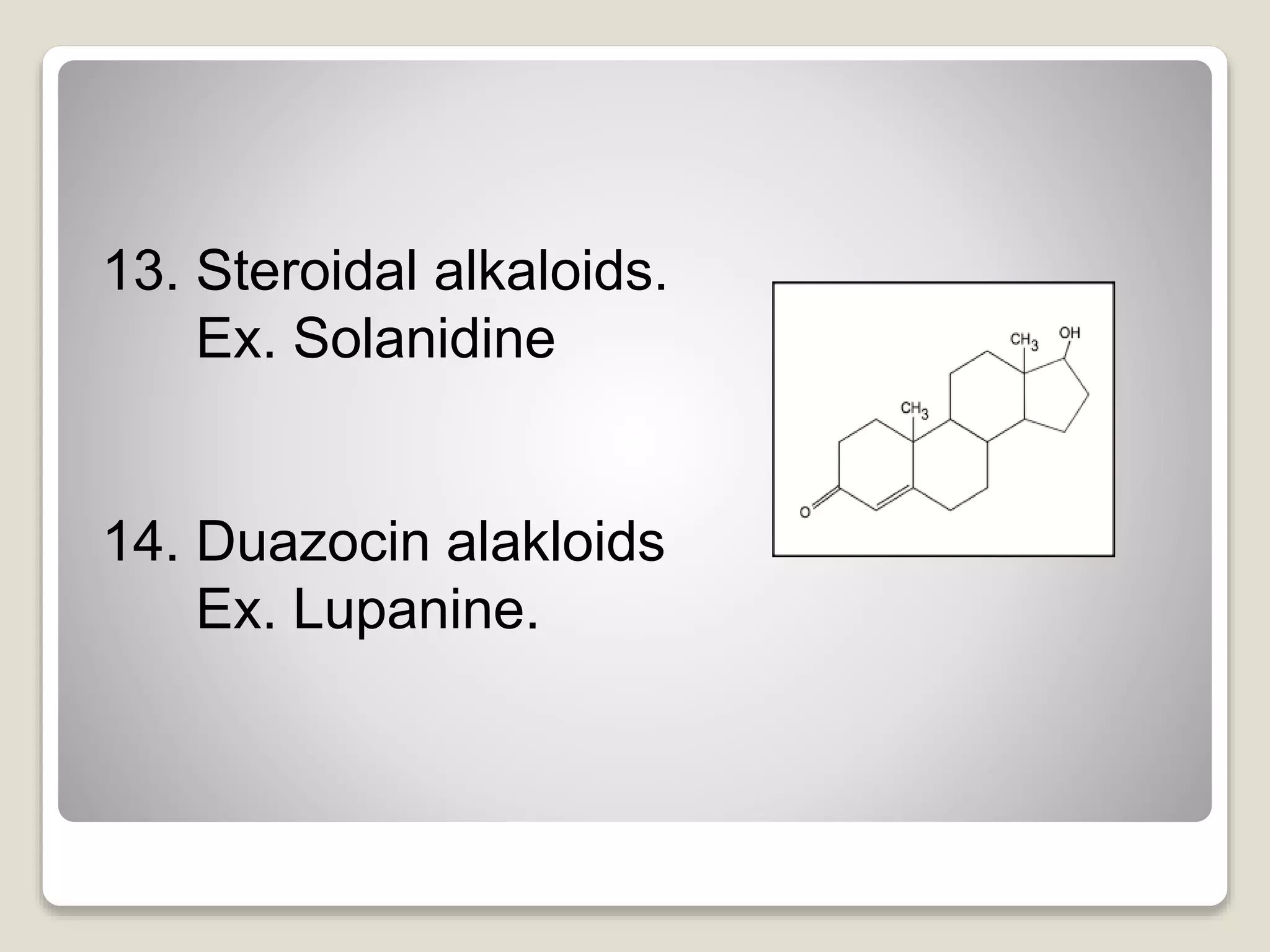
10. Quinazoline derivatives.
Ex. Vasaka etc.
11. Purine derivatives
Ex. Caffeine etc.
12. Diterpene derivatives.
Ex. Aconotine.
13. Steroidal alkaloids.
Ex. Solanidine
14. Duazocin alakloids
Ex. Lupanine.
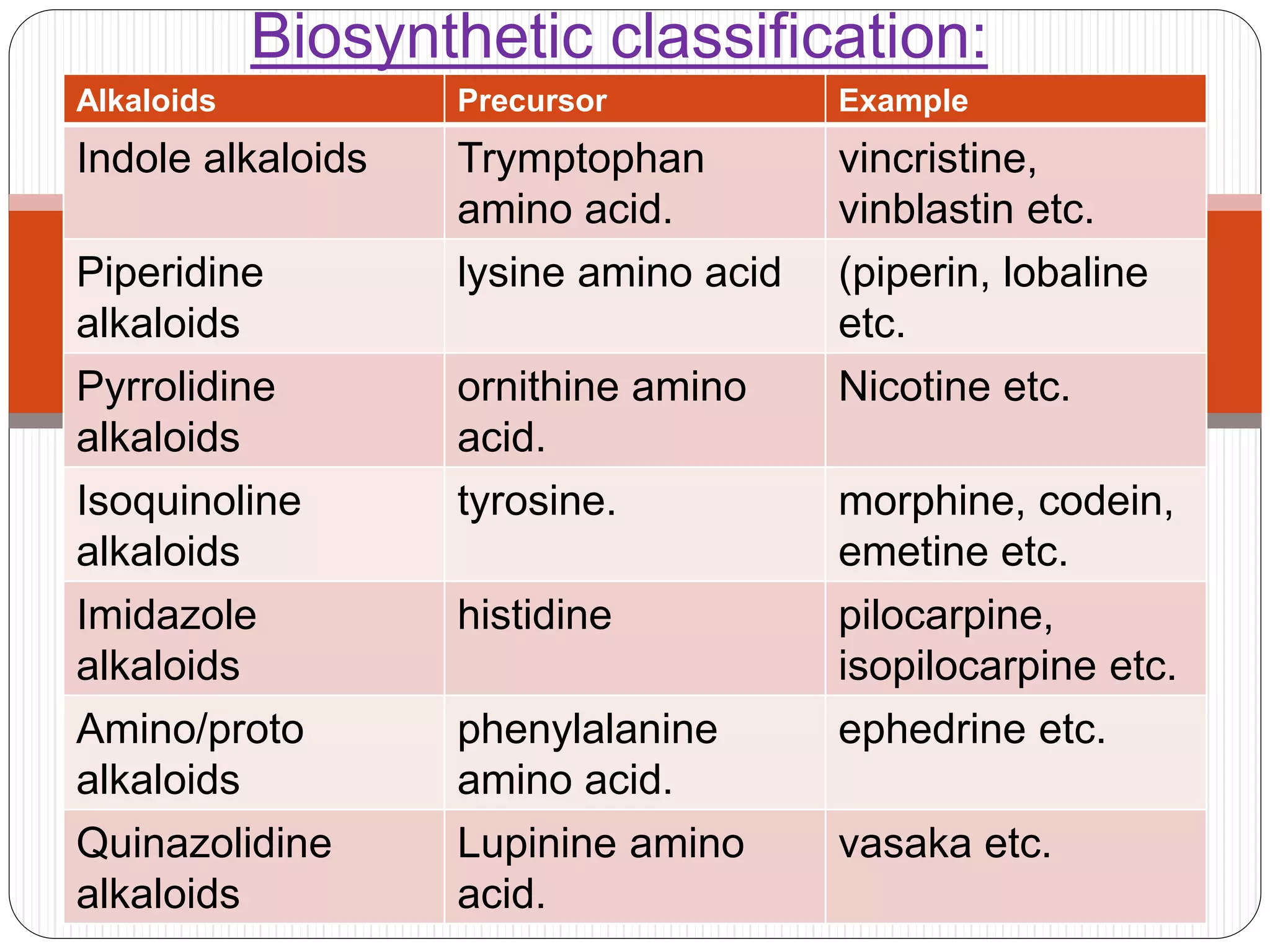
Biosynthetic classification:
Alkaloids Precursor Example
Indole alkaloids Trymptophan
amino acid.
vincristine,
vinblastin etc.
Piperidine
alkaloids
lysine amino acid (piperin, lobaline
etc.
Pyrrolidine
alkaloids
ornithine amino
acid.
Nicotine etc.
Isoquinoline
alkaloids
tyrosine. morphine, codein,
emetine etc.
Imidazole
alkaloids
histidine pilocarpine,
isopilocarpine etc.
Amino/proto
alkaloids
phenylalanine
amino acid.
ephedrine etc.
Quinazolidine
alkaloids
Lupinine amino
acid.
vasaka etc.
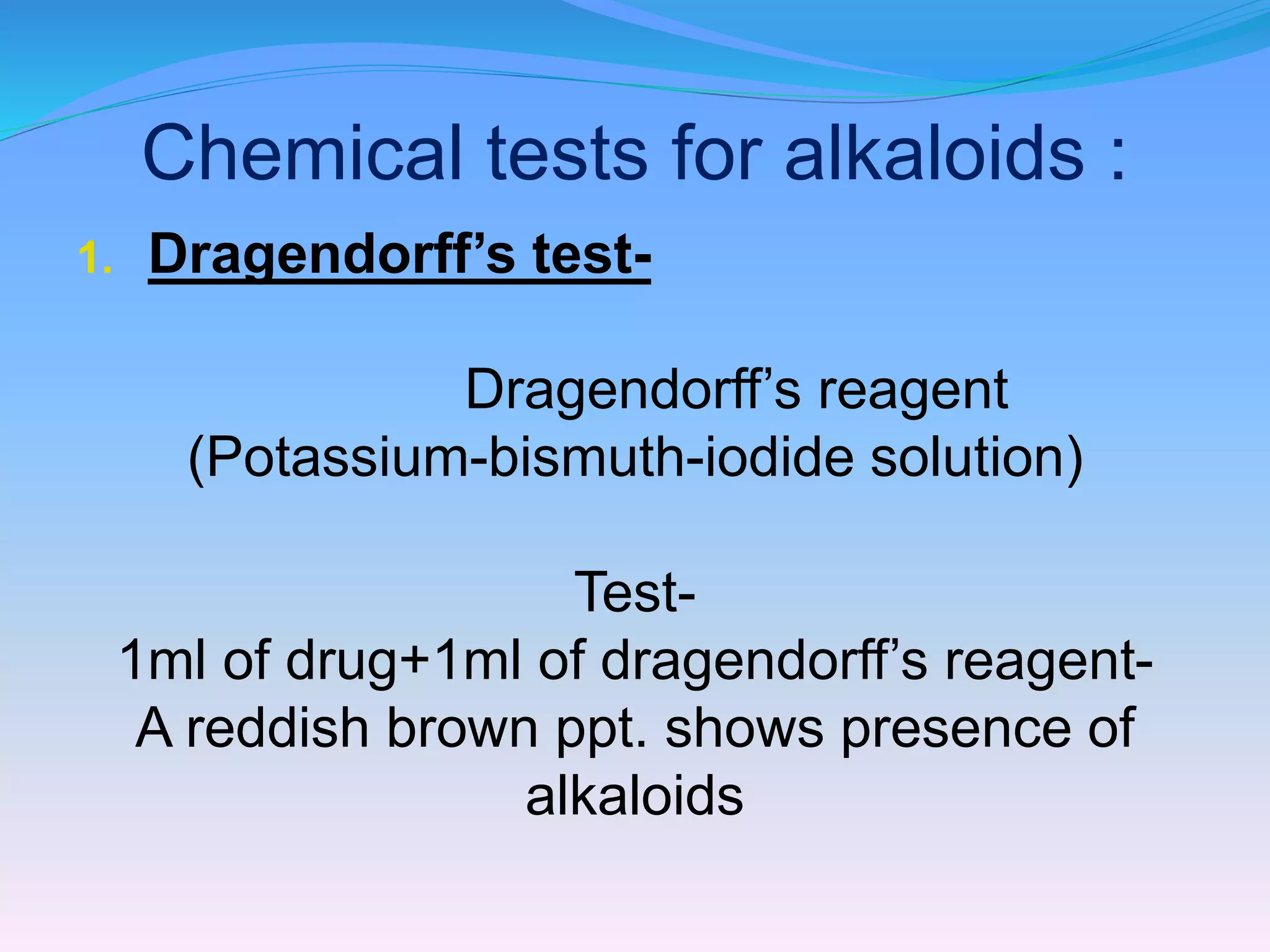
Chemical tests for alkaloids :
1. Dragendorff’s test-
Dragendorff’s reagent
(Potassium-bismuth-iodide solution)
Test-
1ml of drug+1ml of dragendorff’s reagent-
A reddish brown ppt. shows presence of
alkaloids
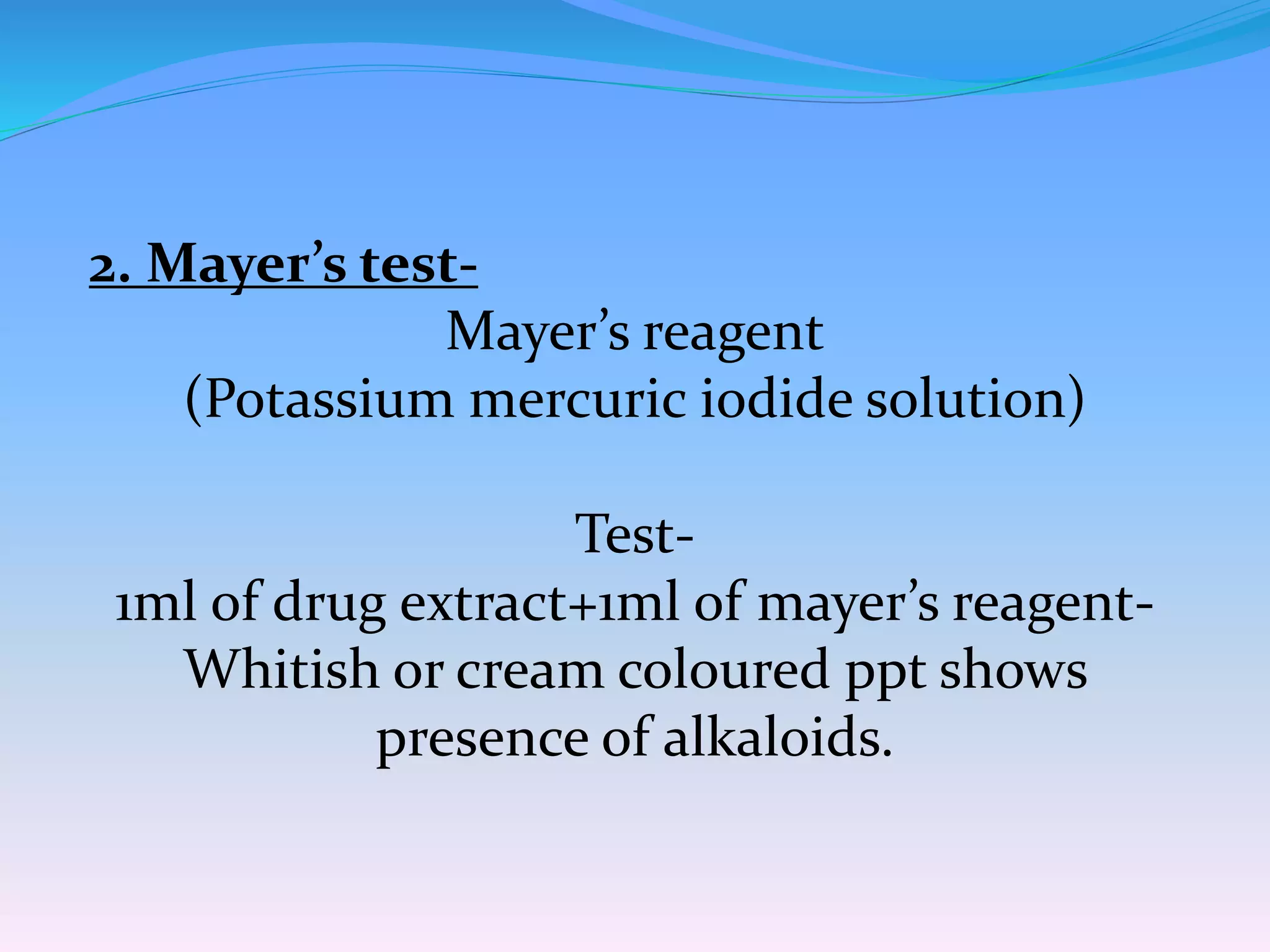
2. Mayer’s test-
Mayer’s reagent
(Potassium mercuric iodide solution)
Test-
1ml of drug extract+1ml of mayer’s reagent-
Whitish or cream coloured ppt shows
presence of alkaloids.
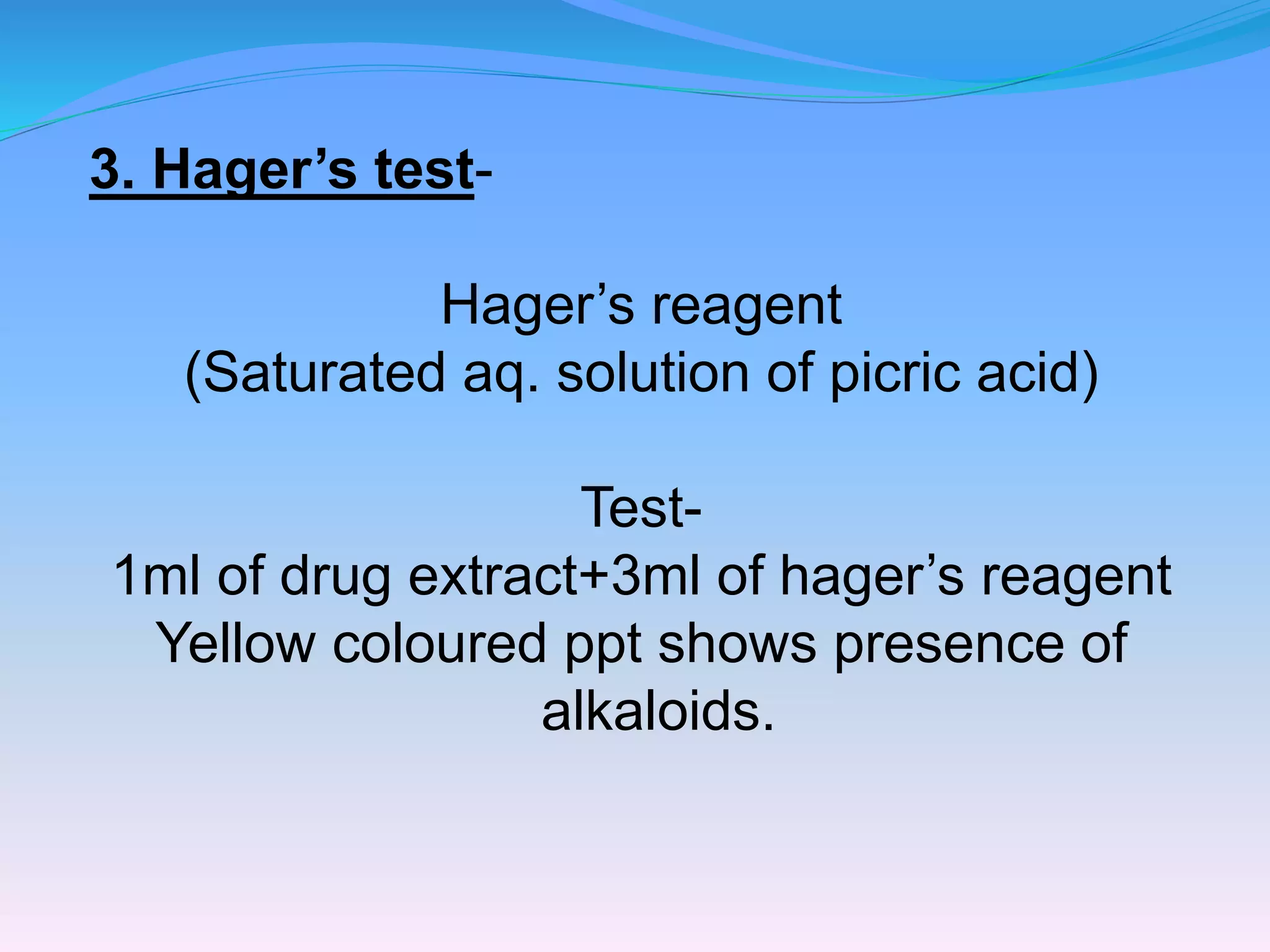
3. Hager’s test-
Hager’s reagent
(Saturated aq. solution of picric acid)
Test-
1ml of drug extract+3ml of hager’s reagent
Yellow coloured ppt shows presence of
alkaloids.
4. Wagner’s test-
Wagner’s reagent
(Iodine-potassium-iodide solution)
Test-
Drug extract+wagner’s reagent
Brown or reddish brown colour shows
presence of alkaloids.
5. Tannic acid test-
Test-
Drug extract+5% tannic acid solution-
Buff colour ppt. shows presence of
alkaloids.
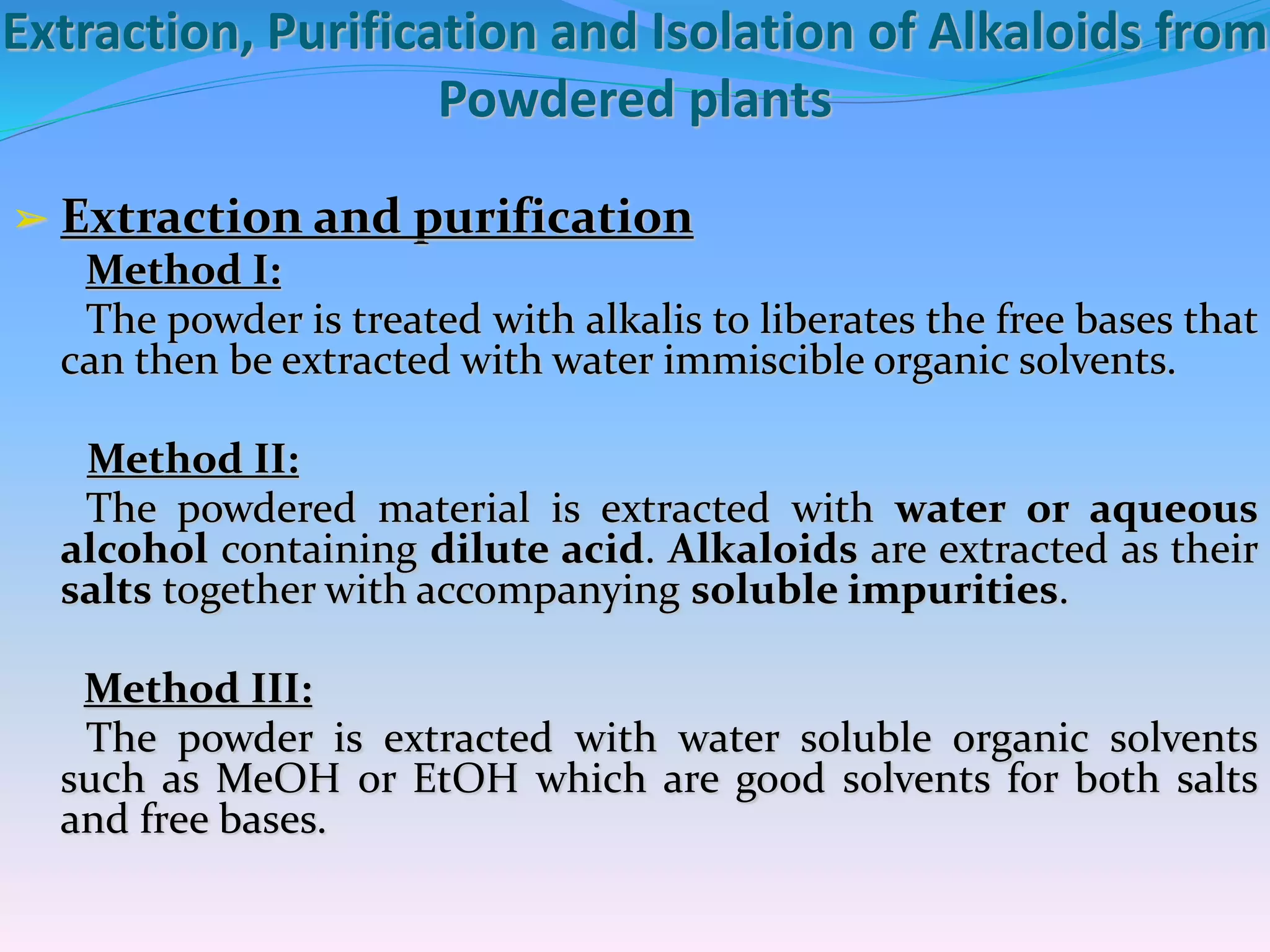
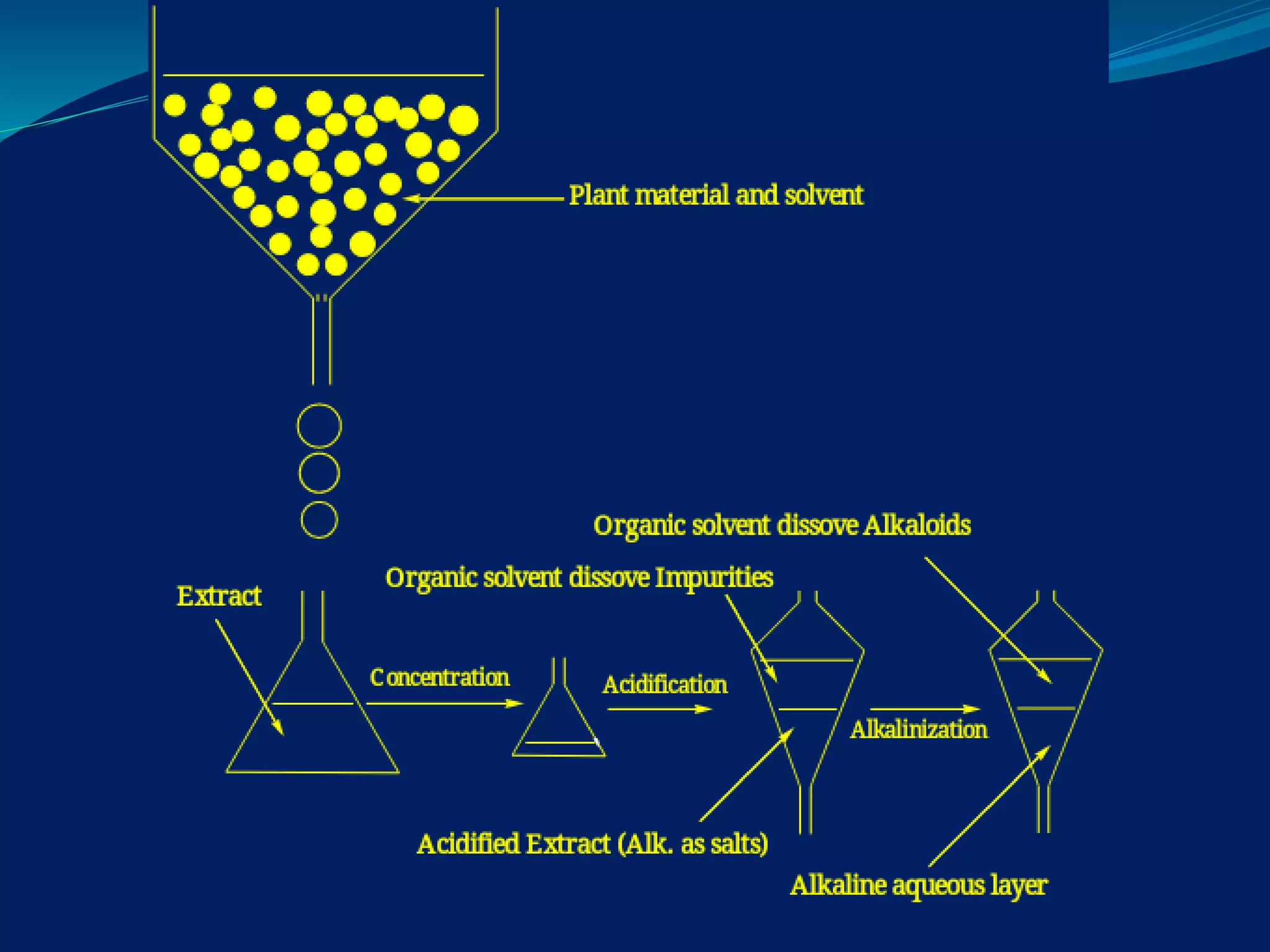
Extraction, Purification and Isolation of Alkaloids from
Powdered plants
➢ Extraction and purification
Method I:
The powder is treated with alkalis to liberates the free bases that
can then be extracted with water immiscible organic solvents.
Method II:
The powdered material is extracted with water or aqueous
alcohol containing dilute acid. Alkaloids are extracted as their
salts together with accompanying soluble impurities.
Method III:
The powder is extracted with water soluble organic solvents
such as MeOH or EtOH which are good solvents for both salts
and free bases.
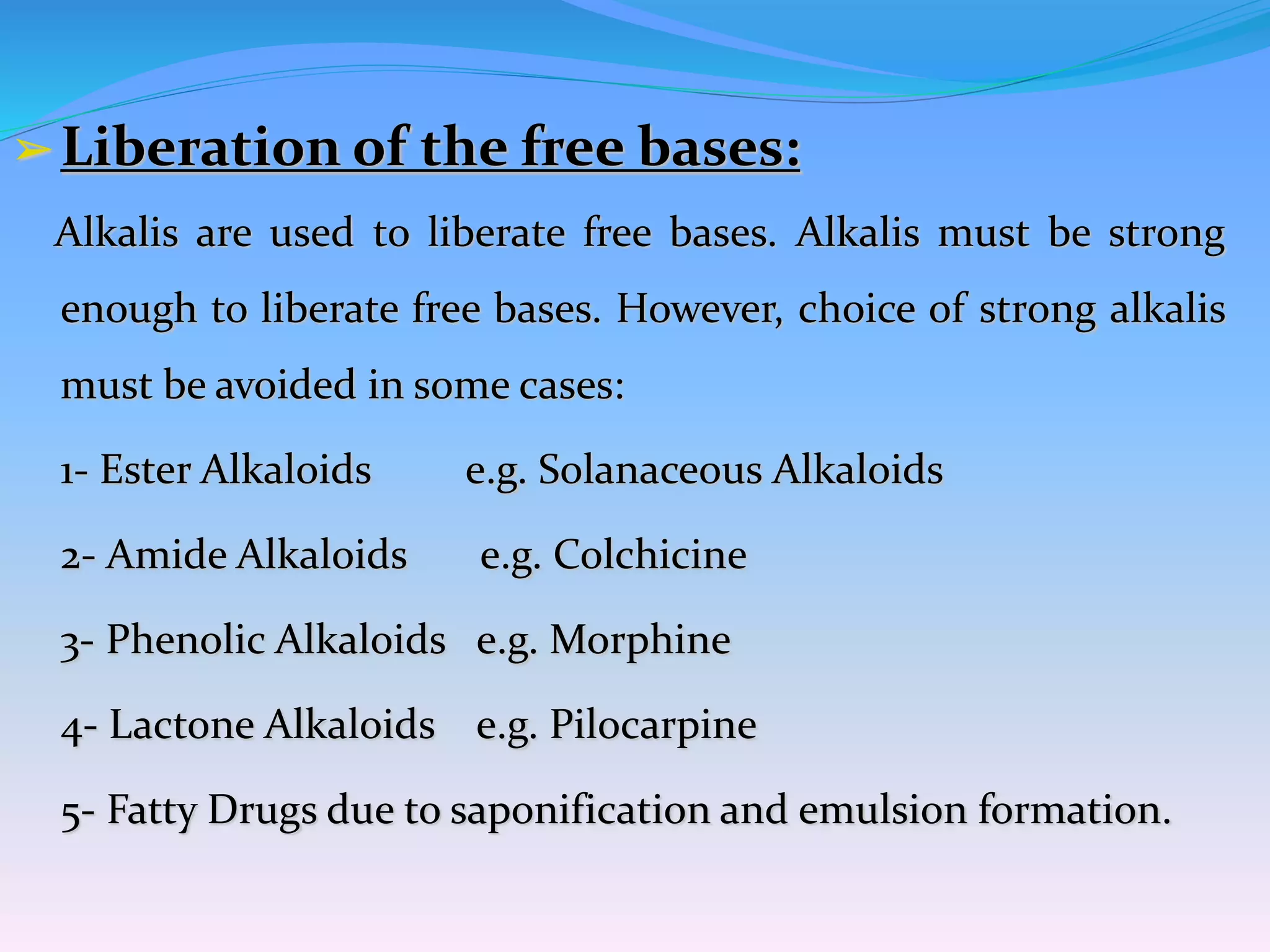
➢Liberation of the free bases:
Alkalis are used to liberate free bases. Alkalis must be strong
enough to liberate free bases. However, choice of strong alkalis
must be avoided in some cases:
1- Ester Alkaloids e.g. Solanaceous Alkaloids
2- Amide Alkaloids e.g. Colchicine
3- Phenolic Alkaloids e.g. Morphine
4- Lactone Alkaloids e.g. Pilocarpine
5- Fatty Drugs due to saponification and emulsion formation.
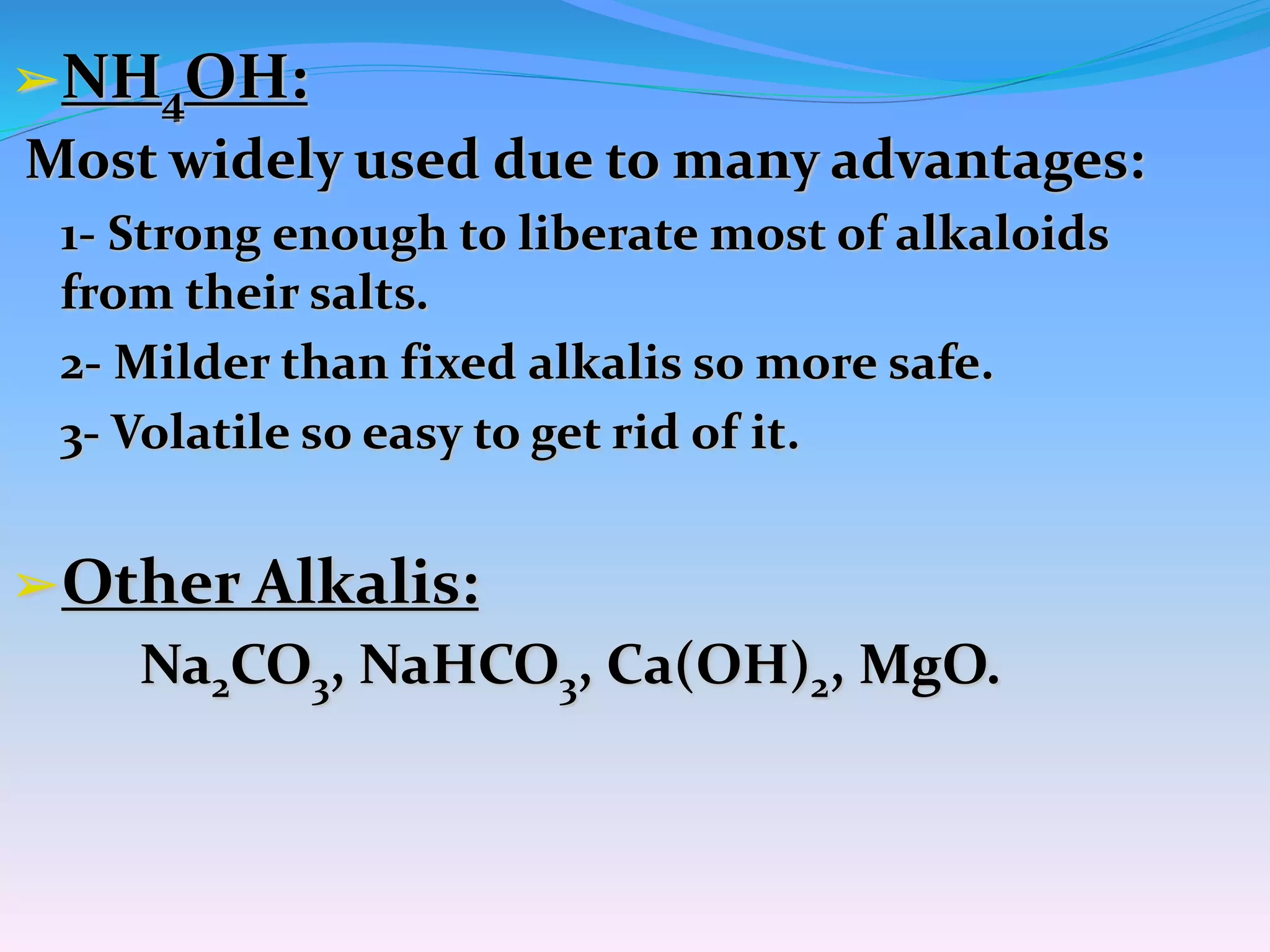
➢NH4OH:
Most widely used due to many advantages:
1- Strong enough to liberate most of alkaloids
from their salts.
2- Milder than fixed alkalis so more safe.
3- Volatile so easy to get rid of it.
➢Other Alkalis:
Na2CO3, NaHCO3, Ca(OH)2, MgO.
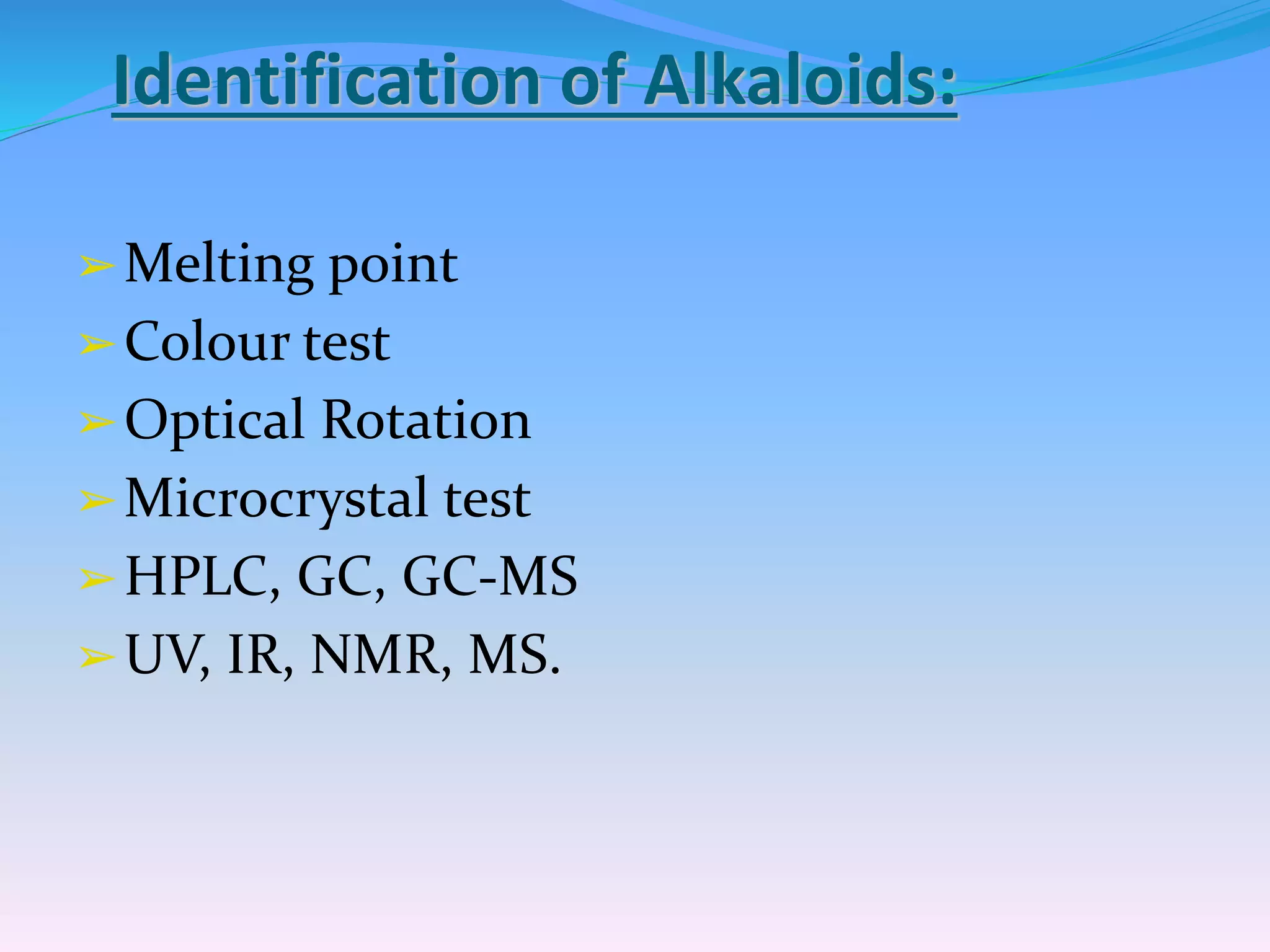
Identification of Alkaloids:
➢Melting point
➢Colour test
➢Optical Rotation
➢Microcrystal test
➢HPLC, GC, GC-MS
➢UV, IR, NMR, MS.
THANX
FOR
GIVING
YOUR
VALUABLE TIME

Alkaloids: Introduction, Property and classification

  • 1.
    ALKALOID: AN OVERVIEW Presentedby Mr. O. P. Verma Associate Professor Dept. of Pharmacognosy Goel Institute of Pharmacy and Sciences, Lucknow
  • 2.
    Content ➢Metabolites ➢Definition ➢Exceptions with respectto definition ➢Distribution, occurence & forms of alkaloids. ➢Physical & chemical properties ➢Classification of alkaloids ➢Chemical test for alkaloids ➢Extraction, isolation & purification of alkaloids
  • 3.
    Primary Metabolites SecondaryMetabolites The metabolites which are required for the growth and maintenance of cellular function are called primary metabolites Secondary metabolites do not play a role in growth, development, or reproduction. However, they play a role in ecological functions like defense mechanisms, serve as antibiotics, and produce pigments. Primary metabolites are compounds that are directly involved in the growth and development of a plant They also indirectly support the cell, in sustaining their life for long duration. Produced in large quantity and extraction is easy Produced in small quantity and extraction is difficult Primary metabolites are a part of the basic molecular structure of an organism. Secondary metabolites are not a part of the basic molecular structure of an organism. Ex. vitamins, amino acids, nucleosides and organic acids Ex. alkaloids, Glycosides, steroids, antibiotics, toxins Difference between Primary Metabolites and Secondary Metabolites
  • 4.
    Alkaloids Definition Alkaloids are basicheterocyclic nitrogenous compounds of plant origin that are physiologically active.
  • 5.
    Modified Definition: Alkaloids arecyclic organic compounds containing nitrogen in a negative state of oxidation with limited distribution among living organisms.
  • 6.
    Exceptions with respectto definition: ➢Basicity: Some alkaloids are not basic e.g. Colchicine, Piperine, Quaternary alkaloids. ➢Nitrogen: The nitrogen in some alkaloids is not in a heterocyclic ring e.g. Ephedrine, Colchicine, Mescaline. ➢Plant Origin: Some alkaloids are derived from Bacteria, Fungi, Insects, Frogs, Animals.
  • 7.
    Distribution and occurence: Rarein lower plants. Families rich in Alkaloids: Apocynaceae, Rubiaceae, Solanaceae and Papaveracea. Families free from Alkaloids: Rosaceae, Labiatae.
  • 8.
    Distribution in Plant: ➢AllParts e.g. Datura. ➢Barks e.g. Cinchona ➢Seeds e.g. Nux vomica ➢Roots e.g. Aconite ➢Fruits e.g. Black pepper ➢Leaves e.g. Tobacco ➢Latex e.g. Opium
  • 9.
    Forms of Alkaloids: ➢Freebases ➢Salts with Organic acids e.g. Oxalic, acetic acids ➢Salts with inorganic acids e.g. HCl, H2SO4. ➢Salts with special acids: e.g. Meconic acid in Opium Quinic acid in Cinchona ➢Glycosidal form e.g. Solanine in Solanum.
  • 10.
    Function in Plants ➢Protective. ➢Detoxification. ➢Sourceof nitrogen. ➢Growth regulators. ➢Source of energy.
  • 11.
    Physical Properties: I- State: ➢Most alkaloids are crystalline solids. ➢ Few alkaloids are amorphous solids e.g. emetine. ➢ Some are liquids that are either: Volatile e.g. nicotine and coniine, or Non-volatile e.g. pilocarpine and hyoscine. II- Colour: The majority of alkaloids are colorless but some are colored e.g.: ➢ Colchicine and berberine are yellow. ➢ Canadine is orange. ➢ Betanedine is red.
  • 12.
    III- Solubility: ➢ Bothalkaloidal bases and their salts are soluble in alcohol. ➢ Generally, the bases are soluble in organic solvents and insoluble in water Exceptions: ➢ Bases soluble in water: caffeine, ephedrine, codeine, colchicine, pilocarpine and quaternary ammonium bases. ➢ Bases insoluble or sparingly soluble in certain organic solvents: morphine in ether, theobromine and theophylline in benzene. ➢ Salts are usually soluble in water and, insoluble or sparingly soluble in organic solvents. Exceptions: ➢ Salts insoluble in water: quinine monosulphate. ➢ Salts soluble in organic solvents: lobeline and apoatropine hydrochlorides are soluble in chloroform.
  • 13.
    Chemical Properties: I- Nitrogen: Primaryamines R-NH2 e.g. Norephedrine Secondary amines R2-NH e.g. Ephedrine Tertiary amines R3-N e.g. Atropine Quaternary ammonium salts R4-N e.g d-Tubocurarine II- Basicity: ➢R2-NH > R-NH2 > R3-N ➢ Saturated hexacyclic amines are more basic than aromatic amines.
  • 14.
    III- Oxygen: ➢Most alkaloidscontain Oxygen and are solid in nature e.g. Atropine. ➢Some alkaloids are free from Oxygen and are mostly liquids e.g. Nicotine.
  • 15.
    IV- Stability: ➢Effect ofheat: Alkaloids are decomposed by heat, except Strychnine and caffeine (sublimable). ➢Reaction with acids: 1- Salt formation. 2- Dil acids hydrolyze Ester Alkaloids e.g. Atropine
  • 16.
    General Classification: ➢True (Typical)Alkaloids that are derived from amino acids and have nitrogen in a heterocyclic ring. e.g Atropine ➢Protoalkaloids that are derived from amino acids and do not have nitrogen in a heterocyclic ring. e.g Ephedrine ➢Pseudo alkaloids that are not derived from amino acids but have nitrogen in a heterocyclic ring. e.g Caffeine ➢False alkaloids are non alkaloids give false positive reaction with alkaloidal reagents.
  • 18.
    Chemical classification: 1. Pyrrolidinederivatives Ex. Hygrine, cocaine etc. 2. Pyperidine derivatives Ex. Piperine, lobeline etc.
  • 19.
    3. Pyrrolizidine derivatives Ex.Echimidine, Symphatine etc. 4. Tropane derivatives Ex. Atropin
  • 20.
    5. Quinoline derivatives Ex.Quinine, cinchonin, Cinchonidine etc. 6. Isoquinoline derivatives Ex. Morphine, narcotine, Narcein, codein etc.
  • 21.
    7. Indole derivatives Ex.Vincrisrine, Vinblastine, etc. 8.Imidazole derivatives Ex. Pilocarpine, Isopilocarpine etc.
  • 22.
    9. Aporphine derivatives. Ex.Boldine etc. 10. Quinazoline derivatives. Ex. Vasaka etc.
  • 23.
    11. Purine derivatives Ex.Caffeine etc. 12. Diterpene derivatives. Ex. Aconotine.
  • 24.
    13. Steroidal alkaloids. Ex.Solanidine 14. Duazocin alakloids Ex. Lupanine.
  • 25.
    Biosynthetic classification: Alkaloids PrecursorExample Indole alkaloids Trymptophan amino acid. vincristine, vinblastin etc. Piperidine alkaloids lysine amino acid (piperin, lobaline etc. Pyrrolidine alkaloids ornithine amino acid. Nicotine etc. Isoquinoline alkaloids tyrosine. morphine, codein, emetine etc. Imidazole alkaloids histidine pilocarpine, isopilocarpine etc. Amino/proto alkaloids phenylalanine amino acid. ephedrine etc. Quinazolidine alkaloids Lupinine amino acid. vasaka etc.
  • 26.
    Chemical tests foralkaloids : 1. Dragendorff’s test- Dragendorff’s reagent (Potassium-bismuth-iodide solution) Test- 1ml of drug+1ml of dragendorff’s reagent- A reddish brown ppt. shows presence of alkaloids
  • 27.
    2. Mayer’s test- Mayer’sreagent (Potassium mercuric iodide solution) Test- 1ml of drug extract+1ml of mayer’s reagent- Whitish or cream coloured ppt shows presence of alkaloids.
  • 28.
    3. Hager’s test- Hager’sreagent (Saturated aq. solution of picric acid) Test- 1ml of drug extract+3ml of hager’s reagent Yellow coloured ppt shows presence of alkaloids.
  • 29.
    4. Wagner’s test- Wagner’sreagent (Iodine-potassium-iodide solution) Test- Drug extract+wagner’s reagent Brown or reddish brown colour shows presence of alkaloids.
  • 30.
    5. Tannic acidtest- Test- Drug extract+5% tannic acid solution- Buff colour ppt. shows presence of alkaloids.
  • 31.
    Extraction, Purification andIsolation of Alkaloids from Powdered plants ➢ Extraction and purification Method I: The powder is treated with alkalis to liberates the free bases that can then be extracted with water immiscible organic solvents. Method II: The powdered material is extracted with water or aqueous alcohol containing dilute acid. Alkaloids are extracted as their salts together with accompanying soluble impurities. Method III: The powder is extracted with water soluble organic solvents such as MeOH or EtOH which are good solvents for both salts and free bases.
  • 33.
    ➢Liberation of thefree bases: Alkalis are used to liberate free bases. Alkalis must be strong enough to liberate free bases. However, choice of strong alkalis must be avoided in some cases: 1- Ester Alkaloids e.g. Solanaceous Alkaloids 2- Amide Alkaloids e.g. Colchicine 3- Phenolic Alkaloids e.g. Morphine 4- Lactone Alkaloids e.g. Pilocarpine 5- Fatty Drugs due to saponification and emulsion formation.
  • 34.
    ➢NH4OH: Most widely useddue to many advantages: 1- Strong enough to liberate most of alkaloids from their salts. 2- Milder than fixed alkalis so more safe. 3- Volatile so easy to get rid of it. ➢Other Alkalis: Na2CO3, NaHCO3, Ca(OH)2, MgO.
  • 35.
    Identification of Alkaloids: ➢Meltingpoint ➢Colour test ➢Optical Rotation ➢Microcrystal test ➢HPLC, GC, GC-MS ➢UV, IR, NMR, MS.
  • 36.