Pharmacognosy and Phytochemistry –II (BP504T)
Institute of Pharmaceutical Research,
GLA University, Mathura
Module I: VINCA
Sonia Singh
Assistant professor
GLA University, Mathura
Objective of the class
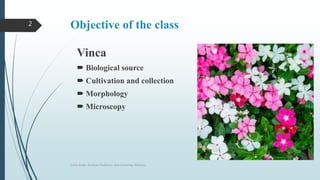
Vinca
 Biological source
 Cultivation and collection
 Morphology
 Microscopy
Sonia Singh, Assistant Professor, GLA University, Mathura
2
Alkaloids of the Indole Group
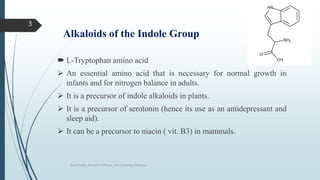
 L-Tryptophan amino acid
 An essential amino acid that is necessary for normal growth in
infants and for nitrogen balance in adults.
 It is a precursor of indole alkaloids in plants.
 It is a precursor of serotonin (hence its use as an antidepressant and
sleep aid).
 It can be a precursor to niacin ( vit. B3) in mammals.
Sonia Singh, Assistant Professor, GLA University, Mathura
3
This group includes:
 The neurohormone serotonin.
 The hallucinogenic alkaloids, psilocin and psilocybin.
 Physostigma alkaloids.
 Ergot alkaloids.
 Nux vomica alkaloids.
 Vinca alkaloids.
Sonia Singh, Assistant Professor, GLA University, Mathura
4
 Synonyms: Vinca rosea, Catharanthus, Madagascar periwinkle.
Barmasi.
 Biological Source: Vinca is the dried entire plant of Catharanthus
roseus Linn., belonging to family Apocynaceae
 Geographical Source: Native of Madagascar and is found in many
tropical and subtropical countries especially in India, Australia,
South Africa and North and South America. The plant is cultivated
as garden plant in Europe and India
Sonia Singh, Assistant Professor, GLA University, Mathura
5
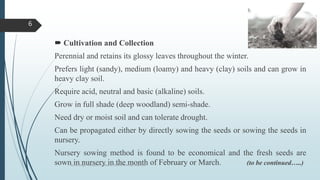
 Cultivation and Collection
Perennial and retains its glossy leaves throughout the winter.
Prefers light (sandy), medium (loamy) and heavy (clay) soils and can grow in
heavy clay soil.
Require acid, neutral and basic (alkaline) soils.
Grow in full shade (deep woodland) semi-shade.
Need dry or moist soil and can tolerate drought.
Can be propagated either by directly sowing the seeds or sowing the seeds in
nursery.
Nursery sowing method is found to be economical and the fresh seeds are
sown in nursery in the month of February or March. (to be continued…..)Sonia Singh, Assistant Professor, GLA University, Mathura
6
The seedlings attain a height of 5–8 cm after two months and then they
are transplanted in to the field at a distance of 45 cm × 30 cm.
Proper fertilization and weeding is done timely and leaves are stripped
after nine months.
In order to collect the whole plant, the stems are first cut about 10 cm
above the grounds and the leaves, seeds, stems are separated and dried.
The roots are collected by plugging which are later washed and dried
under shade and packed.
Sonia Singh, Assistant Professor, GLA University, Mathura
7
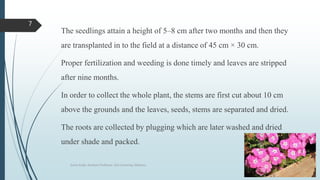
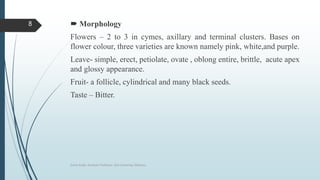
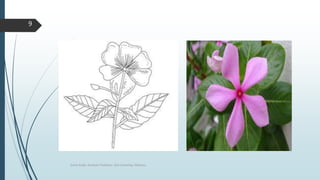
 Morphology
Flowers – 2 to 3 in cymes, axillary and terminal clusters. Bases on
flower colour, three varieties are known namely pink, white,and purple.
Leave- simple, erect, petiolate, ovate , oblong entire, brittle, acute apex
and glossy appearance.
Fruit- a follicle, cylindrical and many black seeds.
Taste – Bitter.
Sonia Singh, Assistant Professor, GLA University, Mathura
8
Sonia Singh, Assistant Professor, GLA University, Mathura
9
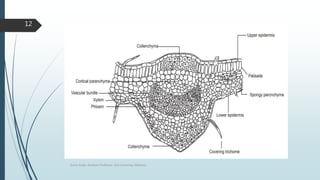
 Microscopical characters:
The transverse section of Vinca leaf
 Lamina: Upper epidermis: Single layered with more or less rectangular cells,
the outer walls of which are circularized. Only covering trichomes are
unicellular, long and dagger shaped, warty and with a bulbous base. Sometimes
very short trichomes are also seen. A few stomata are seen on the upper
epidermis.
Mesophyll:
 Mesophyll is differentiated into palisade and spongy parenchyma.
Palisade:
 Single layered cells elongated and compact.
Sonia Singh, Assistant Professor, GLA University, Mathura
10
Spongy parenchyma:
 5-9 layered, loosely arranged with intercellular spaces. Calcium
oxalate crystals of any kind are totally absent. Vascular strands are
seen here at times.
Lower epidermis:
 Same as upper epidermis but the number of stomata are more.
Midrib:
 Epidermal layers of lamina are continuous in the midrib region also.
Strips of collenchyma appear below the upper epidermis and above
the lower epidermis. This is followed by cortical parenchyma. A well
developed vascular bundle is seen in the center of midrib.
Sonia Singh, Assistant Professor, GLA University, Mathura
11
Sonia Singh, Assistant Professor, GLA University, Mathura
12
References
 W.C.Evans, Trease and Evans Pharmacognosy, 16th edition, W.B. Sounders &
Co.,London, 2009.
 Mohammad Ali. Pharmacognosy and Phytochemistry, CBS Publishers &
Distribution, New Delhi.
 Text book of Pharmacognosy by C.K. Kokate, Purohit, Gokhlae (2007), 37th
Edition, Nirali Prakashan, New Delhi.
Sonia Singh, Assistant Professor, GLA University, Mathura
13
QUIZ ?????......................
 Answer the questions…..
 Biological source……of Vinca ??????
 Cultivated by……
 How many types of stomata?
 Which type of leaf pattern it is?????
 Known for……..
Sonia Singh, Assistant Professor, GLA University, Mathura
14
Sonia Singh, Assistant Professor, GLA University, Mathura
15

Vinca

  • 1.
    Pharmacognosy and Phytochemistry–II (BP504T) Institute of Pharmaceutical Research, GLA University, Mathura Module I: VINCA Sonia Singh Assistant professor GLA University, Mathura
  • 2.
    Objective of theclass Vinca  Biological source  Cultivation and collection  Morphology  Microscopy Sonia Singh, Assistant Professor, GLA University, Mathura 2
  • 3.
    Alkaloids of theIndole Group  L-Tryptophan amino acid  An essential amino acid that is necessary for normal growth in infants and for nitrogen balance in adults.  It is a precursor of indole alkaloids in plants.  It is a precursor of serotonin (hence its use as an antidepressant and sleep aid).  It can be a precursor to niacin ( vit. B3) in mammals. Sonia Singh, Assistant Professor, GLA University, Mathura 3
  • 4.
    This group includes: The neurohormone serotonin.  The hallucinogenic alkaloids, psilocin and psilocybin.  Physostigma alkaloids.  Ergot alkaloids.  Nux vomica alkaloids.  Vinca alkaloids. Sonia Singh, Assistant Professor, GLA University, Mathura 4
  • 5.
     Synonyms: Vincarosea, Catharanthus, Madagascar periwinkle. Barmasi.  Biological Source: Vinca is the dried entire plant of Catharanthus roseus Linn., belonging to family Apocynaceae  Geographical Source: Native of Madagascar and is found in many tropical and subtropical countries especially in India, Australia, South Africa and North and South America. The plant is cultivated as garden plant in Europe and India Sonia Singh, Assistant Professor, GLA University, Mathura 5
  • 6.
     Cultivation andCollection Perennial and retains its glossy leaves throughout the winter. Prefers light (sandy), medium (loamy) and heavy (clay) soils and can grow in heavy clay soil. Require acid, neutral and basic (alkaline) soils. Grow in full shade (deep woodland) semi-shade. Need dry or moist soil and can tolerate drought. Can be propagated either by directly sowing the seeds or sowing the seeds in nursery. Nursery sowing method is found to be economical and the fresh seeds are sown in nursery in the month of February or March. (to be continued…..)Sonia Singh, Assistant Professor, GLA University, Mathura 6
  • 7.
    The seedlings attaina height of 5–8 cm after two months and then they are transplanted in to the field at a distance of 45 cm × 30 cm. Proper fertilization and weeding is done timely and leaves are stripped after nine months. In order to collect the whole plant, the stems are first cut about 10 cm above the grounds and the leaves, seeds, stems are separated and dried. The roots are collected by plugging which are later washed and dried under shade and packed. Sonia Singh, Assistant Professor, GLA University, Mathura 7
  • 8.
     Morphology Flowers –2 to 3 in cymes, axillary and terminal clusters. Bases on flower colour, three varieties are known namely pink, white,and purple. Leave- simple, erect, petiolate, ovate , oblong entire, brittle, acute apex and glossy appearance. Fruit- a follicle, cylindrical and many black seeds. Taste – Bitter. Sonia Singh, Assistant Professor, GLA University, Mathura 8
  • 9.
    Sonia Singh, AssistantProfessor, GLA University, Mathura 9
  • 10.
     Microscopical characters: Thetransverse section of Vinca leaf  Lamina: Upper epidermis: Single layered with more or less rectangular cells, the outer walls of which are circularized. Only covering trichomes are unicellular, long and dagger shaped, warty and with a bulbous base. Sometimes very short trichomes are also seen. A few stomata are seen on the upper epidermis. Mesophyll:  Mesophyll is differentiated into palisade and spongy parenchyma. Palisade:  Single layered cells elongated and compact. Sonia Singh, Assistant Professor, GLA University, Mathura 10
  • 11.
    Spongy parenchyma:  5-9layered, loosely arranged with intercellular spaces. Calcium oxalate crystals of any kind are totally absent. Vascular strands are seen here at times. Lower epidermis:  Same as upper epidermis but the number of stomata are more. Midrib:  Epidermal layers of lamina are continuous in the midrib region also. Strips of collenchyma appear below the upper epidermis and above the lower epidermis. This is followed by cortical parenchyma. A well developed vascular bundle is seen in the center of midrib. Sonia Singh, Assistant Professor, GLA University, Mathura 11
  • 12.
    Sonia Singh, AssistantProfessor, GLA University, Mathura 12
  • 13.
    References  W.C.Evans, Treaseand Evans Pharmacognosy, 16th edition, W.B. Sounders & Co.,London, 2009.  Mohammad Ali. Pharmacognosy and Phytochemistry, CBS Publishers & Distribution, New Delhi.  Text book of Pharmacognosy by C.K. Kokate, Purohit, Gokhlae (2007), 37th Edition, Nirali Prakashan, New Delhi. Sonia Singh, Assistant Professor, GLA University, Mathura 13
  • 14.
    QUIZ ?????......................  Answerthe questions…..  Biological source……of Vinca ??????  Cultivated by……  How many types of stomata?  Which type of leaf pattern it is?????  Known for…….. Sonia Singh, Assistant Professor, GLA University, Mathura 14
  • 15.
    Sonia Singh, AssistantProfessor, GLA University, Mathura 15