Pharmacognosy and Phytochemistry –II Practical (BP508 P)
Institute of Pharmaceutical Research,
GLA University, Mathura
Sonia Singh, Assistant Professor, IPR, GLA University, Mathura
1
Experiment No. 2
Aim: a) To study the organoleptic characteristics of Fennel Fruit.
b) To study the transverse section and powder characteristics of Fennel fruit.
 Outcome:
1) Able to understand the morphological characters of Fennel fruit.
2) Able to know about the different histological features as well as powder
characteristics present in the Fennel fruit.
3) Able to distinguish between the authentic herbal drug and the
substituted/adulterated drug (based on the microscopic and powder study).
Sonia Singh, Assistant Professor, IPR, GLA University, Mathura
2
Materials required:
Simple microscope, compound microscope, watch glass (depending on the need), brush,
slides, coverslips, forcep, tissue paper.
Reagents required:
Chloral hydrate reagent, phloroglucinol reagent, concentrated hydrochloric acid, glycerine.
Crude drug required:
Fennel fruit, Fennel fruit powder
Sonia Singh, Assistant Professor, IPR, GLA University, Mathura
3
 Vernacular names:
Eng: Fennel fruit; San: Madhurika; Hin:Sauf; Beng: Ban mauri; Guj: Variyali; Kan: Bada soppa;
Marathi: Badishep; Tam: Sohikerovirai; Tel: Paddejilakurra.
 Biological source:
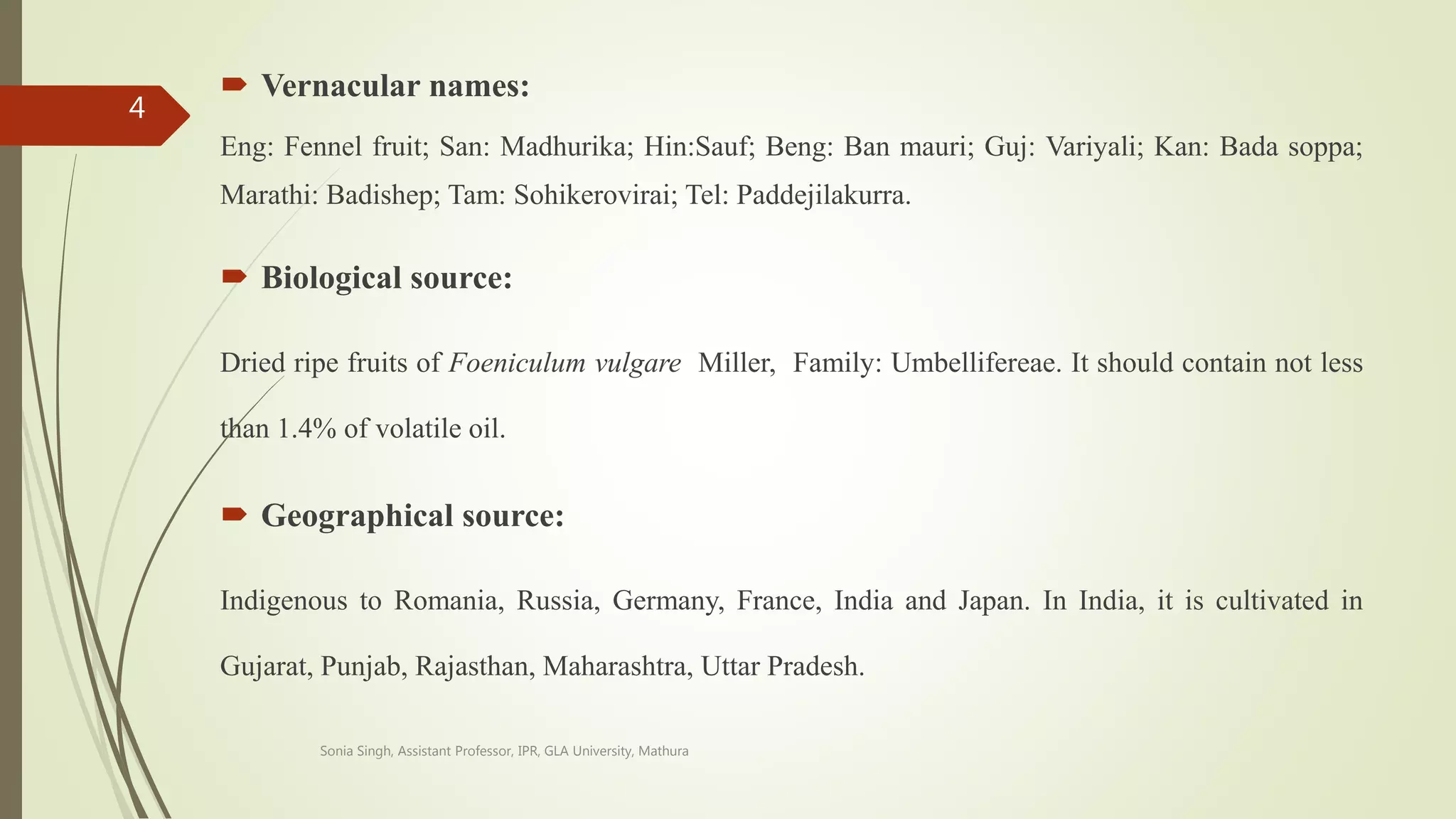
Dried ripe fruits of Foeniculum vulgare Miller, Family: Umbellifereae. It should contain not less
than 1.4% of volatile oil.
 Geographical source:
Indigenous to Romania, Russia, Germany, France, India and Japan. In India, it is cultivated in
Gujarat, Punjab, Rajasthan, Maharashtra, Uttar Pradesh.
Sonia Singh, Assistant Professor, IPR, GLA University, Mathura
4
Morphological characters:
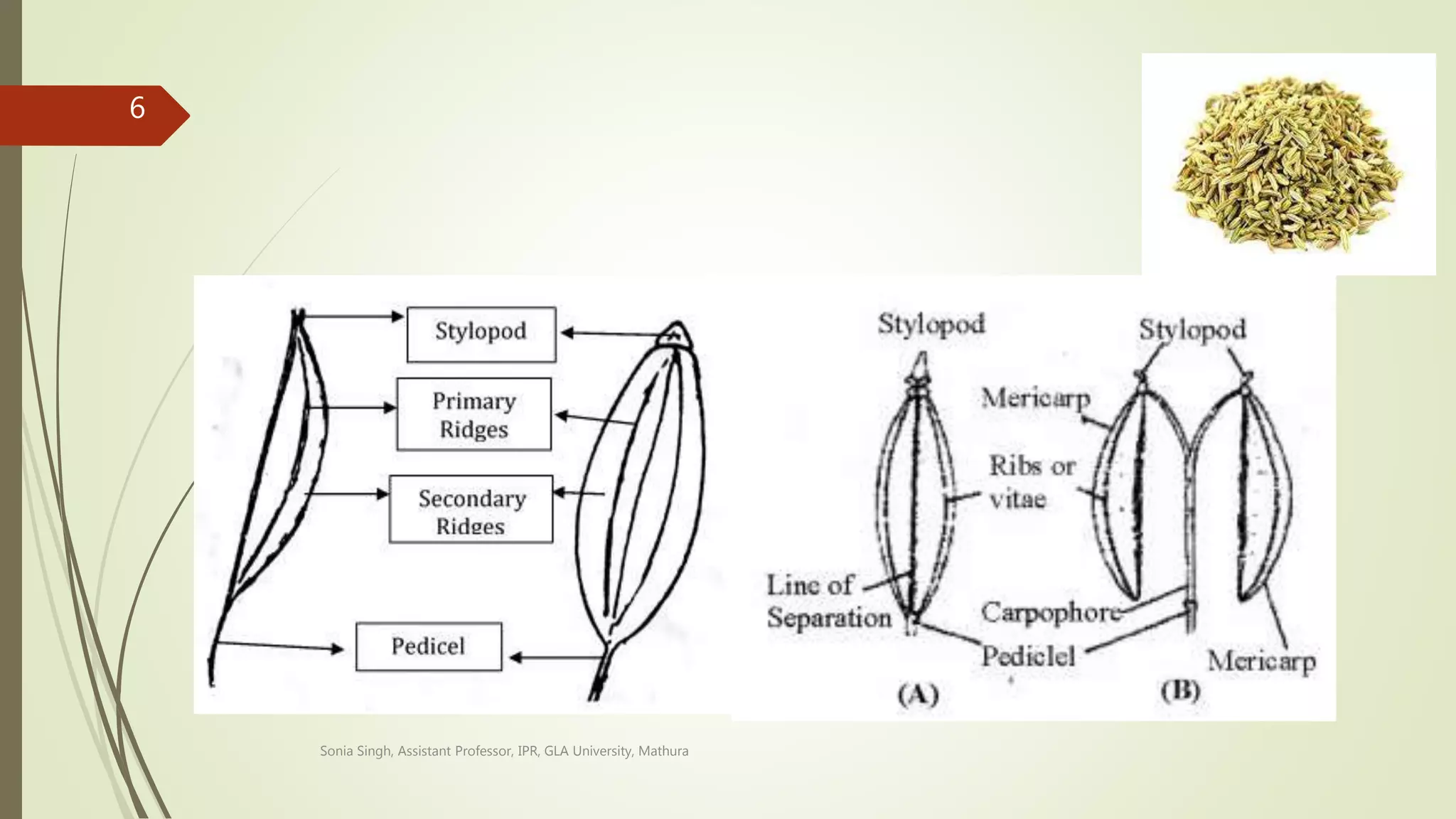
 Condition: dried cremocarp • Colour: yellowish green to yellowish brown coloured •
Surface: glabrous • Shape: oval with bifid stylopod • Odour: aromatic • Taste: sweet,
aromatic and agreeable.
 Fruits are glabrous with straight, prominent, yellow coloured five primary ridges and bifid
stylopod at the top.
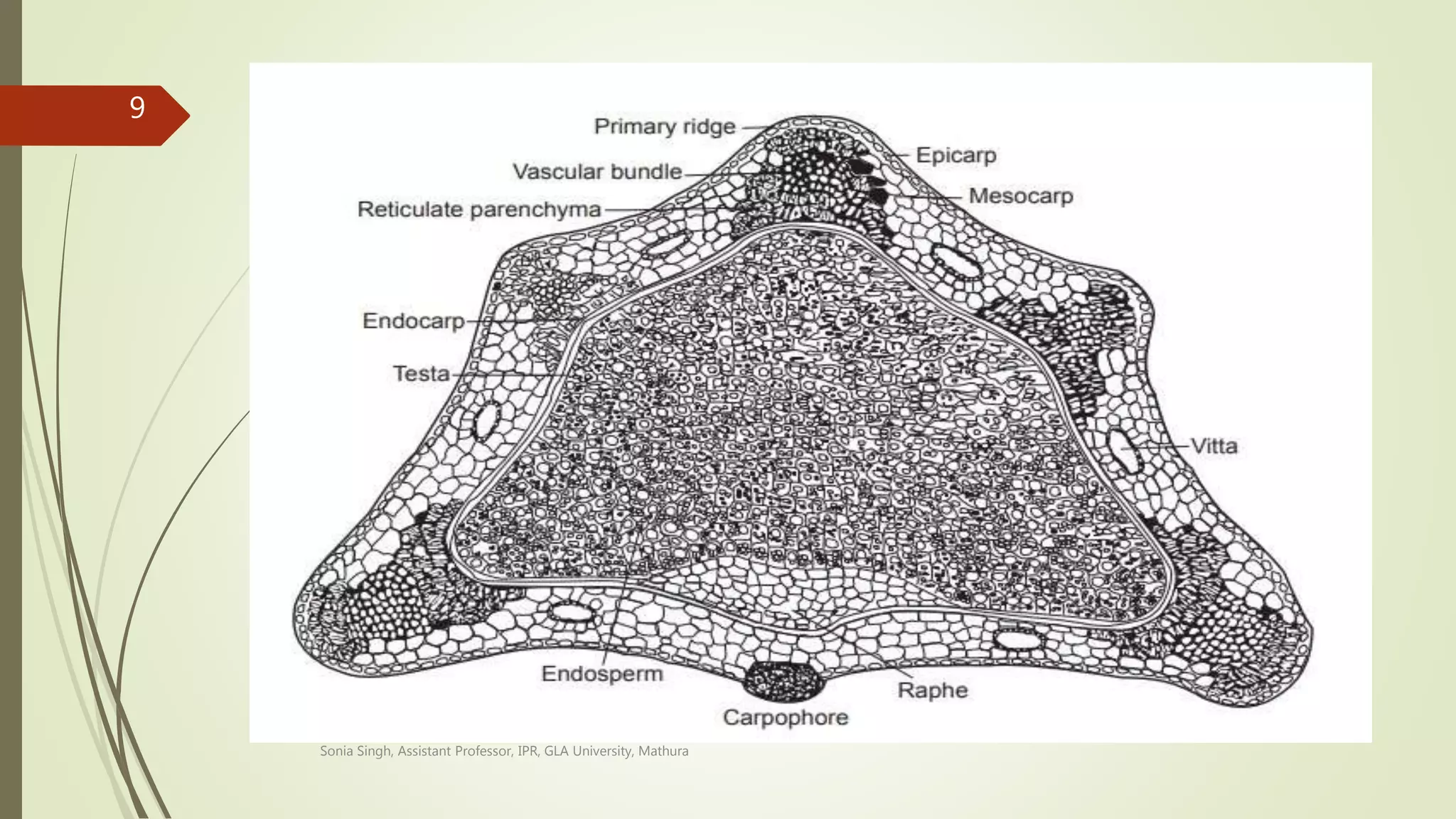
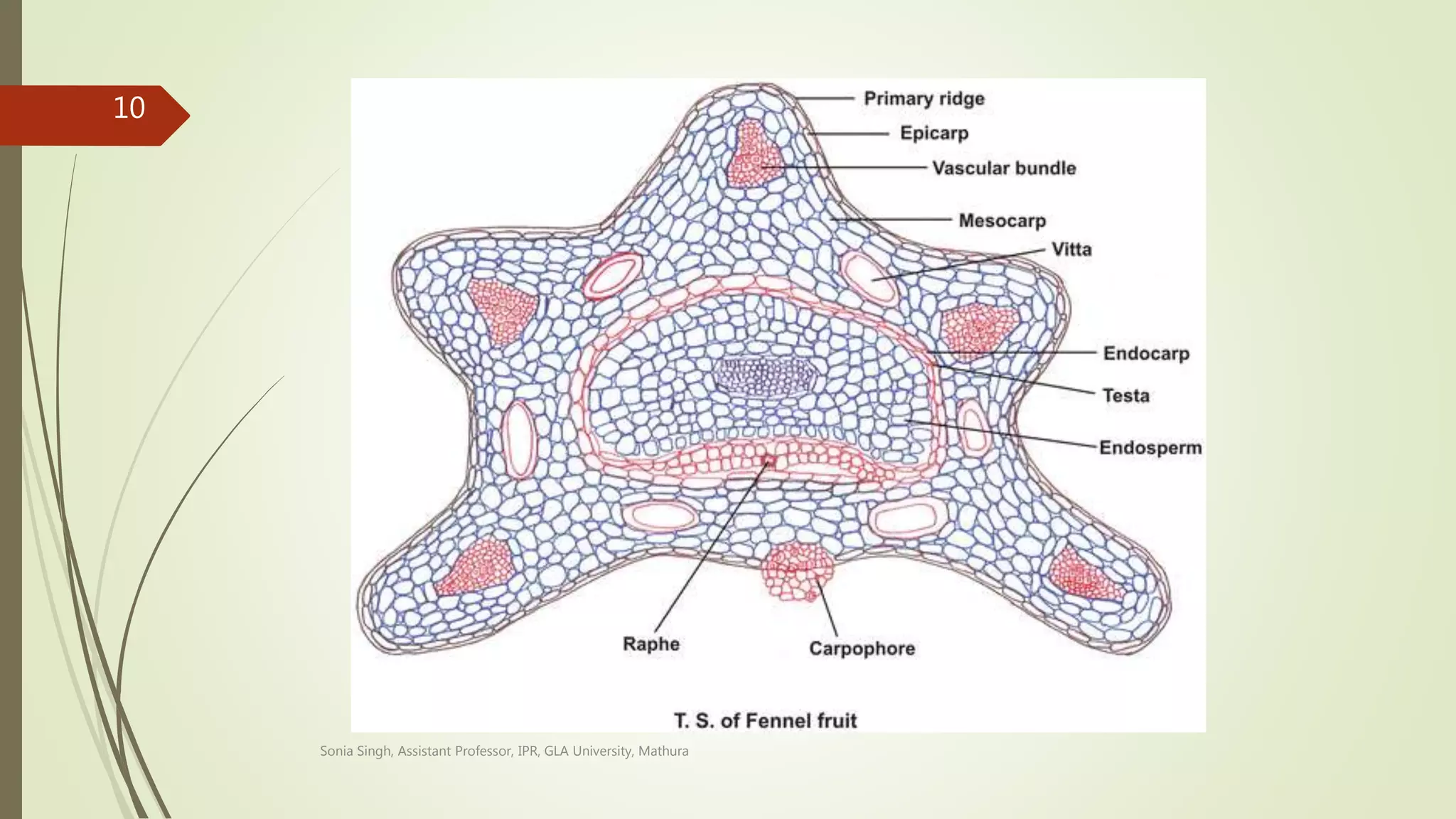
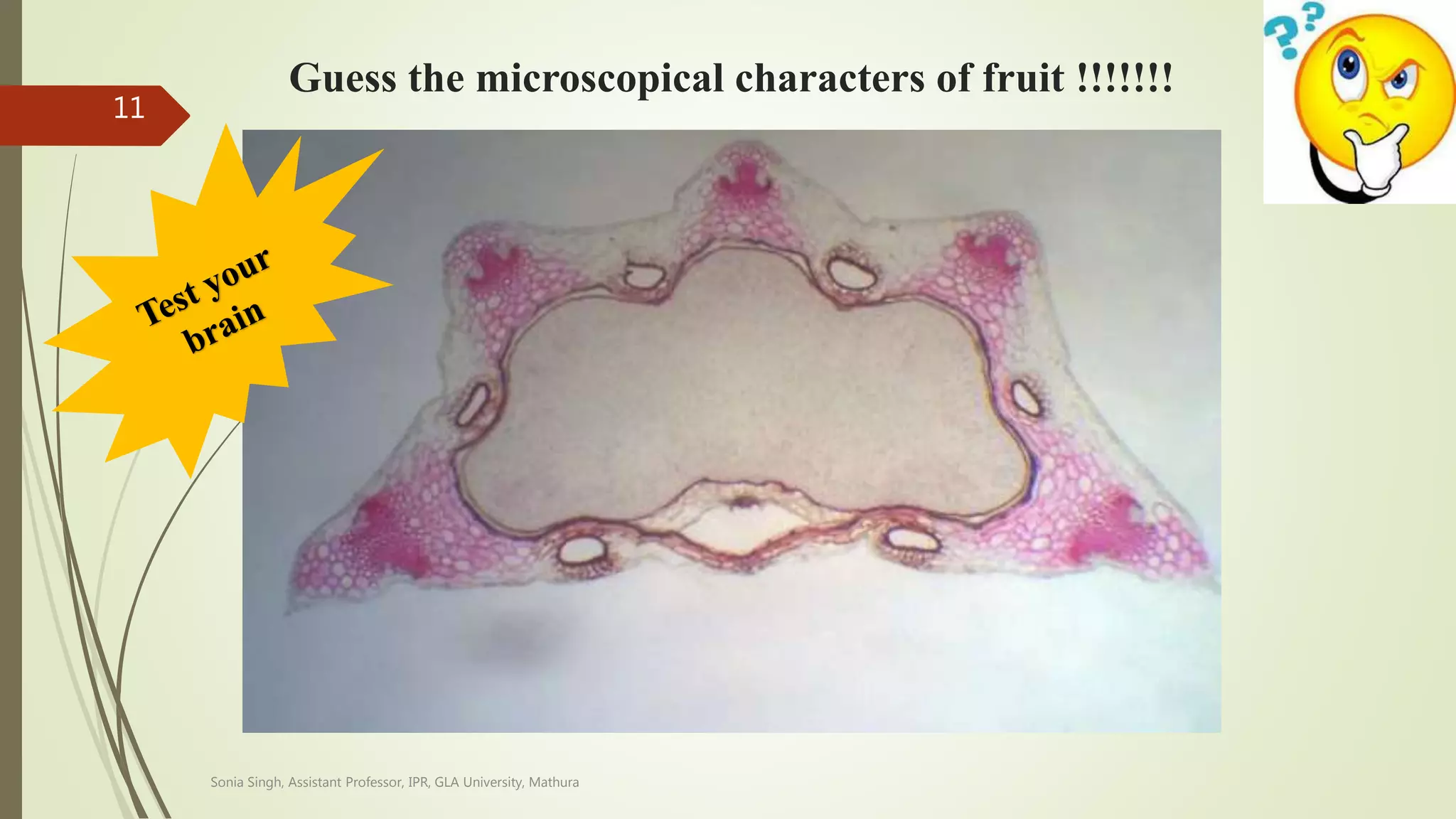
 T.S shows two commissural vittae and four dorsal vittae.
 The embryo is small embedded in upper end with abundant oily endosperm. Commisural
surfaces of the endosperm are not grooved.
Sonia Singh, Assistant Professor, IPR, GLA University, Mathura
5
Sonia Singh, Assistant Professor, IPR, GLA University, Mathura
6
 Microscopical study
Sonia Singh, Assistant Professor, IPR, GLA University, Mathura
7
Sonia Singh, Assistant Professor, IPR, GLA University, Mathura
8
Sonia Singh, Assistant Professor, IPR, GLA University, Mathura
9
Sonia Singh, Assistant Professor, IPR, GLA University, Mathura
10
Guess the microscopical characters of fruit !!!!!!!
Sonia Singh, Assistant Professor, IPR, GLA University, Mathura
11
 Powder characteristics:
1. Mesocarp: lignified and reticulate nature of the parenchyma.
2. Endocarp: cells showing parquetry arrangements.
3. Endosperm: polyhedral, thick walled cells containing oil globules and
calcium oxalate crystals.
4. Vittae: yellowish brown fragments
5. Odour: sweet aroma
Sonia Singh, Assistant Professor, IPR, GLA University, Mathura
12
Sonia Singh, Assistant Professor, IPR, GLA University, Mathura
13
 Chemical constituents
3 to 7% Volatile oils; 20% proteins and fixed oil.
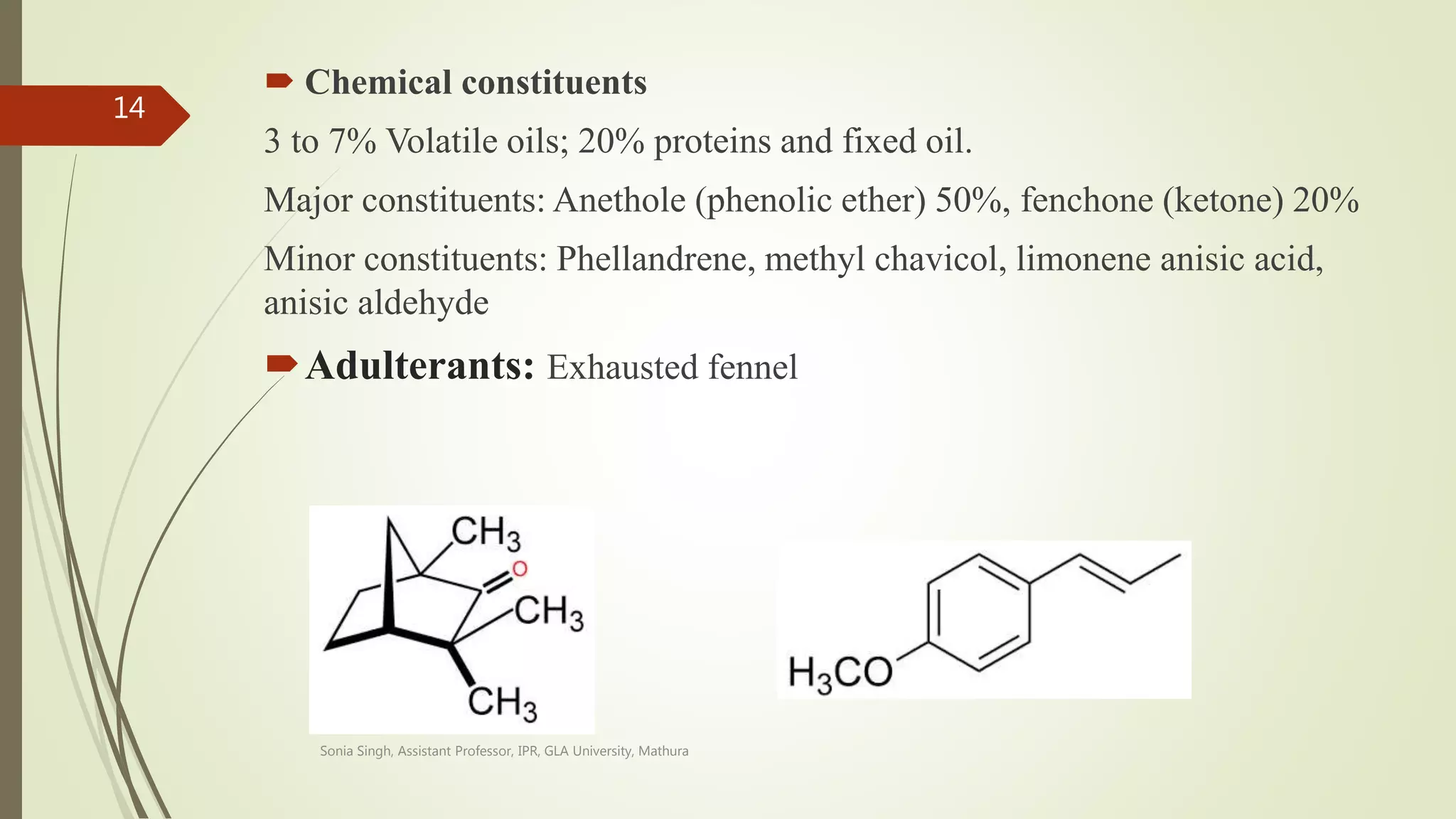
Major constituents: Anethole (phenolic ether) 50%, fenchone (ketone) 20%
Minor constituents: Phellandrene, methyl chavicol, limonene anisic acid,
anisic aldehyde
Adulterants: Exhausted fennel
Fenchone Anethole
Sonia Singh, Assistant Professor, IPR, GLA University, Mathura
14
Substituents:
Sonia Singh, Assistant Professor, IPR, GLA University, Mathura
15
Uses:
 Carminative
 Aromatic
 Stimulant
 Expectorant
 Flavouring agent
 Spices and condiments
 Anethole is used as anti-cancer and anti-inflammatory. Fennel is used as
carminatives. Fennel contains Vitamin C which is used as anti-oxidant.
Coumarin shows anti-coaggulant effect. Fennel has bronchodilatory effect.
Sonia Singh, Assistant Professor, IPR, GLA University, Mathura
16
Clearing technique for Whole, Sectioned and Powdered Material
Chloral Hydrate Solution- (Chloral Hydrate in water, 5:2w/w).
Method:
1. Place the specimen (or section or powder) on a slide, add a few drops of chloral hydrate solution and
place a coverslip on the slide.
2. Using an electrical hotplate, warm the slide until bubbles appear; remove from the heat and when the
bubbles subside, gently re-heat and repeat the process.
3. Add further chloral hydrate solution to the edge of the coverslip as necessary; do not allow to boil dry.
4. After a few minutes of this procedure (or when the specimen appears to be transparent), ensure that
no air bubbles remain under the coverslip, and draw a drop of glycerol solution under the coverslip
using a piece of blotting paper at the opposite edge
Note: Chloral hydrate solution is CORROSIVE and IRRITANT TO THE EYES; CARE is
required in use. Wear SAFETY GLASSES.
Chloral hydrae solution is used for examination of sectioned plant specimen, the study of plant surface
and powdered material.
It clears colouring matter, starch and other contents from plant cell; it restores the natural cellular shape
to dried plant specimens.
The solution does not dissolve calcium oxalate and is therefore ideal for the detection of these crystals.
The solution must not be allowed to contaminate objective lenses or the microscope stage. The addition
of glycerol solution after clearing is to prevent the crystallization of chloral hydrate.
Sonia Singh, Assistant Professor, IPR, GLA University, Mathura
17
Lignin
Method :1. Add 1 or 2 drops of phloroglucinol solution (1% in alcohol) to the section or powder
and allow to dry. 2. Add 1 or 2 drops of concentrated hydrochloric acid and cover with the
coverslip. Lignified cell walls stain red.
This reagent is CORROSIVE and care must be taken in use. Do not allow acid to come into
contact with the microscope stage or lenses.
Starch.
Method: 1. Add 2 or 3 drops of iodine solution (0.01M) to the preparation, followed by a drop of
glycerol solution. Attach a coverslip and examine for blue-black stain. Note that in powdered
drugs, starch may be present both within cells and free.
Sonia Singh, Assistant Professor, IPR, GLA University, Mathura
18
References
 Kokate CK, Purohit AP, Gokhlae SB.Text book of Pharmacognosy. 32nd ed. New
Delhi: Nirali Prakashan. 2005.
 Kokate CK. Practical Pharmacognosy. New Delhi: Vallabh Prakashan.2005.
 Iyengar MA. Pharmacognosy of powdered crude drugs.5th ed. Manipal: Manipal
Power Press. 1997.
Sonia Singh, Assistant Professor, IPR, GLA University, Mathura
19
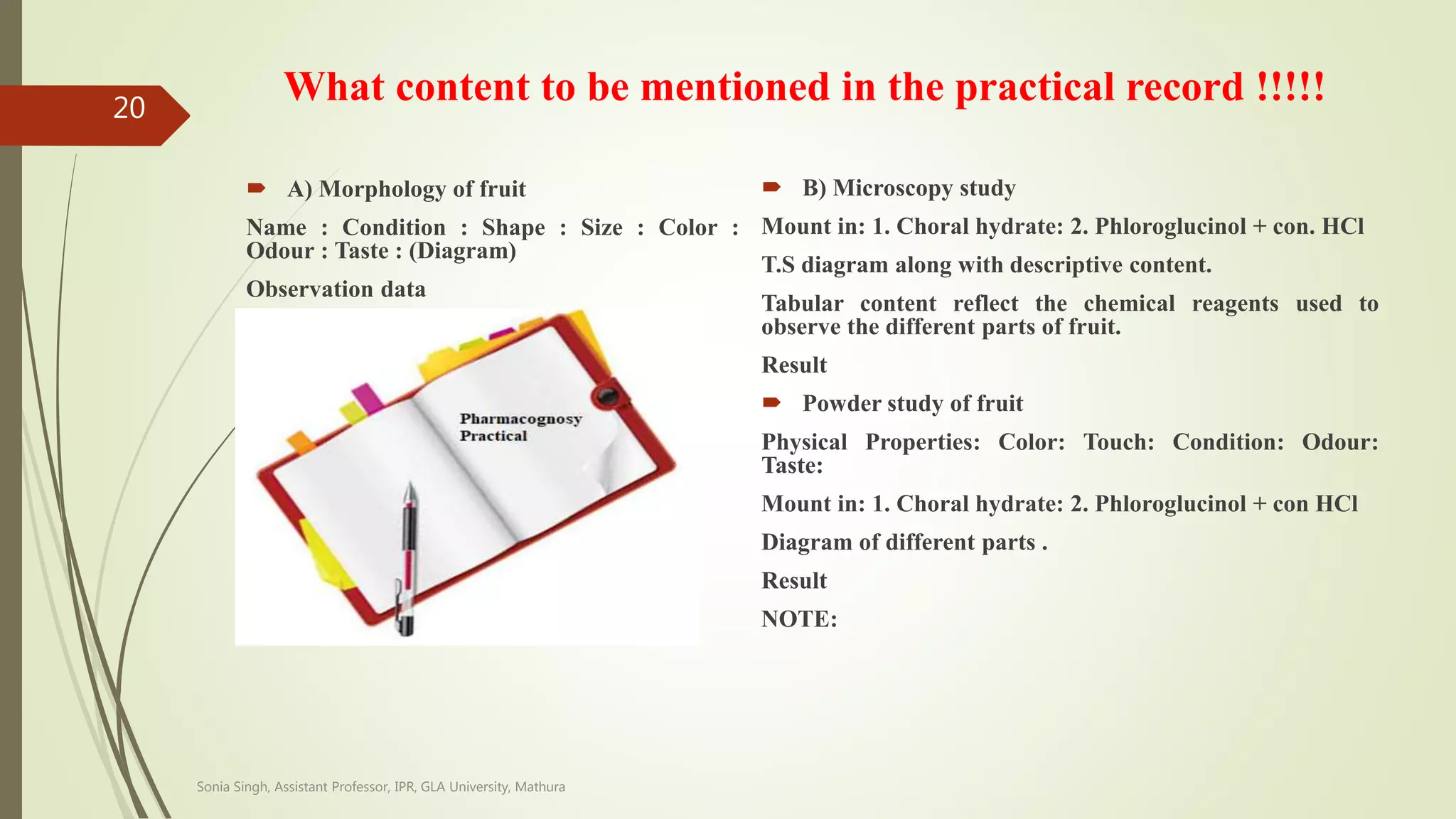
What content to be mentioned in the practical record !!!!!
 A) Morphology of fruit
Name : Condition : Shape : Size : Color :
Odour : Taste : (Diagram)
Observation data
 B) Microscopy study
Mount in: 1. Choral hydrate: 2. Phloroglucinol + con. HCl
T.S diagram along with descriptive content.
Tabular content reflect the chemical reagents used to
observe the different parts of fruit.
Result
 Powder study of fruit
Physical Properties: Color: Touch: Condition: Odour:
Taste:
Mount in: 1. Choral hydrate: 2. Phloroglucinol + con HCl
Diagram of different parts .
Result
NOTE:
Sonia Singh, Assistant Professor, IPR, GLA University, Mathura
20
Sonia Singh, Assistant Professor, IPR, GLA University, Mathura
21

Experiment :Fennel

  • 1.
    Pharmacognosy and Phytochemistry–II Practical (BP508 P) Institute of Pharmaceutical Research, GLA University, Mathura Sonia Singh, Assistant Professor, IPR, GLA University, Mathura 1
  • 2.
    Experiment No. 2 Aim:a) To study the organoleptic characteristics of Fennel Fruit. b) To study the transverse section and powder characteristics of Fennel fruit.  Outcome: 1) Able to understand the morphological characters of Fennel fruit. 2) Able to know about the different histological features as well as powder characteristics present in the Fennel fruit. 3) Able to distinguish between the authentic herbal drug and the substituted/adulterated drug (based on the microscopic and powder study). Sonia Singh, Assistant Professor, IPR, GLA University, Mathura 2
  • 3.
    Materials required: Simple microscope,compound microscope, watch glass (depending on the need), brush, slides, coverslips, forcep, tissue paper. Reagents required: Chloral hydrate reagent, phloroglucinol reagent, concentrated hydrochloric acid, glycerine. Crude drug required: Fennel fruit, Fennel fruit powder Sonia Singh, Assistant Professor, IPR, GLA University, Mathura 3
  • 4.
     Vernacular names: Eng:Fennel fruit; San: Madhurika; Hin:Sauf; Beng: Ban mauri; Guj: Variyali; Kan: Bada soppa; Marathi: Badishep; Tam: Sohikerovirai; Tel: Paddejilakurra.  Biological source: Dried ripe fruits of Foeniculum vulgare Miller, Family: Umbellifereae. It should contain not less than 1.4% of volatile oil.  Geographical source: Indigenous to Romania, Russia, Germany, France, India and Japan. In India, it is cultivated in Gujarat, Punjab, Rajasthan, Maharashtra, Uttar Pradesh. Sonia Singh, Assistant Professor, IPR, GLA University, Mathura 4
  • 5.
    Morphological characters:  Condition:dried cremocarp • Colour: yellowish green to yellowish brown coloured • Surface: glabrous • Shape: oval with bifid stylopod • Odour: aromatic • Taste: sweet, aromatic and agreeable.  Fruits are glabrous with straight, prominent, yellow coloured five primary ridges and bifid stylopod at the top.  T.S shows two commissural vittae and four dorsal vittae.  The embryo is small embedded in upper end with abundant oily endosperm. Commisural surfaces of the endosperm are not grooved. Sonia Singh, Assistant Professor, IPR, GLA University, Mathura 5
  • 6.
    Sonia Singh, AssistantProfessor, IPR, GLA University, Mathura 6
  • 7.
     Microscopical study SoniaSingh, Assistant Professor, IPR, GLA University, Mathura 7
  • 8.
    Sonia Singh, AssistantProfessor, IPR, GLA University, Mathura 8
  • 9.
    Sonia Singh, AssistantProfessor, IPR, GLA University, Mathura 9
  • 10.
    Sonia Singh, AssistantProfessor, IPR, GLA University, Mathura 10
  • 11.
    Guess the microscopicalcharacters of fruit !!!!!!! Sonia Singh, Assistant Professor, IPR, GLA University, Mathura 11
  • 12.
     Powder characteristics: 1.Mesocarp: lignified and reticulate nature of the parenchyma. 2. Endocarp: cells showing parquetry arrangements. 3. Endosperm: polyhedral, thick walled cells containing oil globules and calcium oxalate crystals. 4. Vittae: yellowish brown fragments 5. Odour: sweet aroma Sonia Singh, Assistant Professor, IPR, GLA University, Mathura 12
  • 13.
    Sonia Singh, AssistantProfessor, IPR, GLA University, Mathura 13
  • 14.
     Chemical constituents 3to 7% Volatile oils; 20% proteins and fixed oil. Major constituents: Anethole (phenolic ether) 50%, fenchone (ketone) 20% Minor constituents: Phellandrene, methyl chavicol, limonene anisic acid, anisic aldehyde Adulterants: Exhausted fennel Fenchone Anethole Sonia Singh, Assistant Professor, IPR, GLA University, Mathura 14
  • 15.
    Substituents: Sonia Singh, AssistantProfessor, IPR, GLA University, Mathura 15
  • 16.
    Uses:  Carminative  Aromatic Stimulant  Expectorant  Flavouring agent  Spices and condiments  Anethole is used as anti-cancer and anti-inflammatory. Fennel is used as carminatives. Fennel contains Vitamin C which is used as anti-oxidant. Coumarin shows anti-coaggulant effect. Fennel has bronchodilatory effect. Sonia Singh, Assistant Professor, IPR, GLA University, Mathura 16
  • 17.
    Clearing technique forWhole, Sectioned and Powdered Material Chloral Hydrate Solution- (Chloral Hydrate in water, 5:2w/w). Method: 1. Place the specimen (or section or powder) on a slide, add a few drops of chloral hydrate solution and place a coverslip on the slide. 2. Using an electrical hotplate, warm the slide until bubbles appear; remove from the heat and when the bubbles subside, gently re-heat and repeat the process. 3. Add further chloral hydrate solution to the edge of the coverslip as necessary; do not allow to boil dry. 4. After a few minutes of this procedure (or when the specimen appears to be transparent), ensure that no air bubbles remain under the coverslip, and draw a drop of glycerol solution under the coverslip using a piece of blotting paper at the opposite edge Note: Chloral hydrate solution is CORROSIVE and IRRITANT TO THE EYES; CARE is required in use. Wear SAFETY GLASSES. Chloral hydrae solution is used for examination of sectioned plant specimen, the study of plant surface and powdered material. It clears colouring matter, starch and other contents from plant cell; it restores the natural cellular shape to dried plant specimens. The solution does not dissolve calcium oxalate and is therefore ideal for the detection of these crystals. The solution must not be allowed to contaminate objective lenses or the microscope stage. The addition of glycerol solution after clearing is to prevent the crystallization of chloral hydrate. Sonia Singh, Assistant Professor, IPR, GLA University, Mathura 17
  • 18.
    Lignin Method :1. Add1 or 2 drops of phloroglucinol solution (1% in alcohol) to the section or powder and allow to dry. 2. Add 1 or 2 drops of concentrated hydrochloric acid and cover with the coverslip. Lignified cell walls stain red. This reagent is CORROSIVE and care must be taken in use. Do not allow acid to come into contact with the microscope stage or lenses. Starch. Method: 1. Add 2 or 3 drops of iodine solution (0.01M) to the preparation, followed by a drop of glycerol solution. Attach a coverslip and examine for blue-black stain. Note that in powdered drugs, starch may be present both within cells and free. Sonia Singh, Assistant Professor, IPR, GLA University, Mathura 18
  • 19.
    References  Kokate CK,Purohit AP, Gokhlae SB.Text book of Pharmacognosy. 32nd ed. New Delhi: Nirali Prakashan. 2005.  Kokate CK. Practical Pharmacognosy. New Delhi: Vallabh Prakashan.2005.  Iyengar MA. Pharmacognosy of powdered crude drugs.5th ed. Manipal: Manipal Power Press. 1997. Sonia Singh, Assistant Professor, IPR, GLA University, Mathura 19
  • 20.
    What content tobe mentioned in the practical record !!!!!  A) Morphology of fruit Name : Condition : Shape : Size : Color : Odour : Taste : (Diagram) Observation data  B) Microscopy study Mount in: 1. Choral hydrate: 2. Phloroglucinol + con. HCl T.S diagram along with descriptive content. Tabular content reflect the chemical reagents used to observe the different parts of fruit. Result  Powder study of fruit Physical Properties: Color: Touch: Condition: Odour: Taste: Mount in: 1. Choral hydrate: 2. Phloroglucinol + con HCl Diagram of different parts . Result NOTE: Sonia Singh, Assistant Professor, IPR, GLA University, Mathura 20
  • 21.
    Sonia Singh, AssistantProfessor, IPR, GLA University, Mathura 21