GURU GHASIDAS
VISHWAVIDYALAYA,BILASPUR
SESSION- 2023
TOPIC- STRUCTURE ELUCIDATION OF CITRAL
GUIDED BY PRESENTED BY
DR.VINOD D.RANGARI SIR VINAY BISEN
M.PHARM 1ST SEM
(PHARMACOGNOSY)
Contents
INTRODUCTION
OCCURANCE
ISOLATION
IDENTIFICATION AND ANALYSIS-TLC
STRUCTURE ELUCIDATION
-UV
-IR
-MS
-NMR(1H,13C)
Introduction
Citral- citral is mainly isolated from lemon grass oil.
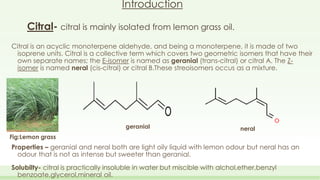
Citral is an acyclic monoterpene aldehyde, and being a monoterpene, it is made of two
isoprene units. Citral is a collective term which covers two geometric isomers that have their
own separate names; the E-isomer is named as geranial (trans-citral) or citral A. The Z-
isomer is named neral (cis-citral) or citral B.These streoisomers occus as a mixture.
Properties – geranial and neral both are light oily liquid with lemon odour but neral has an
odour that is not as intense but sweeter than geranial.
Solubilty- citral is practically insoluble in water but miscible with alchol,ether,benzyl
benzoate,glycerol,mineral oil.
geranial neral
Fig:Lemon grass
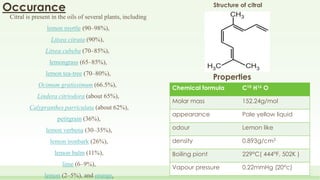
Occurance
Citral is present in the oils of several plants, including
lemon myrtle (90–98%),
Litsea citrata (90%),
Litsea cubeba (70–85%),
lemongrass (65–85%),
lemon tea-tree (70–80%),
Ocimum gratissimum (66.5%),
Lindera citriodora (about 65%),
Calypranthes parriculata (about 62%),
petitgrain (36%),
lemon verbena (30–35%),
lemon ironbark (26%),
lemon balm (11%),
lime (6–9%),
lemon (2–5%), and orange.
Chemical formula C10 H16 O
Molar mass 152.24g/mol
appearance Pale yellow liquid
odour Lemon like
density 0.893g/cm3
Boiling piont 229°C( 444°F, 502K )
Vapour pressure 0.22mmHg (20°c)
Properties
Structure of citral
Isolation of citral
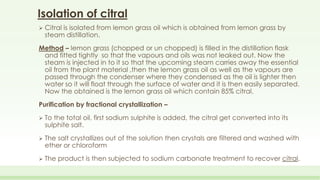
 Citral is isolated from lemon grass oil which is obtained from lemon grass by
steam distillation.
Method – lemon grass (chopped or un chopped) is filled in the distillation flask
and fitted tightly so that the vapours and oils was not leaked out. Now the
steam is injected in to it so that the upcoming steam carries away the essential
oil from the plant material ,then the lemon grass oil as well as the vapours are
passed through the condenser where they condensed as the oil is lighter then
water so it will float through the surface of water and it is then easily separated.
Now the obtained is the lemon grass oil which contain 85% citral.
Purification by fractional crystallization –
 To the total oil, first sodium sulphite is added, the citral get converted into its
sulphite salt.
 The salt crystallizes out of the solution then crystals are filtered and washed with
ether or chloroform
 The product is then subjected to sodium carbonate treatment to recover citral.
Identification and Analysis
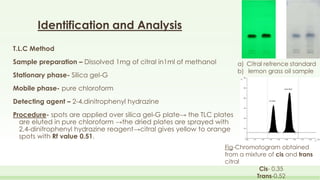
T.L.C Method
Sample preparation – Dissolved 1mg of citral in1ml of methanol
Stationary phase- Silica gel-G
Mobile phase- pure chloroform
Detecting agent – 2-4,dinitrophenyl hydrazine
Procedure- spots are applied over silica gel-G plate→ the TLC plates
are eluted in pure chloroform →the dried plates are sprayed with
2,4-dinitrophenyl hydrazine reagent→citral gives yellow to orange
spots with Rf value 0.51.
a) Citral refrence standard
b) lemon grass oil sample
Fig-Chromatogram obtained
from a mixture of cis and trans
citral
Cis- 0.35
Trans-0.52
Structure elucidation of citral by
UV-spectroscopic technique
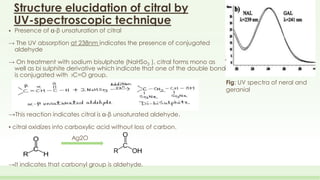
 Presence of -β unsaturation of citral
→ The UV absorption at 238nm indicates the presence of conjugated
aldehyde
→ On treatment with sodium bisulphate (NaHSo3 ), citral forms mono as
well as bi sulphite derivative which indicate that one of the double bond
is conjugated with ›C=O group.
→This reaction indicates citral is -β unsaturated aldehyde.
▪ citral oxidizes into carboxylic acid without loss of carbon.
→It indicates that carbonyl group is aldehyde.
Fig: UV spectra of neral and
geranial
Ag2O
Infrared spectrum of citral
TYPE OF BOND ABSORPTION
FREQUENCY
C-H stretch for alkanes 3000-2850cm-1
CH3 bending 1450 and 1375
CH2 bending 1465
C=C 1680-1600
C=O 1740-1720
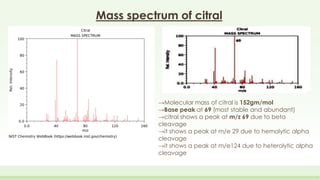
Mass spectrum of citral
→Molecular mass of citral is 152gm/mol
→Base peak at 69 (most stable and abundant)
→citral shows a peak at m/z 69 due to beta
cleavage
→it shows a peak at m/e 29 due to hemolytic alpha
cleavage
→it shows a peak at m/e124 due to heterolytic alpha
cleavage
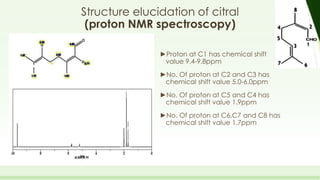
Structure elucidation of citral
(proton NMR spectroscopy)
►Proton at C1 has chemical shift
value 9.4-9.8ppm
►No. Of proton at C2 and C3 has
chemical shift value 5.0-6.0ppm
►No. Of proton at C5 and C4 has
chemical shift value 1.9ppm
►No. Of proton at C6,C7 and C8 has
chemical shift value 1.7ppm
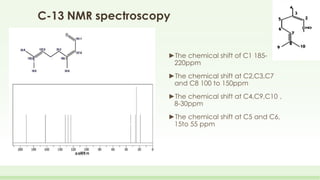
C-13 NMR spectroscopy
►The chemical shift of C1 185-
220ppm
►The chemical shift at C2,C3,C7
and C8 100 to 150ppm
►The chemical shift at C4,C9,C10 ,
8-30ppm
►The chemical shift at C5 and C6,
15to 55 ppm
Uses
1. Citral is potent biomolecule and exhibits various important
therapeutic properties like
antimicrobial,antioxidant,anticancer,antidiabetic and anti
inflammatory.
2. Citral is natural additive used in beverages,foods and
cosmetics.
3. Citral is used in the synthesis of vitamin A,ionone and
methylionone.
4. Mask the smell of smoke

Citral - isolation,identification and structure elucidation

  • 1.
    GURU GHASIDAS VISHWAVIDYALAYA,BILASPUR SESSION- 2023 TOPIC-STRUCTURE ELUCIDATION OF CITRAL GUIDED BY PRESENTED BY DR.VINOD D.RANGARI SIR VINAY BISEN M.PHARM 1ST SEM (PHARMACOGNOSY)
  • 2.
  • 3.
    Introduction Citral- citral ismainly isolated from lemon grass oil. Citral is an acyclic monoterpene aldehyde, and being a monoterpene, it is made of two isoprene units. Citral is a collective term which covers two geometric isomers that have their own separate names; the E-isomer is named as geranial (trans-citral) or citral A. The Z- isomer is named neral (cis-citral) or citral B.These streoisomers occus as a mixture. Properties – geranial and neral both are light oily liquid with lemon odour but neral has an odour that is not as intense but sweeter than geranial. Solubilty- citral is practically insoluble in water but miscible with alchol,ether,benzyl benzoate,glycerol,mineral oil. geranial neral Fig:Lemon grass
  • 4.
    Occurance Citral is presentin the oils of several plants, including lemon myrtle (90–98%), Litsea citrata (90%), Litsea cubeba (70–85%), lemongrass (65–85%), lemon tea-tree (70–80%), Ocimum gratissimum (66.5%), Lindera citriodora (about 65%), Calypranthes parriculata (about 62%), petitgrain (36%), lemon verbena (30–35%), lemon ironbark (26%), lemon balm (11%), lime (6–9%), lemon (2–5%), and orange. Chemical formula C10 H16 O Molar mass 152.24g/mol appearance Pale yellow liquid odour Lemon like density 0.893g/cm3 Boiling piont 229°C( 444°F, 502K ) Vapour pressure 0.22mmHg (20°c) Properties Structure of citral
  • 5.
    Isolation of citral Citral is isolated from lemon grass oil which is obtained from lemon grass by steam distillation. Method – lemon grass (chopped or un chopped) is filled in the distillation flask and fitted tightly so that the vapours and oils was not leaked out. Now the steam is injected in to it so that the upcoming steam carries away the essential oil from the plant material ,then the lemon grass oil as well as the vapours are passed through the condenser where they condensed as the oil is lighter then water so it will float through the surface of water and it is then easily separated. Now the obtained is the lemon grass oil which contain 85% citral. Purification by fractional crystallization –  To the total oil, first sodium sulphite is added, the citral get converted into its sulphite salt.  The salt crystallizes out of the solution then crystals are filtered and washed with ether or chloroform  The product is then subjected to sodium carbonate treatment to recover citral.
  • 6.
    Identification and Analysis T.L.CMethod Sample preparation – Dissolved 1mg of citral in1ml of methanol Stationary phase- Silica gel-G Mobile phase- pure chloroform Detecting agent – 2-4,dinitrophenyl hydrazine Procedure- spots are applied over silica gel-G plate→ the TLC plates are eluted in pure chloroform →the dried plates are sprayed with 2,4-dinitrophenyl hydrazine reagent→citral gives yellow to orange spots with Rf value 0.51. a) Citral refrence standard b) lemon grass oil sample Fig-Chromatogram obtained from a mixture of cis and trans citral Cis- 0.35 Trans-0.52
  • 7.
    Structure elucidation ofcitral by UV-spectroscopic technique  Presence of -β unsaturation of citral → The UV absorption at 238nm indicates the presence of conjugated aldehyde → On treatment with sodium bisulphate (NaHSo3 ), citral forms mono as well as bi sulphite derivative which indicate that one of the double bond is conjugated with ›C=O group. →This reaction indicates citral is -β unsaturated aldehyde. ▪ citral oxidizes into carboxylic acid without loss of carbon. →It indicates that carbonyl group is aldehyde. Fig: UV spectra of neral and geranial Ag2O
  • 8.
    Infrared spectrum ofcitral TYPE OF BOND ABSORPTION FREQUENCY C-H stretch for alkanes 3000-2850cm-1 CH3 bending 1450 and 1375 CH2 bending 1465 C=C 1680-1600 C=O 1740-1720
  • 9.
    Mass spectrum ofcitral →Molecular mass of citral is 152gm/mol →Base peak at 69 (most stable and abundant) →citral shows a peak at m/z 69 due to beta cleavage →it shows a peak at m/e 29 due to hemolytic alpha cleavage →it shows a peak at m/e124 due to heterolytic alpha cleavage
  • 10.
    Structure elucidation ofcitral (proton NMR spectroscopy) ►Proton at C1 has chemical shift value 9.4-9.8ppm ►No. Of proton at C2 and C3 has chemical shift value 5.0-6.0ppm ►No. Of proton at C5 and C4 has chemical shift value 1.9ppm ►No. Of proton at C6,C7 and C8 has chemical shift value 1.7ppm
  • 11.
    C-13 NMR spectroscopy ►Thechemical shift of C1 185- 220ppm ►The chemical shift at C2,C3,C7 and C8 100 to 150ppm ►The chemical shift at C4,C9,C10 , 8-30ppm ►The chemical shift at C5 and C6, 15to 55 ppm
  • 12.
    Uses 1. Citral ispotent biomolecule and exhibits various important therapeutic properties like antimicrobial,antioxidant,anticancer,antidiabetic and anti inflammatory. 2. Citral is natural additive used in beverages,foods and cosmetics. 3. Citral is used in the synthesis of vitamin A,ionone and methylionone. 4. Mask the smell of smoke