





Lexical Functional
    Grammar
 School of Linguistics
Group 4
Class 4 B


• Fira Nursya’bani    0906856
• Luciyana Dwiningrum 0902428
• Meyza Pritama           0902467
• Riestia Handayani       0902434
FIGURES
Joan Wanda
Bresnan

   • Born on August 22, 1945

   •    Professor of Linguistics at
       Standford University

   • Ronald Kaplan’s partner
Ronald M. Kaplan
• Chief Scientist and a Principal
  Researcher at the Powerset
  division of Microsoft Bing

•     Consulting Professor in the
    Linguistics   Department    at
    Stanford University and a
    Principal of Stanford's Center
    for the Study of Language and
    Information (CSLI)
• Lexical Functional Grammar (LFG) was first
  developed in the 1970’s by Joan Bresnan and Ron
    Kaplan.


• They wanted to create a theory that could form the
  basis of a realistic model for linguistic learnability
    and language processing.


•    Since LFG was found, the theory has been
    applied to some new areas, such as morphology,
    syntax and semantics theories.
LFG     has     3    kinds   of   analyzing
 sentence:

• Lexical Structure

• Constituent       Structure      (C     -
  Structure)

• Functional        Structure      (F    –
  Structure)
Lexical Structure

The lexical entry includes information about
the meaning of the lexical item, its argument
structure, and the grammatical functions (e.g.,
subject, object, etc.) that are associated with
those arguments.

e.g.     I hit you
The way to analyze sentence in
lexical structure by labelling
grammatical function.

Grammatical functions are
universal primitives within this
framework, and since they are
associated both with lexical
items and with syntactic
positions they mediate between
lexical    and      constituent
structure representations.
Constituent
Structure
 C-Structure encodes linear
 order,           hierarchical
 groupings, and syntactic
 categories of constituents.

 Notation of C-Structure
 identifies the grammatical
 functions that may occur in
 specific syntactic positions.
Functional Structure
• Structural and lexical information is
  integrated and unified within functional
  structure (F-structure).
• When the lexical items that occupy the
  terminal nodes of the tree are inserted into f-
  structure, the information contained in the
  lexical entry is retrieved and included in the f-
  structure.
•    It is in this way that lexical information is
    combined with the structural information
    available from the c-structure tree.
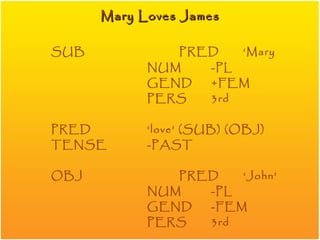
Mary Loves James

SUB            PRED   ‘Mary
            NUM   -PL
            GEND  +FEM
            PERS  3rd

PRED        ‘love’ (SUB) (OBJ)
TENSE       -PAST

OBJ            PRED   ‘John’
            NUM   -PL
            GEND  -FEM
            PERS  3rd

Lexical functional grammar

  • 1.
    Lexical Functional Grammar School of Linguistics
  • 2.
    Group 4 Class 4B • Fira Nursya’bani 0906856 • Luciyana Dwiningrum 0902428 • Meyza Pritama 0902467 • Riestia Handayani 0902434
  • 3.
  • 4.
    Joan Wanda Bresnan • Born on August 22, 1945 • Professor of Linguistics at Standford University • Ronald Kaplan’s partner
  • 5.
    Ronald M. Kaplan •Chief Scientist and a Principal Researcher at the Powerset division of Microsoft Bing • Consulting Professor in the Linguistics Department at Stanford University and a Principal of Stanford's Center for the Study of Language and Information (CSLI)
  • 6.
    • Lexical FunctionalGrammar (LFG) was first developed in the 1970’s by Joan Bresnan and Ron Kaplan. • They wanted to create a theory that could form the basis of a realistic model for linguistic learnability and language processing. • Since LFG was found, the theory has been applied to some new areas, such as morphology, syntax and semantics theories.
  • 7.
    LFG has 3 kinds of analyzing sentence: • Lexical Structure • Constituent Structure (C - Structure) • Functional Structure (F – Structure)
  • 8.
    Lexical Structure The lexicalentry includes information about the meaning of the lexical item, its argument structure, and the grammatical functions (e.g., subject, object, etc.) that are associated with those arguments. e.g. I hit you
  • 9.
    The way toanalyze sentence in lexical structure by labelling grammatical function. Grammatical functions are universal primitives within this framework, and since they are associated both with lexical items and with syntactic positions they mediate between lexical and constituent structure representations.
  • 10.
    Constituent Structure C-Structure encodeslinear order, hierarchical groupings, and syntactic categories of constituents. Notation of C-Structure identifies the grammatical functions that may occur in specific syntactic positions.
  • 11.
    Functional Structure • Structuraland lexical information is integrated and unified within functional structure (F-structure). • When the lexical items that occupy the terminal nodes of the tree are inserted into f- structure, the information contained in the lexical entry is retrieved and included in the f- structure. • It is in this way that lexical information is combined with the structural information available from the c-structure tree.
  • 12.
    Mary Loves James SUB PRED ‘Mary NUM -PL GEND +FEM PERS 3rd PRED ‘love’ (SUB) (OBJ) TENSE -PAST OBJ PRED ‘John’ NUM -PL GEND -FEM PERS 3rd