SYSTEMIC FUNCTIONAL 
LINGUISTICS 
1 
41st INTERNATIONAL SYSTEMIC FUNCTIONAL CONGRESS 
X LATIN-AMERICAN SYSTEMIC FUNCTIONAL CONGRESS 
UNIVERSIDAD NACIONAL DE CUYO, FACULTAD DE FILOSOFÍA Y LETRAS, 
MENDOZA, ARGENTINA
TODAY 
ISFL CONGRESS: theme, 
speakers. 
VISION OF LANGUAGE. 
“HEROES & VILLAINS”. 
CONCLUSIONS. 2
THE CONGRESS ITSELF 
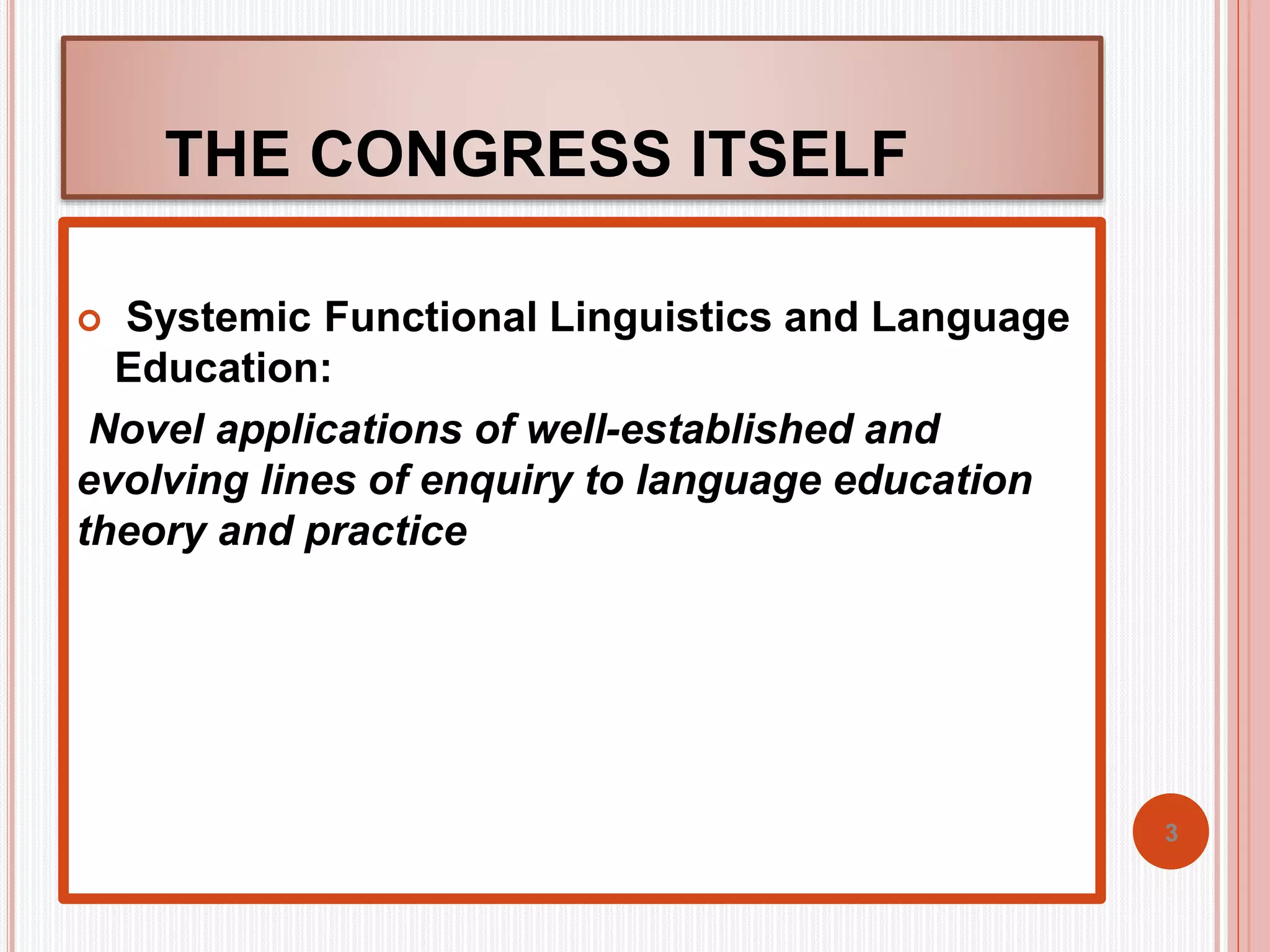
 Systemic Functional Linguistics and Language 
Education: 
Novel applications of well-established and 
evolving lines of enquiry to language education 
theory and practice 
3
THE CONGRESS ITSELF 
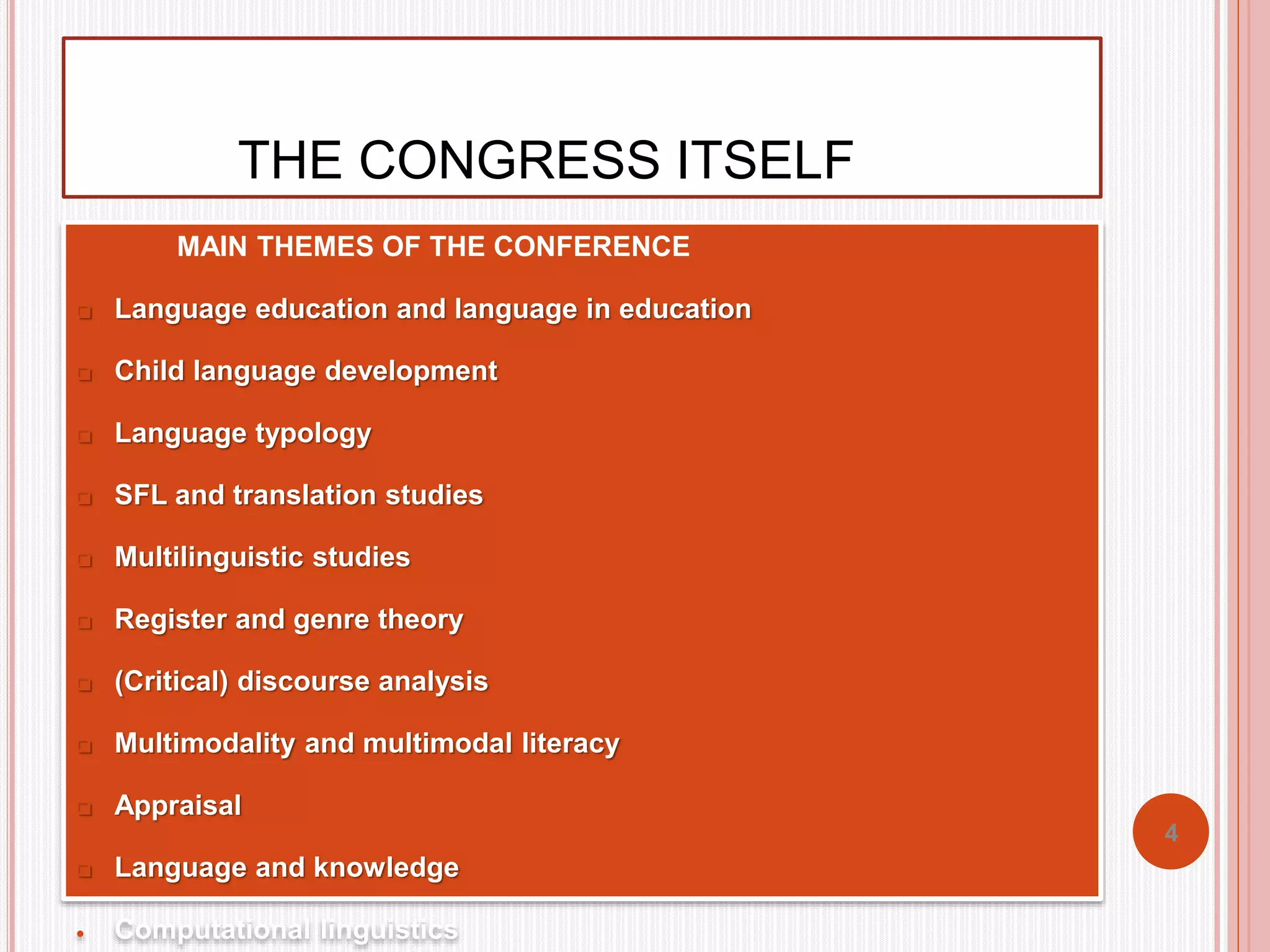
 MAIN THEMES OF THE CONFERENCE 
 Language education and language in education 
 Child language development 
 Language typology 
 SFL and translation studies 
 Multilinguistic studies 
 Register and genre theory 
 (Critical) discourse analysis 
 Multimodality and multimodal literacy 
 Appraisal 
 Language and knowledge 
 Computational linguistics 
4
PLENARY SPEAKERS 
 Ann Borsinger 
 Cecilia Colombi 
 Susan Hood 
 James Martin 
 Karl Maton 
 Teresa Oteíza 
 Caroline Coffin 
5
PLENARY LECTURES 
 COFFIN , CAROLINE (The Open University, UK) 
A LANGUAGE AS SOCIAL SEMIOTIC APPROACH 
TO TEACHING AND LEARNING IN HIGHER 
EDUCATION. 
 approach put forward: LANGUAGE AS SOCIAL 
SEMIOTIC (LASS) to teaching and learning. 
6 
LEARNING LANGUAGE, LEARNING THROUGH 
LANGUAGE & LEARNING ABOUT LANGUAGE 
(Halliday, 2004/1980)
PLENARY LECTURES 
 Susan Hood ( Australia) 
THE LECTURING BODY AND LEARNING TO 
MEAN IN THE UNCOMMON-SENSE WAY OF 
DIFFERENT DISCIPLINES. 
 the opportunity for students to participate in live 
lectures- declining. 
 Discourse dichotomising : the old as bad with the 
new as good. 
 Body language of lecturers- interaction. 7
PLENARY LECTURES 
 Len, Unsworth. 
 ELEVATING EMPATHY IN ANIMATED MOVIE 
ADAPTATIONS OF PICTURE BOOKS: 
EXPLORING MEDIA-SPECIFIC ORIENTATIONS 
TO FOCALIZATION, SOCIAL DISTANCE AND 
ATTITUDE. 
 Interaction of social distance, horizontal, vertical 
angle – a means of inscribing the audience 
viewpoint. 
8
PLENARY LECTURES 
 MARY MACKEN-HORARIK (Australia) 
DEVELOPING A GRAMMATICS “GOOD ENOUGH” 
FOR SCHOOL ENGLISH: four proposals and 
some data. 
9
MARY MACKEN-HORARIK 
10
11 
MARY MACKEN-HORARIK
JIM MARTIN 
 University of Sidney. 
REVISITING FIELD: “ SEMANTIC DENSITY” IN 
ANCIENT HISTORY AND BIOLOGY DISCOURSE. 
 “semantic gravity”, “contextual dependency” 
12
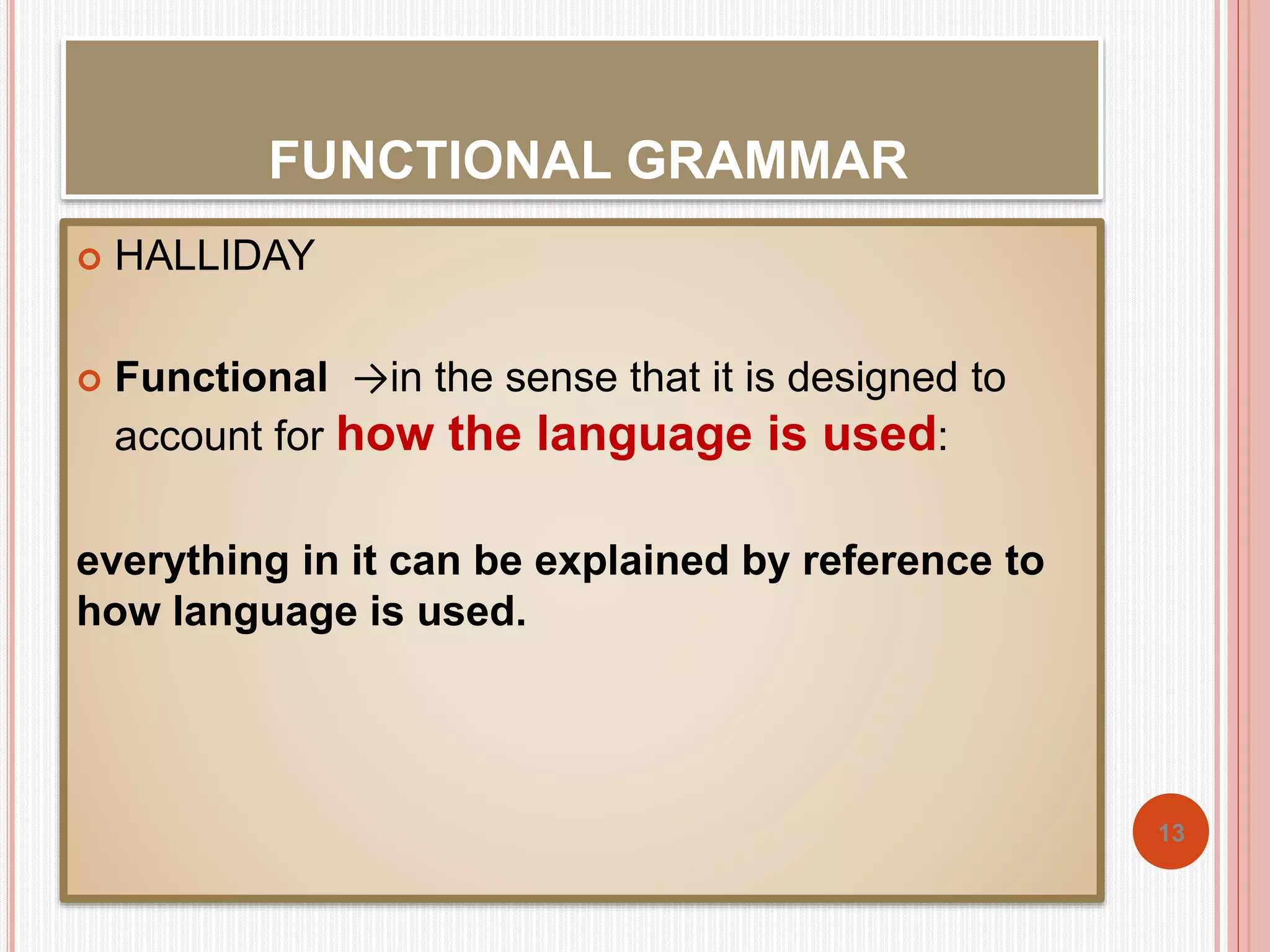
FUNCTIONAL GRAMMAR 
 HALLIDAY 
 Functional →in the sense that it is designed to 
account for how the language is used: 
everything in it can be explained by reference to 
how language is used. 
13
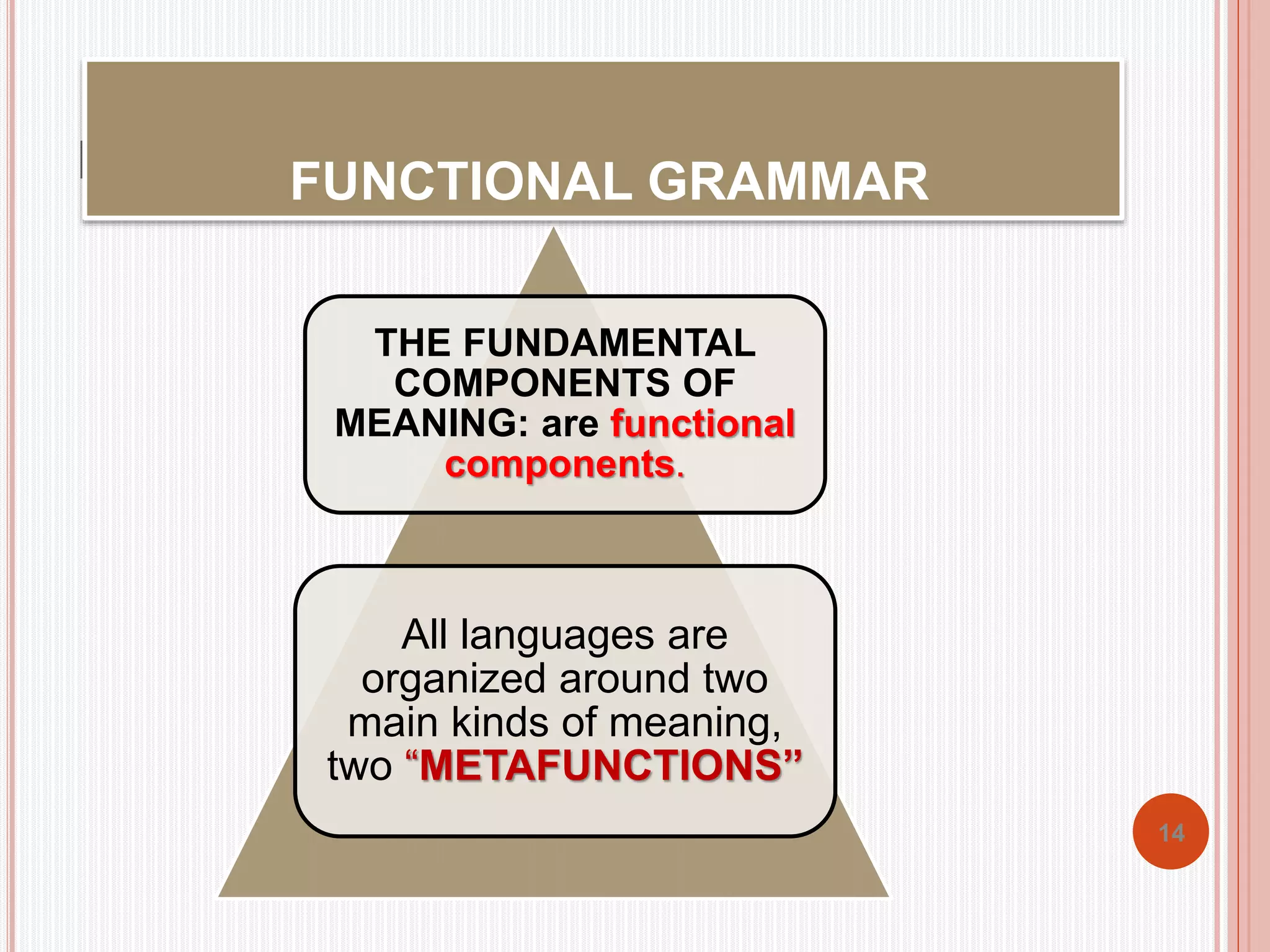
FUNCTIONAL GRAMMAR 
THE FUNDAMENTAL 
COMPONENTS OF 
MEANING: are functional 
components. 
All languages are 
organized around two 
main kinds of meaning, 
two “METAFUNCTIONS” 
14 
FUNCTIONAL GRAMMAR
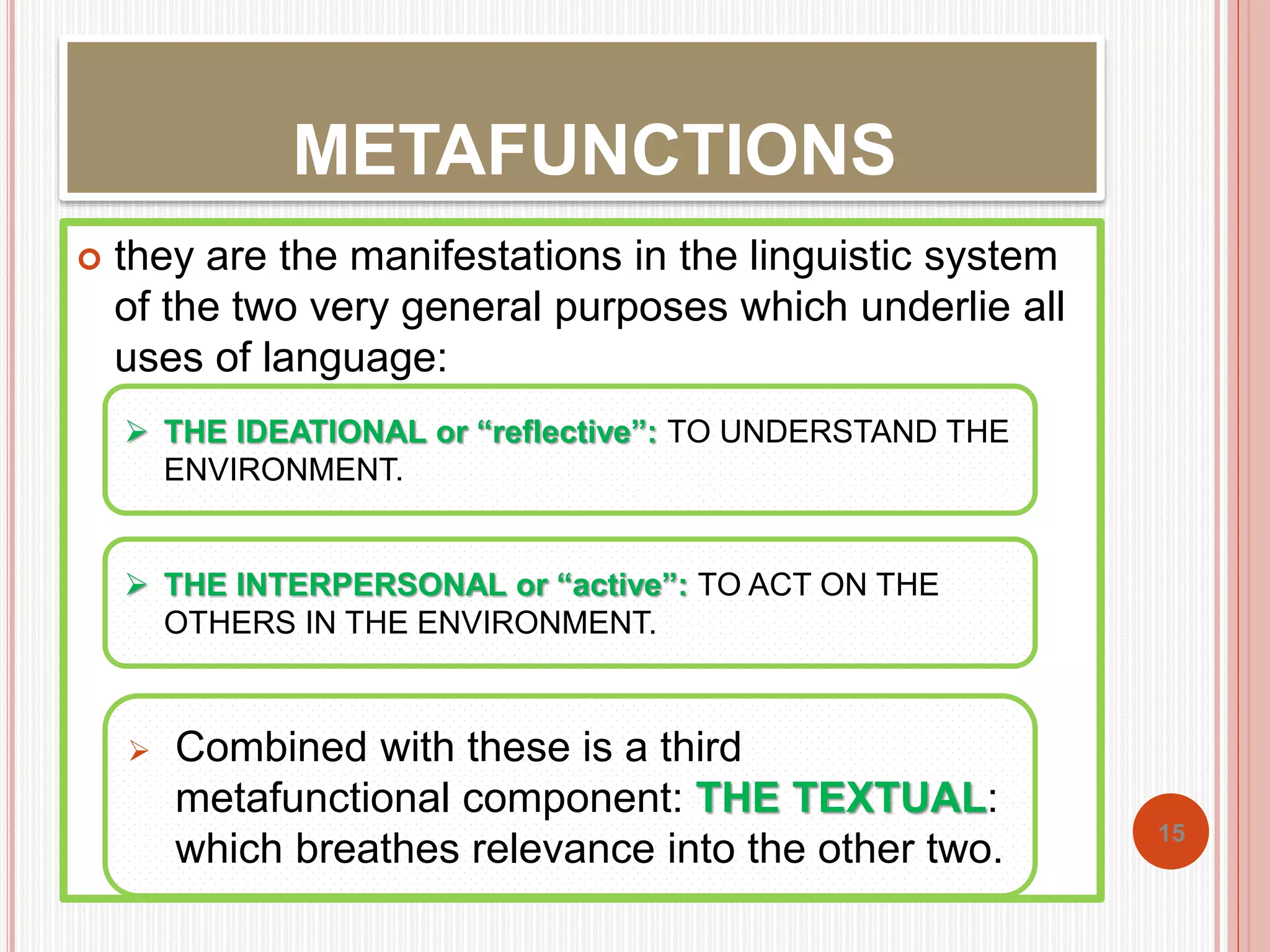
METAFUNCTIONS 
 they are the manifestations in the linguistic system 
of the two very general purposes which underlie all 
uses of language: 
15 
 THE IDEATIONAL or “reflective”: TO UNDERSTAND THE 
ENVIRONMENT. 
 THE INTERPERSONAL or “active”: TO ACT ON THE 
OTHERS IN THE ENVIRONMENT. 
 Combined with these is a third 
metafunctional component: THE TEXTUAL: 
which breathes relevance into the other two.
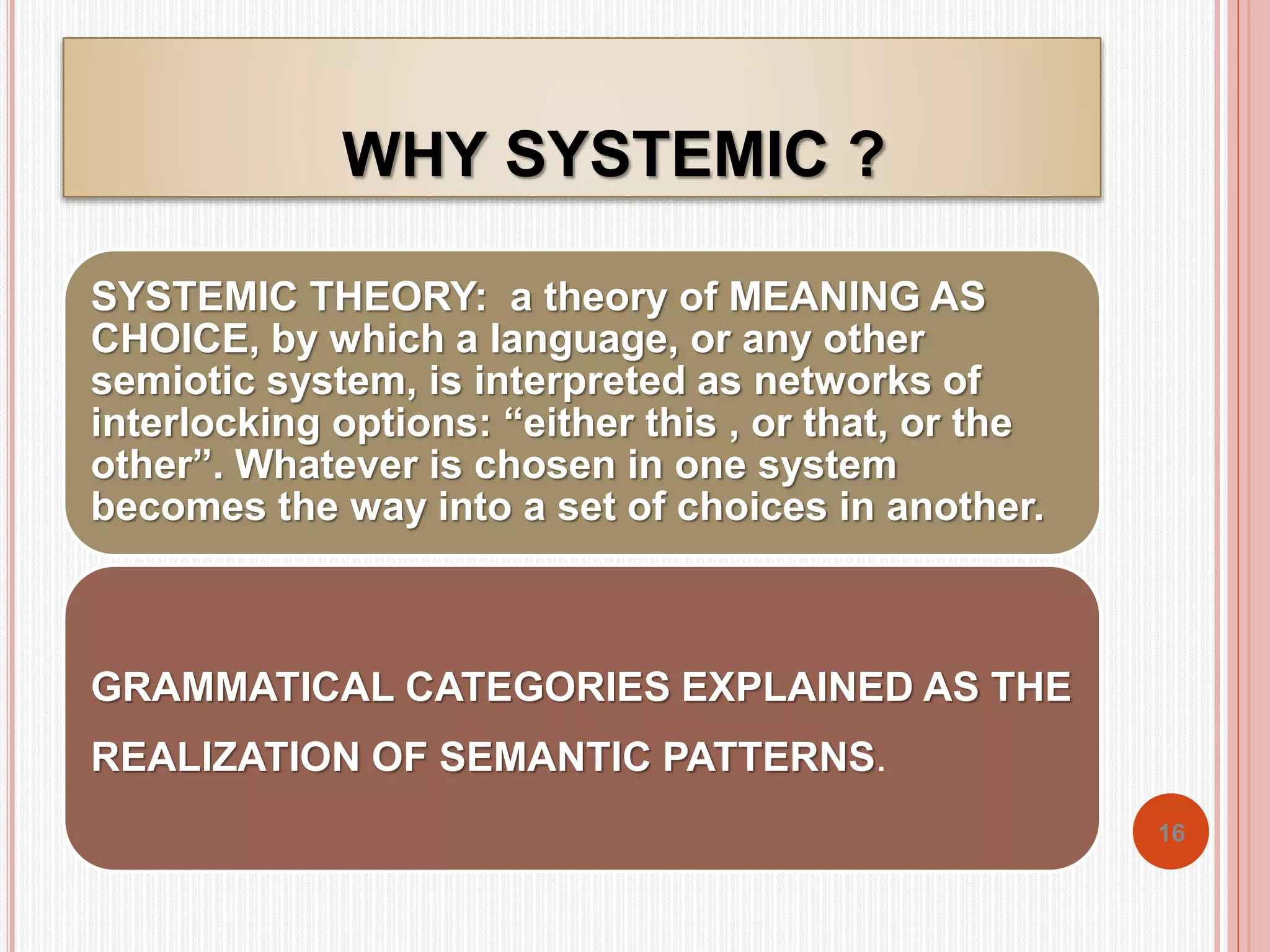
WHY SYSTEMIC ? 
SYSTEMIC THEORY: a theory of MEANING AS 
CHOICE, by which a language, or any other 
semiotic system, is interpreted as networks of 
interlocking options: “either this , or that, or the 
other”. Whatever is chosen in one system 
becomes the way into a set of choices in another. 
GRAMMATICAL CATEGORIES EXPLAINED AS THE 
REALIZATION OF SEMANTIC PATTERNS. 
16
TODAY 
 ISFL CONGRESS: theme, speakers. 
 VISION OF LANGUAGE. 
17
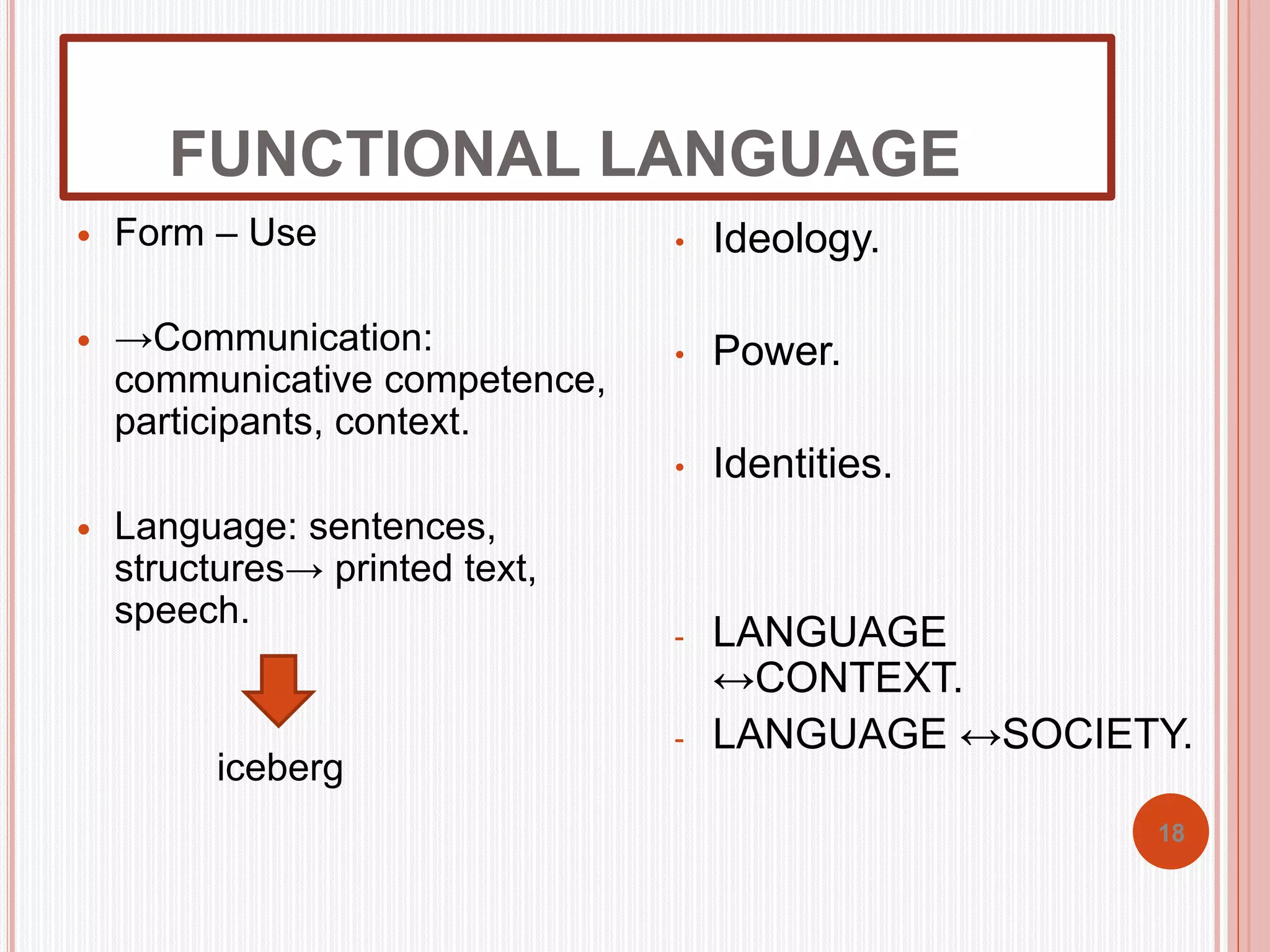
FUNCTIONAL LANGUAGE 
18 
 Form – Use 
 →Communication: 
communicative competence, 
participants, context. 
 Language: sentences, 
structures→ printed text, 
speech. 
iceberg 
• Ideology. 
• Power. 
• Identities. 
- LANGUAGE 
↔CONTEXT. 
- LANGUAGE ↔SOCIETY.
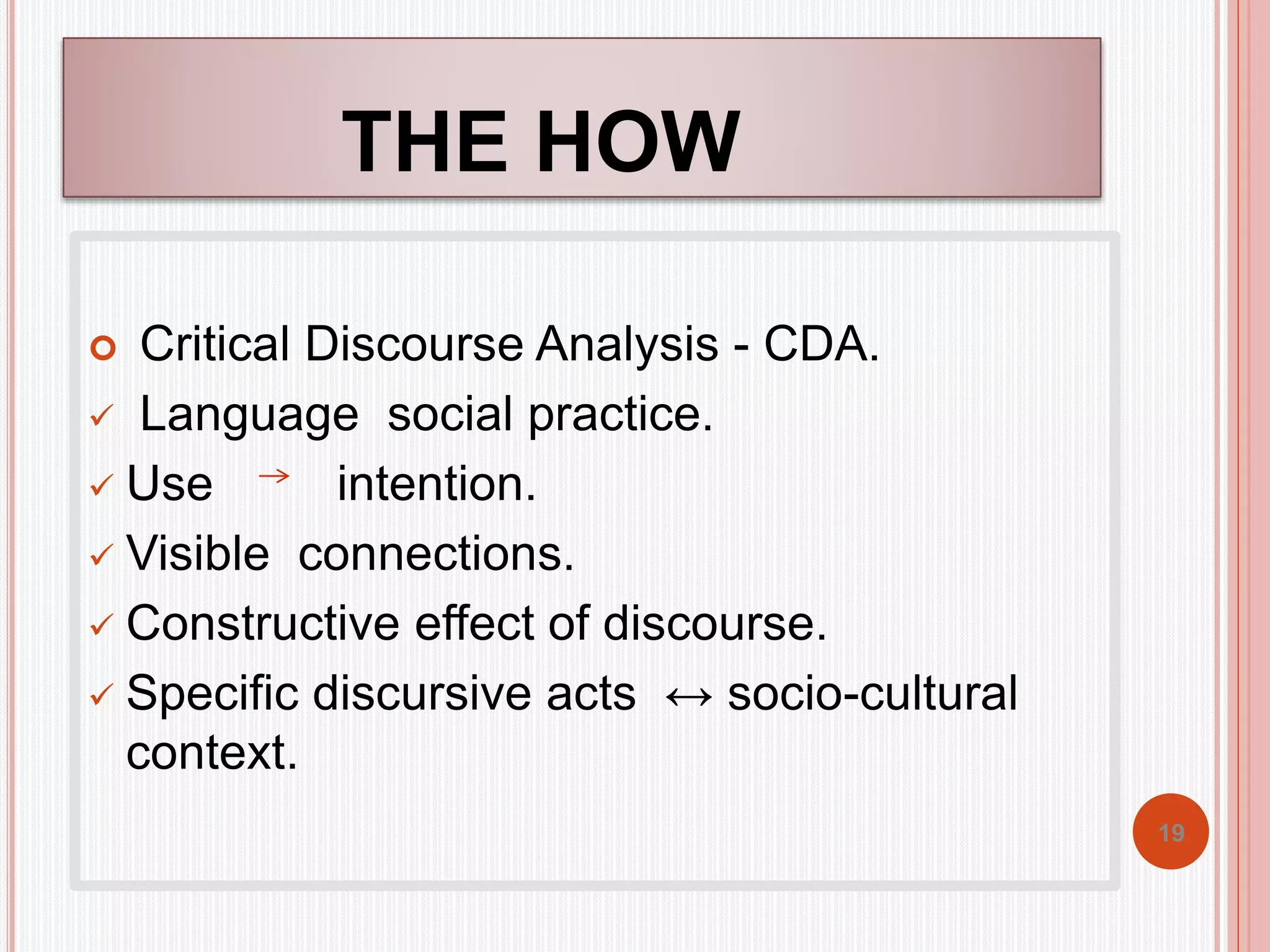
THE HOW 
 Critical Discourse Analysis - CDA. 
 Language social practice. 
 Use intention. 
 Visible connections. 
 Constructive effect of discourse. 
 Specific discursive acts ↔ socio-cultural 
context. 
19
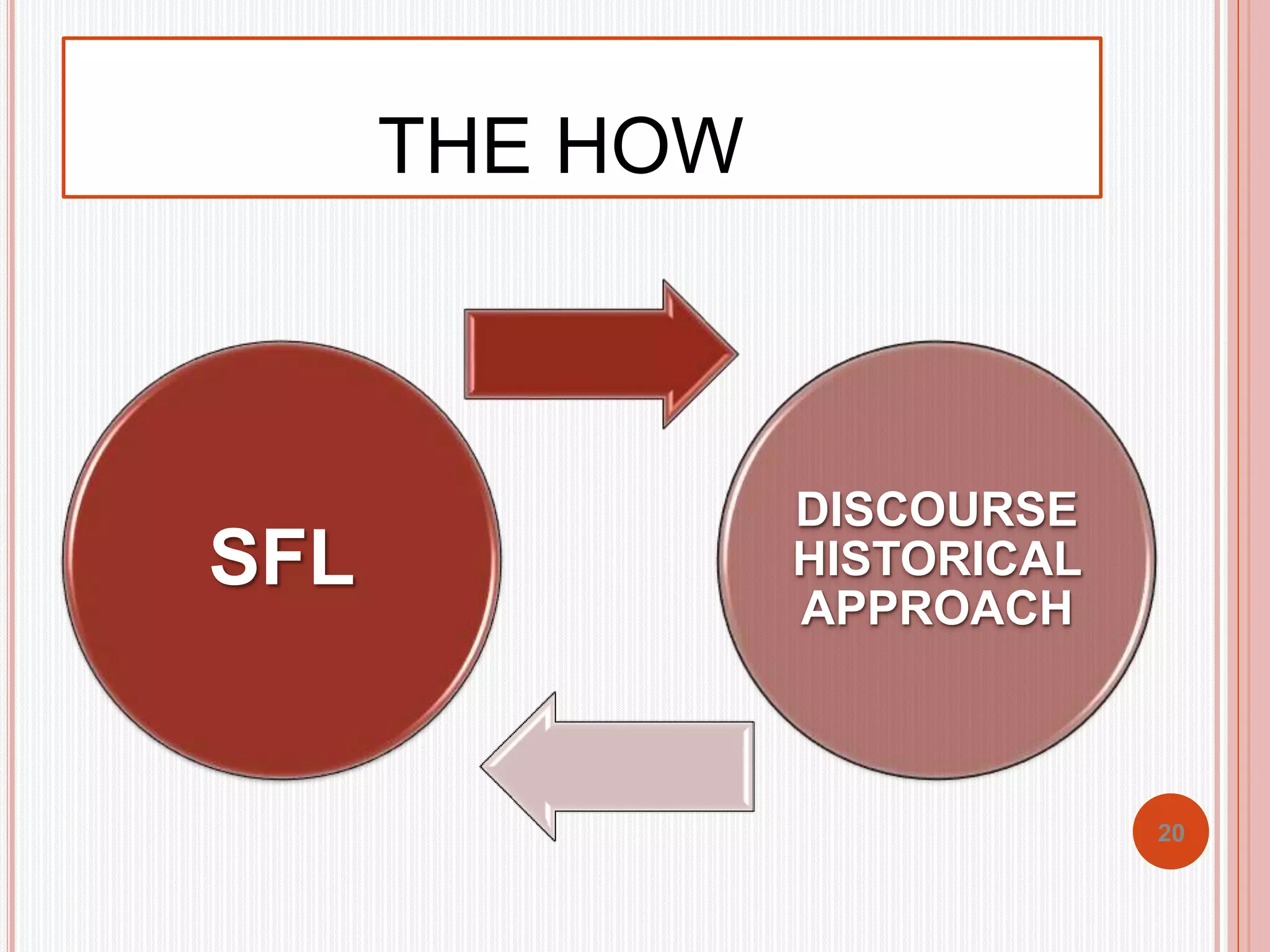
THE HOW 
SFL 
DISCOURSE 
HISTORICAL 
APPROACH 
20
TODAY 
ISFL CONGRESS: theme, 
speakers. 
VISION OF LANGUAGE. 
“HEROES & VILLAINS”. 
21
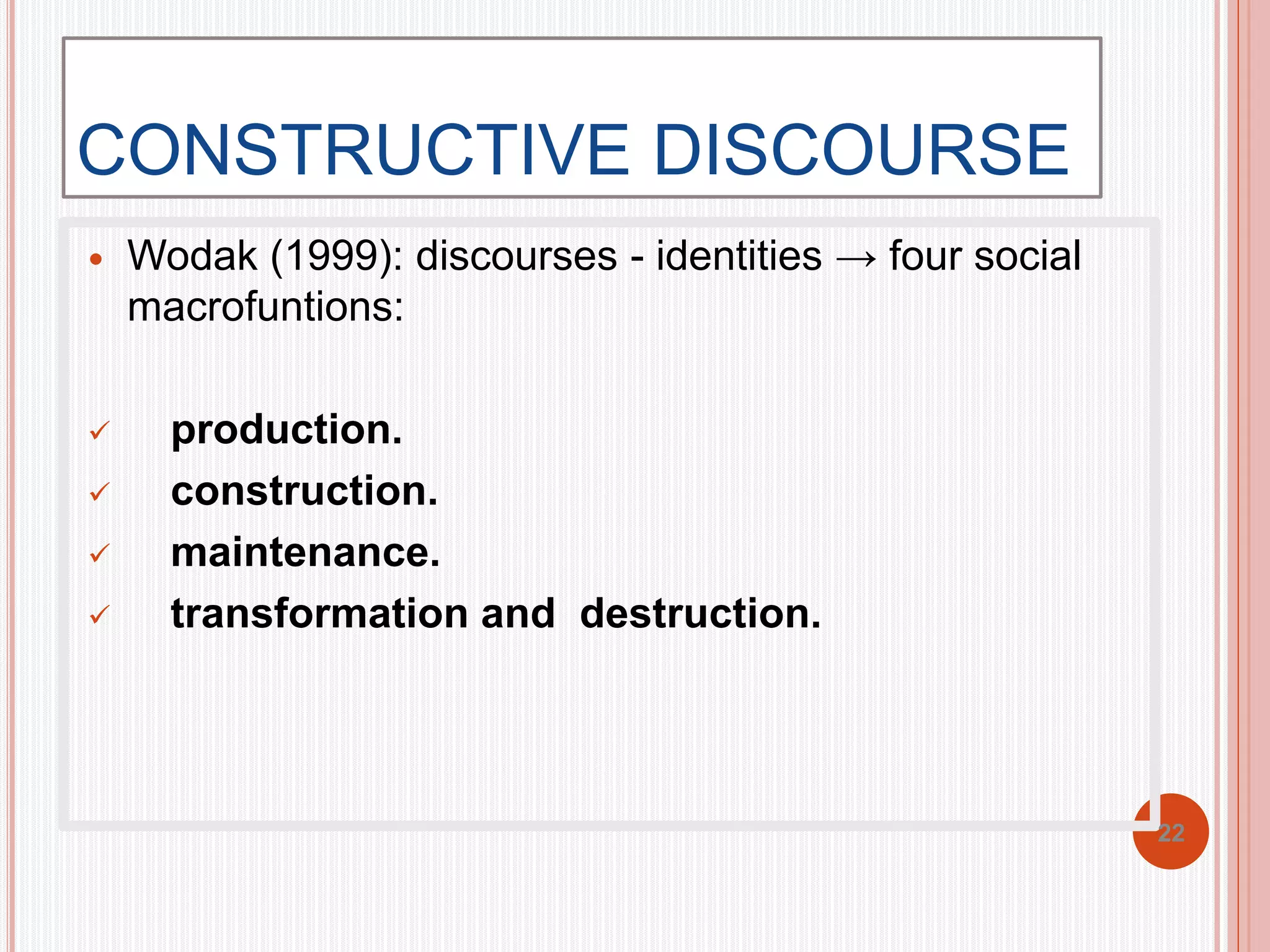
CONSTRUCTIVE DISCOURSE 
 Wodak (1999): discourses - identities → four social 
macrofuntions: 
 production. 
 construction. 
 maintenance. 
 transformation and destruction. 
22
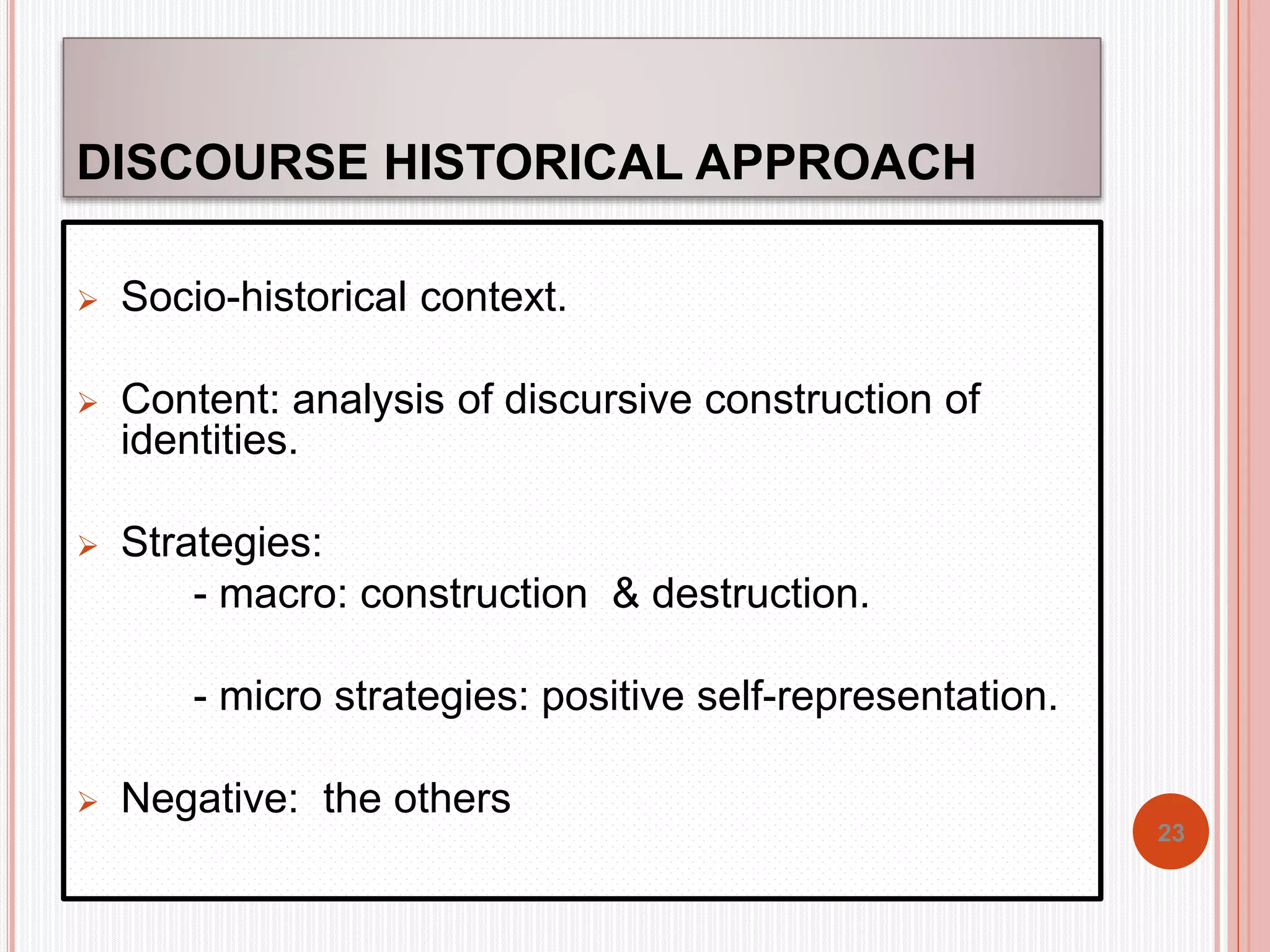
DISCOURSE HISTORICAL APPROACH 
 Socio-historical context. 
 Content: analysis of discursive construction of 
identities. 
 Strategies: 
- macro: construction & destruction. 
- micro strategies: positive self-representation. 
 Negative: the others 
23
24 
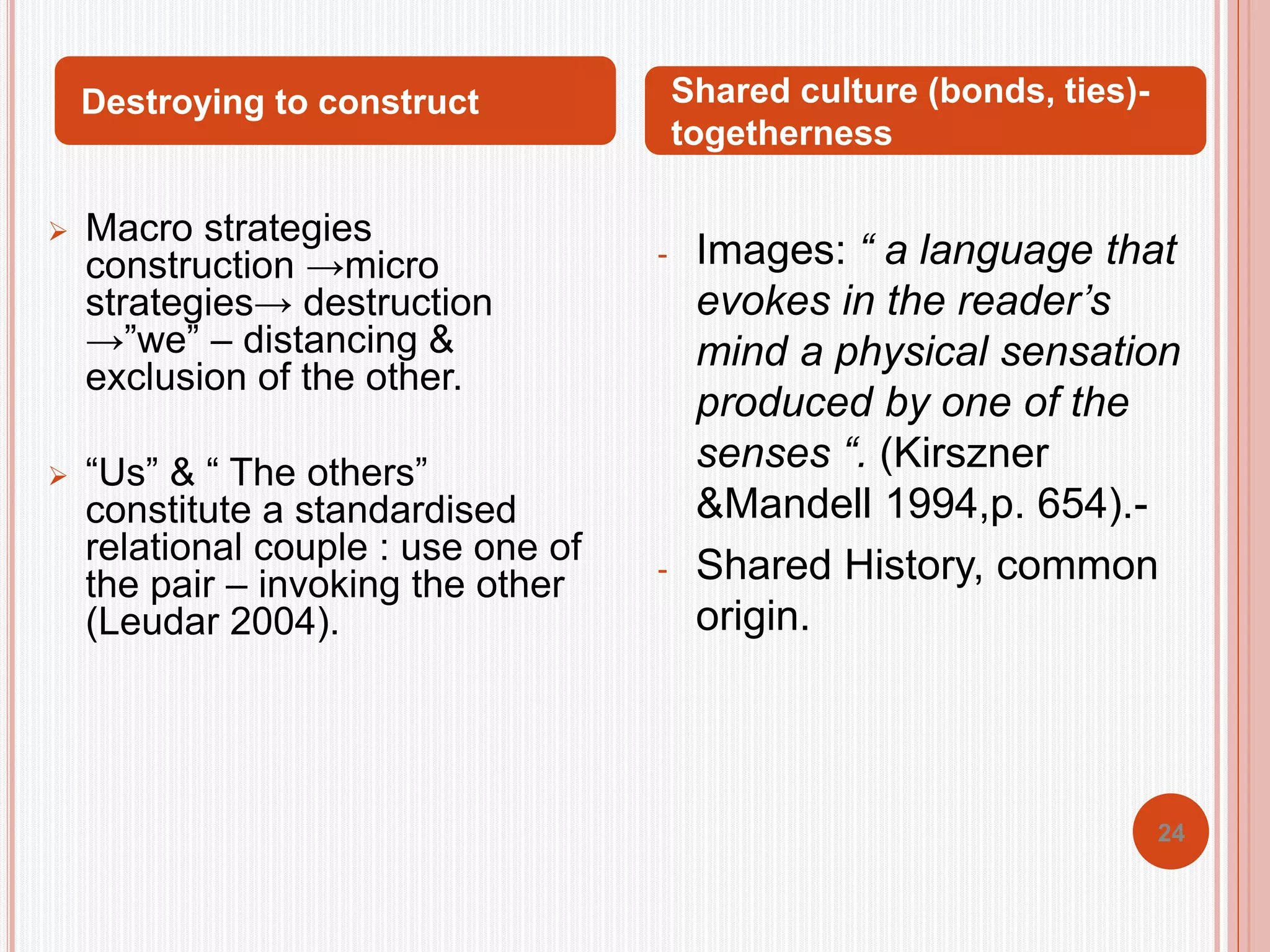
Destroying to construct Shared culture (bonds, ties)- 
 Macro strategies 
construction →micro 
strategies→ destruction 
→”we” – distancing & 
exclusion of the other. 
 “Us” & “ The others” 
constitute a standardised 
relational couple : use one of 
the pair – invoking the other 
(Leudar 2004). 
togetherness 
- Images: “ a language that 
evokes in the reader’s 
mind a physical sensation 
produced by one of the 
senses “. (Kirszner 
&Mandell 1994,p. 654).- 
- Shared History, common 
origin.
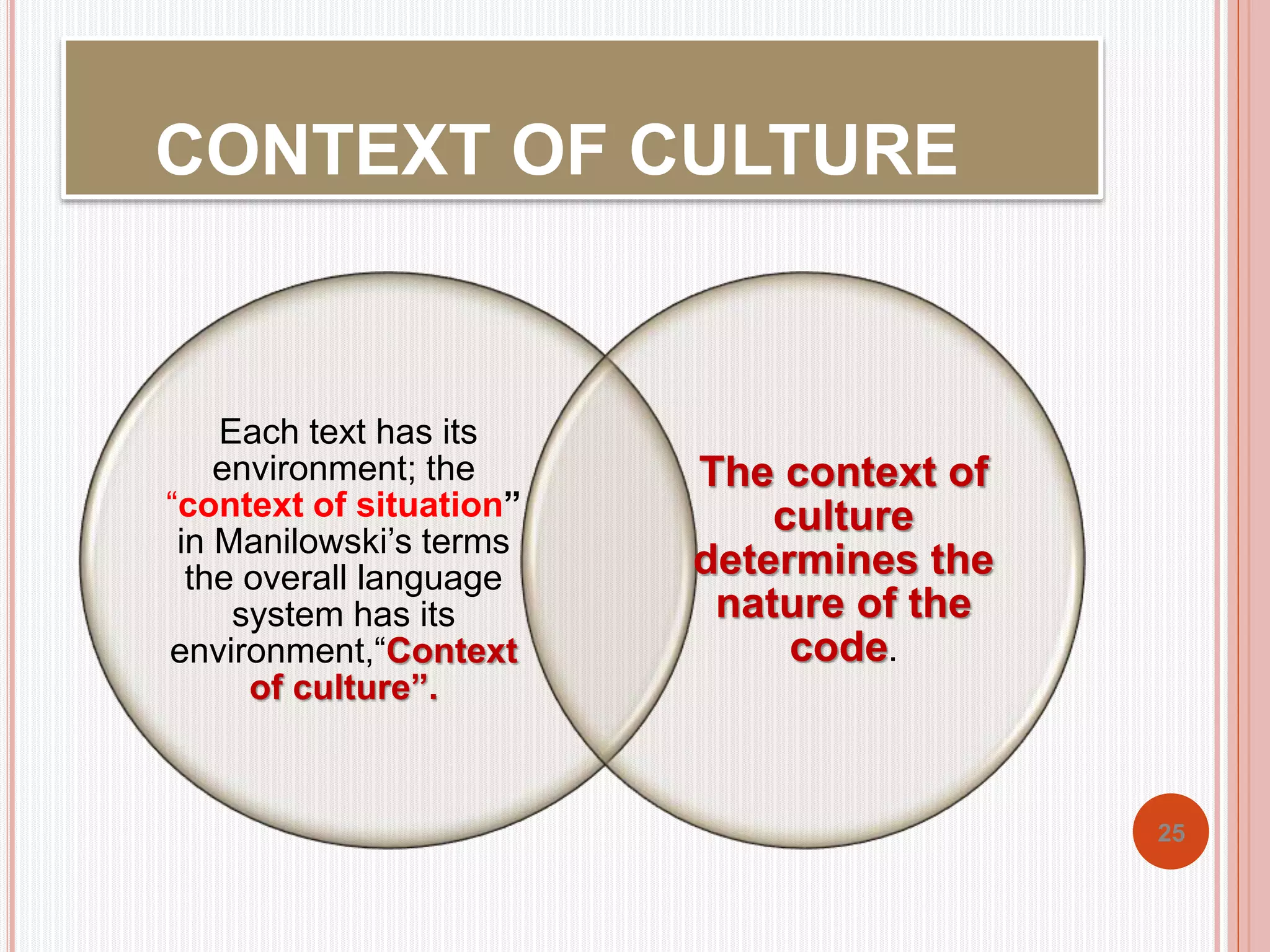
CONTEXT OF CULTURE 
Each text has its 
environment; the 
“context of situation” 
in Manilowski’s terms 
the overall language 
system has its 
environment,“Context 
of culture”. 
The context of 
culture 
determines the 
nature of the 
code. 
25
DISCOURSE ANALYSIS 
HEROES & VILLAINS : 
THEIR DISCURSIVE 
CONSTRUCTION BY BUSH 
AFTER 9/11 
26
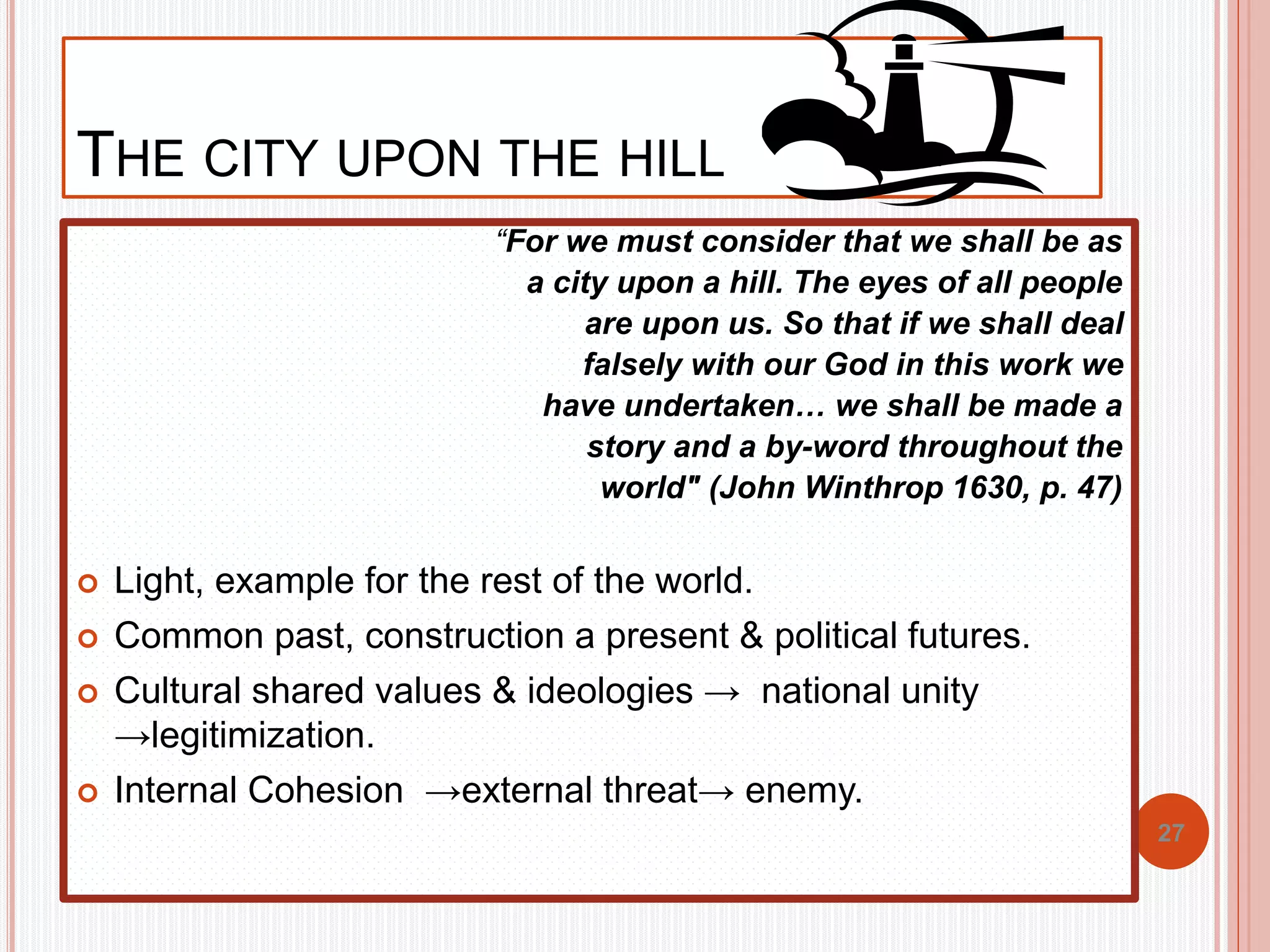
THE CITY UPON THE HILL 
“For we must consider that we shall be as 
a city upon a hill. The eyes of all people 
are upon us. So that if we shall deal 
falsely with our God in this work we 
have undertaken… we shall be made a 
story and a by-word throughout the 
world" (John Winthrop 1630, p. 47) 
 Light, example for the rest of the world. 
 Common past, construction a present & political futures. 
 Cultural shared values & ideologies → national unity 
→legitimization. 
 Internal Cohesion →external threat→ enemy. 
27
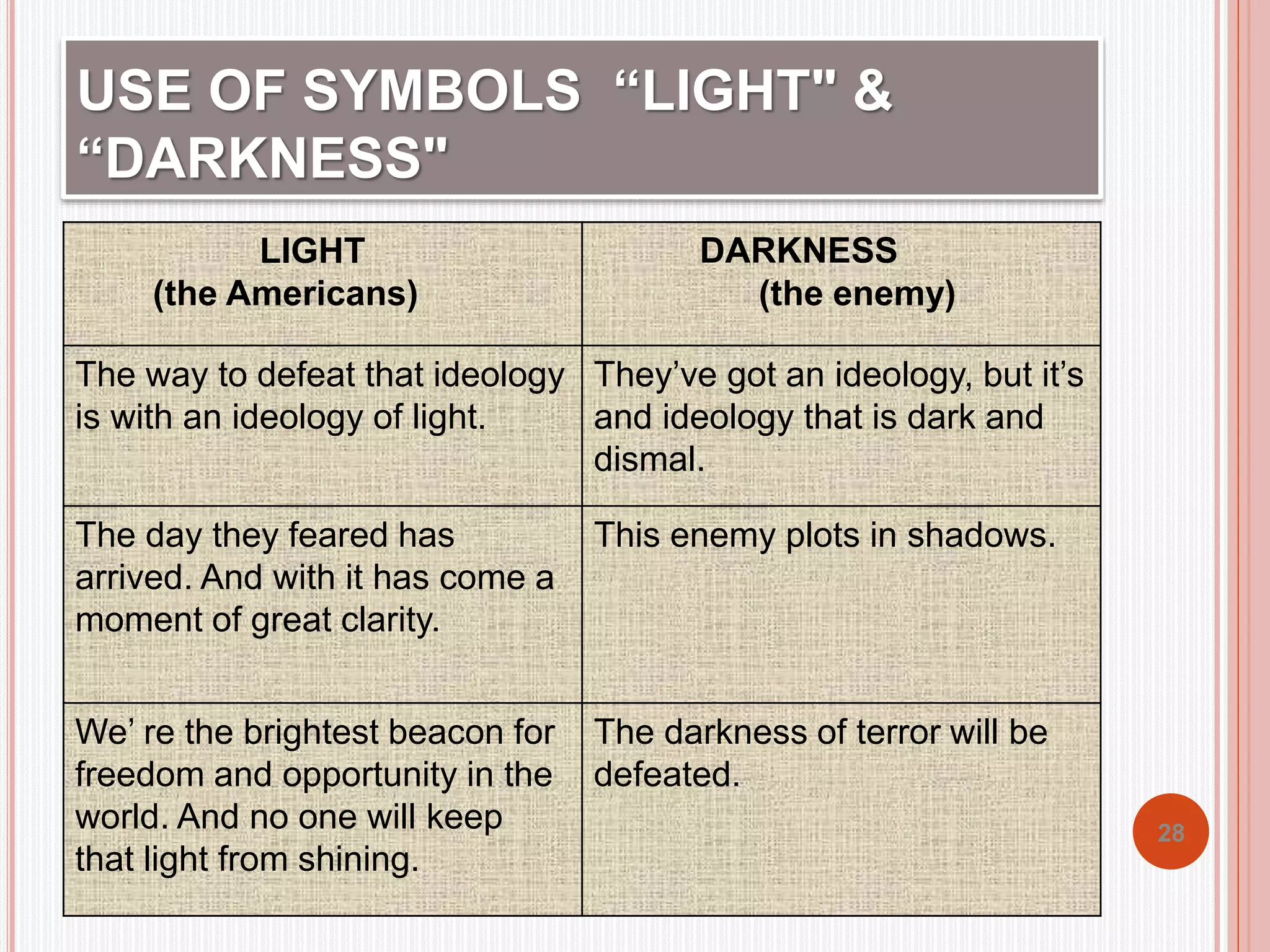
USE OF SYMBOLS “LIGHT" & 
“DARKNESS" 
LIGHT 
(the Americans) 
DARKNESS 
(the enemy) 
The way to defeat that ideology 
is with an ideology of light. 
They’ve got an ideology, but it’s 
and ideology that is dark and 
dismal. 
The day they feared has 
arrived. And with it has come a 
moment of great clarity. 
This enemy plots in shadows. 
We’ re the brightest beacon for 
freedom and opportunity in the 
world. And no one will keep 
that light from shining. 
The darkness of terror will be 
defeated. 
28
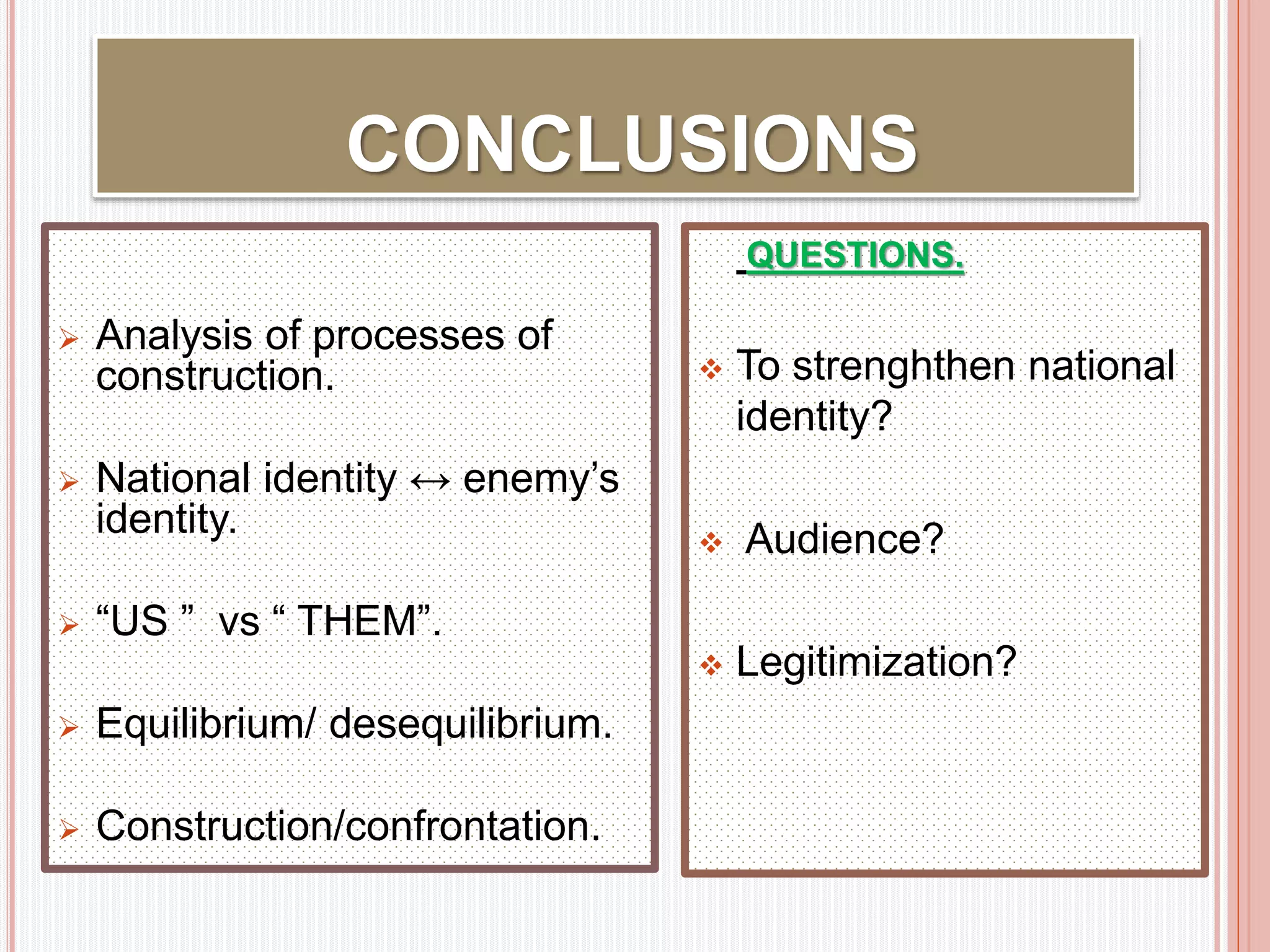
CONCLUSIONS 
29 
 Analysis of processes of 
construction. 
 National identity ↔ enemy’s 
identity. 
 “US ” vs “ THEM”. 
 Equilibrium/ desequilibrium. 
 Construction/confrontation. 
QUESTIONS. 
 To strenghthen national 
identity? 
 Audience? 
 Legitimization?
30 
FOR LISTENING!

Systemic Functional Linguistics

  • 1.
    SYSTEMIC FUNCTIONAL LINGUISTICS 1 41st INTERNATIONAL SYSTEMIC FUNCTIONAL CONGRESS X LATIN-AMERICAN SYSTEMIC FUNCTIONAL CONGRESS UNIVERSIDAD NACIONAL DE CUYO, FACULTAD DE FILOSOFÍA Y LETRAS, MENDOZA, ARGENTINA
  • 2.
    TODAY ISFL CONGRESS:theme, speakers. VISION OF LANGUAGE. “HEROES & VILLAINS”. CONCLUSIONS. 2
  • 3.
    THE CONGRESS ITSELF  Systemic Functional Linguistics and Language Education: Novel applications of well-established and evolving lines of enquiry to language education theory and practice 3
  • 4.
    THE CONGRESS ITSELF  MAIN THEMES OF THE CONFERENCE  Language education and language in education  Child language development  Language typology  SFL and translation studies  Multilinguistic studies  Register and genre theory  (Critical) discourse analysis  Multimodality and multimodal literacy  Appraisal  Language and knowledge  Computational linguistics 4
  • 5.
    PLENARY SPEAKERS Ann Borsinger  Cecilia Colombi  Susan Hood  James Martin  Karl Maton  Teresa Oteíza  Caroline Coffin 5
  • 6.
    PLENARY LECTURES COFFIN , CAROLINE (The Open University, UK) A LANGUAGE AS SOCIAL SEMIOTIC APPROACH TO TEACHING AND LEARNING IN HIGHER EDUCATION.  approach put forward: LANGUAGE AS SOCIAL SEMIOTIC (LASS) to teaching and learning. 6 LEARNING LANGUAGE, LEARNING THROUGH LANGUAGE & LEARNING ABOUT LANGUAGE (Halliday, 2004/1980)
  • 7.
    PLENARY LECTURES Susan Hood ( Australia) THE LECTURING BODY AND LEARNING TO MEAN IN THE UNCOMMON-SENSE WAY OF DIFFERENT DISCIPLINES.  the opportunity for students to participate in live lectures- declining.  Discourse dichotomising : the old as bad with the new as good.  Body language of lecturers- interaction. 7
  • 8.
    PLENARY LECTURES Len, Unsworth.  ELEVATING EMPATHY IN ANIMATED MOVIE ADAPTATIONS OF PICTURE BOOKS: EXPLORING MEDIA-SPECIFIC ORIENTATIONS TO FOCALIZATION, SOCIAL DISTANCE AND ATTITUDE.  Interaction of social distance, horizontal, vertical angle – a means of inscribing the audience viewpoint. 8
  • 9.
    PLENARY LECTURES MARY MACKEN-HORARIK (Australia) DEVELOPING A GRAMMATICS “GOOD ENOUGH” FOR SCHOOL ENGLISH: four proposals and some data. 9
  • 10.
  • 11.
  • 12.
    JIM MARTIN University of Sidney. REVISITING FIELD: “ SEMANTIC DENSITY” IN ANCIENT HISTORY AND BIOLOGY DISCOURSE.  “semantic gravity”, “contextual dependency” 12
  • 13.
    FUNCTIONAL GRAMMAR HALLIDAY  Functional →in the sense that it is designed to account for how the language is used: everything in it can be explained by reference to how language is used. 13
  • 14.
    FUNCTIONAL GRAMMAR THEFUNDAMENTAL COMPONENTS OF MEANING: are functional components. All languages are organized around two main kinds of meaning, two “METAFUNCTIONS” 14 FUNCTIONAL GRAMMAR
  • 15.
    METAFUNCTIONS  theyare the manifestations in the linguistic system of the two very general purposes which underlie all uses of language: 15  THE IDEATIONAL or “reflective”: TO UNDERSTAND THE ENVIRONMENT.  THE INTERPERSONAL or “active”: TO ACT ON THE OTHERS IN THE ENVIRONMENT.  Combined with these is a third metafunctional component: THE TEXTUAL: which breathes relevance into the other two.
  • 16.
    WHY SYSTEMIC ? SYSTEMIC THEORY: a theory of MEANING AS CHOICE, by which a language, or any other semiotic system, is interpreted as networks of interlocking options: “either this , or that, or the other”. Whatever is chosen in one system becomes the way into a set of choices in another. GRAMMATICAL CATEGORIES EXPLAINED AS THE REALIZATION OF SEMANTIC PATTERNS. 16
  • 17.
    TODAY  ISFLCONGRESS: theme, speakers.  VISION OF LANGUAGE. 17
  • 18.
    FUNCTIONAL LANGUAGE 18  Form – Use  →Communication: communicative competence, participants, context.  Language: sentences, structures→ printed text, speech. iceberg • Ideology. • Power. • Identities. - LANGUAGE ↔CONTEXT. - LANGUAGE ↔SOCIETY.
  • 19.
    THE HOW Critical Discourse Analysis - CDA.  Language social practice.  Use intention.  Visible connections.  Constructive effect of discourse.  Specific discursive acts ↔ socio-cultural context. 19
  • 20.
    THE HOW SFL DISCOURSE HISTORICAL APPROACH 20
  • 21.
    TODAY ISFL CONGRESS:theme, speakers. VISION OF LANGUAGE. “HEROES & VILLAINS”. 21
  • 22.
    CONSTRUCTIVE DISCOURSE Wodak (1999): discourses - identities → four social macrofuntions:  production.  construction.  maintenance.  transformation and destruction. 22
  • 23.
    DISCOURSE HISTORICAL APPROACH  Socio-historical context.  Content: analysis of discursive construction of identities.  Strategies: - macro: construction & destruction. - micro strategies: positive self-representation.  Negative: the others 23
  • 24.
    24 Destroying toconstruct Shared culture (bonds, ties)-  Macro strategies construction →micro strategies→ destruction →”we” – distancing & exclusion of the other.  “Us” & “ The others” constitute a standardised relational couple : use one of the pair – invoking the other (Leudar 2004). togetherness - Images: “ a language that evokes in the reader’s mind a physical sensation produced by one of the senses “. (Kirszner &Mandell 1994,p. 654).- - Shared History, common origin.
  • 25.
    CONTEXT OF CULTURE Each text has its environment; the “context of situation” in Manilowski’s terms the overall language system has its environment,“Context of culture”. The context of culture determines the nature of the code. 25
  • 26.
    DISCOURSE ANALYSIS HEROES& VILLAINS : THEIR DISCURSIVE CONSTRUCTION BY BUSH AFTER 9/11 26
  • 27.
    THE CITY UPONTHE HILL “For we must consider that we shall be as a city upon a hill. The eyes of all people are upon us. So that if we shall deal falsely with our God in this work we have undertaken… we shall be made a story and a by-word throughout the world" (John Winthrop 1630, p. 47)  Light, example for the rest of the world.  Common past, construction a present & political futures.  Cultural shared values & ideologies → national unity →legitimization.  Internal Cohesion →external threat→ enemy. 27
  • 28.
    USE OF SYMBOLS“LIGHT" & “DARKNESS" LIGHT (the Americans) DARKNESS (the enemy) The way to defeat that ideology is with an ideology of light. They’ve got an ideology, but it’s and ideology that is dark and dismal. The day they feared has arrived. And with it has come a moment of great clarity. This enemy plots in shadows. We’ re the brightest beacon for freedom and opportunity in the world. And no one will keep that light from shining. The darkness of terror will be defeated. 28
  • 29.
    CONCLUSIONS 29 Analysis of processes of construction.  National identity ↔ enemy’s identity.  “US ” vs “ THEM”.  Equilibrium/ desequilibrium.  Construction/confrontation. QUESTIONS.  To strenghthen national identity?  Audience?  Legitimization?
  • 30.