Structuralism & Generativism
Lecture on Structuralism and Generativism
Fall92
S. Shokooh
English Language Teaching, MA
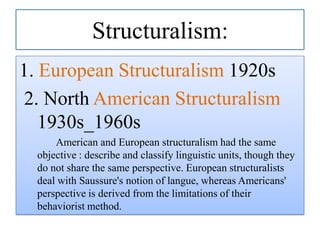
Structuralism:
1. European Structuralism 1920s
2. North American Structuralism
1930s_1960s
American and European structuralism had the same
objective : describe and classify linguistic units, though they
do not share the same perspective. European structuralists
deal with Saussure's notion of langue, whereas Americans'
perspective is derived from the limitations of their
behaviorist method.
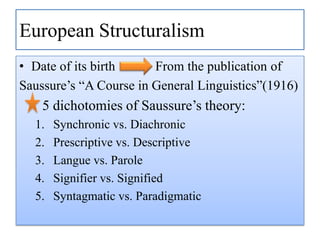
European Structuralism
• Date of its birth
From the publication of
Saussure‟s “A Course in General Linguistics”(1916)

5 dichotomies of Saussure‟s theory:
1.
2.
3.
4.
5.

Synchronic vs. Diachronic
Prescriptive vs. Descriptive
Langue vs. Parole
Signifier vs. Signified
Syntagmatic vs. Paradigmatic
Definition of the first dichotomy
1. Synchronic vs. Diachronic:
Synchronic explanation differs from diachronic, or historical,
explanation in being structural, rather than causal.
It gives a different answer to the question, “Why are things as
they are?” Instead of following the historical development, Synchronic
description demonstrates how all the forms and meanings are
interrelated at a particular point in time in a particular languagesystem. It is important to mention that Saussure was not denying
the validity of historical explanation. He believed that these two
modes are complementary.
A structural description of a language tells us how all the
components fit together.
Definition of the second and third
dichotomies
2. Prescriptive vs. Descriptive:
Prescriptive linguistics are a normative approach concerned
with what is <right> and <wrong>. On the other hand,
descriptive linguistics are only concerned with, well,
describing what is (rather than what should be).

3. Langue vs. Parole:
The dichotomy of langue and parole would more accurately
have to be described as a <trichotomy>, because Ferdinand de
Saussure introduced not only these two, but also a third term,
language.
Continuance
•

Langue, as used by Saussure, describes the general linguistic
system of a given language. it does not refer to a single
person's knowledge about his or her language, but to the
system as a whole, the shared knowledge in a given
community.
• Parole, on the other hand, describes a given utterance. It is
not possible for linguists to directly examine langue, they can
only study parole and infer from it.
• language is the term Saussure uses to describe the abstract
ability to learn and communicate via language. In Persian we
say <
Definition of the forth dichotomy
4. Signifier vs. Signified:
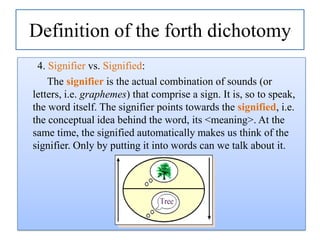
The signifier is the actual combination of sounds (or
letters, i.e. graphemes) that comprise a sign. It is, so to speak,
the word itself. The signifier points towards the signified, i.e.
the conceptual idea behind the word, its <meaning>. At the
same time, the signified automatically makes us think of the
signifier. Only by putting it into words can we talk about it.
Definition of the fifth dichotomy
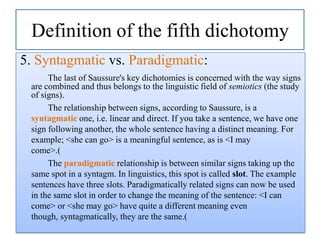
5. Syntagmatic vs. Paradigmatic:
The last of Saussure's key dichotomies is concerned with the way signs
are combined and thus belongs to the linguistic field of semiotics (the study
of signs).
The relationship between signs, according to Saussure, is a
syntagmatic one, i.e. linear and direct. If you take a sentence, we have one
sign following another, the whole sentence having a distinct meaning. For
example; <she can go> is a meaningful sentence, as is <I may
come>.(
The paradigmatic relationship is between similar signs taking up the
same spot in a syntagm. In linguistics, this spot is called slot. The example
sentences have three slots. Paradigmatically related signs can now be used
in the same slot in order to change the meaning of the sentence: <I can
come> or <she may go> have quite a different meaning even
though, syntagmatically, they are the same.(
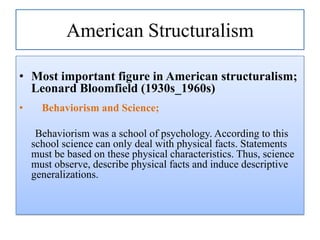
American Structuralism
• Most important figure in American structuralism;
Leonard Bloomfield (1930s_1960s)
•

Behaviorism and Science;

Behaviorism was a school of psychology. According to this
school science can only deal with physical facts. Statements
must be based on these physical characteristics. Thus, science
must observe, describe physical facts and induce descriptive
generalizations.
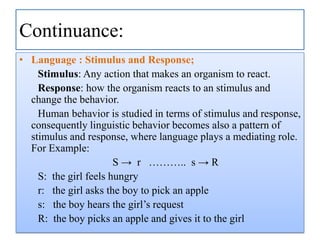
Continuance:
• Language : Stimulus and Response;
Stimulus: Any action that makes an organism to react.
Response: how the organism reacts to an stimulus and
change the behavior.
Human behavior is studied in terms of stimulus and response,
consequently linguistic behavior becomes also a pattern of
stimulus and response, where language plays a mediating role.
For Example:
S → r ……….. s → R
S: the girl feels hungry
r: the girl asks the boy to pick an apple
s: the boy hears the girl‟s request
R: the boy picks an apple and gives it to the girl
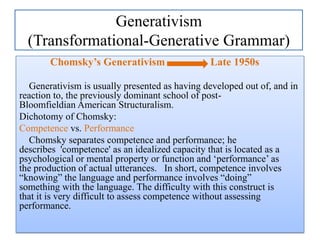
Generativism
(Transformational-Generative Grammar)
Chomsky’s Generativism

Late 1950s

Generativism is usually presented as having developed out of, and in
reaction to, the previously dominant school of postBloomfieldian American Structuralism.
Dichotomy of Chomsky:
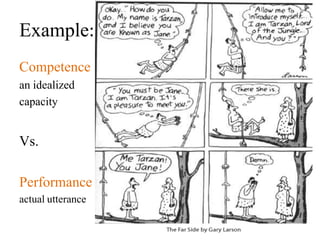
Competence vs. Performance
Chomsky separates competence and performance; he
describes 'competence' as an idealized capacity that is located as a
psychological or mental property or function and „performance‟ as
the production of actual utterances. In short, competence involves
“knowing” the language and performance involves “doing”
something with the language. The difficulty with this construct is
that it is very difficult to assess competence without assessing
performance.
Example:
Competence
an idealized
capacity

Vs.
Performance
actual utterance
Generativism
Language- systems are productive, in the sense that they
allow for the construction and comprehension of
indefinitely many utterances that have never previously
occurred in the experience of any of their users.
Chomsky drew attention to this fact, in his criticism of the
widely held view that children learn their native language
by reproducing the utterances of adult speakers.
Obviously, if children from a fairly early age, are able to
produce novel utterances which a competent speaker of the
language will recognize as grammatically well-formed,
there must be something other than imitation involved.
Generativism
They must have inferred, learned, or acquired the
grammatical rules by which the utterances that they produce
are judged to be well-formed.
Chomsky: language is the knowledge that enables to
understand and produce complex grammatical relations.
Productivity is not to be identified with creativity: but there
is an intrinsic connection between them. Our creativity in the
use of language manifests itself within the limits set by the
productivity of the language-system.
There are significant differences between Chomskyan
Generativism and Bloomfieldian structuralism. One of these is
their attitudes towards linguistic universals,
Generativism
Bloomfield and his followers emphasized the structural diversity
of languages. Generativists, in contrast, are more interested in what
languages have in common.
In this respect, generativism represents a return to the older
tradition of universal grammar which both Saussure and Bloomfield
condemned as speculative and unscientific.
Saussure gives the impression that the sentences of a language
are instances of parole; both he and his followers talk of a langue as
a system of relations and say little or nothing about the rules that are
required to generate sentences.
Chomsky, on the other hand, has insisted from the outset that the
capacity to produce and understand syntactically well-formed
Generativism
sentences is a central part of a speaker‟s linguistic
competence. In this respect, Chomskyan generativism
undoubtedly constitutes an advance upon Saussurean
structuralism.
Resource:
Resources:
“Language and Linguistics” by John Lyons
eka1.wordpress.com
www.ualberta.ca
www.unm.edu
www.en.wikipedia.org

Ppt,s & g

  • 1.
    Structuralism & Generativism Lectureon Structuralism and Generativism Fall92 S. Shokooh English Language Teaching, MA
  • 2.
    Structuralism: 1. European Structuralism1920s 2. North American Structuralism 1930s_1960s American and European structuralism had the same objective : describe and classify linguistic units, though they do not share the same perspective. European structuralists deal with Saussure's notion of langue, whereas Americans' perspective is derived from the limitations of their behaviorist method.
  • 3.
    European Structuralism • Dateof its birth From the publication of Saussure‟s “A Course in General Linguistics”(1916) 5 dichotomies of Saussure‟s theory: 1. 2. 3. 4. 5. Synchronic vs. Diachronic Prescriptive vs. Descriptive Langue vs. Parole Signifier vs. Signified Syntagmatic vs. Paradigmatic
  • 4.
    Definition of thefirst dichotomy 1. Synchronic vs. Diachronic: Synchronic explanation differs from diachronic, or historical, explanation in being structural, rather than causal. It gives a different answer to the question, “Why are things as they are?” Instead of following the historical development, Synchronic description demonstrates how all the forms and meanings are interrelated at a particular point in time in a particular languagesystem. It is important to mention that Saussure was not denying the validity of historical explanation. He believed that these two modes are complementary. A structural description of a language tells us how all the components fit together.
  • 5.
    Definition of thesecond and third dichotomies 2. Prescriptive vs. Descriptive: Prescriptive linguistics are a normative approach concerned with what is <right> and <wrong>. On the other hand, descriptive linguistics are only concerned with, well, describing what is (rather than what should be). 3. Langue vs. Parole: The dichotomy of langue and parole would more accurately have to be described as a <trichotomy>, because Ferdinand de Saussure introduced not only these two, but also a third term, language.
  • 6.
    Continuance • Langue, as usedby Saussure, describes the general linguistic system of a given language. it does not refer to a single person's knowledge about his or her language, but to the system as a whole, the shared knowledge in a given community. • Parole, on the other hand, describes a given utterance. It is not possible for linguists to directly examine langue, they can only study parole and infer from it. • language is the term Saussure uses to describe the abstract ability to learn and communicate via language. In Persian we say <
  • 7.
    Definition of theforth dichotomy 4. Signifier vs. Signified: The signifier is the actual combination of sounds (or letters, i.e. graphemes) that comprise a sign. It is, so to speak, the word itself. The signifier points towards the signified, i.e. the conceptual idea behind the word, its <meaning>. At the same time, the signified automatically makes us think of the signifier. Only by putting it into words can we talk about it.
  • 8.
    Definition of thefifth dichotomy 5. Syntagmatic vs. Paradigmatic: The last of Saussure's key dichotomies is concerned with the way signs are combined and thus belongs to the linguistic field of semiotics (the study of signs). The relationship between signs, according to Saussure, is a syntagmatic one, i.e. linear and direct. If you take a sentence, we have one sign following another, the whole sentence having a distinct meaning. For example; <she can go> is a meaningful sentence, as is <I may come>.( The paradigmatic relationship is between similar signs taking up the same spot in a syntagm. In linguistics, this spot is called slot. The example sentences have three slots. Paradigmatically related signs can now be used in the same slot in order to change the meaning of the sentence: <I can come> or <she may go> have quite a different meaning even though, syntagmatically, they are the same.(
  • 9.
    American Structuralism • Mostimportant figure in American structuralism; Leonard Bloomfield (1930s_1960s) • Behaviorism and Science; Behaviorism was a school of psychology. According to this school science can only deal with physical facts. Statements must be based on these physical characteristics. Thus, science must observe, describe physical facts and induce descriptive generalizations.
  • 10.
    Continuance: • Language :Stimulus and Response; Stimulus: Any action that makes an organism to react. Response: how the organism reacts to an stimulus and change the behavior. Human behavior is studied in terms of stimulus and response, consequently linguistic behavior becomes also a pattern of stimulus and response, where language plays a mediating role. For Example: S → r ……….. s → R S: the girl feels hungry r: the girl asks the boy to pick an apple s: the boy hears the girl‟s request R: the boy picks an apple and gives it to the girl
  • 11.
    Generativism (Transformational-Generative Grammar) Chomsky’s Generativism Late1950s Generativism is usually presented as having developed out of, and in reaction to, the previously dominant school of postBloomfieldian American Structuralism. Dichotomy of Chomsky: Competence vs. Performance Chomsky separates competence and performance; he describes 'competence' as an idealized capacity that is located as a psychological or mental property or function and „performance‟ as the production of actual utterances. In short, competence involves “knowing” the language and performance involves “doing” something with the language. The difficulty with this construct is that it is very difficult to assess competence without assessing performance.
  • 12.
  • 13.
    Generativism Language- systems areproductive, in the sense that they allow for the construction and comprehension of indefinitely many utterances that have never previously occurred in the experience of any of their users. Chomsky drew attention to this fact, in his criticism of the widely held view that children learn their native language by reproducing the utterances of adult speakers. Obviously, if children from a fairly early age, are able to produce novel utterances which a competent speaker of the language will recognize as grammatically well-formed, there must be something other than imitation involved.
  • 14.
    Generativism They must haveinferred, learned, or acquired the grammatical rules by which the utterances that they produce are judged to be well-formed. Chomsky: language is the knowledge that enables to understand and produce complex grammatical relations. Productivity is not to be identified with creativity: but there is an intrinsic connection between them. Our creativity in the use of language manifests itself within the limits set by the productivity of the language-system. There are significant differences between Chomskyan Generativism and Bloomfieldian structuralism. One of these is their attitudes towards linguistic universals,
  • 15.
    Generativism Bloomfield and hisfollowers emphasized the structural diversity of languages. Generativists, in contrast, are more interested in what languages have in common. In this respect, generativism represents a return to the older tradition of universal grammar which both Saussure and Bloomfield condemned as speculative and unscientific. Saussure gives the impression that the sentences of a language are instances of parole; both he and his followers talk of a langue as a system of relations and say little or nothing about the rules that are required to generate sentences. Chomsky, on the other hand, has insisted from the outset that the capacity to produce and understand syntactically well-formed
  • 16.
    Generativism sentences is acentral part of a speaker‟s linguistic competence. In this respect, Chomskyan generativism undoubtedly constitutes an advance upon Saussurean structuralism.
  • 17.
    Resource: Resources: “Language and Linguistics”by John Lyons eka1.wordpress.com www.ualberta.ca www.unm.edu www.en.wikipedia.org