UNIVERSIDADE LUTERANA DO BRASIL


                        OUTLINE

FUNCTIONAL ENGLISH GRAMMAR – NA INTRODUCTION FOR SECOND
                       LANGUAGE


                    Airan Abdalla Costa


                      July 10th, 2010
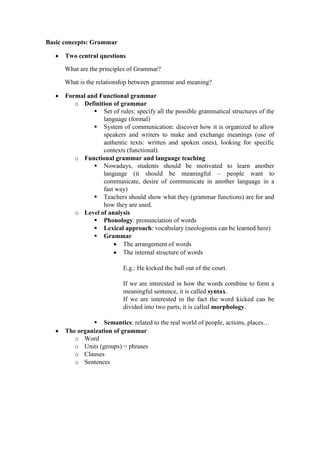
Basic concepts: Grammar

      Two central questions

       What are the principles of Grammar?

       What is the relationship between grammar and meaning?

      Formal and Functional grammar
          o Definition of grammar
                 Set of rules: specify all the possible grammatical structures of the
                   language (formal)
                 System of communication: discover how it is organized to allow
                   speakers and writers to make and exchange meanings (use of
                   authentic texts: written and spoken ones), looking for specific
                   contexts (functional).
          o Functional grammar and language teaching
                 Nowadays, students should be motivated to learn another
                   language (it should be meaningful – people want to
                   communicate, desire of communicate in another language in a
                   fast way)
                 Teachers should show what they (grammar functions) are for and
                   how they are used.
          o Level of analysis
                 Phonology: pronunciation of words
                 Lexical approach: vocabulary (neologisms can be learned here)
                 Grammar
                        The arrangement of words
                        The internal structure of words

                            E.g.: He kicked the ball out of the court.

                            If we are interested in how the words combine to form a
                            meaningful sentence, it is called syntax.
                            If we are interested in the fact the word kicked can be
                            divided into two parts, it is called morphology.

                 Semantics: related to the real world of people, actions, places…
      The organization of grammar
          o Word
          o Units (groups) = phrases
          o Clauses
          o Sentences
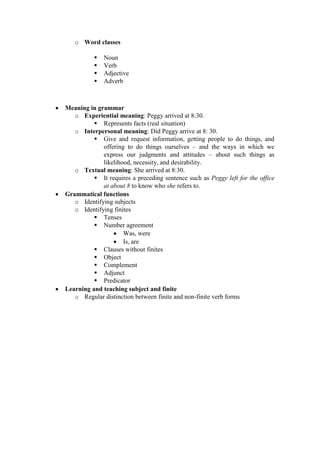
o Word classes

                 Noun
                 Verb
                 Adjective
                 Adverb


   Meaning in grammar
       o Experiential meaning: Peggy arrived at 8:30.
               Represents facts (real situation)
       o Interpersonal meaning: Did Peggy arrive at 8: 30.
               Give and request information, getting people to do things, and
                 offering to do things ourselves – and the ways in which we
                 express our judgments and attitudes – about such things as
                 likelihood, necessity, and desirability.
       o Textual meaning: She arrived at 8:30.
               It requires a preceding sentence such as Peggy left for the office
                 at about 8 to know who she refers to.
   Grammatical functions
       o Identifying subjects
       o Identifying finites
               Tenses
               Number agreement
                      Was, were
                      Is, are
               Clauses without finites
               Object
               Complement
               Adjunct
               Predicator
   Learning and teaching subject and finite
       o Regular distinction between finite and non-finite verb forms

Basic concepts

  • 1.
    UNIVERSIDADE LUTERANA DOBRASIL OUTLINE FUNCTIONAL ENGLISH GRAMMAR – NA INTRODUCTION FOR SECOND LANGUAGE Airan Abdalla Costa July 10th, 2010
  • 2.
    Basic concepts: Grammar  Two central questions What are the principles of Grammar? What is the relationship between grammar and meaning?  Formal and Functional grammar o Definition of grammar  Set of rules: specify all the possible grammatical structures of the language (formal)  System of communication: discover how it is organized to allow speakers and writers to make and exchange meanings (use of authentic texts: written and spoken ones), looking for specific contexts (functional). o Functional grammar and language teaching  Nowadays, students should be motivated to learn another language (it should be meaningful – people want to communicate, desire of communicate in another language in a fast way)  Teachers should show what they (grammar functions) are for and how they are used. o Level of analysis  Phonology: pronunciation of words  Lexical approach: vocabulary (neologisms can be learned here)  Grammar  The arrangement of words  The internal structure of words E.g.: He kicked the ball out of the court. If we are interested in how the words combine to form a meaningful sentence, it is called syntax. If we are interested in the fact the word kicked can be divided into two parts, it is called morphology.  Semantics: related to the real world of people, actions, places…  The organization of grammar o Word o Units (groups) = phrases o Clauses o Sentences
  • 3.
    o Word classes  Noun  Verb  Adjective  Adverb  Meaning in grammar o Experiential meaning: Peggy arrived at 8:30.  Represents facts (real situation) o Interpersonal meaning: Did Peggy arrive at 8: 30.  Give and request information, getting people to do things, and offering to do things ourselves – and the ways in which we express our judgments and attitudes – about such things as likelihood, necessity, and desirability. o Textual meaning: She arrived at 8:30.  It requires a preceding sentence such as Peggy left for the office at about 8 to know who she refers to.  Grammatical functions o Identifying subjects o Identifying finites  Tenses  Number agreement  Was, were  Is, are  Clauses without finites  Object  Complement  Adjunct  Predicator  Learning and teaching subject and finite o Regular distinction between finite and non-finite verb forms