*Cas e Theor y
* Bi ndi ng Theor y

P
repared B
y:
Zhian Fadhil Asaad
Case Theory
is one of the modules of G/B defining Case-assignment to DPs.
Case Theory is in fact a central part of G/B theory which plays an
important role in the analysis of certain movements.
Morphological Case vs Abstract Case
All DPs, in English as well as Latin, are assigned a Case, even when
there's no change in form:
Ali hit the ball. (Ali is nominative & the ball is
accusative)
The ball hit Ali. (the ball is nominative & Ali is
accusative)
One of the interesting things about pronouns in English is that, they
change form depending on their function in the sentence.
Morphological case is the realization of abstract case.
John hit him.
him: is assigned (abstract) accusative case by the verb hit. because
its pronoun, that abstract accusative case is realized as morphological
accusative case. John is abstract nominative case but there's no
realization of that with a visible morphological case ending



pronoun occur as
of prepositions, they
 Whenabstract oblique case the objectsrealized morphologicallyare
assigned
but this is
as
accusative case in English ( from him not from he).
The Principles of Case Theory
Case Filter: every overt DP must be assigned abstract Case.
this insure that all DPs occupy positions to which case assigned –
(PRO does not sit in a case position).
John invited them. (Accusative case is associated with
objects, the assigner of this case is the verb).
They hope that John is the best candidate .
hope is not an ECM verb and it takes CP complement, it can
not provide a source of case because CP ”as maximal projection”
is a barrier to case assignment.
Structural Case vs Inherent Case
In English all verbs assign accusative case & its known as a
Structural Case, as it is generally assigned to the structural
position of the verbal object.
Dative and genitive objects depend on particular verbs and to bear
Inherent Case.
Structural Cases objective and nominative, assigned in terms of
S-structure, from Inherent Cases assigned at D-structure.
Inherent Case is associated with Theta marking, while Structural
Case is not. thus Inherent Case is assigned by α to [DP] if and
only if α theta marks [DP], while Structural Case is assigned
independently of theta marking.
The objects

of prepositions can also be Accusative:
Prepositions can be treated in a similar way to verbs, as assigners of
structural Accusative Case, or in some languages, as an Inherent
Case assigners.
For him to leave now would be unacceptable.
I believe him to be rich. ( PRO sits in the subject position of nonfinite clauses and DP not to bear case).
Nominative Case assigner must have something to do with the
finite inflections for tens and agreement, so agreement is responsible
for Nominative Case.
He hit the ball.
Prepositional Complementizer for : is another functional category
with the ability to assign Case.
**We have two standard Case: Nominative Case
assignment by I, and Accusative Case assignment by verb.
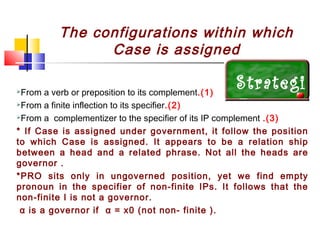
The configurations within which
Case is assigned

Strategi
From a verb or preposition to its complement.(1)
From a finite inflection to its specifier.(2)
es .(3)
From a complementizer to the specifier of its IP complement





* If Case is assigned under government, it follow the position
to which Case is assigned. It appears to be a relation ship
between a head and a related phrase. Not all the heads are
governor .
*PRO sits only in ungoverned position, yet we find empty
pronoun in the specifier of non-finite IPs. It follows that the
non-finite I is not a governor.
α is a governor if α = x0 (not non- finite ).
m-commands



M-command

(4)
α m-command β if the first maximal projection dominating α also β .

The need for barriers:
Although m-command seems to be the right relationship between Case
assigner and assignee. Its not that you can just assign Case to anything
that you m-command to see why consider

(5):
Stowell (1981)stats that government is a unique relationship holding
between two clause elements so that if:
X governs Y then Z can not govern Y, if Z is further from Y than X is. (6)

This gives us the following definition of government:
Government (Relativized Minimality) α govern β if:
α is a governor .(case assignor :V, I, P, or D)
α m-commands β .if,
There is no closer governor to β than α .
ECM

Exceptional Case Marking
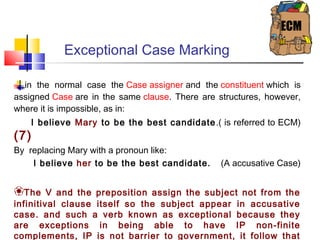
in the normal case the Case assigner and the constituent which is
assigned Case are in the same clause. There are structures, however,
where it is impossible, as in:
I believe Mary to be the best candidate .( is referred to ECM)

(7)

By replacing Mary with a pronoun like:
I believe her to be the best candidate.

❀The

(A accusative Case)

V and the preposition assign the subject not from the
infinitival clause itself so the subject appear in accusative
case. and such a verb known as exceptional because they
are exceptions in being able to have IP non-finite
complements, IP is not barrier to government, it follow that
Of- insertion

Of- insertion
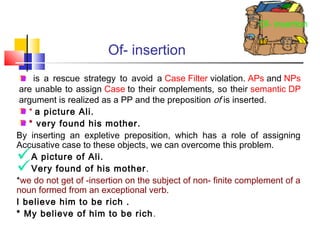
is a rescue strategy to avoid a Case Filter violation. APs and NPs
 are unable to assign Case to their complements, so their semantic DP
 argument is realized as a PP and the preposition of is inserted.
* a picture Ali.
* very found his mother.
By inserting an expletive preposition, which has a role of assigning
Accusative case to these objects, we can overcome this problem.
A picture of Ali.
Very found of his mother .
*we do not get of -insertion on the subject of non- finite complement of a
noun formed from an exceptional verb.
I believe him to be rich .
* My believe of him to be rich .



Of- insertion

If of -insertion is away to circumnavigate the case filter in these
cases why it not be possible in :
My believe of him to be rich .*
Chomsky's answer:
Genitive Case which assume to be assigned by nouns and
adjectives, and Accusative Case differ in that the former
is an Inherent Case while the latter is Structure Case .we
can not get ECM constructions involving the assignment
of Inherent Case .
Adjacency and Condition of Case
Assignment

Theory

Cases are assigned under condition namely government. However there
are differences between Accusative case and nominative case, the most
obvious concerns the direction that these Cases are assigned in :
Verbs and prepositions assign Accusative Case to their
complement which are to their right. (8)
Agreement assigns Nominative Case to its specifier which is
to the left .


PP complements can come in any order. ( 9 )
DP complements must com immediately after the verb.

Adjacency
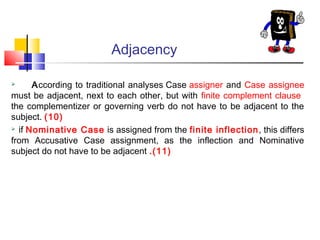
According to traditional analyses Case assigner and Case assignee
must be adjacent, next to each other, but with finite complement clause
the complementizer or governing verb do not have to be adjacent to the
subject. (10)
 if Nominative Case is assigned from the finite inflection, this differs
from Accusative Case assignment, as the inflection and Nominative
subject do not have to be adjacent .(11)

Case and
movement

Case and movement
Case is an S-structure module which means that DPs do not have to
occupy case position at D-structure. If DP generated in a Caseless
position at D-structure remains there .the Case filter apply at S-structure
. If the offending DP moves from its Caseless position to one that is
Case marked the Case filter will be satisfied, and it applies in a number
of structure including:
Subject Movement.
Passivization .
Unaccusatives
 Middles
Subject raising
*All of these movements are A-movements.
Subject Movement

Subject
Movement

The subject of the non-finite clause moves to the subject of the raising
verb.
John i seems [t i to like Mary].
It seems [John likes Mary]. ( Its subj. receives Case from finite
Inflection)
It seems John to like Mary . *
Movement of the subject out of the specifier of VP , where it
originates according to the VP Internal Subject Hypothesis in to canonical
subject position, the specifier of IP .
[ IP He i will [ VP t i write a letter]].( Caseless)
[ IP It will [ VP he write a letter]]. *(subj. remain inside VP)

P
assivization
Passivization: the object moves to the subject position and can not
remain in object position:
John was identified t i .
it was identified John .*
Q*Verbs are generally seen as Accusative Case assignor, why would a
passive verb be different?
A// 1.When a verb is passivised its argument structure is altered so it
no longer has external theta role to assign to its subject.
2. Verb is altered in term of its case-assigning abilities: its Accusative
Case is absorbed as a result of Passivization.
3. Passivization alters the category of the verb to something more like
adjective. The interrogated man.
The tall man.
Unaccusative and Middle Verbs
The object obligatorily moving to the subject position:
Three men arrived.
It arrived three men . * (fail to
assign accusative Case to its object)
* Inherent Cases are assigned in similar way to theta roles in that they
are assigned to specific arguments and not to structural position .
*what ever argument sits in the subject position it will get Nominative
Case ,thus an object that moved to the subject position or subject of a
lower clause that raises to a subject position will all bear Nominative
She helps him.
He was helped.
Binding Theory
An element that can be co-referential with another element (the most
typically pronouns and anaphors) is bound by that element. This
relationship is called binding.
 Peter and Mary love each other.  the constituent Peter and
Mary binds each other.
•John likes himself.
John likes John
•John likes him.
•John thinks that Bill likes him.

Binding Theory and Overt Categories
Anaphors: reflexive pronoun takes a nearby antecedent and can not
refer to something that is too far from it or can not refer to something not
mentioned in the sentence, as a personal pronoun can.
Reciprocal
pronouns : such as each other must also have
antecedents which need to be close by:
The boys said the girls
know each other.
Personal pronouns (pronominal) : they can take more distant
antecedents, but they do not have to have an antecedent at all :
Bill thinks the girls like him.
DPs have different referential properties from either Anaphors or
pronominal, they can never have an antecedent no matter how far
away its must be interpreted as an independent element in the sentence,
these elements called r- expressions :
He said she
likes Hillary

C-command and binding
An element c- commands its sister and every thing dominated by its
sister ,We have already mentioned that anaphors must have close
antecedents and that pronominal can not .
Johnis mother likes himselfi.*
Johnis mother likes himi.
Binding
(12)
a binds β if and only if:
 a and β are co- indexed and
 a c-command β .
Binding Principles

Principle A: An anaphor must be bound locally.

Consider pronominals. these can not have a local c- commanding
antecedent and therefore they can not be bound locally.
Principle B: A pronominals must be free locally. It’s the exact
opposite to Principle A, governing the behavior of anaphors,
accounts for the complementary behavior of the two.
Hisi own mother distrusts Johni .
*He distrusts John.
Principle C: An r-expression must be free every where.



The Governing Category
The local domain within which the anaphor must be bound and the
pronominal must be free could well be taken as the clause which
immediately contains the pronoun. not all clauses count as local domains
for binding purposes, and not all local domains are clauses.
Johni believes [himselfi to be discreet].(13)
Governing Category :



β is a Governing Category for a if β is the smallest clause which
contains a and the governor of a .

Principle A: An anaphor must be bound within its governing
category.
Principle B: A pronominal must be free within its governing category.
Principle C: An r-expression must be free everywhere.
Binding domain which is not
a clause
*Bill i saw[

DP

Binding
Theory
&Empty
Category

Mary's picture of himself i ] . (14)

Binding Theory &Empty Category:
The relationship between Binding Theory and Movement made
possible by the fact that empty categories, including traces left behind
by moved elements. some empty categories like anaphors,
pronominal, and r-expressions.
DP traces as anaphors

DP traces
as
anaphors

A reflexive pronoun is anaphor and hence subject to principle A of

binding Theory is stating that it must be bound in its governing
category. For an object, as is bound within this in the first but not in
the second ,the first is grammatical and the second ungrammatical.
as in:
John i likes himself i.
John i believes Mary likes himself i .*
The governing category differs depending on where the
governor In:
1. Finite clause the governor is the finite inflection of that clause
and so this is governing category .
2. An exceptional clause , the governor is the exceptional verb
which is outside this clause, thus the exceptional clause will not be
governing category and its subject can be bound by an element
outside it.
John i believes himself i to be honest.
John i believes himself i is honest.*
Wh-traces as r-expressions

Wh-traces as
r-expressions

If all traces were anaphors, the same restrictions would show
up for all movements. wh-movement can be moved out of a finite
clause from either the subject or the object position. as in:
Who i did John think [ CP t i [ IP Mary liked t i ]]?
Who i did John think[ CP t i [ IP t i liked Mary]]?
But in :
Who 1 did he 2 say [t1 likes Bartok]?
Who 1 did he 1 say [t1 likes Bartok]? *
Traces left behind by A-movement are r-expressions and therefore
con not be bound by any thing in an A-position.
Pro and the PRO Theorem
The empty subject in pro-drop languages, pro behaves very much like
an empty personal pronoun, this empty category does not have to have an
antecedent. though it can have one as long as this is far enough away.
As in:
He left.
John said that he left.
PRO
PRO always sits in ungoverned position, and this part of Control
Theory is called PRO Theorem, thus it appears never to have a
governing category. A linguistic element can satisfy the
requirement that it must be bound in its governing category, and it
must be free in its governing category if it never has a governing
category. Thus if PRO categorized as both anaphor and
pronominal, we can explain its non-appearance in governed
position. Since PRO is a pronominal anaphor, it is subject to
Principle A and B of the binding theory, from which it follows that
PRO lacks a governing category and is therefore ungoverned.


(15 ) Types of referential elements
(16)Elements of Binding Theory
The place of Binding Theory in
the G/B model

The place of
Binding
Theory in the
G/B model

Binding Theory has an effect on movement indicates that it
must apply after movement have taken place at S-structure. As in :
Which picture of [himself i ]did John i display t i.
Binding Theory applies at neither D nor S-structure but at another
level of representation separate from both, at which all the relevant
binding relations can be made to hold these independent empirical
motivation for such an extra level of representation as well as
conceptual arguments. the inclusion of the Binding Theory into the
overall GB Model will be delayed until these arguments have been
presented.
Beyond S-structure and the Empty
Category Principle
That-trace phenomena, proper government and the
Empty Category Principle:
1. The complementizer introducing a finite clause is optionally
present when there is wh-movement from object position.
2. When movement takes place from subject position the
Comlementizer must be absent.
movement from object position seems to be easier than from
subject position:
What i did he say (that) Mary wanted t i ?
Who i did he say ( *that) t i wanted a beer?
G/B Theory proposed that empty categories are
licensed by notion of proper government.
And also Extraction Site is Important. (the location
that we extract from is important)

•
•
Empty Category Principle

Empty
Category
Principle

Traces must be properly governed: the government
relationship holds between a head and elements within its local
sphere of influence.
Object appear to be more easily licensed than subject, as object is
governed by lexical head( the verb) whereas subject governed by
functional head ( the inflection). so lexical heads are proper
governor but functional heads are not. But movement from subject
position is possible and hence the trace is licensed when there is no
complementizer as in: Who i did he say (*that) t i wanted a
beer?
[ CP Who i did [ IP he say [ CP t i (that) [ IP t i wanted a beer]]]]?


( 17 )

Traces in obj. position will always be properly governed
by lexical head they are the obj. of ,but subj. can only be

Superiority and Invisible Movement

Superiority
and
invisible
movement

multiple wh- question
one the wh In Englishfront of the clause and, onlyothersofremain inelements
moves to the
all
their D-

structure.
[ CP Who i [ IP t i saw what]]?
Multiple wh- questions are interpreted as asking for an answer,
after the answer of the multiple wh- question, unmoved wh-element
is still interpreted as an interrogative operator, not like the whelement found in echo questions (in case of mishearing or
misunderstanding), which are also unmoved:
You saw what?
Multiple wh- question is in principle either wh-element could
move, often it is only grammatical to move one of them (it is the
subject that moves easily than object and this phenomenon is
called the superiority effect) as in:
Who i saw what?
What i did who see t i ?*



The Difference Between PF and LF
PF: S-structure is more closely associated with the
pronunciation of an expression than D-structure, so S-structure
serves as the interface between the syntax and phonology .(18)
LF: D-structure is more closely associated with the
semantics, and LF as the interface between the syntax and
semantics.
Every performer sang a song.
In English there is an interaction between scope interpretation and
certain grammatical facts.
Some professor believes[ every student to have failed].
Some professor believes[ every student has failed].

G/B Theory (LF &PF) added

(19)
Have a Nice Day

Case theory

  • 1.
    *Cas e Theory * Bi ndi ng Theor y P repared B y: Zhian Fadhil Asaad
  • 2.
    Case Theory is oneof the modules of G/B defining Case-assignment to DPs. Case Theory is in fact a central part of G/B theory which plays an important role in the analysis of certain movements.
  • 3.
    Morphological Case vsAbstract Case All DPs, in English as well as Latin, are assigned a Case, even when there's no change in form: Ali hit the ball. (Ali is nominative & the ball is accusative) The ball hit Ali. (the ball is nominative & Ali is accusative) One of the interesting things about pronouns in English is that, they change form depending on their function in the sentence. Morphological case is the realization of abstract case. John hit him. him: is assigned (abstract) accusative case by the verb hit. because its pronoun, that abstract accusative case is realized as morphological accusative case. John is abstract nominative case but there's no realization of that with a visible morphological case ending  pronoun occur as of prepositions, they  Whenabstract oblique case the objectsrealized morphologicallyare assigned but this is as accusative case in English ( from him not from he).
  • 4.
    The Principles ofCase Theory Case Filter: every overt DP must be assigned abstract Case. this insure that all DPs occupy positions to which case assigned – (PRO does not sit in a case position). John invited them. (Accusative case is associated with objects, the assigner of this case is the verb). They hope that John is the best candidate . hope is not an ECM verb and it takes CP complement, it can not provide a source of case because CP ”as maximal projection” is a barrier to case assignment.
  • 5.
    Structural Case vsInherent Case In English all verbs assign accusative case & its known as a Structural Case, as it is generally assigned to the structural position of the verbal object. Dative and genitive objects depend on particular verbs and to bear Inherent Case. Structural Cases objective and nominative, assigned in terms of S-structure, from Inherent Cases assigned at D-structure. Inherent Case is associated with Theta marking, while Structural Case is not. thus Inherent Case is assigned by α to [DP] if and only if α theta marks [DP], while Structural Case is assigned independently of theta marking.
  • 6.
    The objects of prepositionscan also be Accusative: Prepositions can be treated in a similar way to verbs, as assigners of structural Accusative Case, or in some languages, as an Inherent Case assigners. For him to leave now would be unacceptable. I believe him to be rich. ( PRO sits in the subject position of nonfinite clauses and DP not to bear case). Nominative Case assigner must have something to do with the finite inflections for tens and agreement, so agreement is responsible for Nominative Case. He hit the ball. Prepositional Complementizer for : is another functional category with the ability to assign Case. **We have two standard Case: Nominative Case assignment by I, and Accusative Case assignment by verb.
  • 7.
    The configurations withinwhich Case is assigned Strategi From a verb or preposition to its complement.(1) From a finite inflection to its specifier.(2) es .(3) From a complementizer to the specifier of its IP complement    * If Case is assigned under government, it follow the position to which Case is assigned. It appears to be a relation ship between a head and a related phrase. Not all the heads are governor . *PRO sits only in ungoverned position, yet we find empty pronoun in the specifier of non-finite IPs. It follows that the non-finite I is not a governor. α is a governor if α = x0 (not non- finite ).
  • 8.
    m-commands   M-command (4) α m-command βif the first maximal projection dominating α also β . The need for barriers: Although m-command seems to be the right relationship between Case assigner and assignee. Its not that you can just assign Case to anything that you m-command to see why consider (5):
  • 9.
    Stowell (1981)stats thatgovernment is a unique relationship holding between two clause elements so that if: X governs Y then Z can not govern Y, if Z is further from Y than X is. (6) This gives us the following definition of government: Government (Relativized Minimality) α govern β if: α is a governor .(case assignor :V, I, P, or D) α m-commands β .if, There is no closer governor to β than α .
  • 10.
    ECM Exceptional Case Marking inthe normal case the Case assigner and the constituent which is assigned Case are in the same clause. There are structures, however, where it is impossible, as in: I believe Mary to be the best candidate .( is referred to ECM) (7) By replacing Mary with a pronoun like: I believe her to be the best candidate. ❀The (A accusative Case) V and the preposition assign the subject not from the infinitival clause itself so the subject appear in accusative case. and such a verb known as exceptional because they are exceptions in being able to have IP non-finite complements, IP is not barrier to government, it follow that
  • 11.
    Of- insertion Of- insertion isa rescue strategy to avoid a Case Filter violation. APs and NPs  are unable to assign Case to their complements, so their semantic DP  argument is realized as a PP and the preposition of is inserted. * a picture Ali. * very found his mother. By inserting an expletive preposition, which has a role of assigning Accusative case to these objects, we can overcome this problem. A picture of Ali. Very found of his mother . *we do not get of -insertion on the subject of non- finite complement of a noun formed from an exceptional verb. I believe him to be rich . * My believe of him to be rich .  
  • 12.
    Of- insertion If of-insertion is away to circumnavigate the case filter in these cases why it not be possible in : My believe of him to be rich .* Chomsky's answer: Genitive Case which assume to be assigned by nouns and adjectives, and Accusative Case differ in that the former is an Inherent Case while the latter is Structure Case .we can not get ECM constructions involving the assignment of Inherent Case .
  • 13.
    Adjacency and Conditionof Case Assignment Theory Cases are assigned under condition namely government. However there are differences between Accusative case and nominative case, the most obvious concerns the direction that these Cases are assigned in : Verbs and prepositions assign Accusative Case to their complement which are to their right. (8) Agreement assigns Nominative Case to its specifier which is to the left .  PP complements can come in any order. ( 9 ) DP complements must com immediately after the verb. 
  • 14.
    Adjacency According to traditionalanalyses Case assigner and Case assignee must be adjacent, next to each other, but with finite complement clause the complementizer or governing verb do not have to be adjacent to the subject. (10)  if Nominative Case is assigned from the finite inflection, this differs from Accusative Case assignment, as the inflection and Nominative subject do not have to be adjacent .(11) 
  • 15.
    Case and movement Case andmovement Case is an S-structure module which means that DPs do not have to occupy case position at D-structure. If DP generated in a Caseless position at D-structure remains there .the Case filter apply at S-structure . If the offending DP moves from its Caseless position to one that is Case marked the Case filter will be satisfied, and it applies in a number of structure including: Subject Movement. Passivization . Unaccusatives  Middles Subject raising *All of these movements are A-movements.
  • 16.
    Subject Movement Subject Movement The subjectof the non-finite clause moves to the subject of the raising verb. John i seems [t i to like Mary]. It seems [John likes Mary]. ( Its subj. receives Case from finite Inflection) It seems John to like Mary . * Movement of the subject out of the specifier of VP , where it originates according to the VP Internal Subject Hypothesis in to canonical subject position, the specifier of IP . [ IP He i will [ VP t i write a letter]].( Caseless) [ IP It will [ VP he write a letter]]. *(subj. remain inside VP) 
  • 17.
    P assivization Passivization: the objectmoves to the subject position and can not remain in object position: John was identified t i . it was identified John .* Q*Verbs are generally seen as Accusative Case assignor, why would a passive verb be different? A// 1.When a verb is passivised its argument structure is altered so it no longer has external theta role to assign to its subject. 2. Verb is altered in term of its case-assigning abilities: its Accusative Case is absorbed as a result of Passivization. 3. Passivization alters the category of the verb to something more like adjective. The interrogated man. The tall man.
  • 18.
    Unaccusative and MiddleVerbs The object obligatorily moving to the subject position: Three men arrived. It arrived three men . * (fail to assign accusative Case to its object) * Inherent Cases are assigned in similar way to theta roles in that they are assigned to specific arguments and not to structural position . *what ever argument sits in the subject position it will get Nominative Case ,thus an object that moved to the subject position or subject of a lower clause that raises to a subject position will all bear Nominative She helps him. He was helped.
  • 19.
    Binding Theory An elementthat can be co-referential with another element (the most typically pronouns and anaphors) is bound by that element. This relationship is called binding.  Peter and Mary love each other.  the constituent Peter and Mary binds each other. •John likes himself. John likes John •John likes him. •John thinks that Bill likes him. 
  • 20.
    Binding Theory andOvert Categories Anaphors: reflexive pronoun takes a nearby antecedent and can not refer to something that is too far from it or can not refer to something not mentioned in the sentence, as a personal pronoun can. Reciprocal pronouns : such as each other must also have antecedents which need to be close by: The boys said the girls know each other. Personal pronouns (pronominal) : they can take more distant antecedents, but they do not have to have an antecedent at all : Bill thinks the girls like him. DPs have different referential properties from either Anaphors or pronominal, they can never have an antecedent no matter how far away its must be interpreted as an independent element in the sentence, these elements called r- expressions : He said she likes Hillary 
  • 21.
    C-command and binding Anelement c- commands its sister and every thing dominated by its sister ,We have already mentioned that anaphors must have close antecedents and that pronominal can not . Johnis mother likes himselfi.* Johnis mother likes himi. Binding (12) a binds β if and only if:  a and β are co- indexed and  a c-command β .
  • 22.
    Binding Principles Principle A:An anaphor must be bound locally. Consider pronominals. these can not have a local c- commanding antecedent and therefore they can not be bound locally. Principle B: A pronominals must be free locally. It’s the exact opposite to Principle A, governing the behavior of anaphors, accounts for the complementary behavior of the two. Hisi own mother distrusts Johni . *He distrusts John. Principle C: An r-expression must be free every where.  
  • 23.
    The Governing Category Thelocal domain within which the anaphor must be bound and the pronominal must be free could well be taken as the clause which immediately contains the pronoun. not all clauses count as local domains for binding purposes, and not all local domains are clauses. Johni believes [himselfi to be discreet].(13) Governing Category :  β is a Governing Category for a if β is the smallest clause which contains a and the governor of a . Principle A: An anaphor must be bound within its governing category. Principle B: A pronominal must be free within its governing category. Principle C: An r-expression must be free everywhere.
  • 24.
    Binding domain whichis not a clause *Bill i saw[ DP Binding Theory &Empty Category Mary's picture of himself i ] . (14) Binding Theory &Empty Category: The relationship between Binding Theory and Movement made possible by the fact that empty categories, including traces left behind by moved elements. some empty categories like anaphors, pronominal, and r-expressions.
  • 25.
    DP traces asanaphors DP traces as anaphors A reflexive pronoun is anaphor and hence subject to principle A of binding Theory is stating that it must be bound in its governing category. For an object, as is bound within this in the first but not in the second ,the first is grammatical and the second ungrammatical. as in: John i likes himself i. John i believes Mary likes himself i .* The governing category differs depending on where the governor In: 1. Finite clause the governor is the finite inflection of that clause and so this is governing category . 2. An exceptional clause , the governor is the exceptional verb which is outside this clause, thus the exceptional clause will not be governing category and its subject can be bound by an element outside it. John i believes himself i to be honest. John i believes himself i is honest.*
  • 26.
    Wh-traces as r-expressions Wh-tracesas r-expressions If all traces were anaphors, the same restrictions would show up for all movements. wh-movement can be moved out of a finite clause from either the subject or the object position. as in: Who i did John think [ CP t i [ IP Mary liked t i ]]? Who i did John think[ CP t i [ IP t i liked Mary]]? But in : Who 1 did he 2 say [t1 likes Bartok]? Who 1 did he 1 say [t1 likes Bartok]? * Traces left behind by A-movement are r-expressions and therefore con not be bound by any thing in an A-position.
  • 27.
    Pro and thePRO Theorem The empty subject in pro-drop languages, pro behaves very much like an empty personal pronoun, this empty category does not have to have an antecedent. though it can have one as long as this is far enough away. As in: He left. John said that he left.
  • 28.
    PRO PRO always sitsin ungoverned position, and this part of Control Theory is called PRO Theorem, thus it appears never to have a governing category. A linguistic element can satisfy the requirement that it must be bound in its governing category, and it must be free in its governing category if it never has a governing category. Thus if PRO categorized as both anaphor and pronominal, we can explain its non-appearance in governed position. Since PRO is a pronominal anaphor, it is subject to Principle A and B of the binding theory, from which it follows that PRO lacks a governing category and is therefore ungoverned.  (15 ) Types of referential elements (16)Elements of Binding Theory
  • 29.
    The place ofBinding Theory in the G/B model The place of Binding Theory in the G/B model Binding Theory has an effect on movement indicates that it must apply after movement have taken place at S-structure. As in : Which picture of [himself i ]did John i display t i. Binding Theory applies at neither D nor S-structure but at another level of representation separate from both, at which all the relevant binding relations can be made to hold these independent empirical motivation for such an extra level of representation as well as conceptual arguments. the inclusion of the Binding Theory into the overall GB Model will be delayed until these arguments have been presented.
  • 30.
    Beyond S-structure andthe Empty Category Principle That-trace phenomena, proper government and the Empty Category Principle: 1. The complementizer introducing a finite clause is optionally present when there is wh-movement from object position. 2. When movement takes place from subject position the Comlementizer must be absent. movement from object position seems to be easier than from subject position: What i did he say (that) Mary wanted t i ? Who i did he say ( *that) t i wanted a beer? G/B Theory proposed that empty categories are licensed by notion of proper government. And also Extraction Site is Important. (the location that we extract from is important) • •
  • 31.
    Empty Category Principle Empty Category Principle Tracesmust be properly governed: the government relationship holds between a head and elements within its local sphere of influence. Object appear to be more easily licensed than subject, as object is governed by lexical head( the verb) whereas subject governed by functional head ( the inflection). so lexical heads are proper governor but functional heads are not. But movement from subject position is possible and hence the trace is licensed when there is no complementizer as in: Who i did he say (*that) t i wanted a beer? [ CP Who i did [ IP he say [ CP t i (that) [ IP t i wanted a beer]]]]?  ( 17 ) Traces in obj. position will always be properly governed by lexical head they are the obj. of ,but subj. can only be 
  • 32.
    Superiority and InvisibleMovement Superiority and invisible movement multiple wh- question one the wh In Englishfront of the clause and, onlyothersofremain inelements moves to the all their D- structure. [ CP Who i [ IP t i saw what]]? Multiple wh- questions are interpreted as asking for an answer, after the answer of the multiple wh- question, unmoved wh-element is still interpreted as an interrogative operator, not like the whelement found in echo questions (in case of mishearing or misunderstanding), which are also unmoved: You saw what? Multiple wh- question is in principle either wh-element could move, often it is only grammatical to move one of them (it is the subject that moves easily than object and this phenomenon is called the superiority effect) as in: Who i saw what? What i did who see t i ?*  
  • 33.
    The Difference BetweenPF and LF PF: S-structure is more closely associated with the pronunciation of an expression than D-structure, so S-structure serves as the interface between the syntax and phonology .(18) LF: D-structure is more closely associated with the semantics, and LF as the interface between the syntax and semantics. Every performer sang a song. In English there is an interaction between scope interpretation and certain grammatical facts. Some professor believes[ every student to have failed]. Some professor believes[ every student has failed]. G/B Theory (LF &PF) added (19)
  • 34.